Calcium Silicate Prices Q2 2026: USA Leads at USD 567/MT as Global Prices Show Regional Variation
15-Sep-2026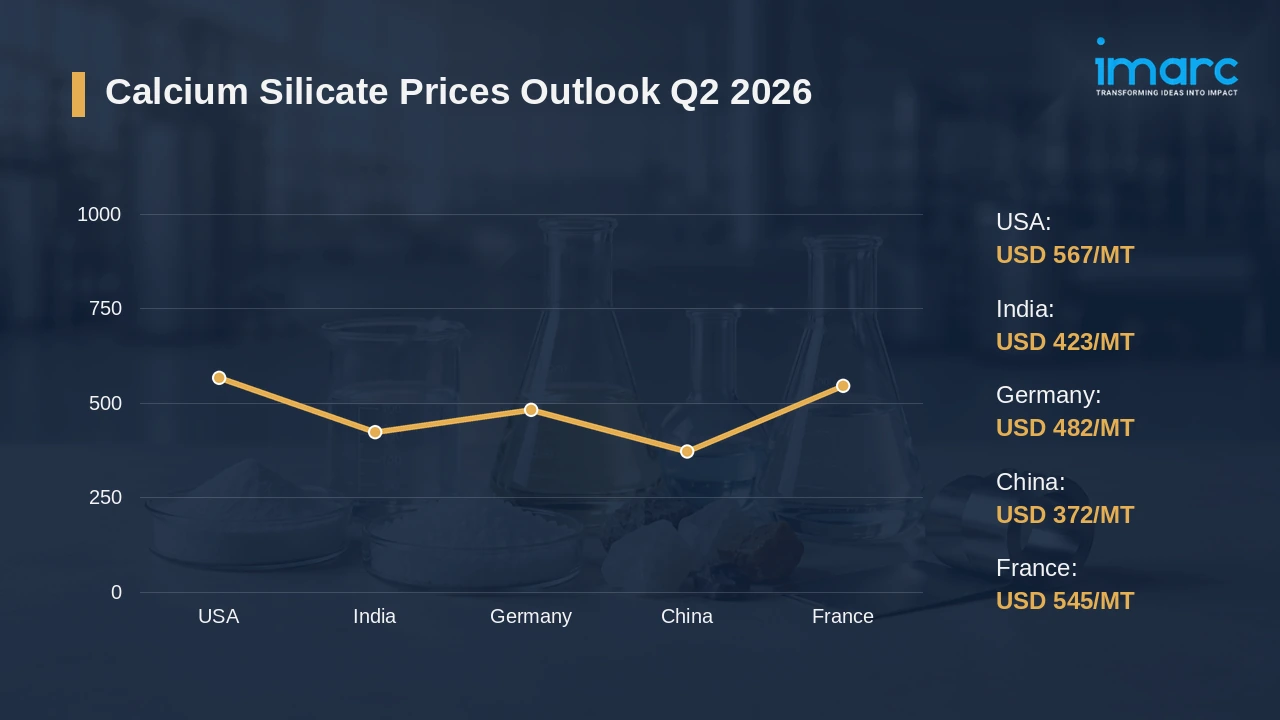
Calcium silicate is a lightweight, non-combustible material formed by reacting lime and silica under controlled hydrothermal conditions, yielding low thermal conductivity and strong resistance to moisture and corrosion. Across construction and heavy industries, it serves fire-rated boards and refractory linings. Calcium silicate prices respond chiefly to lime and silica feedstock costs, kiln and autoclave energy use, freight on regional lanes, and building and petrochemical project cycles.
Global Market Overview:
Globally, the calcium silicate industry was valued at USD 2.2 Billion in 2025. Market projections indicate steady growth, with the industry expected to reach USD 3.1 Billion by 2034, with a compound annual growth rate (CAGR) of 3.77% during 2026-2034. Under stricter fire-safety codes, commercial builders keep specifying insulating boards. Industrial energy-efficiency retrofits and expanding petrochemical capacity in emerging economies also support the calcium silicate price trend over the forecast horizon.
Calcium Silicate Price Trend Q2 2026:
Regional prices (USD per MT) and QoQ changes Q2 2026 vs Q1 2026:
| Region | Price (USD/MT) | QoQ Change | Direction |
|---|---|---|---|
| USA | 567 | +1.34% | ↑ |
| India | 423 | +3.34% | ↑ |
| Germany | 482 | -12.34% | ↓ |
| China | 372 | -0.43% | ↓ |
| France | 545 | -10.42% | ↓ |
To access real-time prices Request Sample
What Moved Prices:
USA:
- In Q2 2026, calcium silicate prices in the USA climbed to USD 567/MT, a 1.34% QoQ gain, as busier construction schedules lifted orders for pipe insulation and fireproofing boards. Heartland distributors fielded noticeably steadier building-material inquiries through June. With labor and energy costs rising, Gulf Coast and Midwest producers held firmer quotations across contract renewals.
- Constrained by supply chain bottlenecks, inland warehouses carried lean inventories, pushing mechanical contractors to secure volumes early for ongoing projects instead of relying on spot availability. Truck and rail freight charges also inflated delivered values. Across refinery and power plant maintenance programs, insulation fabricators kept order books full, limiting any buyer leverage in price negotiations.
India:
- During Q2 2026, calcium silicate values in India rose to USD 423/MT, up 3.34% QoQ, as smart city programs and highway works drew heavier procurement of fire-rated panels. The calcium silicate price chart for India tracked the steepest gain among the five markets. By June, monsoon rains had disrupted plant schedules and lime deliveries.
- Across western and southern manufacturing clusters, higher lime and silica input costs squeezed converter margins, prompting suppliers to pass increases through to distributors and project contractors. On the west coast, longer port dwell times delayed some imported inputs. Buyers still booked forward volumes ahead of the post-monsoon building season, keeping sentiment firm.
Germany:
- In Q2 2026, calcium silicate prices in Germany dropped to USD 482/MT, a steep 12.34% QoQ fall, as weak commercial construction left producers holding surplus insulation board stocks. Domestic mills cut offers repeatedly to clear inventory. Facing slower office and industrial project starts, fabricators trimmed call-off volumes through June.
- Intra-EU shipments from neighboring producers intensified competition, while elevated industrial gas tariffs squeezed margins without giving suppliers the demand backing to recover higher production costs through list prices. Along the Rhine corridor, barge and rail logistics operated without major interruptions. Smooth deliveries only added to the oversupply facing distributors in Bavaria and North Rhine-Westphalia.
China:
- During Q2 2026, calcium silicate prices in China eased to USD 372/MT, slipping 0.43% QoQ, as fewer urban housing starts trimmed board and insulation offtake among coastal converters. Volatile quartz sand and lime costs kept margins uneven. Still, industrial insulation demand from chemical parks limited the decline to a fraction of a percent.
- Environmental compliance spending tied to kiln emissions rules raised operating costs at autoclave plants in northern industrial provinces, preventing producers from cutting export and domestic offers more aggressively. Within the domestic market, ample capacity kept supply comfortable. Distributors in Guangdong and Jiangsu bought cautiously, matching purchases to confirmed project volumes rather than building stock.
France:
- In Q2 2026, calcium silicate prices in France fell to USD 545/MT, down 10.42% QoQ, as tighter public budgets and postponed infrastructure tenders thinned demand for fire-rated components. New-build output across the Paris region stayed sluggish. Although renovation work cushioned part of the drop, it could not restore earlier order volumes.
- Competing for limited orders, stockists in Lyon and Marseille discounted aggressively, pushing assessed values lower across quarterly contract talks with local insulation installers and fire-protection contractors. Electricity bills remained a sizable burden for autoclave operators. Unable to pass that expense on, producers adjusted operating rates to align output with softer demand.
Drivers Influencing the Market:
Several factors continue to shape calcium silicate pricing and market behavior:
- Construction and Industrial Insulation Demand: Fire-rated partitions, boiler lagging, and refinery pipe insulation account for most calcium silicate consumption, tying order volumes to construction and plant maintenance budgets. Per Eurostat, euro area seasonally adjusted construction output fell 1.3% in June 2026 from May, with France’s 2.9% monthly decline ranking third-steepest among reporting member states. Such softness weighs directly on European insulation board orders.
- Upstream Lime and Silica Feedstock Costs: Quicklime and ground silica together form the core raw material bill for calcium silicate producers. According to the USGS, average US quicklime values at the plant held near USD 260 per Metric Ton in 2025, compared with USD 184.6 two years earlier. Elevated lime costs leave producers little room to absorb inflation.
- Energy Expenditure in Autoclave Curing: Steam autoclaving and drying consume large volumes of natural gas and electricity, making energy one of the largest variable costs in board production. Whenever regional gas benchmarks climb, European producers feel the pressure first because of their heavier exposure to imported fuel and higher industrial power tariffs than Asian or American rivals. Such cost swings feed quickly into the calcium silicate price index.
- Ocean Freight and Logistics Economics: Because calcium silicate boards are bulky relative to their value, freight often represents a meaningful share of landed cost for importers. Container rates on Asia-Europe and transpacific lanes shape how competitively Chinese and Indian material can price against locally produced board in Western Europe and North America. Beyond ocean charges, port handling fees add another layer.
- Environmental and Regulatory Compliance: Under REACH in Europe and tightening emissions rules in China, producers carry steadily rising costs for dust control, crystalline silica exposure monitoring, and kiln emissions reporting. Fire-safety product certification adds recurring testing expenses for board makers. Over time, these outlays raise the price floor in strictly regulated jurisdictions, where smaller producers struggle to spread fixed compliance costs.
- Trade Policy and Currency Dynamics: Through import tariffs and anti-dumping reviews, governments influence how freely Asian board supply reaches Western buyers. Shifts in the EUR, INR, and CNY against the dollar alter landed costs for buyers and change the export competitiveness of producers selling into dollar-priced markets. For importers, currency hedging often matters as much as supplier selection.
Recent Highlights & Strategic Developments:
Recent strategic moves within the industry further illustrate evolving dynamics:
- In February 2025, researchers published a study examining internal carbonation of calcium silicate cement (CSC) paste blended with sodium carbonate (Na2CO3) and sodium bicarbonate (NaHCO3). Raising both additive dosages reduced non-hydraulic phases and lifted heat release.
Outlook & Strategic Takeaways:
Looking ahead, the calcium silicate market is expected to expand through 2034. Fire-safety code upgrades, industrial insulation retrofits, and low-carbon binder research should sustain demand, while lime and energy costs remain the pivotal variable in the calcium silicate price forecast.
To navigate this complex landscape, stakeholders should:
- Assess Freight Market Developments: Track container rates on Asia-Europe and transpacific lanes each month, since bulky board shipments amplify small freight moves into noticeable landed cost changes for European importers. Build rate-adjustment clauses into annual logistics contracts with carriers.
- Evaluate Downstream Demand Indicators: Review monthly construction output, housing starts, and refinery turnaround calendars in each region. Aligning purchase timing with these signals helps buyers avoid carrying surplus board stock when projects slip, as German and French distributors experienced during the second quarter.
- Monitor Regional Price Differentials: Benchmark calcium silicate price per MT across all five tracked markets quarterly, since a spread from USD 372/MT in China to USD 567/MT in the USA persists. Use these spreads to time import purchases.
- Review Regulatory Compliance Expenditures: Audit annual spending on crystalline silica dust controls, emissions reporting, and fire-safety certification to find savings that do not weaken worker protection or product performance standards. Share compliance data with suppliers during contract renewals.
- Strengthen Currency Exposure Management: Hedge EUR, INR, and CNY exposure on imported board purchases. Coordinate treasury and procurement teams so that forward currency cover matches expected payment dates, reducing the risk that sudden exchange rate swings erase negotiated supplier savings.
- Explore Emerging Application Segments: Investigate carbonation-cured calcium silicate cements, lightweight fireproof cladding, and insulation for battery and hydrogen plants as sources of new and less cyclical demand for board producers. Partner with research institutes to test commercial viability.
Subscription Plans & Customization:
IMARC offers flexible subscription models to suit varying needs:
- Monthly Updates: 12 deliverables/year
- Quarterly Updates: 4 deliverables/year
- Biannual Updates: 2 deliverables/year
Each includes detailed datasets (Excel + PDF) and post-report analyst support.
Get in Touch With Us
UNITED STATES
Phone: +1-201-971-6302
INDIA
Phone: +91-120-433-0800
UNITED KINGDOM
Phone: +44-753-714-6104
Email: [email protected]
Client Testimonials




.webp)




.webp)












