Diamond Price Analysis: US Market Dominates at USD 4,538/Carat Amid Global Variations
19-Jan-2026.webp)
Diamond is a crystalline allotrope of pure carbon that is renowned for its exceptional hardness and brilliance. Formed deep within the Earth's mantle under extreme pressure and temperature conditions, diamonds are composed solely of carbon atoms that are arranged in a stiff cubic lattice structure. Outside of their extensive use in fine jewelry, diamonds have many critical industrial applications in cutting, drilling, grinding, and polishing. Their extremely high thermal conductivity also finds them valuable in electronics and semiconductor technologies. The price dynamics of diamonds currently continue to be highly influenced by mining output levels, polished inventory conditions, luxury retail demand cycles, currency fluctuations, and logistical efficiencies along the value chain across the world.
Global Market Overview:
Globally, the diamond industry reached a volume of 126.70 Million Carats in 2025. Market projections indicate steady growth, with the industry expected to reach 144.87 Million Carats by 2034, representing a compound annual growth rate (CAGR) of 1.50% from 2026-2034. The market is experiencing an increase in market due to the rising consumer demand for diamond jewelry, especially the luxury variety, in emerging markets, as well as improvements in diamond processing technology. Rising support for high-quality cut and polished diamonds remains an instrumental factor in the further market development, thanks to the technological improvements made that improve the quality, as well as the sourcing of diamonds.
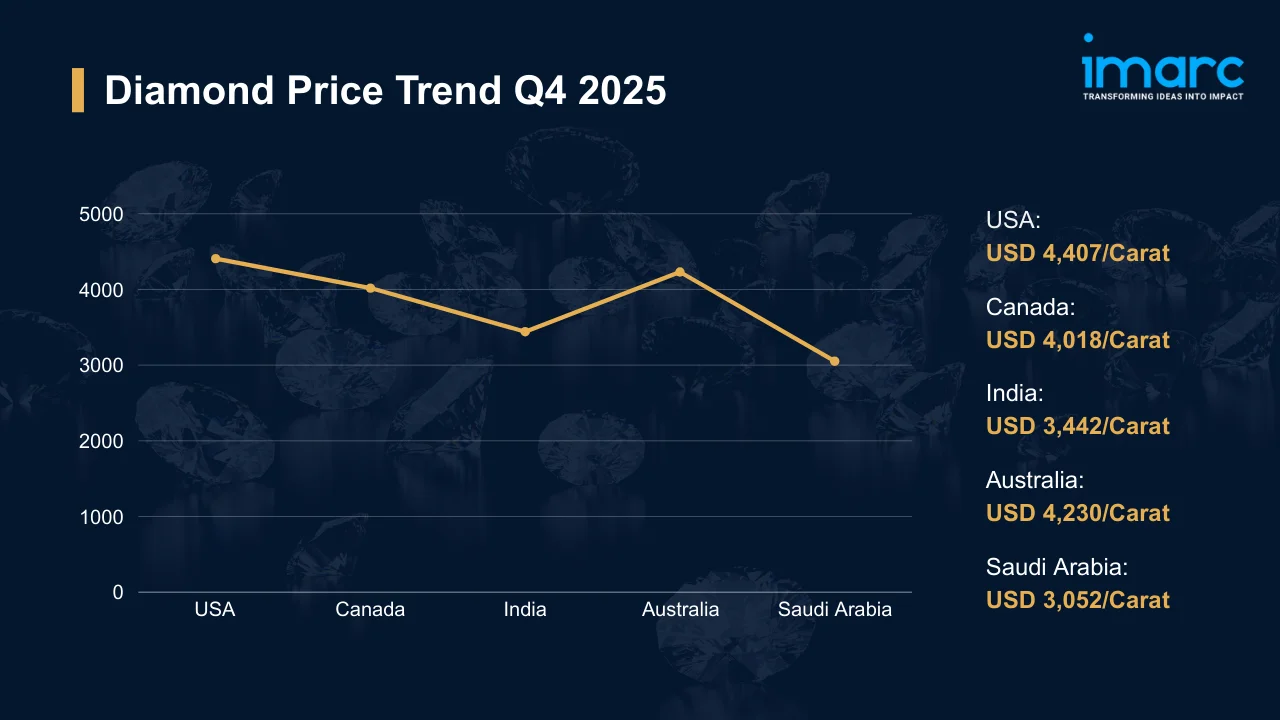
Diamond Price Trend Q3 2025
Regional prices (USD per Carat) and QoQ changes vs Q2 2025:
| Region | Price (USD/Carat) | QoQ Change | Direction |
|---|---|---|---|
| USA | 4,538 | +2.2% | ↑ |
| Canada | 4,096 | +1.9% | ↑ |
| India | 3,545 | +2.0% | ↑ |
| Australia | 4,316 | +2.8% | ↑ |
| Saudi Arabia | 3,111 | +2.0% | ↑ |
To access real-time prices Request Sample
What Moved Prices:
- USA: Diamond prices climbed to USD 4,538/Carat as jewelry retailers accelerated their purchasing activities ahead of peak seasonal sales events. Polished diamond inventories tightened considerably due to strategic release controls implemented by major suppliers. Domestic freight networks encountered sporadic congestion issues, prompting buyers to adopt more proactive restocking strategies. These combined supply-side constraints and robust downstream demand reinforced the quarter's upward pricing momentum.
- Canada: Values advanced to USD 4,096/Carat as several extraction operations in the Northwest Territories moderated their production pacing, limiting available rough diamond volumes. Export scheduling underwent periodic adjustments that affected shipment timing and delivery flows. Consistent offtake from domestic jewelry manufacturers provided underlying support for the price uptick, while currency movements against the US dollar influenced procurement cost calculations.
- India: Prices edged higher to USD 3,545/Carat as certain polishing centers in Gujarat registered improved export inquiries from international markets. Inventory levels remained balanced, enabling processors to sustain stable throughput operations. Rupee fluctuations against major trading currencies affected import-linked cost sentiments, while measured purchasing behavior from manufacturers contributed to the controlled upward price trajectory observed during the quarter.
- Australia: Diamond prices rose to USD 4,316/Carat as supply-side calibrations, including periodic extraction moderation at Western Australian mines, supported firmer valuations. Shipping operations from key ports like Fremantle experienced occasional delays that influenced downstream availability timelines. Steady demand from jewelry producers throughout the domestic market sustained the upward movement across regional trading channels.
- Saudi Arabia: Prices strengthened to USD 3,111/Carat, driven by improving consumer sentiment and more assertive procurement from luxury jewelry retailers aligned with Vision 2030 initiatives. Import-dependent supply chains experienced mild cost variations linked to logistics adjustments. Adequate diamond availability ensured smooth trading activity, though the market maintained a gently rising tone throughout the reporting period.
Drivers Influencing the Market:
Several factors continue to shape diamond pricing and market behavior:
- Seasonal Retail Demand Cycles: Consumer purchasing patterns intensify during wedding seasons and major holiday periods, driving heightened procurement from jewelry retailers. This cyclical demand surge creates upward pressure on polished diamond prices, particularly in mature markets like North America and Europe where discretionary spending remains robust.
- Mining Output Adjustments: Production pacing decisions at major extraction sites in Canada, Australia, and Africa directly influence rough diamond availability. Maintenance schedules, labor constraints, and environmental compliance requirements periodically curtail output volumes, supporting firmer pricing conditions in the midstream and downstream segments.
- Polished Inventory Management Strategies: Key suppliers employ controlled release strategies for polished diamonds to maintain price stability and prevent market oversupply. These inventory management approaches create periodic tightening in availability, enabling sustained pricing power even during softer demand periods.
- Currency Fluctuations: Exchange rate movements between the US dollar and currencies in major processing centers like India significantly impact cost structures. Rupee depreciation increases import costs for rough diamonds, while dollar strength affects export competitiveness and landed costs across international markets.
- Logistics and Transportation Constraints: Freight network congestion and port-related delays at key distribution hubs affect delivery timelines and restocking cycles. These logistical inefficiencies prompt buyers to adopt proactive procurement strategies, contributing to intermittent price firmness across regional markets.
- Luxury Retail Expansion in Emerging Markets: Growing affluence in the Middle East and Asia Pacific regions is fueling expansion of high-end jewelry retail networks. Government initiatives like Saudi Arabia's Vision 2030 are accelerating luxury sector development, creating sustained demand growth for premium diamond products in these emerging consumer markets.
- Processing Capacity Utilization in India: India's position as the global hub for diamond cutting and polishing means that operational conditions in Gujarat directly influence global supply dynamics. Energy availability, labor migration patterns, and capacity utilization rates at polishing clusters shape throughput volumes and pricing across the value chain.
Recent Highlights & Strategic Developments:
Recent strategic moves within the industry further illustrate evolving dynamics:
- In May 2025, Burgundy Diamond Mines entered into a strategic global partnership agreement with prestigious luxury jewelry brands to distribute internationally its sustainably sourced diamonds mined in Canada for export. This partnership between Burgundy Diamond Mines Ltd. and Crossworks Manufacturing Ltd. and André Messika Ltd. is to integrate Burgundy's fancy yellow diamonds into upscale jewelry brand collections.
- In May 2024, De Beers Group publicly displayed the latest innovation in its diamond verification process at the JCK jewelry show in Las Vegas, featuring an innovative tool to detect synthetic diamonds, marking the first time this science has been used in retail jewelry sales to differentiate between diamonds and their laboratory-created alternatives.
- In May 2024, The International School of Gems & Jewelry (ISGJ) and International Diamond Laboratory (IDL) opened a combined center in the Indian city of Ahmedabad. The newly formed institute and testing lab aims to bring increased professionalism to the evaluation and analysis of diamonds, gems, and jewelry in the rapidly growing Indian gems and jewelry industry.
Outlook & Strategic Takeaways:
Looking ahead, the diamond market is expected to maintain gradual upward momentum supported by steady jewelry consumption, expanding luxury retail footprints in emerging economies, and controlled supply management by major producers. Seasonal demand peaks and currency dynamics will continue shaping regional price differentials.
To navigate this complex landscape, stakeholders should:
- Monitor prices on a monthly and regional basis to capture variations between major markets like the USA, Canada, India, Australia, and the Middle East. Regular tracking enables procurement teams to identify optimal purchasing windows and capitalize on temporary price dips or regional arbitrage opportunities.
- Benchmark procurement costs against regional price differentials to optimize sourcing strategies. Understanding price gaps between producing nations and processing centers allows buyers to negotiate more favorable terms and diversify supplier relationships based on landed cost considerations.
- Track mining output announcements and production guidance from major diamond producers in Canada, Australia, and Africa. Extraction rate adjustments and mine development timelines provide leading indicators of future rough diamond availability and potential supply-side pricing pressure.
- Assess processing capacity utilization in India's polishing centers to gauge throughput conditions and potential bottlenecks. Energy availability, labor dynamics, and export order books in Gujarat offer insights into polished diamond supply trajectories and pricing trends.
- Evaluate currency exposure and hedging requirements given the influence of exchange rate movements on import costs and export competitiveness. Rupee-dollar fluctuations particularly impact Indian processing economics, while broader currency dynamics affect international trade flows and landed costs.
- Monitor luxury retail expansion in emerging markets including the Middle East and Asia Pacific to anticipate demand growth trajectories. Government-led initiatives promoting high-end retail development signal sustained consumption increases that could tighten polished diamond availability.
- Diversify supply sources across geographic regions to mitigate risks associated with localized production disruptions, logistical constraints, or geopolitical developments. Maintaining relationships with suppliers in multiple producing countries enhances supply chain resilience.
- Stay informed on laboratory-grown diamond market dynamics as technological advancements and pricing trends in the synthetic segment influence consumer preferences and competitive positioning within the broader jewelry market.
Subscription Plans & Customization:
IMARC offers flexible subscription models to suit varying needs:
- Monthly Updates — 12 deliverables/year
- Quarterly Updates — 4 deliverables/year
- Biannual Updates — 2 deliverables/year
Each includes detailed datasets (Excel + PDF) and post-report analyst support.

Get in Touch With Us
UNITED STATES
Phone: +1-201-971-6302
INDIA
Phone: +91-120-433-0800
UNITED KINGDOM
Phone: +44-753-714-6104
Email: [email protected]
Client Testimonials




.webp)




.webp)












