Dimethyl Ether (DME) Price Update: Sustained Growth Across Key Markets in Q3 2026
07-Oct-2026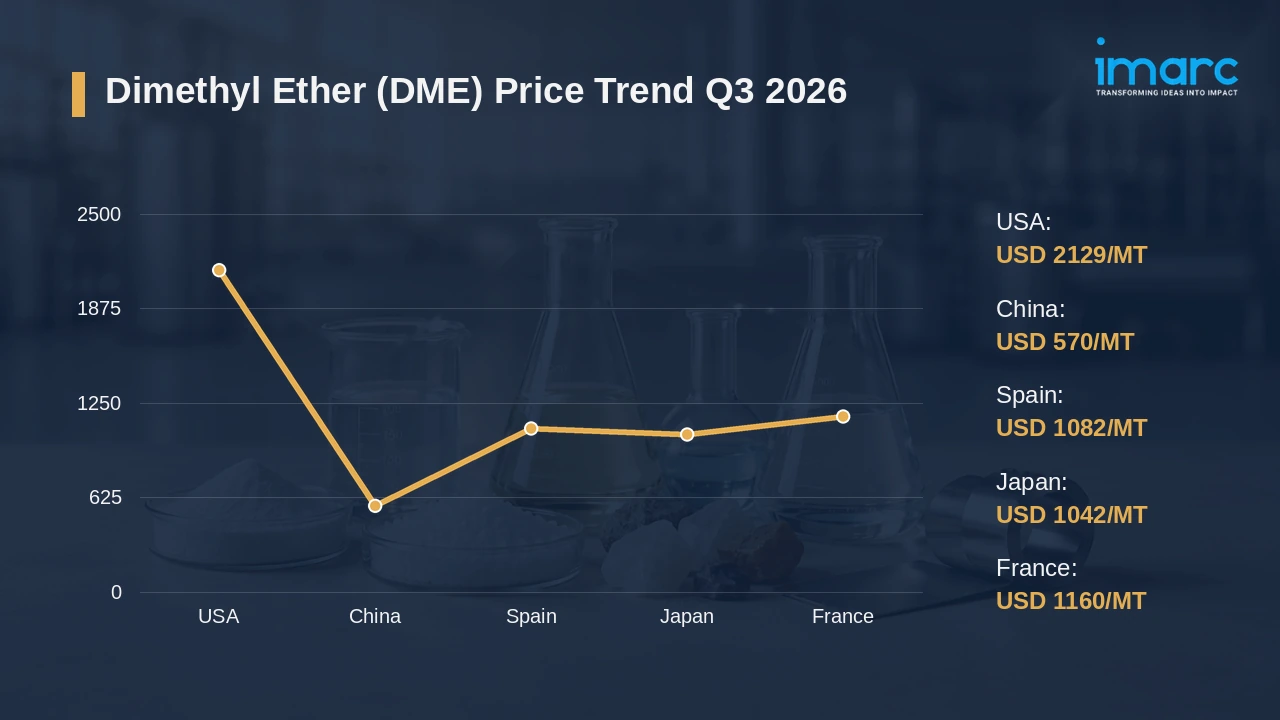
Dimethyl ether (DME), the simplest ether compound, is a colorless gas with a faint odor that liquefies under modest pressure and burns cleanly without sulfur or aromatic content. Within aerosol, LPG blending, and solvent markets, demand stays concentrated. Shaped by methanol feedstock costs, natural gas economics, ocean freight, and personal care and fuel demand cycles, dimethyl ether (DME) prices respond quickly to upstream shifts.
Global Market Overview:
Globally, the dimethyl ether (DME) industry was valued at USD 7.7 Billion in 2025. Market projections indicate steady growth, with the industry expected to reach USD 15.1 Billion by 2034, with a compound annual growth rate (CAGR) of 7.44% during 2026-2034. Clean-fuel blending with LPG anchors much of this expansion. Across personal care, chemical synthesis, and olefin production, rising propellant and feedstock uptake continues to support the dimethyl ether (DME) price trend.
Dimethyl Ether (DME) Price Trend Q3 2026
Regional prices (USD per MT) and QoQ changes Q3 2026 vs Q2 2026:
| Region | Price (USD/MT) | QoQ Change | Direction |
|---|---|---|---|
| USA | 2,129 | +3.31% | ↑ |
| China | 570 | +0.65% | ↑ |
| Spain | 1,082 | +2.87% | ↑ |
| Japan | 1,042 | +2.35% | ↑ |
| France | 1,160 | +2.51% | ↑ |
To access real-time prices Request Sample
What Moved Prices:
USA:
- In Q3 2026, dimethyl ether prices in the USA climbed to USD 2,129/MT, a 3.31% quarter-on-quarter gain, as firm methanol feedstock costs lifted production expenses at domestic synthesis units. Aerosol propellant blenders kept offtake steady. Supported by consistent solvent and fuel blending orders, sellers held offers firm through September.
- Gulf Coast producers ran at disciplined rates and prioritized contract customers, which thinned spot availability for inland buyers. Scheduled maintenance at several units tightened prompt supply further. Against this backdrop, the dimethyl ether (DME) price chart for the quarter traced a steady upward path, with inland freight costs adding modest support to delivered values.
China:
- During Q3 2026, dimethyl ether prices in China edged up to USD 570/MT, a modest 0.65% QoQ rise. Domestic operating rates held steady throughout the period. With coal-based methanol costs firm, production expenses stayed stable at major inland synthesis hubs, while aerosol, solvent, and LPG blending users absorbed available volumes through the quarter.
- Outbound demand from Asian and overseas buyers claimed a sizable portion of Chinese output during the period, leaving fewer tons available for domestic spot trade in coastal markets. Relatively contained CNY movements supported export competitiveness. Even so, ample installed capacity restrained sellers, holding gains well below those of import-dependent markets.
Spain:
- In Q3 2026, dimethyl ether prices in Spain rose to USD 1,082/MT, a 2.87% QoQ increase, as import-dependent distributors absorbed firmer replacement values on cargoes arriving from overseas producers. Aerosol propellant blenders sustained steady offtake. Across solvent and fuel blending accounts, consumption provided a stable base through the quarter.
- At major Mediterranean terminals, elevated port handling charges and inland transport costs lifted delivered values for buyers in Catalonia and Valencia. Asia-Europe container rates eased through September. Even with that freight relief, importers and distributors kept disciplined inventory positions, prioritizing contract customers and limiting the prompt volumes offered to spot buyers across the Iberian market.
Japan:
- In the third quarter of 2026, dimethyl ether prices in Japan rose to USD 1,042/MT, up 2.35% QoQ, as import-dependent buyers paid firmer replacement costs on cargoes from major origins. Domestic production capacity remains limited in scale. Across precision cleaning and aerosol filling lines, offtake stayed consistent, while solvent users added steady baseline volumes.
- Elevated ocean freight and container charges lifted landed values at Japanese terminals. With yen-denominated procurement exposed to currency swings, trading houses leaned toward term contracts rather than spot purchases, seeking greater cost visibility for downstream aerosol and solvent customers. Container availability tightened intermittently, adding replacement uncertainty for importers.
France:
- During Q3 2026, dimethyl ether prices in France advanced to USD 1,160/MT, reflecting a 2.51% QoQ increase, as elevated energy tariffs at storage and blending facilities squeezed handling economics. Aerosol propellant and industrial cleaning demand held steady. Among fuel blending customers, procurement of imported cargoes continued at regular intervals.
- Replacement costs for material from overseas suppliers stayed firm, carrying through to delivered values at French terminals. Although container rates on Asia-Europe corridors softened modestly during September, the relief proved insufficient to offset higher storage energy costs and port charges along the inland distribution chain. Under EU chemical safety rules, compliance overheads set a steady cost floor.
Drivers Influencing the Market:
Several factors continue to shape dimethyl ether pricing and market behavior:
- Aerosol and Fuel Blending Sector Demand: Personal care aerosols, household sprays, and propellant applications form the core of dimethyl ether consumption worldwide, with filling schedules in the aerosol industry creating periodic swings in procurement volumes. Across emerging economies, LPG blending programs add a second demand pillar. Olefin conversion and chemical synthesis uses remain smaller today, yet they broaden the buyer base and reduce dependence on any single sector.
- Upstream Methanol and Natural Gas Feedstock Costs: Methanol dehydration remains the dominant production route, so methanol values set the cost floor for most producers. Per the EIA's September 2026 Short-Term Energy Outlook, Henry Hub natural gas is projected to average USD 3.43 per Million Btu in 2026 against USD 3.53 in 2025. Slightly lower gas costs have not yet translated into softer methanol contract values. In China, coal-based methanol economics carry equal weight.
- Energy Expenditure in Synthesis and Storage: Methanol dehydration over alumina catalysts requires sustained heat input, and compression adds further power demand during liquefaction and storage. Because of this, electricity and fuel tariffs shape conversion margins directly. Throughout Europe, elevated energy charges at storage and blending terminals have kept handling economics tight, a cost that importers pass through in delivered offers to downstream customers.
- Ocean Freight and Logistics Economics: Import-dependent buyers in Japan, Spain, and France absorb freight movements directly in landed values. According to Drewry's World Container Index, the composite rate rose 1% to USD 4,500 per 40ft container in mid-September 2026, led by firmer Transpacific pricing ahead of pre-Golden Week demand. Moving the opposite way, Asia-Europe spot rates softened through September, giving European importers partial relief while port congestion in Asia kept delivery schedules uneven.
- Environmental and Regulatory Compliance: Classified as an extremely flammable gas, dimethyl ether requires pressurized storage, specialized handling, and strict transport documentation under chemical safety frameworks such as the EU's REACH regulation. Compliance testing and safety audits raise operating overheads for distributors. Meanwhile, clean-fuel policies favoring low-emission LPG blends create a supportive regulatory pull, and these opposing forces both register in the dimethyl ether (DME) price index across regulated markets.
- Trade Policy and Currency Dynamics: Export flows from China, the largest producer, set the competitive benchmark for import-dependent buyers across Asia and Europe. Through tariff adjustments and anti-dumping reviews, policymakers can shift sourcing patterns within a single quarter. Exchange rates matter just as much. For Japanese and European importers, movements in the yen and euro against the US dollar alter landed costs, while a softer CNY can widen export arbitrage for Chinese suppliers.
Recent Highlights & Strategic Developments:
Recent strategic moves within the industry further illustrate evolving dynamics:
- In March 2026, researchers at ICT Mumbai, formerly the University Department of Chemical Technology (UDCT), developed a catalytic route for turning carbon dioxide into dimethyl ether. Blendable with LPG at up to 20%, the fuel is set for scale-up with Godavari Biorefineries Ltd. in Nashik, supported by national research programs.
- In March 2025, a simulation study modeled the conversion of carbon dioxide captured from power plant flue gas into dimethyl ether through a carbon capture, utilization, and storage (CCUS) pathway. Using Aspen HYSYS V.11, the researchers applied an indirect synthesis route, pairing an acid gas chemical solvent package for capture with the Peng-Robinson package for downstream stages.
Outlook & Strategic Takeaways:
Looking ahead, the dimethyl ether market is expected to expand steadily through 2034, sustained by LPG blending programs, personal care aerosol demand, and emerging CO2-to-DME conversion technologies. Methanol feedstock trajectories, along with freight costs on import lanes, will remain the pivotal variables shaping the dimethyl ether (DME) price forecast across both producing and import-dependent regions.
To navigate this complex landscape, stakeholders should:
- Monitor Regional Price Differentials: Track the wide spread between Chinese export offers and US domestic values to identify cost-effective sourcing windows each quarter. Compare landed import costs against prevailing contract rates before committing to term volumes.
- Assess Freight Market Developments: Monitor container rate trends on Transpacific and Asia-Europe corridors to anticipate shifts in landed values. Negotiate freight contracts with rate adjustment clauses tied to prevailing spot benchmarks on key import lanes.
- Evaluate Downstream Demand Indicators: Track aerosol filling schedules and LPG blending program volumes across principal consuming regions. Align these signals with the dimethyl ether (DME) price per MT to time inventory builds and avoid overstocking.
- Review Regulatory Compliance Expenditures: Audit current costs tied to pressurized storage, flammable gas handling, and hazardous transport documentation across operating sites. Identify operational efficiencies that lower compliance overheads without weakening chemical safety obligations.
- Strengthen Currency Exposure Management: Implement hedging programs for imports priced in US dollars, particularly for yen- and euro-based buyers. Coordinate treasury and procurement teams so foreign exchange cover matches anticipated cargo payment timelines.
- Explore Emerging Application Segments: Investigate commercial opportunities in CO2-derived DME, olefin conversion, and renewable fuel blending as decarbonization policies mature. Engage research partners early to evaluate scale-up economics and secure first-mover supply positions.
Subscription Plans & Customization:
IMARC offers flexible subscription models to suit varying needs:
- Monthly Updates: 12 deliverables/year
- Quarterly Updates: 4 deliverables/year
- Biannual Updates: 2 deliverables/year
Each includes detailed datasets (Excel + PDF) and post-report analyst support.

Get in Touch With Us
UNITED STATES
Phone: +1-201-971-6302
INDIA
Phone: +91-120-433-0800
UNITED KINGDOM
Phone: +44-753-714-6104
Email: [email protected]
Client Testimonials




.webp)




.webp)












