Global Portland Cement Prices Increase in Q2 2026 as Demand Outpaces Supply
15-Jul-2026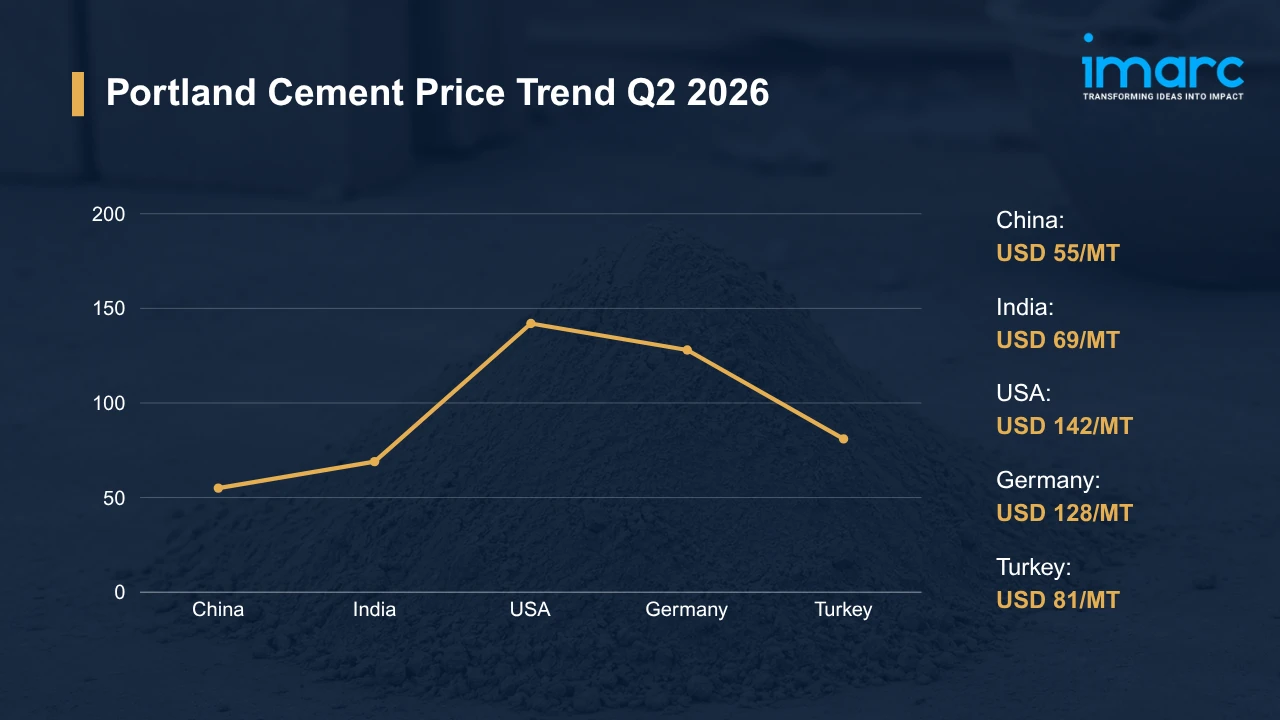
Portland cement is a hydraulic binding powder, produced by calcining limestone and clay into clinker and then intergrinding the result with gypsum to a fine, reactive consistency. Across construction, infrastructure, and precast concrete segments, Portland cement prices reflect the cost of coal and petcoke consumed during calcination, electricity drawn in grinding operations, additive procurement, and inbound and outbound freight on key supply corridors. Demand cycles in housing, road-building, and industrial construction are the primary volume drivers shaping quarterly price direction across all tracked markets.
Global Market Overview:
Globally, the Portland cement industry reached a volume of 2.5 Billion Tons in 2025. Market projections indicate steady growth, with the industry expected to reach a volume of 3.2 Billion Tons by 2034, with a compound annual growth rate (CAGR) of 2.99% during 2026-2034. Sustained urbanization across South and Southeast Asia, expanding government housing programs, and long-cycle transport and energy infrastructure pipelines are pushing consumption upward. The Portland cement price trend tracks tightening kiln fuel costs and firm ready-mix concrete demand as core signals, with low-carbon clinker regulations in Europe adding cost pressure that further shapes regional price divergence.
Portland Cement Price Trend Q2 2026:
Regional prices (USD per MT) and QoQ changes Q2 2026 vs Q1 2026:
| Region | Price (USD/MT) | QoQ Change | Direction |
|---|---|---|---|
| China | 55 | +3.81% | ↑ |
| India | 69 | +4.53% | ↑ |
| USA | 142 | +2.93% | ↑ |
| Germany | 128 | +3.24% | ↑ |
| Turkey | 81 | +3.83% | ↑ |
To access real-time prices Request Sample
What Moved Prices:
China:
- In Q2 2026, Portland cement prices in China climbed to USD 55/MT, lifted by firmer infrastructure procurement and accelerating construction dispatches across government-funded road, rail, and energy corridors. Ready-mix concrete offtake expanded through the period as project schedules accelerated and contractor inventory replenishment tightened available mill supply.
- Kiln operators exercised disciplined output controls, resisting pressure to release surplus volumes into a tightening spot market. Coal-fired energy costs stayed elevated, underpinning cost floors throughout the quarter. Clinker handling and inland freight charges added further support to delivered pricing, with the Portland cement price chart through Q2 2026 confirming a consistent upward bias driven by supply-side restraint.
India:
- During Q2 2026, Portland cement prices in India advanced to USD 69/MT on sustained procurement from housing contractors, rural road-building programs, and urban infrastructure projects. Government-funded connectivity schemes generated steady mill offtake, allowing producers to lift offer levels with limited buyer resistance through the quarter.
- Higher petcoke and coal costs pressed production economics at leading clinker facilities. Seasonal buying ahead of monsoon-related shutdowns pulled procurement forward, compressing spot availability in major distribution corridors. Coastal and inland logistics costs remained firm, keeping landed prices elevated across both organized and trader-driven supply channels.
USA:
- In the second quarter of 2026, Portland cement prices in the USA firmed to USD 142/MT as infrastructure repair programs, residential building activity, and commercial construction maintained consistent mill order flow. Federal-funded highway and bridge projects sustained demand across the Midwest, Gulf Coast, and Southeast, limiting any buyer leverage in contract negotiations.
- Terminal handling fees, inland trucking rates, and labor costs kept delivered pricing structurally elevated. Supply constraints in select regional logistics corridors tightened spot availability. Ready-mix producers maintained active procurement schedules, reinforcing supplier pricing power and preventing meaningful price concessions through the period.
Germany:
- In Q2 2026, Portland cement prices in Germany rose to USD 128/MT, supported by sustained cost pressure from energy expenditure, carbon compliance obligations, and maintenance-related kiln downtime at several regional plants. Infrastructure renovation tender activity and selective commercial construction kept order books from softening materially.
- EU Emissions Trading System charges continued filtering into cement quotations, adding a regulatory cost layer absent in Asian and Turkish competing origins. Imported clinker and grinding additive costs remained firm. Domestic freight expenses provided further support, keeping net producer realizations at levels consistent with the quarterly price advance over Q1 2026.
Turkey:
- During Q2 2026, Portland cement prices in Turkey strengthened to USD 81/MT as domestic construction demand recovered and regional export interest from neighboring buyers improved producer sentiment. Building contractor procurement for urban residential and road projects generated consistent clinker offtake across major production hubs through the period.
- Coal and electricity costs exerted upward pressure on clinker calcination economics, with producers incorporating higher fuel expenditure into offer adjustments. Port handling charges and inland distribution fees elevated delivered prices for buyers sourcing through major logistics points. Competitive exporter discipline in regional trade lanes further supported firmer mill price floors.
Drivers Influencing the Market:
Several factors continue to shape Portland cement pricing and market behavior:
- Construction and Infrastructure Sector Demand: Residential, commercial, and infrastructure development remain the primary drivers of Portland cement demand worldwide. Ongoing urbanization, public infrastructure projects, and investments in transportation, energy, and water infrastructure continue to support cement consumption and strengthen pricing across key markets.
- Clinker Fuel and Energy Expenditure: Coal and petcoke consumed during calcination represent the single largest cost input for most Portland cement producers. The US EIA Quarterly Coal Report released in April 2026 recorded average US coal export prices at USD 106.85 per short ton in Q4 2025, reflecting a persistently elevated industrial fuel cost environment. Producer cost floors are anchored to prevailing coal and petcoke benchmarks, and regional energy price gaps between China, Europe, and North America continue generating competitive positioning divergence. Tracking the Portland cement price index against fuel cost movements reveals the tight pass-through relationship between energy inputs and finished cement quotations.
- Limestone and Raw Material Procurement: Quarry permitting timelines, limestone quality variability, and additive supply constraints shape production cost structures across cement manufacturing regions. Clay, iron ore fines, and gypsum sourced domestically or through imports affect blending economics and grinding costs for individual producers.
- Ocean Freight and Logistics Economics: Cement and clinker move as bulk commodities, subject to vessel availability constraints, port congestion, and charter rate variability across Capesize and Handymax trade corridors. Delivered price competitiveness for imported cement in supply-deficit markets shifts materially with freight rate cycles, affecting buyer calculations on import parity versus domestic sourcing. Inland transportation and terminal handling fees in Germany and the USA contribute a structurally elevated share of the cost buildup from mill to buyer, reinforcing the price premium in those markets relative to producing regions in Asia.
- Trade Policy and Currency Dynamics: Tariff regimes, anti-dumping duties, and import licensing frameworks regulate cross-border cement and clinker flows in markets where domestic capacity falls short of demand. Turkish lira and Indian rupee exchange rate movements alter export competitiveness and shift import parity calculations in destination markets. Currency-adjusted landed costs for USD-priced buyers may diverge substantially from mill gate prices, with procurement teams factoring exchange rate volatility into contract versus spot sourcing decisions across origin markets.
Recent Highlights & Strategic Developments:
Recent strategic moves within the industry further illustrate evolving dynamics:
- In May 2025, Tarmac, part of the CRH group, expanded availability of its Portland limestone cement across England and Wales following revisions to national concrete standards that widened permitted applications for the lower-carbon product. The move reflected accelerating industry adoption of blended cement formulations aimed at reducing clinker content and associated emissions intensity across UK construction projects.
Outlook & Strategic Takeaways:
Looking ahead, the Portland cement market is expected to expand steadily through 2034, anchored by sustained infrastructure investment, urbanization-driven housing construction, and rising industrial project activity across South Asia, the Middle East, and Sub-Saharan Africa. Clinker fuel cost trajectories and carbon compliance expenditure in high-regulatory-burden markets will remain the pivotal variables shaping the Portland cement price forecast across producing regions over the medium-term horizon.
To navigate this complex landscape, stakeholders should:
- Assess Clinker Fuel Cost Movements: Monitor coal and petcoke price trends across key producer markets to anticipate kiln operating cost shifts that filter into cement quotations. Build forward cost visibility by integrating energy market intelligence into quarterly procurement planning cycles.
- Evaluate Infrastructure Pipeline Activity: Track public infrastructure spending programs and construction tender activity across South Asia, the Middle East, and North America as forward demand signals. Correlating government-approved project volumes with expected cement consumption allows more precise inventory positioning and supply contract calibration.
- Review Carbon Compliance Expenditures: Audit the carbon cost implications of sourcing from EU-regulated producers versus lower-compliance-burden markets in Asia or Turkey. Procurement structures that balance carbon footprint objectives with landed cost efficiency require advance planning under continuously evolving regulatory frameworks.
- Strengthen Currency Exposure Management: Implement hedging strategies for cement procurement denominated in Turkish lira, Indian rupee, or euro to stabilize landed cost projections. Treasury and procurement functions should align foreign exchange coverage timelines with anticipated import payment schedules across active origin markets.
- Monitor Regional Price Differentials: Track quarterly pricing variations across China, India, USA, Germany, and Turkey to identify cost-saving procurement windows. Benchmarking the Portland cement price per MT against landed cost data helps procurement teams identify sourcing advantages before contract cycles close.
- Explore Low-Carbon Cement Alternatives: Investigate commercial viability of Portland limestone cement, slag-blended, and fly-ash composite formulations to reduce carbon liability and procurement cost exposure. Supplier technical teams can assess specification compliance for target project applications, enabling informed switching decisions before supply contracts are committed.
Subscription Plans & Customization:
IMARC offers flexible subscription models to suit varying needs:
- Monthly Updates: 12 deliverables/year
- Quarterly Updates: 4 deliverables/year
- Biannual Updates: 2 deliverables/year
Each includes detailed datasets (Excel + PDF) and post-report analyst support.

Get in Touch With Us
UNITED STATES
Phone: +1-201-971-6302
INDIA
Phone: +91-120-433-0800
UNITED KINGDOM
Phone: +44-753-714-6104
Email: [email protected]
Client Testimonials




.webp)




.webp)












