Global Rhenium Prices in Q1 2026: USA Leads at USD 3,255/MT Amid Tight Supply Conditions
18-Jun-2026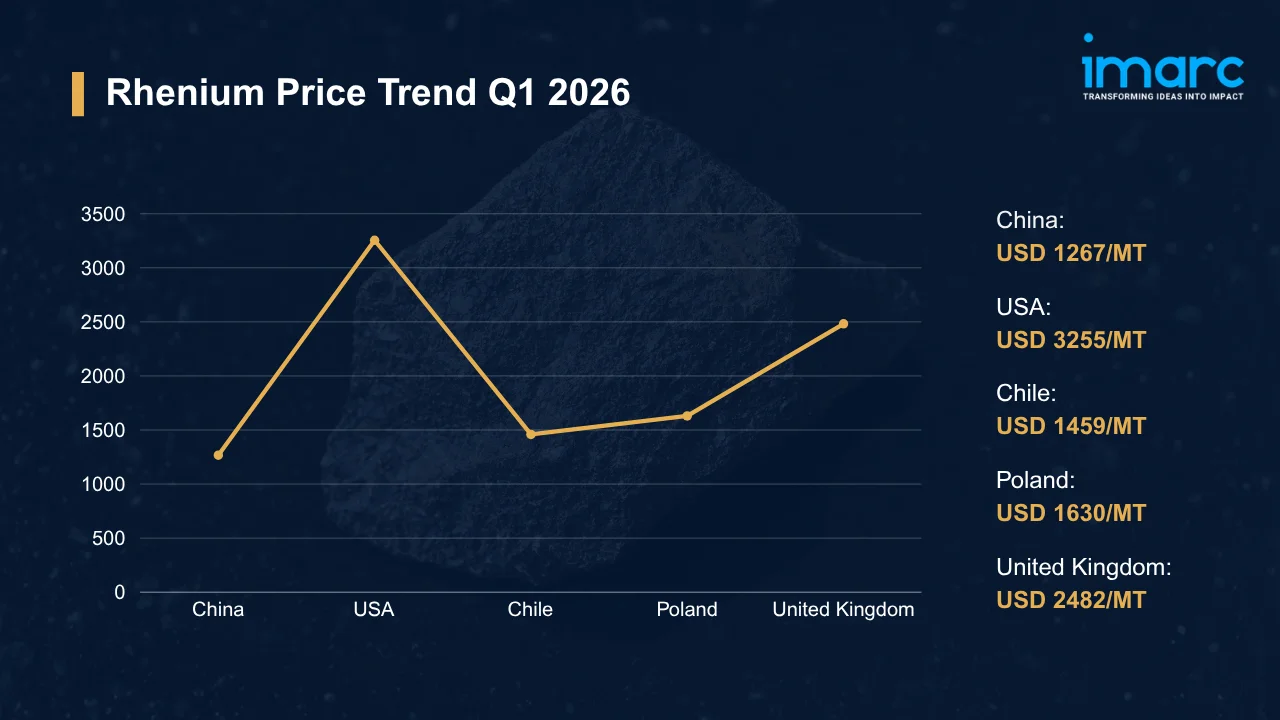
Rhenium is a rare refractory metal. It is prized for creep resistance at turbine operating temperatures and for the chemical stability that makes it essential in platinum-rhenium naphtha-reforming catalysts and high-performance filaments. Rhenium prices reflect procurement activity across aerospace OEMs, petroleum refiners, and specialty electronics producers, each drawing on distinctly different forms of the metal. Upstream molybdenum byproduct recovery rates, roasting-stage energy costs, air and sea freight on key specialty-metal lanes, and OEM turbine production schedules are the variables that move assessed values quarter to quarter.
Global Market Overview:
Globally, the rhenium industry reached a volume of 60.61 Tons in 2025. Market projections indicate steady growth, with the industry expected to reach a volume of 92.39 Tons by 2034, with a compound annual growth rate (CAGR) of 4.80% during 2026-2034. Aerospace fleet renewal programs and expanding petroleum-reforming catalyst installations across Asia and the Middle East anchor that trajectory, pulling the rhenium price trend upward as byproduct supply grows only incrementally alongside copper-molybdenum mine throughput.
Rhenium Price Trend Q1 2026:
Regional prices (USD per MT) and QoQ changes Q1 2026 vs Q4 2025:
| Region | Price (USD/MT) | QoQ Change | Direction |
|---|---|---|---|
| China | 1,267 | +2.21% | ↑ |
| USA | 3,255 | +3.22% | ↑ |
| Chile | 1,459 | +2.45% | ↑ |
| Poland | 1,630 | +1.76% | ↑ |
| United Kingdom | 2,482 | +3.34% | ↑ |
To access real-time prices Request Sample
What Moved Prices:
China:
- In Q1 2026, at USD 1,267/MT, rhenium prices in China posted a 2.21% QoQ gain as aerospace alloy procurement tightened spot APR inventory across domestic casting hubs. Superalloy programs concentrated in Shenyang and Guiyang absorbed available stock at an accelerated pace through January and February. Catalyst refiners added to the demand pool, converting what had been a balanced market at end-Q4 into a supply-constrained one by mid-quarter.
- Domestic refiners released material on controlled schedules, matching output to contracted volumes rather than spot demand. Selective export agreements further decreased the amount available to open-market traders. Tracking the rhenium price chart through Q1 2026 shows a consistent upward gradient from January through March, with no reversal week visible in the assessed data. Turbine component manufacturers stayed cautious on volumes, wary of accumulating excess stock at elevated price levels.
USA:
- During Q1 2026, USD 3,255/MT marked the assessed rhenium price in the USA, a 3.22% QoQ advance driven by tight distributor inventories and firm aerospace alloy demand from turbine engine OEMs in Connecticut and Ohio. Proactive procurement accelerated as production schedules at jet engine facilities expanded beyond what contracted supply volumes could comfortably absorb. Import activity remained cautious, limiting the replenishment available to distributors holding low buffer stocks.
- Air-freight surcharges on inbound specialty metal shipments kept landed cost floors elevated for most of the quarter. Lead times from South American APR suppliers stretched beyond standard windows, compounding the supply squeeze. Both factors sustained upward price momentum through March without any notable demand softening to offset them.
Chile:
- Supported by export demand from North American and European superalloy buyers, rhenium prices in Chile reached USD 1,459/MT in Q1 2026, a 2.45% QoQ gain. Copper-molybdenum porphyry operations across the Atacama region maintained broadly stable throughput, though rhenium recovery per Ton of molybdenum roasted exhibited marginal batch-to-batch variability tied to concentrate grade fluctuations. Export order books from OEM procurement teams filled faster than in Q4 2025.
- Molymet and other Andean processors allocated the majority of output to contracted buyers, leaving limited volume for spot tenders. Scheduled maintenance at one processing facility constrained APR supply through February. Port handling at Valparaiso and San Antonio improved toward quarter-end, though that efficiency gain arrived too late to offset the mid-quarter tightness that had already pushed prices higher.
Poland:
- Throughout Q1 2026, rhenium prices in Poland rose to USD 1,630/MT, marking a 1.76% QoQ gain against a backdrop of firm European aerospace and defense turbine demand. KGHM maintained consistent byproduct recovery throughput, yet intermittent schedule adjustments at the Glogow copper smelter complex limited the volume available for spot market transactions. Demand from turbine component manufacturers across Germany and France absorbed allocations faster than comparable periods in 2025.
- Expanding NATO defense production programs generated strategic procurement pressure among Central European alloy producers, adding a floor to regional pricing that spot-market softening could not easily erode. Inland metal-handling capacity on key Central European freight routes tightened modestly, lifting transportation costs. Landed prices for downstream Polish buyers rose correspondingly.
United Kingdom:
- Across the specialty alloy segment in Q1 2026, rhenium prices in the United Kingdom climbed to USD 2,482/MT, a 3.34% QoQ increase as aerospace Tier-1 suppliers secured material for turbine blade casting programs at accelerating build rates. Absent meaningful domestic production capacity, UK buyers competed directly with Continental European buyers for Polish and Chilean allocations, sustaining import premiums throughout the quarter.
- Distributor import schedules stayed conservative, prioritizing contract fill over spot accumulation. Extended supplier lead times from global refining hubs then tightened the short-term availability picture further. Sterling held relatively stable against major supply-region currencies, delivering only marginal landed cost relief, while clearance times at Felixstowe and Tilbury remained within normal parameters.
Drivers Influencing the Market:
Several factors continue to shape rhenium pricing and market behavior:
- Aerospace and Superalloy Sector Demand: The aerospace industry remains the largest consumer of rhenium, driven by its critical role in nickel-based superalloys used in turbine blades and other high-temperature engine components. Boeing delivered 600 commercial aircraft in 2025, a 72.4% year-on-year increase per its January 2026 press release, providing direct evidence of the scale of build-rate recovery pulling rhenium into superalloy casting programs across major OEM facilities. Contracted procurement agreements between aerospace OEMs and superalloy producers lock in rhenium consumption well in advance, insulating demand from short-term price softening.
- Upstream Molybdenum Byproduct Recovery: Rhenium is produced primarily as a byproduct of molybdenum recovery from copper-porphyry ores, limiting its supply flexibility. This dependence on broader mining activity influences the rhenium price index, while disruptions at major producing operations can quickly tighten supply and affect global pricing.
- Energy Expenditure in Processing: Molybdenum concentrate roasting is thermally intensive, with natural gas and electricity representing a substantial share of variable operating costs at rhenium recovery facilities. Producers in energy cost-sensitive jurisdictions adjust throughput and recovery rates in response to gas tariff movements, not rhenium price signals. When energy costs rise sharply, available APR volume can contract even if rhenium demand is firm, creating short-cycle supply tightness that spot prices then amplify.
- Ocean Freight and Logistics Economics: Given rhenium's high value-to-weight ratio, a significant share of international trade moves by air freight rather than sea, making landed prices sensitive to air cargo rate cycles on specialty-metal corridors from Santiago and Warsaw to North American and Asian consuming hubs. Container freight on longer Chile-to-Europe sea routes and overland transport within Central Europe add secondary cost layers for buyers outside major ports. Rate movements on these corridors filter directly into distributor margin calculations and, ultimately, into the prices offered to downstream alloy producers.
- Environmental and Regulatory Compliance: Strategic mineral designations and evolving regulatory frameworks have increased compliance requirements across the rhenium supply chain. Additional obligations related to handling, storage, and trade documentation contribute to operating costs, which are often reflected in market pricing.
Recent Highlights & Strategic Developments:
Recent strategic moves within the industry further illustrate evolving dynamics:
- In October 2025, Solitario Resources Corp. added the Cat Creek molybdenum-rhenium porphyry project in Colorado to its portfolio and secured permits for a 2026 Core drilling program. Rhenium's US Critical Metal classification was cited as a core rationale, underscoring its strategic value across aerospace and defense supply chains.
- In August 2025, Plus Therapeutics, Inc. announced a commercial launch timeline for its CNSide CSF Assay Platform and initiated a dose-optimization trial for REYOBIQ, a rhenium-186 radiotherapeutic targeting leptomeningeal metastases. Medical isotope applications represent an emerging demand category for rhenium outside its established industrial base.
Outlook & Strategic Takeaways:
Looking ahead, the rhenium market is expected to expand, propelled by aerospace fleet renewal demand, increasing petroleum-reforming catalyst capacity across emerging markets, and a growing medical isotope application base that diversifies end-use absorption beyond traditional turbine alloy programs. Molybdenum byproduct recovery rates at copper-porphyry operations in Chile and Poland will remain the decisive supply variable shaping the rhenium price forecast, given that primary production cannot be expanded independently of upstream copper and molybdenum mine throughput.
To navigate this complex landscape, stakeholders should:
- Assess Freight and Logistics Developments: Monitor air-cargo rate trends on specialty metal corridors and container shipping benchmarks on Latin America-to-Europe lanes quarterly. Negotiate logistics contracts with rate-adjustment provisions tied to published air cargo indices to stabilize landed cost projections against freight volatility.
- Evaluate Downstream Demand Indicators: Track aerospace OEM delivery schedules, turbine engine order books, and petroleum-refining capacity investment data across principal consuming regions each quarter. Correlate those demand signals with procurement planning cycles to optimize inventory positioning before spot supply windows tighten.
- Review Regulatory Compliance Expenditures: Audit current costs associated with critical mineral designation obligations, chemical safety documentation, and export license requirements across key supply jurisdictions. Identify process efficiencies that reduce compliance burden without compromising material handling and storage standards.
- Strengthen Currency Exposure Management: Implement hedging strategies for procurement denominated in Chilean peso and Polish zloty to stabilize landed cost projections as supply-region currencies fluctuate against the US dollar. Coordinate treasury and procurement teams to align foreign exchange coverage with anticipated import payment timelines.
- Explore Secondary Recovery and Recycling Programs: Investigate rhenium recovery from spent superalloy scrap and exhausted petroleum-reforming catalysts to diversify supply beyond primary byproduct streams. Engage secondary processors to assess volume availability and price competitiveness relative to primary market benchmarks.
- Monitor Regional Price Differentials: Track quarterly pricing variations across China, Chile, Poland, and the USA to identify cost-efficient procurement windows. Benchmark rhenium price per MT by origin against prevailing contract rates and landed costs to inform sourcing allocation decisions each quarter.
Subscription Plans & Customization:
IMARC offers flexible subscription models to suit varying needs:
- Monthly Updates: 12 deliverables/year
- Quarterly Updates: 4 deliverables/year
- Biannual Updates: 2 deliverables/year
Each includes detailed datasets (Excel + PDF) and post-report analyst support.

Get in Touch With Us
UNITED STATES
Phone: +1-201-971-6302
INDIA
Phone: +91-120-433-0800
UNITED KINGDOM
Phone: +44-753-714-6104
Email: [email protected]
Client Testimonials




.webp)




.webp)












