LPG Price Update: Sustained Growth Across Key Markets in Q3 2026
14-Oct-2026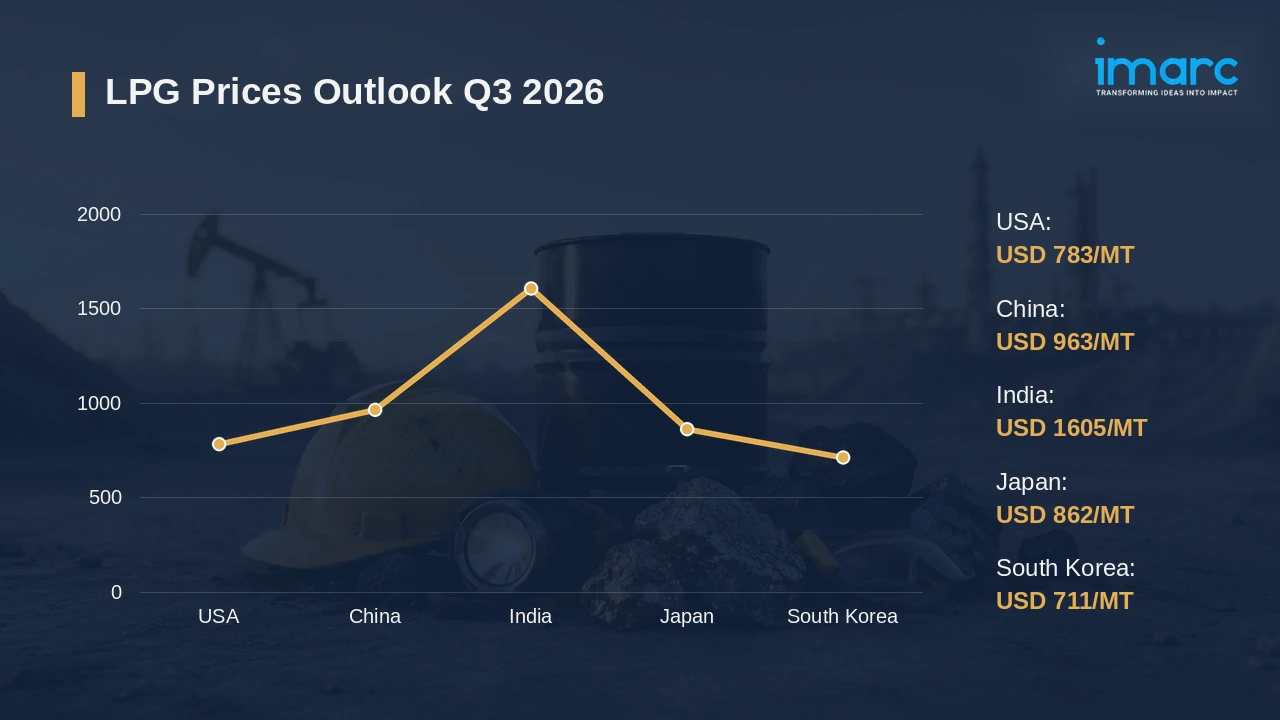
Liquefied petroleum gas, known commercially as LPG, blends propane and butane into a fuel stored under moderate pressure as a liquid. Across households, autogas fleets, and petrochemical crackers, consumption remains steady. LPG prices track natural gas processing economics, refinery operating rates, very large gas carrier freight, seasonal heating cycles, and petrochemical feedstock competition across major importing economies.
Global Market Overview:
Globally, the LPG industry was valued at USD 149.6 Billion in 2025. Market projections indicate steady growth, with the industry expected to reach USD 199.0 Billion by 2034, with a compound annual growth rate (CAGR) of 3.19% during 2026-2034. Supported by clean-fuel substitution programs and expanding propane dehydrogenation capacity, the LPG price trend remains anchored, while distribution infrastructure buildouts widen household access across emerging economies.
LPG Price Trend Q3 2026:
Regional prices (USD per MT) and QoQ changes Q3 2026 vs Q2 2026:
| Region | Price (USD/MT) | QoQ Change | Direction |
|---|---|---|---|
| USA | 783 | +12.34% | ↑ |
| China | 963 | +15.50% | ↑ |
| India | 1,605 | +21.23% | ↑ |
| Japan | 862 | +23.13% | ↑ |
| South Korea | 711 | +11.90% | ↑ |
To access real-time prices Request Sample
What Moved Prices:
USA:
- In Q3 2026, LPG prices in the USA climbed to USD 783/MT as petrochemical crackers and Gulf Coast export terminals absorbed available propane and butane volumes. Fractionation plant output held broadly steady. Routed toward Asian and Latin American buyers, heavy export commitments thinned material offered into the domestic spot market through September.
- Advancing ahead of the winter draw season, residential heating distributors firmed term negotiations at Mont Belvieu while terminal loading slots stayed fully booked through the quarter. The LPG price chart tracked rising waterborne netbacks. Across key distribution corridors, inland rail and truck logistics operated without notable disruption.
China:
- During Q3 2026, LPG prices in China advanced to USD 963/MT as propane dehydrogenation units and petrochemical producers lifted import cargo purchases across eastern coastal terminals. Elevated very large gas carrier freight rates added further weight to landed costs. Though comfortable, domestic refinery output trailed the appetite of feedstock consumers.
- Tariff-driven redirection of US-origin cargoes kept Chinese buyers reliant on Middle Eastern and alternative Atlantic suppliers, lifting the replacement cost embedded in each incremental import parcel. To cap exposure to spot premiums, procurement teams locked term volumes early. Port congestion stayed limited, though berth scheduling tightened as discharge volumes rose.
India:
- In the third quarter of 2026, LPG prices in India surged to USD 1,605/MT as household cooking gas distribution networks and industrial consumers absorbed both domestic and imported volumes. Refinery production growth lagged the pace of consumption. At western coast import ports, terminal handling charges compounded the landed cost burden.
- Subsidy administration under the national cooking fuel program shaped retail pass-through, leaving oil marketing companies to absorb part of the import cost escalation on domestic cylinder sales. Across the supply base, import dependence remained structurally high. Distributors serving urban and rural markets replenished inventory steadily through the quarter.
Japan:
- During Q3 2026, LPG prices in Japan rose to USD 862/MT as import dependent buyers faced firmer replacement costs from Middle Eastern and North American loading origins. Limited domestic production left the market tethered to overseas offers. Ahead of the winter heating season, utilities secured cargoes early.
- Yen weakness against the dollar inflated import parity values, pushing contract formulas higher for residential and commercial distributors already managing thin retail margins across the country. Among Asian buyers, competition for available spot shipments intensified. Storage terminals ran at workable utilization, which kept physical availability adequate despite the cost escalation.
South Korea:
- In Q3 2026, LPG prices in South Korea increased to USD 711/MT as petrochemical operators substituting away from naphtha and residential heating consumers absorbed available import volumes. Term contract costs from Middle Eastern suppliers firmed. As competing Asian buyers bid for the same cargoes, regional availability tightened.
- Cracker economics favored LPG over naphtha for part of the quarter, lifting flexible feedstock substitution rates at major Yeosu and Daesan complexes through the September loading cycle. Across receiving terminals, import scheduling stayed orderly. Buyers hedged a portion of winter requirements through paper positions to stabilize budget exposure.
Drivers Influencing the Market:
Several factors continue to shape LPG pricing and market behavior:
- Residential and Petrochemical Sector Demand: Across the largest consuming economies, cooking fuel distribution networks and propane dehydrogenation units anchor baseline offtake. Seasonal heating cycles lift fourth quarter and first quarter procurement, while cracker operators rotate between LPG and naphtha depending on where relative feedstock spreads settle each month. Beyond these two pillars, autogas fleets add steady incremental volume. Subsidy programs across South Asia sustain household consumption irrespective of international price movements.
- Upstream Natural Gas Processing and Refinery Output: Propane and butane emerge as byproducts of gas processing and crude refining, so supply tracks drilling economics more than LPG demand. According to the EIA, US propane exports averaged 2 Million barrels per day during the first half of 2026, up 11% from the comparable 2025 period. Record domestic production sat behind that increase. Downstream, the capacity for fractionation determines the speed at which output enters waterborne markets.
- Energy Expenditure in Processing and Fractionation: Gas processing plants, fractionators, and refinery units consume substantial electricity and fuel gas to separate, chill, and store propane and butane streams ahead of export loading. Through utility tariffs, producer cost floors move with regional power pricing. Whenever regional power costs climb, the LPG price index firms across affected producing hubs. Cold weather compounds the effect by lifting processing load and heating demand together.
- Ocean Freight and Logistics Economics: Because very large gas carriers move the bulk of intercontinental LPG volumes, charter rates sit directly inside delivered pricing for importing regions. Baltic Exchange assessments placed the Houston to Chiba benchmark at USD 320.71 per Metric Ton in mid-September 2026, with daily time charter equivalent returns near USD 193,696. Adding to this pressure, canal transit limits and tight tonnage lists amplify the swings.
- Environmental and Regulatory Compliance: Storage, odorization, cylinder certification, and transport rules govern how LPG reaches end users, and compliance spending scales with the stringency of each jurisdiction. Across South Asia and Africa, clean cooking mandates expand the addressable market, while emissions frameworks in Europe increasingly favor bio-LPG and renewable dimethyl ether blends. Certification backlogs occasionally delay new distribution capacity.
- Trade Policy and Currency Dynamics: Tariffs, import duties, and quota adjustments redirect cargo flows between basins within weeks, resetting regional premiums well before physical balances on the water actually change. Following Chinese levies on US-origin propane, buyers leaned toward Middle Eastern suppliers, while Indian and Japanese importers absorbed more Atlantic tonnage. Dollar strength compounds the effect for importing economies.
Recent Highlights & Strategic Developments:
Recent strategic moves within the industry further illustrate evolving dynamics:
- In March 2026, the Government of India instructed refiners and petrochemical complexes to channel propane, butane, and related hydrocarbon streams into the LPG pool. Domestic output rose roughly 25%, with the incremental volume routed entirely to household consumption.
- In August 2025, the Government of India sanctioned INR 12,000 Crore toward targeted LPG subsidy support under the Pradhan Mantri Ujjwala Yojana for 2025-26. A further INR 30,000 Crore was cleared to compensate IOCL, BPCL, and HPCL for under-recoveries on domestic cylinder sales.
Outlook & Strategic Takeaways:
Looking ahead, the LPG market is expected to expand steadily through 2034 on clean cooking programs and widening autogas adoption. Freight economics on very large gas carriers, alongside the trajectory of US natural gas liquids output, will remain the pivotal variables shaping the LPG price forecast through the decade.
To navigate this complex landscape, stakeholders should:
- Monitor Regional Price Differentials: Track quarterly spreads between Asian, North American, and European delivered values to identify favorable procurement windows. Establish benchmarking routines that compare landed costs against prevailing term contract rates each quarter.
- Assess Freight Market Developments: Monitor very large gas carrier charter assessments and canal transit conditions on primary export corridors. Negotiate logistics agreements with adjustment clauses linked to published spot freight benchmarks.
- Evaluate Downstream Demand Indicators: Review cracker operating rates, cylinder refill volumes, and heating degree day forecasts across consuming regions. Correlate those signals with LPG price per MT movements to time inventory builds ahead of seasonal peaks.
- Review Regulatory Compliance Expenditures: Audit cylinder certification, odorization, and storage compliance costs across each operating jurisdiction annually. Identify process efficiencies that trim administrative burden without compromising safety obligations or distribution reliability.
- Strengthen Currency Exposure Management: Implement hedging coverage for dollar denominated import payments in volatile local currency markets. Align treasury coverage windows with cargo nomination and payment schedules to stabilize landed cost planning.
- Explore Alternative Feedstock Flexibility: Assess cracker configurations that permit rapid switching between LPG and naphtha as relative spreads shift. Engage suppliers on bio-LPG and renewable blend availability to prepare for tightening emissions rules.
Subscription Plans & Customization:
IMARC offers flexible subscription models to suit varying needs:
- Monthly Updates: 12 deliverables/year
- Quarterly Updates: 4 deliverables/year
- Biannual Updates: 2 deliverables/year
Each includes detailed datasets (Excel + PDF) and post-report analyst support.

Get in Touch With Us
UNITED STATES
Phone: +1-201-971-6302
INDIA
Phone: +91-120-433-0800
UNITED KINGDOM
Phone: +44-753-714-6104
Email: [email protected]
Client Testimonials




.webp)




.webp)