Mentha Oil Price Update: Mixed Movements Across Key Markets in Q1 2026
22-May-2026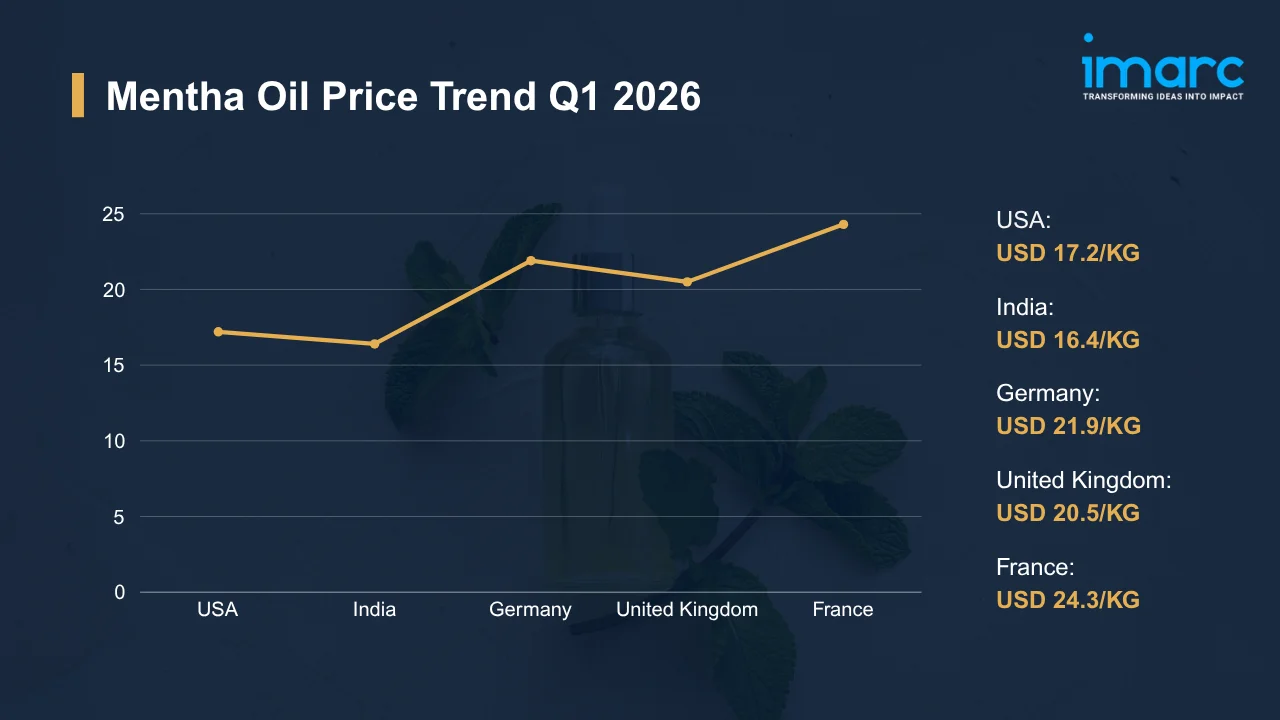
Derived through steam distillation of Mentha arvensis leaves, mentha oil is a volatile essential oil rich in menthol, menthone, and isomenthone that impart its sharp cooling profile. Pharmaceutical formulations, confectionery, oral hygiene products, and cosmetics represent the primary consumption channels for this commodity globally. Mentha oil prices hinge on upstream mint leaf harvest yields, distillation energy costs, container freight rates along Asia-to-Europe and Asia-to-North America corridors, and cyclical demand shifts across FMCG end-use sectors.
Global Market Overview:
Globally, the mentha oil industry was valued at USD 597.60 Million in 2025. Market projections indicate steady growth, with the industry expected to reach USD 1,083.96 Million by 2034, with a compound annual growth rate (CAGR) of 6.84% during 2026-2034. Accelerating pharmaceutical consumption and natural-ingredient preferences in cosmetics anchor the mentha oil price trend, while FMCG expansion across Southeast Asia and Latin America broadens the downstream demand base.
Mentha Oil Price Trend Q1 2026:
Regional prices (USD per KG) and QoQ changes Q1 2026 vs Q4 2025:
| Region | Price (USD/KG) | QoQ Change | Direction |
|---|---|---|---|
| USA | 17.2 | +1.18% | ↑ |
| India | 16.4 | +2.50% | ↑ |
| Germany | 21.9 | -0.45% | ↓ |
| United Kingdom | 20.5 | +2.50% | ↑ |
| France | 24.3 | +1.25% | ↑ |
To access real-time prices Request Sample
What Moved Prices:
USA:
- In Q1 2026, mentha oil prices in the USA touched USD 17.2/KG, a 1.18% QoQ uptick reflecting tighter domestic inventories. Pharmaceutical and personal care manufacturers drove firm downstream offtake. Limited spot availability of high menthol content grades squeezed liquidity, and the mentha oil price chart tracked consistent upward pressure across the quarter.
- Stretched lead times on inbound Asian shipments pushed buyers toward forward contracting over spot procurement. Oral care and confectionery producers held offtake volumes steady, while rising distillation energy costs at Gulf Coast processing sites compressed supplier margins through March.
India:
- During Q1 2026, at USD 16.4/KG, mentha oil prices in India firmed on the back of reduced crop arrivals from Uttar Pradesh producing clusters. Controlled selling in anticipation of better realizations kept spot volumes tight, while FMCG and pharmaceutical demand held steady across the quarter.
- Export commitments bound for North American and European buyers drained regional availability, shrinking volumes accessible to domestic converters. Rising energy tariffs at Uttar Pradesh distillation facilities layered on cost pressure, and INR-USD exchange rate swings injected variability into export contract pricing through the period.
Germany:
- In the first quarter of 2026, mentha oil prices in Germany edged down to USD 21.9/KG as improved import logistics moderated the prior upward trajectory. Cosmetic and pharmaceutical buyers gained negotiation leverage with better supply availability from Asian origins, even as food flavoring demand stayed resilient.
- Across the Shanghai-to-Rotterdam corridor, softening container freight rates through early 2026 trimmed landed costs for German importers. Competitive trader tendering and smoother port throughput at Hamburg offset persistent regulatory certification expenses, supporting the marginal QoQ decline.
United Kingdom:
- During Q1 2026, mentha oil prices in the United Kingdom advanced to USD 20.5/KG, lifted by steady demand from oral hygiene, confectionery, and wellness segments. Post-Brexit customs protocols kept import costs elevated, and constrained availability from major producing regions encouraged forward contract coverage among buyers.
- With domestic stockpiles running thin, procurement urgency intensified across key distribution hubs. Wellness and aromatherapy segment expansion provided supplementary demand support, though stable gas storage levels capped energy-related surcharges for UK-based blending and repackaging operations.
France:
- In Q1 2026, at USD 24.3/KG, mentha oil prices in France registered a 1.25% QoQ gain amid firm demand from premium cosmetics, perfumery, and pharmaceutical buyers. Selective availability of high-purity grades constrained supply, pushing procurement expenses above Q4 2025 levels.
- Prioritizing quality-certified and traceable material, French importers absorbed higher acquisition costs relative to standard-grade alternatives. Consumer appetite for natural and plant-based personal care ingredients showed no signs of easing, and EU chemical safety compliance requirements layered on incremental cost for distributors.
Drivers Influencing the Market:
Several factors continue to shape mentha oil pricing and market behavior:
- Pharmaceutical and Personal Care Sector Demand: Baseline procurement volumes for mentha oil rest on sustained offtake from pharmaceutical, oral care, and personal care producers. Across emerging markets, urbanization and rising disposable incomes feed consistent order flows for menthol-based formulations. Seasonal shifts in confectionery and wellness product manufacturing introduce periodic variability, though the underlying demand trajectory remains upward.
- Upstream Mint Leaf Harvest and Distillation Costs: Mentha arvensis crop yields in India swing sharply with monsoon timing and post-harvest weather patterns. That volatility feeds directly into raw material availability at distillation units, where labor cost inflation and agrochemical input pricing compound extraction expenses. The mentha oil price index stays acutely sensitive to these upstream cost movements, particularly when harvest shortfalls coincide with elevated distillation overheads.
- Energy Expenditure in Steam Distillation: For mentha oil processors, natural gas and electricity tariffs dictate a large share of per-kilogram production costs at the distillation stage. Per the EIA, Henry Hub natural gas spot prices averaged USD 7.72 per Million Btu in January 2026, then dropped to USD 2.77 per Million Btu by April, exposing producers to sharp cost swings within a single quarter. Such volatility complicates forward pricing and margin management for distillers worldwide.
- Ocean Freight and Logistics Economics: Landed costs for mentha oil hinge on container shipping rate dynamics along Asia-to-Europe and Asia-to-North America lanes. Drewry’s World Container Index surged 12% to USD 2,553 per 40-foot container in mid-May 2026, propelled by early peak season surcharges and capacity tightening on transpacific routes. Blank sailing announcements and port congestion add transit time uncertainty that disrupts procurement calendars.
- Environmental and Regulatory Compliance: Under tightening EU chemical safety frameworks, essential oil importers face rising registration, evaluation, and testing expenditures that filter into landed pricing. Sustainability certification demands from downstream cosmetics and food manufacturers add another compliance layer. Producers lacking pre-certified supply chains absorb disproportionate costs, widening price differentials between compliant and non-compliant origins.
- Trade Policy and Currency Dynamics: When the Indian rupee weakens against the euro or sterling, CIF costs for European importers climb even if FOB prices hold steady at origin. Post-Brexit customs protocols continue layering administrative and duty-related charges on UK-bound shipments. Tariff adjustments on essential oil HS classifications periodically reshape landed cost calculations for buyers in North America and Europe.
Recent Highlights & Strategic Developments:
Recent strategic moves within the industry further illustrate evolving dynamics:
- In April 2025, the Multi Commodity Exchange of India Limited (MCX) revised specifications for mentha oil futures contracts. Under updated GLC capillary column testing criteria, the minimum L-menthol content threshold moved to 68%, with material testing at 67% eligible for settlement subject to a 1:1 discount adjustment.
Outlook & Strategic Takeaways:
Looking ahead, the mentha oil market is expected to sustain measured expansion through 2034, anchored by resilient pharmaceutical and personal care consumption alongside accelerating natural-ingredient adoption in food and cosmetics applications globally. Harvest yield variability in India and distillation energy cost trajectories will remain the pivotal variables shaping the mentha oil price forecast across producing and consuming regions.
To navigate this complex landscape, stakeholders should:
- Monitor Regional Price Differentials: Track quarterly pricing shifts across the USA, the UK, India, Germany, and France to spot cost-saving procurement windows. Establish landed-cost benchmarking protocols against prevailing contract rates for sharper sourcing decisions.
- Assess Freight Market Developments: Monitor container shipping rate movements on Asia-to-Europe and transpacific corridors to anticipate landed cost fluctuations. Negotiate flexible logistics contracts with rate adjustment clauses tied to prevailing spot market conditions.
- Evaluate Downstream Demand Indicators: Track pharmaceutical and FMCG order books across principal consumption regions to calibrate inventory positioning. Correlate seasonal demand signals with procurement cycles to avoid overstocking during softer quarters.
- Review Regulatory Compliance Expenditures: Audit current costs tied to essential oil quality certification and EU chemical safety registration. Identify process efficiencies that trim compliance overhead without weakening safety or traceability standards.
- Strengthen Currency Exposure Management: Implement INR-hedging strategies for India-sourced procurement to stabilize landed cost projections. Benchmarking mentha oil price per KG against regional contract rates helps procurement teams capture cost-saving windows across sourcing geographies.
- Explore Emerging Application Segments: Investigate growth potential in aromatherapy, natural wellness, and plant-based personal care for portfolio diversification. Engage research partners to assess commercial viability of novel menthol-derivative formulations that could expand addressable demand.
Subscription Plans & Customization:
IMARC offers flexible subscription models to suit varying needs:
- Monthly Updates — 12 deliverables/year
- Quarterly Updates — 4 deliverables/year
- Biannual Updates — 2 deliverables/year
Each includes detailed datasets (Excel + PDF) and post-report analyst support.

.webp)
Get in Touch With Us
UNITED STATES
Phone: +1-201-971-6302
INDIA
Phone: +91-120-433-0800
UNITED KINGDOM
Phone: +44-753-714-6104
Email: [email protected]
Client Testimonials




.webp)




.webp)












