Mung Beans Price Update: Continued Decline Across Key Markets in Q1 2026
22-May-2026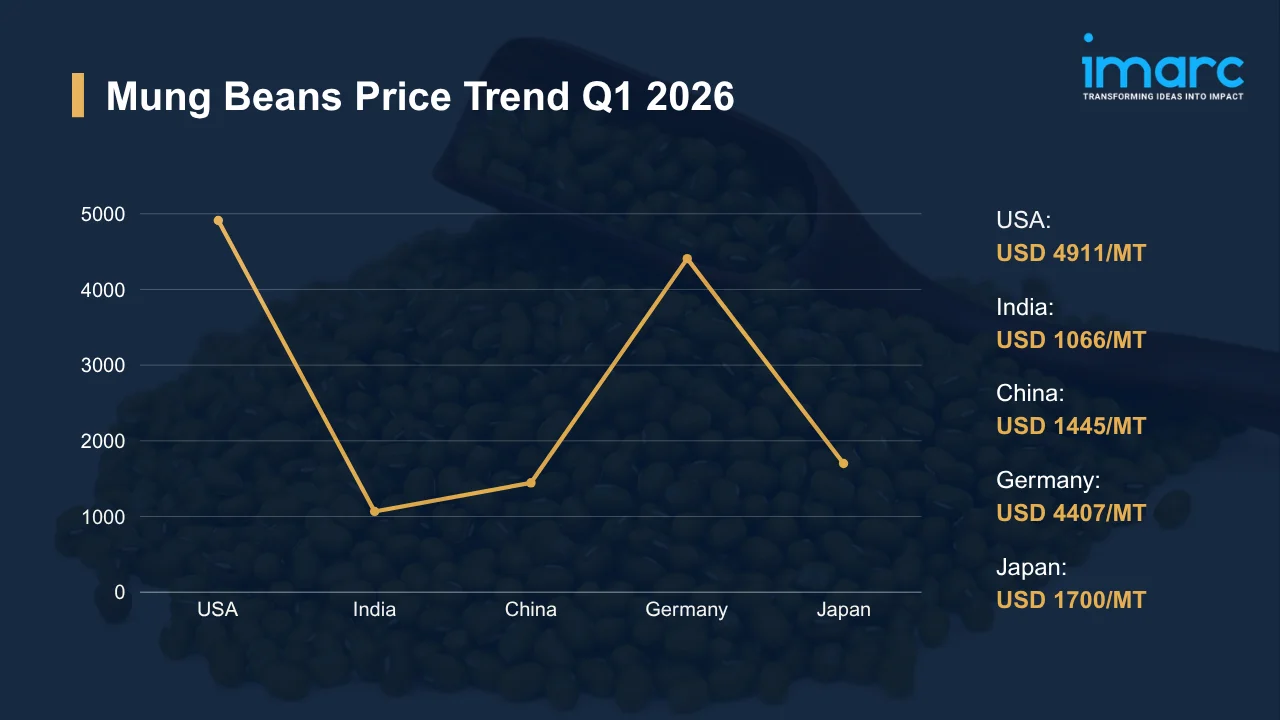
Classified under the Vigna radiata species, mung beans are small green-hulled legumes prized for high protein density and rapid digestibility. Whole seeds, sprouts, flour, and extruded noodle formats position the crop across food processing, health supplement, ethnic cuisine, and plant-based protein sectors worldwide. Mung beans prices hinge on seasonal harvest cycles, post-farm-gate storage costs, ocean freight volatility along Asia-origin corridors, and procurement rhythms within retail and industrial food channels.
Global Market Overview:
Globally, the mung beans industry was valued at USD 4,613.6 Million in 2025. Market projections indicate steady growth, with the industry expected to reach USD 5,877.9 Million by 2034, with a compound annual growth rate (CAGR) of 2.65% during 2026-2034. Fueled by plant-based protein adoption and gluten-free ingredient demand across both mature and emerging consumer markets, the mung beans price trend draws further support from sustainable farming practices and functional food product development.
Mung Beans Price Trend Q1 2026:
Regional prices (USD per MT) and QoQ changes Q1 2026 vs Q4 2025:
| Region | Price (USD/MT) | QoQ Change | Direction |
|---|---|---|---|
| USA | 4911 | -3.67% | ↓ |
| India | 1066 | -3.00% | ↓ |
| China | 1445 | -3.99% | ↓ |
| Germany | 4407 | -2.99% | ↓ |
| Japan | 1700 | -3.08% | ↓ |
To access real-time prices Request Sample
What Moved Prices:
USA:
- In Q1 2026, demand softened across import channels. At USD 4911/MT, a 3.67% QoQ drop, mung beans prices in the USA reflected reduced procurement from food processors working through carryover inventories built during prior harvest windows. The mung beans price chart confirmed persistent downward pressure.
- Across transpacific shipping corridors, moderating container freight rates compressed landed costs for bulk importers. Ethnic food segment offtake held at baseline levels without triggering any restocking acceleration from major warehouse operators. Distributors favored turnover efficiency over speculative volume.
India:
- During Q1 2026, arrivals stayed abundant. Weighed down by robust kharif and rabi output reaching wholesale mandis in Rajasthan, Madhya Pradesh, and Maharashtra, mung beans prices in India dropped to USD 1066/MT. Household consumption grew at a tepid pace.
- With export inquiries from Southeast Asian and Middle Eastern buyers staying muted, competition among traders eased considerably. Government buffer stock mechanisms and comfortable carryover reserves reinforced supply adequacy at key distribution nodes. Buyers negotiated lower contract terms throughout.
China:
- In the first quarter of 2026, inventories stayed ample. Tempered offtake from food processing units and health supplement manufacturers in Heilongjiang and Anhui provinces pulled mung beans prices in China down to USD 1445/MT. Spot interest remained weak.
- Through steady import flows from Myanmar and other Southeast Asian origins, supply balance remained comfortable across domestic channels. CNY stability against the US dollar limited procurement cost swings. Buyers rotated existing stock rather than accumulating fresh positions.
Germany:
- During Q1 2026, German import demand softened noticeably. Specialty food distributors and plant-based product manufacturers scheduled conservative restocking cycles, pulling mung beans prices to USD 4407/MT as Asian-origin warehouse stocks stayed adequate. Buyer urgency dropped across major hubs.
- Constrained by elevated but stabilizing EU organic certification and food safety compliance overheads, processors saw limited incremental cost pressure. Softening Asia-Europe container freight and efficient cross-border trucking through Hamburg and Rotterdam trimmed landed expenses. The quarter's price decline held firm.
Japan:
- In Q1 2026, structured contracts and efficient port handling at Yokohama and Kobe maintained strong product availability, yet mung bean prices in Japan still slipped to USD 1700/MT. Foodservice demand offered no uplift.
- Across urban cold-chain distribution networks in Tokyo and Osaka, buyers maintained cautious volume commitments below prior-year levels. Yen-yuan currency shifts introduced marginal cost variability for importers. Overall import expense trajectories trended lower in step with global freight corrections.
Drivers Influencing the Market:
Several factors continue to shape mung beans pricing and market behavior:
- Food Processing and Plant-Based Protein Demand: Baseline procurement stays rooted in food manufacturing globally. According to the OECD-FAO Agricultural Outlook 2025-2034, global pulse output is projected to rise by 26 Million Tons by 2034, with Asia accounting for close to 40% of this expansion and India alone expected to add nearly 8 Million Tons. Rising per capita pulse consumption, forecast at 8.6 Kilograms annually by 2034, reinforces long-term demand foundations.
- Upstream Agricultural Input and Harvest Economics: Governed by seed expenses, irrigation access, labor availability, and post-harvest drying costs, production economics shift with each cropping cycle. Monsoon timing matters enormously in South Asia. Yield swings between Rajasthan, Myanmar, and Heilongjiang force traders to recalibrate spot valuations whenever harvest arrivals deviate from seasonal expectations.
- Energy Expenditure in Processing and Distribution: Gas and electricity expenses directly influence processing margins. Natural gas price fluctuations affect calcination, drying, and cold-chain storage operations across pulse processing hubs, with producers in energy-intensive regions absorbing cost swings that feed through into wholesale mung beans valuations. The mung beans price index captures these shifts.
- Ocean Freight and Logistics Economics: On Asia-origin corridors feeding Europe, North America, and the Gulf, container rates shape landed cost structures for import-dependent buyers. Drewry's composite World Container Index surged 16% to USD 2,557 per 40-ft container in early January 2026, propelled by carrier rate hikes and FAK adjustments on transpacific and Asia-Europe trade lanes. Mung beans import parity calculations shift accordingly.
- Environmental and Regulatory Compliance: Across importing jurisdictions enforcing strict phytosanitary protocols and organic certification mandates, food safety audits progressively raise operating costs for exporters and intermediaries. Registration requirements under EU chemical safety frameworks layer documentation burdens that translate into higher per-unit compliance charges for distributors. These costs pass through to end-market valuations.
- Trade Policy and Currency Dynamics: When producing nations tighten export quotas or adjust tariff schedules, procurement cost variability spikes for sourcing teams. Rupee-dollar and yuan-dollar exchange rate swings reshape import parity arithmetic on major trade corridors, while bilateral agreements between India, Australia, and ASEAN blocs alter preferential access terms. Currency hedging urgency rises alongside this volatility.
Recent Highlights & Strategic Developments:
Recent strategic moves within the industry further illustrate evolving dynamics:
- In November 2025, researchers from the Department of Agronomy, Iowa State University published the first standardized BBCH phenological growth scale tailored specifically to mung beans. Covering stages from germination through senescence, the two-digit classification linked each growth phase with planting-day intervals and accumulated growing degree days.
Outlook & Strategic Takeaways:
Looking ahead, the mung beans market is expected to expand at a measured pace through 2034 as plant-based protein uptake, functional food formulation, and broadening consumption in emerging economies sustain underlying demand. Upstream harvest economics and freight cost trajectories will remain the decisive variables shaping the mung beans price forecast across supply regions.
To navigate this complex landscape, stakeholders should:
- Monitor Regional Price Differentials: Track quarterly landed-cost variations between Asian origins and destination markets to pinpoint procurement windows with favorable pricing. Establish internal benchmarking that compares CIF quotes against prevailing contract terms.
- Assess Freight Market Developments: Review container rate movements on transpacific and Asia-Europe corridors before locking in shipment schedules. Negotiate logistics agreements with rate-adjustment clauses linked to WCI or SCFI benchmark fluctuations.
- Evaluate Downstream Demand Indicators: Correlate retail order-book data and food processor capacity utilization rates with inventory replenishment timing. Align procurement volumes to verified demand signals rather than speculative forward-buying assumptions.
- Review Regulatory Compliance Expenditures: Audit recurring costs tied to organic certification, phytosanitary testing, and food safety documentation across each import jurisdiction. Identify process streamlining opportunities that cut administrative overhead without sacrificing compliance integrity.
- Strengthen Currency Exposure Management: Implement forward contracts or options hedging on rupee, yuan, and yen exposures tied to scheduled import payments. Benchmarking mung beans price per MT against hedged versus unhedged landed costs reveals tangible savings potential.
- Explore Emerging Application Segments: Investigate commercial feasibility of mung bean protein isolates, fortified snack formulations, and sprouted-ingredient product lines. Engage R&D partners to validate scalability before committing capital to new processing capacity.
Subscription Plans & Customization:
IMARC offers flexible subscription models to suit varying needs:
- Monthly Updates — 12 deliverables/year
- Quarterly Updates — 4 deliverables/year
- Biannual Updates — 2 deliverables/year
Each includes detailed datasets (Excel + PDF) and post-report analyst support.

.webp)
Get in Touch With Us
UNITED STATES
Phone: +1-201-971-6302
INDIA
Phone: +91-120-433-0800
UNITED KINGDOM
Phone: +44-753-714-6104
Email: [email protected]
Client Testimonials




.webp)




.webp)












