Palm Oil Price Falls 5.7% in Northeast Asia, 5.1% in Southeast Asia Q4 2025 Update
21-Oct-2025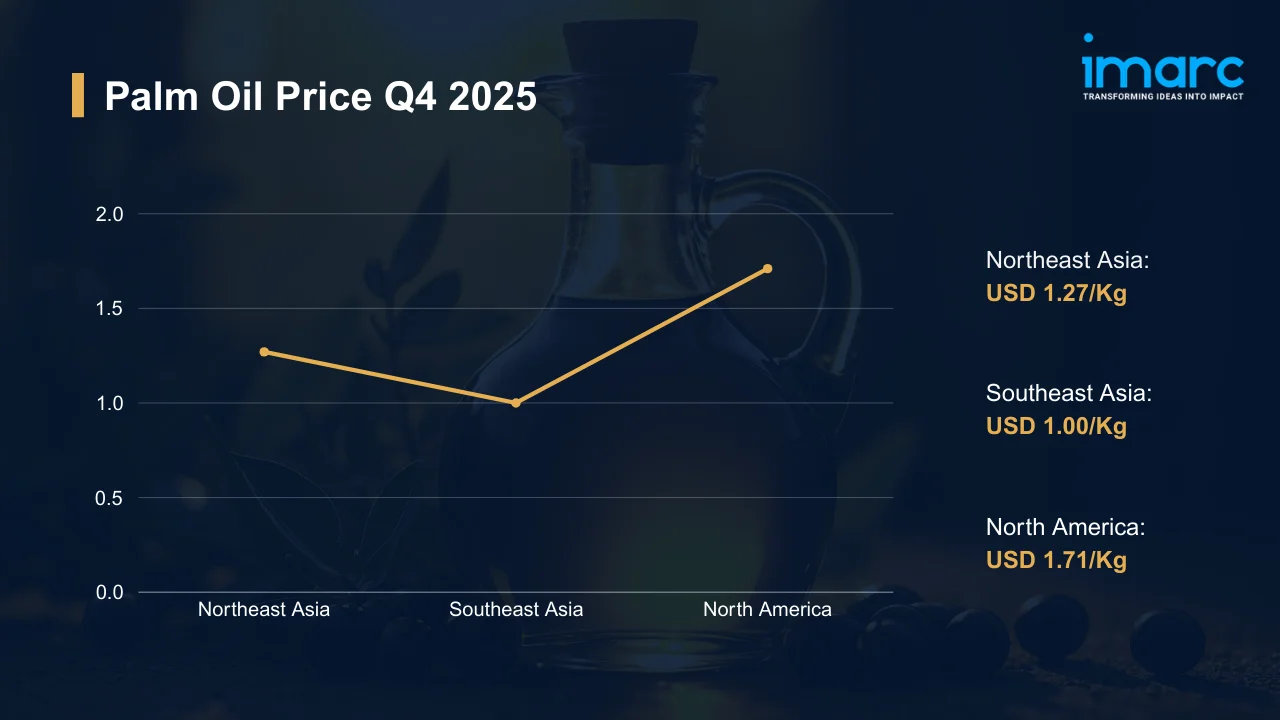
Summary:
Q4 2025 delivered broad pricing pressure across all three tracked palm oil markets, as stronger supply from leading producing nations and subdued downstream consumption converged sharply. Palm oil prices fell between 3.4% and 5.7% quarter-on-quarter, reflecting elevated mill-level stockpiles, competition from alternative vegetable oils, and restrained procurement by food processors and oleochemical manufacturers. The Israel–Iran–USA conflict is inflicting a severe shock on global energy flows. The IEA reported that as of March 15, 2026, oil shipments through the Strait of Hormuz collapsed to less than 10% of pre-war levels, a disruption that is driving up energy and transportation costs across commodity supply chains, including palm oil.
Palm Oil Price Q4 2025:
Regional prices (USD per KG) and QoQ changes Q4 vs Q3 2025:
| Region | Price (USD/KG) | QoQ Change | Direction |
|---|---|---|---|
| Northeast Asia | 1.27 | -5.7% | ↓ Decline |
| Southeast Asia | 1.00 | -5.1% | ↓ Decline |
| North America | 1.71 | -3.4% | ↓ Decline |
To access real-time prices Request Sample
Kindly note: IMARC’s pricing database tracks palm oil price movements across major global markets.
What Moved Prices:
Northeast Asia:
- In Q4 2025, palm oil prices in Northeast Asia declined to USD 1.27/KG, primarily on account of weaker import demand from the food processing and oleochemical manufacturing industries. Reduced procurement quantities amid subdued consumer goods consumption, combined with an increased supply from key producing nations delivering higher yields, kept market conditions firmly in negative territory.
- Competitive pricing from soybean and sunflower oil alternatives diverted significant buyer attention across the region, reinforcing downward price pressure. The palm oil price chart for Northeast Asia reflects a steady descent through the quarter, shaped by elevated port-level inventory accumulation among major importing countries, which suppressed restocking activity and extended bearish market conditions well into year-end.
Southeast Asia:
- During Q4 2025, palm oil prices in Southeast Asia eased to USD 1.00/KG, driven by strong seasonal output as favorable weather lifted fresh fruit bunch yields and extraction volumes across major plantation zones. Elevated stockpiles at mills and refineries compelled processors to offer more competitive prices to reduce surplus inventory, sustaining broad downward pressure throughout the quarter.
- Weaker export demand from major importing markets, particularly from food and industrial end use segments, reduced volume offtake and suppressed pricing further. Falling biodiesel blending mandates tied to declining petroleum benchmarks reduced a key demand driver, while competitive alternative vegetable oil pricing offered buyers viable substitutes, compounding negative market sentiment across the region.
North America:
- In the fourth quarter of 2025, palm oil prices in North America declined to USD 1.71/KG, reflecting reduced import activity from food manufacturers and personal care product formulators who maintained conservative procurement strategies. Falling international benchmark valuations from exporting origins lowered the landed cost assessments for imported palm oil cargoes, enabling further price adjustments across the domestic market.
- Abundant supply availability from Indonesia and Malaysia sustained comfortable import pipeline volumes, while competitive pricing from domestic soybean and canola oil producers limited support for higher palm oil prices. Conservative inventory management among refiners and downstream users curtailed restocking, generating moderately pessimistic but broadly stable market conditions through year-end.
Palm Oil Price Outlook After the Israel–Iran–USA Conflict:
Rising Feedstock and Energy Costs Under Conflict Pressure: The Israel–Iran–USA war is inflicting a significant energy cost shock on the palm oil market. As of March 13, 2026, crude oil prices surged approximately 40% since hostilities began, according to Bloomberg, raising transportation and refining expenses throughout the value chain. These cost pressures might narrow processor margins and introduce upward price momentum, partially offsetting the subdued demand environment that defined Q4 2025.
Regional Trade Uncertainty and Demand Volatility in Key Markets: The ongoing Israel–Iran–USA conflict is introducing significant demand uncertainty across palm oil’s core end-use sectors. Buyers in food processing and oleochemical industries might defer import decisions as geopolitical risk escalates, compressing near-term demand volumes. Price volatility might intensify as market participants struggle to assess conflict-driven disruption duration and scale, complicating procurement planning for refiners and downstream users worldwide.
Procurement Behavior and Inventory Strategies:
Key Factors Influencing the Palm Oil Price?
Immediate Market Reaction
With import-dependent markets like Northeast Asia and North America keenly observing the conflict's course, the palm oil market is directly reacting to the interruption in Middle Eastern trade channels. Crude feedstock and energy costs are increasing as the Strait of Hormuz closes, putting upstream cost pressure on both producers and refiners. Increased logistical costs and freight uncertainties put trade flows from Southeast Asia, the main center for the export of palm oil, at risk. Conflict-driven energy cost volatility continues to change procurement decisions among major importing countries, putting pressure on the palm oil price index and undermining market confidence overall.
Impact on Palm Oil Prices
The conflict might trigger several key changes in the palm oil market:
- Crude Oil-Driven Cost Escalation: The Strait of Hormuz closure is pushing global crude oil benchmarks to significantly elevated levels, raising energy and transportation costs for palm oil processors, refiners, and exporters. Higher diesel and fuel oil expenses will increase the cost of harvesting, milling, and distributing palm oil across domestic and export channels, potentially narrowing refining margins and introducing upward cost-side price pressure on end-market pricing.
- Demand-Side Contraction from Downstream Sectors: Food processors, cosmetic formulators, and oleochemical manufacturers in major palm oil importing regions might reduce procurement volumes in response to escalating geopolitical risk and economic uncertainty. Constrained downstream demand from these key sectors will weigh on palm oil consumption volumes, limiting price recovery prospects even as supply-side cost pressures intensify due to energy cost escalation across the production value chain.
- Biodiesel Blending Disruption and Policy Uncertainty: Government biodiesel blending mandates in key palm oil producing countries, such as Indonesia and Malaysia, might face policy reassessment as conflict-driven fuel price shocks destabilize domestic energy markets. Disruption to blending programs would reduce a critical demand channel for palm oil, while simultaneously raising the cost of palm oil-derived biofuel production, creating a complex and potentially negative pricing environment for market participants.
Taken together, these pressures will create an environment where rising cost-side forces compete against weakening downstream demand, generating price instability that might persist through the first half of 2026. Market participants might navigate a bifurcated pricing dynamic, with input cost escalation in producing regions contrasting sharply against subdued buying activity in major consuming markets worldwide.
Supply Chain Disruptions
Palm oil supply chains face mounting disruption as the Strait of Hormuz closure inflates freight costs and forces vessel rerouting. Southeast Asian palm oil shipments destined for Northeast Asia and North America endure elevated transit expenses and extended delivery timelines as major carriers detour around Africa’s Cape of Good Hope. As of March 2, 2026, VLCC spot rates for the key Mideast-to-China crude tanker route surged to an all-time record of USD 424,000 per day, shattering the previous benchmark and sharply raising the landed cost of energy and commodity shipments throughout palm oil’s core import corridors.
Alternative routing around the Cape of Good Hope adds up extra days to transit times, increasing inventory holding costs and reducing supply chain predictability for palm oil buyers across key importing regions. Palm oil importers in Northeast Asia and North America might need to secure larger safety stock volumes to buffer delivery uncertainty, raising overall procurement expenditure. Producers in Southeast Asia could accelerate inventory liquidation to maintain cash flow, potentially creating near-term market softness before logistics conditions normalize.
Global Market Overview:
Globally, the palm oil industry was valued at USD 59.3 Billion in 2025. Market projections indicate steady growth, with the industry expected to reach USD 80.7 Billion by 2034, with a compound annual growth rate (CAGR) of 3.30% during 2026-2034. Expanding demand from food processing, cosmetics, and biofuels forms the core growth driver, alongside steadily rising consumption in emerging economies. Innovations in plantation management and sustainable certification enhance productivity, reinforcing the long-term positive palm oil price trend across global markets.
Recent Highlights & Strategic Developments:
Recent strategic moves within the industry further illustrate evolving dynamics:
- In January 2025, Hindustan Unilever Limited approved the takeover of Vishwatej Oil Industries’ palm oil operations in Telangana, a move aligned with the company’s strategy to strengthen domestic sourcing and reduce reliance on imported supplies under India’s National Mission on Edible Oils initiative.
Palm Oil Price Forecast (2026):
Near-term palm oil prices will remain sensitive to conflict-driven energy cost movements and shifting downstream demand patterns. Procurement caution is likely to persist among food processors and oleochemical manufacturers, while supply chain disruptions limit regular import flows. Currency volatility in key importing markets may further influence purchasing behavior, reinforcing short-term price fluctuations across the palm oil market. These combined dynamics will continue to shape the palm oil price forecast throughout the year ahead.
If geopolitical hostilities escalate further, palm oil prices will likely face sustained upward pressure as energy costs climb and logistics expenses rise across shipping routes. Producers in conflict-exposed regions might curtail output, tightening global availability while buyers increase precautionary stockpiling. Conversely, if diplomatic resolution leads to a Strait of Hormuz reopening, palm oil prices might trend towards pre-conflict levels by mid-2026 as freight costs ease and supply chain flows normalize.
Strategic Takeaways:
Looking ahead, the palm oil market is expected to maintain a broadly positive growth trajectory over the medium term, underpinned by rising demand from the food processing, biofuel, and personal care sectors. Navigating near-term geopolitical uncertainty while aligning with favorable long-term fundamentals will be critical for stakeholders across the value chain.
To navigate this complex landscape, stakeholders should:
- Monitor Regional Price Differentials: Track quarterly pricing variations across Northeast Asia, Southeast Asia, and North America to identify cost-efficient procurement windows. Benchmarking landed palm oil price per KG against prevailing contract rates will help procurement teams identify cost-saving opportunities.
- Monitor Geopolitical Risk Exposure: Track escalation dynamics in the current conflict and assess how shifts in hostility levels might affect palm oil pricing, feedstock availability, and logistics costs. Establish clear internal alert thresholds that trigger procurement review or hedging action.
- Assess Upstream Feedstock and Energy Costs: Monitor crude palm oil and energy price movements in major producing regions to anticipate processing cost changes. Proactive cost modeling will enable faster price adjustment decisions, protecting margin stability during periods of rapid market volatility.
- Diversify Supply Chain Routes: Evaluate alternative sourcing geographies and shipping corridors to reduce dependence on conflict-exposed trade lanes. Secondary supplier agreements and contingency freight arrangements will provide critical operational resilience if primary routes face sustained disruption or insurance withdrawal.
- Adjust Procurement Strategy for Conflict Conditions: Adopt flexible contract structures, including price reopener clauses and force majeure provisions, to protect against conflict-driven price spikes. Precautionary inventory buffers will reduce procurement exposure if palm oil availability tightens abruptly during geopolitical escalation.
- Engage Sustainable Certification Programs: Evaluate certified sustainable palm oil sourcing under RSPO and related frameworks to meet evolving regulatory and buyer requirements. Premium certified palm oil might command higher prices, offering strategic differentiation for suppliers committed to responsible production practices.
Subscription Plans & Customization:
IMARC offers flexible subscription models to suit varying needs:
- Monthly Updates — 12 deliverables/year
- Quarterly Updates — 4 deliverables/year
- Biannual Updates — 2 deliverables/year
Each includes detailed datasets (Excel + PDF) and post-report analyst support.

.webp)
Get in Touch With Us
UNITED STATES
Phone: +1-201-971-6302
INDIA
Phone: +91-120-433-0800
UNITED KINGDOM
Phone: +44-753-714-6104
Email: [email protected]
Client Testimonials




.webp)




.webp)












