Propionic Acid Price Falls 12.1% in China, 6.3% in USA — Q1 2026 Update
12-May-2026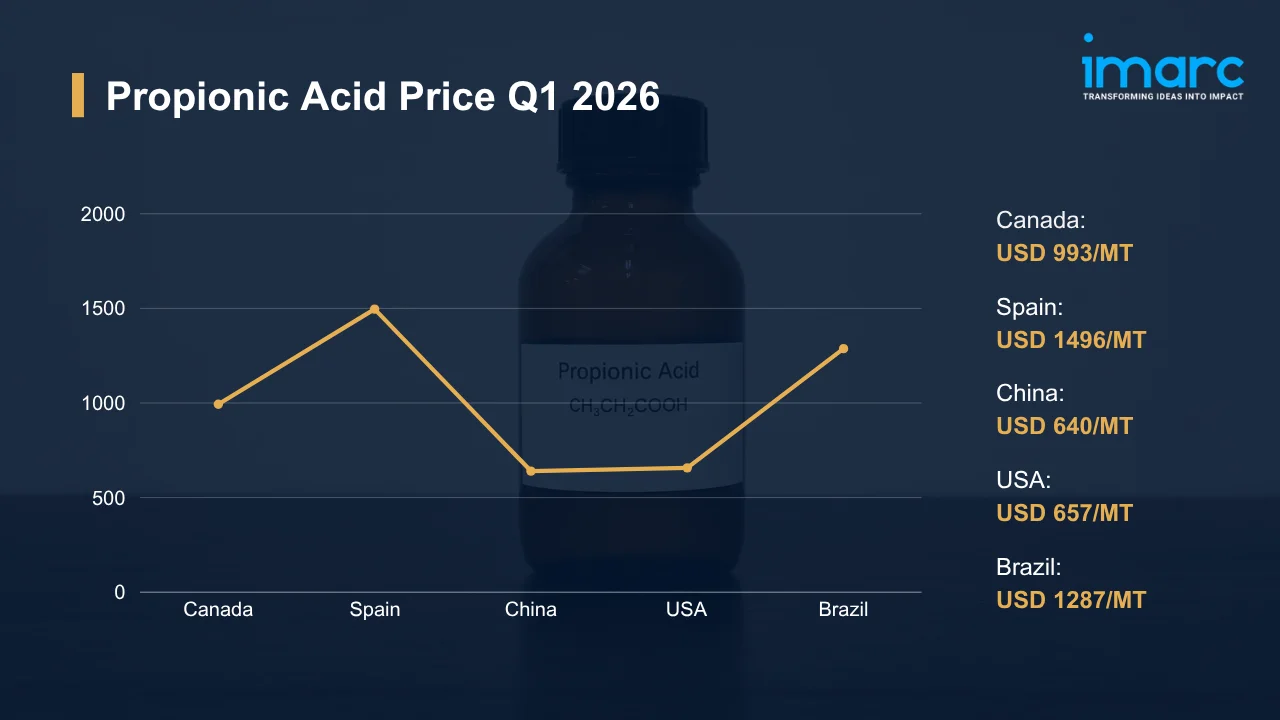
Summary:
Across global propionic acid trade through Q1 2026, pressure built quietly under subdued offtake from feed and food preservation segments, pinning propionic acid prices while feedstock supply held comfortably steady at major producing hubs. Across tracked markets, the spread ran from a 12.1% decline to a 2.1% gain QoQ. Then came the late-April Brent spike. Brent crude jumped roughly 6.08% in late April 2026 to USD 118.03 per barrel as Strait of Hormuz disruption deepened further, according to Al Jazeera.
Propionic Acid Price Q1 2026:
Regional prices (USD per MT) and QoQ changes Q1 2026 vs Q4 2025:
| Region | Price (USD/MT) | QoQ Change | Direction |
|---|---|---|---|
| Canada | 993 | -4.5% | ↓ Decline |
| Spain | 1496 | +2.2% | ↑ Growth |
| China | 640 | -12.1% | ↓ Decline |
| USA | 657 | -6.3% | ↓ Decline |
| Brazil | 1287 | -2.1% | ↓ Decline |
To access real-time prices Request Sample
Kindly note: IMARC’s pricing database tracks propionic acid price movements across major global markets.
What Moved Prices:
Canada:
- During Q1 2026, Canadian propionic acid prices softened to USD 993/MT, not from production headwinds but rather from sluggish feed-preservation offtake across the prairie livestock belt combined with steady import flows from US Gulf Coast suppliers. Producers held domestic output unchanged through Q1. Across feed mills, inventories built modestly through March.
- Across compound feed mills in Quebec and Ontario, procurement teams kept order sizes lean into March, drawing on existing inventories rather than committing to forward volumes amid the soft demand backdrop. The propionic acid price chart reflects a steady downward drift. Rail freight conditions stayed unchanged.
Spain:
- Spain stood alone on the gainer side in Q1 2026, with propionic acid prices climbing to USD 1496/MT on firm pull from compound feed millers and a steady demand baseline from cured meat processors that absorb predictable preservative volumes. Through the quarter, periodic maintenance turnarounds tightened spot availability. Buyers absorbed the modest premium without resistance.
- Within the European converter base, Asian import pressure on the propionic acid segment stayed muted across Q1, leaving Spanish producers with room to defend offer levels through the quarter without aggressive discounting. Energy costs at domestic plants held stable. Mediterranean port logistics ran without major disruption from Middle East tensions.
China:
- During Q1 2026, propionic acid prices in China dropped to USD 640/MT, the steepest regional move of the period as surplus output and lukewarm offtake from chemical and food processing buyers drove inventory accumulation across Shandong and the Yangtze River Delta. Export pull from regional buyers stayed broadly soft. Domestic absorption fell short of supply.
- Conservative purchasing dominated the buying community, with downstream converters and feed-additive blenders trimming order sizes to match short-term operating needs only, as RMB-denominated offers softened on weak fundamentals and producer pricing power eroded. Steady feedstock availability supported continuous plant operation. Producers accepted successive offer reductions through the quarter.
USA:
- In Q1 2026, US propionic acid prices fell to USD 657/MT, less from active demand weakness than from absent restocking signals across food preservation and animal nutrition end uses against comfortable Gulf Coast supply. Producers ran at steady capacity utilization. Through March, demand failed to expand at any meaningful pace.
- Pushed lower by competitively priced Asian import offers, domestic suppliers had limited room to lift prices, while Midwest converter buyers stuck to disciplined procurement and drew from existing stocks rather than building positions ahead of an uncertain demand outlook. Stable inland freight conditions removed any logistics-driven cost push.
Brazil:
- During Q1 2026, propionic acid prices in Brazil softened to USD 1287/MT amid balanced supply conditions and an unremarkable demand profile from industrial and food sector buyers across São Paulo’s manufacturing belt. Domestic production held steady throughout the quarter. Import arrivals reinforced regional product availability.
- Cautious procurement strategies defined the quarter for Brazilian buyers, who limited fresh commitments to immediate operational requirements while watching BRL exchange rate movements against the dollar throughout the entire period. Currency stability offered some predictability for cross-border transactions. Livestock feed pull stayed unremarkable through March.
Propionic Acid Price Outlook After the Israel–Iran–USA Conflict:
Rising Energy Costs and Feedstock Price Pressure for Propionic Acid: Conflict-driven energy market volatility transmits directly into propionic acid economics, with cracker margins repricing within weeks of any sustained Brent move and producers passing through the cost shock to converters across Asia. As a result, cost pass-through dynamics remain strong, keeping propionic acid prices closely aligned with ongoing energy market fluctuations.
Regional Demand Volatility and Procurement Uncertainty in Propionic Acid Markets: Across import-dependent regions, buyers might delay forward commitments on propionic acid while waiting for clearer signals on freight and feedstock costs, with the demand picture clouded by ongoing geopolitical tensions and uneven cost transmission timelines. Macro uncertainty will amplify regional price spreads. On the supply side, markets with thinner domestic buffers feel the pressure earliest.
Immediate Market Reaction:
Conflict pressure transmission into propionic acid pricing depends on regional feedstock chains and available buffer stocks. Across the Gulf, producers face direct exposure to operational disruption, while Asian and European converters reliant on imported propionic acid feedstock are seeing offer levels firm up across the entire segment. The propionic acid price index might trend higher in regions with thinner domestic production buffers, while ethane-advantaged producers in North America hold a relative cost advantage as oil-linked costs climb.
Impact on Propionic Acid Prices:
The conflict might trigger several key changes in the propionic acid market:
- Feedstock Cost Escalation: Pushed by sustained pressure on naphtha and ethylene, the production cost base for propionic acid manufacturers might rise globally, with the steepest impact across Asian and European producers reliant on Middle East crude flows. Producers will face the choice between absorbing thinner margins or passing higher input costs through to downstream buyers. Across the contract base, reopener clauses will see active use.
- Trade Flow Reconfiguration: Across the trade lane network, disruption will force buyers to source from alternative origins, reshaping established patterns and lifting CIF benchmarks for import-dependent propionic acid markets through the rest of 2026. Asian and European importers might shift procurement toward the USA, Brazilian, or domestic suppliers. On the supply side, reconfiguration tightens regional balances elsewhere as Middle Eastern volumes remain stranded under blockade conditions.
- Demand-Side Caution: Across end-use industries spanning food preservation, animal feed, and herbicide formulation, buyers might pull back on forward purchasing as input cost uncertainty rises and contract negotiations stall over price visibility concerns. Procurement teams will favor smaller, more frequent transactions over bulk forward commitments. On the producer side, such a shift compresses near-term order books and complicates production planning across major regions.
Combined, these three pressures might produce uneven regional outcomes, with cost-led firmness in import-dependent markets sitting alongside softer dynamics where domestic propionic acid supply remains comfortable through the second half of 2026. Producers will navigate both ends carefully. On the buy side, decision matrices have grown more complex than at any point in recent quarters.
Supply Chain Disruptions:
Propionic acid supply chains face direct disruption through Persian Gulf shipping routes that handle the ethylene-based feedstock flows reaching Asian and European processors and downstream chemical plants. With the Strait of Hormuz effectively closed, in April 2026, businesses paid up to USD 4 Million for Panama Canal transit slots that normally cost USD 300,000 to 400,000. Freight premiums, extended transit times, and elevated insurance costs filter into landed prices.
On the routing side, producers might send cargoes around the Cape of Good Hope, accepting longer voyages and higher bunker fuel costs that lift CIF benchmarks across propionic acid destination ports. Inventory positioning will shift as import-dependent converters carry larger buffer stocks. Within North America’s ethane-based ethylene complex, domestic producers hold a cost advantage that will widen further if oil-linked costs persist. Incremental export demand might flow their way as alternative supply sources strain to meet redirected volumes.
Global Market Overview:
Globally, the propionic acid industry was valued at USD 1.90 Billion in 2025. Market projections indicate steady growth, with the industry expected to reach USD 2.37 Billion by 2034, with a compound annual growth rate (CAGR) of 2.50% during 2026-2034. Driven by rising feed-grade preservative demand, sustained food and beverage (F&B) processing growth, and broader adoption across pharmaceutical and herbicide applications, the propionic acid price trend continues to evolve favorably for producers. Continued innovation in production efficiency anchors the long-term outlook.
Recent Highlights & Strategic Developments:
Recent strategic moves within the industry further illustrate evolving dynamics:
- In October 2025, the European Commission approved Regulation (EU) 2025/2186, permitting the use of propionic acid, sodium propionate, and ammonium propionate as feed additives across all land-based animal categories. The substances fell under the silage additives functional group, authorized under Regulation (EC) No 1831/2003.
Propionic Acid Price Forecast (2026):
Regional propionic acid spreads should widen before meaningful convergence emerges. Through mid-2026, propionic acid prices will respond to the interplay between conflict-driven feedstock cost movements and a steady-but-uninspiring demand profile across feed, food, and herbicide applications anchoring consumption across major regions. Procurement caution might persist as buyers wait for resolution on shipping and energy costs.
Should geopolitical hostilities intensify further into the summer, propionic acid prices will face renewed upward pressure as ethylene costs climb, freight risk premiums widen, and producers in conflict-exposed regions throttle output. A diplomatic resolution would ease bunker surcharges and restore feedstock flows. By late 2026, prices would soften toward pre-conflict baselines. Across procurement teams worldwide, scenario planning becomes central to the propionic acid price forecast for 2026.
Strategic Takeaways:
Looking ahead, the propionic acid market is expected to navigate a delicate balance between geopolitically-driven cost pressure and moderate demand growth across feed, food, and pharmaceutical end uses, with producer pricing power hinging on conflict duration and supply rebalancing. By Q3, the market will reveal whether stabilization or further escalation prevails.
To navigate this complex landscape, stakeholders should:
- Monitor Geopolitical Risk Exposure: Track escalation dynamics in the Israel-Iran-USA conflict and assess how shifts in hostility levels might affect propionic acid pricing, feedstock supply, and shipping costs. Establish internal alert thresholds that trigger procurement or hedging action quickly.
- Diversify Supply Chain Routes: Evaluate alternative sourcing geographies and shipping corridors to reduce dependence on conflict-exposed trade lanes. Secondary supplier agreements and contingency freight arrangements will provide critical resilience if primary routes face prolonged disruption through late 2026.
- Adjust Procurement Strategy for Conflict Conditions: Adopt flexible contract structures with price reopener clauses and force majeure provisions to protect against geopolitical price spikes. Precautionary inventory buffers might reduce exposure if Strait of Hormuz feedstock supply tightens abruptly through Q2.
- Track Regional Price Differentials: Monitor quarterly pricing variations across Canada, Spain, China, USA, and Brazil to identify cost-saving procurement windows. Benchmarking the propionic acid price per MT against regional contract rates will help procurement teams capture timing advantages.
- Monitor Upstream Feedstock Costs: Maintain close visibility on ethylene, naphtha, and crude oil benchmarks that anchor propionic acid production economics. Early signals from upstream cost movements often precede end-product price adjustments by several weeks across major producing regions.
- Engage Suppliers on Forward Visibility: Open structured dialogue with major producers about Q3 and Q4 2026 capacity plans, inventory positions, and shipping commitments. Forward visibility will reduce stockout risk and enable more informed contract negotiations across the year ahead.
Subscription Plans & Customization:
IMARC offers flexible subscription models to suit varying needs:
- Monthly Updates — 12 deliverables/year
- Quarterly Updates — 4 deliverables/year
- Biannual Updates — 2 deliverables/year
Each includes detailed datasets (Excel + PDF) and post-report analyst support.

Get in Touch With Us
UNITED STATES
Phone: +1-201-971-6302
INDIA
Phone: +91-120-433-0800
UNITED KINGDOM
Phone: +44-753-714-6104
Email: sales@imarcgroup.com
Client Testimonials




.webp)




.webp)












