Sodium Alginate Price Falls 2.3% in Spain, 2.0% in Japan — Q1 2026 Update
05-May-2026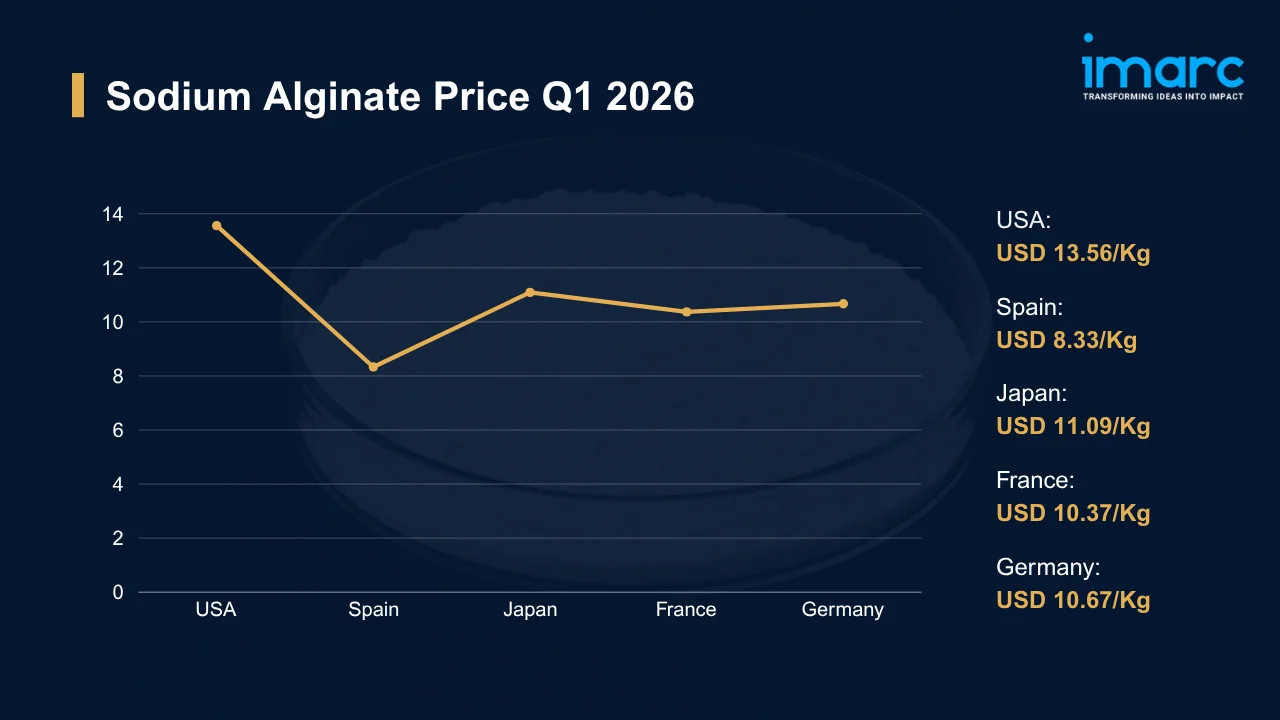
Summary:
Q1 2026 closed weak for sodium alginate, with every tracked market posting a quarter-on-quarter decline against Q4 levels. Ample brown seaweed harvests and slack offtake from food, pharma, and cosmetic formulators weighed on sodium alginate prices throughout. Across the tracked basket, declines ran between 1.1% and 2.3% QoQ. Compounding the picture, Al Jazeera reported that in early March 2026, the Israel–Iran–USA conflict knocked roughly one-fifth of global crude and natural gas supply offline, lifting forward energy and freight risk premiums going into the next cycle.
Sodium Alginate Price Q1 2026:
Regional prices (USD per KG) and QoQ changes Q1 2026 vs Q4 2025:
| Region | Price (USD/KG) | QoQ Change | Direction |
|---|---|---|---|
| USA | 13.56 | -1.2% | ↓ Decline |
| Spain | 8.33 | -2.3% | ↓ Decline |
| Japan | 11.09 | -2.0% | ↓ Decline |
| France | 10.37 | -1.3% | ↓ Decline |
| Germany | 10.67 | -1.1% | ↓ Decline |
To access real-time prices Request Sample
Kindly note: IMARC's pricing database tracks sodium alginate price movements across major global markets.
What Moved Prices:
USA:
- During Q1 2026, sodium alginate prices in the USA dipped to USD 13.56/KG. Procurement teams stayed defensive throughout the quarter. Soft pull from food processors and pharma formulators, paired with healthy brown seaweed inflows and lukewarm thickening-segment offtake, left feedstock pipelines well-supplied and starved the market of any pricing tailwind through end-March.
- Even as offers slid, the sodium alginate price chart traced a steady downward drift through Q1, with buyers leaning on structured distribution agreements over forward stocking and citing competitive Asian import availability that eroded domestic pricing power through end-March. Bulk-channel order books stayed conspicuously thin. Distributors trimmed warehouse stock without restocking.
Spain:
- In Q1 2026, sodium alginate prices in Spain slumped to USD 8.33/KG, the basket's steepest 2.3% drop. Demand fundamentals weakened across most end-uses. Subdued offtake from food manufacturers and textile-printing converters, combined with abundant brown seaweed availability at origin, weighed on negotiated levels and reinforced cautious purchasing across the regional buying base through quarter-end.
- Buyer leverage stayed firm right through the quarter. Imports from major brown seaweed origins flowed without delay, padding warehouse inventories. Substitution pressure from alternative gelling agents in dairy and confectionery applications, layered onto cautious converter sentiment among food manufacturers, tilted negotiations toward the buy-side and suppressed any meaningful price recovery before March-end.
Japan:
- During the first quarter of 2026, sodium alginate prices in Japan eased to USD 11.09/KG. Import-reliant feed flows held broadly stable through the quarter. Domestic consumption from specialty food-additive and pharmaceutical-excipient segments stayed range-bound, while Japanese procurement desks ran disciplined inventory programs and ducked bulk commitments that could otherwise have firmed up spot offers.
- Across major North Asian shipping lanes, stable freight conditions kept logistics from inflating landed costs. CIF feedstock pricing barely budged through the period. Procurement teams matched sourcing to confirmed downstream production schedules, and excess inventory across importer networks reinforced cautious buying among industrial consumers, capping any spot-market price firmness right through the quarter's close.
France:
- In Q1 2026, sodium alginate prices in France slipped to USD 10.37/KG. Pressure on offer levels stayed visible across the quarter. Balanced supply, layered onto moderated demand from food-processing and cosmetic-formulation industries, kept domestic production output steady through end-March, while consumption patterns lacked the momentum required to lift negotiated prices off their lows.
- Inventory build-up across European converter networks blunted any urgency to replenish stock. Buyers banked clear leverage in price talks. Substitution pressure from alternative thickening agents in cosmetic and dairy formulations further tempered alginate offtake, while energy-related production costs stabilized after the prior quarter's volatility and absorbed any incremental input cost inflation.
Germany:
- During Q1 2026, sodium alginate prices in Germany softened to USD 10.67/KG, the basket's mildest 1.1% slip. The market avoided sharper margin pain. Steady offtake from pharmaceutical, food-stabilization, and industrial thickening applications held imports in rough equilibrium with consumption, underpinning the gentle correction without exposing German producers to deeper compression on alginate margins.
- Across Mittelstand converter clusters, coordinated distributor networks kept procurement flows orderly. Buyer sentiment leaned conservative throughout the quarter. Tightening EU sustainability mandates and elevated power tariffs continued to shape producer cost structures, although stable Rhine corridor logistics absorbed minor disruptions without lifting landed pricing for German end-users in food, pharma, and industrial channels.
Sodium Alginate Price Outlook After the Israel–Iran–USA Conflict:
Rising Energy and Freight Costs Tightening Sodium Alginate Logistics: Spillover from the conflict will lift fuel and tanker costs across the corridors carrying brown seaweed feedstock and finished sodium alginate cargoes worldwide. On March 2, 2026, the benchmark VLCC freight rate for Middle East–China crude voyages hit an all-time high of USD 423,736 per day. Landed prices might absorb the squeeze.
Regional Demand Volatility and Forward Price Uncertainty for Sodium Alginate: Macro-level uncertainty around how long the conflict drags on will weigh on procurement confidence across food, pharmaceutical, and personal care end-uses globally. As buyers shorten forward-cover horizons, demand visibility might narrow and align purchases more tightly with confirmed downstream production schedules across European, North American, and Asian end-use segments over the coming months. Pricing direction will pivot on headline-risk swings.
Immediate Market Reaction:
As escalation reverberates through global energy and freight markets, sodium alginate sits exposed through shipping lanes that move brown seaweed feedstock from Asian and South American sources to European and North American processors. Across the regional landscape, the sodium alginate price index might respond unevenly. European buyers will absorb higher landed costs first given their reliance on imported feedstock. Asian processors face thinner direct exposure but absorb selective shipping surcharges. Market participants are already adjusting cargo nominations and rewriting clauses to capture elevated war-risk premiums on Persian Gulf transit routes.
Impact on Sodium Alginate Prices:
The conflict might trigger several key changes in the sodium alginate market:
- Feedstock and Energy Cost Transmission: Bunker fuel and electricity costs tied to the conflict will lift alginate production and shipping expenses across global markets. Energy-intensive processing stages, drying, purification, and packaging in particular, might absorb higher tariffs in Europe and East Asia, where producers face the steepest power exposure and run the thinnest margins to swallow input cost inflation. Smaller producers will struggle most acutely.
- Logistics and Trade Route Disruption: By rerouting around the Cape of Good Hope, vessels tack on transit days. Asia-Europe shipments for finished alginate cargoes will face delays of roughly 10 to 14 days, lifting landed costs for European converters that lean on Asian-origin material across food, pharmaceutical, and cosmetic end-use segments. On the buyer side, sourcing might tilt toward shorter-haul suppliers, swapping product variety for delivery certainty.
- Procurement Strategy Realignment: Buyers will overhaul how they write contracting terms. Across the buying base, procurement teams will pivot toward longer-tenor agreements with price reopener clauses and force majeure provisions, looking to insulate downstream operations from sudden input cost spikes through the volatile months ahead. Inventory builds might step up across food processing, pharmaceutical, and personal care end-users, reflecting caution about further escalation and the need to ring-fence production schedules.
Combined feedstock cost transmission, route-driven logistics inflation, and procurement realignment will reshape sodium alginate price formation across major consuming regions through the first half of the year and well into H2 2026. Cautious procurement will dominate buyer behavior across food, pharmaceutical, and industrial end-uses. Direction might pivot fast on headline flow.
Supply Chain Disruptions:
Sodium alginate supply chains lean on intercontinental shipping that moves brown seaweed feedstock from Asian and South American sources into European and North American processing hubs. Across the network, key shipments transit Indian Ocean and Mediterranean lanes. Freight rate volatility, port congestion, and geopolitical disruptions along these routes continue to influence delivery timelines and overall cost structures.
Producers will redirect freight bookings onto Cape of Good Hope routings, swapping longer transit times for delivery certainty across Asia-Europe and Asia-North America corridors that move finished sodium alginate cargoes through the period. At intermediate hubs in Singapore, Rotterdam, and Houston, inventory accumulation might absorb part of the disruption, while strategic stockpile drawdowns at major importers smooth the transition. Costs feed through to downstream converters quickly. Procurement teams will favor longer-dated arrangements with built-in price flexibility.
Global Market Overview:
Globally, the sodium alginate industry was valued at USD 338.86 Million in 2025. Market projections indicate steady growth, with the industry expected to reach USD 527.26 Million by 2034, with a compound annual growth rate (CAGR) of 5.04% during 2026-2034. Demand from food stabilization, pharmaceutical excipient, and cosmetic formulation segments will keep driving volume expansion through the period. The sodium alginate price trend reflects steady consumption, technological advances in extraction, and tightening sustainability standards across major producing regions through 2034.
Recent Highlights & Strategic Developments:
Recent strategic moves within the industry further illustrate evolving dynamics:
- In May 2025, scientists at Yalova University, writing in the ‘International Journal of Biological Macromolecules’, unveiled a sodium alginate-coated composite that pairs a zirconium-based porous carrier with hydroxyapatite for controlled tetracycline delivery. The optimized system achieved an adsorption capacity of 188.68 mg/g and provided sustained drug release of up to 78 hours in gastric fluid and 63 hours in intestinal fluid.
Sodium Alginate Price Forecast (2026):
Through Q2 and Q3 2026, sodium alginate prices will stay sensitive to conflict-driven energy costs and shifting downstream demand patterns across food, pharmaceutical, and cosmetic end uses globally, with the buyer base watching headlines closely throughout. Procurement caution might persist into mid-year. On the geopolitical front, any easing of risk will pry open a window for price stabilization.
Should hostilities intensify, sodium alginate prices will face renewed upward pressure as energy and logistics costs climb, risk premiums widen across global trade routes, and producers in conflict-exposed zones curtail output. Tighter availability will lift offer levels meaningfully. By contrast, a diplomatic resolution will ease freight and restore feedstock flows, letting prices drift back toward pre-conflict ranges. Across both scenarios, the sodium alginate price forecast will pivot on conflict trajectory.
Strategic Takeaways:
Looking ahead, the sodium alginate market is expected to expand modestly globally. Adequate seaweed feedstock availability, conflict-driven volatility in global energy and freight costs, and shifting demand from food, pharmaceutical, and cosmetic end-use applications will jointly shape pricing direction across major consuming regions through the coming forecast horizon and beyond.
To navigate this complex landscape, stakeholders should:
- Monitor Regional Price Differentials: Track quarter-over-quarter price variations across the USA, Spain, Japan, France, and Germany to spot procurement windows ahead of contract renewals. Comparing landed costs against contract benchmarks helps identify the optimal sourcing geography for each end-use segment.
- Monitor Geopolitical Risk Exposure: Track escalation dynamics in the current conflict and assess how shifts in hostility levels might affect sodium alginate pricing, feedstock availability, and logistics costs. Establish internal alert thresholds that trigger procurement or hedging action quickly.
- Diversify Feedstock Sources: Evaluate alternative seaweed suppliers beyond current vendor portfolios to mitigate concentration risk in brown algae sourcing channels. Securing secondary supply agreements that activate during primary source disruption helps protect production continuity across all formulation lines.
- Diversify Supply Chain Routes: Evaluate alternative sourcing geographies and shipping corridors carefully to reduce dependence on conflict-exposed trade lanes. Secondary supplier agreements and contingency freight arrangements will provide critical resilience if primary routes face disruption during peak demand periods.
- Track Feedstock and Energy Cost Inputs: Monitor brown seaweed harvest cycles, electricity tariffs, and bunker fuel benchmarks each month to anticipate cost-side movement in sodium alginate price per KG. Early signals consistently improve procurement timing and contract negotiation leverage across regions.
- Monitor Regulatory and Sustainability Mandates: Track evolving EU and US compliance standards covering food-grade and pharmaceutical-grade sodium alginate certification, including sustainability benchmarks and supplier audits. Early adaptation to tightening rules avoids reformulation costs and protects supplier relationships during regulatory shifts.
Subscription Plans & Customization:
IMARC offers flexible subscription models to suit varying needs:
- Monthly Updates — 12 deliverables/year
- Quarterly Updates — 4 deliverables/year
- Biannual Updates — 2 deliverables/year
Each includes detailed datasets (Excel + PDF) and post-report analyst support.

Get in Touch With Us
UNITED STATES
Phone: +1-201-971-6302
INDIA
Phone: +91-120-433-0800
UNITED KINGDOM
Phone: +44-753-714-6104
Email: [email protected]
Client Testimonials




.webp)




.webp)












