Track Inconel Prices with IMARC Group's Real-Time Reports, Price Charts, and Forecasts
04-Aug-2026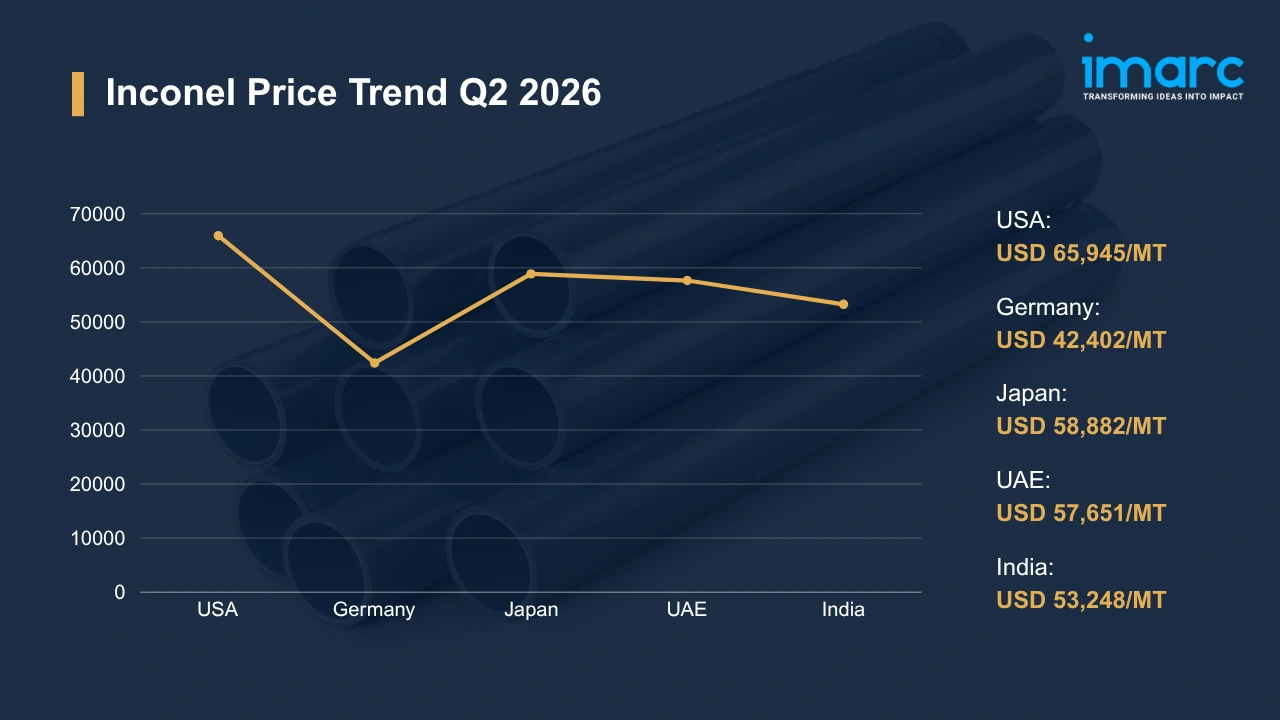
Inconel is a nickel-chromium superalloy family with exceptional thermal and corrosion resistance. Widely applied in aerospace, gas turbines, chemical processing, and nuclear systems, Inconel prices are shaped by upstream nickel ore availability, energy expenditure in alloy processing, procurement cycles tied to aerospace production programs, and freight logistics costs on major supply routes. High-temperature performance requirements sustain consistent demand across all primary end-use segments.
Global Market Overview:
Globally, the Inconel industry reached a volume of 24.87 Thousand Tons in 2025. Market projections indicate steady growth, with the industry expected to reach a volume of 32.64 Thousand Tons by 2034, with a compound annual growth rate (CAGR) of 3.07% during 2026-2034. Expanding aerospace fleets and growing gas turbine programs provide the foundation. Rising energy infrastructure investment across emerging markets further broadens the Inconel price trend into new application segments.
Inconel Price Trend Q2 2026:
Regional prices (USD per MT) and QoQ changes Q2 2026 vs Q1 2026:
| Region | Price (USD/MT) | QoQ Change | Direction |
|---|---|---|---|
| USA | 65,945 | +1.23% | ↑ |
| Germany | 42,402 | +2.13% | ↑ |
| Japan | 58,882 | +1.82% | ↑ |
| UAE | 57,651 | +1.88% | ↑ |
| India | 53,248 | +1.92% | ↑ |
To access real-time prices Request Sample
What Moved Prices:
USA:
- In Q2 2026, Inconel prices in the USA rose to USD 65,945/MT, reflecting firm procurement from aerospace and defense contract manufacturers responding to elevated build rates across commercial and military aircraft programs. Tightening alloy processor lead times and constrained domestic scrap availability further reinforced the upward price trajectory through the quarter.
- Supply rigidity across nickel-chromium alloy fabricators, combined with producers maintaining firm price floors on forward contracts, limited spot market flexibility. Across the quarter, the Inconel price chart reflected sustained buyer activity from Gulf Coast energy OEMs and precision component manufacturers maintaining steady order books.
Germany:
- During Q2 2026, Inconel prices in Germany advanced to USD 42,402/MT as industrial procurement from automotive engineering and chemical processing sectors remained consistent, supporting alloy demand. Limited import availability and cautious distributor replenishment strategies sustained upward pricing momentum through the quarter.
- Elevated energy processing costs for alloy producers, particularly in natural gas-intensive operations, translated into firmer supplier pricing stances on term contracts. With chemical reactor and heat exchanger fabricator demand holding steady, spot market supply narrowed and buyer negotiation leverage contracted through the period.
Japan:
- In Q2 2026, Inconel prices in Japan rose to USD 58,882/MT, supported by persistent procurement from precision manufacturing and turbine component producers maintaining consistent production schedules. Export demand for high-grade nickel alloys from regional aerospace OEMs and elevated domestic industrial activity underpinned the quarterly price advance.
- Reduced import inflows from Western alloy processors, combined with extended delivery lead times, tightened spot availability for industrial buyers. Against this backdrop, firm JPY hedging costs and rising manufacturing input expenses sustained producer pricing discipline, limiting any downside correction through the period.
UAE:
- In Q2 2026, Inconel prices in the UAE advanced to USD 57,651/MT as demand from energy infrastructure expansion programs, including downstream oil and gas facility upgrades, maintained consistent procurement volumes. Regional industrial fabrication projects and free-zone activity continued to support buyer offtake throughout the quarter.
- Heavy reliance on imported alloys, primarily from Asian and European processors, sustained elevated landed cost baselines across key distribution centers. With limited local alloy production capacity, supply flexibility remained constrained, enabling suppliers to maintain firm contract pricing and limiting buyers’ ability to negotiate discounts.
India:
- In Q2 2026, Inconel prices in India rose to USD 53,248/MT, supported by increasing demand from power generation equipment producers and heavy engineering fabricators progressing with domestic infrastructure initiatives. Rising import dependency and elevated alloy processing costs maintained upward pressure on delivered price levels through the period.
- Continued INR depreciation against major trading currencies amplified import cost burdens for high-grade nickel alloy procurement. At major port gateways including Chennai and Nhava Sheva, logistics costs remained elevated amid robust import volumes, limiting landed cost improvements despite moderating freight rates on select trade corridors.
Drivers Influencing the Market:
Several factors continue to shape Inconel pricing and market behavior:
- Aerospace and Defense Sector Demand: Aerospace OEMs and defense system integrators represent the primary demand pool for Inconel globally. According to IATA’s 2025 World Air Transport Statistics, Boeing 737 variants operated 10.8 Million flights in 2025, up 12.0% year-on-year, while Airbus A350 fleet activity rose sharply versus 2019 levels. These elevated utilization rates drive accelerated MRO and new turbine component demand, directly sustaining procurement volumes for high-performance nickel alloys.
- Upstream Nickel and Chromium Feedstock Costs: Nickel constitutes the dominant cost variable in Inconel manufacturing, with LME price movements directly influencing producer input economics. Per the USGS Mineral Commodity Summaries 2025, global nickel mine production fell to an estimated 3.7 Million Tons in 2024, with output in Australia and the Philippines declining 26% and 20% respectively. Persistent supply concentration in Indonesia continues to shape the Inconel price index across downstream alloy processors.
- Energy Expenditure in Alloy Processing: Across Inconel production facilities, high-temperature furnace operations, vacuum induction melting, and electroslag remelting processes consume substantial natural gas and electricity inputs. Production economics in North American and European centers are particularly sensitive to industrial gas tariff movements, squeezing processor margins during periods of utility rate escalation. When utility rate pressures persist, producers progressively translate elevated input costs into firmer contract and spot pricing.
- Ocean Freight and Logistics Economics: Inconel shipments move along Asia-Europe, Asia-North America, and intra-Asian trade corridors, with container rates on these lanes directly influencing delivered costs for regional buyers. At major alloy import hubs, extended transit times and port handling delays raise landed cost burdens, particularly for procurement teams dependent on just-in-time delivery schedules. To manage freight cost exposure, shipper consolidation strategies and flexible logistics contracting have become primary procurement tools.
- Environmental and Regulatory Compliance: Compliance-related expenditures shape Inconel producer cost structures. Across the EU, USA, and Japan, chemical handling, environmental discharge, and workplace safety regulations impose recurring documentation, testing, and waste management costs on processors, progressively filtering into market pricing as producers seek to maintain operating margins. Smaller processors bear proportionally higher compliance burdens given limited scale economies, with chemical registration requirements adding overhead at every supply chain tier.
- Trade Policy and Currency Dynamics: Currency exposure now shapes buyer strategy. Across major consuming markets, import tariffs on specialty alloys and nickel inputs create differential cost structures, compounding procurement burdens for industrial buyers dependent on offshore material sourcing. JPY and INR depreciation further amplify landed cost exposure for Japanese and Indian fabricators, with strategic export licensing controls in nickel-producing nations adding supply-side risk and limiting cost-mitigation options.
Recent Highlights & Strategic Developments:
Recent strategic moves within the industry further illustrate evolving dynamics:
- In June 2025, Aidro Srl, an Italian additive manufacturing specialist based in Taino, extended its DNV Additive Manufacturing facility certification to include Nickel Alloy 718, enabling expanded production of high-performance components. The certification broadened the company’s capabilities in aerospace, gas turbine, and high-temperature industrial manufacturing applications.
Outlook & Strategic Takeaways:
Looking ahead, the Inconel market is expected to maintain steady volume expansion through 2034, sustained by commercial aerospace fleet growth, increasing gas turbine installations across energy infrastructure programs, and broadening applications in chemical processing and nuclear engineering sectors globally. Nickel and chromium feedstock cost trajectories, combined with evolving additive manufacturing supply chains, will remain the pivotal drivers shaping the Inconel price forecast over the medium-term horizon.
To navigate this complex landscape, stakeholders should:
- Monitor Regional Price Differentials: Track quarterly Inconel price movements across the USA, Germany, Japan, UAE, and India to identify cost-saving procurement windows. Establish benchmarking protocols that compare landed costs against prevailing contract rates for optimal sourcing decisions.
- Assess Freight Market Developments: Monitor container shipping rate trends on Asia-Europe, Asia-North America, and Asia-Middle East trade corridors to anticipate landed cost movements. Negotiate logistics contracts incorporating rate adjustment provisions to buffer against spot market freight rate surges.
- Evaluate Downstream Demand Indicators: Track aerospace order backlogs, gas turbine installation pipelines, and chemical plant expansion programs across principal consuming regions. Correlate procurement planning cycles with end-use production schedules, benchmarking the Inconel price per MT in key import markets to optimize inventory positioning.
- Review Regulatory Compliance Expenditures: Audit compliance costs associated with nickel alloy handling, environmental discharge, and chemical registration obligations across relevant jurisdictions. Identify operational efficiencies that reduce regulatory burden without compromising safety and environmental performance standards.
- Strengthen Currency Exposure Management: Implement hedging strategies for procurement denominated in JPY, EUR, and INR to stabilize landed cost projections under volatile exchange rate conditions. Align treasury and procurement functions so that foreign currency coverage matches anticipated alloy import payment schedules.
- Explore Emerging Application Segments: Investigate commercial potential within hydrogen production equipment, advanced nuclear reactor components, and high-temperature chemical reactor lining as emerging segments for Inconel. Engage with OEM specification teams to assess alloy qualification requirements in sectors adjacent to traditional aerospace and energy end-markets.
Subscription Plans & Customization:
IMARC offers flexible subscription models to suit varying needs:
- Monthly Updates: 12 deliverables/year
- Quarterly Updates: 4 deliverables/year
- Biannual Updates: 2 deliverables/year
Each includes detailed datasets (Excel + PDF) and post-report analyst support.

Get in Touch With Us
UNITED STATES
Phone: +1-201-971-6302
INDIA
Phone: +91-120-433-0800
UNITED KINGDOM
Phone: +44-753-714-6104
Email: [email protected]
Client Testimonials




.webp)




.webp)












