
Nickel Nano Powder Market Size, Share, Trends and Forecast by Type, Application, and Region, 2026-2034
Nickel Nano Powder Market Size and Share:
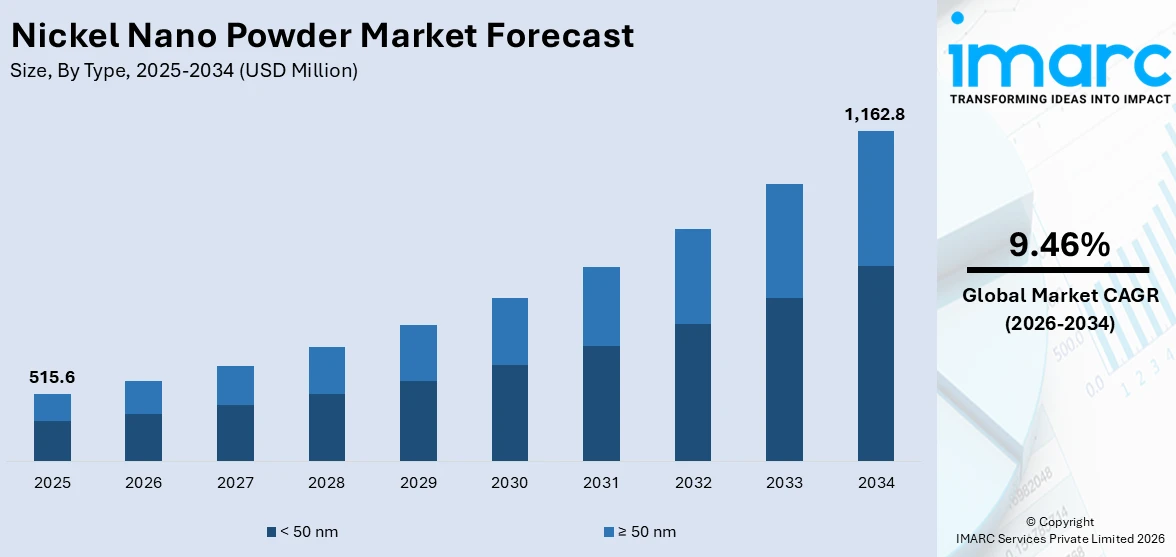
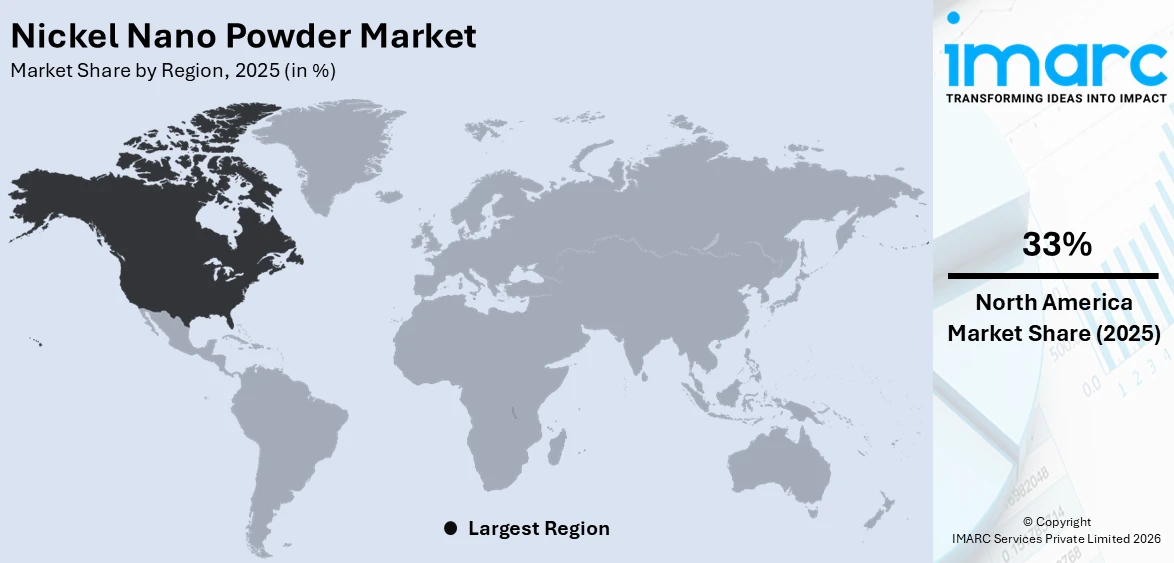
The global nickel nano powder market size was valued at USD 515.6 Million in 2025. Looking forward, IMARC Group estimates the market to reach USD 1,162.8 Million by 2034, exhibiting a CAGR of 9.46% from 2026-2034. North America currently dominates the market, holding a market share of 33% in 2025. The region benefits from a well-established research and development (R&D) infrastructure, significant government investments in nanotechnology, and strong demand from the electronics and energy storage sectors, along with the presence of key industry players supporting the nickel nano powder market share.
The expanding utilization of nickel nano powder across diverse end-use industries is a primary factor propelling the market growth. The material offers exceptional properties, including high surface area-to-volume ratio, superior catalytic activity, and excellent thermal and electrical conductivity, making it indispensable in electronics, chemical manufacturing, and energy applications. The growing adoption of nanotechnology in advanced coatings, paints, and composite materials for construction and infrastructure projects is further augmenting demand. Additionally, the surging requirement for sustainable energy storage solutions to support renewable energy integration and the electrification of transportation systems are offering a favorable nickel nano powder market outlook.
The United States has emerged as a major region in the nickel nano powder market owing to many factors. The country possesses a robust ecosystem of research institutions, universities, and private enterprises focused on nanotechnology innovation and commercialization. On March 5, 2024, the National Nanotechnology Initiative (NNI) released its additional document regarding the President's 2024 budget proposal. NNI reported that the President's budget proposal for 2024 requested an unprecedented USD 2.16 Billion, with a continued focus on foundational research that would drive new discoveries and boost funding for application-focused R&D to progress future technologies. The expanding electronics manufacturing sector, particularly the demand for multilayer ceramic capacitors (MLCCs) and advanced battery materials, is driving significant product uptake. The presence of leading nanomaterial suppliers and favorable regulatory frameworks supporting advanced material development continue to fuel the market expansion.
To get more information on this market Request Sample
Nickel Nano Powder Market Trends:
Surging Demand in Electronics Applications
The electronics industry represents a critical driver of nickel nano powder consumption, fueled by the escalating demand for miniaturized and high-performance electronic components. Nickel nanoparticles below 50nm demonstrate superior conductivity and thermal stability, making them essential for MLCCs, conductive inks, printed electronics, and flexible circuits. The proliferation of smartphones, tablets, and Internet of Things (IoT) devices is amplifying the requirement for advanced electronic components that rely on high-quality nickel nano powder. Moreover, the expansion of 5G telecommunications infrastructure is further intensifying demand for nickel-based nanomaterials in circuit fabrication. According to Nokia’s annual Mobile Broadband Index (MBiT) report, India’s 5G subscriber base is projected to increase 2.65 times, rising to 770 Million by 2028, up from 290 Million in 2024. Additionally, the push towards ultra-thin, lightweight, and energy-efficient electronic devices is reinforcing the need for nanoscale nickel materials that can deliver reliable electrical performance within compact component designs.
Rising Adoption in Energy Storage
The global transition towards renewable energy and sustainable power systems is among the major nickel nano powder market trends. As per IMARC Group, the global renewable energy market size was valued at USD 960.9 Billion in 2024 and is set to reach USD 1,818.42 Billion by 2033. The material's enhanced catalytic activity and electrochemical properties make it highly suitable for next-generation batteries, supercapacitors, and fuel cell technologies. The increasing deployment of grid-scale energy storage systems and the rapid expansion of electric vehicle (EV) production are creating substantial demand for advanced battery materials incorporating nickel nanoparticles. Additionally, ongoing research into nickel-based cathode materials for lithium-ion batteries is demonstrating enhanced energy density, improved cycle life, and reduced production costs, further strengthening the nickel nano powder market forecast.
Advancements in Production Technologies
Continuous innovations in nanoparticle synthesis techniques are transforming the nickel nano powder manufacturing landscape, enabling more efficient production while maintaining stringent quality standards. Advanced methods, including radio frequency plasma technology, chemical vapor deposition, sol-gel processes, and laser pyrolysis, are improving particle size control, purity levels, and surface chemistry customization. These technological improvements are reducing production costs while enhancing the performance characteristics of nickel nano powder across various applications. For instance, in October 2025, Tekna became the first company worldwide to receive NADCAP accreditation for metallic powder manufacturing under the newly developed Audit Criteria AC7143, establishing a global benchmark for quality and traceability. Furthermore, the development of scalable production methods is enabling manufacturers to meet the surging demand from the electronics, energy storage, and healthcare sectors while maintaining consistent product quality and particle size distribution, bolstering the overall nickel nano powder market growth.
Nickel Nano Powder Industry Segmentation:
IMARC Group provides an analysis of the key trends in each segment of the global nickel nano powder market, along with forecast at the global, regional, and country levels from 2026-2034. The market has been categorized based on type and application.

Analysis by Type:
- < 50 nm
- ≥ 50 nm
< 50 nm holds 60% of the market share. Nickel nanoparticles below 50 nanometers are preferred across a wide range of applications due to their significantly higher surface area-to-volume ratio, which enhances catalytic activity, reactivity, and dispersion in various formulations. These ultra-fine particles are especially well-suited for the production of sophisticated electronics, such as conductive inks and MLCC electrodes, owing to their exceptional thermal and electrical conductivity. Additionally, the segment is becoming more popular in energy storage applications, where the increased electrochemical characteristics lead to better battery performance. The growing need for high-purity nanomaterials in laboratory and research applications further solidifies this segment's dominance. Additionally, continuous advancements in surface modification and nanoparticle manufacturing methods are enhancing the stability and uniformity of <50 nm nickel powders, facilitating their broader use in high-precision commercial and research applications.
Analysis by Application:
Access the comprehensive market breakdown Request Sample
- Chemical Manufacturing
- Electronics
- Research and Lab
- Nuclear Energy
- Nanomaterials
- Others
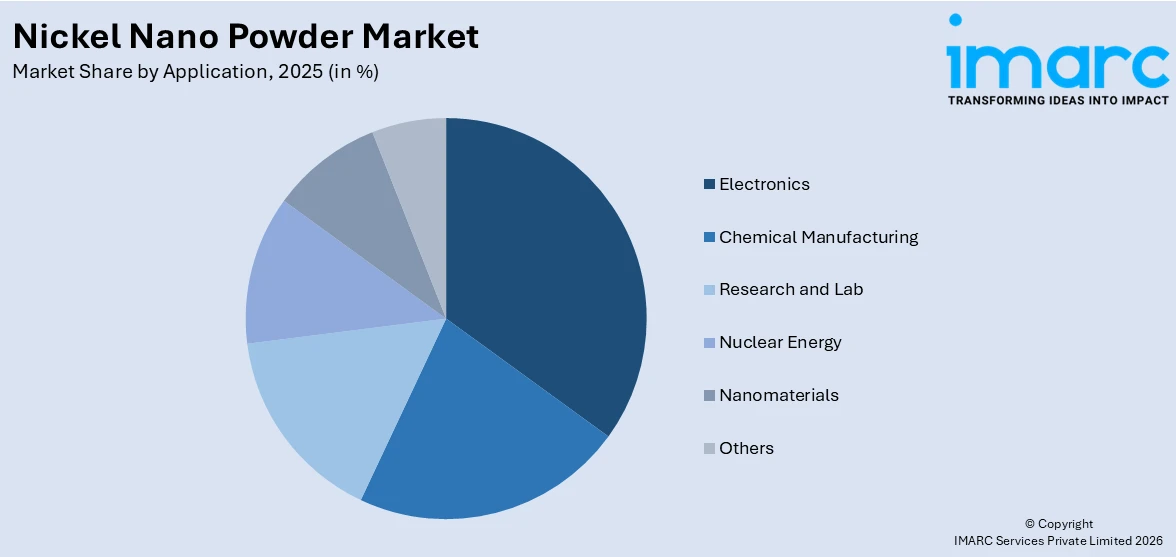
Electronics leads the market with a share of 25%. The electronics sector is the primary consumer of nickel nano powder, driven by the material's exceptional electrical conductivity, magnetic properties, and thermal stability. Nickel nanoparticles serve as critical components in the manufacture of MLCCs, which are essential in virtually all modern electronic devices. The rapid expansion of 5G telecommunications infrastructure, the proliferation of IoT, and the growing complexity of automotive electronics are further amplifying the demand for nickel-based nanomaterials. As per IMARC Group, the global IoT market size reached USD 1,022.6 Billion in 2024 and is set to attain USD 3,486.8 Billion by 2033. Additionally, the increasing adoption of nickel nanoparticles in magnetic storage devices, conductive films, and electromagnetic shielding applications is broadening the electronics segment's consumption base.
Regional Analysis:
To get more information on the regional analysis of this market Request Sample
- North America
- United States
- Canada
- Europe
- Germany
- France
- United Kingdom
- Italy
- Spain
- Others
- Asia Pacific
- China
- Japan
- India
- South Korea
- Australia
- Indonesia
- Others
- Latin America
- Brazil
- Mexico
- Others
- Middle East and Africa
North America, accounting for 33% of the share, enjoys the leading position in the market. The region's dominance is attributed to its well-established nanotechnology research infrastructure, substantial government investments in advanced materials development, and the presence of leading nanomaterial manufacturers. The strong demand from the electronics, aerospace, and energy storage sectors provides a robust consumption base for nickel nano powder. Furthermore, the growing emphasis on domestic supply chain resilience for critical minerals and advanced materials, coupled with favorable regulatory frameworks supporting nanotechnology adoption, continues to strengthen North America's position as the leading regional market for nickel nano powder. In addition, accelerating investments in renewable energy technologies and the rapid rollout of 5G networks are creating sustained demand for high-performance nickel nano powder across the region. North America is at the forefront of global 5G adoption, achieving 363 Million 5G connections by Q3 2025, which accounted for nearly 95% of the area's population.
Key Regional Takeaways:
United States Nickel Nano Powder Market Analysis
The United States represents the dominant force within the market, driven by its comprehensive research ecosystem, advanced manufacturing capabilities, and significant end-use demand. The country's robust electronics manufacturing sector, particularly the production of high-performance capacitors, sensors, and conductive materials, is a primary consumption driver. The growing investment in clean energy technologies and EV infrastructure is further amplifying demand for nickel-based nanomaterials in battery and energy storage applications. As per IEA, in the United States, in 2024, sales of electric cars increased by approximately 10% compared to 2023. Additionally, the United States benefits from a mature nanotechnology startup ecosystem and venture funding network that accelerates the commercialization of nickel nano powder across healthcare, electronics, and advanced manufacturing applications. The government's continued support through initiatives, combined with substantial private sector investment in nanomaterial research, positions the country as a key contributor to global market expansion. The increasing focus on developing domestic supply chains for critical nanomaterials also strengthens the long-term demand outlook.
Europe Nickel Nano Powder Market Analysis
Europe represents a significant market for nickel nano powder, supported by strong R&D capabilities, advanced industrial infrastructure, and growing demand from the electronics, automotive, and energy sectors. The region's focus on green technology initiatives and sustainability is driving adoption of nanomaterials in energy storage and environmental remediation applications. Major economies, including Germany, France, and the United Kingdom, are leading the adoption of nickel nanoparticles in automotive electronics, aerospace composites, and chemical catalysis. European research institutions and academic collaborations are contributing to the development of novel applications for nickel nano powder, particularly in biomedical devices and fuel cell technologies. The European Union's regulatory frameworks supporting nanotechnology development, combined with increasing industrial demand, continue to sustain the region's position. Additionally, the accelerating deployment of renewable energy systems and 5G infrastructure across Europe is expanding the use of nickel nano powder in advanced batteries, power electronics, and high-frequency communication components.
Asia-Pacific Nickel Nano Powder Market Analysis
Asia-Pacific represents a rapidly growing market for nickel nano powder, driven by robust industrialization, extensive electronics manufacturing capacity, and substantial investments in nanotechnology R&D. China, Japan, and South Korea are at the forefront, leveraging advanced manufacturing capabilities and strong focus on technological innovation. The region's growing EV production, expanding 5G infrastructure, and increasing adoption of advanced battery technologies are creating significant demand for high-quality nickel nano powder. Sales of EVs in India's premium segment increased by 66% year-over-year to 2,027 units in the initial five months of 2025, compared to 1,223 units during the corresponding timeframe in 2024, according to information from the VAHAN portal managed by the Ministry of Road Transport and Highways. The presence of key MLCC manufacturers in Japan and South Korea further reinforces regional demand.
Latin America Nickel Nano Powder Market Analysis
Latin America is emerging as a growing market for nickel nano powder, supported by increasing government investment in nanotechnology, expanding industrial sectors, and rising demand for advanced electronic components. Brazil leads regional adoption through strong research capabilities and the growing applications in environmental technology and energy storage. The expanding electronics manufacturing base and increasing cross-border collaborations are contributing to the steady development of nickel nano powder demand in the region.
Middle East and Africa Nickel Nano Powder Market Analysis
The Middle East and Africa region is witnessing gradual growth in nickel nano powder demand, driven by expanding industrial diversification programs, increasing investments in advanced materials, and growing adoption of nanotechnology across various sectors. The growing focus on renewable energy infrastructure, particularly solar energy projects incorporating nanomaterial-enhanced components, is creating emerging opportunities for nickel nano powder applications in the region. In December 2023, TotalEnergies announced that it was prepared to begin construction of a 216 megawatt solar facility with battery storage in South Africa, expected to be operational by 2025.
Competitive Landscape:
The competitive landscape of the global nickel nano powder market is characterized by a mix of established nanomaterial manufacturers and emerging technology-focused enterprises. Key market players are investing in R&D to enhance production efficiency, improve particle size control, and expand product portfolios to meet evolving application requirements. Strategic capacity expansions, partnerships with end-use industries, and vertical integration initiatives are prominent growth strategies being adopted by market participants. Companies are also focusing on developing proprietary synthesis technologies, such as radio frequency plasma and chemical vapor deposition, to achieve competitive differentiation through superior product quality and cost-effectiveness. Additionally, the pursuit of quality certifications and accreditations is gaining importance as manufacturers seek to meet stringent specifications for aerospace, defense, and high-performance electronics applications.
The report provides a comprehensive analysis of the competitive landscape in the nickel nano powder market with detailed profiles of all major companies, including:
- ACS Material LLC
- American Elements
- CVMR Corporation
- Guangzhou Hongwu Material Technology Co. Ltd.
- Nanografi Nano Technology
- Nanoshel LLC
- Nanostructured & Amorphous Materials Inc.
- Otto Chemie Pvt. Ltd.
- Parshwamani Metals
- Sisco Research Laboratories Pvt. Ltd
- Sky Spring Nanomaterials Inc.
- Tekna
Nickel Nano Powder Report Scope:
| Report Features | Details |
|---|---|
| Base Year of the Analysis | 2025 |
| Historical Period | 2020-2025 |
| Forecast Period | 2026-2034 |
| Units | Million USD |
| Scope of the Report | Exploration of Historical Trends and Market Outlook, Industry Catalysts and Challenges, Segment-Wise Historical and Predictive Market Assessment: ·
|
| Types Covered | < 50 nm, ≥ 50 nm |
| Applications Covered | Chemical Manufacturing, Electronics, Research and Lab, Nuclear Energy, Nanomaterials, Others |
| Regions Covered | North America, Europe, Asia Pacific, Latin America, Middle East and Africa |
| Countries Covered | United States, Canada, Germany, France, United Kingdom, Italy, Spain, China, Japan, India, South Korea, Australia, Indonesia, Brazil, Mexico |
| Companies Covered | ACS Material LLC, American Elements, CVMR Corporation, Guangzhou Hongwu Material Technology Co. Ltd., Nanografi Nano Technology, Nanoshel LLC, Nanostructured & Amorphous Materials Inc., Otto Chemie Pvt. Ltd., Parshwamani Metals, Sisco Research Laboratories Pvt. Ltd, Sky Spring Nanomaterials Inc., Tekna, etc. |
| Customization Scope | 10% Free Customization |
| Post-Sale Analyst Support | 10-12 Weeks |
| Delivery Format | PDF and Excel through Email (We can also provide the editable version of the report in PPT/Word format on special request) |
Key Benefits for Stakeholders:
- IMARC's report offers a comprehensive quantitative analysis of various market segments, historical and current market trends, market forecasts, and dynamics of the nickel nano powder market from 2020-2034.
- The research study provides the latest information on the market drivers, challenges, and opportunities in the global nickel nano powder market.
- The study maps the leading, as well as the fastest-growing, regional markets. It further enables stakeholders to identify the key country-level markets within each region.
- Porter's Five Forces analysis assists stakeholders in assessing the impact of new entrants, competitive rivalry, supplier power, buyer power, and the threat of substitution. It helps stakeholders to analyze the level of competition within the nickel nano powder industry and its attractiveness.
- Competitive landscape allows stakeholders to understand their competitive environment and provides an insight into the current positions of key players in the market.
Frequently Asked Questions About the Nickel Nano Powder Market Report
The nickel nano powder market was valued at USD 515.6 Million in 2025.
The nickel nano powder market is projected to exhibit a CAGR of 9.46% during 2026-2034, reaching a value of USD 1,162.8 Million by 2034.
The increasing demand for lightweight materials with high thermal and electrical conductivity, the growing adoption of nickel nano powder in electronics manufacturing, rising utilization in energy storage systems for batteries and supercapacitors, and continual advancements in nanoparticle synthesis technologies are among the key factors driving the market.
North America currently dominates the nickel nano powder market, accounting for a share of 33%. The region's leadership is supported by its advanced research infrastructure, significant government funding for nanotechnology initiatives, strong electronics manufacturing base, and the presence of key nanomaterial suppliers.
Some of the major players in the nickel nano powder market include ACS Material LLC, American Elements, CVMR Corporation, Guangzhou Hongwu Material Technology Co. Ltd., Nanografi Nano Technology, Nanoshel LLC, Nanostructured & Amorphous Materials Inc., Otto Chemie Pvt. Ltd., Parshwamani Metals, Sisco Research Laboratories Pvt. Ltd, Sky Spring Nanomaterials Inc., Tekna, etc.
Need more help?
- Speak to our experienced analysts for insights on the current market scenarios.
- Include additional segments and countries to customize the report as per your requirement.
- Gain an unparalleled competitive advantage in your domain by understanding how to utilize the report and positively impacting your operations and revenue.
- For further assistance, please connect with our analysts.
 Request Customization
 Speak to an Analyst
 Request Brochure
 Inquire Before Buying
Benefits of Customization
- Personalize this research
- Triangulate with your data
- Get data as per your format and definition
- Gain a deeper dive into a specific application, geography, customer, or competitor
- Any level of personalization
Get in Touch With Us
UNITED STATES
Phone: +1-201-971-6302
INDIA
Phone: +91-120-433-0800
UNITED KINGDOM
Phone: +44-753-714-6104
Email: [email protected]
Client Testimonials




.webp)




.webp)













Related Reports

Choose your plan
*Please note that the prices mentioned below are starting prices for each bundle type. Kindly contact our team for further details.*
Single User License
- 1 User License, Access on 2 Devices
- PDF Report + Excel Dataset (Password Protected)
- Lifetime Access
- No Printing Rights
- 10% Free Report Customization
- 10–12 Weeks of Analyst Support
Five User License
- Access for 5 Users, 2 Devices per User
- PDF Report + Excel Dataset (Password Protected)
- Lifetime Access
- Dedicated Account Manager
- 12–14 Weeks of Analyst Support
- No Printing Rights
- 15% Free Report Customization
- 25% Discount on Your Next Purchase
Corporate User License
- Unlimited User Access (Within Your Organization)
- PDF Report + Excel Dataset
- Lifetime Access
- Dedicated Account Manager
- 14–20 Weeks of Analyst Support
- No Printing Rights
- 20% Free Report Customization
- 30% Discount on Your Next Purchase
Essential Insights
What's included:
3 reports
- Lifetime Access
- PDF Reports
- Excel Datasets
- 2 Weeks of Free Analyst Support
- 2 User Licenses
- Access on 2 Devices
- Printing Rights
- Complimentary PowerPoint (PPT) Version
- Complimentary License Upgrade
Professional Access
What's included:
5 reports
- Lifetime Access
- PDF Reports
- Excel Datasets
- 8 Weeks of Free Analyst Support
- 2 User Licenses
- Access on 2 Devices
- Printing Rights
- Complimentary PowerPoint (PPT) Version
- Complimentary License Upgrade
Business Advantage
What's included:
8 reports
- Lifetime Access
- PDF Reports
- Excel Datasets
- 14 Weeks of Free Analyst Support
- 2 User Licenses
- Access on 2 Devices
- Printing Rights
- Complimentary PowerPoint (PPT) Version
- Complimentary License Upgrade
Enterprise Intelligence
What's included:
10 reports
- Lifetime Access
- PDF Reports
- Excel Datasets
- 20 Weeks of Free Analyst Support
- 2 User Licenses
- Access on 2 Devices
- Printing Rights
- Complimentary PowerPoint (PPT) Version
- Complimentary License Upgrade