
North America Potassium Permanganate Market Size, Share, Trends and Forecast by Application, Grade, and Country, 2026-2034
North America Potassium Permanganate Market Summary:
The North America potassium permanganate market size was valued at USD 262.525 Million in 2025 and is projected to reach USD 400.66 Million by 2034, growing at a compound annual growth rate of 4.81% from 2026-2034.
The North American market demonstrates sustained growth driven by industrial water treatment requirements, and environmental compliance mandates. Additionally, diversified chemical manufacturing applications is supporting the market growth. Apart from this, the increasing regulatory emphasis on water quality standards alongside growing aquaculture operations and metal processing activities continues to strengthen demand fundamentals across the region, thereby expanding the North America potassium permanganate market share.
Key Takeaways and Insights:
- By Application: Water treatment dominates the market with a share of 46% in 2025, propelled by municipal infrastructure modernization initiatives and stringent discharge regulations requiring advanced oxidation processes for contaminant removal and disinfection across industrial and municipal facilities.
- By Grade: Free flowing grade leads the market with a share of 80% in 2025, attributed to superior handling characteristics enabling automated dosing systems, reduced operational complexity in large-scale treatment plants, and enhanced safety profiles minimizing dust generation during storage and application.
- Key Players: The North American potassium permanganate market exhibits consolidated supplier dynamics with established chemical manufacturers maintaining significant distribution networks. Competition centers on product consistency, technical support capabilities, supply chain reliability, and value-added services addressing specific industrial requirements.
The market landscape reflects mature industrial adoption patterns where potassium permanganate serves as an essential oxidizing agent across water treatment, chemical synthesis, and metal processing sectors. Municipal water authorities increasingly deploy permanganate-based treatment systems to address emerging contaminants including taste and odor compounds, iron and manganese, and organic micropollutants. Simultaneously, industrial users leverage its versatility for applications ranging from wastewater treatment to electronics manufacturing, while pharmaceutical and aquaculture sectors rely on specialized grades meeting stringent purity requirements for biosecurity and therapeutic applications. The compound's distinctive purple coloration provides immediate visual confirmation of treatment dosing, enabling operators to quickly identify system malfunctions or underdosing conditions, a practical advantage demonstrated during the 2023 algal bloom event in Lake Erie where Toledo's water treatment facility utilized permanganate's color signature to optimize rapid response protocols, adjusting dosing rates in real-time to manage geosmin levels threatening municipal supply quality. This operational transparency combined with proven treatment effectiveness positions permanganate as a cornerstone technology within North American water infrastructure. Federal infrastructure investments create sustained momentum, with the Bipartisan Infrastructure Law channeling unprecedented capital toward aging water treatment facilities requiring oxidant upgrades. In October 2024, the Environmental Protection Agency announced $6.2 billion in Fiscal Year 2025 funding through the Clean Water and Drinking Water State Revolving Funds, directly supporting municipal utilities' procurement of advanced water treatment chemicals including potassium permanganate for iron, manganese, and PFAS mitigation programs.
North America Potassium Permanganate Market Trends:
Expansion of Hydroponic and Controlled Environment Agriculture
The proliferation of hydroponic farming operations across North America significantly elevates potassium permanganate consumption as growers implement rigorous nutrient solution sanitation protocols. These advanced agricultural systems require continuous pathogen control to prevent disease transmission through recirculating water networks, positioning potassium permanganate as an essential disinfectant that maintains plant health without introducing synthetic pesticide residues. The technology enables precise dosing for root zone sterilization while providing supplemental manganese and potassium nutrients that support optimal crop development. Commercial greenhouse operations increasingly adopt automated injection systems that deliver controlled permanganate concentrations, enhancing operational efficiency and crop yields across lettuce, tomato, and herb production facilities throughout the United States and Canada. In 2025, GrowSpan Greenhouse Structures revealed its finished Venlo greenhouse at its Dyersville, Iowa facilities. The organization conducted a ribbon-cutting event on Thursday, April 3rd, between 12:00 p.m. and 3:00 p.m. CST located at 1440 Field of Dreams Way. The Venlo greenhouse covers 25,000 square feet and aims to improve efficiency in large-scale commercial agriculture.
Federal Water Infrastructure Modernization Initiatives
Unprecedented federal investment in water infrastructure creates transformative market dynamics for oxidant suppliers serving municipal utilities across North America. The Bipartisan Infrastructure Law authorized a five-year, $50 billion allocation specifically targeting drinking water, wastewater, and stormwater systems requiring urgent capacity upgrades and contamination remediation. In October 2024, the Environmental Protection Agency announced $6.2 billion in Fiscal Year 2025 allocations through the State Revolving Funds, with mandated prioritization for disadvantaged communities facing acute water quality challenges. In 2025, the Department of the Interior announced an investment of nearly $82 million from President Biden’s Investing in America initiative to provide clean, safe drinking water to Tribal communities in the Western region. The funding will support 23 initiatives via a new program created under the Inflation Reduction Act, the largest climate investment in history. These capital flows directly finance pre-oxidation system installations, automated chemical feed equipment, and operator training programs that embed potassium permanganate deeper into treatment protocols, establishing long-term consumption patterns that outlast the initial infrastructure buildout period.
Industrial Process Optimization
Manufacturing sectors increasingly recognize permanganate's efficiency in specialized applications including electronics fabrication wastewater treatment, metal surface preparation, and chemical intermediate synthesis. Semiconductor manufacturers deploy permanganate solutions for removing photoresist residues and organic contaminants from silicon wafers, while metal finishing operations utilize it for manganese coating development and oxide layer formation. The compound's strong oxidizing properties enable rapid reaction kinetics reducing process cycle times, with automated dosing systems enhancing operational consistency and minimizing chemical waste generation across high-volume production environments. IMARC Group predicts that the North America semiconductor materials market is projected to attain USD 7,501.9 Million in 2024.
Market Outlook 2026-2034:
North American demand trajectories reflect infrastructure modernization cycles, environmental compliance acceleration, and industrial diversification supporting consistent market expansion through the forecast horizon. Water utilities face mounting pressure to address legacy distribution system challenges including iron and manganese leaching, while aging infrastructure replacement programs incorporate advanced treatment capabilities. The market generated a revenue of USD 262.525 Million in 2025 and is projected to reach a revenue of USD 400.66 Million by 2034, growing at a compound annual growth rate of 4.81% from 2026-2034. Industrial growth in food processing, beverage production, and specialty chemicals manufacturing generates incremental permanganate requirements, complemented by emerging applications in lithium battery recycling and rare earth element recovery.
North America Potassium Permanganate Market Report Segmentation:
|
Segment Category |
Leading Segment |
Market Share |
|
Application |
Water Treatment |
46% |
|
Grade |
Free Flowing Grade |
80% |
Application Insights:
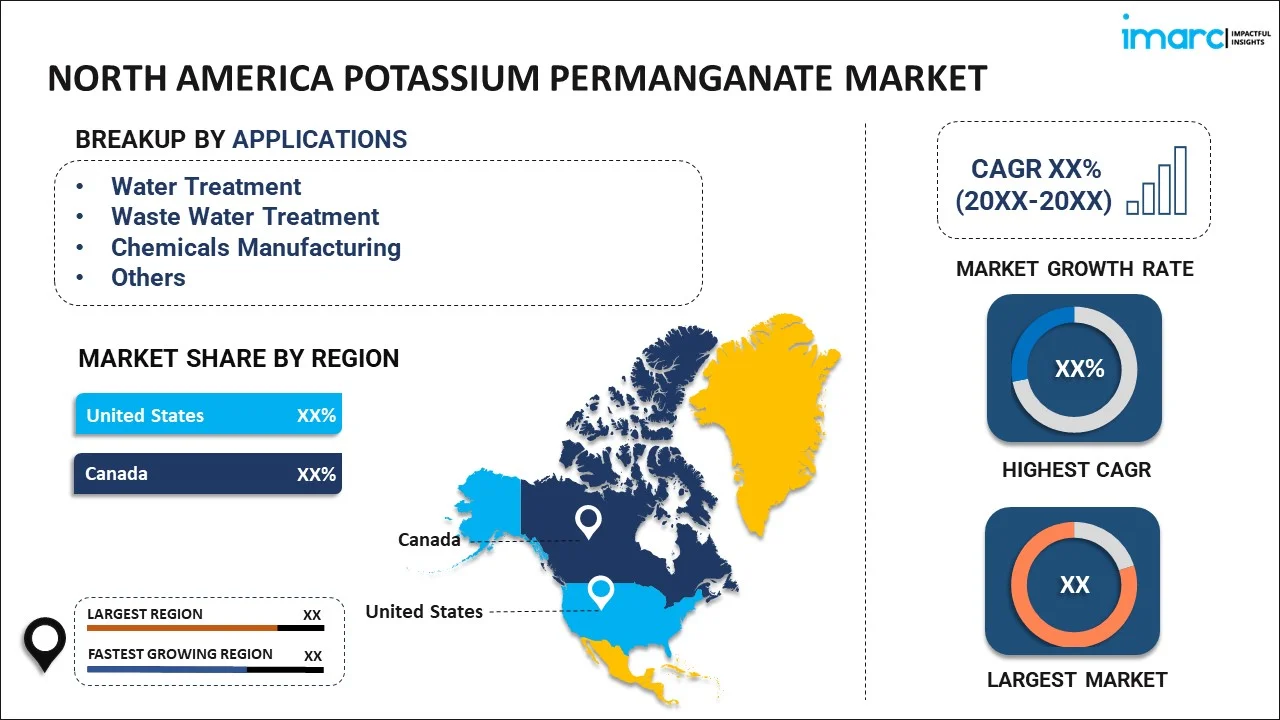
To get detailed segment analysis of this market, Request Sample
- Water Treatment
- Waste Water Treatment
- Chemicals Manufacturing
- Aquaculture
- Metal Processing
- Air and Gas Purification
- Others
Water treatment dominates with a market share of 46% of the total North America potassium permanganate market in 2025.
Municipal water treatment facilities represent the cornerstone of permanganate consumption across North America, with applications spanning raw water oxidation, taste and odor control, iron and manganese removal, and disinfection byproduct precursor reduction. Treatment plant operators value permanganate's dual functionality as both an oxidant and disinfectant, enabling streamlined chemical handling protocols while achieving multiple treatment objectives. The compound effectively oxidizes dissolved iron and manganese into precipitable forms removable through conventional filtration, simultaneously addressing geosmin and methylisoborneol compounds responsible for earthy-musty tastes affecting consumer acceptance.
Industrial water users deploy permanganate systems for cooling tower biofouling control, boiler feedwater conditioning, and process water purification addressing specific contaminant profiles. Oil and gas operations utilize permanganate injection for hydrogen sulfide mitigation in produced water, while food and beverage manufacturers implement it for equipment sanitization and ingredient processing applications. The segment's growth dynamics reflect escalating regulatory scrutiny of emerging contaminants including pharmaceuticals, personal care products, and per- and polyfluoroalkyl substances, with permanganate serving as a first-line oxidation technology capable of degrading complex organic molecules into more readily removable intermediates.
Grade Insights:
- Free Flowing Grade
- Technical Grade
- Pharmaceutical Grade
Free flowing grade leads with a share of 80% of the total North America potassium permanganate market in 2025.
Free flowing formulations incorporate anti-caking agents and moisture control additives ensuring consistent particle flowability essential for automated feeding systems, volumetric dispensing equipment, and bulk handling operations. Large-scale water treatment facilities prioritize this grade for its superior storage stability, reduced bridging tendency in hoppers, and predictable dissolution characteristics enabling precise dosing control. The formulation's engineered particle size distribution optimizes both flow properties and dissolution kinetics, with manufacturers tailoring specifications to accommodate diverse application equipment ranging from dry chemical feeders to solution preparation systems.
Industrial users appreciate free flowing grade permanganate's operational advantages including minimized dust generation during transfer operations, enhanced worker safety profiles, and extended shelf life under typical warehouse conditions. The grade's dominant market position reflects infrastructure requirements at municipal treatment plants and industrial facilities where material handling automation, occupational health considerations, and inventory management efficiency drive procurement decisions. Technical specifications addressing moisture content, particle size consistency, and flow index parameters enable seamless integration with existing chemical feed infrastructure, while bulk packaging options reduce per-unit costs for high-volume consumers maintaining strategic chemical reserves.
Country Insights:
- United States
- Canada
The United States dominates North American potassium permanganate consumption, driven by extensive municipal water infrastructure serving major metropolitan areas, substantial industrial manufacturing base spanning chemical processing and electronics sectors, and stringent Environmental Protection Agency regulations mandating advanced oxidation treatment. Large-scale aquaculture operations across southern states and comprehensive wastewater treatment networks support sustained demand growth trajectories.
Canada represents a significant regional market supported by mining sector applications requiring water treatment for mineral processing operations, expanding aquaculture industry along Atlantic and Pacific coastlines, and municipal utilities addressing iron-manganese removal in groundwater-dependent communities. Provincial environmental regulations governing industrial discharge standards and growing food processing sector operations drive incremental permanganate adoption across diverse end-use applications.
Market Dynamics:
Growth Drivers:
Why is the North America Potassium Permanganate Market Growing?
Infrastructure Modernization and Treatment Capacity Expansion
Aging municipal water systems across North America require comprehensive upgrades addressing distribution network deterioration, treatment plant capacity constraints, and evolving regulatory requirements. In 2026, two hundred and ten metres of aging water lines along Dobbin’s Lane, Sharpe’s Lane and Catty’s Lane in Upper Island Cove are being replaced to ensure continued service. In Carbonear, 303 metres of watermain and sewer systems along Garlands Lane are being replaced to provide reliable service to 13 existing homes and to support future residential growth. Utilities implement advanced oxidation processes incorporating permanganate to manage iron and manganese leaching from deteriorating pipes, control biological regrowth in distribution systems, and comply with revised surface water treatment regulations. Infrastructure investment programs funded through federal and state initiatives accelerate treatment plant expansions integrating permanganate feed systems, while population growth in metropolitan regions necessitates capacity additions at existing facilities. The compound's effectiveness in controlling seasonal algal blooms, managing taste and odor episodes, and reducing disinfection byproduct formation supports its specification in treatment train designs, with engineering firms increasingly recommending permanganate integration during facility planning phases to address multiple water quality objectives through single chemical addition points.
Environmental Compliance Intensification
Regulatory agencies continue tightening discharge limits for industrial wastewater and municipal effluents, compelling facilities to adopt advanced treatment technologies capable of meeting stringent contaminant removal requirements. In 2025, U.S. Environmental Protection Agency (EPA) Administrator Lee Zeldin revealed the agency's plan to revise the 2024 Effluent Limitations Guidelines (ELGs) for Steam Electric Power Generating Units. This initiative furthers the objectives of President Trump’s Unleashing American Energy Executive Order by guaranteeing the nation has dependable, cost-effective electricity while safeguarding our country’s water resources in accordance with the Clean Water Act. Permanganate oxidation effectively addresses recalcitrant organic compounds, reduces biochemical oxygen demand, and precipitates heavy metals facilitating compliance with National Pollutant Discharge Elimination System permits. Industries facing enforcement actions for permit violations implement permanganate treatment systems as proven compliance strategies, while proactive manufacturers integrate oxidation processes during facility expansions to ensure regulatory conformance. Environmental justice initiatives targeting water quality improvements in disadvantaged communities drive municipal investments in advanced treatment capabilities, with permanganate systems offering cost-effective solutions for small and medium-sized utilities addressing legacy contamination issues including manganese, iron, and taste-causing compounds affecting public confidence in drinking water safety.
Industrial Process Diversification
Manufacturing sectors expand permanganate utilization beyond traditional applications, discovering value in specialized processes including electronics fabrication, pharmaceutical intermediate synthesis, and advanced materials production. Semiconductor manufacturers employ permanganate for photoresist removal and wafer cleaning operations requiring precise oxidation control, while chemical producers utilize it for synthesizing complex organic intermediates and specialty compounds. Metal finishing operations adopt permanganate-based processes for surface preparation, oxide coating development, and electroplating pretreatment, with automotive and aerospace suppliers specifying permanganate treatments for critical component manufacturing. Emerging applications in battery recycling leverage permanganate's oxidizing power for lithium recovery from spent cells, while rare earth element processing operations employ it for selective oxidation and precipitation steps, expanding the compound's industrial footprint into high-value technology sectors driving incremental demand growth. In 2025, American Battery Technology Company, an integrated critical battery materials firm, and Call2Recycle, the leading consumer battery stewardship and collection initiative in the country, have announced a strategic alliance to promote the recycling of lithium-ion batteries for consumers throughout the United States. This partnership broadens ABTC’s business approach from mainly business-to-business activities to encompass a direct-to-consumer recycling avenue, fostering a stronger circular economy for critical battery metals.
Market Restraints:
What Challenges the North America Potassium Permanganate Market is Facing?
Alternative Oxidation Technology Competition
Advanced oxidation processes including ozone generation, ultraviolet irradiation combined with hydrogen peroxide, and electrochemical oxidation offer competitive treatment alternatives addressing similar water quality objectives. Facilities evaluating treatment options weigh permanganate against alternatives based on contaminant profiles, operational complexity, energy consumption, and lifecycle costs. Ozone systems provide strong oxidation potential without chemical storage requirements, while UV-based technologies eliminate residual concerns associated with chemical additions. Technology selection depends on site-specific factors including source water characteristics, treatment goals, operational expertise, and capital budget constraints, with some facilities choosing alternative approaches over permanganate despite its proven effectiveness and operational simplicity.
Supply Chain Concentration and Logistics Constraints
North American permanganate supply depends on limited domestic production capacity supplemented by imports from global manufacturers, creating potential vulnerability to supply disruptions, transportation delays, and price volatility. Bulk chemical logistics require specialized handling equipment, hazardous materials transportation compliance, and inventory management capabilities that smaller utilities and industrial users may struggle to maintain. Geographic distance from production facilities to end-use locations increases freight costs, particularly for remote communities and industrial sites lacking rail access, while regulatory requirements governing oxidizer transportation impose additional compliance burdens. Supply reliability concerns prompt some users to maintain larger safety stocks increasing working capital requirements, while others explore alternative chemistries offering more diversified supplier options and simplified logistics profiles.
Handling Safety and Regulatory Requirements
Permanganate's strong oxidizing properties necessitate stringent handling protocols, specialized storage infrastructure, and comprehensive worker training programs addressing potential exposure risks and reactivity hazards. Facilities must implement engineering controls preventing incompatible material contact, establish emergency response procedures for spill containment, and maintain material safety documentation meeting occupational health regulations. Smaller operations lacking dedicated environmental health and safety resources may perceive permanganate handling requirements as operational barriers, particularly when alternative technologies offer simpler implementation profiles. Insurance considerations, liability concerns, and community opposition to hazardous chemical storage influence procurement decisions, with some municipalities favoring treatment approaches minimizing chemical inventory despite potentially higher operating costs or reduced treatment effectiveness for specific contaminant removal applications.
Competitive Landscape:
The North American potassium permanganate market demonstrates concentrated supplier dynamics where established chemical manufacturers leverage vertical integration, distribution network breadth, and technical service capabilities to maintain market positions. Competition emphasizes product quality consistency, regulatory compliance documentation, and supply reliability meeting customer operational requirements across municipal, industrial, and specialty application segments. Suppliers differentiate through value-added services including water treatment consultation, dosing system optimization, and regulatory compliance support helping customers maximize permanganate effectiveness while minimizing operational costs. Market participants invest in logistics infrastructure enabling efficient bulk delivery, maintain strategic inventory locations reducing lead times, and develop application-specific formulations addressing unique customer requirements. The competitive environment favors suppliers demonstrating long-term supply reliability, technical expertise supporting diverse applications, and flexible commercial terms accommodating varying customer procurement preferences and budget cycles.
North America Potassium Permanganate Market Report Coverage:
|
Report Features |
Details |
|
Base Year of the Analysis |
2025 |
|
Historical Period |
2020-2025 |
|
Forecast Period |
2026-2034 |
|
Units |
Million USD |
|
Scope of the Report |
Exploration of Historical Trends and Market Outlook, Industry Catalysts and Challenges, Segment-Wise Historical and Future Market Assessment:
|
|
Applications Covered |
Water Treatment, Waste Water Treatment, Chemicals Manufacturing, Aquaculture, Metal Processing, Air and Gas Purification, Others |
|
Grades Covered |
Free Flowing Grade, Technical Grade, Pharmaceutical Grade |
|
Countries Covered |
United States, Canada |
|
Customization Scope |
10% Free Customization |
|
Post-Sale Analyst Support |
10-12 Weeks |
|
Delivery Format |
PDF and Excel through Email (We can also provide the editable version of the report in PPT/Word format on special request) |
Frequently Asked Questions About the North America Potassium Permanganate Market Report
The North America potassium permanganate market size was valued at USD 262.525 Million in 2025.
The North America potassium permanganate market is expected to grow at a compound annual growth rate of 4.81% from 2026-2034 to reach USD 400.66 Million by 2034.
Water treatment dominated the market with a 46% share in 2025, driven by municipal infrastructure modernization, regulatory compliance requirements, and growing demand for advanced oxidation processes addressing emerging contaminants, taste and odor control, and iron-manganese removal across drinking water and industrial applications.
Key factors driving the North America potassium permanganate market include infrastructure modernization initiatives upgrading aging water treatment systems, intensifying environmental compliance mandates requiring advanced oxidation capabilities, industrial process diversification expanding applications across electronics manufacturing and specialty chemical production, and growing aquaculture biosecurity requirements.
Major challenges include competition from alternative oxidation technologies offering comparable treatment effectiveness, supply chain concentration creating potential vulnerability to disruptions and price volatility, handling safety requirements necessitating specialized infrastructure and worker training, regulatory compliance burdens associated with oxidizer transportation and storage, and operational complexity concerns among smaller facilities lacking dedicated technical resources for permanganate system management.
Need more help?
- Speak to our experienced analysts for insights on the current market scenarios.
- Include additional segments and countries to customize the report as per your requirement.
- Gain an unparalleled competitive advantage in your domain by understanding how to utilize the report and positively impacting your operations and revenue.
- For further assistance, please connect with our analysts.
 Request Customization
 Speak to an Analyst
 Request Brochure
 Inquire Before Buying
Benefits of Customization
- Personalize this research
- Triangulate with your data
- Get data as per your format and definition
- Gain a deeper dive into a specific application, geography, customer, or competitor
- Any level of personalization
Get in Touch With Us
UNITED STATES
Phone: +1-201-971-6302
INDIA
Phone: +91-120-433-0800
UNITED KINGDOM
Phone: +44-753-714-6104
Email: [email protected]
Client Testimonials




.webp)




.webp)













Related Reports

Choose your plan
*Please note that the prices mentioned below are starting prices for each bundle type. Kindly contact our team for further details.*
Single User License
- 1 User License, Access on 2 Devices
- PDF Report + Excel Dataset (Password Protected)
- Lifetime Access
- No Printing Rights
- 10% Free Report Customization
- 10–12 Weeks of Analyst Support
Five User License
- Access for 5 Users, 2 Devices per User
- PDF Report + Excel Dataset (Password Protected)
- Lifetime Access
- Dedicated Account Manager
- 12–14 Weeks of Analyst Support
- No Printing Rights
- 15% Free Report Customization
- 25% Discount on Your Next Purchase
Corporate User License
- Unlimited User Access (Within Your Organization)
- PDF Report + Excel Dataset
- Lifetime Access
- Dedicated Account Manager
- 14–20 Weeks of Analyst Support
- No Printing Rights
- 20% Free Report Customization
- 30% Discount on Your Next Purchase
Essential Insights
What's included:
3 reports
- Lifetime Access
- PDF Reports
- Excel Datasets
- 2 Weeks of Free Analyst Support
- 2 User Licenses
- Access on 2 Devices
- Printing Rights
- Complimentary PowerPoint (PPT) Version
- Complimentary License Upgrade
Professional Access
What's included:
5 reports
- Lifetime Access
- PDF Reports
- Excel Datasets
- 8 Weeks of Free Analyst Support
- 2 User Licenses
- Access on 2 Devices
- Printing Rights
- Complimentary PowerPoint (PPT) Version
- Complimentary License Upgrade
Business Advantage
What's included:
8 reports
- Lifetime Access
- PDF Reports
- Excel Datasets
- 14 Weeks of Free Analyst Support
- 2 User Licenses
- Access on 2 Devices
- Printing Rights
- Complimentary PowerPoint (PPT) Version
- Complimentary License Upgrade
Enterprise Intelligence
What's included:
10 reports
- Lifetime Access
- PDF Reports
- Excel Datasets
- 20 Weeks of Free Analyst Support
- 2 User Licenses
- Access on 2 Devices
- Printing Rights
- Complimentary PowerPoint (PPT) Version
- Complimentary License Upgrade