
Oman E-Commerce Market Size, Share, Trends and Forecast by Type, Transaction, and Region, 2026-2034
Oman E-Commerce Market Summary:
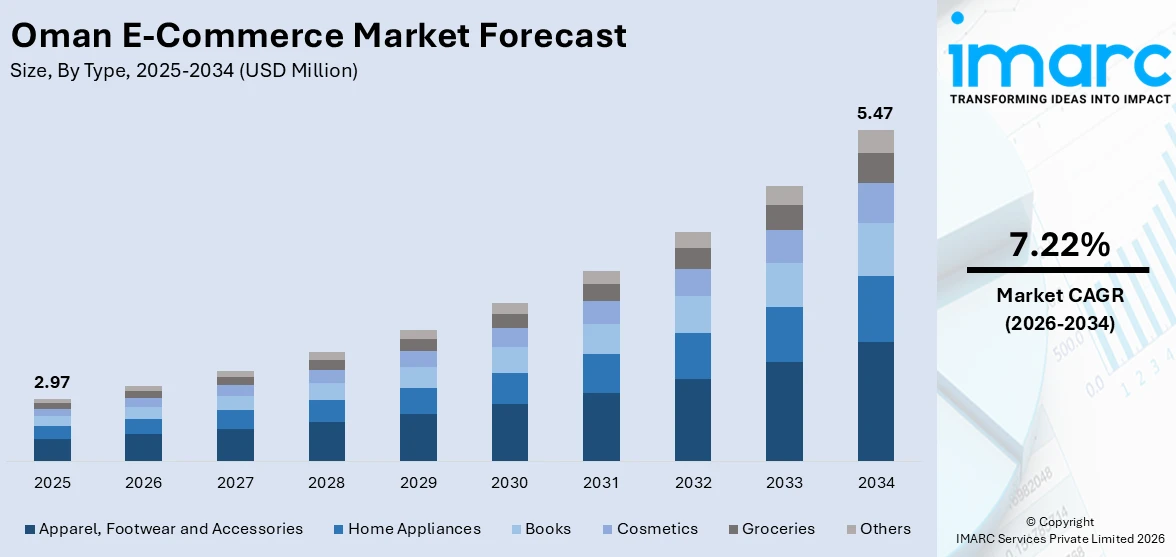
The Oman e-commerce market size was valued at USD 2.97 Million in 2025 and is projected to reach USD 5.47 Million by 2034, growing at a compound annual growth rate of 7.22% from 2026-2034.
The Oman e-commerce market is experiencing rapid expansion driven by rising digital adoption, increasing smartphone penetration, and supportive government initiatives under the Vision 2040 framework. A young, tech-savvy population is shifting purchasing habits toward online platforms, accelerating demand for fashion, groceries, and consumer electronics. Expanding digital payment infrastructure and improving logistics capabilities are further strengthening the online retail ecosystem, positioning Oman as an emerging e-commerce hub within the GCC region.
Key Takeaways and Insights:
- By Type: Apparel, footwear and accessories dominate the market with a share of 28% in 2025, driven by growing consumer preference for browsing diverse styles and accessing global fashion trends through convenient online platforms. The proliferation of regional and international fashion e-retailers is further strengthening this segment.
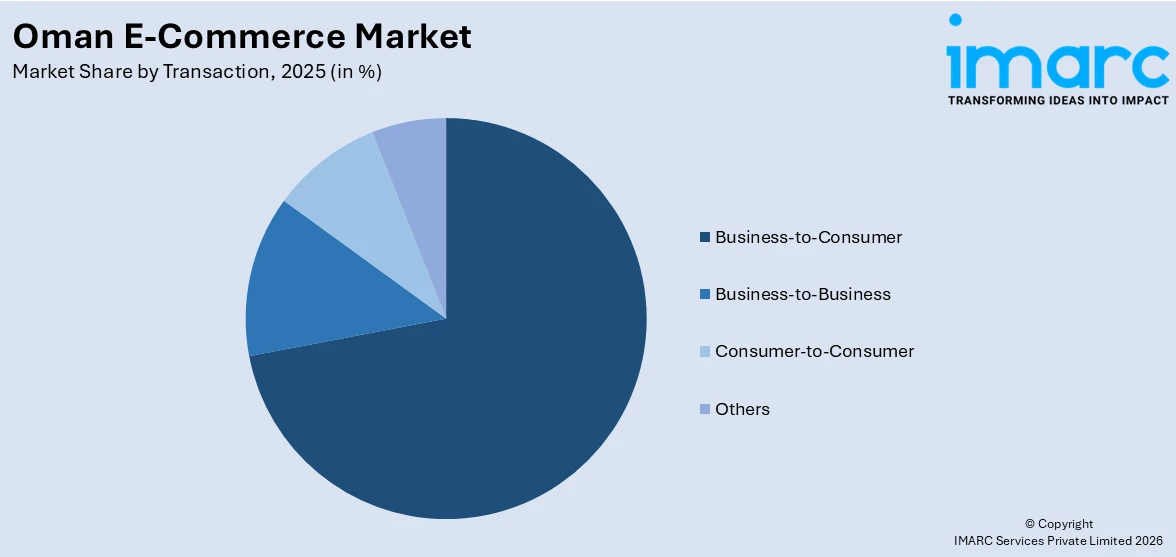
- By Transaction: Business-to-consumer leads the market with a share of 72% in 2025, supported by mature online retail operations, expanding on-demand food delivery services, and increasing consumer confidence in digital transactions across urban centers.
- By Region: Muscat represents the largest region with 46% share in 2025, driven by superior digital infrastructure, high population density, robust logistics networks, and concentrated retail presence that enable same day fulfillment and an enhanced online shopping experience.
- Key Players: Key players drive the Oman e-commerce market by expanding product portfolios, enhancing logistics capabilities, strengthening digital payment integration, and leveraging strategic partnerships. Their investments in technology, marketing, and fulfillment infrastructure accelerate adoption and ensure consistent product availability across diverse consumer segments.
To get more information on this market Request Sample
The Oman e-commerce industry is moving forward as the government, the private sector, and consumers in Oman together recognize the potential of e-commerce as a means to achieve economic diversification and convenience. The National Digital Economy Program of Vision 2040 is accelerating the process as it aims to simplify business licensing, develop digital payment systems, and improve logistics infrastructure. The launch of the e-Payment Gateway of the Central Bank of Oman is further simplifying transactions and increasing consumer confidence in online payments. Mobile commerce is also gaining popularity as the adoption of smartphones is increasing, especially among the younger generation who are increasingly preferring app-based online shopping experiences. The increasing number of social commerce platforms, cross-border Oman e-commerce trade with the GCC and Asian countries, and the entry of international e-commerce platforms are together increasing product offerings and competition, resulting in continuous growth of the Oman e-commerce market share.
Oman E-Commerce Market Trends:
Surge in Mobile-First Shopping Behavior
Oman is witnessing a pronounced shift toward mobile-based online shopping as smartphone penetration continues to deepen across the population. Consumers increasingly prefer browsing and purchasing through mobile applications, with devices accounting for a dominant share of e-commerce transactions. For instance, Oman recorded approximately 7.06 million cellular mobile connections at the start of 2024, equivalent to over 150.8% of the total population, according to industry report. This widespread connectivity is enabling real-time product discovery, seamless payment processing, and accelerating Oman e-commerce market growth.
Expansion of Social Commerce Channels
Social media platforms are increasingly serving as primary discovery and sales channels for e-commerce in Oman, particularly among small and medium enterprises. Businesses leverage influencer marketing, live shopping features, and community-driven engagement to promote products directly to consumers. For example, Oman had approximately 3.29 million social media users in January 2025, representing about 60.9% of the total population. This growing social media ecosystem is reshaping how consumers discover brands and make purchasing decisions, blurring the boundaries between social interaction and online retail.
Growth of Cross-Border E-Commerce
Cross-border online shopping is gaining significant traction in Oman as consumers increasingly access global platforms offering wider product variety at competitive prices. Chinese platforms, GCC-based marketplaces, and international fashion retailers are expanding their reach into the Omani market. For instance, Asyad Express reported an 81% increase in volume growth of Amazon operations in Oman in 2024, reflecting surging demand for cross-border deliveries. Improved customs digitization and bonded warehousing near Sohar and Salalah free zones are facilitating faster clearance and delivery times.
Market Outlook 2026-2034:
The Oman e-commerce industry is set to grow from strength to strength, thanks to the continuous digital transformation efforts, increased mobile and internet penetration, and the rising demand for convenience among Oman’s consumers. Government-backed projects such as Vision 2040’s National Digital Economy Program and the implementation of the Central Bank of Oman’s e-Payment Gateway are ensuring that the e-commerce industry has an enabling environment. The development of logistics infrastructure, such as last-mile delivery solutions and fulfillment centers, is expected to enhance the reliability of services and cut down delivery times. The rising number of cross-border transactions, the adoption of social commerce, and the entry of international e-commerce players are expected to increase competition, product offerings, and service standards, which will collectively boost revenue streams and ensure a mature e-commerce industry in the Sultanate. The market generated a revenue of USD 2.97 Million in 2025 and is projected to reach a revenue of USD 5.47 Million by 2034, growing at a compound annual growth rate of 7.22% from 2026-2034.
Oman E-Commerce Market Report Segmentation:
|
Segment Category |
Leading Segment |
Market Share |
|
Type |
Apparel, Footwear and Accessories |
28% |
|
Transaction |
Business-to-Consumer |
72% |
|
Region |
Muscat |
46% |
Type Insights:
- Home Appliances
- Apparel, Footwear and Accessories
- Books
- Cosmetics
- Groceries
- Others
Apparel, footwear and accessories dominate with a market share of 28% of the total Oman e-commerce market in 2025.
The clothing, footwear, and accessories category is at the forefront of the Oman e-commerce market, due to the rising interest in the convenience of viewing various styles and accessing global fashion trends through online platforms. The rise of regional and international fashion online retailers has led to the expansion of product offerings and the emergence of competitive pricing. The rising interest in modest fashion, athleisure wear, and branded accessories also supports this category, as consumers increasingly show interest in online shopping experiences that provide a comprehensive variety of products, easy navigation, and home delivery across the Sultanate.
The category is supported by the rising use of smartphones for shopping, regular promotional activities, and the emergence of buy-now-pay-later options that make purchasing easier. Social influencers also play a critical role in influencing fashion decisions and directing traffic to online shopping platforms. Improved return policies, various sizes, and online shopping experiences also continue to build consumer confidence in the online purchase of fashion products. Rising interest in seasonal collections, limited-edition collaborations, and personalized fashion advice is also accelerating the online consumption of fashion products across various demographics.
Transaction Insights:
Access the comprehensive market breakdown Request Sample
- Business-to-Consumer
- Business-to-Business
- Consumer-to-Consumer
- Others
Business-to-consumer leads with a share of 72% of the total Oman e-commerce market in 2025.
The business-to-consumer segment holds the largest market share in the Oman e-commerce industry, due to the mature online shopping experience, the rising demand for on-demand food and grocery delivery services, and the increasing adoption of digital payments. The demand for convenience, competitive pricing, and a wide range of products in fashion, electronics, and everyday items drives the dominance of the business-to-consumer segment. The increasing number of contactless payment options and mobile wallet services is improving the online checkout experience, making it easier and encouraging more purchases online in the Sultanate.
The business-to-consumer segment is also driven by the increasing use of aggressive marketing campaigns by global and local e-commerce platforms, such as personalized recommendations, loyalty rewards, and flash sales. The quick-commerce model with fast delivery options is gaining popularity in the major cities, changing the way consumers expect delivery speed and reliability. The government's regulatory environment with enhanced consumer protection and the formalization of e-commerce licensing procedures is increasing trust in online transactions, encouraging first-time buyers, and reinforcing repeat business behavior in various product categories.
Regional Insights:
- Muscat
- Al Batinah
- Al-Sharqiyah
- Al-Dakhiliyah
- Dhofar
- Others
Muscat exhibits a clear dominance with a 46% share of the total Oman e-commerce market in 2025.
Muscat leads the Oman e-commerce market owing to its superior digital infrastructure, high population density, and concentrated retail and logistics presence that enable efficient same-day fulfilment. The governorate benefits from robust fiber connectivity, a high concentration of fulfilment centers, and a young, digitally engaged population that actively embraces online shopping. The presence of advanced logistics facilities at Muscat International Airport significantly enhances last-mile delivery capacity, supporting rapid order processing and reliable e-commerce operations across the capital region.
The region's e-commerce ecosystem is further strengthened by the presence of cloud kitchens, dark stores, and omnichannel retail operations that optimize delivery speed and product accessibility. Growing investment in warehousing infrastructure and dedicated e-fulfilment centers is enabling seamless order management and faster dispatch times. Rising consumer confidence in digital payments, coupled with expanding product availability across multiple platforms, reinforces Muscat's position as the primary hub for online commerce, attracting both domestic and international e-commerce operators seeking concentrated market access.
Market Dynamics:
Growth Drivers:
Why is the Oman E-Commerce Market Growing?
Government-Led Digital Transformation Initiatives
The Omani government’s commitment to digital transformation under Vision 2040 is a foundational driver of e-commerce growth in the Sultanate. Executive programs covering e-commerce, digital government, and artificial intelligence are streamlining business licensing, expanding digital payment systems, and strengthening regulatory frameworks. These reforms are creating a more enabling environment for e-commerce enterprises and consumers alike. For instance, the National E-Commerce Plan has reached 75% completion, achieving full progress in e-procurement, legal frameworks, and business facilitation. The launch of the Maroof Oman platform by the Ministry of Commerce, Industry and Investment Promotion is formalizing local e-stores, enhancing consumer trust, and regulating online transactions. Such comprehensive policy interventions are laying the groundwork for sustained digital retail expansion.
Rising Internet and Smartphone Penetration
Oman’s high internet and smartphone penetration rates are enabling broad-based access to e-commerce platforms across urban and semi-urban areas. The widespread availability of 4G and 5G networks enhances online shopping experiences, allowing consumers to browse and purchase products seamlessly from mobile devices. The country’s young and digitally engaged population is particularly receptive to online retail, driving transaction volumes higher. For instance, there were approximately 4.58 million internet users in Oman at the start of 2024, with internet penetration standing at 97.8% of the total population, according to industry report. This near-universal connectivity creates a vast addressable market for e-commerce businesses. Combined with rising disposable incomes and shifting consumer preferences toward convenience, the expanding digital user base is fueling sustained growth in online shopping activity across all product categories.
Expansion of Digital Payment Infrastructure
The development and deployment of secure, user-friendly digital payment solutions is significantly lowering barriers to e-commerce adoption in Oman. The Central Bank of Oman’s e-Payment Gateway is standardizing transaction processing across platforms, reducing checkout abandonment, and enabling auto-settlement for cross-border orders. Mobile wallets, QR-code payments, and near-field communication-based transactions are gaining rapid acceptance among younger consumers. For instance, Thawani Technologies, which received the Central Bank of Oman’s first fintech license, has been instrumental in advancing mobile payment solutions tailored to the local market. The introduction of Apple Pay and Samsung Pay in Oman in 2024 further expanded contactless payment options, reducing reliance on cash-on-delivery and accelerating the shift toward seamless digital transactions. These developments are building consumer confidence and encouraging repeat purchases across online platforms.
Market Restraints:
What Challenges the Oman E-Commerce Market is Facing?
Limited Logistics Infrastructure in Remote Areas
Despite ongoing improvements, last-mile delivery infrastructure remains underdeveloped in several interior governorates and rural areas across Oman. Elevated delivery costs, longer transit times, and limited courier coverage in regions such as Al-Dakhiliyah, Al-Sharqiyah, and Al Wusta discourage potential online shoppers and increase operational costs for e-commerce businesses. The cost gap between urban and rural delivery constrains the expansion of addressable markets beyond major population centers, limiting the full realization of the country’s e-commerce potential.
Online Payment Security and Trust Concerns
Consumer concerns regarding online payment security, data privacy, and fraud continue to hinder broader e-commerce adoption in Oman. While digital payment infrastructure is expanding, a segment of the population remains cautious about sharing financial information on online platforms. Cash-on-delivery persists as a preferred payment mode for many shoppers, increasing logistics complexity and return rates. Building consumer trust through robust cybersecurity measures and transparent dispute resolution mechanisms remains an ongoing challenge for market participants.
Low E-Commerce Share of Total Retail Sales
Despite rapid growth, e-commerce still accounts for a relatively small proportion of total retail sales in Oman, indicating significant untapped potential but also highlighting persistent consumer attachment to brick-and-mortar shopping. Limited digital literacy among older demographics, established retail habits, and the desire for physical product inspection before purchase present barriers to faster online retail adoption. Overcoming these behavioral factors requires sustained investment in consumer education, seamless return policies, and enhanced digital shopping experiences.
Competitive Landscape:
The Oman e-commerce market is characterized by a competitive landscape that is dynamic, with global e-commerce players, regional marketplaces, and local experts competing for the attention of consumers. Global players compete on the basis of a wide product range and efficient logistics, while regional marketplaces compete on the basis of Arabic-language interfaces and geographically shorter distances. Local players are increasingly using social media platforms and omnichannel approaches to differentiate their products. The competition is further fueled by investments in fulfillment infrastructure, digital payments, and AI-powered personalization. Partnerships and acquisitions are also fueling consolidation, allowing scale players to integrate end-to-end service verticals and increase their reach in the Sultanate.
Oman E-Commerce Market Report Coverage:
|
Report Features |
Details |
|
Base Year of the Analysis |
2025 |
|
Historical Period |
2020-2025 |
|
Forecast Period |
2026-2034 |
|
Units |
Million USD |
|
Scope of the Report |
Exploration of Historical Trends and Market Outlook, Industry Catalysts and Challenges, Segment-Wise Historical and Future Market Assessment:
|
|
Types Covered |
Home Appliances, Apparel, Footwear and Accessories, Books, Cosmetics, Groceries, Others |
|
Transactions Covered |
Business-to-Consumer, Business-to-Business, Consumer-to-Consumer, Others |
|
Regions Covered |
Muscat, Al Batinah, Al-Sharqiyah, Al-Dakhiliyah, Dhofar, Others |
|
Customization Scope |
10% Free Customization |
|
Post-Sale Analyst Support |
10-12 Weeks |
|
Delivery Format |
PDF and Excel through Email (We can also provide the editable version of the report in PPT/Word format on special request) |
Frequently Asked Questions About the Oman E-Commerce Market Report
The Oman e-commerce market size was valued at USD 2.97 Million in 2025.
The Oman e-commerce market is expected to grow at a compound annual growth rate of 7.22% from 2026-2034 to reach USD 5.47 Million by 2034.
Apparel, footwear and accessories dominated the market with a share of 28%, driven by growing consumer preference for online fashion shopping, the proliferation of regional and international e-retailers, and increasing social-commerce-driven apparel discovery.
Key factors driving the Oman e-commerce market include government-led digital transformation under Vision 2040, rising internet and smartphone penetration, expanding digital payment infrastructure, growing cross-border trade, and increasing consumer preference for online shopping convenience.
Major challenges include limited logistics infrastructure in remote areas, online payment security and trust concerns, low e-commerce share of total retail sales, digital literacy gaps among older demographics, and persistent consumer preference for physical retail experiences.
Need more help?
- Speak to our experienced analysts for insights on the current market scenarios.
- Include additional segments and countries to customize the report as per your requirement.
- Gain an unparalleled competitive advantage in your domain by understanding how to utilize the report and positively impacting your operations and revenue.
- For further assistance, please connect with our analysts.
 Request Customization
 Speak to an Analyst
 Request Brochure
 Inquire Before Buying
Benefits of Customization
- Personalize this research
- Triangulate with your data
- Get data as per your format and definition
- Gain a deeper dive into a specific application, geography, customer, or competitor
- Any level of personalization
Get in Touch With Us
UNITED STATES
Phone: +1-201-971-6302
INDIA
Phone: +91-120-433-0800
UNITED KINGDOM
Phone: +44-753-714-6104
Email: [email protected]
Client Testimonials




.webp)




.webp)













Related Reports

Choose your plan
*Please note that the prices mentioned below are starting prices for each bundle type. Kindly contact our team for further details.*
Single User License
- 1 User License, Access on 2 Devices
- PDF Report + Excel Dataset (Password Protected)
- Lifetime Access
- No Printing Rights
- 10% Free Report Customization
- 10–12 Weeks of Analyst Support
Five User License
- Access for 5 Users, 2 Devices per User
- PDF Report + Excel Dataset (Password Protected)
- Lifetime Access
- Dedicated Account Manager
- 12–14 Weeks of Analyst Support
- No Printing Rights
- 15% Free Report Customization
- 25% Discount on Your Next Purchase
Corporate User License
- Unlimited User Access (Within Your Organization)
- PDF Report + Excel Dataset
- Lifetime Access
- Dedicated Account Manager
- 14–20 Weeks of Analyst Support
- No Printing Rights
- 20% Free Report Customization
- 30% Discount on Your Next Purchase
Essential Insights
What's included:
3 reports
- Lifetime Access
- PDF Reports
- Excel Datasets
- 2 Weeks of Free Analyst Support
- 2 User Licenses
- Access on 2 Devices
- Printing Rights
- Complimentary PowerPoint (PPT) Version
- Complimentary License Upgrade
Professional Access
What's included:
5 reports
- Lifetime Access
- PDF Reports
- Excel Datasets
- 8 Weeks of Free Analyst Support
- 2 User Licenses
- Access on 2 Devices
- Printing Rights
- Complimentary PowerPoint (PPT) Version
- Complimentary License Upgrade
Business Advantage
What's included:
8 reports
- Lifetime Access
- PDF Reports
- Excel Datasets
- 14 Weeks of Free Analyst Support
- 2 User Licenses
- Access on 2 Devices
- Printing Rights
- Complimentary PowerPoint (PPT) Version
- Complimentary License Upgrade
Enterprise Intelligence
What's included:
10 reports
- Lifetime Access
- PDF Reports
- Excel Datasets
- 20 Weeks of Free Analyst Support
- 2 User Licenses
- Access on 2 Devices
- Printing Rights
- Complimentary PowerPoint (PPT) Version
- Complimentary License Upgrade