
Oman Foodservice Market Size, Share, Trends and Forecast by Sector, Systems, Types of Restaurants, and Region, 2026-2034
Oman Foodservice Market Summary:
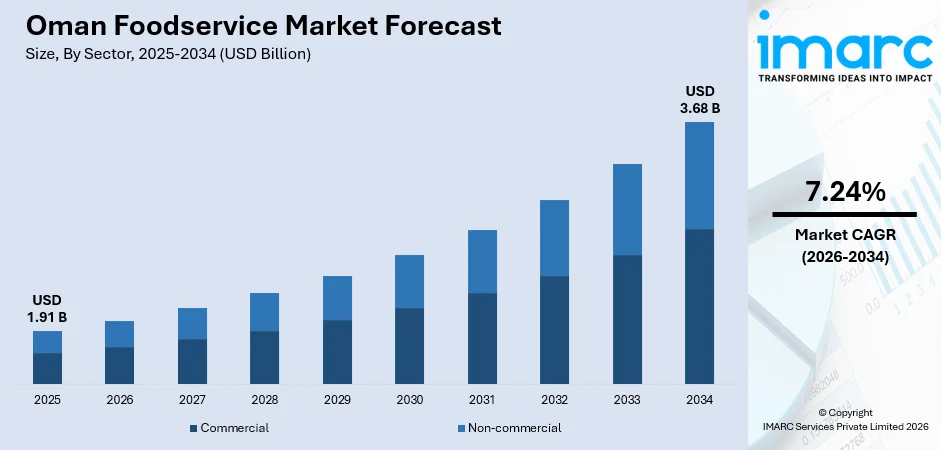
The Oman foodservice market size was valued at USD 1.91 Billion in 2025 and is projected to reach USD 3.68 Billion by 2034, growing at a compound annual growth rate of 7.24% from 2026-2034.
The Oman foodservice market is expanding steadily as the country accelerates economic diversification and tourism infrastructure development under Vision 2040. Rising disposable incomes, a young and urbanizing population, and growing expatriate communities are fueling demand for diverse dining experiences. Increasing consumer preference for premium dining, digital food ordering platforms, and international cuisines continues to reshape the competitive landscape across the Oman foodservice market share.
Key Takeaways and Insights:
- By Sector: Commercial dominates the market with a share of 82% in 2025, driven by a flourishing tourism sector, expanding international restaurant chains, and growing consumer spending on out-of-home dining experiences across urban centers throughout Oman.
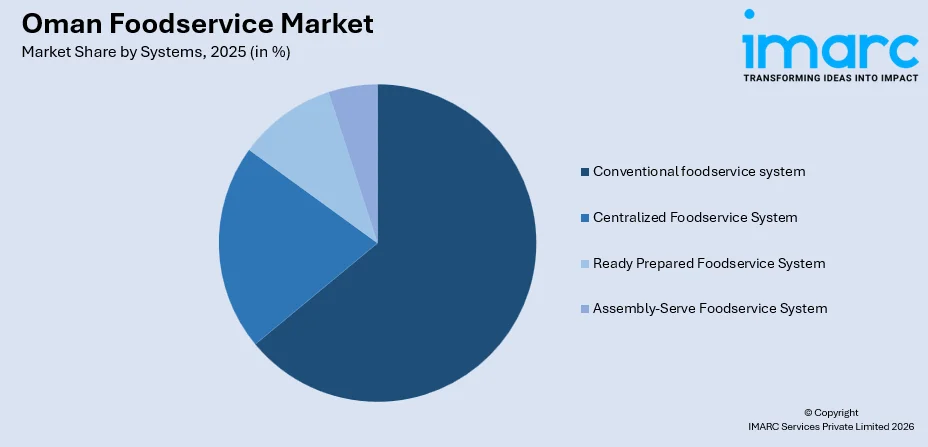
- By Systems: Conventional foodservice system leads the market with a share of 64% in 2025, reflecting the enduring preference among Omani consumers for freshly prepared meals and traditional on-premise cooking methods that ensure quality, authenticity, and customization in dining establishments.
- By Types of Restaurants: Full-service restaurants hold the largest segment with a market share of 48% in 2025, underscoring the strong cultural affinity for experiential, family-oriented dining and the growing demand for premium hospitality offerings that combine diverse cuisines with attentive table service.
- By Region: Muscat represents the largest region with 38% share in 2025, propelled by its position as the economic and administrative capital, hosting the highest concentration of international hotels, upscale restaurants, and a diverse expatriate population driving consistent foodservice demand.
- Key Players: Key players shape the Oman foodservice market by diversifying dining concepts, investing in digital ordering infrastructure, expanding franchise networks, and strengthening supply chain capabilities. Their strategic partnerships with international brands and focus on localized menu innovation drive market expansion and consumer engagement nationwide.
To get more information on this market Request Sample
The Oman foodservice market is gaining significant momentum as the country pursues ambitious economic diversification objectives under its Vision 2040 framework. The government’s commitment to transforming Oman into a premier tourism destination is generating unprecedented demand for diverse foodservice establishments across hotels, resorts, airports, and commercial complexes. A youthful demographic profile, with a median age of approximately 30 years, is fostering evolving dining preferences that favor international cuisines, digital convenience, and experiential gastronomy. The expanding expatriate workforce, which constitutes a substantial portion of the population in urban centers, further amplifies demand for varied culinary offerings. Oman welcomed approximately 3.9 million visitors in 2025, reflecting robust tourism growth that directly stimulates the hospitality and foodservice sectors. Cloud kitchens and online delivery platforms are emerging as transformative forces, enabling operators to reach wider audiences with reduced overhead costs. Meanwhile, government-led food security initiatives are strengthening local supply chains, supporting menu innovation with locally sourced ingredients, and reducing import dependency. These converging factors position the Oman foodservice market for sustained growth throughout the forecast period.
Oman Foodservice Market Trends:
Rising Prominence of Cloud Kitchens and Digital Ordering Platforms
The proliferation of cloud kitchens and delivery-only food concepts is reshaping the Oman foodservice landscape. Digital ordering platforms and mobile applications are enabling operators to expand reach without traditional dine-in infrastructure. Mandatory electronic payment compliance has accelerated this transition, streamlining transactions and unlocking new customer touchpoints. In October 2025, KitchenomiKs, an Oman-based cloud kitchen startup, has expanded its satellite kitchen network across Oman and the GCC and partnered with the Oman Convention and Exhibition Centre for a state-of-the-art kitchen facility, positioning itself as the largest cloud kitchen operator in the country.
Influx of International Luxury Dining Brands
Oman is witnessing a surge in premium international restaurant brands establishing presence in the country, driven by the growing hospitality infrastructure and rising affluent consumer base. This trend reflects Oman’s evolution as a luxury tourism destination and the increasing sophistication of its dining scene. In April 2025, Nobu Hospitality announced the launch of Nobu Hotel, Restaurant, and Residences Muscat on Yiti Beach, developed in partnership with OMRAN Group, spanning over 60,000 square meters and featuring a signature Nobu Restaurant alongside an 80-room luxury hotel.
Growing Consumer Demand for Health-Conscious and Locally Sourced Menus
Health and wellness awareness is increasingly influencing menu development across Oman’s foodservice sector, as consumers seek clean-label, organic, and nutritionally transparent dining options. This shift is driving operators to integrate locally sourced ingredients and adopt farm-to-table concepts that align with national food security priorities. Under the Food Security Lab 2024 initiative, the Oman government earmarked over OMR 10 Million for 30 food ecosystem projects, representing its most extensive investment in strengthening local agricultural supply chains and supporting the Oman foodservice market growth.
Market Outlook 2026-2034:
The Oman foodservice market is poised for robust expansion throughout the forecast period, underpinned by accelerating tourism development, urbanization, and economic diversification under Vision 2040. Strategic government investments in hospitality infrastructure, including new hotel clusters, cruise terminals, and integrated tourism complexes, are expected to create sustained demand for diverse foodservice offerings. The proliferation of digital ordering platforms, growing preference for premium dining experiences, and expansion of cloud kitchen models will further catalyze growth. Additionally, strengthening food security programs and rising private sector investment in restaurant concepts are anticipated to bolster operator confidence and market competitiveness. The market generated a revenue of USD 1.91 Billion in 2025 and is projected to reach a revenue of USD 3.68 Billion by 2034, growing at a compound annual growth rate of 7.24% from 2026-2034.
Oman Foodservice Market Report Segmentation:
|
Segment Category |
Leading Segment |
Market Share |
|
Sector |
Commercial |
82% |
|
Systems |
Conventional Foodservice System |
64% |
|
Types of Restaurants |
Full-Service Restaurants |
48% |
|
Region |
Muscat |
38% |
Sector Insights:
- Commercial
- Non-commercial
Commercial dominates with a market share of 82% of the total Oman foodservice market in 2025.
The dominant role of the commercial sector in the foodservice market in Oman is a result of the thriving restaurant scene in the country, which includes full-service restaurants, quick service restaurants, cafes, and specialty food outlets. The increasing number of tourists in Oman has been a major driver for the growth of commercial foodservice, as the country has been hosting a large number of tourists, thus creating a huge demand for commercial foodservice in the country. The presence of global franchises and local restaurant concepts has been diversifying the commercial foodservice scene in the country.
Increasing urbanization and rising household expenditure on food-away-from-home are reinforcing the commercial sector's dominance. The Muscat metropolitan area serves as the primary hub for commercial foodservice activity, supported by high disposable incomes and a diverse expatriate population. Government-backed tourism investment programs, including the development of integrated tourism complexes across key governorates, are creating new commercial dining opportunities throughout the country. The ongoing expansion of shopping malls, entertainment districts, and hospitality zones further strengthens this segment's growth trajectory, attracting both international franchise operators and homegrown restaurant concepts to capitalize on rising consumer demand.
Systems Insights:
Access the comprehensive market breakdown Request Sample
- Conventional Foodservice System
- Centralized Foodservice System
- Ready Prepared Foodservice System
- Assembly-Serve Foodservice System
Conventional foodservice system leads with a share of 64% of the total Oman foodservice market in 2025.
The leadership of the conventional foodservice system is a reflection of Oman's rich culinary culture and the country's preference for fresh food prepared on-site using conventional cooking techniques. The conventional foodservice system is most common in full-service restaurants, independent restaurants, and family-owned restaurants that focus on quality and authenticity. The significance of communal and family dining in Oman's culture supports the preference for conventional cooking practices. The increased dependence of the hospitality industry on conventional kitchen operations to provide a superior dining experience is also seen in the increased number of three- to five-star hotels, where customized menus are prepared according to local and international preferences.
The prevalence of independent operators, which comprise a large majority of foodservice outlets in Oman, also helps to support the market share of the conventional system. These outlets generally focus on in-house food preparation as a point of differentiation, providing authentic Omani, Middle Eastern, and Asian cuisine that is prepared using conventional cooking methods. The system also derives benefit from the country’s focus on food quality and freshness, which corresponds to the growing trend of consumer interest in clean-label dining. At the same time, the development of tourism in secondary cities such as Salalah and Nizwa is driving demand for conventional dining outlets that support cultural tourism experiences.
Types of Restaurants Insights:
- Fast Food Restaurants
- Full-Service Restaurants
- Limited Service Restaurants
- Special Food Services Restaurants
Full-service restaurants hold the largest share at 48% of the total Oman foodservice market in 2025.
Full-service restaurants account for the leading share of the foodservice sector in Oman, driven by the country's long-standing cultural affinity for experiential dining that brings together a variety of cuisines with personalized table service. The sector benefits from the country's strong family dining culture, where meals with extended family members at full-service restaurants remain an integral part of social life. The rising number of tourists in the country has also boosted demand for full-service restaurants, as tourists increasingly seek immersive culinary experiences. The entry of world-class dining brands into Muscat's growing hospitality sector reflects the rising demand for upscale, chef-driven cuisine.
The full-service sector is aided by the growth of the luxury hospitality infrastructure in Oman, where upscale hotels feature signature restaurants as essential dining experiences. The entry of world-class dining brands in upscale hotels in the capital reflects the positive movement in the sector. The rising consumer sentiment towards indulging in upscale dining experiences, especially among the younger generation and upmarket expatriate communities, is expected to continue the positive movement. The government's ambitious plans for the future of tourism are expected to drive demand for full-service dining outlets in tourist hubs in Oman.
Regional Insights:
- Muscat
- Al Batinah
- Al-Sharqiyah
- Al-Dakhiliyah
- Dhofar
- Others
Muscat exhibits a clear dominance in the market with a 38% share of the total Oman foodservice market in 2025.
Muscat's leading position in the Oman foodservice market is driven by its position as the country's economic, administrative, and tourism hub. The governorate is home to the largest number of international hotels, fine dining restaurants, quick-service eateries, and cloud kitchens. As the most populated governorate with a large number of expatriates, Muscat provides a steady and varied stream of demand for foodservice operators across all dining segments and price points, making it an attractive entry point for both established international brands and new, homegrown concepts seeking to tap into the country's most valuable consumer segment.
The region enjoys the benefits of steady infrastructure development, such as the expansion of commercial areas, shopping malls, and entertainment facilities to support the rising demand for foodservice. The Al Mouj integrated development project has established itself as a prime foodservice destination, with international restaurant brands setting up operations in the region and positioning Muscat as the culinary capital of the Gulf region. Tourism infrastructure development, such as the upgrade of airport and cruise terminal facilities, is also expected to boost Muscat's foodservice market with rising tourist arrivals over the forecast period.
Market Dynamics:
Growth Drivers:
Why is the Oman Foodservice Market Growing?
Accelerating Tourism Development Under Vision 2040
Oman’s strategic push to establish itself as a premier Middle Eastern tourism destination is generating transformative demand for foodservice establishments across all segments. The government’s comprehensive tourism strategy aims to attract 11.7 million tourists annually by 2040 and increase tourism’s contribution to GDP by 2040. This ambition is supported by massive infrastructure investments, including new hotel clusters, cruise terminals, eco-tourism facilities, and cultural heritage sites that each require integrated dining solutions. The development of integrated tourism complexes across regions such as Salalah, Jabal Akhdar, and coastal areas is expanding foodservice demand beyond Muscat, creating opportunities for operators in secondary markets and encouraging diversification of dining concepts to serve both domestic and international visitor preferences.
Expanding Young and Urbanized Population with Rising Disposable Incomes
Oman's demographic profile is a significant catalyst for foodservice market growth, characterized by a predominantly young population and a highly urbanized society concentrated in key metropolitan centers. This youthful, urbanized population exhibits strong preferences for dining out, trying diverse cuisines, and engaging with digital food platforms. Increasing disposable incomes and evolving lifestyle patterns are shifting household expenditure toward food-away-from-home, supporting expansion across quick-service, casual dining, and premium restaurant segments. Oman’s population grew to approximately 5.27 Million in 2024, representing a increase from the prior year[RG6] , with the Muscat governorate hosting the largest concentration of both citizens and expatriates. The growing expatriate community, which contributes substantially to the urban consumer base, further amplifies demand for varied culinary offerings that cater to diverse cultural preferences and dietary requirements.
Digital Transformation and Growth of Online Food Delivery Ecosystem
The adoption of digital technology in the Oman foodservice market is fueling the growth of the market, as it allows restaurants to cater to a wider customer base through online ordering and delivery services. The government’s mandate for electronic payment compliance has also contributed to the digitalization of the market, as it provides a seamless experience for transactions, thereby opening up new revenue streams for restaurants and cloud kitchens. The convenience-driven consumer behavior exhibited by Oman’s young and tech-savvy population is also fueling the growth of delivery-centric foodservice models. The digitalization of the market also includes data analytics for menu engineering, customer relationship management, and operational efficiency enhancements.
Market Restraints:
What Challenges the Oman Foodservice Market is Facing?
High Dependency on Food Imports and Supply Chain Vulnerabilities
Despite government efforts to enhance food security, Oman continues to rely heavily on imported food products, particularly processed foods, grains, and specialty ingredients essential for diverse restaurant menus. This dependency exposes foodservice operators to global price volatility, shipping disruptions, and geopolitical uncertainties that can rapidly escalate ingredient costs. Operators face the challenge of either absorbing increased procurement expenses or passing costs to price-sensitive consumers, both of which can compress margins and constrain business expansion plans.
Rising Operational Costs Including Labor, Energy, and Rental Expenses
Foodservice operators in Oman face mounting pressure from escalating labor costs driven by Omanization requirements, increasing energy tariffs, and rising commercial rental rates in prime urban locations. These structural cost pressures particularly affect small and medium-sized independent operators who lack the economies of scale to absorb rising expenses. The cumulative impact of regulatory compliance costs, including digital tax stamps on imported beverages and mandatory electronic payment system integration, further constrains profitability and limits reinvestment capacity.
Intense Competition and Market Fragmentation Limiting Profitability
The Oman foodservice market is characterized by significant fragmentation, with a large number of independent operators competing alongside expanding international franchise chains. This intense competition creates pricing pressures, shortens business lifecycles for underperforming establishments, and makes it challenging for new entrants to achieve sustainable profitability. The rapid growth of cloud kitchens and delivery-only concepts has further intensified competitive dynamics, requiring traditional operators to invest in digital capabilities and delivery infrastructure to maintain market relevance.
Competitive Landscape:
The foodservice industry in Oman has a competitive environment that is marked by a combination of global franchises and local standalone outlets. The industry is still highly fragmented, with the majority of outlets being local standalone outlets that focus on providing authentic local dining experiences. Global franchises are growing steadily through franchise agreements, capitalizing on brand strength and efficiency to meet the rising demand from urban consumers and tourists. The competition is becoming more fierce through digital platforms, with foodservice players investing in delivery services, mobile ordering, and loyalty programs. Collaborations between hospitality companies and global restaurant brands are enhancing the premium dining segment, while cloud kitchen companies are revolutionizing the industry by providing multiple virtual brands from common kitchen facilities.
Oman Foodservice Market Report Coverage:
|
Report Features |
Details |
|
Base Year of the Analysis |
2025 |
|
Historical Period |
2020-2025 |
|
Forecast Period |
2026-2034 |
|
Units |
Billion USD |
|
Scope of the Report |
Exploration of Historical Trends and Market Outlook, Industry Catalysts and Challenges, Segment-Wise Historical and Future Market Assessment:
|
|
Sectors Covered |
Commercial, Non-commercial |
|
Systems Covered |
Conventional Foodservice System, Centralized Foodservice System, Ready Prepared Foodservice System, Assembly-Serve Foodservice System |
|
Types of Restaurants Covered |
Fast Food Restaurants, Full-Service Restaurants, Limited Service Restaurants, Special Food Services Restaurants |
|
Regions Covered |
Muscat, Al Batinah, Al-Sharqiyah, Al-Dakhiliyah, Dhofar, Others |
|
Customization Scope |
10% Free Customization |
|
Post-Sale Analyst Support |
10-12 Weeks |
|
Delivery Format |
PDF and Excel through Email (We can also provide the editable version of the report in PPT/Word format on special request) |
Frequently Asked Questions About the Oman Foodservice Market Report
The Oman foodservice market size was valued at USD 1.91 Billion in 2025.
The Oman foodservice market is expected to grow at a compound annual growth rate of 7.24% from 2026-2034 to reach USD 3.68 Billion by 2034.
Commercial dominated the market with a share of 82%, driven by flourishing tourism growth, expanding international restaurant chains, rising consumer spending on out-of-home dining, and the proliferation of diverse culinary offerings across urban centers.
Key factors driving the Oman foodservice market include accelerating tourism development under Vision 2040, expanding young and urbanized population, rising disposable incomes, digital transformation of food ordering, and growing demand for diverse dining experiences.
Major challenges include high dependency on food imports and supply chain vulnerabilities, rising operational costs from labor and energy expenses, Omanization compliance requirements, intense market fragmentation, and pricing pressures from expanding competition.
Need more help?
- Speak to our experienced analysts for insights on the current market scenarios.
- Include additional segments and countries to customize the report as per your requirement.
- Gain an unparalleled competitive advantage in your domain by understanding how to utilize the report and positively impacting your operations and revenue.
- For further assistance, please connect with our analysts.
 Request Customization
 Speak to an Analyst
 Request Brochure
 Inquire Before Buying
Benefits of Customization
- Personalize this research
- Triangulate with your data
- Get data as per your format and definition
- Gain a deeper dive into a specific application, geography, customer, or competitor
- Any level of personalization
Get in Touch With Us
UNITED STATES
Phone: +1-201-971-6302
INDIA
Phone: +91-120-433-0800
UNITED KINGDOM
Phone: +44-753-714-6104
Email: [email protected]
Client Testimonials




.webp)




.webp)













Related Reports

Choose your plan
*Please note that the prices mentioned below are starting prices for each bundle type. Kindly contact our team for further details.*
Single User License
- 1 User License, Access on 2 Devices
- PDF Report + Excel Dataset (Password Protected)
- Lifetime Access
- No Printing Rights
- 10% Free Report Customization
- 10–12 Weeks of Analyst Support
Five User License
- Access for 5 Users, 2 Devices per User
- PDF Report + Excel Dataset (Password Protected)
- Lifetime Access
- Dedicated Account Manager
- 12–14 Weeks of Analyst Support
- No Printing Rights
- 15% Free Report Customization
- 25% Discount on Your Next Purchase
Corporate User License
- Unlimited User Access (Within Your Organization)
- PDF Report + Excel Dataset
- Lifetime Access
- Dedicated Account Manager
- 14–20 Weeks of Analyst Support
- No Printing Rights
- 20% Free Report Customization
- 30% Discount on Your Next Purchase
Essential Insights
What's included:
3 reports
- Lifetime Access
- PDF Reports
- Excel Datasets
- 2 Weeks of Free Analyst Support
- 2 User Licenses
- Access on 2 Devices
- Printing Rights
- Complimentary PowerPoint (PPT) Version
- Complimentary License Upgrade
Professional Access
What's included:
5 reports
- Lifetime Access
- PDF Reports
- Excel Datasets
- 8 Weeks of Free Analyst Support
- 2 User Licenses
- Access on 2 Devices
- Printing Rights
- Complimentary PowerPoint (PPT) Version
- Complimentary License Upgrade
Business Advantage
What's included:
8 reports
- Lifetime Access
- PDF Reports
- Excel Datasets
- 14 Weeks of Free Analyst Support
- 2 User Licenses
- Access on 2 Devices
- Printing Rights
- Complimentary PowerPoint (PPT) Version
- Complimentary License Upgrade
Enterprise Intelligence
What's included:
10 reports
- Lifetime Access
- PDF Reports
- Excel Datasets
- 20 Weeks of Free Analyst Support
- 2 User Licenses
- Access on 2 Devices
- Printing Rights
- Complimentary PowerPoint (PPT) Version
- Complimentary License Upgrade