
Oman Travel & Tourism Market Size, Share, Trends and Forecast by Type, Service Offering, Purpose of Visit, Booking Type, and Region, 2026-2034
Oman Travel & Tourism Market Summary:
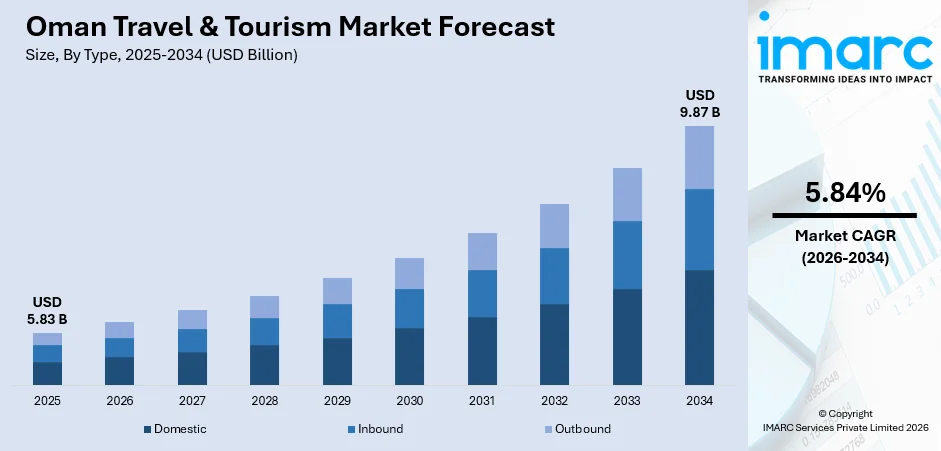
The Oman travel & tourism market size was valued at USD 5.83 Billion in 2025 and is projected to reach USD 9.87 Billion by 2034, growing at a compound annual growth rate of 5.84% from 2026-2034.
The Oman travel & tourism market is experiencing robust expansion driven by the government's strategic commitment to economic diversification under Vision 2040. Increasing investment in tourism infrastructure, including new hotels, resorts, and eco-tourism destinations, is attracting both domestic and international visitors. The sultanate's rich cultural heritage, stunning natural landscapes spanning deserts, mountains, and coastlines, and warm hospitality create a compelling value proposition for leisure and business travelers alike. Visa liberalization measures, including visa-free entry for over 103 countries, have significantly lowered barriers for inbound tourists, while digital transformation initiatives are streamlining the travel booking experience. The tourism sector contributed OMR 2.12 Billion (USD 5.51 Billion) to the national economy in 2024, reinforcing its growing significance as a key economic pillar. Rising domestic tourism participation, expanding airline connectivity, community-based tourism development, and growing interest in adventure and wellness experiences are further strengthening the foundation of the Oman travel & tourism market share.
Key Takeaways and Insights:
- By Type: Domestic dominates the market with a share of 55% in 2025, driven by increasing staycation culture, government campaigns promoting internal travel, and Omani residents exploring diverse natural and cultural destinations across the sultanate's governorates.
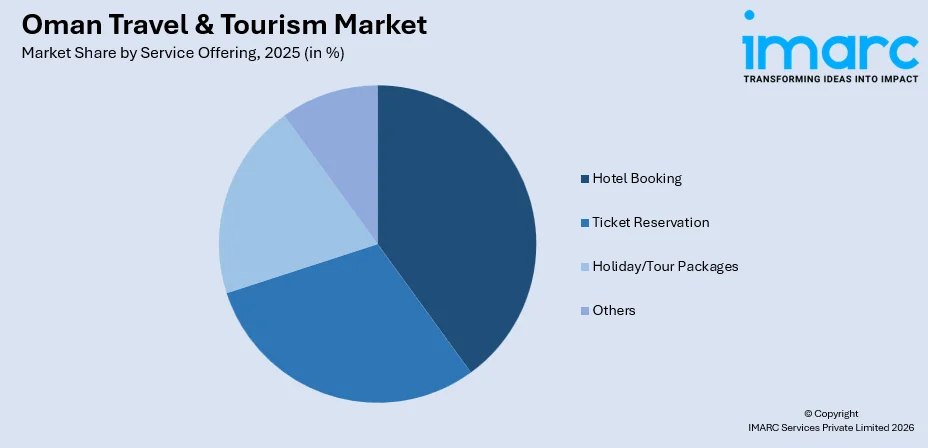
- By Service Offering: Hotel booking leads the market with a share of 38% in 2025, reflecting strong demand for quality accommodation options fueled by expanding hospitality infrastructure, rising occupancy rates, and growing preference for curated hotel experiences among domestic and international travelers.
- By Purpose of Visit: Leisure and recreation represent the biggest segment with a market share of 62% in 2025, underscoring the appeal of Oman's diverse adventure, eco-tourism, and beach offerings that attract visitors seeking relaxation and culturally immersive travel experiences.
- By Booking Type: Online exhibits a clear dominance in the market with 57% share in 2025, reflecting growing digital adoption among travelers and the expansion of online travel agencies and government-backed booking platforms that simplify itinerary planning.
- By Region: Muscat is the largest region with 34% share in 2025, supported by the concentration of international airport connectivity, premium hotels, cultural attractions, and government institutions that position it as the primary entry point for tourism activity.
- Key Players: Key players drive the Oman travel & tourism market by expanding hospitality portfolios, investing in digital booking platforms, developing eco-tourism and adventure experiences, and forming strategic partnerships that enhance destination marketing, improve service quality, and attract diverse visitor segments across the sultanate.
To get more information on this market Request Sample
The Oman travel & tourism market is advancing as the sultanate implements transformative initiatives to position itself as a premier destination in the Middle East. Government-led efforts under the National Tourism Strategy emphasize infrastructure modernization, sustainable destination development, and diversification of tourism offerings beyond traditional urban centers. The expansion of eco-tourism, adventure tourism, and wellness experiences is broadening the market's appeal to a wider demographic of travelers seeking unique and authentic experiences. Digital innovation is playing a pivotal role in reshaping the booking landscape, with centralized platforms connecting travelers to local service providers and curated experiences across the country. Sustained public investment in tourism projects, coupled with regulatory reforms and strategic partnerships, reflects the government's long-term commitment to developing the sector as a cornerstone of economic diversification. Strengthening airline connectivity, rising hotel capacity, and targeted international marketing campaigns are accelerating visitor growth, reinforcing the Oman travel & tourism market growth trajectory.
Oman Travel & Tourism Market Trends:
Accelerating Growth of Eco-Tourism and Nature-Based Experiences
Oman is witnessing a significant shift toward sustainable and nature-based tourism as travelers seek environmentally conscious destinations offering authentic outdoor experiences. The government has designated a substantial portion of the country's landmass as protected areas, encompassing marine reserves, mountain ecosystems, and desert sanctuaries. Community-based tourism initiatives involving local artisans, heritage site management, and agritourism are gaining momentum. In 2025, the Environment Authority awarded contracts worth OMR 44 Million (USD 114.29 Million) to develop eco-tourism infrastructure across seven nature reserves, reflecting the sultanate's commitment to balancing environmental preservation with experiential tourism development.
Digital Transformation Reshaping Travel Planning and Booking
The adoption of digital platforms and mobile applications is fundamentally transforming how travelers plan and book their visits to Oman. Online travel agencies, airline-integrated holiday platforms, and government-backed booking portals are replacing traditional travel agency models with seamless, self-service itinerary creation. The Ministry of Heritage and Tourism launched the Experience Oman digital platform, featuring over 200 tourism service providers, 350 curated experiences, and 140 hotels, enabling travelers to access comprehensive booking services through a single centralized gateway that connects local operators with international markets.
Expansion of Luxury and Boutique Hospitality Offerings
Oman's hospitality landscape is evolving with the entry of premium international hotel brands and the development of boutique properties in distinctive natural settings. Mountain resorts, coastal retreats, and desert eco-lodges are catering to high-value travelers seeking culturally immersive experiences combined with world-class amenities. The country aims to add 9,600 new hotel rooms by 2030, with 2,600 rooms scheduled for completion by the end of 2025. In September 2025, TUI Group signed a strategic partnership with Omran Group to develop a cluster of five new hotels in the Dhofar Governorate, underscoring international confidence in Oman's luxury tourism potential.
Market Outlook 2026-2034:
The Oman travel & tourism market is poised for sustained expansion as the sultanate accelerates its economic diversification agenda and positions tourism as a central growth pillar. The market generated a revenue of USD 5.83 Billion in 2025 and is projected to reach a revenue of USD 9.87 Billion by 2034, growing at a compound annual growth rate of 5.84% from 2026-2034. Strategic investments in airport infrastructure, with plans to significantly expand passenger capacity over the coming years, will enhance accessibility to the country. The ongoing development of eco-tourism destinations, adventure tourism products, and wellness retreats is diversifying the market's appeal beyond traditional sightseeing. Strengthening airline connectivity with new European, Asian, and GCC routes, combined with digital innovation in travel planning and the expansion of visa-free arrangements, will continue to attract a broader base of international and domestic travelers, supporting the long-term growth outlook.
Oman Travel & Tourism Market Report Segmentation:
|
Segment Category |
Leading Segment |
Market Share |
|
Type |
Domestic |
55% |
|
Service Offering |
Hotel Booking |
38% |
|
Purpose of Visit |
Leisure and Recreation |
62% |
|
Booking Type |
Online |
57% |
|
Region |
Muscat |
34% |
Type Insights:
- Domestic
- Inbound
- Outbound
Domestic dominates with a market share of 55% of the total Oman travel & tourism market in 2025.
The domestic segment holds the largest share of the Oman travel & tourism market, reflecting the growing inclination of Omani residents to explore their own country's diverse landscapes and cultural heritage. Government-backed campaigns promoting internal travel have successfully encouraged staycations, weekend getaways, and family-oriented trips to various governorates. Rising disposable incomes, improved road connectivity between remote destinations, and the expansion of local hospitality options have made domestic travel more accessible and appealing. The increasing availability of curated local experiences and adventure offerings in previously underserved regions is further motivating residents to discover new destinations within the sultanate.
The surge in domestic tourism has also strengthened the hospitality sector, with hotels across the sultanate recording increased occupancy and revenues driven by local travelers. Cultural festivals, seasonal events such as the Khareef monsoon season in Dhofar, and the promotion of lesser-known destinations have broadened the domestic travel appeal. The growing emphasis on heritage tourism, wellness retreats, and nature-based experiences continues to attract diverse traveler segments, significantly contributing to the national tourism economy and reinforcing the domestic segment's role as the primary demand driver within the Oman travel & tourism market.
Service Offering Insights:
Access the comprehensive market breakdown Request Sample
- Ticket Reservation
- Hotel Booking
- Holiday/Tour Packages
- Others
Hotel booking leads with a share of 38% of the total Oman travel & tourism market in 2025.
The hotel booking segment commands the largest share of the Oman travel & tourism market, driven by the expanding hospitality infrastructure and rising demand for quality accommodation experiences across the sultanate. The growth of international hotel brands alongside boutique and eco-lodge properties has widened the range of options available to travelers, catering to diverse preferences from luxury resorts to mid-range accommodations. Increasing occupancy rates and revenue performance in the three-to-five-star hotel category underscore the segment's vitality. Hotel revenues at three-to-five-star properties reached nearly OMR 258 Million by the end of 2025, reflecting an increase of 21% compared to the prior year.
The hotel booking segment is further strengthened by the government's strategic push to expand room capacity and diversify accommodation offerings across different regions. New developments in mountain resorts, coastal retreats, and desert lodges are attracting high-value travelers seeking distinctive experiences. The integration of hotel inventory into digital booking platforms enables seamless reservation and comparison for domestic and international visitors alike. Ongoing construction of new hospitality properties across multiple governorates, coupled with the entry of international hotel brands and the expansion of boutique and eco-friendly lodging options, is ensuring continued growth in hotel booking volumes and reinforcing the segment's market position.
Purpose of Visit Insights:
- Business
- Leisure and Recreation
- Education
- Medical
- Social Activity
- Others
Leisure and recreation represent the largest segment, accounting for 62% of the total Oman travel & tourism market in 2025.
The travel and tourism market in Oman is dominated by the leisure and recreation segment, which reflects the nation's increasing appeal as a destination for leisure, adventure, and cultural discovery. From immaculate coasts and striking mountain ranges to vast desert vistas, Oman's varied natural settings provide visitors with a wide selection of leisure pursuits, such as hiking, diving, desert safaris, and ecotourism experiences. Throughout the year, both domestic and foreign tourists looking for unique outdoor experiences are drawn to the area by the government's focus on creating adventure tourism products including cable cars, ziplines, and mountain paths.
The year-round maintenance of leisure demand has been made possible by the growth of seasonal tourism offers and cultural festivals. Salalah's yearly monsoon season, internationally renowned sporting events, and heritage festivities often draw leisure tourists from local and worldwide markets. The growth of spa resorts, wellness retreats, and lodging alternatives in the outdoors keeps improving the value offer of the market. The sultanate's standing as a tranquil and safe travel destination, along with the growing popularity of immersive and experiencing travel, is making leisure and recreation the mainstay of the Omani travel and tourism industry.
Booking Type Insights:
- Travel Companies
- Travel Agencies
- Online
- Others
The online segment holds the largest share with a 57% share of the total Oman travel & tourism market in 2025.
Due to rising traveler digital adoption, the growth of online travel agents, airline booking platforms, and consolidated government portals, the online booking segment now accounts for the majority of the Oman travel & tourism business. The transition from traditional offline channels to digital booking methods has been expedited by the ease with which one can compare costs, read reviews, and create personalized itineraries from a single site. Both domestic and foreign travelers' preferences for online booking have been further strengthened by mobile-first trip planning and the expansion of secure payment gateways. The end-to-end booking process is still being streamlined by the incorporation of all travel services into a single digital platform.
The government's aggressive commitment to digital tourist infrastructure has sped up the growth trajectory of the online segment. Dedicated adventure tourism apps and centralized booking platforms offer tourists a single point of contact for lodging, guided tours, transportation, and carefully chosen activities around the sultanate. Travel planning is made easier by these digital initiatives, which also lower booking friction and link small and medium-sized local tourism businesses with global markets. The internet segment is becoming even more dominant in the travel and tourist business of Oman thanks to the continuous development of multilingual digital tools, online training courses for travel agencies, and real-time event integration.
Regional Insights:
- Muscat
- Al Batinah
- Al-Sharqiyah
- Al-Dakhiliyah
- Dhofar
- Others
Muscat represents the leading segment with 34% share of the total Oman travel & tourism market in 2025.
With its concentration of international airport links, upscale hotel assets, cultural landmarks, and contemporary infrastructure, Muscat is Oman's main entry point for tourists. The capital is a fascinating place for both business and leisure travelers because of its unique combination of medieval forts, traditional souks, and modern attractions. The city's popularity as a major center for tourists entering the sultanate is increased by its well-developed transit system, variety of food and entertainment options, and closeness to natural features. The majority of air travel through the nation's airport network is handled by Muscat's international airport, which continues to be the primary point of entry.
Major international hotel chains and upscale developments are still drawn to the area's hospitality industry, which boosts the city's tourism potential. Consistent demand from domestic, regional, and international tourists across all seasons is reflected in the strong hotel occupancy performance. With continued infrastructure improvements and focused destination marketing initiatives, the government's plan to diversify tourism outside of Muscat by creating destinations in Dhofar, Al-Dakhiliyah, and Al-Sharqiyah is anticipated to progressively reallocate visitor flows while maintaining Muscat's position as the leading travel and tourism hub for the Omani market.
Market Dynamics:
Growth Drivers:
Why is the Oman Travel & Tourism Market Growing?
Government-Led Vision 2040 and Strategic Tourism Investment
One of the main factors propelling the travel and tourism industry's expansion is the Omani government's dedication to establishing tourism as a key component of economic diversification. Over the next few decades, Vision 2040 sets ambitious goals to boost tourism's contribution to the national economy and dramatically increase visitor numbers. The Ministry of Heritage and Tourism has carried out extensive planning that includes regulatory reform, destination development, and infrastructure renovation. Barriers for inbound passengers have been greatly lowered by visa liberalization initiatives, such as the introduction of an effective e-visa system and visa-free access for nationals of several nations. A strong pipeline of tourist projects is being created throughout the sultanate by significant public and private investment pledges encompassing eco-tourism, resort clusters, and mixed-use developments. The travel and tourist industry is laying a solid foundation for long-term, steady growth thanks to these calculated investments, institutional coordination, and policy simplification.
Expansion of Hospitality Infrastructure and Accommodation Capacity
Through the expansion of the variety and caliber of lodging alternatives accessible to tourists, the quick growth of hospitality infrastructure is greatly enhancing the travel and tourism industry in Oman. Together, the opening of boutique mountain and desert lodges, the entry of foreign hotel brands, and the growth of coastal resorts are increasing the nation's ability to handle the rising demand for tourists. Modern tourists are drawn to new hotels that prioritize sustainability, cultural authenticity, and experience offerings. The increase in the number of available rooms encourages guests to stay longer and spend more money, which boosts tourism's economic impact. The sultanate's overall lodging capacity is gradually growing due to ongoing building across several governorates, with a significant number of additional rooms scheduled for completion in the upcoming years. Targeted marketing initiatives support this infrastructural development, positioning Oman as a year-round destination for adventure, leisure, and wellness travel.
Rising Domestic Tourism and Diversification of Visitor Base
A steady demand foundation that supplements foreign visitors is being provided by the rise in domestic travel, which is becoming an increasingly important factor in propelling the Oman travel & tourism industry. Omani citizens have been inspired to travel within their own nation by government advertising, seasonal events, and the creation of attractions in previously neglected areas. With an increase in arrivals from European, Asian, and GCC nations, the diversity of source markets for foreign tourists is also bolstering market resilience by lowering reliance on any one group. The sultanate's appeal has grown internationally thanks to the opening of specialized tourism promotion offices in important foreign markets. This expanding tourist base strengthens market stability overall and lessens susceptibility to demand swings from individual source markets by ensuring steady revenue streams and fostering the growth of tourism infrastructure across several regions.
Market Restraints:
What Challenges the Oman Travel & Tourism Market is Facing?
Seasonal Concentration and Geographic Imbalance of Tourism Activity
Geographical concentration of visitor activity and seasonal variations in demand provide a serious challenge to the Omani travel and tourism industry. The peak travel season is restricted to the cooler months in most countries due to the severe summer temperatures, which results in significant demand unpredictability that impacts hotel occupancy, revenue consistency, and employment stability throughout the year. While many other governorates have unrealized tourism potential but lack sufficient lodging, transportation, and visitor facilities to draw significant visitor numbers, tourism infrastructure and visitor flows are still mostly centered around Muscat and Dhofar.
Skilled Workforce Shortage and Omanization Challenges
Building a locally trained workforce to satisfy the expectations of a growing industry is a recurring challenge for the tourism sector. The sector's Omanization rate is still comparatively low, underscoring the industry's ongoing reliance on foreign workers for operations related to hospitality and tourism. Building a sustainable and nationally representative tourism workforce that can support the sector's long-term growth ambitions will require overcoming cultural preferences that discourage employment in hospitality roles, aligning academic qualifications with industry requirements, and creating specialized training programs for emerging tourism segments like eco-tourism and digital services.
Limited International Brand Awareness Compared to Regional Competitors
In contrast to other travel destinations like the United Arab Emirates, Saudi Arabia, and Qatar, which have greater marketing budgets and well-established tourist ecosystems, Oman struggles with comparatively low international brand recognition despite its abundance of natural and cultural resources. To effectively compete for a greater share of regional and worldwide tourism flows, a consistent investment in social media participation, targeted marketing campaigns, and organizing international events is necessary to develop a distinctive global tourism character.
Competitive Landscape:
International hotel chains, internet travel agencies, and government-supported tourist development organizations are all becoming more and more prevalent in Oman's travel and tourism industry, which is characterized by a dynamic competitive landscape. Investments in upscale and boutique lodging, eco-friendly travel experiences, and technologically advanced booking solutions are how market players set themselves apart. The development of integrated tourism destinations is being accelerated by strategic alliances between local developers and global hospitality firms. As businesses improve service quality, broaden their geographic reach, and create specialty products for the eco-tourism, adventure-tourism, and wellness markets, competition is getting more fierce. Operators are investing in mobile applications, data-driven personalization, and seamless booking experiences in an effort to meet the increasing demand for online services and boost consumer loyalty as a result of digital innovation, which is changing the competitive landscape.
Oman Travel & Tourism Market Report Coverage:
|
Report Features |
Details |
|
Base Year of the Analysis |
2025 |
|
Historical Period |
2020-2025 |
|
Forecast Period |
2026-2034 |
|
Units |
Billion USD |
|
Scope of the Report |
Exploration of Historical Trends and Market Outlook, Industry Catalysts and Challenges, Segment-Wise Historical and Future Market Assessment:
|
|
Types Covered |
Domestic, Inbound, Outbound |
|
Service Offerings Covered |
Ticket Reservation, Hotel Booking, Holiday/Tour Packages, Others |
|
Purposes of Visit Covered |
Business, Leisure and Recreation, Education, Medical, Social Activity, Others |
|
Booking Types Covered |
Travel Companies, Travel Agencies, Online, Others |
|
Regions Covered |
Muscat, Al Batinah, Al-Sharqiyah, Al-Dakhiliyah, Dhofar, Others |
|
Customization Scope |
10% Free Customization |
|
Post-Sale Analyst Support |
10-12 Weeks |
|
Delivery Format |
PDF and Excel through Email (We can also provide the editable version of the report in PPT/Word format on special request) |
Frequently Asked Questions About the Oman Travel & Tourism Market Report
The Oman travel & tourism market size was valued at USD 5.83 Billion in 2025.
The Oman travel & tourism market is expected to grow at a compound annual growth rate of 5.84% from 2026-2034 to reach USD 9.87 Billion by 2034.
Domestic, holding the largest revenue share of 55%, remains pivotal for Oman's travel and tourism market, driven by growing staycation culture, government campaigns promoting internal travel, improved road infrastructure, and Omani residents' increasing preference for exploring diverse local destinations.
Key factors driving the Oman travel & tourism market include government-led Vision 2040 investments, expanding hospitality infrastructure, visa liberalization, rising domestic tourism, digital transformation in travel booking, and growing international visitor diversification.
Major challenges include seasonal concentration of tourism demand, geographic imbalance of visitor activity, skilled workforce shortages, low Omanization rates in hospitality, and limited international brand awareness compared to regional competitors.
Need more help?
- Speak to our experienced analysts for insights on the current market scenarios.
- Include additional segments and countries to customize the report as per your requirement.
- Gain an unparalleled competitive advantage in your domain by understanding how to utilize the report and positively impacting your operations and revenue.
- For further assistance, please connect with our analysts.
 Request Customization
 Speak to an Analyst
 Request Brochure
 Inquire Before Buying
Benefits of Customization
- Personalize this research
- Triangulate with your data
- Get data as per your format and definition
- Gain a deeper dive into a specific application, geography, customer, or competitor
- Any level of personalization
Get in Touch With Us
UNITED STATES
Phone: +1-201-971-6302
INDIA
Phone: +91-120-433-0800
UNITED KINGDOM
Phone: +44-753-714-6104
Email: [email protected]
Client Testimonials




.webp)




.webp)













Related Reports

Choose your plan
*Please note that the prices mentioned below are starting prices for each bundle type. Kindly contact our team for further details.*
Single User License
- 1 User License, Access on 2 Devices
- PDF Report + Excel Dataset (Password Protected)
- Lifetime Access
- No Printing Rights
- 10% Free Report Customization
- 10–12 Weeks of Analyst Support
Five User License
- Access for 5 Users, 2 Devices per User
- PDF Report + Excel Dataset (Password Protected)
- Lifetime Access
- Dedicated Account Manager
- 12–14 Weeks of Analyst Support
- No Printing Rights
- 15% Free Report Customization
- 25% Discount on Your Next Purchase
Corporate User License
- Unlimited User Access (Within Your Organization)
- PDF Report + Excel Dataset
- Lifetime Access
- Dedicated Account Manager
- 14–20 Weeks of Analyst Support
- No Printing Rights
- 20% Free Report Customization
- 30% Discount on Your Next Purchase
Essential Insights
What's included:
3 reports
- Lifetime Access
- PDF Reports
- Excel Datasets
- 2 Weeks of Free Analyst Support
- 2 User Licenses
- Access on 2 Devices
- Printing Rights
- Complimentary PowerPoint (PPT) Version
- Complimentary License Upgrade
Professional Access
What's included:
5 reports
- Lifetime Access
- PDF Reports
- Excel Datasets
- 8 Weeks of Free Analyst Support
- 2 User Licenses
- Access on 2 Devices
- Printing Rights
- Complimentary PowerPoint (PPT) Version
- Complimentary License Upgrade
Business Advantage
What's included:
8 reports
- Lifetime Access
- PDF Reports
- Excel Datasets
- 14 Weeks of Free Analyst Support
- 2 User Licenses
- Access on 2 Devices
- Printing Rights
- Complimentary PowerPoint (PPT) Version
- Complimentary License Upgrade
Enterprise Intelligence
What's included:
10 reports
- Lifetime Access
- PDF Reports
- Excel Datasets
- 20 Weeks of Free Analyst Support
- 2 User Licenses
- Access on 2 Devices
- Printing Rights
- Complimentary PowerPoint (PPT) Version
- Complimentary License Upgrade