
Online Entertainment Market Size, Share, Trends, and Forecast by Form, Revenue Model, Device, and Region, 2026-2034
Online Entertainment Market Size and Share:
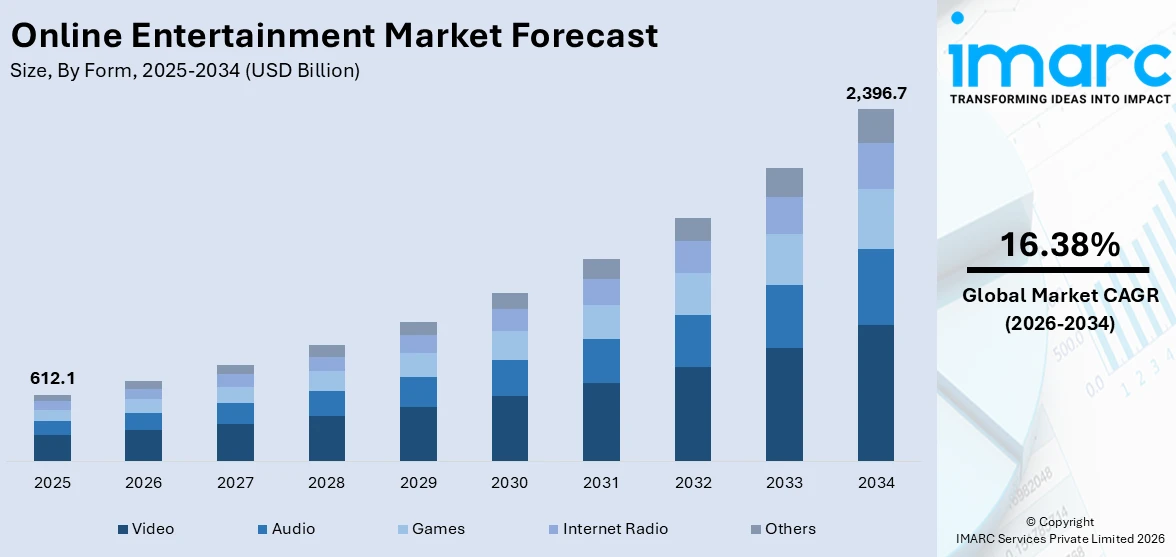
The global online entertainment market size was valued at USD 612.1 Billion in 2025. Looking forward, IMARC Group estimates the market to reach USD 2,396.7 Billion by 2034, exhibiting a CAGR of 16.38% from 2026-2034. North America currently dominates the market, holding a market share of over 45.6% in 2025. The global expansion of internet infrastructure, which enables smooth access through high-speed connectivity, is driving the industry. Convenient entry points are made possible by the widespread use of smartphones, and a variety of audiences are drawn to inexpensive subscription models. Through personalized content recommendations and immersive watching experiences, technological innovations like artificial intelligence customization improve user engagement.
|
Report Attribute
|
Key Statistics
|
|---|---|
|
Base Year
|
2025
|
|
Forecast Years
|
2026-2034
|
|
Historical Years
|
2020-2025
|
|
Market Size in 2025
|
USD 612.1 Billion |
|
Market Forecast in 2034
|
USD 2,396.7 Billion |
| Market Growth Rate 2026-2034 | 16.38% |
The expansion of internet infrastructure worldwide is pivotal in enabling access to online entertainment. High-speed internet, particularly with the rollout of 4G and 5G networks, is making streaming and other online services seamless, even in remote regions. Additionally, the widespread use of smartphones, tablets, laptops, and smart TVs is bolstering the online entertainment market growth. With these devices becoming more affordable and technologically advanced, a larger audience can engage with digital content across multiple platforms. Besides this, online entertainment offers competitive pricing compared to traditional forms like cable television or movie theaters. Free and ad-supported models, alongside affordable subscription plans, attract a diverse audience seeking value for money. In addition, continuous improvements in 4K streaming, virtual reality (VR), and augmented reality (AR) technologies are elevating the quality of online entertainment, offering audiences more immersive and engaging experiences.
To get more information on this market Request Sample
The United States plays a crucial role in the market, driven by the increasing investment in creating exclusive, high-budget content that keeps viewers subscribing and attracts new audiences. Furthermore, the consolidation of multiple streaming services into a single platform to enhances user convenience, expands content accessibility, and improves the overall viewing experience is impelling the market growth. This strategy often includes personalized recommendations, simplified navigation, and flexible subscription options, making it a key driver in attracting and retaining subscribers. In 2024, Disney announced the integration of Hulu into the Disney+ app for US Disney Bundle subscribers, allowing seamless access to both libraries. This update provides personalized recommendations, easier content discovery, and expanded subscription options. A marketing campaign celebrates this milestone with refreshed branding and experiential activations.
Online Entertainment Market Trends:
Rising Internet Penetration
Increased internet penetration represents a fundamental driver propelling market expansion across global regions. The worldwide internet user base reached substantial levels, providing vast audiences for digital entertainment platforms across diverse geographic markets. Proliferation of affordable smartphones combined with competitive mobile data plans accelerates access to streaming services in emerging economies where traditional infrastructure limitations previously constrained growth. High-speed connectivity supported by fourth and fifth generation network advancements ensures seamless streaming experiences for video content, gaming applications, and live interactive features that characterize modern entertainment consumption. Smart television proliferation alongside connected device ecosystems enriches entertainment options beyond mobile usage patterns alone. These technological developments enable on-demand content access, real-time streaming capabilities, and interactive experiences that attract diverse audience segments spanning multiple demographics. The online entertainment market forecast anticipates continued momentum as internet connectivity improvements extend into previously underserved regions worldwide.
Proliferation of Smartphones
Smartphone proliferation serves as a crucial factor impelling substantial market momentum across demographic segments and geographic regions. Global smartphone adoption rates demonstrate widespread device accessibility among populations seeking convenient entertainment access through portable technologies. This widespread adoption benefits from affordable smartphone availability combined with competitive mobile data pricing structures that enable broader audience participation in digital entertainment ecosystems. Modern smartphones feature high-resolution display technologies, advanced graphics processing capabilities, and powerful computational resources that enhance streaming quality, gaming experiences, and interactive content engagement across applications. These devices support seamless platform access for diverse entertainment offerings including movies, music libraries, gaming applications, and live streaming services that cater to varied entertainment preferences and consumption patterns. Artificial intelligence integration alongside personalized application experiences enhances mobile entertainment engagement through adaptive recommendations and tailored content discovery mechanisms. Mobile-friendly platform optimization coupled with improved connectivity through advanced network infrastructure amplifies smartphone influence across market dynamics.
Expansion of the Gaming Industry
Gaming industry growth constitutes a vital factor positively influencing overall market trajectory through technological innovation and audience engagement. Global gaming revenues demonstrate substantial expansion driven by advancements across multiple technology domains including graphics rendering, artificial intelligence implementation, and virtual reality integration that create increasingly immersive gaming experiences. Cloud gaming platform emergence democratizes high-quality game access without expensive hardware requirements, attracting broader audience participation across demographic segments previously constrained by equipment costs. Esports popularity combined with live-streaming platform growth increases audience engagement while driving industry revenues through sponsorships, advertising, and subscription models. Mobile gaming supported by enhanced smartphone capabilities alongside affordable internet connectivity contributes significantly to industry expansion across emerging markets where traditional gaming infrastructure remains limited. These converging factors drive sustained interest, investment capital, and revenue generation across gaming sectors while simultaneously boosting broader entertainment market dynamics through audience spillover effects and technological innovations that benefit adjacent digital entertainment categories through shared infrastructure improvements and audience development strategies.
Online Entertainment Industry Segmentation:
IMARC Group provides an analysis of the key trends in each segment of the global online entertainment market, along with forecast at the global, regional, and country levels from 2026-2034. The market has been categorized based on form, revenue model, and device.
Analysis by Form:
- Video
- Audio
- Games
- Internet Radio
- Others
Video segment leads the market, accounting for 43.0% in 2025. Video holds the biggest online entertainment market share driven by the increasing demand for streaming services and on-demand content. The growing popularity of subscription-based platforms offering diverse libraries of movies, TV shows, and original productions is playing a pivotal role. Short-form videos, fueled by social media platforms, are captivating audiences with engaging, easily viewed content. Advances in internet connectivity, such as 5G, and the proliferation of smartphones are enabling seamless video streaming, further driving usage. User preferences for live streaming events, from sports to concerts, are adding another layer to video’s dominance. The integration of high-quality production techniques and immersive formats like 4K and virtual reality are elevating viewer experiences, attracting larger audiences. Additionally, video content’s versatility, ranging from educational tutorials to entertainment clips, caters to a broad range of interests. These factors collectively position video as the most viewed and lucrative form of online entertainment.
Analysis by Revenue Model:
- Subscription
- Advertisement
- Sponsorship
- Others
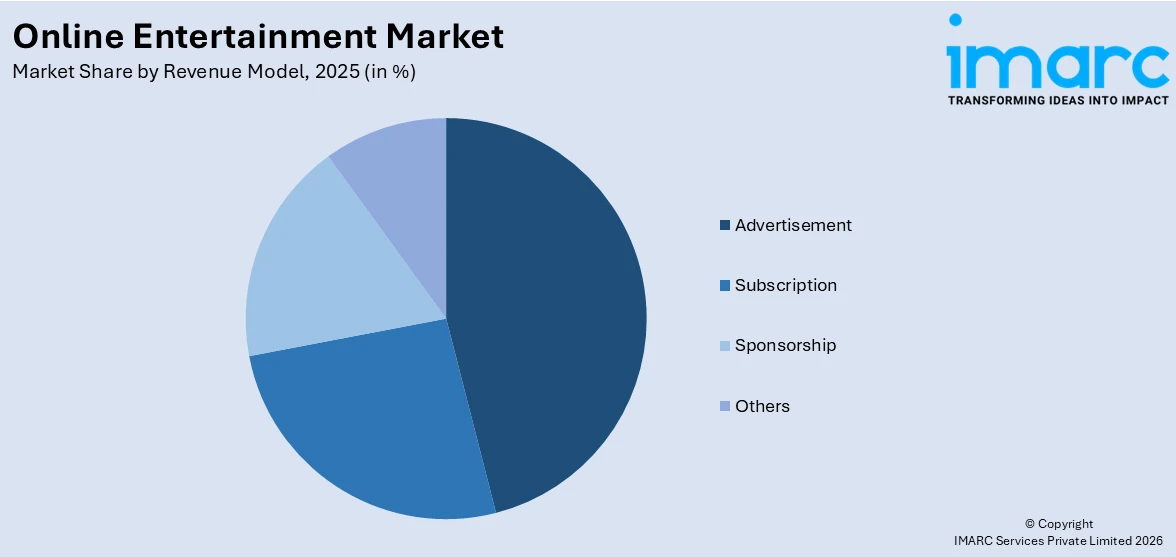
Advertisement represents the largest segment because of its effectiveness in reaching vast, targeted audiences. Digital advertising leverages advanced analytics and algorithms to deliver personalized ads, ensuring higher engagement and conversion rates. The widespread adoption of streaming platforms, social media, and mobile apps is creating abundant opportunities for advertisers to reach users across diverse demographics. Advertisers benefit from the ability to integrate ads seamlessly into content through formats like in-stream videos, banners, and sponsored posts, enhancing visibility without disrupting user experiences. Furthermore, the growing user base of free, ad-supported platforms has fueled ad spending, as brands prioritize cost-effective strategies to maximize exposure. Innovations such as interactive ads and immersive formats like AR further enhance engagement, making digital advertising an indispensable revenue driver. As businesses shift budgets from traditional media to digital channels, advertisements continue to dominate the market, providing sustainable growth for entertainment platforms.
Analysis by Device:
Access the comprehensive market breakdown Request Sample
- Smartphones
- Smart TVs, Projectors and Monitors
- Laptop, Desktop and Tablets
- Others
Smartphones dominate the market due to their unparalleled convenience, affordability, and widespread adoption across the globe. Their portability allows users to access online entertainment anywhere, making them a preferred device for watching digital content. Enhanced internet connectivity, such as 4G and 5G networks, supports seamless streaming and gaming experiences. Advances in smartphone technology, including larger screens, better resolutions, and powerful processors, are significantly improving the quality of entertainment watching. Affordable data plans and the availability of budget-friendly smartphones are further increasing their penetration, even in developing regions. Mobile-friendly apps and platforms designed for entertainment, such as streaming services, social media, and online games, are also contributing to their dominance. Additionally, the integration of features like personalized recommendations and offline viewing options caters to diverse user preferences, solidifying smartphones as the leading device for accessing a wide range of online entertainment. Their versatility ensures they remain indispensable in this fast-growing market.
Regional Analysis:
To get more information on the regional analysis of this market Request Sample
- North America
- United States
- Canada
- Asia Pacific
- China
- Japan
- India
- South Korea
- Australia
- Indonesia
- Others
- Europe
- Germany
- France
- United Kingdom
- Italy
- Spain
- Russia
- Others
- Latin America
- Brazil
- Mexico
- Others
- Middle East and Africa
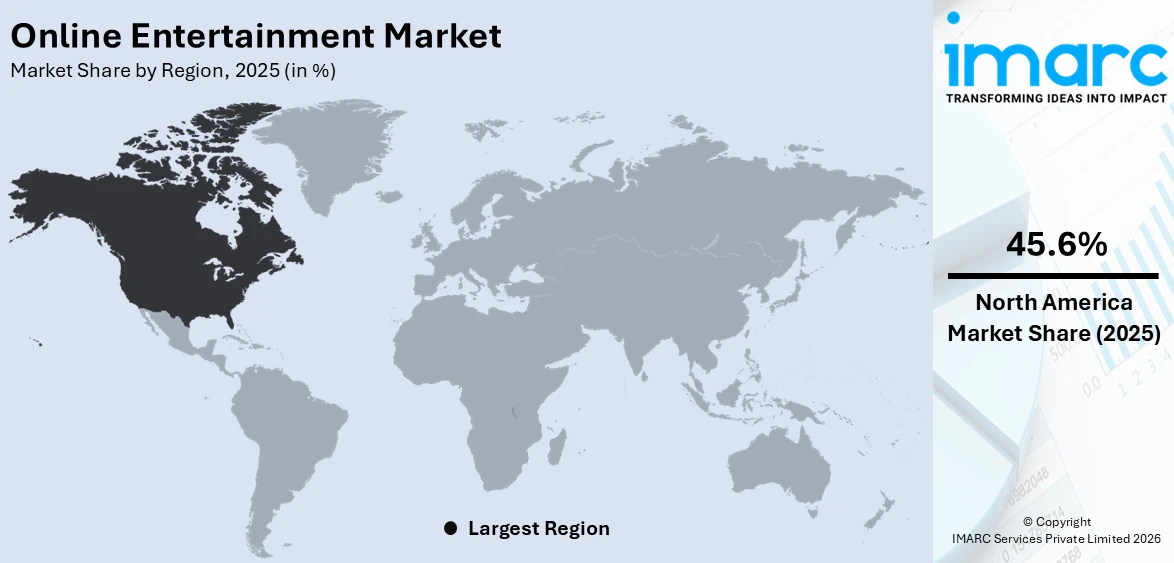
In 2025, North America accounted for the largest market share of 45.6%. According to the online entertainment market statistics, North America has high internet penetration rates, with robust broadband and high-speed mobile networks, facilitating seamless streaming and online gaming experiences. Apart from this, mobile gaming and cloud gaming are major growth areas. North America is a considerable market casual as well as competitive gaming, which is continuously supported by platforms like Twitch, along with game developers that are focusing on mobile-first experiences. Moreover, platforms like Netflix, Hulu, Amazon Prime Video, and Disney+ are major players in the market, offering extensive libraries of on-demand video content. Their popularity continues to drive market growth. In October 2024, Netflix and Universal Filmed Entertainment Group announced the renewed licensing deal which would give Netflix exclusive rights to the animated films of Illumination and DreamWorks Animation. In addition, from 2027, Netflix will get rights to live-action films by Universal Pictures and Focus Features in the United States for an exclusive 10-month window.
Key Regional Takeaways:
United States Online Entertainment Market Analysis
The United States market demonstrates exceptional strength driven by widespread internet access availability and increasing consumer demand for diversified digital content across entertainment categories. High household penetration rates for streaming service subscriptions reflect robust consumer adoption patterns, with leading platforms commanding substantial market presence through extensive content libraries and exclusive programming investments. Mobile gaming expansion combined with digital event proliferation accelerates market momentum as consumers embrace diverse entertainment formats across devices and platforms. Content diversification strategies alongside advanced streaming technology deployment from major providers drive continuous innovation across competitive landscapes. Popularity of esports competitions combined with live streaming service adoption positions the United States market at the forefront of global entertainment trends. Favorable regulatory environments encourage platform investment while supporting competitive dynamics that benefit consumers through expanded choices and improved service quality across subscription tiers and content offerings.
Europe Online Entertainment Market Analysis
European markets demonstrate consistent expansion trajectories supporting overall entertainment economy growth across diverse national markets and demographic segments. Increasing internet penetration combined with evolving content distribution mechanisms provides continuing catalysts for sustained spending growth across forecast periods. Video-on-demand platforms achieve significant market penetration across major economies, reflecting consumer migration from traditional media consumption toward digital streaming alternatives. The transformation from conventional media formats toward digital streaming gains momentum while gaming achieves substantial mobilization levels across leading markets. Local platform operators compete vigorously with international providers through strategic focus on regional content development that attracts subscriber loyalty. Regulatory frameworks addressing data privacy and content rights establish stable market environments that encourage innovation investments while protecting consumer interests. European consumer preferences continue evolving toward digital entertainment formats, creating expanding opportunities for both global platforms and regional service providers across entertainment categories.
Asia Pacific Online Entertainment Market Analysis
The Asia Pacific region experiences dynamic market expansion propelled by rising disposable income levels alongside increasing internet access across populous nations. Leading economies demonstrate substantial entertainment industry growth trajectories supported by expanding internet advertising revenues, video streaming adoption, gaming proliferation, and esports participation. Video streaming platforms combined with gaming applications occupy central positions within regional growth dynamics as mobile gaming demonstrates particularly strong expansion patterns. Strategic partnerships between technology companies alongside government infrastructure investments enhance regional market development potential. Local content production combined with regional platform customization strategies strengthen market positions across diverse linguistic and cultural markets. The Asia Pacific region positions itself as an increasingly significant competitive force within global entertainment landscapes as domestic platform development progresses alongside international service expansion across markets characterized by substantial population bases and growing middle-class consumer segments seeking premium entertainment experiences.
Latin America Online Entertainment Market Analysis
Latin America's streaming landscape remains among the strongest growth regions characterized by diverse platform offerings addressing varied consumer preferences across income segments. Substantial numbers of active streaming platforms operate across regional markets, with significant proportions offering free access models, subscription-based services, advertisement-supported formats, and hybrid approaches combining multiple revenue mechanisms. Platform diversity provides consumers with extensive choices spanning different content categories and pricing structures suited to varied economic circumstances across regional populations. The subscription-with-ads model gains traction across Latin American markets following successful implementation in other regions, offering dual benefits through supplementary advertising revenues for platforms while enabling reduced subscription prices for cost-conscious consumers. This evolving model framework supports continued market expansion as streaming platforms adapt business strategies to regional economic conditions and consumer preferences while maintaining content quality and service reliability standards.
Middle East and Africa Online Entertainment Market Analysis
The Middle East and Africa region experiences robust market growth driven by accelerating digital adoption patterns, particularly across leading economies demonstrating exceptional internet infrastructure development. Substantial internet user populations combined with high penetration rates reflect advanced digital connectivity supporting online entertainment consumption across diverse content categories. Social media platform adoption rates indicate strong digital engagement preferences among populations increasingly comfortable with streaming services and mobile-based entertainment formats. Cellular mobile connection penetration exceeding population levels demonstrates widespread device accessibility enabling convenient entertainment access across geographic areas. These comprehensive internet and mobile connectivity levels fuel remarkable growth trajectories within regional entertainment markets spanning streaming platforms, digital content consumption, and mobile-based entertainment applications. As digital infrastructure continues improving across regional markets, key economies position themselves as significant drivers supporting continued regional growth across entertainment categories responding to surging demand for streaming services alongside mobile-focused entertainment delivery mechanisms.
Competitive Landscape:
Key players in the market are focusing on enhancing user experiences through technological innovations, such as improved streaming quality and personalized content recommendations. They are investing in original content production to attract and retain subscribers while forming strategic partnerships to expand their global reach. Additionally, they are exploring new formats like VR, AR, and interactive content to engage users in unique ways. Efforts to improve accessibility through mobile-friendly platforms and regional content are further broadening their appeal across diverse demographics and markets. Many are also leveraging advanced analytics to understand user preferences and tailor offerings accordingly. These companies are also adopting flexible subscription models and integrating advertising to diversify revenue streams. In July 2024, ABEMA, a forward-looking television service, incorporated AI-driven multilingual subtitles into "ABEMA Live," an online live entertainment platform operating in Japan and Asia. ABEMA Live allows users to buy and view a range of pay-per-view entertainment from different nations.
The report provides a comprehensive analysis of the competitive landscape in the online entertainment market with detailed profiles of all major companies, including:
- Amazon.com, Inc.
- Apple Inc.
- Electronic Arts Inc.
- Google LLC
- JioHotstar
- Netflix, Inc.
- Nintendo Co., Ltd.
- Rakuten Group, Inc.
- Sony Corporation
- Spotify AB
- Tencent Holdings Ltd.
- Ubisoft Entertainment
- Xfinity
Latest News and Developments:
- February 2025: Reliance Industries and The Walt Disney Company announced the merger of JioCinema and Disney+ Hotstar to form JioHotstar in India. The new streaming platform combines over 300,000 hours of content including entertainment and live sports, with a potential customer base of 500 Million users. JioHotstar offers content in 19 languages with subscription plans starting at ₹149 for three months, featuring 4K streaming capabilities and AI-powered recommendations.
- January 2025: Industry analysts predict significant consolidation trends for 2025, with at least one second-tier streaming service expected to cease standalone operations through merger or acquisition. Streaming services are anticipated to combat subscriber churn through long-term subscription discounts and flexible pause options. News organizations are expected to intensify focus on platforms like YouTube and TikTok, emphasizing short-form content while reducing investments in traditional television personalities.
- December 2024: Inspired Entertainment announced a partnership with Aristocrat Interactive to launch the first-ever online V-Lottery gaming suite for the Virginia Lottery. This suite will feature virtual sports games like football, basketball, and horse racing, enhancing the iLottery experience.
- October 2024: Caesars Entertainment launched Horseshoe Online Casino, a new online platform and mobile app aimed at seasoned casino players. Initially available in Michigan, it offers a high-quality, player-centric experience with exclusive games, promotions, and integration with Caesars Rewards. The platform features customizable promotions, classic Horseshoe branding, and a range of games across multiple categories.
- September 2024: Ultra Media & Entertainment Group announced a Rs 500 crore investment to launch two new OTT platforms, Ultra Play and Ultra Gaane, as part of its growth strategy. Ultra Play focuses on Hindi film classics, offering a vast library of over 2,000 films. The investment will support content acquisition, production, and marketing, aiming for a revenue of Rs 200 crore by FY 2024-25.
- December 2024: Discovery Inc has secured a distribution deal, guaranteeing that WBD's streaming platform Max will be accessible at no cost to every Spectrum TV Select subscriber. Customers will get access to Max With Ads, with an estimated value of USD 9.99/month and offering content from HBO, Warner Bros., DC, and much more.
- May 2024: Gordon Ramsay and Fox launched Bite, a global food brand and entertainment platform. The platform will offer a variety of food-related content, along with products and experiences.
- March 2024: Kustom Entertainment, Inc., a prominent company in live event marketing and concert production and a part of Digital Ally Inc., introduced Kustom Tickets, a groundbreaking online platform aimed at offering customers an easy and enjoyable ticket purchasing experience.
Online Entertainment Market Report Scope:
| Report Features | Details |
|---|---|
| Base Year of the Analysis | 2025 |
| Historical Period | 2020-2025 |
| Forecast Period | 2026-2034 |
| Units | Billion USD |
|
Scope of the Report |
Exploration of Historical Trends and Market Outlook, Industry Catalysts and Challenges, Segment-Wise Historical and Future Market Assessment:
|
| Forms Covered | Video, Audio, Games, Internet Radio, Others |
| Revenue Models Covered | Subscription, Advertisement, Sponsorship, Others |
| Devices Covered | Smartphones, Smart TVs, Projectors and Monitors, Laptop, Desktop and Tablets, Others |
| Regions Covered | Asia Pacific, Europe, North America, Latin America, Middle East and Africa |
| Countries Covered | United States, Canada, Germany, France, United Kingdom, Italy, Spain, Russia, China, Japan, India, South Korea, Australia, Indonesia, Brazil, Mexico |
| Companies Covered | Amazon.com, Inc., Apple Inc., Electronic Arts Inc., Google LLC, JioHotstar, Netflix, Inc., Nintendo Co., Ltd., Rakuten Group, Inc., Sony Corporation, Spotify AB, Tencent Holdings Ltd., Ubisoft Entertainment, Xfinity, etc. |
| Customization Scope | 10% Free Customization |
| Post-Sale Analyst Support | 10-12 Weeks |
| Delivery Format | PDF and Excel through Email (We can also provide the editable version of the report in PPT/Word format on special request) |
Key Benefits for Stakeholders:
- IMARC’s report offers a comprehensive quantitative analysis of various market segments, historical and current market trends, market forecasts, and dynamics of the online entertainment market from 2020-2034.
- The research study provides the latest information on the market drivers, challenges, and opportunities in the global online entertainment market.
- The study maps the leading, as well as the fastest-growing, regional markets. It further enables stakeholders to identify the key country-level markets within each region.
- Porter's Five Forces analysis assists stakeholders in assessing the impact of new entrants, competitive rivalry, supplier power, buyer power, and the threat of substitution. It helps stakeholders to analyze the level of competition within the online entertainment industry and its attractiveness.
- Competitive landscape allows stakeholders to understand their competitive environment and provides an insight into the current positions of key players in the market.
Frequently Asked Questions About the Online Entertainment Market Report
The online entertainment market was valued at USD 612.1 Billion in 2025.
IMARC estimates the global online entertainment market to exhibit a CAGR of 16.38% during 2026-2034.
The market is driven by expansion of internet infrastructure worldwide enabling seamless access through high-speed connectivity. Widespread smartphone adoption provides convenient entry points while affordable subscription models attract diverse audiences. Technological advancements including artificial intelligence personalization enhance user engagement through tailored content recommendations and immersive viewing experiences.
On a regional level, the market has been classified into North America, Asia Pacific, Europe, Latin America, and Middle East and Africa, wherein North America currently dominates the global market.
Some of the major players in the global online entertainment market include Amazon.com, Inc., Apple Inc., Electronic Arts Inc., Google LLC, JioHotstar, Netflix, Inc., Nintendo Co., Ltd., Rakuten Group, Inc., Sony Corporation, Spotify AB, Tencent Holdings Ltd., Ubisoft Entertainment, Xfinity, etc.
Need more help?
- Speak to our experienced analysts for insights on the current market scenarios.
- Include additional segments and countries to customize the report as per your requirement.
- Gain an unparalleled competitive advantage in your domain by understanding how to utilize the report and positively impacting your operations and revenue.
- For further assistance, please connect with our analysts.
 Request Customization
 Speak to an Analyst
 Request Brochure
 Inquire Before Buying
Benefits of Customization
- Personalize this research
- Triangulate with your data
- Get data as per your format and definition
- Gain a deeper dive into a specific application, geography, customer, or competitor
- Any level of personalization
Get in Touch With Us
UNITED STATES
Phone: +1-201-971-6302
INDIA
Phone: +91-120-433-0800
UNITED KINGDOM
Phone: +44-753-714-6104
Email: [email protected]
Client Testimonials




.webp)




.webp)













Related Reports

Choose your plan
*Please note that the prices mentioned below are starting prices for each bundle type. Kindly contact our team for further details.*
Single User License
- 1 User License, Access on 2 Devices
- PDF Report + Excel Dataset (Password Protected)
- Lifetime Access
- No Printing Rights
- 10% Free Report Customization
- 10–12 Weeks of Analyst Support
Five User License
- Access for 5 Users, 2 Devices per User
- PDF Report + Excel Dataset (Password Protected)
- Lifetime Access
- Dedicated Account Manager
- 12–14 Weeks of Analyst Support
- No Printing Rights
- 15% Free Report Customization
- 25% Discount on Your Next Purchase
Corporate User License
- Unlimited User Access (Within Your Organization)
- PDF Report + Excel Dataset
- Lifetime Access
- Dedicated Account Manager
- 14–20 Weeks of Analyst Support
- No Printing Rights
- 20% Free Report Customization
- 30% Discount on Your Next Purchase
Essential Insights
What's included:
3 reports
- Lifetime Access
- PDF Reports
- Excel Datasets
- 2 Weeks of Free Analyst Support
- 2 User Licenses
- Access on 2 Devices
- Printing Rights
- Complimentary PowerPoint (PPT) Version
- Complimentary License Upgrade
Professional Access
What's included:
5 reports
- Lifetime Access
- PDF Reports
- Excel Datasets
- 8 Weeks of Free Analyst Support
- 2 User Licenses
- Access on 2 Devices
- Printing Rights
- Complimentary PowerPoint (PPT) Version
- Complimentary License Upgrade
Business Advantage
What's included:
8 reports
- Lifetime Access
- PDF Reports
- Excel Datasets
- 14 Weeks of Free Analyst Support
- 2 User Licenses
- Access on 2 Devices
- Printing Rights
- Complimentary PowerPoint (PPT) Version
- Complimentary License Upgrade
Enterprise Intelligence
What's included:
10 reports
- Lifetime Access
- PDF Reports
- Excel Datasets
- 20 Weeks of Free Analyst Support
- 2 User Licenses
- Access on 2 Devices
- Printing Rights
- Complimentary PowerPoint (PPT) Version
- Complimentary License Upgrade