
Online Financing Platform for SMBs Market Size, Share, Trends and Forecast by Application, and Region, 2026-2034
Online Financing Platform for SMBs Market Size and Share:
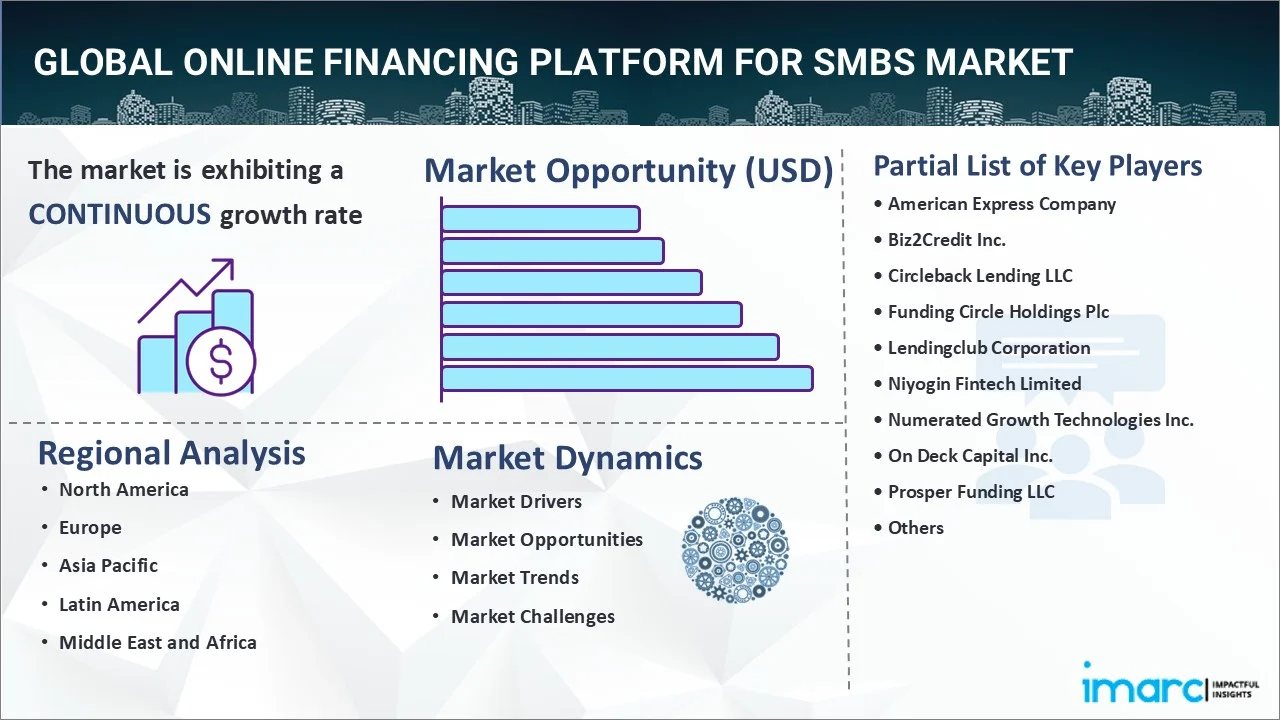
The global online financing platform for SMBs market size was valued at USD 4.43 Billion in 2025. Looking forward, IMARC Group estimates the market to reach USD 13.24 Billion by 2034, exhibiting a CAGR of 12.95% from 2026-2034. North America currently dominates the market, holding a market share of 38%. The market represents a transformative digital ecosystem enabling small and medium-sized businesses to access capital through streamlined web-based and mobile applications. These platforms eliminate traditional banking barriers by leveraging advanced algorithms, alternative credit scoring mechanisms, and real-time data analytics to expedite loan approvals and disbursements. By democratizing financial services and offering flexible repayment structures, these digital solutions empower entrepreneurs to secure working capital, expand operations, and navigate economic uncertainties with unprecedented efficiency, fundamentally reshaping the landscape of online financing platform for SMBs market share.
|
Report Attribute
|
Key Statistics
|
|---|---|
|
Base Year
|
2025
|
|
Forecast Years
|
2026-2034
|
|
Historical Years
|
2020-2025
|
|
Market Size in 2025
|
USD 4.43 Billion |
|
Market Forecast in 2034
|
USD 13.24 Billion |
| Market Growth Rate (2026-2034) | 12.95% |
Digital transformation initiatives worldwide are fundamentally reshaping how small and medium-sized businesses access capital, driving unprecedented demand for online financing platforms. As enterprises increasingly migrate toward cloud-based operations and mobile-first strategies, traditional brick-and-mortar banking models struggle to meet the speed and flexibility requirements of modern entrepreneurs. This paradigm shift accelerates adoption of technology-enabled lending solutions that leverage artificial intelligence, machine learning, and blockchain technologies to assess creditworthiness beyond conventional metrics. Global connectivity improvements, particularly in emerging economies, expand platform accessibility across diverse geographic markets. For example, in emerging markets the formal MSME finance gap is estimated at some US$ 5.7 trillion, equivalent to about 19 % of GDP and one‑fifth of total private‑sector credit, underscoring the urgent need for alternative financing channels. Regulatory frameworks evolve to accommodate fintech innovation while maintaining consumer protection standards. The proliferation of smartphones and improved internet infrastructure democratizes financial services, enabling previously underserved business segments to access funding opportunities. These converging factors create a robust ecosystem where digital lending platforms thrive, supported by venture capital investments and strategic partnerships between technology companies and financial institutions seeking competitive differentiation in rapidly evolving markets.
To get more information on this market Request Sample
The United States leads online financing platform for SMBs market growth with a share of 87% through a mature fintech ecosystem, supportive regulatory environment, and widespread entrepreneurial activity. Small business formation rates maintain momentum across diverse sectors, creating sustained demand for accessible capital solutions. American entrepreneurs demonstrate high comfort levels with digital financial tools, accelerated by pandemic-era adoption of contactless services and remote business operations. The regulatory landscape balances innovation encouragement with consumer protection through frameworks that enable alternative lenders while maintaining market integrity. Established financial institutions increasingly partner with technology providers to enhance service delivery and compete effectively against digital-native platforms. Access to sophisticated data analytics, credit scoring algorithms, and automated underwriting systems enables rapid loan processing that traditional banking channels cannot match. Geographic diversity across states creates varied economic conditions, requiring flexible financing solutions tailored to regional business cycles. Strong venture capital presence fuels platform development and market expansion initiatives, establishing the region as the primary innovation hub for financial technology advancement.
Online Financing Platform for SMBs Market Trends:
Alternative Credit Scoring Integration
Financing platforms increasingly incorporate alternative data sources beyond traditional credit bureau information to evaluate small business creditworthiness comprehensively. This innovation analyzes transaction histories, social media presence, supplier relationships, customer reviews, and operational metrics to build holistic risk profiles. Advanced machine learning algorithms process diverse data points including seasonal revenue patterns, inventory turnover rates, and digital footprint indicators to predict repayment probability accurately. This approach particularly benefits businesses lacking extensive credit histories or operating in non-traditional sectors where conventional scoring methods prove inadequate. Real-time data integration enables dynamic credit limit adjustments based on business performance fluctuations. Platform providers leverage banking APIs to access transactional data with customer consent, creating transparent assessment processes. According to recent industry reporting, 84 % of lenders now use a combination of traditional + alternative data to underwrite borrowers (though only ~3 % rely on alternative data alone). These sophisticated methodologies reduce approval times from weeks to hours while expanding access for minority-owned enterprises, startups, and businesses in underserved communities previously excluded from traditional lending channels through outdated evaluation criteria.
Embedded Finance Solutions
Integration of financing capabilities directly into business software ecosystems represents transformative online financing platform for SMBs market trends reshaping capital access paradigms. E-commerce platforms, accounting software providers, and point-of-sale systems now embed lending products within their existing interfaces, eliminating friction between business operations and funding acquisition. This seamless integration enables automatic loan applications triggered by working capital needs identified through real-time financial monitoring. Businesses access credit without leaving familiar operational environments, reducing application complexity and accelerating decision-making processes. Platform partnerships between software providers and financial institutions create mutually beneficial ecosystems where data sharing enhances risk assessment accuracy while expanding customer reach. These embedded solutions often feature automated repayment mechanisms linked directly to revenue streams, aligning payment obligations with cash flow realities. The model particularly resonates with digitally native businesses accustomed to integrated technology stacks, driving widespread adoption across sectors from retail to professional services as convenience becomes paramount in competitive lending markets.
Flexible Financing Structures
Platform providers increasingly offer customizable financing products tailored to diverse business needs and revenue models rather than standardized loan structures. Revenue-based financing gains prominence, where repayment amounts fluctuate according to monthly sales performance, providing breathing room during seasonal downturns or economic uncertainties. For example, Shiprocket recently launched “Shiprocket Capital” in India, providing Rs 100 crore (~US$ 12 million) in revenue‑based financing to SMBs, with repayments tied to a flat fee plus a percentage of monthly revenue. Invoice financing and supply chain financing options address specific working capital requirements without traditional collateral demands. Subscription-based credit lines enable businesses to draw funds as needed while paying only for utilized amounts, mirroring consumption patterns familiar in software-as-a-service models. Hybrid products combine elements of term loans, lines of credit, and merchant cash advances to match individual business cash flow characteristics. This flexibility extends to repayment schedules, allowing businesses to choose daily, weekly, or monthly payment frequencies aligned with revenue collection cycles. Transparent pricing models with clear fee structures replace complex interest calculations, building trust and enabling informed decision-making for entrepreneurs navigating growth funding options.
Online Financing Platform for SMBs Industry Segmentation:
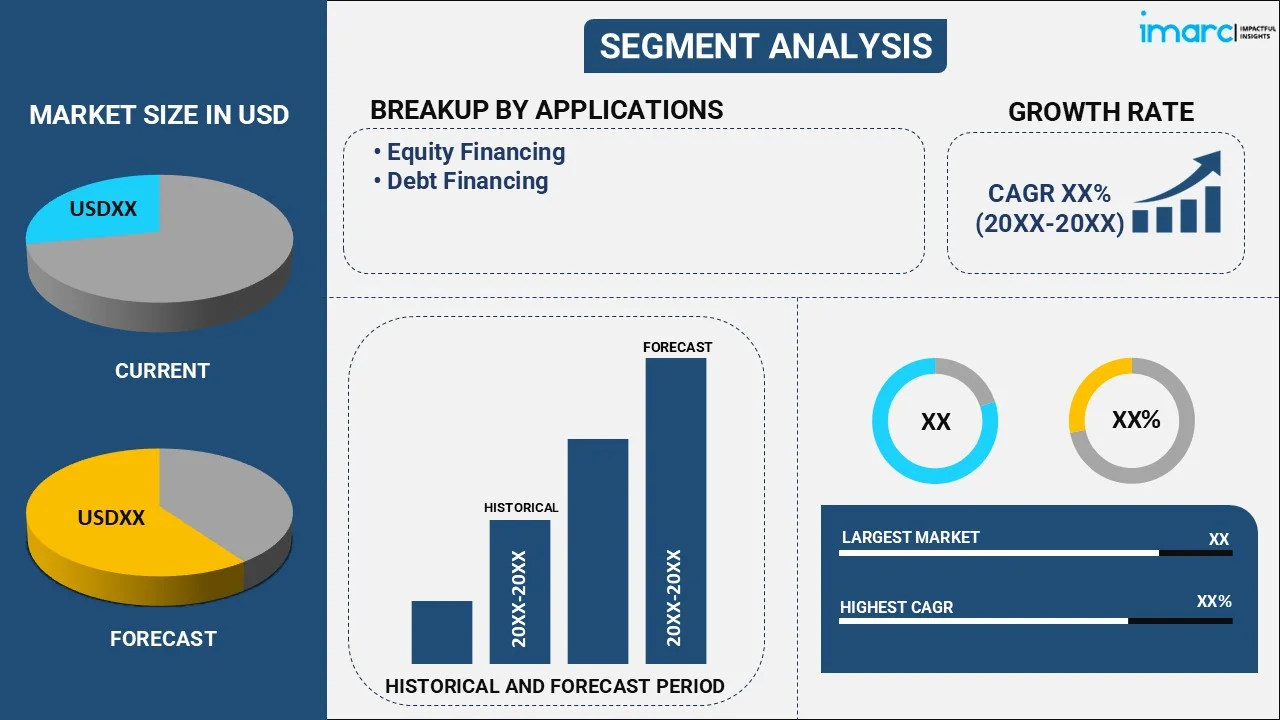
IMARC Group provides an analysis of the key trends in each segment of the global online financing platform for SMBs market, along with forecast at the global, regional, and country levels from 2026-2034. The market has been categorized based on application.
Analysis by Application:
To get detailed segment analysis of this market Request Sample
- Equity Financing
- Debt Financing
Debt financing applications command the dominant position with 75% share in 2024, reflecting strong business preference for maintaining ownership control while accessing growth capital. This application category encompasses term loans, credit lines, and invoice financing products that enable businesses to preserve equity stakes and decision-making authority. The online financing platform for SMBs market outlook indicates sustained preference for debt instruments as entrepreneurs prioritize operational flexibility without diluting ownership structures. Digital platforms excel at streamlining debt product delivery through automated underwriting systems that evaluate repayment capacity using comprehensive data analytics. Competitive interest rates and transparent fee structures make debt financing increasingly attractive compared to alternative funding mechanisms. Businesses appreciate predictable repayment schedules that facilitate financial planning and budgeting processes. The segment benefits from regulatory clarity and established legal frameworks governing lending relationships. Platform innovations continue enhancing debt product accessibility for businesses previously excluded from traditional banking channels, expanding addressable markets significantly.
Regional Analysis:
To get more information on the regional analysis of this market Request Sample
- North America
- United States
- Canada
- Asia Pacific
- China
- Japan
- India
- South Korea
- Australia
- Indonesia
- Others
- Europe
- Germany
- France
- United Kingdom
- Italy
- Spain
- Russia
- Others
- Latin America
- Brazil
- Mexico
- Others
- Middle East and Africa
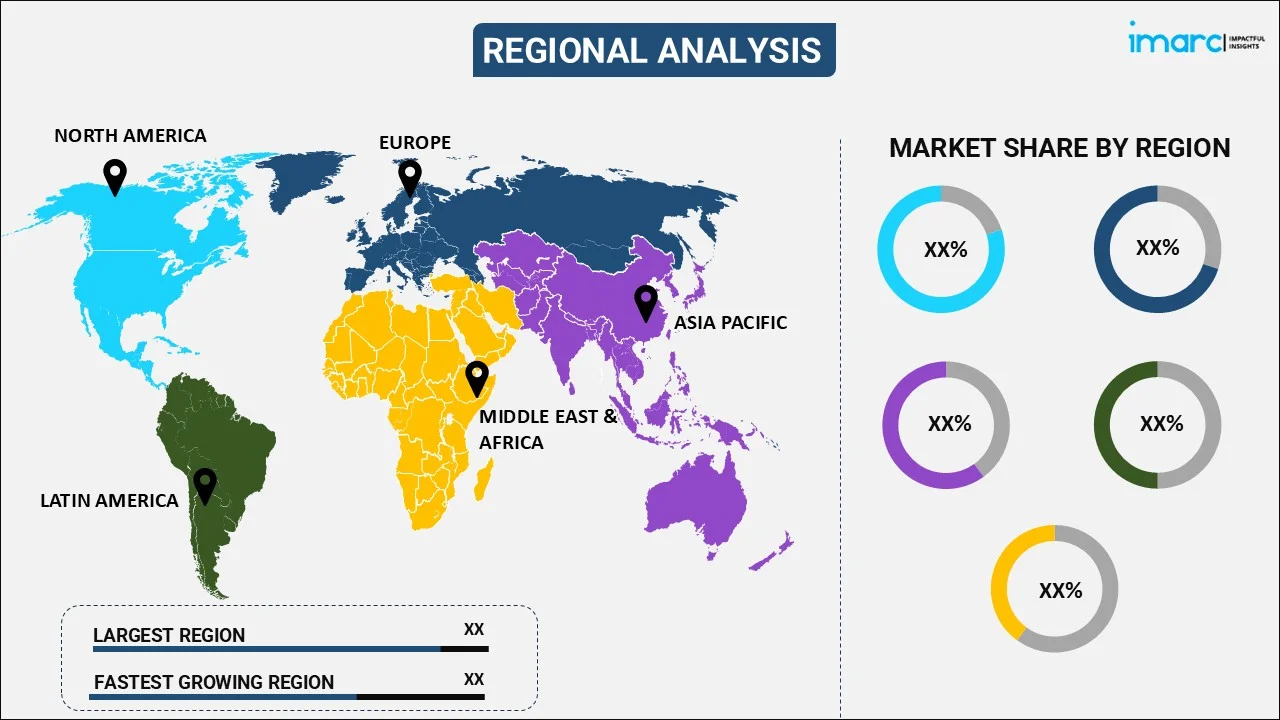
North America dominates the global landscape with 38% regional share, driven by concentrated platform presence in the United States and expanding adoption across Canada and Mexico. Cross-border trade integration through agreements facilitates platform expansion strategies targeting businesses engaged in regional commerce. Canadian markets demonstrate strong digital literacy and regulatory environments supportive of fintech innovation, though adoption rates lag behind southern neighbors due to more concentrated banking sector and different business financing traditions. Mexican markets present significant growth opportunities as internet penetration increases and entrepreneurial activity accelerates, particularly in urban centers where smartphone adoption enables platform access. Regional platforms increasingly offer multi-currency capabilities and cross-border financing products supporting businesses operating across national boundaries. Language localization and culturally adapted user interfaces enhance platform accessibility across diverse communities. The region benefits from established payment infrastructure, reliable telecommunications networks, and regulatory cooperation enabling platform scalability across jurisdictions.
Key Regional Takeaways:
United States Online Financing Platform for SMBs Market Analysis
The United States maintains a mature and sophisticated online financing ecosystem supported by robust fintech infrastructure, progressive regulatory frameworks, and high digital adoption rates among business owners. Platform providers benefit from extensive venture capital funding, enabling continuous innovation in underwriting technologies, user experience design, and product development. The regulatory environment balances consumer protection with innovation encouragement through state-level licensing requirements and federal oversight mechanisms that maintain market integrity while permitting alternative lending models. Strong partnerships between traditional financial institutions and technology companies create hybrid solutions combining banking expertise with digital agility. Geographic diversity across states generates varied economic conditions and industry concentrations, requiring platforms to offer flexible products addressing regional business characteristics. High smartphone penetration and reliable internet connectivity enable seamless platform access across urban and rural markets. The competitive landscape drives continuous improvement in approval speed, pricing transparency, and customer service quality, establishing the region as the global benchmark for digital lending innovation.
Asia Pacific Online Financing Platform for SMBs Market Analysis
Asia Pacific emerges as a rapidly expanding region characterized by diverse market maturity levels, massive underbanked business populations, and accelerating smartphone adoption rates. Markets including China, India, and Southeast Asian nations demonstrate particularly strong growth trajectories fueled by government digitalization initiatives and entrepreneurial ecosystem development. Mobile-first platform designs address infrastructure realities where desktop computer access remains limited but smartphone penetration reaches high levels even in rural areas. Regulatory frameworks vary significantly across jurisdictions, with some markets implementing progressive fintech policies while others maintain restrictive banking regulations requiring careful navigation. Alternative credit scoring proves particularly valuable in addressing limited credit history availability among small business owners. E-commerce platform integration facilitates financing access for online merchants representing substantial business segments. Cultural preferences for relationship-based lending transition gradually toward technology-enabled solutions as younger entrepreneurs embrace digital tools. Regional platforms increasingly leverage local payment systems and digital wallet integrations to enhance user convenience and transaction efficiency.
Europe Online Financing Platform for SMBs Market Analysis
Europe presents a fragmented yet sophisticated market landscape shaped by diverse regulatory regimes, strong consumer protection standards, and varying levels of digital banking adoption across member states. Western European markets demonstrate high fintech maturity with established platform presence and competitive landscapes, while Eastern European regions exhibit rapid growth potential as digital infrastructure improves and entrepreneurial activity accelerates. The European Union's Payment Services Directive facilitates cross-border operations through standardized regulatory frameworks, enabling platform scaling across jurisdictions. Open banking regulations mandate data sharing between financial institutions and authorized third parties, creating opportunities for enhanced credit assessment and personalized product offerings. Language diversity requires substantial localization investments for platforms targeting pan-European markets. Strong banking sector presence creates both competition and partnership opportunities as traditional institutions develop digital capabilities or acquire fintech companies. Privacy regulations impose stringent data handling requirements affecting platform operations but building consumer trust through transparency and protection mechanisms valued by business owners.
Latin America Online Financing Platform for SMBs Market Analysis
Latin America represents a high-growth region characterized by large underbanked business populations, increasing internet connectivity, and progressive regulatory attitudes toward fintech innovation. Markets including Brazil, Mexico, Argentina, and Colombia lead regional adoption as governments implement digital transformation initiatives and regulatory sandboxes enabling platform experimentation. Massive informal economy segments present both opportunities and assessment complexities as platforms develop methodologies for evaluating businesses lacking traditional financial documentation. Mobile-first designs prove essential as smartphone adoption outpaces desktop computer access across income levels. Alternative credit scoring utilizing utility payment histories, rental records, and social network data enables risk assessment for businesses excluded from conventional banking systems. Economic volatility and currency fluctuations require sophisticated risk management capabilities and flexible product structures. Regional platforms increasingly integrate with popular messaging applications and social media platforms where business owners conduct significant commercial activities, meeting customers in familiar digital environments rather than requiring separate application processes.
Middle East and Africa Online Financing Platform for SMBs Market Analysis
The Middle East and Africa region exhibits nascent but accelerating market development driven by young populations, improving digital infrastructure, and government commitments to economic diversification. Gulf Cooperation Council markets demonstrate high smartphone penetration and supportive regulatory environments as governments pursue fintech hub development strategies attracting international platform operators. African markets present substantial growth potential as mobile money adoption establishes digital payment foundations enabling lending platform operations. Internet connectivity improvements through submarine cable investments and satellite technologies expand platform accessibility across rural communities. Islamic finance principles influence product design requirements in Muslim-majority markets, necessitating Sharia-compliant structures avoiding interest-based lending. Limited credit bureau coverage makes alternative data sources particularly valuable for assessing business creditworthiness. Regional platforms increasingly partner with telecommunications companies leveraging mobile network operator data for risk assessment. Language diversity and cultural variations require localized approaches respecting regional business practices and communication preferences across diverse markets.
Competitive Landscape:
The competitive landscape exhibits dynamic characteristics with diverse platform types including pure-play fintech startups, traditional bank digital initiatives, and marketplace lending platforms connecting investors with borrowers. Competition intensifies around user experience optimization, approval speed, pricing transparency, and customer service quality as differentiation factors. Strategic partnerships between technology providers and financial institutions create hybrid models combining regulatory compliance expertise with innovative product development capabilities. The online financing platform for SMBs market forecast anticipates continued consolidation as larger platforms acquire smaller competitors or specialized solution providers to expand product portfolios and geographic reach. Investment in artificial intelligence and machine learning technologies drives competitive advantages in risk assessment accuracy and operational efficiency. Platform providers increasingly focus on vertical specialization, targeting specific industries with tailored products addressing unique financing needs. Regulatory compliance capabilities, data security infrastructure, and fraud prevention systems become critical competitive factors as oversight intensifies. Customer acquisition costs rise amid growing marketing expenditures, pressuring platforms to optimize retention strategies and lifetime value maximization through cross-selling and product diversification initiatives.
The report provides a comprehensive analysis of the competitive landscape in the online financing platform for SMBs market with detailed profiles of all major companies, including:
- American Express Company
- Biz2Credit Inc.
- Circleback Lending LLC
- Funding Circle Holdings Plc
- Lendingclub Corporation
- Niyogin Fintech Limited
- Numerated Growth Technologies Inc.
- On Deck Capital Inc.
- Prosper Funding LLC
- Sofi Technologies Inc.
- Versara Lending LLC
Latest News and Developments:
- In July 2025: Adyen, the global fintech and payments platform, launched “Capital”, an embedded financing solution for SMBs via platform‑businesses. The platform enables fast, flexible loans with repayment linked to daily sales, minimal paperwork, and transparent fees. Platform operators earn revenue share while Adyen assumes credit risk.
- In June 2025: Walmart‑owned Flipkart obtained a licence from the Reserve Bank of India to operate as an NBFC, allowing it to provide direct loans to customers and sellers through its e‑commerce and fintech platforms. This move strengthens Flipkart’s embedded financing capabilities for SMBs.
Online Financing Platform for SMBs Market Report Scope:
| Report Features | Details |
|---|---|
| Base Year of the Analysis | 2025 |
| Historical Period | 2020-2025 |
| Forecast Period | 2026-2034 |
| Units | Billion USD |
| Scope of the Report | Exploration of Historical Trends and Market Outlook, Industry Catalysts and Challenges, Segment-Wise Historical and Future Market Assessment:
|
| Applications Covered | Equity Financing, Debt Financing |
| Regions Covered | Asia Pacific, Europe, North America, Latin America, Middle East and Africa |
| Countries Covered | United States, Canada, Germany, France, United Kingdom, Italy, Spain, Russia, China, Japan, India, South Korea, Australia, Indonesia, Brazil, Mexico |
| Companies Covered | American Express Company, Biz2Credit Inc., Circleback Lending LLC, Funding Circle Holdings Plc, Lendingclub Corporation, Niyogin Fintech Limited, Numerated Growth Technologies Inc., On Deck Capital Inc., Prosper Funding LLC, Sofi Technologies Inc., Versara Lending LLC. |
| Customization Scope | 10% Free Customization |
| Post-Sale Analyst Support | 10-12 Weeks |
| Delivery Format | PDF and Excel through Email (We can also provide the editable version of the report in PPT/Word format on special request) |
Key Benefits for Stakeholders:
- IMARC’s report offers a comprehensive quantitative analysis of various market segments, historical and current market trends, market forecasts, and dynamics of the online financing platform for SMBs market from 2020-2034.
- The research study provides the latest information on the market drivers, challenges, and opportunities in the global online financing platform for SMBs market.
- The study maps the leading, as well as the fastest-growing, regional markets. It further enables stakeholders to identify the key country-level markets within each region.
- Porter's five forces analysis assists stakeholders in assessing the impact of new entrants, competitive rivalry, supplier power, buyer power, and the threat of substitution. It helps stakeholders to analyze the level of competition within the online financing platform for SMBs industry and its attractiveness.
- Competitive landscape allows stakeholders to understand their competitive environment and provides an insight into the current positions of key players in the market.
Frequently Asked Questions About the Online Financing Platform for SMBs Market Report
The online financing platform for SMBs market was valued at USD 4.43 Billion in 2025.
The online financing platform for SMBs market is projected to exhibit a CAGR of 12.95% during 2026-2034, reaching a value of USD 13.24 Billion by 2034.
Key drivers include widespread digital transformation initiatives, increasing smartphone adoption enabling mobile-first platform access, alternative credit scoring methodologies expanding business accessibility, evolving regulatory frameworks supporting fintech innovation, and strong demand for flexible financing products offering faster approval processes than traditional banking channels while maintaining transparent pricing structures and convenient application experiences.
North America currently dominates the online financing platform for SMBs market, accounting for a share of 38%. The region benefits from mature fintech infrastructure, supportive regulatory environments, high digital adoption rates among entrepreneurs, extensive venture capital funding, and established partnerships between traditional financial institutions and technology companies driving continuous innovation.
Some of the major players in the online financing platform for SMBs market include American Express Company, Biz2Credit Inc., Circleback Lending LLC, Funding Circle Holdings Plc, Lendingclub Corporation, Niyogin Fintech Limited, Numerated Growth Technologies Inc., On Deck Capital Inc., Prosper Funding LLC, Sofi Technologies Inc., Versara Lending LLC.
Need more help?
- Speak to our experienced analysts for insights on the current market scenarios.
- Include additional segments and countries to customize the report as per your requirement.
- Gain an unparalleled competitive advantage in your domain by understanding how to utilize the report and positively impacting your operations and revenue.
- For further assistance, please connect with our analysts.
 Request Customization
 Speak to an Analyst
 Request Brochure
 Inquire Before Buying
Benefits of Customization
- Personalize this research
- Triangulate with your data
- Get data as per your format and definition
- Gain a deeper dive into a specific application, geography, customer, or competitor
- Any level of personalization
Get in Touch With Us
UNITED STATES
Phone: +1-201-971-6302
INDIA
Phone: +91-120-433-0800
UNITED KINGDOM
Phone: +44-753-714-6104
Email: [email protected]
Client Testimonials




.webp)




.webp)













Related Reports

Choose your plan
*Please note that the prices mentioned below are starting prices for each bundle type. Kindly contact our team for further details.*
Single User License
- 1 User License, Access on 2 Devices
- PDF Report + Excel Dataset (Password Protected)
- Lifetime Access
- No Printing Rights
- 10% Free Report Customization
- 10–12 Weeks of Analyst Support
Five User License
- Access for 5 Users, 2 Devices per User
- PDF Report + Excel Dataset (Password Protected)
- Lifetime Access
- Dedicated Account Manager
- 12–14 Weeks of Analyst Support
- No Printing Rights
- 15% Free Report Customization
- 25% Discount on Your Next Purchase
Corporate User License
- Unlimited User Access (Within Your Organization)
- PDF Report + Excel Dataset
- Lifetime Access
- Dedicated Account Manager
- 14–20 Weeks of Analyst Support
- No Printing Rights
- 20% Free Report Customization
- 30% Discount on Your Next Purchase
Essential Insights
What's included:
3 reports
- Lifetime Access
- PDF Reports
- Excel Datasets
- 2 Weeks of Free Analyst Support
- 2 User Licenses
- Access on 2 Devices
- Printing Rights
- Complimentary PowerPoint (PPT) Version
- Complimentary License Upgrade
Professional Access
What's included:
5 reports
- Lifetime Access
- PDF Reports
- Excel Datasets
- 8 Weeks of Free Analyst Support
- 2 User Licenses
- Access on 2 Devices
- Printing Rights
- Complimentary PowerPoint (PPT) Version
- Complimentary License Upgrade
Business Advantage
What's included:
8 reports
- Lifetime Access
- PDF Reports
- Excel Datasets
- 14 Weeks of Free Analyst Support
- 2 User Licenses
- Access on 2 Devices
- Printing Rights
- Complimentary PowerPoint (PPT) Version
- Complimentary License Upgrade
Enterprise Intelligence
What's included:
10 reports
- Lifetime Access
- PDF Reports
- Excel Datasets
- 20 Weeks of Free Analyst Support
- 2 User Licenses
- Access on 2 Devices
- Printing Rights
- Complimentary PowerPoint (PPT) Version
- Complimentary License Upgrade