
Packaged Salad Market Size, Share, Trends and Forecast by Product, Processing, Distribution Channel, and Region, 2026-2034
Packaged Salad Market Size and Share:
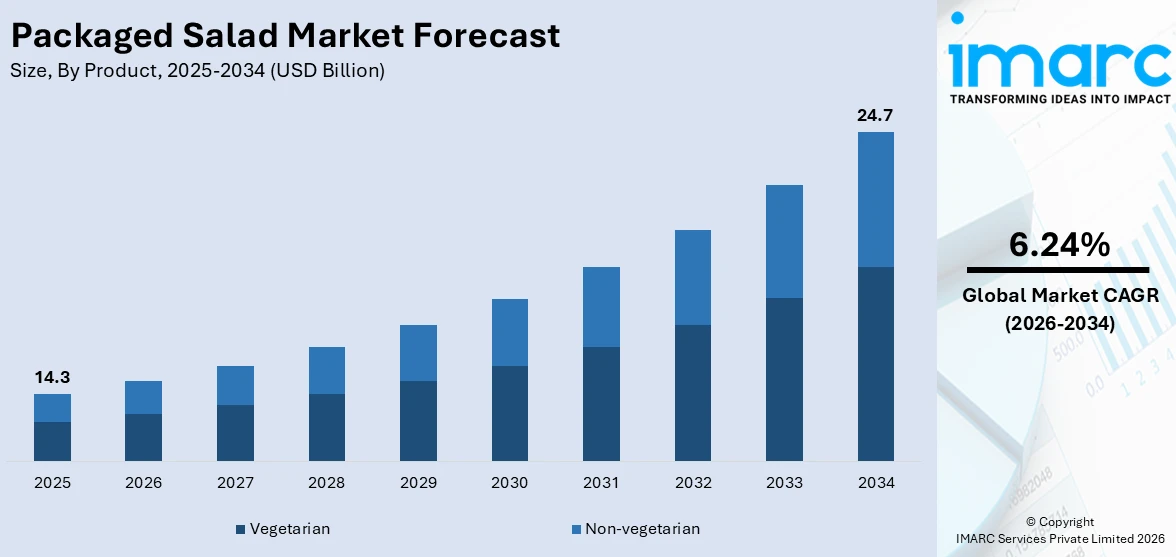
The global packaged salad market size was valued at USD 14.3 Billion in 2025. Looking forward, IMARC Group estimates the market to reach USD 24.7 Billion by 2034, exhibiting a CAGR of 6.24% from 2026-2034. North America currently dominates the market, holding a market share of 39.8% in 2025. The region enjoys the benefits of a deeply rooted health-conscious consumer behavior, established cold chain logistics for the distribution of fresh produce, extensive retail shelf space allocated to ready-to-eat salad products, and a demand for convenient and nutritious meal solutions that drive the market share of packaged salads.
The packaged salad market is being fueled by the increasing consumer focus on health and wellness, as consumers are looking for healthy food options that fit their busy lifestyles. The growing trend of plant-based and vegetarian diets in various parts of the world is also contributing to the increasing demand for healthy and fresh salad products. Moreover, the rising trend of urbanization and the development of modern retail channels, such as supermarkets and hypermarkets, are making the product more accessible to consumers. The increasing focus on clean-label and organic food products is also encouraging the development of premium packaged salad products. The growing popularity of salad kits, which offer a combination of fresh greens and gourmet toppings and dressing, is also fueling the growth of the packaged salad market.
The United States has emerged as a major region in the packaged salad market owing to many factors. The country benefits from a robust retail infrastructure that ensures wide product availability across supermarkets, grocery chains, and online platforms. Health-conscious consumer behavior continues to strengthen, with demand for low-calorie, fiber-rich, and protein-enhanced salad options rising steadily. According to the USDA Economic Research Service, fresh vegetables accounted for 39 percent of total U.S. per capita vegetable availability in 2024, reaching approximately 148 pounds per person, underscoring the sustained consumer preference for fresh produce. The rapid expansion of meal-kit delivery services and direct-to-consumer salad subscription models is further broadening distribution channels. Moreover, the growing preference for organic and pesticide-free salad greens among younger demographics is driving innovation in the packaged salad market outlook across the country.
To get more information on this market Request Sample
Packaged Salad Market Trends:
Growing Consumer Health Consciousness
The escalating consumer awareness regarding the importance of balanced nutrition and preventive healthcare is significantly boosting the demand for packaged salads worldwide. As chronic lifestyle diseases such as obesity, diabetes, and cardiovascular conditions become more prevalent, individuals are proactively shifting toward healthier dietary choices. Packaged salads, which offer a convenient source of essential vitamins, minerals, dietary fiber, and antioxidants, are increasingly viewed as a practical solution for health-focused consumers. The growing availability of specialized salad varieties tailored to specific dietary requirements, including keto-friendly, high-protein, and low-carbohydrate options, is further expanding the consumer base. For instance, in 2025, the Dole brand was ranked the most-trusted brand in salad kits in the BrandSpark Most Trusted Awards, as determined by over 29,000 American shoppers. Retailers are also dedicating expanded shelf space to packaged salad products within their fresh produce sections, reinforcing consumer access and purchase frequency across diverse market segments.
Expansion of Plant-Based Diets
The accelerating shift toward plant-based and vegan dietary patterns is emerging as a pivotal driver for the packaged salad market forecast. As environmental sustainability, ethical considerations, and health benefits increasingly influence consumer food choices, more individuals are incorporating plant-based meal options into their daily routines. Packaged salads, inherently composed of fresh vegetables, leafy greens, legumes, and grains, seamlessly align with these evolving dietary preferences. Manufacturers are responding by introducing innovative product formulations that incorporate superfoods such as quinoa, chickpeas, kale, and chia seeds, appealing to nutritionally conscious consumers. For example, in January 2025, a joint study by YouGov and Veganuary estimated that approximately 25.8 million individuals worldwide attempted veganism during the campaign period. The growing accessibility of plant-based salad options across both offline retail channels and online grocery platforms is further strengthening the packaged salad market trends and attracting a broader consumer demographic.
Innovation in Packaging Technology
Continuous advancements in packaging technologies are playing a transformative role in enhancing the quality, shelf life, and consumer appeal of packaged salad products. Modified atmosphere packaging, vacuum-sealed containers, and biodegradable packaging materials are being widely adopted by manufacturers to maintain product freshness while reducing food waste and environmental impact. These innovations address a key consumer concern regarding the perishability of fresh produce, thereby building confidence in packaged salad purchases. Additionally, sustainable packaging solutions are gaining traction as environmentally conscious consumers increasingly prioritize eco-friendly products. For instance, in July 2025, BrightFarms debuted a bold new packaging and rebrand across its salad kit line, highlighting benefits such as pesticide-free produce and guaranteed freshness to better connect with millennial and Generation Z consumers. Smart packaging features, including freshness indicators and resealable designs, are further enhancing user convenience. These technological developments are essential for expanding distribution reach and supporting growth of packaged salads.
Packaged Salad Industry Segmentation:
IMARC Group provides an analysis of the key trends in each segment of the global packaged salad market, along with forecast at the global, regional, and country levels from 2026-2034. The market has been categorized based on product, processing, and distribution channel.

Analysis by Product:
- Vegetarian
- Non-vegetarian
Vegetarian holds 67.5% of the market share. Vegetarian packaged salads, composed primarily of fresh leafy greens, vegetables, fruits, grains, and plant-based proteins, represent the dominant product category within the global packaged salad market. The segment benefits from the rising global adoption of vegetarian and vegan lifestyles driven by health awareness, environmental sustainability, and ethical considerations. Consumers increasingly view vegetarian packaged salads as a convenient, nutritious, and low-calorie meal option that supports balanced dietary intake. The widespread availability of diverse vegetarian salad varieties, including superfood blends, Mediterranean-inspired mixes, and Asian-influenced options, caters to evolving consumer palates. For instance, in February 2025, Dole Fresh Vegetables launched four new trend-setting salad kit varieties, including Chopped Smash Burger and three premium kits featuring apple harvest, cool melon, and strawberry poppyseed flavors, with retail distribution across North America by April 2025. The growing emphasis on clean-label ingredients and organic certifications continues to strengthen consumer confidence in vegetarian salad products.
Analysis by Processing:
- Organic
- Conventional
Conventional leads the market with a share of 67.9%. Conventional packaged salads, processed through conventional farming practices with the use of synthetic fertilizers and pesticides, continue to hold a dominating market share in the global market due to their low price, easy availability, and accessibility to a large number of consumers. The market for conventional packaged salads is aided by well-established agricultural supply chains, ensuring the constant availability of the product in the market at a competitive price, making it a daily purchase for budget-conscious consumers. Conventional processing techniques also help the product to have a longer shelf life through cost-effective preservation methods, making it easily available through various distribution channels. The scalability of conventional farming practices helps the producers to cater to the increasing demand in the market efficiently while maintaining the quality and safety standards of the product in various markets. In addition, the familiarity and trust associated with conventionally processed salad products continue to influence consumer preferences, especially in budget-conscious markets where price is a major deciding factor for food choices.
Analysis by Distribution Channel:
Access the comprehensive market breakdown Request Sample
- Online Stores
- Offline Stores
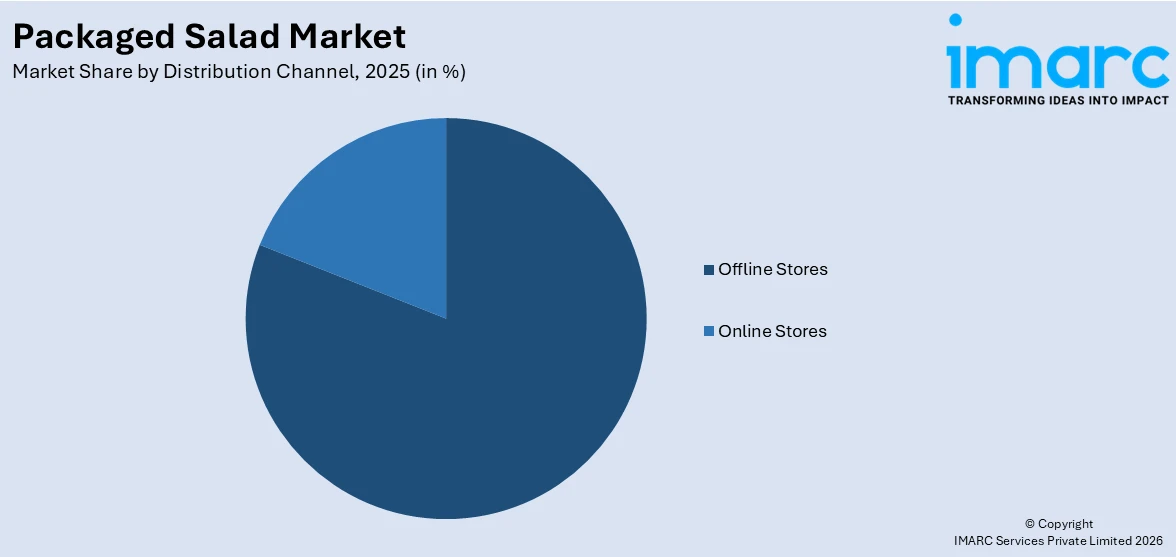
Offline dominates the market, with a share of 81.2%. Offline distribution channels, including supermarkets, hypermarkets, grocery stores, convenience stores, and specialty food stores, act as the major distribution channel for packaged salads across the globe. Consumers mainly prefer the purchase of packaged salads through offline stores because of their ability to judge the freshness of the product, check the packaging integrity, and compare the varieties available. The large refrigerated storage capacity in modern retail stores ensures the best possible preservation and display of the product, thereby promoting impulse buying and repeat business. In-store merchandising, promotions, and private labels by retailers also promote sales volume and further consolidate the dominance of the offline market. Furthermore, the increasing reach of organized retailing in emerging markets is increasing consumer access to packaged salad products, and the dedicated fresh produce section in retail stores is further improving product visibility and attracting health-conscious consumers.
Regional Analysis:
To get more information on the regional analysis of this market Request Sample
- North America
- United States
- Canada
- Asia-Pacific
- China
- Japan
- India
- South Korea
- Australia
- Indonesia
- Others
- Europe
- Germany
- France
- United Kingdom
- Italy
- Spain
- Russia
- Others
- Latin America
- Brazil
- Mexico
- Others
- Middle East and Africa
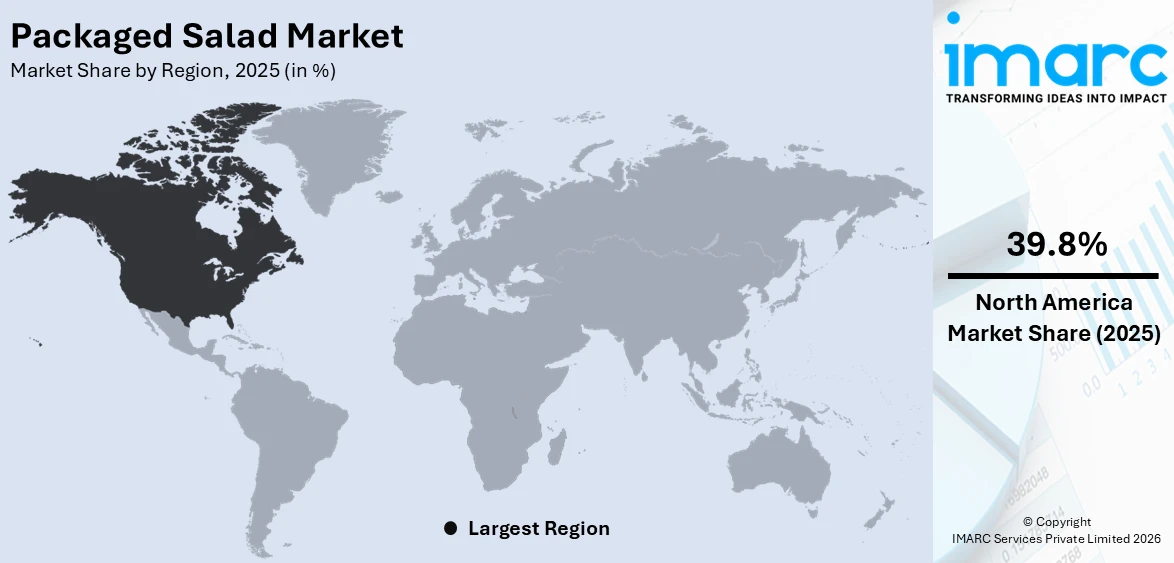
North America, accounting for 39.8% of the share, enjoys the leading position in the market. The region has the advantage of a well-established culture of convenience-driven food habits, a well-developed modern retail infrastructure, and a high level of consumer awareness about healthy eating practices. The well-developed cold chain logistics infrastructure in North America ensures the efficient distribution and storage of perishable packaged salad products from production facilities to retail stores. In addition, the well-established presence of key packaged salad brands, along with ongoing innovations in salad kits, organic products, and clean-label formulations, ensures strong consumer demand. The rising adoption of online grocery shopping and meal kit delivery services is further widening the distribution base and reach in the region. In addition, the rising focus on sustainable packaging solutions and locally sourced ingredients is further enhancing consumer confidence and ensuring long-term market development in the region.
Key Regional Takeaways:
United States Packaged Salad Market Analysis
The United States is the biggest and most developed market for packaged salads in the world, thanks to the deeply ingrained consumer preference for healthy, nutritious, and convenient food choices. The country has an advanced retail infrastructure with supermarkets, hypermarkets, and specialty grocery stores allocating substantial shelf space to a wide variety of packaged salad offerings such as bagged greens, chopped kits, and gourmet salads. Health-conscious consumer behavior is becoming increasingly stronger with greater awareness about the nutritional advantages of fresh vegetable consumption among various demographic segments. The growing number of greenhouse-grown and indoor-farmed salad manufacturers is improving product availability throughout the year and meeting the consumer demand for sustainably produced, pesticide-free salad products. The growing investment in controlled environment agriculture and vertical farming technology is making it possible for manufacturers to expand their production capacity and develop wider retail distribution networks across the United States, ensuring greater product availability and improved freshness. The rising trend of salad kits that combine fresh greens with unique toppings, protein sources, and specialty dressings is luring younger consumer segments such as millennials and Generation Z, who are increasingly interested in both flavor diversity and nutritional superiority in their food choices.
Europe Packaged Salad Market Analysis
The European market for packaged salads is growing steadily due to the increasing focus on health and wellness, clean label, and sustainable food sourcing practices among consumers. The United Kingdom, Germany, France, Italy, and Spain are some of the major markets for salad consumption in the region, thanks to their well-established retail infrastructure and a strong culture of consuming fresh produce. European consumers are increasingly demanding organic and pesticide-free salads due to the strict food safety standards and increased awareness about the environment. There is a growing demand for high-quality, locally sourced, and artisanal salads, which is encouraging manufacturers to expand their product offerings. Strategic consolidation efforts among the major salad manufacturers and distributors are redefining the competitive landscape, as they aim to optimize their production capacities, enhance geographic presence, and improve supply chain efficiencies in the major European markets. The growing popularity of convenience-driven salad products, such as single-serve salads and meal-replacement salads, is further fueling market penetration in the region, as consumers with increasingly busy lifestyles are looking for healthy meal alternatives on the go.
Asia-Pacific Packaged Salad Market Analysis
The Asia-Pacific region is emerging as the fastest-growing market for packaged salads, driven by rapid urbanization, rising disposable incomes, and the increasing adoption of Western dietary habits among urban populations. Countries including Japan, China, India, Australia, South Korea, and Indonesia are witnessing growing consumer interest in convenient, healthy, and ready-to-eat food options. The expanding modern retail landscape, including the proliferation of supermarkets, hypermarkets, and convenience stores, is improving product accessibility and enabling broader consumer engagement with packaged salad categories. The accelerating growth in packaged fresh produce consumption across major Asian economies reflects the expanding consumer appetite for convenient and nutritionally balanced salad options that align with increasingly fast-paced urban lifestyles. The growing adoption of plant-based diets, particularly across markets with strong vegetarian traditions, is further strengthening demand for vegetarian and plant-forward packaged salad products. Additionally, the rising influence of international food culture, health-focused media content, and digital food platforms is encouraging consumer experimentation with diverse salad formats and ingredient combinations across the region.
Latin America Packaged Salad Market Analysis
The Latin American market for packaged salads is growing at a steady pace due to increasing health awareness among consumers in urban areas and the rising availability of fresh and ready-to-eat produce. Brazil and Mexico are the main consumption markets for the region, due to rising disposable incomes and dietary preferences. For example, according to industry sources, Brazil leads the demand for packaged salads in the region, and supermarkets are the main distribution channels for fresh and processed salad items. The rising middle class and the development of organized retail infrastructure are creating a positive market environment.
Middle East and Africa Packaged Salad Market Analysis
The Middle East and Africa packaged salad market is at a nascent but growing stage, supported by rapid urbanization, increasing expatriate populations, and the expansion of modern foodservice and retail channels. The growing presence of international supermarket chains and quick-service restaurants in major urban centers across the Gulf Cooperation Council countries is improving product visibility. For instance, according to industry estimates, the Gulf region is witnessing increasing imports of fresh and pre-packaged salad products to meet rising demand from health-conscious urban consumers and hospitality sectors. The improving cold chain logistics infrastructure is further enabling wider distribution of perishable packaged salad products across the region.
Competitive Landscape:
Key producers, regional competitors, and the emergence of new greenhouse-based businesses dominate the packed salad industry. To meet the evolving needs of customers, the major competitors in the market are constantly involved in research and development (R&D) to create new varieties of salad kits, premium ingredient combinations, and flavor-focused formulations. The competitive environment is being redefined by partnerships, mergers, and acquisitions as businesses seek to expand their customer base and boost supply chain effectiveness. Biodegradable packaging, sustainable sourcing, and investments in controlled environment agriculture are examples of sustainability initiatives that are becoming new ways to stand out from the competition. In the increasingly competitive market, businesses are also utilizing direct-to-consumer business models, e-commerce, and internet marketing to engage with the younger generation and foster brand loyalty.
The report provides a comprehensive analysis of the competitive landscape in the packaged salad market with detailed profiles of all major companies, including:
- Bonduelle
- Brightfarms Inc.
- Dole Food Company Inc.
- Earthbound Farm (Taylor Fresh Foods Inc.)
- Eat Smart
- Fresh Express (Chiquita Brands International)
- Gotham Greens
- Mann Packing Co. Inc. (Fresh Del Monte Produce Inc.)
- Misionero
- United Salad Co.
- Zina's Salads Inc.
Packaged Salad Market Report Scope:
| Report Features | Details |
|---|---|
| Base Year of the Analysis | 2025 |
| Historical Period | 2020-2025 |
| Forecast Period | 2026-2034 |
| Units | Billion USD |
| Scope of the Report |
Exploration of Historical Trends and Market Outlook, Industry Catalysts and Challenges, Segment-Wise Historical and Future Market Assessment:
|
| Products Covered | Vegetarian, Non-Vegetarian |
| Processings Covered | Organic, Conventional |
| Distribution Channels Covered | Online Stores, Offline Stores |
| Regions Covered | Asia Pacific, Europe, North America, Latin America, Middle East and Africa |
| Countries Covered | United States, Canada, Germany, France, United Kingdom, Italy, Spain, Russia, China, Japan, India, South Korea, Australia, Indonesia, Brazil, Mexico |
| Companies Covered | Bonduelle, Brightfarms Inc., Dole Food Company Inc., Earthbound Farm (Taylor Fresh Foods Inc.), Eat Smart, Fresh Express (Chiquita Brands International), Gotham Greens, Mann Packing Co. Inc. (Fresh Del Monte Produce Inc.), Misionero, United Salad Co., Zina's Salads Inc., etc. |
| Customization Scope | 10% Free Customization |
| Post-Sale Analyst Support | 10-12 Weeks |
| Delivery Format | PDF and Excel through Email (We can also provide the editable version of the report in PPT/Word format on special request) |
Key Benefits for Stakeholders:
- IMARC's report offers a comprehensive quantitative analysis of various market segments, historical and current market trends, market forecasts, and dynamics of the packaged salad market from 2020-2034.
- The research study provides the latest information on the market drivers, challenges, and opportunities in the global packaged salad market.
- The study maps the leading, as well as the fastest-growing, regional markets. It further enables stakeholders to identify the key country-level markets within each region.
- Porter's Five Forces analysis assists stakeholders in assessing the impact of new entrants, competitive rivalry, supplier power, buyer power, and the threat of substitution. It helps stakeholders to analyze the level of competition within the packaged salad industry and its attractiveness.
- Competitive landscape allows stakeholders to understand their competitive environment and provides an insight into the current positions of key players in the market.
Frequently Asked Questions About the Packaged Salad Market Report
The packaged salad market was valued at USD 14.3 Billion in 2025.
The packaged salad market is projected to exhibit a CAGR of 6.24% during 2026-2034, reaching a value of USD 24.7 Billion by 2034.
The packaged salad market is primarily driven by the rising consumer emphasis on health and wellness, the accelerating adoption of plant-based and vegetarian diets, increasing demand for convenient ready-to-eat meal solutions, advancements in packaging technologies that extend shelf life, and the growing preference for organic and clean-label food products across global consumer segments.
North America currently dominates the packaged salad market, accounting for a share of 39.8%. The region benefits from deeply established health-conscious consumer behavior, extensive modern retail infrastructure, robust cold chain logistics, and strong demand for convenient, nutrient-rich salad options.
Some of the major players in the packaged salad market include Bonduelle, Brightfarms Inc., Dole Food Company Inc., Earthbound Farm (Taylor Fresh Foods Inc.), Eat Smart, Fresh Express (Chiquita Brands International), Gotham Greens, Mann Packing Co. Inc. (Fresh Del Monte Produce Inc.), Misionero, United Salad Co., Zina's Salads Inc., etc.
Need more help?
- Speak to our experienced analysts for insights on the current market scenarios.
- Include additional segments and countries to customize the report as per your requirement.
- Gain an unparalleled competitive advantage in your domain by understanding how to utilize the report and positively impacting your operations and revenue.
- For further assistance, please connect with our analysts.
 Request Customization
 Speak to an Analyst
 Request Brochure
 Inquire Before Buying
Benefits of Customization
- Personalize this research
- Triangulate with your data
- Get data as per your format and definition
- Gain a deeper dive into a specific application, geography, customer, or competitor
- Any level of personalization
Get in Touch With Us
UNITED STATES
Phone: +1-201-971-6302
INDIA
Phone: +91-120-433-0800
UNITED KINGDOM
Phone: +44-753-714-6104
Email: [email protected]
Client Testimonials




.webp)




.webp)













Related Reports

Choose your plan
*Please note that the prices mentioned below are starting prices for each bundle type. Kindly contact our team for further details.*
Single User License
- 1 User License, Access on 2 Devices
- PDF Report + Excel Dataset (Password Protected)
- Lifetime Access
- No Printing Rights
- 10% Free Report Customization
- 10–12 Weeks of Analyst Support
Five User License
- Access for 5 Users, 2 Devices per User
- PDF Report + Excel Dataset (Password Protected)
- Lifetime Access
- Dedicated Account Manager
- 12–14 Weeks of Analyst Support
- No Printing Rights
- 15% Free Report Customization
- 25% Discount on Your Next Purchase
Corporate User License
- Unlimited User Access (Within Your Organization)
- PDF Report + Excel Dataset
- Lifetime Access
- Dedicated Account Manager
- 14–20 Weeks of Analyst Support
- No Printing Rights
- 20% Free Report Customization
- 30% Discount on Your Next Purchase
Essential Insights
What's included:
3 reports
- Lifetime Access
- PDF Reports
- Excel Datasets
- 2 Weeks of Free Analyst Support
- 2 User Licenses
- Access on 2 Devices
- Printing Rights
- Complimentary PowerPoint (PPT) Version
- Complimentary License Upgrade
Professional Access
What's included:
5 reports
- Lifetime Access
- PDF Reports
- Excel Datasets
- 8 Weeks of Free Analyst Support
- 2 User Licenses
- Access on 2 Devices
- Printing Rights
- Complimentary PowerPoint (PPT) Version
- Complimentary License Upgrade
Business Advantage
What's included:
8 reports
- Lifetime Access
- PDF Reports
- Excel Datasets
- 14 Weeks of Free Analyst Support
- 2 User Licenses
- Access on 2 Devices
- Printing Rights
- Complimentary PowerPoint (PPT) Version
- Complimentary License Upgrade
Enterprise Intelligence
What's included:
10 reports
- Lifetime Access
- PDF Reports
- Excel Datasets
- 20 Weeks of Free Analyst Support
- 2 User Licenses
- Access on 2 Devices
- Printing Rights
- Complimentary PowerPoint (PPT) Version
- Complimentary License Upgrade