
Philippines AI in Healthcare Market Size, Share, Trends and Forecast by Offering, Technology, Application, End User, and Region, 2026-2034
Philippines AI in Healthcare Market Summary:
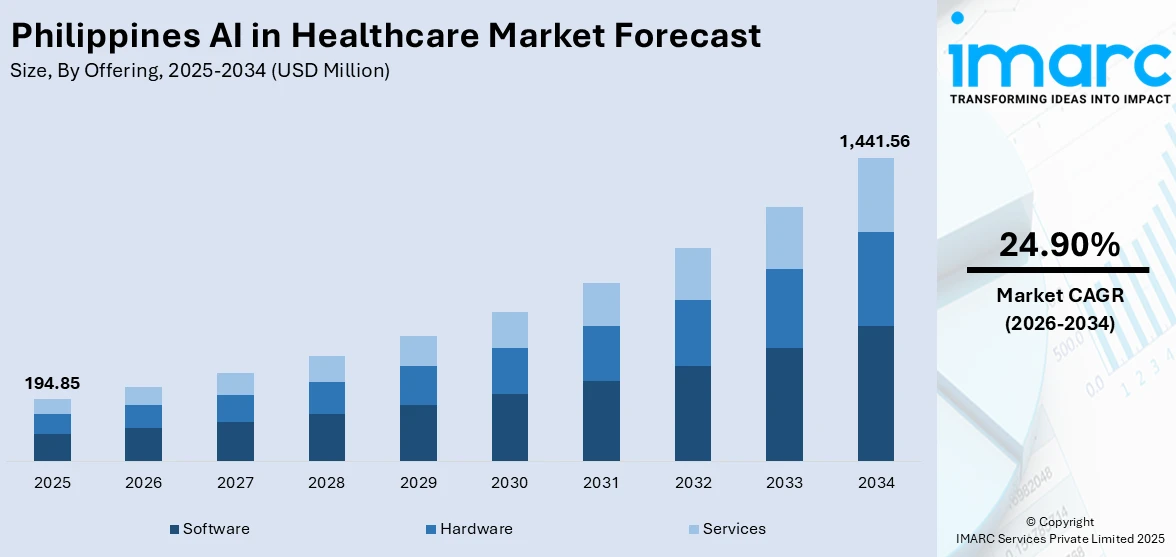
The Philippines AI in healthcare market size was valued at USD 194.85 Million in 2025 and is projected to reach USD 1,441.56 Million by 2034, growing at a compound annual growth rate of 24.90% from 2026-2034.
The Philippines AI in healthcare market is experiencing robust expansion driven by increasing digital health adoption, government-led modernization initiatives, and growing demand for intelligent clinical decision support systems. Rising investments in telemedicine platforms, AI-powered diagnostic imaging, and administrative automation are transforming healthcare delivery across the archipelago. The convergence of expanding technology infrastructure, workforce optimization needs, and evolving patient expectations continues to propel market advancement and innovation throughout the Philippine healthcare ecosystem.
Key Takeaways and Insights:
- By Offering: Software dominates the market with a share of 52.7% in 2025, owing to its scalability, lower deployment costs through cloud-based subscription models, and seamless integration with existing hospital information systems. Growing demand for AI-powered analytics platforms is fueling the market expansion.
- By Technology: Machine learning leads the market with a share of 44.9% in 2025. This dominance is driven by its superior pattern recognition capabilities in medical imaging diagnostics, predictive analytics for patient outcomes, and adaptive algorithm training on locally sourced clinical datasets.
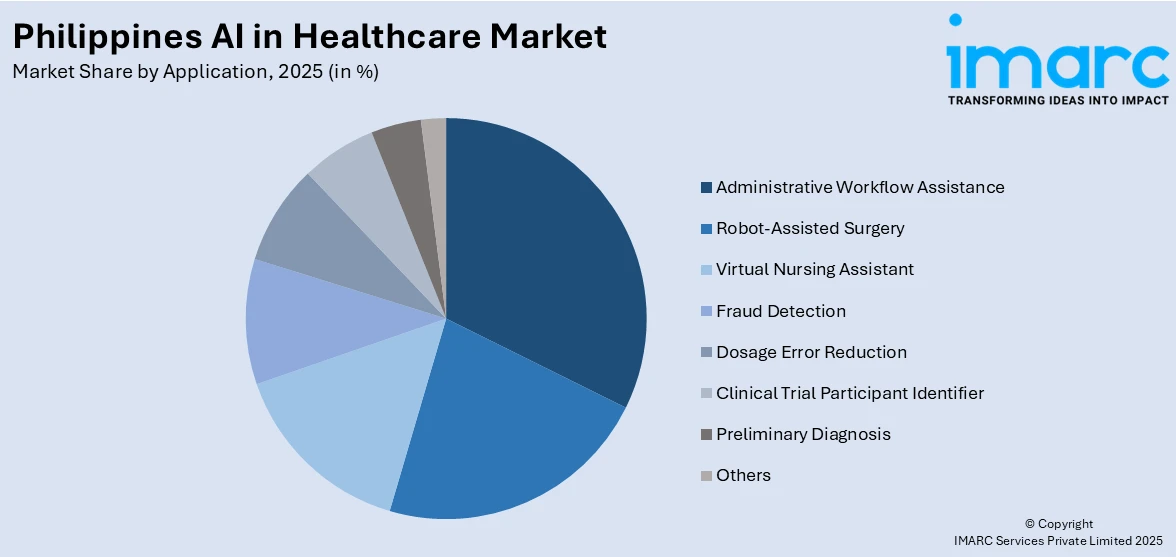
- By Application: Administrative workflow assistance represents the largest segment with a market share of 29.6% in 2025, reflecting the critical need for automated claims processing, scheduling optimization, and documentation management that underpins operational efficiency improvements throughout Philippine healthcare facilities.
- By End User: Healthcare providers hold the biggest share of 48.3% in 2025, owing to continued hospital-led adoption of AI-powered diagnostic tools, electronic health record management systems, and clinical decision support platforms that enhance patient care delivery.
- By Region: Luzon is the largest region with 63.5% share in 2025, driven by the concentration of Metro Manila's tertiary hospitals, advanced technology infrastructure, established medical research institutions, and higher healthcare spending capacity across the National Capital Region.
- Key Players: Key players drive the Philippines AI in healthcare market by expanding AI-powered diagnostic platforms, improving clinical workflow automation technologies, and strengthening nationwide deployment capabilities. Their investments in research, affordability, and partnerships with government health agencies boost awareness, accelerate adoption, and ensure consistent technology availability across diverse healthcare settings.
To get more information on this market Request Sample
The Philippines AI in healthcare market is propelled by a convergence of structural healthcare challenges and accelerating digital transformation initiatives that are reshaping medical service delivery across the archipelago. The country's persistent physician shortage, which falls significantly below World Health Organization recommended ratios, has created an urgent imperative for technology-enabled solutions that can extend diagnostic reach and optimize clinical workflows. Government modernization efforts, including the National AI Strategy Roadmap 2.0 launched by the Department of Trade and Industry, have established a comprehensive policy framework targeting healthcare as a priority sector for AI deployment. Furthermore, the rapid expansion of telemedicine infrastructure, growing hospital investments in intelligent imaging analytics, and increasing adoption of automated claims processing systems are collectively accelerating market penetration. The rising integration of machine learning algorithms into patient management platforms and the development of locally trained clinical datasets continue to strengthen the Philippines AI in healthcare market share. Strategic partnerships between technology providers and healthcare institutions are further catalyzing innovation, while workforce upskilling programs are building the technical capacity needed to sustain long-term AI adoption across primary, secondary, and tertiary care settings.
Philippines AI in Healthcare Market Trends:
Government AI investment and national strategy acceleration
The Philippine government is intensifying its commitment to AI-driven healthcare through strategic policy frameworks and dedicated funding mechanisms. The Department of Science and Technology has announced substantial allocations for AI research projects covering healthcare, education, and mobility sectors. The National AI Strategy Roadmap 2.0, launched by the Department of Trade and Industry with Asian Development Bank support, designates healthcare as a priority sector and establishes a national Center for AI Research to accelerate development, foster industry collaboration, and build domestic capabilities in intelligent clinical technologies.
AI-powered diagnostic imaging adoption in hospital networks
Philippine hospitals are increasingly integrating AI-assisted imaging technologies to enhance diagnostic accuracy and clinical throughput. Leading institutions such as The Medical City in Pasig have integrated advanced AI systems for chest X-ray and mammography analysis, achieving significant improvements in diagnostic finalization rates while increasing imaging equipment utilization. Metro Manila hospitals are deploying machine learning algorithms capable of flagging early-stage lung cancer indicators with high accuracy rates, demonstrating the growing clinical validation of AI diagnostic tools across tertiary healthcare facilities nationwide.
Telemedicine and remote healthcare expansion through AI integration
The convergence of telemedicine platforms with AI capabilities is transforming healthcare access across the Philippine archipelago, particularly in geographically isolated communities. The Philippines eHealth market reached an estimated USD 2,820 Million in 2024, reflecting substantial investments in digital health infrastructure including remote monitoring, electronic health records, and AI-powered triage systems. The ATIPAN+ Telehealth Project has conducted over 8,550 consultations for indigenous Ati communities in Western Visayas since its establishment, illustrating how technology-enabled remote care is bridging longstanding healthcare access disparities.
Market Outlook 2026-2034:
The Philippines AI in healthcare market is positioned for substantial expansion over the forecast period, underpinned by accelerating digital transformation across hospital networks, growing government policy support, and increasing private sector investment in intelligent health technologies. The proliferation of cloud-based AI platforms, machine learning-powered diagnostic tools, and automated administrative systems is expected to drive sustained revenue growth as healthcare providers seek operational efficiency and improved patient outcomes. The market generated a revenue of USD 194.85 Million in 2025 and is projected to reach a revenue of USD 1,441.56 Million by 2034, growing at a compound annual growth rate of 24.90% from 2026-2034. Rising demand for AI-enabled telemedicine platforms, intelligent claims processing automation, and predictive analytics for chronic disease management will continue to create significant opportunities. The expanding digital health infrastructure, supported by national broadband connectivity initiatives and workforce upskilling programs, is expected to further accelerate market penetration across urban and emerging provincial healthcare facilities throughout the Philippines.
Philippines AI in Healthcare Market Report Segmentation:
|
Segment Category |
Leading Segment |
Market Share |
|
Offering |
Software |
52.7% |
|
Technology |
Machine Learning |
44.9% |
|
Application |
Administrative Workflow Assistance |
29.6% |
|
End User |
Healthcare Providers |
48.3% |
|
Region |
Luzon |
63.5% |
Offering Insights:
- Hardware
- Software
- Services
Software dominates with a market share of 52.7% of the total Philippines AI in healthcare market in 2025.
The software segment's commanding position in the Philippines AI in healthcare market reflects the healthcare sector's accelerating transition toward cloud-based AI platforms, electronic health record management systems, and intelligent analytics solutions. Software offerings provide scalable deployment through subscription-based pricing models that significantly reduce upfront capital expenditure for hospitals and clinics, making advanced AI capabilities accessible to a broader range of healthcare institutions. The flexibility of software-as-a-service models enables healthcare facilities to implement AI functionalities incrementally, aligning technology investments with evolving clinical needs and budget constraints while minimizing infrastructure maintenance burdens.
Cloud-hosted AI software platforms are particularly well-suited to the Philippine healthcare landscape, where distributed hospital systems across multiple islands require centralized data management and remote accessibility. The growing availability of hospital informatics programs at leading institutions is fostering a skilled workforce capable of deploying and managing sophisticated healthcare AI applications. Substantial investments flowing into digital health software infrastructure continue to support AI integration across clinical, administrative, and patient engagement workflows, positioning software as the foundational layer enabling broader healthcare digital transformation initiatives throughout the Philippine archipelago.
Technology Insights:
- Machine Learning
- Context Aware Computing
- Natural Language Processing
- Others
Machine learning leads with a share of 44.9% of the total Philippines AI in healthcare market in 2025.
Machine learning technology commands the largest share within the Philippines AI in healthcare market owing to its proven effectiveness in clinical diagnostics, predictive patient analytics, and adaptive pattern recognition across diverse medical datasets. The technology's ability to continuously improve diagnostic accuracy through iterative training on locally sourced Filipino patient datasets has positioned it as the preferred foundation for healthcare AI deployments. Philippine hospitals are increasingly deploying machine learning-powered imaging algorithms capable of flagging early-stage disease indicators, demonstrating the technology's critical role in augmenting physician capabilities across resource-constrained clinical environments where diagnostic expertise remains scarce.
The expanding application of machine learning extends beyond diagnostic imaging into claims processing automation, drug interaction analysis, and population health management across Philippine healthcare networks. National policy frameworks have identified machine learning as a core technology for healthcare sector transformation, establishing dedicated research and development funding pathways to accelerate adoption. The country's robust information technology sector provides a substantial talent pipeline of data scientists and algorithm specialists capable of supporting healthcare-specific machine learning development and deployment, ensuring the technical human capital necessary to sustain continued growth in intelligent clinical applications throughout the Philippines.
Application Insights:
Access the comprehensive market breakdown Request Sample
- Robot-Assisted Surgery
- Virtual Nursing Assistant
- Administrative Workflow Assistance
- Fraud Detection
- Dosage Error Reduction
- Clinical Trial Participant Identifier
- Preliminary Diagnosis
- Others
Administrative workflow assistance is the largest segment with 29.6% share of the total Philippines AI in healthcare market in 2025.
Administrative workflow assistance dominates the application landscape in the Philippines AI in healthcare market, reflecting the critical operational burden that manual documentation, claims processing, and scheduling management place on resource-constrained healthcare facilities. Philippine hospitals and clinics face substantial administrative overhead that diverts clinical staff from patient-facing activities, creating strong demand for intelligent automation solutions that streamline repetitive back-office processes. The national health insurance system's ongoing modernization efforts have prioritized AI-powered claims processing solutions to improve filing efficiency, reduce return rates, and accelerate member reimbursements across the healthcare financing ecosystem.
The adoption of AI-driven administrative automation is accelerating as Philippine healthcare institutions recognize measurable efficiency gains in claims adjudication, patient scheduling, and medical records management. The massive scale of insurance transactions processed annually underscores the critical need for intelligent processing solutions that can handle growing volumes without proportional staffing increases. Early pilot programs deploying AI-based workflow tools have demonstrated substantial productivity improvements, faster processing turnaround times, and enhanced accuracy rates, validating the commercial viability of automated administrative systems across Philippine healthcare settings and encouraging broader institutional adoption throughout public and private sector facilities nationwide.
End User Insights:
- Healthcare Providers
- Pharmaceutical and Biotechnology Companies
- Patients
- Others
Healthcare providers hold the largest share with 48.3% of the total Philippines AI in healthcare market in 2025.
Healthcare providers constitute the dominant end-user segment in the Philippines AI in healthcare market, driven by hospitals and clinical networks that are prioritizing AI investments to address operational inefficiencies, diagnostic bottlenecks, and workforce capacity limitations. Tertiary hospitals concentrated in major metropolitan areas are leading adoption through targeted pilot deployments in high-return clinical areas including imaging triage, claims automation, and procurement forecasting. The concentration of advanced medical infrastructure, specialist expertise, and technology budgets within large hospital systems positions healthcare providers as the primary adopters and integration partners for AI solution vendors entering the Philippine market.
The healthcare provider segment's dominance is further reinforced by the Philippine government's emphasis on strengthening hospital-level digital health capabilities through national strategy frameworks and dedicated funding allocations. Government-sponsored workforce development programs have upskilled thousands of Filipinos in data science and AI competencies, creating a growing talent pool that supports healthcare provider adoption of intelligent clinical tools. Hospital systems are increasingly deploying AI across multiple touchpoints, from emergency department triage to outpatient scheduling, generating comprehensive workflow optimization that positions providers as the primary demand catalyst within the Philippine healthcare AI ecosystem and driving continued market expansion.
Regional Insights:
- Luzon
- Visayas
- Mindanao
Luzon represents the leading region with 63.5% share of the total Philippines AI in healthcare market in 2025.
Luzon commands the largest regional share in the Philippines AI in healthcare market, anchored by the concentration of premier tertiary hospitals, advanced technology infrastructure, government health agencies, and medical research institutions within the region. The National Capital Region serves as the primary hub for healthcare AI adoption, hosting leading hospital networks that are deploying intelligent diagnostic imaging, automated claims processing, and clinical decision support systems. The region's superior broadband connectivity, established healthcare information technology vendor presence, and proximity to central government policymakers create a favorable environment for pilot program development and scaled AI implementation across diverse clinical settings.
The concentration of healthcare spending power, medical education institutions, and specialized clinical facilities within Luzon further reinforces the region's market leadership position. Major hospital groups headquartered in the metropolitan area serve as anchor clients for AI solution providers, generating reference implementations that subsequently expand to provincial and regional healthcare facilities. The region's established ecosystem of technology startups, academic research centers, and international healthcare partnerships continues to drive innovation in locally adapted AI applications, positioning Luzon as both the largest current market and the primary incubator for healthcare AI solutions destined for broader national deployment.
Market Dynamics:
Growth Drivers:
Why is the Philippines AI in Healthcare Market Growing?
Critical Healthcare Workforce Shortage Driving AI-Enabled Clinical Augmentation
The Philippines faces a persistent and widening gap between healthcare workforce supply and population demand, creating a structural imperative for AI-powered clinical augmentation tools that can extend physician reach and diagnostic capacity. The workforce deficit compels hospitals and local government health units to seek technology solutions that amplify clinician productivity without compromising diagnostic quality. AI-powered platforms are emerging as essential force multipliers, enabling individual physicians to manage significantly larger patient volumes through automated preliminary assessments, intelligent triage recommendations, and data-driven diagnostic suggestions. The structural nature of this physician shortage, coupled with continued outmigration of Filipino healthcare professionals, ensures sustained long-term demand for AI clinical decision support systems that bridge the capacity gap across primary, secondary, and tertiary care settings throughout the Philippines.
Government Digital Health Infrastructure Investment and Policy Support
The Philippine government has established a comprehensive policy and investment framework that directly supports the adoption of AI technologies across the national healthcare system. The Department of Trade and Industry launched the National AI Strategy Roadmap 2.0 in July 2024, designating healthcare as a priority sector for AI deployment and establishing the Center for AI Research to accelerate development and industry partnerships. The government's National Broadband Plan further strengthens the digital health ecosystem by enhancing connectivity infrastructure essential for AI-enabled telemedicine platforms and cloud-based clinical applications. Additionally, the SPARTA program has upskilled Filipinos in data science and AI competencies, building a critical human capital foundation that enables healthcare institutions to effectively deploy and manage intelligent clinical systems at scale.
Expanding Administrative Automation Demand in Healthcare Insurance Processing
The growing complexity and volume of healthcare insurance transactions in the Philippines is generating substantial demand for AI-powered administrative automation solutions that can streamline claims processing, reduce errors, and accelerate reimbursement timelines. PhilHealth, the national health insurance corporation, has experienced significant year-over-year growth in claims processing volumes, highlighting the escalating transactional burden on existing manual processing systems. This surge in claims volume has made intelligent automation a strategic priority, prompting the national insurer to explore partnerships with technology providers to pilot AI-powered claims processing systems targeting substantial reductions in filing time and return-to-sender rates. The demonstrated efficiency gains from early automation pilots are creating a compelling business case for broader AI deployment across billing, scheduling, documentation, and compliance monitoring functions within Philippine healthcare organizations. Healthcare institutions are increasingly recognizing that sustainable operational scalability requires intelligent workflow tools capable of managing rising administrative demands without proportional increases in staffing costs, positioning claims automation as a critical investment priority across both public and private sector healthcare facilities nationwide.
Market Restraints:
Limited Digital Infrastructure and Connectivity Gaps in Provincial Areas
The Philippines faces significant digital infrastructure limitations that constrain the deployment of AI-powered healthcare solutions beyond major urban centers. The country's fixed broadband speeds substantially trail regional peers across Southeast Asia, creating persistent connectivity disadvantages. These connectivity gaps, exacerbated by the archipelagic geography and historical underinvestment in broadband infrastructure, restrict the reliable operation of cloud-based AI clinical tools, real-time diagnostic imaging transmission, and telemedicine platforms in rural and remote communities where healthcare access needs are most acute.
Evolving Data Privacy Regulations and Compliance Complexity
The regulatory landscape governing health data management in the Philippines is becoming increasingly complex, creating compliance challenges for healthcare AI solution providers. The National Privacy Commission has issued AI-specific advisories mandating privacy-by-design principles, designated data protection officers, privacy impact assessments, and timely breach notification requirements, with substantial administrative fines for serious violations. The layered requirements of existing data privacy legislation, combined with emerging AI-specific guidance, impose substantial compliance costs that can delay deployment timelines and increase the total cost of AI system implementation across healthcare institutions.
High Implementation Costs and Limited Institutional AI Readiness
The substantial upfront investment required for AI system procurement, integration, training, and ongoing maintenance presents a significant barrier to widespread adoption across Philippine healthcare facilities. Many provincial hospitals and smaller clinics operate within constrained budgets that limit their capacity to invest in advanced technology infrastructure, specialized technical talent, and the organizational change management required for successful AI deployment. Industry assessments indicate that a relatively small proportion of Philippine firms have adopted AI technologies, reflecting a persistent readiness gap between technology availability and institutional capacity to implement and sustain intelligent healthcare solutions effectively.
Competitive Landscape:
The Philippines AI in healthcare market exhibits a dynamic competitive landscape characterized by a mix of established multinational technology providers, regional health technology firms, and emerging domestic startups competing across diagnostic imaging, administrative automation, and clinical decision support segments. Market participants are differentiating through localized dataset training, interoperability with Philippine healthcare information systems, and strategic partnerships with government health agencies and hospital networks. Competition is intensifying as providers invest in cloud-based platform scalability, mobile-accessible deployment models suited to the archipelagic geography, and vernacular language processing capabilities for Filipino patient interactions. Strategic collaborations between technology vendors and academic medical centers are fostering innovation in AI algorithm development tailored to regional disease patterns and clinical workflows. The competitive environment is further shaped by government procurement preferences favoring solutions aligned with the National AI Strategy Roadmap and PhilHealth interoperability requirements, encouraging market participants to pursue compliance-driven product development and pilot program engagement as key differentiation strategies.
Philippines AI in Healthcare Market Report Coverage:
|
Report Features |
Details |
|
Base Year of the Analysis |
2025 |
|
Historical Period |
2020-2025 |
|
Forecast Period |
2026-2034 |
|
Units |
Million USD |
|
Scope of the Report |
Exploration of Historical Trends and Market Outlook, Industry Catalysts and Challenges, Segment-Wise Historical and Future Market Assessment:
|
|
Offerings Covered |
Hardware, Software, Services |
|
Technologies Covered |
Machine Learning, Context Aware Computing, Natural Language Processing, Others |
|
Applications Covered |
Robot-Assisted Surgery, Virtual Nursing Assistant, Administrative Workflow Assistance, Fraud Detection, Dosage Error Reduction, Clinical Trial Participant Identifier, Preliminary Diagnosis, Others |
|
End Users Covered |
Healthcare Providers, Pharmaceutical and Biotechnology Companies, Patients, Others |
|
Regions Covered |
Luzon, Visayas, Mindanao |
|
Customization Scope |
10% Free Customization |
|
Post-Sale Analyst Support |
10-12 Weeks |
|
Delivery Format |
PDF and Excel through Email (We can also provide the editable version of the report in PPT/Word format on special request) |
Frequently Asked Questions About the Philippines AI in Healthcare Market Report
The Philippines AI in healthcare market size was valued at USD 194.85 Million in 2025.
The Philippines AI in healthcare market is expected to grow at a compound annual growth rate of 24.90% from 2026-2034 to reach USD 1,441.56 Million by 2034.
Software dominated the market with a share of 52.7%, driven by the scalability of cloud-based AI platforms, lower deployment costs through subscription models, and seamless integration with existing hospital information management systems.
Key factors driving the Philippines AI in healthcare market include the critical physician shortage necessitating clinical augmentation, government digital health investment through the National AI Strategy Roadmap 2.0, and expanding administrative automation demand in insurance claims processing.
Major challenges include limited digital infrastructure and broadband connectivity gaps in provincial areas, evolving data privacy regulations imposing compliance complexity, high AI system implementation costs, limited institutional readiness among smaller healthcare facilities, and the digital skills gap constraining effective technology deployment.
Need more help?
- Speak to our experienced analysts for insights on the current market scenarios.
- Include additional segments and countries to customize the report as per your requirement.
- Gain an unparalleled competitive advantage in your domain by understanding how to utilize the report and positively impacting your operations and revenue.
- For further assistance, please connect with our analysts.
 Request Customization
 Speak to an Analyst
 Request Brochure
 Inquire Before Buying
Benefits of Customization
- Personalize this research
- Triangulate with your data
- Get data as per your format and definition
- Gain a deeper dive into a specific application, geography, customer, or competitor
- Any level of personalization
Get in Touch With Us
UNITED STATES
Phone: +1-201-971-6302
INDIA
Phone: +91-120-433-0800
UNITED KINGDOM
Phone: +44-753-714-6104
Email: [email protected]
Client Testimonials




.webp)




.webp)













Related Reports

Choose your plan
*Please note that the prices mentioned below are starting prices for each bundle type. Kindly contact our team for further details.*
Single User License
- 1 User License, Access on 2 Devices
- PDF Report + Excel Dataset (Password Protected)
- Lifetime Access
- No Printing Rights
- 10% Free Report Customization
- 10–12 Weeks of Analyst Support
Five User License
- Access for 5 Users, 2 Devices per User
- PDF Report + Excel Dataset (Password Protected)
- Lifetime Access
- Dedicated Account Manager
- 12–14 Weeks of Analyst Support
- No Printing Rights
- 15% Free Report Customization
- 25% Discount on Your Next Purchase
Corporate User License
- Unlimited User Access (Within Your Organization)
- PDF Report + Excel Dataset
- Lifetime Access
- Dedicated Account Manager
- 14–20 Weeks of Analyst Support
- No Printing Rights
- 20% Free Report Customization
- 30% Discount on Your Next Purchase
Essential Insights
What's included:
3 reports
- Lifetime Access
- PDF Reports
- Excel Datasets
- 2 Weeks of Free Analyst Support
- 2 User Licenses
- Access on 2 Devices
- Printing Rights
- Complimentary PowerPoint (PPT) Version
- Complimentary License Upgrade
Professional Access
What's included:
5 reports
- Lifetime Access
- PDF Reports
- Excel Datasets
- 8 Weeks of Free Analyst Support
- 2 User Licenses
- Access on 2 Devices
- Printing Rights
- Complimentary PowerPoint (PPT) Version
- Complimentary License Upgrade
Business Advantage
What's included:
8 reports
- Lifetime Access
- PDF Reports
- Excel Datasets
- 14 Weeks of Free Analyst Support
- 2 User Licenses
- Access on 2 Devices
- Printing Rights
- Complimentary PowerPoint (PPT) Version
- Complimentary License Upgrade
Enterprise Intelligence
What's included:
10 reports
- Lifetime Access
- PDF Reports
- Excel Datasets
- 20 Weeks of Free Analyst Support
- 2 User Licenses
- Access on 2 Devices
- Printing Rights
- Complimentary PowerPoint (PPT) Version
- Complimentary License Upgrade