
Philippines Air Compressor Market Size, Share, Trends and Forecast by Type, Technology, Lubrication Method, Power Rating, End User, and Region, 2026-2034
Philippines Air Compressor Market Summary:
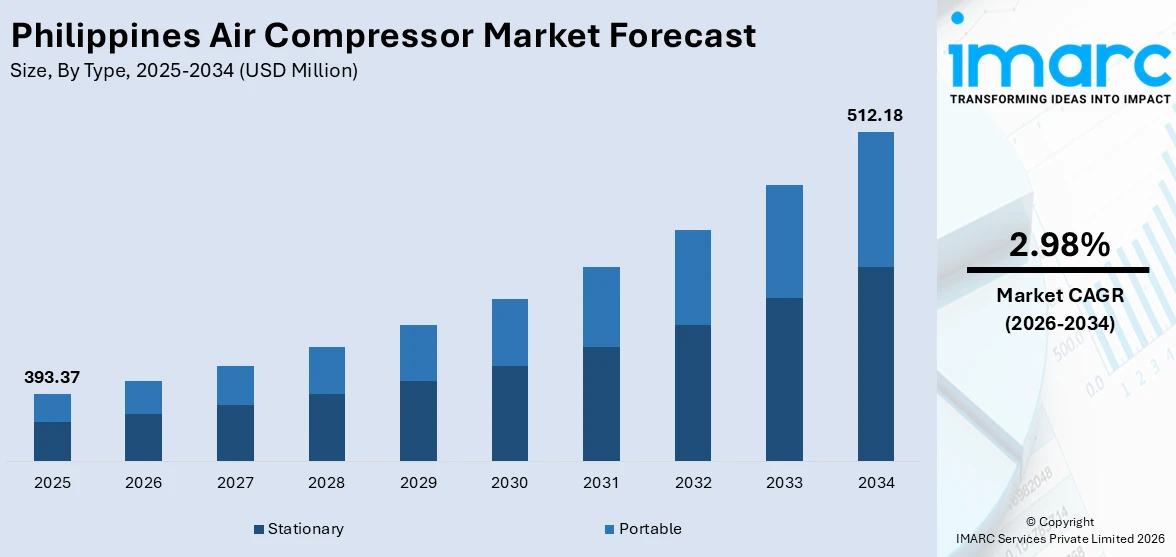
The Philippines air compressor market size was valued at USD 393.37 Million in 2025 and is projected to reach USD 512.18 Million by 2034, growing at a compound annual growth rate of 2.98% from 2026-2034.
The Philippines air compressor market is experiencing steady expansion, driven by the country’s accelerating industrialization and large-scale infrastructure development programs. Growing demand from manufacturing, semiconductors, and construction sectors is fueling adoption of advanced compressed air systems. Advancements in energy-efficient compressor technologies, expanding industrial zones, and government-led infrastructure modernization efforts are strengthening the foundation for sustained growth, positioning the Philippines as a key contributor to the regional Philippines air compressor market share.
Key Takeaways and Insights:
- By Type: Stationary dominates the market with a share of 61.2% in 2025, owing to its widespread deployment across manufacturing facilities, industrial parks, and fixed-location operations requiring continuous and reliable compressed air supply. Expanding factory operations are bolstering demand.
- By Technology: Rotary or screw leads the market with a share of 46.8% in 2025, driven by its superior energy efficiency, continuous duty capability, and reduced maintenance requirements that align with the operational demands of large-scale industrial facilities across the Philippines.
- By Lubrication Method: Oil-filled exhibits a clear dominance in the market with 58.9% share in 2025, reflecting strong industrial preference for durable, cost-effective compressor systems that deliver reliable performance under demanding operating conditions prevalent in Philippine manufacturing environments.
- By Power Rating: 101 to 300 kW represents the largest segment with a market share of 34.6% in 2025, owing to its suitability for medium-to-large-scale industrial operations that require consistent, high-volume compressed air output for production and assembly processes.
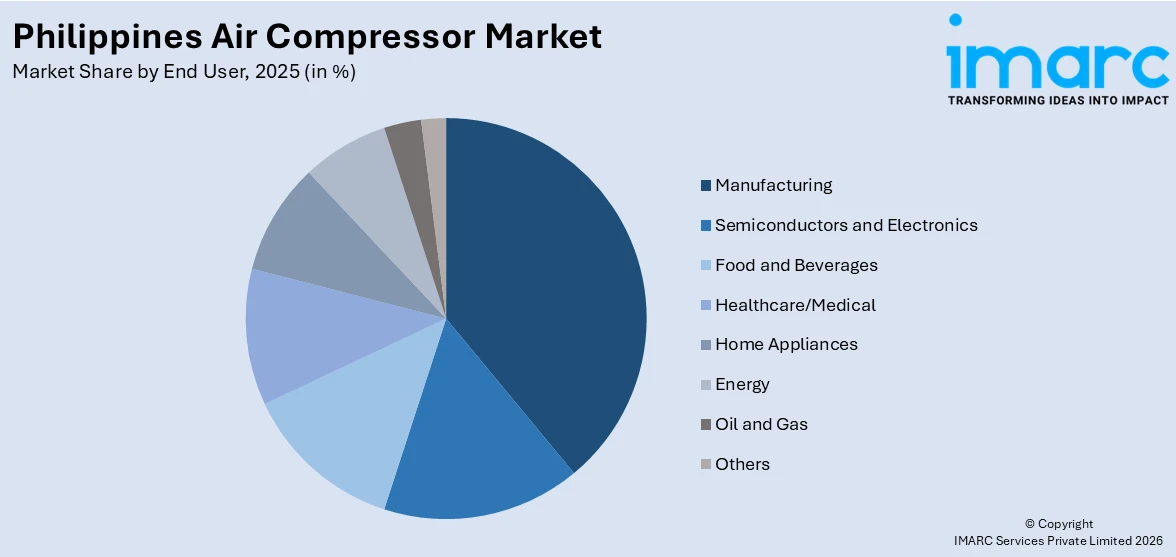
- By End User: Manufacturing comprises the biggest segment with 39.7% share in 2025, driven by the country’s expanding industrial base and rising factory output in sectors including electronics, automotive components, food processing, and general consumer goods manufacturing.
- By Region: Luzon accounts for the most prominent region with 66.1% share in 2025, driven by the concentration of industrial parks, special economic zones, and manufacturing clusters in Metro Manila, Central Luzon, and CALABARZON that collectively drive the majority of compressor demand.
- Key Players: The market is competitive, with global manufacturers dominating industrial demand alongside local distributors and service providers. Players compete through energy-efficient models, after-sales support, spare-part availability, and strong presence across construction, manufacturing, and mining end-users.
To get more information on this market Request Sample
The Philippines air compressor market is advancing steadily as the country strengthens its industrial capacity and expands critical infrastructure networks. A key factor shaping market momentum is the robust growth of the manufacturing sector, which remains the primary demand driver for compressed air systems across factory operations, assembly lines, and material handling applications. The country’s manufacturing purchasing managers’ index reached 54.3 in December 2024, marking the joint-strongest reading since November 2017 and signaling sustained expansion in factory activity. Increased investment in special economic zones, rising electronics production, and modernization of food processing and pharmaceutical manufacturing are collectively generating higher demand for reliable compressed air solutions. Government infrastructure programs, including the Build Better More initiative, are further supporting industrial development and creating favorable conditions for compressor adoption. Energy efficiency improvements and advanced compressor technologies are also enhancing operational viability across cost-sensitive industries throughout the Philippines.
Philippines Air Compressor Market Trends:
Accelerating Adoption of Energy-Efficient Compressor Systems
The Philippines is witnessing growing adoption of variable speed drive and energy-efficient compressor technologies as industries seek to optimize operational costs amid elevated electricity prices. Manufacturers and industrial operators are increasingly prioritizing compressor systems that dynamically adjust air output to match real-time demand, minimizing energy waste during partial-load conditions. Government sustainability initiatives and green building standards are further encouraging facilities to upgrade aging compressor fleets with newer, more efficient units. The Department of Energy gradually raised its targets, increasing the goal from 30% to 35% by 2030, with a longer-term objective of reaching 50% by 2050. This shift toward energy optimization is reshaping procurement decisions across manufacturing, semiconductor, and food processing sectors, supporting Philippines air compressor market growth.
Integration of Smart Monitoring and IoT-Enabled Compressor Technologies
Industrial facilities across the Philippines are progressively integrating Internet of Things capabilities into compressed air systems, enabling real-time performance monitoring, predictive maintenance scheduling, and remote diagnostics. These digitally connected compressor systems allow plant operators to detect potential failures before they cause costly downtime, optimize air pressure settings for varying production demands, and reduce unnecessary energy consumption. The convergence of Industry 4.0 practices with compressed air management is transforming how Philippine manufacturers approach equipment reliability, operational efficiency, and long-term lifecycle cost management across diverse industrial operations.
Expanding Demand from Semiconductor and Electronics Manufacturing
The Philippines’ semiconductor and electronics manufacturing sector is driving specialized compressor demand, particularly for oil-free and high-purity compressed air systems that meet stringent cleanroom requirements. Assembly, testing, and packaging facilities concentrated in special economic zones require contamination-free air supply for sensitive production processes. As the country positions itself to capture a larger share of global semiconductor supply chains, investments in precision manufacturing infrastructure are generating sustained demand for advanced compressor systems designed to deliver consistent air quality standards essential for electronic component production and testing operations. For instance, in October 2025, ACUVEX Corp. invested P3 million in Cavite Economic Zone to fabricate jigs and fixtures for industrial production. PEZA expects the project to boost precision manufacturing, strengthen supply chains, and support ecozone investment growth.
Market Outlook 2026-2034:
The Philippines air compressor market is positioned for sustained growth, supported by continued industrial expansion, large-scale infrastructure investments, and rising demand from advanced manufacturing sectors. In parallel, favorable government initiatives under the Build Better More program and the Luzon Economic Corridor framework are expected to stimulate new industrial development across key manufacturing corridors. Increasing adoption of energy-efficient and IoT-enabled compressor technologies will also drive modernization of existing compressed air infrastructure. As per an industry report, the Armstrong AX line offers competitive pricing, around 30% energy savings, and delivers return on investment in under one year, making it attractive for ROI-focused enterprises. Growing investments in semiconductor fabrication, food processing, and healthcare manufacturing will create additional demand channels, while the expansion of industrial parks in Central Luzon and CALABARZON will further strengthen regional market dynamics and foster a more competitive compressor landscape throughout the forecast period. The market generated a revenue of USD 393.37 Million in 2025 and is projected to reach a revenue of USD 512.18 Million by 2034, growing at a compound annual growth rate of 2.98% from 2026-2034.
Philippines Air Compressor Market Report Segmentation:
|
Segment Category |
Leading Segment |
Market Share |
|
Type |
Stationary |
61.2% |
|
Technology |
Rotary or Screw |
46.8% |
|
Lubrication Method |
Oil-filled |
58.9% |
|
Power Rating |
101 to 300 kW |
34.6% |
|
End User |
Manufacturing |
39.7% |
|
Region |
Luzon |
66.1% |
Type Insights:
- Portable
- Stationary
Stationary dominates with a share of 61.2% of the total Philippines air compressor market in 2025.
The stationary compressor segment holds the commanding share of the Philippines air compressor market, driven by the widespread deployment of fixed-installation systems across manufacturing plants, industrial zones, and large-scale production facilities. These compressors deliver continuous, high-volume compressed air essential for powering production lines, automated assembly systems, pneumatic tools, and material handling equipment. The Philippine Statistics Authority reported that the Value of Production Index for manufacturing grew 1.9% year-on-year in December 2025, reflecting sustained industrial activity that directly supports demand for reliable stationary compressor installations capable of meeting round-the-clock operational requirements across diverse factory environments.
Stationary compressors are particularly favored in the Philippines for their superior energy efficiency, lower per-unit air production costs, and ability to integrate with centralized compressed air distribution networks that serve multiple production zones simultaneously. The expansion of industrial parks and special economic zones across Luzon, including the CALABARZON corridor where major semiconductor and electronics firms have expanded facilities, is generating additional demand for permanently installed compressor systems. Ongoing infrastructure modernization and factory automation trends are further reinforcing the stationary segment’s dominant position in the Philippine industrial landscape.
Technology Insights:
- Reciprocating/Piston
- Rotary/Screw
- Centrifugal
Rotary or screw leads with a share of 46.8% of the total Philippines air compressor market in 2025.
Rotary screw compressors have emerged as the preferred technology choice in the Philippines owing to their continuous duty operation capability, high volumetric efficiency, and lower noise levels compared with reciprocating alternatives. These units deliver consistent air pressure across extended operating periods, making them ideal for manufacturing environments requiring uninterrupted compressed air supply.
The growing adoption of variable speed drive technology in rotary screw compressors is enhancing their appeal among Philippine industrial operators seeking to manage elevated electricity costs. Variable speed models dynamically adjust motor output to match real-time air demand, reducing energy waste during partial-load periods. Industrial compressed air systems can account for up to 40% of a facility’s total electricity consumption, making VSD-equipped rotary screw compressors a strategic investment for cost-conscious manufacturers operating in the Philippines, where industrial electricity rates remain among the highest in Southeast Asia.
Lubrication Method Insights:
- Oil-filled
- Oil-free
Oil-filled accounts for the highest revenue share of 58.9% of the total Philippines air compressor market in 2025.
Oil-filled compressors maintain their dominant position in the Philippines market due to their proven durability, superior cooling capabilities, and cost-effective performance across a broad range of industrial applications. The oil injection process enhances sealing, reduces internal wear, and enables extended operational lifespans under demanding conditions. Philippine manufacturing enterprises, which contributed approximately 15.68% of the country’s gross domestic product in 2024, rely heavily on oil-filled compressor systems for general industrial applications including automotive parts fabrication, metal working, plastic molding, and packaging operations that do not require oil-free air standards.
The preference for oil-filled compressors is further reinforced by their lower initial acquisition costs and reduced maintenance complexity compared with oil-free alternatives. For small and medium-sized industrial operators that form a significant portion of Philippine manufacturing, oil-filled systems offer an accessible entry point for mechanized production. The growing network of local service providers and authorized distributors ensures consistent availability of replacement parts, lubricants, and technical support across major industrial corridors. These factors collectively sustain strong demand for oil-filled compressor units across general manufacturing, construction support, and automotive service applications throughout the country.
Power Rating Insights:
- 0-100 kW
- 101-300 kW
- 301-500 kW
- 501 kW and Above
101 to 300 kW represents the leading segment with a share of 34.6% of the total Philippines air compressor market in 2025.
The 101 to 300 kW power range serves as the backbone of medium-to-large industrial compressed air requirements in the Philippines, providing sufficient output capacity for factory production lines, semiconductor fabrication support, and heavy manufacturing processes. These compressors deliver the balanced combination of high air volume and pressure stability needed for continuous industrial operations. The Philippines’ national government infrastructure budget reached PHP 6.33 Trillion for 2025, representing a 10% year-on-year increase that supports industrial development activities requiring reliable mid-range to high-capacity compressed air systems.
Compressors in the 101 to 300 kW range are increasingly favored by industrial park operators and large manufacturing facilities seeking standardized compressed air solutions that can serve multiple production zones through centralized distribution systems. The expansion of Central Luzon’s industrial base is generating demand for mid-range power compressors suitable for new factory installations in electronics, pharmaceutical, and consumer goods manufacturing. These units offer operational flexibility while maintaining energy-efficient performance across variable load conditions.
End User Insights:
Access the comprehensive market breakdown Request Sample
- Manufacturing
- Semiconductors and Electronics
- Food and Beverages
- Healthcare/Medical
- Home Appliances
- Energy
- Oil and Gas
- Others
Manufacturing holds the largest share at 39.7% of the total Philippines air compressor market in 2025.
The manufacturing sector stands as the primary demand driver for air compressors in the Philippines, utilizing compressed air systems across diverse production processes including assembly, finishing, packaging, and quality testing operations. Compressed air powers pneumatic tools, automated machinery, conveyor systems, and spray-painting equipment essential to factory operations. Philippine manufacturing production recorded a growth rate of 2.4% year-on-year in September 2025, reflecting continued expansion that sustains demand for reliable compressed air infrastructure across the country’s growing network of factories, industrial parks, and export processing zones.
The diversification of Philippine manufacturing into higher-value subsectors including electronics components, pharmaceutical products, and automotive parts is expanding the scope of compressor applications across specialized production environments. Major industrial corridors in CALABARZON and Central Luzon are attracting new manufacturing investments that require dedicated compressed air networks for precision fabrication and cleanroom operations. The electronics sector alone contributed over 50.6% of the Philippines’ total merchandise exports in 2024, underscoring the scale of manufacturing activity that generates sustained demand for advanced compressor systems meeting varied pressure, purity, and reliability requirements.
Regional Insights:
- Luzon
- Visayas
- Mindanao
Luzon comprises the largest region with 66.1% share of the total Philippines air compressor market in 2025.
Luzon commands the dominant share of the Philippines air compressor market owing to its concentration of major industrial parks, special economic zones, and manufacturing clusters across Metro Manila, CALABARZON, and Central Luzon. The island hosts the country’s largest semiconductor facilities, food processing plants, automotive assembly operations, and pharmaceutical manufacturing units that collectively generate the highest demand for compressed air systems.
The Luzon Economic Corridor, launched in April 2024 as a trilateral initiative between the Philippines, the United States, and Japan, is further strengthening the island’s industrial infrastructure through investments in rail connectivity, port modernization, clean energy, and semiconductor supply chains. Central Luzon attracted PHP 14.9 Billion in foreign investment pledges during the first quarter of 2025, accounting for over half the national total. Ongoing development of new industrial estates, expressway networks, and international airport facilities is expected to sustain Luzon’s dominant position as the primary hub for compressor demand across the Philippines throughout the forecast period.
Market Dynamics:
Growth Drivers:
Why is the Philippines Air Compressor Market Growing?
Robust Expansion of Manufacturing and Industrial Activity
The Philippines’ manufacturing sector is experiencing sustained growth, creating strong demand for compressed air systems across diverse production environments. Factory output continues to expand as the country strengthens its position as a regional manufacturing hub for electronics, food processing, pharmaceuticals, and consumer goods. This industrial momentum is supported by growing foreign direct investment flowing into special economic zones and export processing areas where compressed air systems are integral to production line operations. Likewise, rising domestic consumption, expanding export orders from key trading partners, and government initiatives promoting industrial competitiveness are reinforcing the manufacturing sector’s growth trajectory, directly supporting increased procurement of air compressors for new factory installations and capacity expansion projects. The diversification of Philippine manufacturing into higher-value subsectors including semiconductor components, medical devices, and automotive parts is further broadening the range of compressor applications required to support increasingly sophisticated production environments across the country.
Large-Scale Infrastructure Development and Construction Programs
The Philippines government’s ambitious infrastructure development agenda is generating significant demand for air compressors across construction sites, tunnel boring operations, and heavy civil works projects. directed toward transportation infrastructure, public buildings, and industrial corridor development. Similarly, infrastructure investments under the Build Better More program are driving construction activity that relies heavily on portable and stationary compressed air systems for concrete spraying, pneumatic drilling, sandblasting, and structural finishing applications. The development of major flagship projects including expressway networks, commuter rail lines, airport modernization, and port expansion across Luzon is creating sustained demand for high-capacity compressor systems at construction sites. For instance, San Miguel Corp planned to invest USD 5.16 Billion to build two tolled expressways, SALEx costing USD 2.615 Billion and NALEx USD 2.545 Billion, improving Manila connectivity. Besides this, public-private partnership opportunities are further expanding the market potential for air compressors used in infrastructure construction. These development initiatives are expected to maintain elevated construction sector activity over the forecast period, supporting consistent demand growth for compressed air equipment across the Philippines.
Rising Emphasis on Energy Efficiency and Operational Cost Optimization
The Philippines’ position as one of the highest-cost electricity markets in Southeast Asia is compelling industrial operators to prioritize energy-efficient compressor solutions that minimize operational expenditure. Philippine electricity rates averaged approximately USD 0.22 per kilowatt-hour in 2024, significantly exceeding rates in neighboring markets such as Thailand and Malaysia. This cost pressure is driving demand for variable speed drive compressors, heat recovery systems, and smart pressure management technologies that optimize energy utilization across varying production loads. Industrial facilities are increasingly conducting compressed air audits to identify system inefficiencies including air leaks, pressure drops, and oversized equipment that contribute to unnecessary energy expenditure. The transition from older, less efficient reciprocating compressors to modern rotary screw and centrifugal units equipped with advanced controls is gaining momentum across manufacturing plants, food processing facilities, and pharmaceutical production environments. Government sustainability programs and growing corporate environmental commitments are further accelerating the adoption of next-generation compressor systems designed to deliver superior energy performance throughout the country.
Market Restraints:
What Challenges the Philippines Air Compressor Market is Facing?
Elevated Electricity Costs and Energy Price Volatility
The Philippines faces among the highest electricity costs in Southeast Asia, with average rates significantly exceeding those of neighboring manufacturing economies such as Thailand, Vietnam, and Malaysia. This elevated energy pricing directly impacts the operating economics of compressed air systems, which represent substantial energy consumers within industrial facilities. Frequent electricity price adjustments driven by global fuel cost fluctuations, transmission charge increases, and feed-in tariff allowance revisions create budgetary uncertainty for industrial operators relying on continuous compressor operation, discouraging some smaller enterprises from expanding their compressed air capacity.
Supply Chain Constraints and Import Dependency
The Philippines’ heavy reliance on imported compressor equipment, components, and raw materials creates vulnerability to global supply chain disruptions, currency fluctuations, and international shipping delays. Limited domestic compressor manufacturing capability means that most industrial-grade units must be sourced from international suppliers, adding procurement lead times and logistics costs. Peso depreciation against major trading currencies periodically increases the landed cost of compressor systems and spare parts, restricting purchasing capacity among price-sensitive small and medium-sized industrial operators across the country.
Infrastructure and Logistics Challenges Across Island Geography
The Philippines’ archipelagic geography presents unique distribution and servicing challenges for compressor suppliers seeking to serve industrial clients across dispersed island locations. While Luzon benefits from well-developed logistics networks, industrial operators in Visayas and Mindanao face higher freight costs, longer equipment delivery timelines, and limited access to specialized technical support and maintenance services. Regulatory requirements associated with air compressor emissions, noise pollution standards, and industrial safety compliance further add operational complexity for enterprises deploying compressed air systems across multiple geographic locations throughout the country.
Competitive Landscape:
The Philippines air compressor market features a competitive landscape shaped by international compressor manufacturers, regional distributors, and local service providers working to address growing industrial demand. Major global players leverage established brand recognition, advanced technology portfolios, and comprehensive after-sales service networks to maintain strong market positions. Competition is intensifying as companies focus on energy-efficient product launches, expanded service coverage, enhanced financing options, and strategic partnerships with Philippine-based distributors. Local service providers are strengthening their roles by offering customized installation, maintenance solutions, and rapid technical support tailored to the specific operational requirements of Philippine industries. The growing emphasis on variable speed drive technologies, IoT-enabled monitoring, and predictive maintenance capabilities is further shaping competitive dynamics as companies differentiate through innovation, reliability, and cost-effective lifecycle management across the market.
Recent Developments:
- Atlas Copco unveiled the B‑Air 185‑12, the world’s first battery‑driven portable screw air compressor, offering fuel‑free, low‑emission operation with 5–12 bar pressure and a 55 kWh battery for full‑shift performance. It boosts energy efficiency, reduces maintenance, and supports sustainable and urban‑friendly industrial use, with availability for markets including the Philippines.
Philippines Air Compressor Market Report Coverage:
|
Report Features |
Details |
|
Base Year of the Analysis |
2025 |
|
Historical Period |
2020-2025 |
|
Forecast Period |
2026-2034 |
|
Units |
Million USD |
|
Scope of the Report |
Exploration of Historical Trends and Market Outlook, Industry Catalysts and Challenges, Segment-Wise Historical and Future Market Assessment:
|
|
Types Covered |
Portable, Stationary |
|
Technologies Covered |
Reciprocating/Piston, Rotary/Screw, Centrifugal |
|
Lubrication Methods Covered |
Oil-filled, Oil-free |
|
Power Ratings Covered |
0-100 kW, 101-300 kW, 301-500 kW, 501 kW and Above |
|
End Users Covered |
Manufacturing, Semiconductors and Electronics, Food and Beverages, Healthcare/Medical, Home Appliances, Energy, Oil and Gas, Others |
|
Regions Covered |
Luzon, Visayas, Mindanao |
|
Customization Scope |
10% Free Customization |
|
Post-Sale Analyst Support |
10-12 Weeks |
|
Delivery Format |
PDF and Excel through Email (We can also provide the editable version of the report in PPT/Word format on special request) |
Frequently Asked Questions About the Philippines Air Compressor Market Report
The Philippines air compressor market size was valued at USD 393.37 Million in 2025.
The market is expected to grow at a compound annual growth rate of 2.98% from 2026-2034 to reach USD 512.18 Million by 2034.
Stationary, holding the largest revenue share of 61.2%, remains the dominant type in the Philippines air compressor market, driven by widespread industrial deployment, continuous operation requirements, and expanding manufacturing facility installations across major economic zones.
Key factors driving the Philippines air compressor market include robust manufacturing sector expansion, large-scale infrastructure development programs, growing semiconductor and electronics production, rising energy efficiency priorities, and increasing industrial automation adoption across the country.
Major challenges include elevated electricity costs impacting operational economics, supply chain constraints due to import dependency, logistics challenges across the archipelagic geography, currency volatility affecting equipment procurement, and regulatory compliance complexities for industrial operations.
Need more help?
- Speak to our experienced analysts for insights on the current market scenarios.
- Include additional segments and countries to customize the report as per your requirement.
- Gain an unparalleled competitive advantage in your domain by understanding how to utilize the report and positively impacting your operations and revenue.
- For further assistance, please connect with our analysts.
 Request Customization
 Speak to an Analyst
 Request Brochure
 Inquire Before Buying
Benefits of Customization
- Personalize this research
- Triangulate with your data
- Get data as per your format and definition
- Gain a deeper dive into a specific application, geography, customer, or competitor
- Any level of personalization
Get in Touch With Us
UNITED STATES
Phone: +1-201-971-6302
INDIA
Phone: +91-120-433-0800
UNITED KINGDOM
Phone: +44-753-714-6104
Email: [email protected]
Client Testimonials




.webp)




.webp)













Related Reports

Choose your plan
*Please note that the prices mentioned below are starting prices for each bundle type. Kindly contact our team for further details.*
Single User License
- 1 User License, Access on 2 Devices
- PDF Report + Excel Dataset (Password Protected)
- Lifetime Access
- No Printing Rights
- 10% Free Report Customization
- 10–12 Weeks of Analyst Support
Five User License
- Access for 5 Users, 2 Devices per User
- PDF Report + Excel Dataset (Password Protected)
- Lifetime Access
- Dedicated Account Manager
- 12–14 Weeks of Analyst Support
- No Printing Rights
- 15% Free Report Customization
- 25% Discount on Your Next Purchase
Corporate User License
- Unlimited User Access (Within Your Organization)
- PDF Report + Excel Dataset
- Lifetime Access
- Dedicated Account Manager
- 14–20 Weeks of Analyst Support
- No Printing Rights
- 20% Free Report Customization
- 30% Discount on Your Next Purchase
Essential Insights
What's included:
3 reports
- Lifetime Access
- PDF Reports
- Excel Datasets
- 2 Weeks of Free Analyst Support
- 2 User Licenses
- Access on 2 Devices
- Printing Rights
- Complimentary PowerPoint (PPT) Version
- Complimentary License Upgrade
Professional Access
What's included:
5 reports
- Lifetime Access
- PDF Reports
- Excel Datasets
- 8 Weeks of Free Analyst Support
- 2 User Licenses
- Access on 2 Devices
- Printing Rights
- Complimentary PowerPoint (PPT) Version
- Complimentary License Upgrade
Business Advantage
What's included:
8 reports
- Lifetime Access
- PDF Reports
- Excel Datasets
- 14 Weeks of Free Analyst Support
- 2 User Licenses
- Access on 2 Devices
- Printing Rights
- Complimentary PowerPoint (PPT) Version
- Complimentary License Upgrade
Enterprise Intelligence
What's included:
10 reports
- Lifetime Access
- PDF Reports
- Excel Datasets
- 20 Weeks of Free Analyst Support
- 2 User Licenses
- Access on 2 Devices
- Printing Rights
- Complimentary PowerPoint (PPT) Version
- Complimentary License Upgrade