
Philippines Airport Ground Handling Market Size, Share, Trends and Forecast by Service, Airport, Service Provider, and Region, 2026-2034
Philippines Airport Ground Handling Market Summary:
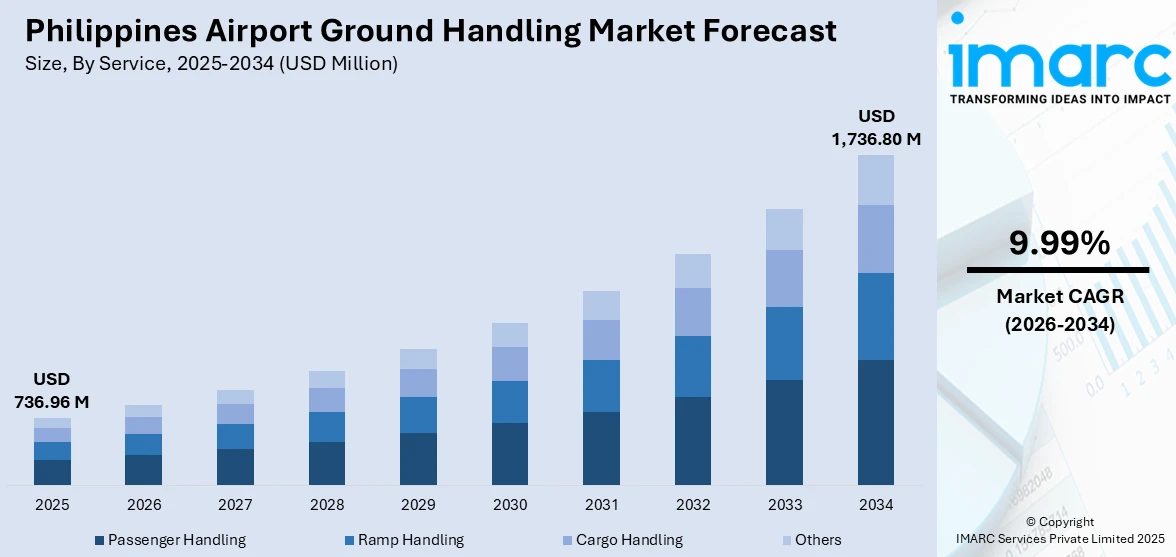
The Philippines airport ground handling market size was valued at USD 736.96 Million in 2025 and is projected to reach USD 1,736.80 Million by 2034, growing at a compound annual growth rate of 9.99% from 2026-2034.
The Philippines airport ground handling market is experiencing rapid growth because air passenger traffic now exceeds its pre-pandemic levels, major airport modernization projects continue, and tourism revenue growth brings more international visitors to the country. The Philippines airport ground handling market also continues to expand because government infrastructure development programs, airport operations privatization and airline fleet growth create rising demand for complete ground handling services.
Key Takeaways and Insights:
- By Service: Passenger handling dominates the market with a share of 41.3% in 2025, owing to record-breaking air traffic volumes at Philippine airports and rising demand for seamless check-in, boarding, and arrival processing services. Expanding international routes are fueling the market expansion.
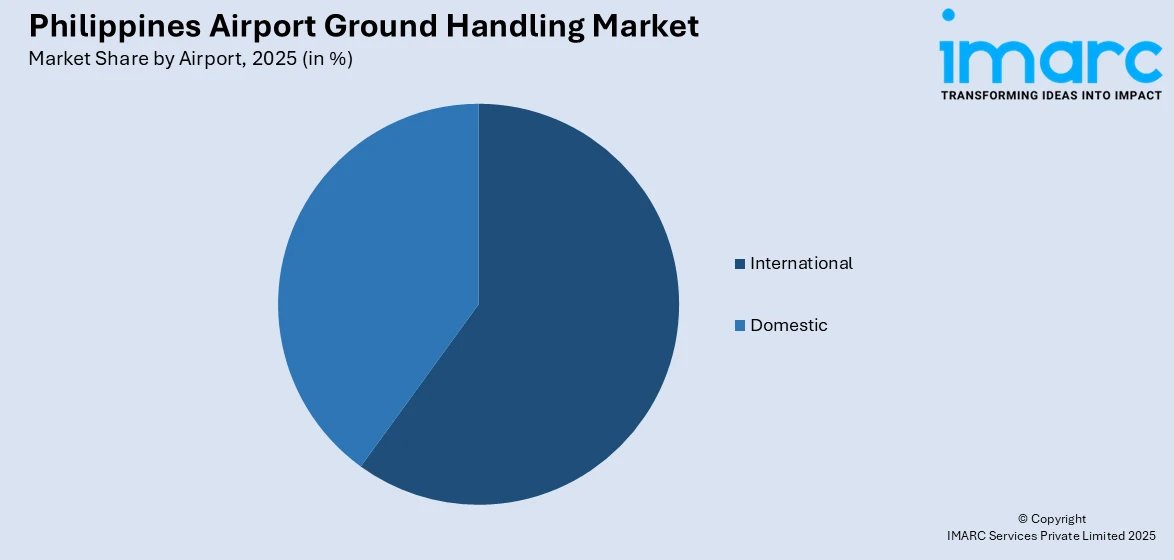
- By Airport: International leads the market with a share of 56.8% in 2025. This dominance is driven by growing international visitor arrivals, expanded airline connectivity to global destinations, and heightened demand for specialized ground handling services at international gateway airports.
- By Service Provider: Airlines and airports represent the largest segment with a market share of 53.2% in 2025, reflecting the prevalent self-handling model adopted by major Philippine carriers and airport operators who maintain in-house ground handling operations to ensure quality control and cost efficiency.
- By Region: Luzon comprises the largest region with 69.4% share in 2025, driven by the concentration of aviation activity at Ninoy Aquino International Airport and Clark International Airport, which collectively handle the majority of passenger and cargo volumes nationwide.
- Key Players: The market is dominated by a few established handlers at major gateways, while smaller regional operators serve secondary airports. Competition hinges on long-term airline contracts, safety compliance, turnaround speed, equipment availability, and ability to scale across multiple airports.
To get more information on this market Request Sample
The Philippines airport ground handling market is experiencing significant momentum as the country's aviation sector enters a transformative growth phase. The demand for efficient passenger handling, ramp operations, cargo management, and related support services is being propelled by strong post-pandemic recovery in air travel and ambitious infrastructure modernization programs. The privatization of Ninoy Aquino International Airport under the New NAIA Infrastructure Corporation and the development of the New Manila International Airport in Bulacan are reshaping the competitive landscape for ground handling services. NAIA recorded a historic 50.1 million passengers in 2024, representing a 10.43% increase over the previous year, which directly amplifies the volume of ground handling operations required. Additionally, the government's commitment to decentralizing air traffic through regional airport expansion in Visayas and Mindanao is creating new opportunities for service providers to establish operations beyond the traditional Luzon-centric aviation hub.
Philippines Airport Ground Handling Market Trends:
Digital Transformation and Biometric Integration in Passenger Processing
Philippine airports are rapidly adopting digital technologies to streamline ground handling operations and enhance passenger experience. Automated self-service kiosks, biometric boarding gates, and integrated passenger processing systems are replacing manual workflows. For instance, in March 2025, New NAIA Infrastructure Corporation partnered with Collins Aerospace to deploy a comprehensive systems overhaul at NAIA, introducing common-use self-service kiosks, biometric screening, and baggage reconciliation technology across all terminals, with full implementation targeted by September 2025.
Expansion of Regional Airport Infrastructure and Decentralized Operations
The Philippines is actively expanding its airport network beyond Metro Manila to address capacity constraints and distribute ground handling demand across regions. Accordingly, Clark International Airport emerged as a strategic logistics hub, with cargo volumes surging by 100% within the first five months of 2025, handling approximately 35,903 tonnes via 2,522 flights. This rapid growth is prompting ground handling providers to expand their service footprint to regional gateways in Visayas and Mindanao.
Growing Emphasis on Sustainable Ground Support Equipment and Practices
Environmental sustainability is becoming a key focus for ground handling operators in the Philippines as airports adopt cleaner operational practices. Airlines and airport operators are increasingly transitioning to electric ground support equipment, energy-efficient ramp vehicles, and sustainable fueling systems. As such, the government allocated PHP 1.976 Billion for the procurement of biometric e-gates and modernized border processing infrastructure in 2025, reflecting the broader push toward technology-driven and environmentally conscious airport operations nationwide.
Market Outlook 2026-2034:
The Philippines airport ground handling market is poised for robust expansion during the forecast period, driven by sustained growth in air passenger traffic, accelerating airport modernization programs, and increasing privatization of aviation infrastructure. For example, the development of the New Manila International Airport in Bulacan, designed to serve 35 million passengers annually in its first phase, will create substantial new demand for ground handling services. In accordance with this, rising international tourism, expanded airline connectivity to global destinations, and growing e-commerce-driven cargo volumes are expected to amplify demand for comprehensive ground handling solutions across the archipelago. The market generated a revenue of USD 736.96 Million in 2025 and is projected to reach a revenue of USD 1,736.80 Million by 2034, growing at a compound annual growth rate of 9.99% from 2026-2034.
Philippines Airport Ground Handling Market Report Segmentation:
|
Segment Category |
Leading Segment |
Market Share |
|
Service |
Passenger Handling |
41.3% |
|
Airport |
International |
56.8% |
|
Service Provider |
Airlines and Airports |
53.2% |
|
Region |
Luzon |
69.4% |
Service Insights:
- Passenger Handling
- Ramp Handling
- Cargo Handling
- Others
Passenger handling dominates with a market share of 41.3% of the total Philippines airport ground handling market in 2025.
The passenger handling services in the Philippines form the essential foundation which supports all ground handling operations through their various functions. The segment's dominance exists because Philippine airports experience continuous growth in air passenger numbers. The airlines and service providers need to expand their passenger handling operations because the airports face record-level passenger traffic.
The growth trajectory of passenger handling is further reinforced by expanding international connectivity and tourism recovery efforts. The Philippines welcomed 5.95 Million international visitor arrivals in 2024, representing a 9.2% increase over the previous year. Major carriers including Philippine Airlines and Cebu Pacific continue to launch new international routes, requiring corresponding expansion of passenger handling infrastructure at departure and arrival terminals. Ground handling providers are investing in advanced check-in counters, automated boarding systems, and dedicated transfer desks to accommodate the rising complexity of passenger processing operations.
Airport Insights:
Access the comprehensive market breakdown Request Sample
- Domestic
- International
International leads with a share of 56.8% of the total Philippines airport ground handling market in 2025.
International airport operations command the largest share of ground handling revenue owing to the higher service complexity and broader scope of operations required for cross-border air travel. International flights necessitate specialized immigration processing, customs cargo handling, enhanced security protocols, and multilingual passenger assistance that collectively demand greater resource deployment. NAIA, the country's primary international gateway, recorded 293,488 flights in 2024, marking an 8.08% increase compared to pre-pandemic levels in 2019. This flight volume growth directly translates into expanded requirements for international ground handling services.
The international segment benefits from the Philippine government's strategic initiatives to position the country as a premier aviation hub in Southeast Asia. Airlines and airports are preparing for this transition through two main activities which involve modernizing ground support equipment, training specialized handling crews and establishing partnerships with international service providers to meet global aviation standards and service benchmarks.
Service Provider Insights:
- Independent
- Airlines and Airports
The airlines and airports segment exhibits a clear dominance with a 53.2% share of the total Philippines airport ground handling market in 2025.
Airlines and airport operators maintain the leading position in ground handling service provision, as major Philippine carriers prefer retaining in-house control over critical ground operations to maintain service quality and operational consistency. MacroAsia Airport Services Corporation, the country's largest ground handling company, reported record revenue of PHP 4.17 Billion from ground handling and aviation services in 2024, reflecting a 33% increase over the previous year.
Philippine aviation companies show preference for self-handling operations at their airports and airlines because major aviation groups implement vertical integration business strategies. Philippine Airlines operates its own ground handling division to provide passenger services and ramp services and baggage handling services at its main airports while Cebu Pacific has established a similar dedicated ground handling operation. The integrated ground handling systems at NAIA and Clark International Airport operated by NNIC and LIPAD respectively enable their airport operators to manage both infrastructure operations and actual service delivery which helps their airline partners coordinate their terminal and airside operations.
Region Insights:
- Luzon
- Visayas
- Mindanao
Luzon represents the leading region with a 69.4% share of the total Philippines airport ground handling market in 2025.
Luzon's commanding market position is anchored by the presence of NAIA and Clark International Airport, which collectively process the vast majority of the country's air traffic. These gateways handle the majority of international and domestic passenger movements, making the region the primary focal point for airline operations. The high frequency of flights, dense airline presence, and continuous infrastructure upgrades create sustained demand for ground handling, maintenance, fueling, baggage handling, and passenger services across Luzon’s airport network.
Beyond passenger traffic, Luzon also plays a critical role in air cargo and logistics activity. NAIA and Clark function as key nodes for express freight, e-commerce shipments, and time-sensitive industrial cargo serving Metro Manila and nearby industrial corridors. The clustering of airlines, logistics firms, and support service providers enables operational efficiencies and economies of scale. For example, Megawide and Carmona signed a 30-year JVA in September 2025 for the 5.3-hectare South Luzon Integrated Terminal Exchange (SLITx). The PPP project will integrate buses, logistics, commercial space, and smart infrastructure to boost regional connectivity. This concentration attracts continued investment in modern equipment, digital handling systems, and skilled manpower, reinforcing Luzon’s dominance in the national airport ground handling market.
Market Dynamics:
Growth Drivers:
Why is the Philippines Airport Ground Handling Market Growing?
Surging Air Passenger Traffic and Post-Pandemic Recovery in Aviation
The Philippines aviation sector has experienced a remarkable post-pandemic recovery, with passenger volumes surpassing pre-pandemic levels and establishing new records at major gateway airports. This sustained growth in air traffic is the primary catalyst driving demand for ground handling services across the country. Higher passenger volumes require proportional expansion of check-in counters, boarding gate operations, baggage handling systems, and ramp services. The domestic segment contributed 2.54 million passengers while international traffic rose 8.16% to 2.42 million, creating balanced demand growth across all ground handling service categories. This traffic momentum is compelling ground handling companies to recruit additional personnel, invest in modern equipment, and extend operating hours to accommodate increasing flight frequencies and turnaround requirements.
Large-Scale Airport Infrastructure Development and Privatization Programs
The Philippine government's aggressive infrastructure development agenda is creating substantial new opportunities for ground handling service expansion. Major airport construction and modernization projects are underway across the archipelago, requiring corresponding investment in ground handling infrastructure and capabilities. As such, in February 2026, Lufthansa Technik and FedEx invested over USD 600 Million in Clark International Airport, with a USD 400 Million MRO facility and a USD 200 Million logistics expansion, strengthening the Philippines’ push to become a regional aviation and investment hub. These infrastructure investments are expanding the addressable market for handling services and attracting new entrants seeking to capitalize on growing aviation capacity.
Rapid Growth in International Tourism and Expanding Airline Connectivity
The robust recovery in international tourism and the continuous expansion of airline route networks is generating sustained demand for specialized ground handling services at Philippine airports. The diversification of source markets and growing airline connectivity to destinations across Asia, North America, and Europe require ground handlers to provide increasingly sophisticated services including multilingual passenger assistance, premium lounge management, and complex transfer handling. The Bureau of Immigration recorded 7.84 million international arrivals during the first half of 2025, reflecting an 8% increase over the same period in the previous year. Major carriers are expanding their fleets and route networks, with Cebu Pacific signing a landmark memorandum of understanding with Airbus in July 2024 for up to 152 A320neo family aircraft valued at approximately USD 24 Billion. This fleet expansion translates directly into higher ground handling service demand across Philippine airports.
Market Restraints:
What Challenges the Philippines Airport Ground Handling Market is Facing?
Airport Capacity Constraints and Infrastructure Bottlenecks
Philippine airports, especially NAIA, are operating beyond their intended capacity, creating major operational bottlenecks for ground handling services. Heavy passenger volumes contribute to congested aprons, limited aircraft parking positions, and restricted ramp access. These physical constraints reduce the ability of ground handlers to deploy equipment smoothly, manage aircraft turnaround efficiently, and maintain consistent service standards. Peak traffic periods further intensify delays and strain airport support operations.
Skilled Workforce Shortage and Rising Labor Costs in Aviation Services
The rapid growth in aviation activity has created acute demand for trained ground handling personnel, including ramp agents, passenger service agents, and cargo handlers. Competition for skilled aviation workers is intensifying as airlines, airport operators, and independent service providers simultaneously expand their operations. The requirement for specialized certifications, safety training, and regulatory compliance further limits the available talent pool. Rising labor costs driven by minimum wage increases and competitive compensation packages place additional pressure on ground handling margins.
Regulatory Complexity and Fragmented Concession Frameworks
The Philippine aviation sector operates under a complex regulatory framework that involves multiple government agencies including the Civil Aviation Authority of the Philippines, the Manila International Airport Authority, and the Department of Transportation. Ground handling operators must navigate overlapping jurisdictions, varied concession requirements, and evolving compliance standards across different airports. This regulatory fragmentation increases operational costs, creates uncertainty for long-term investment planning, and can delay the entry of new service providers seeking to compete in the market.
Competitive Landscape:
The Philippines airport ground handling market features a moderately concentrated competitive landscape shaped by the operational dominance of airline-affiliated service providers and a select number of independent operators. Major airlines such as Philippine Airlines and Cebu Pacific maintain dedicated ground handling subsidiaries that service their own fleets and selectively extend services to partner carriers. Independent handlers including MacroAsia Airport Services Corporation and Philippine Airport Ground Support Solutions compete for third-party airline contracts across multiple airports. The market is witnessing increasing competitive intensity as airport privatization opens new service opportunities, technology adoption raises operational benchmarks, and growing air traffic volumes attract both domestic and international ground handling companies seeking to establish or expand their presence in the Philippine aviation market.
Recent Developments:
- In February 2026, Philippine Airlines announced its plan to increase domestic jet services from NAIA starting March 2026 as it fully withdraws turboprop flights by March 29. The airline will transfer its operations to three hubs which are located in Cebu and Clark and Iloilo to create additional flight capacity for high-demand jet routes while reducing airport congestion which the government requires.
- In February 2025, Avion Express Philippines planned to launch ACMI services to help airlines meet seasonal capacity needs. The model which received announcement from major carriers and regulators shows its ability to support fleet expansion while boosting profits and solving aircraft supply shortages. The company is finalizing certifications before starting operations this year.
Philippines Airport Ground Handling Market Report Coverage:
|
Report Features |
Details |
|
Base Year of the Analysis |
2025 |
|
Historical Period |
2020-2025 |
|
Forecast Period |
2026-2034 |
|
Units |
USD Million |
|
Scope of the Report |
Exploration of Historical Trends and Market Outlook, Industry Catalysts and Challenges, Segment-Wise Historical and Future Market Assessment:
|
|
Services Covered |
Passenger Handling, Ramp Handling, Cargo Handling, Others |
|
Airports Covered |
Domestic, International |
|
Service Providers Covered |
Independent, Airlines and Airports |
|
Regions Covered |
Luzon, Visayas, Mindanao |
|
Customization Scope |
10% Free Customization |
|
Post-Sale Analyst Support |
10-12 Weeks |
|
Delivery Format |
PDF and Excel through Email (We can also provide the editable version of the report in PPT/Word format on special request) |
Frequently Asked Questions About the Philippines Airport Ground Handling Market Report
The Philippines airport ground handling market size was valued at USD 736.96 Million in 2025.
The Philippines airport ground handling market is expected to grow at a compound annual growth rate of 9.99% from 2026-2034 to reach USD 1,736.80 Million by 2034.
Passenger handling dominated the market with a share of 41.3%, driven by record-breaking air traffic volumes at Philippine airports and the growing need for efficient check-in, boarding, and arrival processing services.
Key factors driving the Philippines airport ground handling market include surging air passenger volumes, large-scale airport modernization and privatization initiatives, expanding international tourism, and growing airline fleet investments.
Major challenges include airport capacity constraints at overcrowded terminals, skilled workforce shortages in aviation services, regulatory complexity across multiple oversight agencies, rising operational costs, and infrastructure limitations at regional airports.
Need more help?
- Speak to our experienced analysts for insights on the current market scenarios.
- Include additional segments and countries to customize the report as per your requirement.
- Gain an unparalleled competitive advantage in your domain by understanding how to utilize the report and positively impacting your operations and revenue.
- For further assistance, please connect with our analysts.
 Request Customization
 Speak to an Analyst
 Request Brochure
 Inquire Before Buying
Benefits of Customization
- Personalize this research
- Triangulate with your data
- Get data as per your format and definition
- Gain a deeper dive into a specific application, geography, customer, or competitor
- Any level of personalization
Get in Touch With Us
UNITED STATES
Phone: +1-201-971-6302
INDIA
Phone: +91-120-433-0800
UNITED KINGDOM
Phone: +44-753-714-6104
Email: [email protected]
Client Testimonials




.webp)




.webp)













Related Reports

Choose your plan
*Please note that the prices mentioned below are starting prices for each bundle type. Kindly contact our team for further details.*
Single User License
- 1 User License, Access on 2 Devices
- PDF Report + Excel Dataset (Password Protected)
- Lifetime Access
- No Printing Rights
- 10% Free Report Customization
- 10–12 Weeks of Analyst Support
Five User License
- Access for 5 Users, 2 Devices per User
- PDF Report + Excel Dataset (Password Protected)
- Lifetime Access
- Dedicated Account Manager
- 12–14 Weeks of Analyst Support
- No Printing Rights
- 15% Free Report Customization
- 25% Discount on Your Next Purchase
Corporate User License
- Unlimited User Access (Within Your Organization)
- PDF Report + Excel Dataset
- Lifetime Access
- Dedicated Account Manager
- 14–20 Weeks of Analyst Support
- No Printing Rights
- 20% Free Report Customization
- 30% Discount on Your Next Purchase
Essential Insights
What's included:
3 reports
- Lifetime Access
- PDF Reports
- Excel Datasets
- 2 Weeks of Free Analyst Support
- 2 User Licenses
- Access on 2 Devices
- Printing Rights
- Complimentary PowerPoint (PPT) Version
- Complimentary License Upgrade
Professional Access
What's included:
5 reports
- Lifetime Access
- PDF Reports
- Excel Datasets
- 8 Weeks of Free Analyst Support
- 2 User Licenses
- Access on 2 Devices
- Printing Rights
- Complimentary PowerPoint (PPT) Version
- Complimentary License Upgrade
Business Advantage
What's included:
8 reports
- Lifetime Access
- PDF Reports
- Excel Datasets
- 14 Weeks of Free Analyst Support
- 2 User Licenses
- Access on 2 Devices
- Printing Rights
- Complimentary PowerPoint (PPT) Version
- Complimentary License Upgrade
Enterprise Intelligence
What's included:
10 reports
- Lifetime Access
- PDF Reports
- Excel Datasets
- 20 Weeks of Free Analyst Support
- 2 User Licenses
- Access on 2 Devices
- Printing Rights
- Complimentary PowerPoint (PPT) Version
- Complimentary License Upgrade