
Philippines Aluminum Cans Market Size, Share, Trends and Forecast by Application, and Region, 2026-2034
Philippines Aluminum Cans Market Summary:
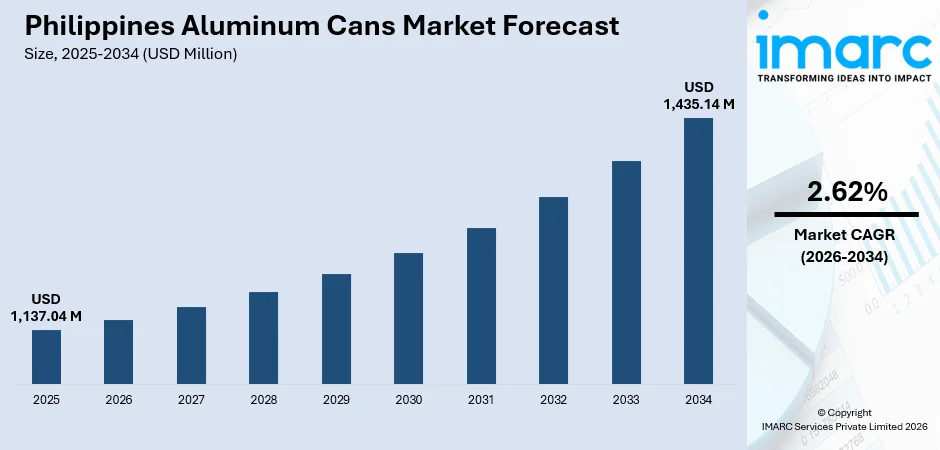
The Philippines aluminum cans market size was valued at USD 1,137.04 Million in 2025 and is projected to reach USD 1,435.14 Million by 2034, growing at a compound annual growth rate of 2.62% from 2026-2034.
The Philippines aluminum cans market is gaining momentum as the beverage and food processing industries increasingly adopt lightweight, recyclable packaging solutions. Rising urbanization, growing consumer preference for convenience-oriented ready-to-drink formats, and expanding modern retail infrastructure are supporting market expansion. Regulatory developments promoting sustainable packaging, alongside investments in domestic manufacturing capacity and heightened environmental awareness, are collectively strengthening the Philippines aluminum cans market share.
Key Takeaways and Insights:
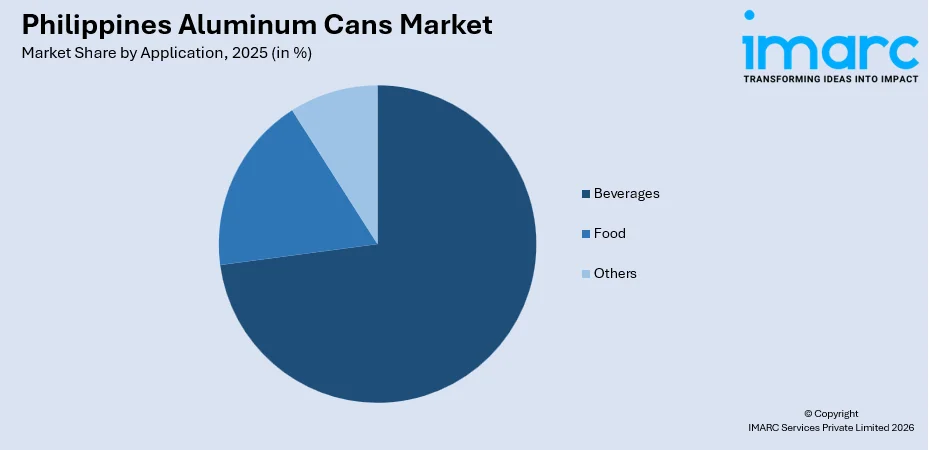
- By Application: Beverages dominates the market with a share of 72.6% in 2025, owing to strong consumption of carbonated soft drinks, beer, and energy drinks in canned formats. Expanding distribution networks and the tropical climate sustain year-round demand for canned beverages across urban and rural retail channels.
- By Region: Luzon comprises the largest region with 64.8% share in 2025, driven by the concentration of major beverage and food manufacturing facilities in Metro Manila and surrounding industrial zones, along with the island's dense urban population base generating substantial packaged goods consumption.
- Key Players: The market is concentrated among a few large packaging producers supplying major beverage brands, with competition shaped by long-term contracts, can size/printing capabilities, and supply reliability. Players also differentiate through lightweighting, recycled-content offerings, and proximity to high-volume bottling hubs.
To get more information on this market Request Sample
The Philippines aluminum cans market is expanding as beverage and food manufacturers increasingly adopt aluminum packaging to meet evolving consumer demands for portability, sustainability, and convenience. The market benefits from the country's thriving beverage industry, with the Philippine alcoholic beverages market valued at USD 7.27 Billion in 2024, underscoring the significant consumption base that drives canned format adoption. Aluminum cans offer superior barrier properties, rapid chilling capabilities, and indefinite recyclability without quality loss, making them the preferred choice for carbonated soft drinks, energy drinks, and canned seafood products. The Extended Producer Responsibility Act mandates that large enterprises with total assets exceeding PHP 100 Million implement packaging recovery programs, with escalating targets reaching 80% by 2028, accelerating the shift toward recyclable aluminum packaging. Ongoing infrastructure investments and modernized production lines are enhancing domestic supply chain resilience. Moreover, rising health consciousness among consumers is also strengthening demand for functional beverages in aluminum cans, influencing the Philippines aluminum cans market outlook.
Philippines Aluminum Cans Market Trends:
Premiumization and craft beverage expansion in aluminum can formats
Young urban consumers in the Philippines are driving increasing demand for premium and craft beverages which come packaged in aluminum cans. The introduction of artisanal beers, flavored malt beverages and ready-to-drink cocktails in sleek can formats has created new market opportunities which extend beyond existing lager and soft drink categories. Social media influence together with nightlife culture drives consumers to adopt visually distinctive canned beverages which create opportunities for manufacturers to produce specialized can sizes, finishes and designs that generate higher prices while establishing brand identity in the Philippines aluminum cans market.
Sustainability-driven shift from plastic to aluminum packaging
The Philippines is experiencing an operational shift from plastic containers to aluminum cans because people are becoming more environmentally conscious and governments are imposing stricter environmental regulations. An industry survey found that 88.7% of respondents believe companies must adopt a proactive and transparent approach in addressing global environmental challenges. The national law that requires producers to take responsibility for their packaging waste is driving food and beverage companies to choose recyclable packaging solutions that support circular economy operations. Companies are now selecting aluminum cans as their preferred packaging solution because these containers maintain their material integrity during endless recycling processes which companies now use to meet their sustainability objectives. The Philippine aluminum can market experiences growth because consumers increasingly prefer brands which show environmental responsibility by using recyclable packaging materials while they choose between aluminum cans and traditional plastic containers.
Expansion of canned food and ready-to-eat product categories
The Philippines canned food sector is expanding as urbanization and busy lifestyles drive demand for convenient, shelf-stable meal solutions packaged in aluminum cans. According to an industry report, the Philippines contains more than 150 cities which together house about 40 percent of its population in urban areas that exceed 50 percent urban development. The increasing demand for premium canned seafood products together with flavored ready-to-eat meals and specialty meat items from younger consumers creates new aluminum can packaging requirements that extend beyond standard beverage packaging needs. Modern retail channels and e-commerce platforms provide consumers with wider access to canned food products whereas advanced canning technologies deliver superior taste retention together with extended shelf life and improved food safety standards for all products distributed nationwide.
Market Outlook 2026-2034:
The market for aluminum cans in the Philippines will experience continuous growth because of rising beverage consumption, increasing sustainability efforts, and ongoing development projects in manufacturing plants that exist throughout the country. The beverage and food processing industries will continue to grow because consumers want eco-friendly packaging solutions that they can recycle easily. Aluminum can usage will increase because the country has a growing population and more people are shopping through modern retail stores and online marketplaces. A study shows that 46% of Filipinos shop online three or more times every month. The average person spent USD 273 on e-commerce in 2024 but this amount is expected to increase to USD 302 by 2025. The combination of domestic production investments and advanced can-making technology will drive improvements in supply chain operations. The Extended Producer Responsibility framework has established new sustainable packaging regulations which will benefit aluminum can producers operating in the Philippine market. The market generated a revenue of USD 1,137.04 Million in 2025 and is projected to reach a revenue of USD 1,435.14 Million by 2034, growing at a compound annual growth rate of 2.62% from 2026-2034.
Philippines Aluminum Cans Market Report Segmentation:
|
Segment Category |
Leading Segment |
Market Share |
|
Application |
Beverages |
72.6% |
|
Region |
Luzon |
64.8% |
Application Insights:
Access the comprehensive market breakdown Request Sample
- Beverages
- Food
- Others
Beverages dominates with a market share of 72.6% of the total Philippines aluminum cans market in 2025.
The beverages segment commands the largest share of the Philippines aluminum cans market, reflecting the country's robust consumption of carbonated soft drinks, beer, and energy drinks in canned formats. Euromonitor estimates show that alcohol consumption in the Philippines reached 3.6 billion liters in 2024, with beer dominating the market and accounting for about 74% of total alcoholic beverage consumption. The tropical climate and widespread availability of chilled canned beverages through convenience stores, sari-sari outlets, and modern retail channels sustain year-round demand. Aluminum cans are preferred by beverage manufacturers for their superior carbonation retention, rapid chilling properties, and lightweight portability that enhance consumer convenience.
The dominance of the beverages segment is further reinforced by the expansion of major beverage companies within the Philippine market. As such, in September 2025, Coca-Cola Europacific Aboitiz Philippines commenced construction of a 42-hectare manufacturing plant at TARI Estate in Tarlac City, representing one of the company's largest production site investments globally. The facility underscores the growing commitment of beverage manufacturers to scaling operations in the Philippines, directly supporting increased demand for aluminum cans across carbonated drinks, juices, and ready-to-drink categories in both urban and rural distribution networks nationwide.
Region Insights:
- Luzon
- Visayas
- Mindanao
Luzon leads with a share of 64.8% of the total Philippines aluminum cans market in 2025.
Luzon dominates the Filipino aluminum can market because major beverage and food manufacturing plants of the country operate from Metro Manila, Laguna and Central Luzon industrial corridors. The region hosts essential production facilities which major beverage bottlers and canned food manufacturers operate because its advanced logistics network connects expressways, ports and distribution centers. The urban population density in Luzon creates high demand for canned beverages and food products because Metro Manila functions as the main distribution center for packaged goods throughout the Philippines.
In addition, Luzon benefits from a well-established supply ecosystem that supports large-scale aluminum can manufacturing, including access to raw material suppliers, recycling networks, and skilled industrial labor. The presence of major packaging converters and proximity to end-use customers allow faster turnaround times, lower transportation costs, and improved supply reliability. Government-led infrastructure investments, expanding industrial parks, and rising demand from convenience stores, supermarkets, and foodservice channels further reinforce Luzon's leadership in the Philippines aluminum cans market. For instance, Central Luzon continues to attract industrial locators, led by developments such as Aboitiz InfraCapital's TARI Estate, which recently handed over a 42-hectare site to its anchor tenant. Victoria Industrial Park is also gaining traction, targeting up to 20 locators and planning a 100-hectare expansion over the next three years.
Market Dynamics:
Growth Drivers:
Why is the Philippines Aluminum Cans Market Growing?
Surging beverage consumption driven by urbanization and demographic expansion
The Philippines’ rapid urbanization and young consumer base are driving strong demand for packaged beverages in aluminum cans. According to an industry report, the Philippines’ population has reached about 118 million, ranking second largest in Southeast Asia. More than 60% of citizens fall within the 15–64 age group, resulting in a largely young consumer base. Carbonated soft drinks, energy drinks, and beer remain key categories, supported by the tropical climate that sustains year-round demand for chilled, portable formats. Growth in convenience stores, supermarkets, and modern retail is also expanding access across urban and semi-urban areas. Additionally, rising popularity of ready-to-drink cocktails, flavored malt beverages, and functional drinks is diversifying can usage. Moreover, e-commerce and tourism recovery are further accelerating canned beverage consumption nationwide.
Regulatory momentum toward sustainable and recyclable packaging materials
Environmental regulations in the Philippines are supporting increased adoption of aluminum cans as companies move away from single-use plastics. Extended producer responsibility requirements compel large firms to establish packaging recovery programs, encouraging the use of highly recyclable materials. Aluminum cans benefit from strong recycling rates and established collection systems, making them an attractive compliance option for beverage and food manufacturers. Local governments are also expanding aluminum recycling initiatives alongside public awareness campaigns promoting sustainable packaging. This alignment between national sustainability goals, corporate ESG commitments, and growing consumer preference for eco-friendly products is reinforcing aluminum cans’ role in the Philippine packaging market.
Expansion of domestic manufacturing and production capacity
Strategic investments in domestic manufacturing are strengthening the Philippines’ aluminum can supply chain and supporting market expansion. Beverage companies and packaging producers are increasing capacity through new plants, production upgrades, and advanced can-making technologies to meet rising demand. These efforts improve efficiency, boost output, and reduce reliance on imported cans. IMARC Group estimates that the Philippines beverage packaging market reached USD 3,671.93 Million in 2025 and is forecast to grow to USD 5,567.23 Million by 2034, expanding at an expected CAGR of about 4.73% during 2026–2034. Growth of industrial zones and economic areas is encouraging modern facilities with high-speed, energy-efficient lines. Existing plants are also adopting automation, quality control systems, and waste-reduction processes. The entry of more domestic and global manufacturers is raising competition, enhancing product standards, and ensuring steady supply across the country’s expanding beverage and food sectors.
Market Restraints:
What Challenges the Philippines Aluminum Cans Market is Facing?
Volatility in global aluminum raw material prices
The Philippines aluminum cans market faces challenges stemming from fluctuations in global aluminum commodity prices, which directly impact production costs for domestic can manufacturers. Price volatility is driven by shifts in global supply-demand dynamics, geopolitical trade tensions, energy cost variations in primary aluminum smelting regions, and speculative trading activity in international commodity markets. These cost pressures constrain manufacturers' ability to maintain competitive pricing, particularly in the price-sensitive Philippine market where consumers and beverage producers are highly responsive to packaging cost changes. Sudden price increases can disrupt procurement planning, compress profit margins, and create uncertainty across the entire manufacturing value chain.
Competition from alternative packaging formats including PET bottles
Aluminum cans face persistent competition from polyethylene terephthalate bottles, glass containers, and flexible packaging formats that offer lower upfront costs and established supply chains in the Philippines. Plastic bottles dominate certain beverage categories, particularly bottled water and large-format carbonated drinks, owing to their lighter weight and lower per-unit packaging cost. The widespread availability of refillable glass bottle systems in traditional retail channels, especially through sari-sari stores and neighborhood outlets, further limits aluminum can penetration in specific market segments. Consumer price sensitivity and deeply established packaging preferences present ongoing competitive challenges for aluminum can adoption.
Underdeveloped recycling infrastructure across the archipelago
Despite aluminum's inherent recyclability, the Philippines faces significant challenges in waste collection and recycling infrastructure, particularly outside major urban centers. Fragmented waste management systems across the archipelago's numerous islands limit the efficient recovery and recycling of used aluminum cans, reducing the circular economy benefits that drive adoption in more developed markets. The informal waste sector handles a substantial portion of recyclable material collection but operates without standardized processes, leading to inconsistent recovery rates and material contamination. Limited investment in modern sorting and processing facilities constrains the development of a comprehensive closed-loop aluminum recycling ecosystem across the country.
Competitive Landscape:
The aluminum can market in the Philippines faces intense competition because international packaging companies together with local manufacturers, supply the beverage and food processing sectors. The companies use their production capacity, their advanced can-making equipment, their ability to make custom products and their location near major bottling centers as their main competitive factors. Companies maintain stable supply relationships with major beverage companies to ensure predictable product delivery and price establishment. Businesses are using their financial resources to create high-speed production systems, develop lightweight can designs and implement environmentally friendly manufacturing methods for their competitive advantage. The industry is experiencing a slow process of consolidation which occurs when larger companies purchase local production sites to increase their manufacturing capabilities and market presence. The development of specialty can dimension, custom-shaped containers and exceptional printing techniques enables manufacturers to access more profitable market segments. Companies build distribution systems that operate efficiently while delivering goods on time and providing technical support to their customers which creates customer trust and helps them succeed in their respective markets.
Recent Developments:
- In February 2026, SM Prime introduced Green Recycling Machines in SM Supermalls across the Philippines to collect and compress PET bottles, strengthening national waste diversion efforts. The program also builds on existing reverse vending machines that accept aluminum cans, encouraging Filipino consumers to support recycling and circular economy initiatives.
- In August 2025, BPI became the first Philippine bank to install a workplace reverse vending machine in Makati, launching its “Turn Waste Into Points” program. Employees recycle PET bottles and aluminum cans to earn rewards via the VYBE app. Collected materials support recycling, upcycling, and circular economy goals through September 2025.
Philippines Aluminum Cans Market Report Coverage:
|
Report Features |
Details |
|
Base Year of the Analysis |
2025 |
|
Historical Period |
2020-2025 |
|
Forecast Period |
2026-2034 |
|
Units |
Million USD |
|
Scope of the Report |
Exploration of Historical Trends and Market Outlook, Industry Catalysts and Challenges, Segment-Wise Historical and Future Market Assessment:
|
|
Applications Covered |
Beverages, Food, Others |
|
Regions Covered |
Luzon, Visayas, Mindanao |
|
Customization Scope |
10% Free Customization |
|
Post-Sale Analyst Support |
10-12 Weeks |
|
Delivery Format |
PDF and Excel through Email (We can also provide the editable version of the report in PPT/Word format on special request) |
Frequently Asked Questions About the Philippines Aluminum Cans Market Report
The Philippines aluminum cans market size was valued at USD 1,137.04 Million in 2025.
The Philippines aluminum cans market is expected to grow at a compound annual growth rate of 2.62% from 2026-2034 to reach USD 1,435.14 Million by 2034.
Beverages dominated the market with a share of 72.6%, driven by widespread consumption of carbonated soft drinks, beer, and energy drinks in aluminum can formats across the country's expanding retail and foodservice channels.
Key factors driving the Philippines aluminum cans market include surging beverage consumption fueled by urbanization, regulatory momentum toward sustainable packaging under the Extended Producer Responsibility Act, and expansion of domestic manufacturing capacity by leading producers.
Major challenges include volatility in global aluminum raw material prices, persistent competition from alternative packaging formats such as PET bottles and glass containers, and underdeveloped recycling infrastructure across the country's geographically dispersed island regions.
Need more help?
- Speak to our experienced analysts for insights on the current market scenarios.
- Include additional segments and countries to customize the report as per your requirement.
- Gain an unparalleled competitive advantage in your domain by understanding how to utilize the report and positively impacting your operations and revenue.
- For further assistance, please connect with our analysts.
 Request Customization
 Speak to an Analyst
 Request Brochure
 Inquire Before Buying
Benefits of Customization
- Personalize this research
- Triangulate with your data
- Get data as per your format and definition
- Gain a deeper dive into a specific application, geography, customer, or competitor
- Any level of personalization
Get in Touch With Us
UNITED STATES
Phone: +1-201-971-6302
INDIA
Phone: +91-120-433-0800
UNITED KINGDOM
Phone: +44-753-714-6104
Email: [email protected]
Client Testimonials




.webp)




.webp)













Related Reports

Choose your plan
*Please note that the prices mentioned below are starting prices for each bundle type. Kindly contact our team for further details.*
Single User License
- 1 User License, Access on 2 Devices
- PDF Report + Excel Dataset (Password Protected)
- Lifetime Access
- No Printing Rights
- 10% Free Report Customization
- 10–12 Weeks of Analyst Support
Five User License
- Access for 5 Users, 2 Devices per User
- PDF Report + Excel Dataset (Password Protected)
- Lifetime Access
- Dedicated Account Manager
- 12–14 Weeks of Analyst Support
- No Printing Rights
- 15% Free Report Customization
- 25% Discount on Your Next Purchase
Corporate User License
- Unlimited User Access (Within Your Organization)
- PDF Report + Excel Dataset
- Lifetime Access
- Dedicated Account Manager
- 14–20 Weeks of Analyst Support
- No Printing Rights
- 20% Free Report Customization
- 30% Discount on Your Next Purchase
Essential Insights
What's included:
3 reports
- Lifetime Access
- PDF Reports
- Excel Datasets
- 2 Weeks of Free Analyst Support
- 2 User Licenses
- Access on 2 Devices
- Printing Rights
- Complimentary PowerPoint (PPT) Version
- Complimentary License Upgrade
Professional Access
What's included:
5 reports
- Lifetime Access
- PDF Reports
- Excel Datasets
- 8 Weeks of Free Analyst Support
- 2 User Licenses
- Access on 2 Devices
- Printing Rights
- Complimentary PowerPoint (PPT) Version
- Complimentary License Upgrade
Business Advantage
What's included:
8 reports
- Lifetime Access
- PDF Reports
- Excel Datasets
- 14 Weeks of Free Analyst Support
- 2 User Licenses
- Access on 2 Devices
- Printing Rights
- Complimentary PowerPoint (PPT) Version
- Complimentary License Upgrade
Enterprise Intelligence
What's included:
10 reports
- Lifetime Access
- PDF Reports
- Excel Datasets
- 20 Weeks of Free Analyst Support
- 2 User Licenses
- Access on 2 Devices
- Printing Rights
- Complimentary PowerPoint (PPT) Version
- Complimentary License Upgrade