
Philippines Aluminum Extrusion Market Size, Share, Trends and Forecast by Product Type, Alloy Type, End-Use Industry, and Region, 2026-2034
Philippines Aluminum Extrusion Market Summary:
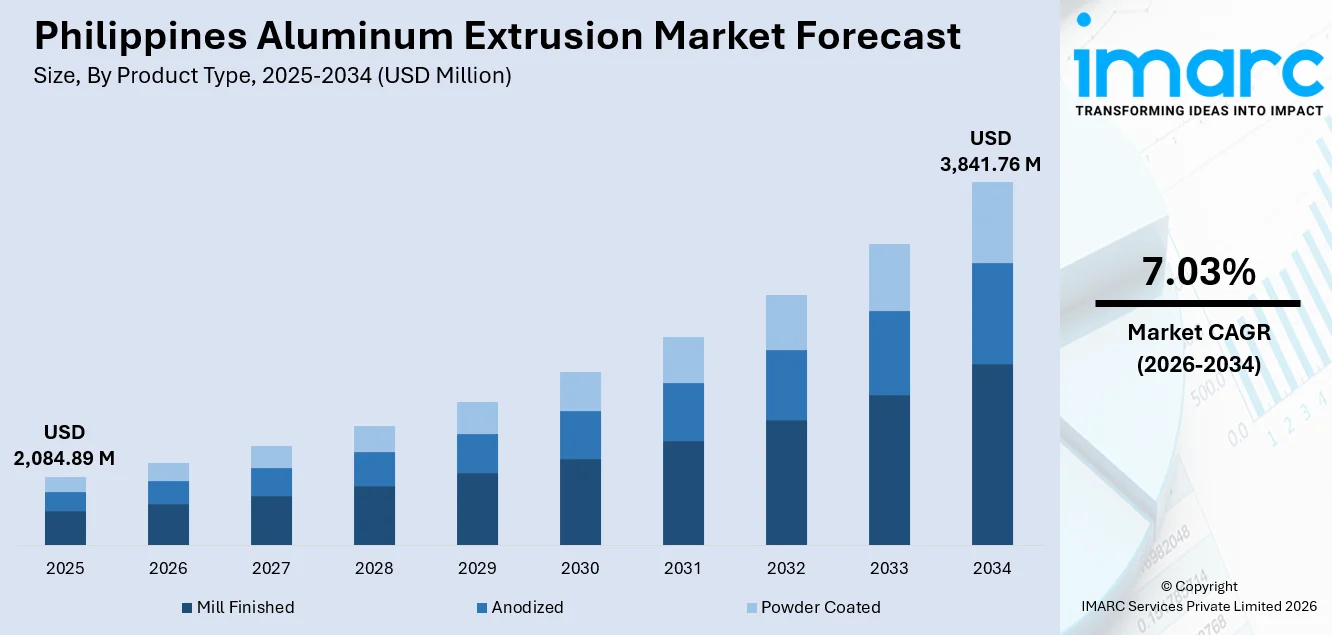
The Philippines aluminum extrusion market size was valued at USD 2,084.89 Million in 2025 and is projected to reach USD 3,841.76 Million by 2034, growing at a compound annual growth rate of 7.03% from 2026-2034.
The Philippines aluminum extrusion market is experiencing robust expansion driven by accelerating infrastructure development under the government's Build Better More program, rapid urbanization, and a thriving construction sector. Rising demand for lightweight, corrosion-resistant materials in building facades, window frames, and structural applications is strengthening consumption. The growing automotive industry, expanding renewable energy installations, and increasing adoption of green building standards are further propelling demand for aluminum extrusions, reinforcing the Philippines aluminum extrusion market share.
Key Takeaways and Insights:
- By Product Type: Mill finished dominates the market with a share of 43.5% in 2025, owing to its cost-effectiveness, versatile applicability across construction and industrial sectors, and suitability for secondary finishing processes that meet diverse project specifications.
- By Alloy Type: 6000 series aluminum alloy leads the market with a share of 48.9% in 2025, driven by its superior strength-to-weight ratio, excellent corrosion resistance, and high extrudability that make it the preferred choice for building facades, window frames, and structural components.
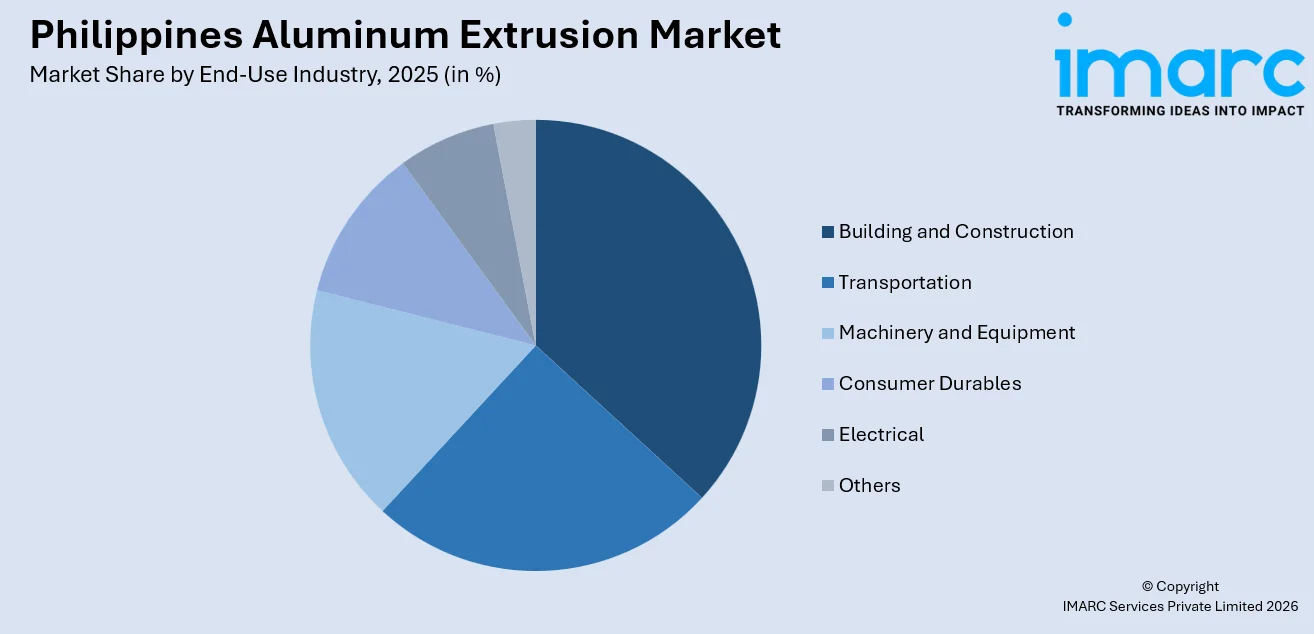
- By End-Use Industry: Building and construction represents the largest segment with a market share of 36.7% in 2025, reflecting the country's infrastructure-driven growth strategy, rising demand for sustainable building materials, and ongoing urbanization across major metropolitan areas.
- By Region: Luzon comprises the biggest region with 61.9% share in 2025, driven by the concentration of Metro Manila's construction activity, the Luzon Economic Corridor initiative, and the presence of major industrial zones in CALABARZON and Central Luzon.
- Key Players: The market is moderately fragmented, led by a few domestic producers with regional reach, alongside imports from China and ASEAN. Competition centers on pricing, delivery reliability, construction demand, and basic customization rather than advanced profiles.
To get more information on this market Request Sample
The Philippines aluminum extrusion market is advancing as the country accelerates infrastructure modernization, sustainable construction, and industrial development. The government's Build Better More program, which allocated PHP 1.507 Trillion in infrastructure spending for 2025, representing approximately 5.2% of GDP, is driving significant demand for aluminum extrusions in transportation networks, energy projects, and urban development. The construction sector's expansion, fueled by large-scale projects such as the Metro Manila Subway and Luzon Spine Expressway Network, is creating sustained consumption of extruded aluminum profiles for structural frameworks, curtain walls, and facade systems. Simultaneously, the renewable energy sector's rapid growth, with the country installing a record 794.34 megawatts of new renewable energy capacity in 2024, is generating additional demand for aluminum mounting structures and solar panel racking systems. The automotive industry's consistent growth and the increasing adoption of green building certifications further reinforce the market's positive trajectory across the forecast period.
Philippines Aluminum Extrusion Market Trends:
Infrastructure-Led Demand Surge Through Government Mega-Projects
The Philippines is witnessing unprecedented infrastructure investment that is directly stimulating demand for aluminum extrusions. The government's Build Better More programs encompasses 207 Infrastructure Flagship Projects valued at approximately PHP 9.86 Trillion, prioritizing transportation corridors, inter-island bridges, and urban transit systems. This sustained capital outlay is generating substantial requirements for aluminum extrusions in structural frameworks, railings, and architectural components, accelerating the Philippines aluminum extrusion market growth.
Renewable Energy Expansion Driving New Aluminum Applications
The rapid deployment of solar and wind energy projects is opening a new demand channel for aluminum extrusions in the Philippines. Renewable installations rely heavily on extruded aluminum for mounting structures, racking systems, and durable support frames due to its strength, corrosion resistance, and lightweight properties. For instance, in January 2025, Masdar announced plans to develop 1 gigawatt of solar, wind, and battery storage capacity in the Philippines by 2030, highlighting the accelerating energy transition and boosting extrusion demand.
Green Building Certification Accelerating Sustainable Aluminum Adoption
The adoption of green building standards is reshaping material preferences in the Philippines construction sector. As of 2023, the Philippines ranked 10th globally in the U.S. Green Building Council's list of top countries for LEED certifications and secured the 5th position among Southeast Asian nations in the Green Economy Index. The Philippine Green Building Code and the BERDE rating system are driving architects and developers to specify aluminum extrusions for energy-efficient window systems, recyclable facade materials, and sustainable structural components, reinforcing demand for high-quality extruded profiles.
Market Outlook 2026-2034:
The Philippines aluminum extrusion market is poised for sustained expansion over the forecast period, supported by the convergence of infrastructure modernization, renewable energy deployment, and industrial growth. In line with this, the government's continued commitment to infrastructure development through the Build Better More program, coupled with rising private sector investment in commercial and residential construction, will sustain demand for extruded aluminum profiles. As per an industry report, the Philippines construction sector is projected to grow 6.2% in real terms in 2025, driven by infrastructure and renewable investments. Construction loans rose 13.2% YoY, while approved building permits increased 22% YoY in early 2025. Accelerating automotive production, expanding solar energy installations, and growing adoption of lightweight materials in manufacturing further influence the market outlook. The market generated a revenue of USD 2,084.89 Million in 2025 and is projected to reach a revenue of USD 3,841.76 Million by 2034, growing at a compound annual growth rate of 7.03% from 2026-2034.
Philippines Aluminum Extrusion Market Report Segmentation:
|
Segment Category |
Leading Segment |
Market Share |
|
Product Type |
Mill Finished |
43.5% |
|
Alloy Type |
6000 Series Aluminum Alloy |
48.9% |
|
End-Use Industry |
Building and Construction |
36.7% |
|
Region |
Luzon |
61.9% |
Product Type Insights:
- Mill Finished
- Anodized
- Powder Coated
Mill finished dominates with a market share of 43.5% of the total Philippines aluminum extrusion market in 2025.
Mill finished aluminum extrusions hold the dominant position in the Philippines market owing to their cost-effectiveness and broad applicability across construction and industrial applications. These profiles undergo minimal surface treatment after extrusion, making them the most economical option for projects where advanced aesthetic finishing is not a primary requirement. The growing demand from the residential construction sector, heavily relies on mill finished extrusions for structural frameworks, window supports, and basic architectural elements.
Mill finished profiles also serve as the base material for subsequent finishing processes, including anodizing and powder coating, which further amplifies their consumption volume. Their versatility enables use in diverse applications ranging from scaffolding and formwork in construction sites to internal structural components in commercial buildings. The Philippine Ports Authority's announcement of 84 port projects in 2024, requiring a combined investment of PHP 28.59 Billion, exemplifies the scale of infrastructure activity driving demand for mill finished aluminum extrusions across the country.
Alloy Type Insights:
- 1000 Series Aluminum Alloy
- 2000 Series Aluminum Alloy
- 3000 Series Aluminum Alloy
- 5000 Series Aluminum Alloy
- 6000 Series Aluminum Alloy
- 7000 Series Aluminum Alloy
6000 series aluminum alloy leads with a share of 48.9% of the total Philippines aluminum extrusion market in 2025.
The 6000 series aluminum alloy, primarily comprising aluminum-magnesium-silicon compositions, commands the largest share of the Philippines aluminum extrusion market due to its exceptional combination of strength, corrosion resistance, and extrudability. These alloys are the preferred material for building and construction applications, including window frames, curtain wall systems, door profiles, and structural members. The Philippines construction industry's expansion by 10.7% in real terms in 2024, supported by investments in transportation and renewable energy projects, has directly reinforced the demand for 6000 series alloys.
The alloy's excellent weldability and surface finishing characteristics make it ideal for architectural applications where both structural integrity and aesthetic appeal are required. In the Philippines, where tropical climate conditions demand superior corrosion resistance, 6000 series alloys offer significant advantages over alternative materials. The Luzon Economic Corridor initiative, launched in April 2024 as a trilateral partnership between the Philippines, United States, and Japan, is accelerating infrastructure investments in rail, ports, and clean energy deployments across Luzon, generating substantial requirements for high-performance 6000 series extrusions.
End-Use Industry Insights:
Access the comprehensive market breakdown Request Sample
- Building and Construction
- Transportation
- Machinery and Equipment
- Consumer Durables
- Electrical
- Others
Building and construction exhibits a clear dominance with a 36.7% share of the total Philippines aluminum extrusion market in 2025.
The building and construction sector is the largest consumer of aluminum extrusions in the Philippines, driven by the country's robust infrastructure development agenda and sustained urbanization. Aluminum extrusions are extensively used in curtain wall systems, window frames, door profiles, roofing structures, and modular construction components due to their lightweight nature, durability, and resistance to tropical weather conditions. The Philippines construction market, which reached USD 39.40 Billion in 2024, is fueling consistent demand for extruded aluminum profiles across residential, commercial, and infrastructure segments.
The government's allocation for infrastructure development, underscores the continued commitment to construction-driven growth. Major projects such as the Metro Manila Subway, spanning approximately, and the Luzon Spine Expressway Network are creating large-scale demand for aluminum extrusions in structural applications. The residential segment’s dominance further sustains consumption of aluminum profiles for housing developments, condominium projects, and mixed-use buildings across the country.
Regional Insights:
- Luzon
- Visayas
- Mindanao
Luzon holds the largest share with 61.9% of the total Philippines aluminum extrusion market in 2025.
Luzon dominates the Philippines aluminum extrusion market, anchored by Metro Manila’s leading role in the country’s construction industry and Central Luzon’s strong growth outlook. The region concentrates major economic activities, industrial zones, and logistics infrastructure, with CALABARZON serving as the Philippines’ manufacturing hub. The Luzon Economic Corridor, a flagship trilateral initiative between the Philippines, United States, and Japan launched recently, is accelerating coordinated investments in rail, port modernization, clean energy, and semiconductor supply chains connecting key hubs, generating sustained demand for aluminum extrusions across construction and infrastructure applications.
Beyond large-scale infrastructure, Luzon’s dominance is reinforced by sustained urbanization, commercial real estate development, and industrial expansion across key cities. As such, Camella concluded its regional “Momentum” real estate event across Luzon, highlighting new residential offerings and multigenerational living trends. The company unveiled new communities including Belterre (2 hectares) in Bulacan and Sonvielle (2.8 hectares) in Pangasinan, supporting regional growth. Likewise, rising demand for residential towers, industrial sheds, and logistics parks is increasing the use of aluminum extrusions in façades, windows, curtain walls, and structural components. Proximity to ports, fabrication clusters, and end-use industries also enables faster project execution and cost efficiencies, further strengthening Luzon’s position as the primary consumption and distribution center for aluminum extrusions in the Philippines.
Market Dynamics:
Growth Drivers:
Why is the Philippines Aluminum Extrusion Market Growing?
Accelerating Government Infrastructure Investment Under Build Better More Program
The Philippine government's Build Better More infrastructure program is the primary catalyst for aluminum extrusion demand growth. In the first half of 2024, government infrastructure expenditure reached PHP 612 Billion, exceeding the budgeted target by 12%, reflecting the administration's accelerated spending momentum. These investments span transportation networks, urban transit systems, inter-island bridges, and port modernization projects that generate substantial demand for aluminum extrusions in structural frameworks, railings, facade systems, and architectural components. The construction industry expanded by 10.7% in real terms in 2024, with an average annual growth rate of 7.1% projected between 2025 and 2028, ensuring sustained consumption of extruded aluminum profiles.
Robust Automotive Sector Growth Increasing Lightweight Material Demand
The Philippines automotive industry is driving incremental demand for aluminum extrusions as manufacturers increasingly adopt lightweight materials to improve fuel efficiency and vehicle performance. The combined sales of the Chamber of Automotive Manufacturers of the Philippines and the Truck Manufacturers Association reached a record 467,252 units in 2024, representing an 8.7% increase over the prior year. In February 2025, Toyota Motor Philippines reported record-breaking sales of 218,019 vehicles in 2024, capturing 46% of the total Philippine automotive market share. The industry has set an aspirational target of 500,000 unit sales for 2025, with new model introductions and the proposed Revitalizing the Automotive Industry for Competitiveness Enhancement program offering maximum incentives per enrolled car model. This sustained automotive expansion is generating growing requirements for aluminum extrusions in chassis components, body panels, engine parts, and heat exchangers.
Rapid Solar Energy Deployment Creating New Demand Channels
The Philippines' accelerating transition to renewable energy is opening significant new demand avenues for aluminum extrusions used in solar panel mounting structures, racking systems, and support frames. For instance, in November 2024, Terra Solar Philippines awarded China Energy Engineering Group an engineering, procurement, and construction contract for a 3.5 gigawatt solar and 4.5 gigawatt-hour battery project in Luzon, set to begin operations in 2026. These large-scale solar deployments require substantial volumes of aluminum extrusions for panel mounting and structural support, creating a rapidly expanding demand channel.
Market Restraints:
What Challenges the Philippines Aluminum Extrusion Market is Facing?
Heavy Reliance on Aluminum Imports Creating Supply Chain Vulnerabilities
The Philippines lacks significant primary aluminum smelting capacity, making the country heavily dependent on imports from Malaysia, Taiwan, the United Arab Emirates, Qatar, and South Korea to meet its aluminum requirements. This import dependency exposes manufacturers to global supply chain disruptions, shipping delays, and fluctuating freight costs that can erode profit margins. Freight premiums in island provinces can surge, further compounding cost pressures for downstream aluminum extrusion processors and limiting their ability to offer competitive pricing to end users.
Shortage of Specialized Technical Workforce Constraining Production Capacity
The aluminum extrusion industry requires specialized technical expertise in die design, precision extrusion operations, surface finishing processes, and quality control procedures. The Philippines faces a persistent shortage of skilled workers with the advanced metalworking capabilities needed to operate modern extrusion presses, perform complex die corrections, and maintain consistent product quality. This talent gap constrains the ability of domestic manufacturers to expand production capacities, adopt advanced technologies, and meet the growing quality standards demanded by commercial and industrial customers.
Raw Material Price Volatility Impacting Manufacturing Economics
Fluctuations in global aluminum prices and energy costs significantly impact the production economics of aluminum extrusion manufacturers in the Philippines. As a net importer of primary aluminum, the country is particularly susceptible to price volatility driven by geopolitical tensions, trade policies, and shifts in global demand-supply dynamics. These cost uncertainties create challenges for manufacturers in maintaining stable pricing, securing long-term contracts, and planning capital investments, ultimately affecting profit margins and the competitiveness of domestically produced extrusions against imported finished products.
Competitive Landscape:
The Philippines aluminum extrusion market features a moderately competitive landscape with a mix of domestic manufacturers and international suppliers. Companies are focusing on expanding production capacities, achieving international quality certifications, and diversifying product portfolios to serve the growing construction and industrial sectors. Strategic investments in advanced extrusion technologies, automated finishing lines, and sustainable manufacturing practices are emerging as key competitive differentiators. Market participants are also strengthening distribution networks and forming partnerships with construction companies and project developers to secure long-term supply agreements and enhance market positioning across the country's expanding infrastructure development landscape.
Recent Developments:
- In January 2026, One and One Green Technologies secured roughly USD 39 Million in recycled metal contracts, boosting aluminum product deliveries. This reflects stronger metal supply and supports the Philippines’ aluminum extrusion market, which benefits from increased recycled aluminum availability amid rising construction and infrastructure demand, reinforcing local industry growth and sustainability.
- In June 2025, Huawei launched the nova Y73 in the Philippines featuring an aerospace-grade aluminium alloy body, highlighting rising use of high-performance aluminum in electronics. Such applications expand demand beyond construction, supporting growth in the Philippine aluminum extrusion market as manufacturers increasingly require durable, lightweight extruded components for consumer devices.
Philippines Aluminum Extrusion Market Report Coverage:
|
Report Features |
Details |
|
Base Year of the Analysis |
2025 |
|
Historical Period |
2020-2025 |
|
Forecast Period |
2026-2034 |
|
Units |
Million USD |
|
Scope of the Report |
Exploration of Historical Trends and Market Outlook, Industry Catalysts and Challenges, Segment-Wise Historical and Future Market Assessment:
|
|
Product Types Covered |
Mill Finished, Anodized, Powder Coated |
|
Alloy Types Covered |
1000 Series Aluminum Alloy, 2000 Series Aluminum Alloy, 3000 Series Aluminum Alloy, 5000 Series Aluminum Alloy, 6000 Series Aluminum Alloy, 7000 Series Aluminum Alloy |
|
End-Use Industries Covered |
Building and Construction, Transportation, Machinery and Equipment, Consumer Durables, Electrical, Others |
|
Regions Covered |
Luzon, Visayas, Mindanao |
|
Customization Scope |
10% Free Customization |
|
Post-Sale Analyst Support |
10-12 Weeks |
|
Delivery Format |
PDF and Excel through Email (We can also provide the editable version of the report in PPT/Word format on special request) |
Frequently Asked Questions About the Philippines Aluminum Extrusion Market Report
The Philippines aluminum extrusion market size was valued at USD 2,084.89 Million in 2025.
The Philippines aluminum extrusion market is expected to grow at a compound annual growth rate of 7.03% from 2026-2034 to reach USD 3,841.76 Million by 2034.
Mill finished dominated the market with a share of 43.5%, owing to its cost-effectiveness, versatile applicability across construction and industrial sectors, and suitability as a base material for secondary finishing processes meeting diverse project requirements.
Key factors driving the Philippines aluminum extrusion market include accelerating government infrastructure investment, robust automotive sector growth, expanding renewable energy deployments, rising adoption of green building standards, and sustained urbanization across major metropolitan regions.
Major challenges include heavy reliance on aluminum imports creating supply chain vulnerabilities, shortage of specialized technical workforce constraining production capacity, raw material price volatility impacting manufacturing economics, and freight cost premiums in island provinces.
Need more help?
- Speak to our experienced analysts for insights on the current market scenarios.
- Include additional segments and countries to customize the report as per your requirement.
- Gain an unparalleled competitive advantage in your domain by understanding how to utilize the report and positively impacting your operations and revenue.
- For further assistance, please connect with our analysts.
 Request Customization
 Speak to an Analyst
 Request Brochure
 Inquire Before Buying
Benefits of Customization
- Personalize this research
- Triangulate with your data
- Get data as per your format and definition
- Gain a deeper dive into a specific application, geography, customer, or competitor
- Any level of personalization
Get in Touch With Us
UNITED STATES
Phone: +1-201-971-6302
INDIA
Phone: +91-120-433-0800
UNITED KINGDOM
Phone: +44-753-714-6104
Email: [email protected]
Client Testimonials




.webp)




.webp)













Related Reports

Choose your plan
*Please note that the prices mentioned below are starting prices for each bundle type. Kindly contact our team for further details.*
Single User License
- 1 User License, Access on 2 Devices
- PDF Report + Excel Dataset (Password Protected)
- Lifetime Access
- No Printing Rights
- 10% Free Report Customization
- 10–12 Weeks of Analyst Support
Five User License
- Access for 5 Users, 2 Devices per User
- PDF Report + Excel Dataset (Password Protected)
- Lifetime Access
- Dedicated Account Manager
- 12–14 Weeks of Analyst Support
- No Printing Rights
- 15% Free Report Customization
- 25% Discount on Your Next Purchase
Corporate User License
- Unlimited User Access (Within Your Organization)
- PDF Report + Excel Dataset
- Lifetime Access
- Dedicated Account Manager
- 14–20 Weeks of Analyst Support
- No Printing Rights
- 20% Free Report Customization
- 30% Discount on Your Next Purchase
Essential Insights
What's included:
3 reports
- Lifetime Access
- PDF Reports
- Excel Datasets
- 2 Weeks of Free Analyst Support
- 2 User Licenses
- Access on 2 Devices
- Printing Rights
- Complimentary PowerPoint (PPT) Version
- Complimentary License Upgrade
Professional Access
What's included:
5 reports
- Lifetime Access
- PDF Reports
- Excel Datasets
- 8 Weeks of Free Analyst Support
- 2 User Licenses
- Access on 2 Devices
- Printing Rights
- Complimentary PowerPoint (PPT) Version
- Complimentary License Upgrade
Business Advantage
What's included:
8 reports
- Lifetime Access
- PDF Reports
- Excel Datasets
- 14 Weeks of Free Analyst Support
- 2 User Licenses
- Access on 2 Devices
- Printing Rights
- Complimentary PowerPoint (PPT) Version
- Complimentary License Upgrade
Enterprise Intelligence
What's included:
10 reports
- Lifetime Access
- PDF Reports
- Excel Datasets
- 20 Weeks of Free Analyst Support
- 2 User Licenses
- Access on 2 Devices
- Printing Rights
- Complimentary PowerPoint (PPT) Version
- Complimentary License Upgrade