
Philippines Canned Food Market Size, Share, Trends and Forecast by Product Type, Type, Distribution Channel, and Region 2026-2034
Philippines Canned Food Market Overview:
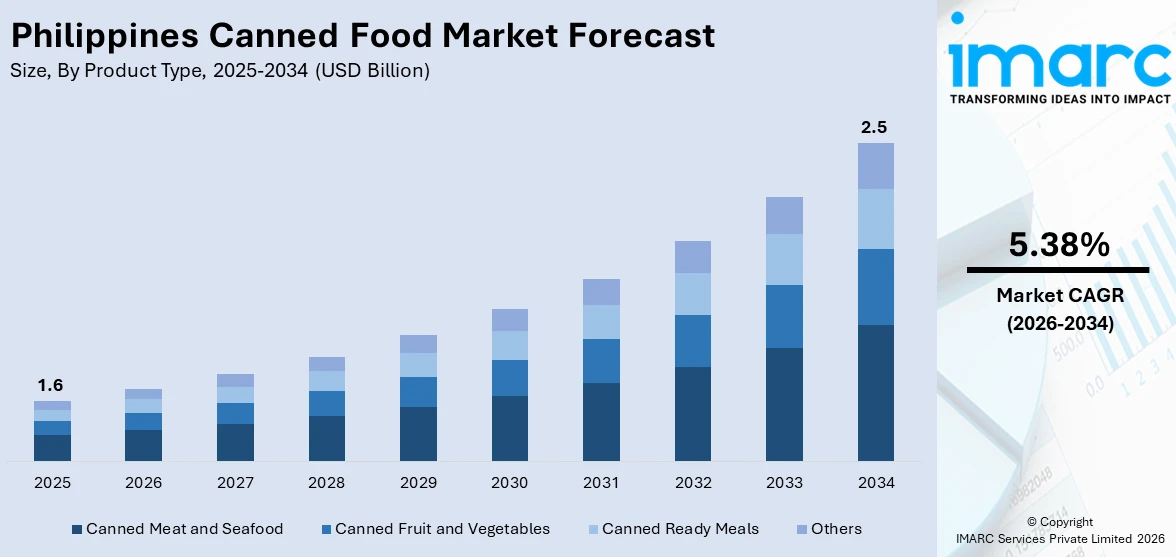
The Philippines canned food market grew from USD 1.6 Billion in 2025 to USD 1.7 Billion in 2026. Looking forward, the market is expected to reach USD 2.5 Billion by 2034, exhibiting a growth rate (CAGR) of 5.38% during 2026-2034. The market is undergoing robust expansion, propelled by boosting need for convenient, long-shelf-life products. Chief factors involve busy lifestyles, urbanization, and heightening customer demand for affordable, ready-to-eat meals. The market exhibits substantial prospect in export as well as domestic markets.
|
Report Attribute
|
Key Statistics
|
|---|---|
|
Base Year
|
2025 |
|
Forecast Years
|
2026-2034
|
|
Historical Years
|
2020-2025
|
| Base Year Market Size (2025) | USD 1.6 Billion |
| Market Size (2026) | USD 1.7 Billion |
| Forecast Market Size (2034) | USD 2.5 Billion |
| CAGR (2026-2034) | 5.38% |
Key Trends of Philippines Canned Food Market:
Rising Demand for Convenience and Ready-to-Eat Products
The demand for canned food in the Philippines is being significantly influenced by the growing preference for convenience. As urbanization continues, time-constrained consumers are increasingly turning to ready-to-eat, shelf-stable meals. For instance, as per a research article published in the Journal of Photogrammetry, Remote Sensing and Geoinformation Science, in August 2024, it is projected that by the year 2050, around 84% of the people across Philippines will reside in urban regions. Moreover, canned food products offer ease of preparation, long shelf life, and portability, making them a popular choice among busy professionals, students, and households. Products like canned meats, vegetables, fruits, and ready-to-eat meals are gaining traction in supermarkets and convenience stores. Additionally, the rise in online food retailing has expanded access to these products, catering to a broader range of consumers seeking quick, accessible meals. Manufacturers are capitalizing on this trend by innovating with new flavors and health-conscious formulations to meet evolving consumer preferences.
To get more information on this market Request Sample
Health and Sustainability Focus in Canned Food Offerings
There is an increasing shift towards healthier and more sustainable canned food choices in the Philippines market. With growing awareness of health conditions like obesity and lifestyle diseases, consumers are seeking products that offer lower sodium, reduced sugar, and fewer preservatives. For instance, as per industry reports, child obesity and adult obesity is anticipated to elevate by 6.9% and 4.6% respectively across Philippines during the time period 2020 to 2035. Canned food companies are responding by reformulating products to align with these health trends, introducing low-calorie, organic, and nutrient-rich options. Furthermore, sustainability is becoming a key driver of consumer choices, as concerns about the environmental impact of packaging and production practices rise. Many companies are adopting eco-friendly packaging materials and committing to sustainable sourcing of ingredients. This focus on health and sustainability not only meets consumer demand but also aligns with global industry shifts towards more responsible food production. As these trends continue to shape the market, canned food manufacturers are increasingly integrating both nutrition and environmental responsibility into their product development strategies.
Growth Drivers of Philippines Canned Food Market:
Expanding Urban Population and Busy Lifestyles
This intense urbanization that is being experienced throughout the Philippines is radically altering consumer patterns in food consumption and creating high demand for convenient meal solutions. The migration of more Filipinos into urban areas seeking employment and education opportunities makes their existence more time-bound every day, as they have little time to prepare their traditional meals. This population change leads to a high demand for ready-to-eat and accessible foods that do not need a lot of cooking or require almost no cooking. Canned food products are ideally suited to these needs in their lifestyles, as they are a source of ready-to-eat meals that may be eaten either cold or warmed slightly. The labor force population, especially millennials and Gen Z consumers between the ages of 16 and 35, is a large consumer group that is highly sensitive to canned foods because of their convenience, low prices, and high shelf life. This trend is further amplified by the growing number of single-person households and nuclear families in urban areas, which prioritize convenience over elaborate cooking. The expanding urban infrastructure, including modern retail outlets and e-commerce platforms, enhances product accessibility and further accelerates the Philippines canned food market demand across metropolitan regions.
Rising Disposable Income and Consumer Spending Power
The steady growth in disposable income levels among Filipino consumers is creating favorable conditions for market expansion, enabling households to diversify their food purchases and explore premium canned food varieties. As economic conditions improve and employment rates strengthen, consumers demonstrate increased willingness to spend on quality food products that offer both convenience and nutritional value. This economic empowerment allows middle-class families to stock their pantries with a wider variety of canned goods, including premium imported brands, organic options, and specialty products that were previously considered luxury items. The shift from purely price-driven purchasing decisions to value-based choices reflects the maturation of consumer preferences in the market. Additionally, improved household storage capabilities, with more families owning refrigerators and proper storage facilities, facilitate bulk purchasing of canned products during promotional periods. This economic progression also enables consumers to prioritize product quality, nutritional content, and brand reputation over mere affordability. The combination of rising incomes and evolving consumer sophistication creates sustained demand for both mainstream and premium canned food products, thereby strengthening overall Philippines canned food market growth prospects.
E-Commerce Expansion and Digital Retail Transformation
The rapid proliferation of e-commerce platforms and digital marketplaces is revolutionizing the canned food distribution landscape in the Philippines, creating unprecedented access to diverse product selections and enhancing consumer convenience. Online retail channels have experienced explosive growth, particularly accelerated by the COVID-19 pandemic, which normalized digital shopping behaviors across all demographic segments. E-commerce platforms offer consumers the ability to browse extensive product catalogs, compare prices, read reviews, and make informed purchasing decisions from the comfort of their homes. The integration of sophisticated logistics networks ensures efficient last-mile delivery, even to remote provincial areas that traditionally had limited access to premium canned food brands. Mobile commerce applications with user-friendly interfaces and secure payment systems further lower barriers to online shopping. Digital marketing strategies, including targeted social media advertising and influencer partnerships, effectively reach younger consumers who prefer online shopping over traditional retail. Flash sales, exclusive online discounts, and subscription models create additional incentives for digital purchases. This digital retail transformation not only expands market reach but also generates valuable consumer data that manufacturers and retailers leverage for product development and inventory management, ultimately driving sustained market analysis and strategic growth.
Opportunities of Philippines Canned Food Market:
Export Market Expansion for Philippines Canned Seafood
The Philippines possesses significant competitive advantages in canned seafood production, particularly tuna and sardines, presenting substantial opportunities for international market expansion and foreign revenue generation. The country's strategic geographic location, surrounded by rich fishing grounds in the Pacific Ocean and the South China Sea, provides abundant access to high-quality seafood raw materials. Filipino manufacturers have developed world-class processing facilities and expertise in seafood canning technologies, enabling them to produce products that meet stringent international food safety standards and quality certifications. Growing global demand for protein-rich, convenient meal options, especially in North America, Europe, the Middle East, and Asia-Pacific markets, creates favorable export conditions. International consumers increasingly recognize Philippine canned seafood products for their superior taste, freshness, and competitive pricing compared to alternatives, fueling the Philippines canned food market share. The government's support through trade agreements, export facilitation programs, and participation in international food exhibitions further enhances market access. Opportunities exist to develop value-added products such as flavored tuna variants, premium seafood medleys, and ready-to-eat seafood meals tailored to international preferences. Establishing strategic partnerships with global distributors and major retail chains can significantly amplify export volumes and brand recognition in overseas markets.
Product Innovation in Health-Conscious and Organic Segments
The rising health consciousness among Filipino consumers creates substantial opportunities for manufacturers to develop innovative canned food products that emphasize nutritional value, clean ingredients, and functional health benefits. Modern consumers actively seek products with reduced sodium content, no artificial preservatives, organic certifications, and enhanced nutritional profiles such as added vitamins, minerals, and omega-3 fatty acids. According to the Philippines canned food market analysis, this trend opens avenues for introducing premium product lines that cater to specific dietary requirements, including gluten-free, vegan, low-sugar, and high-protein options. Manufacturers can leverage local agricultural resources to develop canned products featuring indigenous Filipino ingredients, superfoods, and traditional recipes with modern nutritional enhancements. The growing prevalence of lifestyle diseases such as diabetes, hypertension, and cardiovascular conditions motivates consumers to make healthier food choices, creating demand for reformulated canned products that deliver both taste and wellness benefits. Opportunities also exist in developing functional canned foods fortified with probiotics, antioxidants, and other bioactive compounds that support immune health and overall well-being. Strategic positioning of health-oriented canned food brands through credible nutritional claims, transparent labeling, and endorsements from health professionals can capture market share among the expanding health-conscious consumer segment and drive differentiation in the increasingly competitive landscape.
Sustainable Packaging and Eco-Friendly Product Development
Environmental sustainability has emerged as a critical consumer concern and regulatory priority, creating significant opportunities for canned food manufacturers to differentiate their brands through eco-friendly packaging innovations and sustainable sourcing practices. Consumers, particularly younger demographics, increasingly prefer brands that demonstrate environmental responsibility and minimize ecological footprints. This shift creates demand for canned products packaged in recyclable materials, BPA-free linings, and containers made from recycled content. Manufacturers can invest in advanced packaging technologies that reduce material usage while maintaining product integrity and shelf life. Opportunities exist to develop biodegradable labels, plant-based inks, and sustainable packaging designs that minimize environmental impact throughout the product lifecycle. Beyond packaging, consumers value transparency regarding ingredient sourcing, ethical fishing practices, fair trade certifications, and carbon footprint reduction initiatives. Implementing sustainable supply chain practices, such as partnering with certified sustainable fisheries and organic farms, enhances brand credibility and appeals to environmentally conscious consumers. Marketing campaigns that authentically communicate sustainability commitments, supported by credible third-party certifications and measurable environmental impact metrics, can build strong brand loyalty and command premium pricing. The alignment of business practices with environmental sustainability not only addresses consumer preferences but also positions companies favorably amid evolving regulatory frameworks and international sustainability standards, thereby creating long-term competitive advantages in the market environment.
Philippines Canned Food Market Segmentation:
IMARC Group provides an analysis of the key trends in each segment of the market, along with forecasts at the country level for 2026-2034. Our report has categorized the market based on product type, type, and distribution channel.
Product Type Insights:
- Canned Meat and Seafood
- Canned Fruit and Vegetables
- Canned Ready Meals
- Others
The report has provided a detailed breakup and analysis of the market based on the product type. This includes canned meat and seafood, canned fruit and vegetables, canned ready meals, and others.
Type Insights:
- Organic
- Conventional
A detailed breakup and analysis of the market based on the type have also been provided in the report. This includes organic and conventional.
Distribution Channel Insights:
Access the comprehensive market breakdown Request Sample
- Supermarkets and Hypermarkets
- Convenience Stores
- E-commerce
- Others
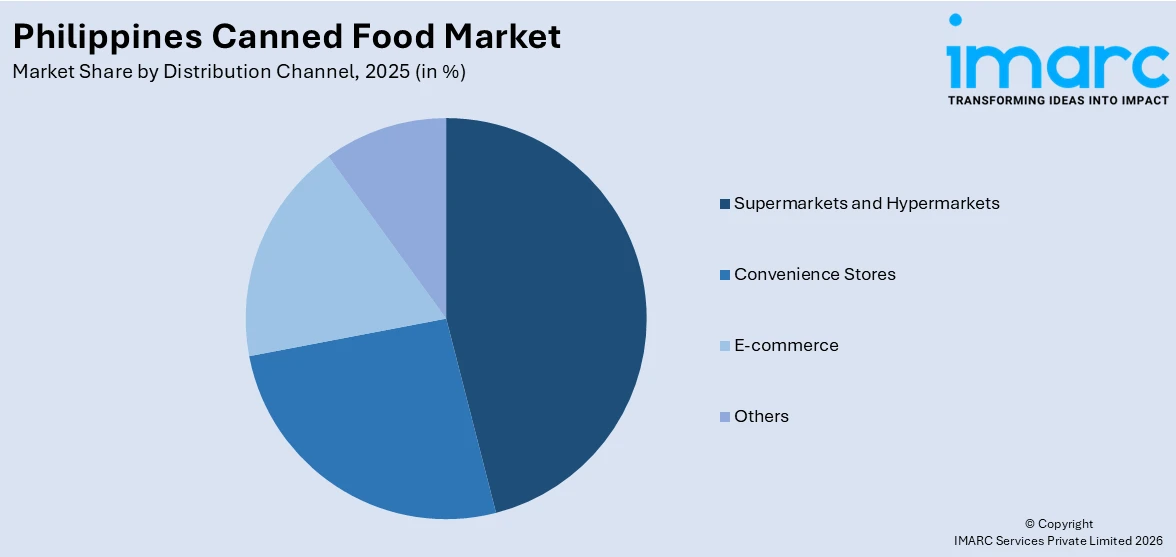
A detailed breakup and analysis of the market based on the distribution channel have also been provided in the report. This includes supermarkets and hypermarkets, convenience stores, e-commerce, and others.
Regional Insights:
- Luzon
- Visayas
- Mindanao
The report has also provided a comprehensive analysis of all the major regional markets, which include Luzon, Visayas, and Mindanao.
Competitive Landscape:
The market research report has also provided a comprehensive analysis of the competitive landscape. Competitive analysis such as market structure, key player positioning, top winning strategies, competitive dashboard, and company evaluation quadrant has been covered in the report. Also, detailed profiles of all major companies have been provided.

Philippines Canned Food Market News:
- In 2025, Mega Prime Foods, a notable canned food provider, announced a tactical collaboration with TikTok Shop to leverage its ACE Indicator System for boosting its e-commerce foothold and proving better access to its customers across Philippines to its comprehensive range of product lines.
Philippines Canned Food Market Report Coverage:
| Report Features | Details |
|---|---|
| Base Year of the Analysis | 2025 |
| Historical Period | 2020-2025 |
| Forecast Period | 2026-2034 |
| Units | Billion USD |
| Scope of the Report | Exploration of Historical Trends and Market Outlook, Industry Catalysts and Challenges, Segment-Wise Historical and Future Market Assessment:
|
| Product Types Covered | Canned Meat and Seafood, Canned Fruit and Vegetables, Canned Ready Meals, Others |
| Types Covered | Organic, Conventional |
| Distribution Channels Covered | Supermarkets and Hypermarkets, Convenience Stores, E-Commerce, Others |
| Regions Covered | Luzon, Visayas, Mindanao |
| Customization Scope | 10% Free Customization |
| Post-Sale Analyst Support | 10-12 Weeks |
| Delivery Format | PDF and Excel through Email (We can also provide the editable version of the report in PPT/Word format on special request) |
Key Benefits for Stakeholders:
- IMARC’s industry report offers a comprehensive quantitative analysis of various market segments, historical and current market trends, market forecasts, and dynamics of the Philippines canned food market from 2020-2034.
- The research report provides the latest information on the market drivers, challenges, and opportunities in the Philippines canned food market.
- Porter's five forces analysis assist stakeholders in assessing the impact of new entrants, competitive rivalry, supplier power, buyer power, and the threat of substitution. It helps stakeholders to analyze the level of competition within the Philippines canned food industry and its attractiveness.
- Competitive landscape allows stakeholders to understand their competitive environment and provides an insight into the current positions of key players in the market.
Frequently Asked Questions About the Philippines Canned Food Market Report
The canned food market size increased from USD 1.6 Billion in 2025 to USD 1.7 Billion in 2026.
The Philippines canned food market is projected to exhibit a CAGR of 5.38% during 2026-2034.
The Philippines canned food market is projected to reach a value of USD 2.5 Billion by 2034.
The market experiences swift growth driven by rising urbanization patterns, increasing consumer preference for convenient ready-to-eat meal solutions, and expanding e-commerce distribution channels that enhance product accessibility. Health-conscious reformulations with reduced sodium and preservatives, alongside sustainable packaging innovations and eco-friendly sourcing practices, are reshaping product development strategies and strengthening the market share of innovative brands.
The market is driven by an expanding urban population with busy lifestyles requiring convenient meal options, rising disposable income levels enabling diversified food purchases, robust e-commerce platform expansion facilitating wider market access, growing seafood consumption, particularly canned tuna and sardines, and increasing household refrigerator ownership supporting bulk purchasing behaviors across diverse consumer segments nationwide.
Need more help?
- Speak to our experienced analysts for insights on the current market scenarios.
- Include additional segments and countries to customize the report as per your requirement.
- Gain an unparalleled competitive advantage in your domain by understanding how to utilize the report and positively impacting your operations and revenue.
- For further assistance, please connect with our analysts.
 Request Customization
 Speak to an Analyst
 Request Brochure
 Inquire Before Buying
Benefits of Customization
- Personalize this research
- Triangulate with your data
- Get data as per your format and definition
- Gain a deeper dive into a specific application, geography, customer, or competitor
- Any level of personalization
Get in Touch With Us
UNITED STATES
Phone: +1-201-971-6302
INDIA
Phone: +91-120-433-0800
UNITED KINGDOM
Phone: +44-753-714-6104
Email: [email protected]
Client Testimonials




.webp)




.webp)













Related Reports

Choose your plan
*Please note that the prices mentioned below are starting prices for each bundle type. Kindly contact our team for further details.*
Single User License
- 1 User License, Access on 2 Devices
- PDF Report + Excel Dataset (Password Protected)
- Lifetime Access
- No Printing Rights
- 10% Free Report Customization
- 10–12 Weeks of Analyst Support
Five User License
- Access for 5 Users, 2 Devices per User
- PDF Report + Excel Dataset (Password Protected)
- Lifetime Access
- Dedicated Account Manager
- 12–14 Weeks of Analyst Support
- No Printing Rights
- 15% Free Report Customization
- 25% Discount on Your Next Purchase
Corporate User License
- Unlimited User Access (Within Your Organization)
- PDF Report + Excel Dataset
- Lifetime Access
- Dedicated Account Manager
- 14–20 Weeks of Analyst Support
- No Printing Rights
- 20% Free Report Customization
- 30% Discount on Your Next Purchase
Essential Insights
What's included:
3 reports
- Lifetime Access
- PDF Reports
- Excel Datasets
- 2 Weeks of Free Analyst Support
- 2 User Licenses
- Access on 2 Devices
- Printing Rights
- Complimentary PowerPoint (PPT) Version
- Complimentary License Upgrade
Professional Access
What's included:
5 reports
- Lifetime Access
- PDF Reports
- Excel Datasets
- 8 Weeks of Free Analyst Support
- 2 User Licenses
- Access on 2 Devices
- Printing Rights
- Complimentary PowerPoint (PPT) Version
- Complimentary License Upgrade
Business Advantage
What's included:
8 reports
- Lifetime Access
- PDF Reports
- Excel Datasets
- 14 Weeks of Free Analyst Support
- 2 User Licenses
- Access on 2 Devices
- Printing Rights
- Complimentary PowerPoint (PPT) Version
- Complimentary License Upgrade
Enterprise Intelligence
What's included:
10 reports
- Lifetime Access
- PDF Reports
- Excel Datasets
- 20 Weeks of Free Analyst Support
- 2 User Licenses
- Access on 2 Devices
- Printing Rights
- Complimentary PowerPoint (PPT) Version
- Complimentary License Upgrade