
Philippines Cloud Security Market Size, Share, Trends and Forecast by Component, Deployment, Enterprise Size, End Use Industry, and Region, 2026-2034
Philippines Cloud Security Market Summary:
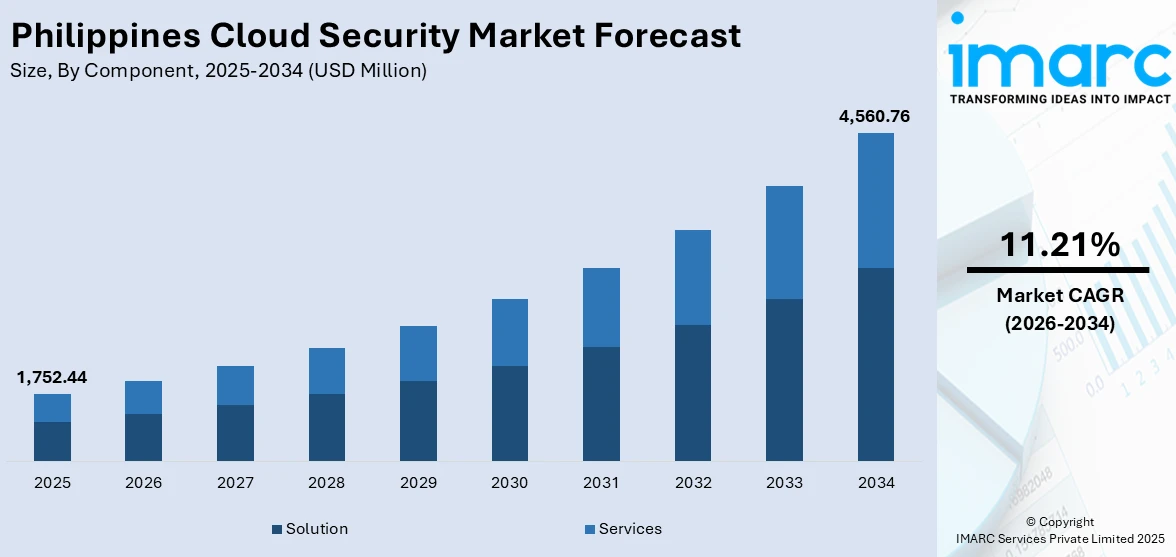
The Philippines cloud security market size was valued at USD 1,752.44 Million in 2025 and is projected to reach USD 4,560.76 Million by 2034, growing at a compound annual growth rate of 11.21% from 2026-2034.
The Philippines’ market for cloud security has been growing significantly with increasing migration and strengthening digital defense strategies for various institutions. The growing number of Internet users, the ease and widespread adoption of various government institutions’ cloud migration policies, and the growing dependence on digital solutions for financial and other services are core factors encouraging investments in cloud security solutions. Investment in artificial intelligence-based detection solutions, zero-trust security solutions, and managed security solutions has significantly redefined the Philippines’ approach to cloud security, making the country a dynamic and evolving hub for security solutions in Southeast Asia.
Key Takeaways and Insights:
-
By Component: Solution dominate the market with a share of 64.9% in 2025, driven by the growing demand for integrated cloud access security brokers, posture management tools, and workload protection platforms across enterprise environments.
-
By Deployment: Public leads the market with a share of 48.6% in 2025, reflecting the widespread adoption of scalable, cost-efficient public cloud platforms among enterprises seeking flexible and on-demand security services.
-
By Enterprise Size: Large enterprises hold the largest market share of 59.3% in 2025, owing to their extensive digital infrastructure, dedicated security budgets, and stringent compliance requirements for cloud environments.
-
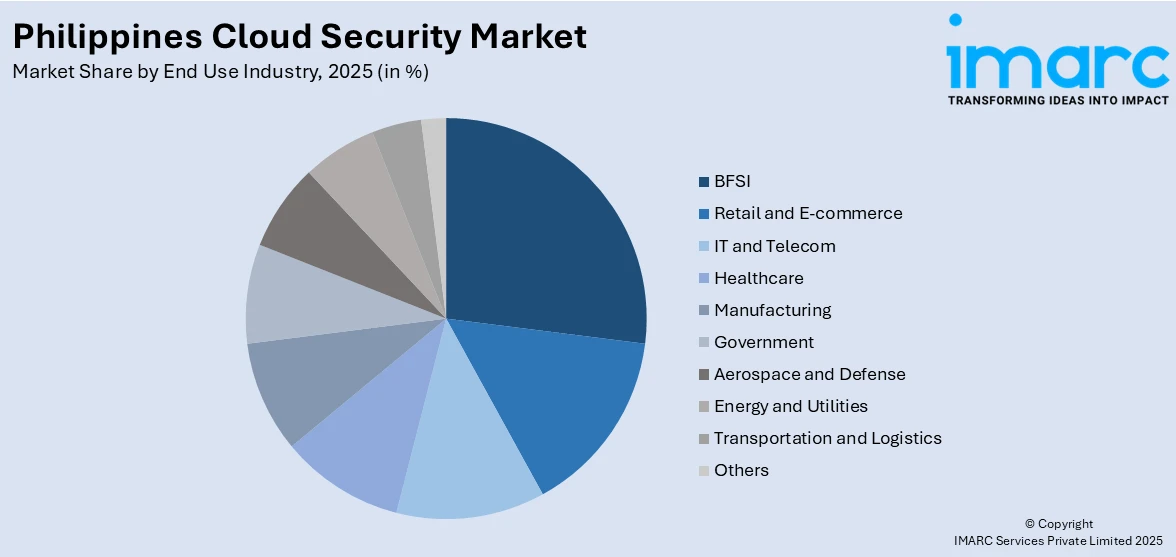
By End Use Industry: BFSI dominates the market share of 27.4% in 2025, propelled by the rapid digitization of banking services, central bank cybersecurity mandates, and the critical need to protect sensitive financial data.
-
By Region: Luzon leads the market with a share of 65.1% in 2025, driven by the concentration of corporate headquarters, financial institutions, technology firms, and government agencies in the National Capital Region and surrounding provinces.
-
Key Players: The Philippines cloud security market exhibits a competitive landscape characterized by a mix of global technology providers and regional cybersecurity firms competing across solution innovation, managed service offerings, and strategic partnerships with local enterprises.
To get more information on this market Request Sample
The Philippines cloud security market is advancing rapidly as enterprises, government institutions, and financial organizations embrace cloud-based infrastructure to modernize operations and deliver citizen-centric digital services. The country’s cloud-first government strategy is accelerating the migration of national and local agencies to centralized cloud platforms, creating substantial demand for security solutions that address data sovereignty, access management, and threat monitoring. In 2023, the Department of Information and Communications Technology (DICT) expanded its Cloud First Policy implementation, requiring government agencies to prioritize secure cloud adoption under the Government Cloud (GovCloud) program to strengthen cybersecurity and data protection. The financial sector remains a pivotal contributor to market growth, with digital banking platforms and fintech services requiring robust encryption, fraud detection, and real-time security monitoring. Expanding internet connectivity, a burgeoning business process outsourcing industry, and the proliferation of remote work arrangements are further broadening the digital attack surface, compelling organizations to prioritize cloud security investments. This evolving landscape is attracting both international vendors and domestic service providers to build localized security capabilities.
Philippines Cloud Security Market Trends:
Accelerated Adoption of Zero-Trust Security Frameworks
Philippine organizations are increasingly transitioning toward zero-trust security architectures that require continuous verification of users and devices before granting access to cloud resources. This approach is gaining traction as enterprises move away from perimeter-based defenses and adopt identity-centric models that incorporate multi-factor authentication, micro-segmentation, and behavioral analytics to protect distributed cloud workloads and sensitive data assets. In October 2025, the Philippines’ Department of Information and Communications Technology (DICT) mandated data transmission and internet providers under the Konektadong Pinoy Act’s Implementing Rules and Regulations to adopt zero-trust frameworks and secure software development practices to strengthen national cybersecurity.
Integration of Artificial Intelligence in Cloud Threat Detection
The incorporation of artificial intelligence and machine learning capabilities into cloud security platforms is transforming how Philippine enterprises detect and respond to cyber threats. AI-powered security information and event management systems are enabling real-time anomaly detection, automated incident response, and predictive threat intelligence, allowing organizations to proactively identify suspicious activities across increasingly complex and multi-cloud environments. In December 2023, Microsoft launched its Secure Future Initiative in the Philippines, introducing AI-based cyber defenses and enhanced cloud identity protection to strengthen threat detection, vulnerability response, and cloud security resilience for enterprises and critical infrastructure organizations.
Rising Demand for Cloud Security Posture Management Tools
Cloud security posture management solutions are witnessing growing adoption across Philippine enterprises seeking continuous visibility into misconfigurations, compliance violations, and security gaps within their cloud deployments. As organizations expand their multi-cloud strategies and deploy containerized applications, these tools provide automated assessments, policy enforcement, and remediation guidance to strengthen overall cloud governance and maintain alignment with evolving regulatory requirements. In 2023, the Bangko Sentral ng Pilipinas (BSP) strengthened its cloud computing and cybersecurity risk management guidelines for banks and financial institutions, requiring continuous monitoring, configuration oversight, and compliance controls for cloud-hosted systems.
Market Outlook 2026-2034:
The Philippines cloud security market is poised for sustained expansion, underpinned by the government's cloud-first digital transformation agenda, rising enterprise cloud adoption, and the escalating sophistication of cyber threats targeting critical sectors. Increasing investments in hyperscale data center infrastructure, the rapid growth of fintech and digital banking ecosystems, and strengthening regulatory compliance frameworks are expected to drive higher revenue streams. Additionally, the expanding business process outsourcing industry and growing remote work adoption are broadening the digital attack surface, fostering a more resilient, mature, and innovation-driven cloud security landscape across the country. The market generated a revenue of USD 1,752.44 Million in 2025 and is projected to reach a revenue of USD 4,560.76 Million by 2034, growing at a compound annual growth rate of 11.21% from 2026-2034.
Philippines Cloud Security Market Report Segmentation:
|
Segment Category |
Leading Segment |
Market Share |
|
Component |
Solution |
64.9% |
|
Deployment |
Public |
48.6% |
|
Enterprise Size |
Large Enterprises |
59.3% |
|
End Use Industry |
BFSI |
27.4% |
|
Region |
Luzon |
65.1% |
Component Insights:
- Solution
- CASB
- CDR
- CSPM
- CIEM
- CWPP
- Services
- Professional Services
- Managed Services
The solution dominates with a market share of 64.9% of the total Philippines cloud security market in 2025.
The solution space is the biggest market segment for cloud security in the Philippines, as organizations increasingly look for comprehensive cloud-native security solutions for securing their evolving digital landscape. Organizations in industries such as financial services, government, and technology seek integrated security software suites that integrate cloud access security brokers, cloud security posture management, and cloud workload protection into comprehensive security solutions. Organizations seek comprehensive security solutions because of the increasing complexity of multi-cloud and hybrid cloud environments, for which they require automated security solutions that offer an array of services such as continuous monitoring, detection, and policy.
The interest in solution-based deployments is an implication of the maturing cybersecurity landscape in the country. Enterprises are moving towards more preventive measures rather than taking a reactive stance. There is a high demand for cloud security solutions that provide timely information about the flow of information, access patterns, and configuration issues. In addition, the move towards containers, serverless computing, and DevSecOps promotes the use of specialized solutions that can be used in conjunction with modern app-building paradigms.
Deployment Insights:
- Private
- Hybrid
- Public
The public leads with a share of 48.6% of the total Philippines cloud security market in 2025.
Public cloud deployment leads the Philippines cloud security market as organizations embrace the scalability, cost efficiency, and agility offered by public cloud platforms. Enterprises and government agencies are migrating critical workloads to public cloud environments to benefit from on-demand resource provisioning, reduced capital expenditures, and access to advanced managed security services. The government’s cloud-first policy has particularly accelerated public cloud adoption among national agencies and local government units, creating significant demand for security solutions tailored to public cloud architectures.
The dominance of public cloud deployment is further reinforced by the entry of major hyperscale cloud providers establishing local availability zones and data center regions within the Philippines. This localization of infrastructure addresses data sovereignty requirements and reduces latency for security workloads, making public cloud a more viable option for regulated industries. Small and medium enterprises also favor public cloud security due to its pay-as-you-go pricing model and lower barriers to entry, enabling broader market participation.
Enterprise Size Insights:
- Large Enterprises
- SMEs
The large enterprises dominates with a market share of 59.3% of the total Philippines cloud security market in 2025.
Large enterprises are the primary contributors to the Philippines cloud security market, driven by their extensive and complex IT infrastructure that requires comprehensive security frameworks. These organizations operate across multiple cloud environments and manage vast volumes of sensitive customer and operational data, necessitating robust security architectures that encompass identity and access management, data loss prevention, and advanced threat protection. Strict governance mandates and regulatory compliance obligations from central banking authorities and data privacy regulators further compel large enterprises to maintain significant cloud security investments.
The digital transformation initiatives undertaken by major Philippine corporations in financial services, telecommunications, and business process outsourcing sectors drive continuous upgrades to cloud security capabilities. Large enterprises are increasingly adopting platform consolidation strategies that provide single-pane-of-glass visibility across their cloud estates, enabling more efficient security operations. Their capacity to allocate dedicated cybersecurity budgets and engage specialized managed security service providers positions them as the dominant market segment.
End Use Industry Insights:
Access the comprehensive market breakdown Request Sample
- BFSI
- Retail and E-commerce
- IT and Telecom
- Healthcare
- Manufacturing
- Government
- Aerospace and Defense
- Energy and Utilities
- Transportation and Logistics
- Others
The BFSI leads with a share of 27.4% of the total Philippines cloud security market in 2025.
The banking, financial services, and insurance sector is the largest end-use industry in the Philippines cloud security market, driven by the rapid digitization of financial services, the proliferation of digital banking platforms, and the expansion of mobile payment ecosystems. Financial institutions face heightened cybersecurity requirements from the central bank, which mandates stringent security protocols, incident reporting frameworks, and risk assessment procedures for all supervised entities. To strengthen national digital defenses, the Philippine government approved the National Cybersecurity Plan 2023–2028 under Executive Order No. 58 in 2024, establishing a coordinated framework to protect critical financial infrastructure, improve cyber incident response, and enhance regulatory oversight. The increasing adoption of open banking interfaces, digital lending platforms, and e-wallet services has significantly expanded the threat surface, driving demand for specialized cloud security solutions.
The BFSI sector’s dominance is reinforced by its need for advanced identity orchestration, behavioral biometrics, and API security to safeguard customer transactions and prevent fraud. Financial organizations are investing heavily in cloud-native security solutions that integrate seamlessly with their digital banking infrastructure and provide real-time monitoring of suspicious activities. Regulatory mandates around data privacy, anti-money laundering, and financial account protection continue to elevate cloud security as a strategic priority for the industry.
Regional Insights:
- Luzon
- Visayas
- Mindanao
Luzon exhibits a clear dominance with a 65.1% share of the total Philippines cloud security market in 2025.
Luzon dominates the Philippines cloud security market, anchored by the National Capital Region, which serves as the country’s economic, financial, and technological hub. The concentration of multinational corporations, large financial institutions, government headquarters, major data center facilities, and the thriving business process outsourcing industry in Metro Manila and surrounding provinces generates substantial demand for advanced cloud security solutions. The region benefits from superior digital infrastructure, higher broadband penetration, and greater access to skilled cybersecurity professionals.
Luzon’s leadership is further supported by the presence of major hyperscale data center investments and the establishment of local cloud availability zones that serve as the backbone for cloud service delivery across the country. Government digital transformation programs, centered in the National Capital Region, drive the adoption of centralized cloud platforms and associated security solutions. The region’s vibrant fintech ecosystem and extensive e-commerce activity additionally contribute to its outsized share of cloud security spending.
Market Dynamics:
Growth Drivers:
Why is the Philippines Cloud Security Market Growing?
Accelerating Digital Transformation Across Government and Enterprise Sectors
The Philippines is undergoing a profound digital transformation driven by national policy directives that prioritize cloud adoption, e-governance, and digital service delivery. The government’s cloud-first strategy is encouraging hundreds of national agencies and local government units to migrate legacy systems to centralized cloud platforms, creating an expansive need for security solutions that protect sensitive citizen data and ensure service continuity. In June 2025, the Department of Information and Communications Technology (DICT) reported that its e-Government Data Exchange Platform (eGovDX) had already connected more than 1,000 government services and processed over 500 million secure transactions, reinforcing the need for resilient, privacy-focused cloud infrastructure across agencies. This transformation extends beyond the public sector, with enterprises across financial services, telecommunications, retail, and outsourcing industries embracing cloud infrastructure to enhance operational efficiency, reduce costs, and deliver innovative digital products. The migration of critical workloads to cloud environments necessitates comprehensive security measures encompassing encryption, identity management, and continuous threat monitoring, directly fueling demand for cloud security solutions across the archipelago.
Escalating Frequency and Sophistication of Cyber Threats
The Philippines faces a rapidly intensifying cyber threat landscape characterized by increasingly sophisticated attack vectors targeting organizations across all sectors. The proliferation of phishing campaigns, ransomware attacks, supply chain compromises, and AI-powered social engineering schemes has significantly elevated the urgency for robust cloud security defenses. In 2024, Globe Business partnered with U.S.-based cybersecurity firm Zscaler to bring Zero Trust cloud security services to Philippine enterprises, strengthening protection against online attacks and securing users, applications, and data across distributed cloud environments. Financial institutions, government agencies, and critical infrastructure operators are particularly vulnerable as cybercriminals exploit the expanding digital attack surface created by remote work arrangements, digital payment platforms, and interconnected cloud environments. This growing threat environment compels organizations to invest in advanced cloud security capabilities including real-time threat intelligence, automated incident response, behavioral analytics, and endpoint protection integrated with cloud platforms.
Strengthening Regulatory and Compliance Frameworks
The Philippine regulatory landscape is becoming increasingly robust, with government agencies and financial regulators establishing comprehensive cybersecurity requirements that mandate organizations to adopt advanced security measures and report incidents promptly. Data privacy legislation, cybercrime prevention laws, and central bank circulars are creating a compliance-driven environment that compels enterprises to invest in cloud security solutions that enable continuous monitoring, audit readiness, and regulatory alignment. In March 2025, Singapore-based cybersecurity provider ABP Group opened an office in Manila to support Philippine enterprises in strengthening cybersecurity frameworks and improving regulatory compliance amid rapid digital expansion. The financial sector faces particularly stringent requirements, with supervisory authorities mandating cybersecurity risk assessments, incident response frameworks, and secure digital infrastructure for all financial institutions. Additionally, the growing importance of international compliance certifications for the country’s outsourcing and technology services exports is motivating organizations to adopt recognized security standards, further accelerating cloud security adoption across the Philippines.
Market Restraints:
What Challenges the Philippines Cloud Security Market is Facing?
Acute Shortage of Skilled Cybersecurity Professionals
The Philippines faces a significant shortfall of qualified cybersecurity professionals, which constrains the ability of organizations to effectively deploy, manage, and optimize cloud security solutions. This talent gap is particularly acute in specialized areas such as cloud architecture security, incident response, and threat intelligence analysis. The limited pool of skilled practitioners drives up labor costs and forces many enterprises to rely on under-resourced internal teams, reducing the overall effectiveness of cloud security implementations across the country.
Budget Constraints Among Small and Medium Enterprises
Small and medium enterprises, which constitute the vast majority of businesses in the Philippines, often face significant budgetary limitations that hinder their ability to invest in comprehensive cloud security solutions. Many smaller organizations lack dedicated cybersecurity budgets and awareness of advanced cloud security benefits, resulting in inadequate protection levels. This financial barrier restricts broader market penetration and leaves a substantial portion of the business community vulnerable to cloud-based threats and compliance shortfalls.
Data Sovereignty and Infrastructure Limitations
Concerns surrounding data sovereignty and the geographic distribution of cloud infrastructure present challenges for cloud security adoption in the Philippines. Organizations in regulated industries face uncertainty about data residency requirements when utilizing international cloud service providers. Additionally, uneven broadband connectivity and infrastructure gaps outside major urban centers limit the seamless deployment of cloud security solutions, particularly in provincial areas where digital infrastructure remains underdeveloped and susceptible to disruptions.
Competitive Landscape:
The Philippines cloud security market is characterized by an increasingly competitive environment as both global technology providers and regional cybersecurity firms vie for market share across enterprise, government, and financial services verticals. Market participants are differentiating through platform consolidation strategies, offering integrated security suites that combine cloud access security, identity management, threat intelligence, and compliance monitoring into unified solutions. Competition is intensifying around managed detection and response services, particularly as organizations seek to offset cybersecurity talent shortages through outsourced security operations. Strategic partnerships between international cloud security vendors and local system integrators are enabling deeper market penetration and localized service delivery. Innovation in AI-driven analytics, automation, and low-touch security modules is becoming a key competitive differentiator. Players are also investing in local data center presence, certifications, and industry-specific solutions to build credibility and address the unique regulatory requirements of Philippine enterprises.
Recent Developments:
-
In July 2025, Agents Stack entered the Philippine market, introducing AI-driven cybersecurity and cloud optimization services for government, banking, telecom, energy, and manufacturing sectors. The launch aims to enhance national cyber resilience, strengthen threat detection, and improve cloud security posture amid rising cyber risks and accelerated digital transformation across industries.
Philippines Cloud Security Market Report Coverage:
|
Report Features |
Details |
|
Base Year of the Analysis |
2025 |
|
Historical Period |
2020-2025 |
|
Forecast Period |
2026-2034 |
|
Units |
Million USD |
|
Scope of the Report |
Exploration of Historical Trends and Market Outlook, Industry Catalysts and Challenges, Segment-Wise Historical and Future Market Assessment:
|
|
Components Covered |
|
|
Deployments Covered |
Private, Hybrid, Public |
|
Enterprise Sizes Covered |
Large Enterprises, SMEs |
|
End Use Industries Covered |
BFSI, Retail and E-commerce, IT and Telecom, Healthcare, Manufacturing, Government, Aerospace and Defense, Energy and Utilities, Transportation and Logistics, Others |
|
Regions Covered |
Luzon, Visayas, Mindanao |
|
Customization Scope |
10% Free Customization |
|
Post-Sale Analyst Support |
10-12 Weeks |
|
Delivery Format |
PDF and Excel through Email (We can also provide the editable version of the report in PPT/Word format on special request) |
Frequently Asked Questions About the Philippines Cloud Security Market Report
The Philippines cloud security market size was valued at USD 1752.44 Million in 2025.
The Philippines cloud security market is expected to grow at a compound annual growth rate of 11.21% from 2026-2034 to reach USD 4560.76 Million by 2034.
Solution, holding the largest share of 64.9%, lead the Philippines cloud security market, driven by growing enterprise demand for integrated cloud access security brokers, posture management, and workload protection platforms.
Key factors driving the Philippines cloud security market include accelerating digital transformation across government and enterprise sectors, escalating cyber threats, strengthening regulatory frameworks, expanding cloud adoption, and growing investments in data center infrastructure.
Major challenges include an acute shortage of skilled cybersecurity professionals, budget constraints among small and medium enterprises, data sovereignty concerns, infrastructure limitations in provincial areas, and low cybersecurity awareness among smaller organizations.
Need more help?
- Speak to our experienced analysts for insights on the current market scenarios.
- Include additional segments and countries to customize the report as per your requirement.
- Gain an unparalleled competitive advantage in your domain by understanding how to utilize the report and positively impacting your operations and revenue.
- For further assistance, please connect with our analysts.
 Request Customization
 Speak to an Analyst
 Request Brochure
 Inquire Before Buying
Benefits of Customization
- Personalize this research
- Triangulate with your data
- Get data as per your format and definition
- Gain a deeper dive into a specific application, geography, customer, or competitor
- Any level of personalization
Get in Touch With Us
UNITED STATES
Phone: +1-201-971-6302
INDIA
Phone: +91-120-433-0800
UNITED KINGDOM
Phone: +44-753-714-6104
Email: [email protected]
Client Testimonials




.webp)




.webp)













Related Reports

Choose your plan
*Please note that the prices mentioned below are starting prices for each bundle type. Kindly contact our team for further details.*
Single User License
- 1 User License, Access on 2 Devices
- PDF Report + Excel Dataset (Password Protected)
- Lifetime Access
- No Printing Rights
- 10% Free Report Customization
- 10–12 Weeks of Analyst Support
Five User License
- Access for 5 Users, 2 Devices per User
- PDF Report + Excel Dataset (Password Protected)
- Lifetime Access
- Dedicated Account Manager
- 12–14 Weeks of Analyst Support
- No Printing Rights
- 15% Free Report Customization
- 25% Discount on Your Next Purchase
Corporate User License
- Unlimited User Access (Within Your Organization)
- PDF Report + Excel Dataset
- Lifetime Access
- Dedicated Account Manager
- 14–20 Weeks of Analyst Support
- No Printing Rights
- 20% Free Report Customization
- 30% Discount on Your Next Purchase
Essential Insights
What's included:
3 reports
- Lifetime Access
- PDF Reports
- Excel Datasets
- 2 Weeks of Free Analyst Support
- 2 User Licenses
- Access on 2 Devices
- Printing Rights
- Complimentary PowerPoint (PPT) Version
- Complimentary License Upgrade
Professional Access
What's included:
5 reports
- Lifetime Access
- PDF Reports
- Excel Datasets
- 8 Weeks of Free Analyst Support
- 2 User Licenses
- Access on 2 Devices
- Printing Rights
- Complimentary PowerPoint (PPT) Version
- Complimentary License Upgrade
Business Advantage
What's included:
8 reports
- Lifetime Access
- PDF Reports
- Excel Datasets
- 14 Weeks of Free Analyst Support
- 2 User Licenses
- Access on 2 Devices
- Printing Rights
- Complimentary PowerPoint (PPT) Version
- Complimentary License Upgrade
Enterprise Intelligence
What's included:
10 reports
- Lifetime Access
- PDF Reports
- Excel Datasets
- 20 Weeks of Free Analyst Support
- 2 User Licenses
- Access on 2 Devices
- Printing Rights
- Complimentary PowerPoint (PPT) Version
- Complimentary License Upgrade