
Philippines Coffee and Tea Capsules Market: Industry Trends, Share, Size, Growth, Opportunity and Forecast 2026-2034
Philippines Coffee and Tea Capsules Market Size, Share, Trends & Forecast (2026-2034)
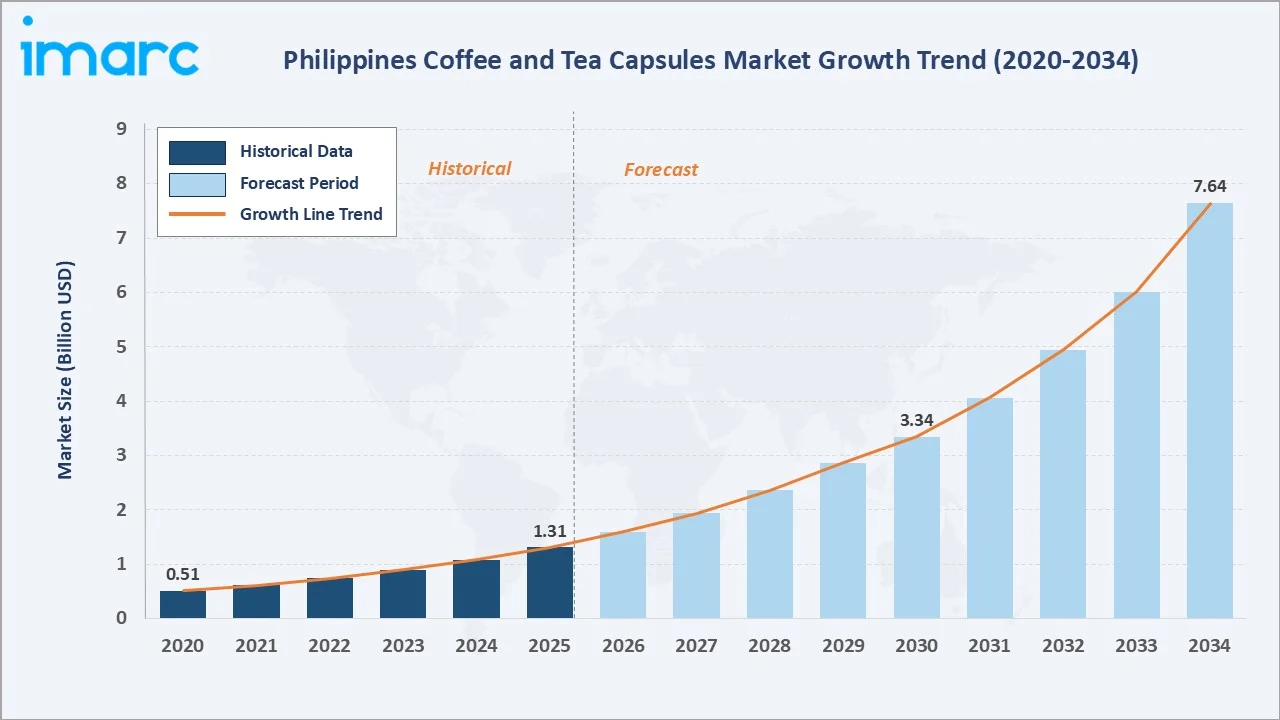
The Philippines coffee and tea capsules market reached USD 1.31 Billion in 2025 and is projected to reach USD 7.64 Billion by 2034, growing at a CAGR of 20.56% during 2026-2034. The market is driven by the emerging café culture, growing inclination toward premium beverage products, and the expanding e-commerce ecosystem. In 2025, the Philippines exported approximately USD 6.63 million worth of coffee and tea extracts, while imports reached a substantially higher USD 582 million. This sizeable import base supports the growth of the market by ensuring broad availability of diverse flavors, blends, and premium beverage inputs.
Market Snapshot
|
Metric |
Value |
|
Market Size (2025) |
USD 1.31 Billion |
|
Forecast Market Size (2034) |
USD 7.64 Billion |
|
CAGR (2026-2034) |
20.56% |
|
Base Year |
2025 |
|
Historical Period |
2020-2025 |
|
Forecast Period |
2026-2034 |
The Philippines coffee and tea capsules market has grown from USD 0.51 billion in 2020 to USD 1.31 billion in 2025, reflecting a rapid expansion underpinned by evolving consumer lifestyles, growing café culture, and increasing penetration of single-serve brewing systems. The market is projected to reach USD 3.34 billion by 2030 and USD 7.64 billion by 2034, sustaining an exceptional 20.56% CAGR throughout the forecast period.
To get more information on this market, Request Sample
Executive Summary
The Philippines coffee and tea capsules market is one of the fastest-growing beverage categories in Southeast Asia, driven by a powerful convergence of cultural, economic, and technological forces. The market reflects the Philippines' deep affinity for coffee culture now evolving toward premium international blends and specialty capsule formats. As urbanization accelerates, time-pressed consumers are increasingly turning to capsule-based brewing systems for café-quality beverages at home and in the office.
The rising middle class, supported by sustained GDP growth and increasing per-capita income, is driving premium product adoption, particularly for internationally recognized brands. E-commerce platforms and direct-to-consumer subscription services are transforming distribution, enabling brands to reach consumers in regional markets. Sustainability consciousness is accelerating demand for biodegradable and recyclable capsule alternatives, while brewing machine technology improvements are enhancing the home brewing experience.
Key Market Insights
|
Insight |
Data |
|
Key Market Opportunity |
Emerging café culture & specialty coffee shop proliferation |
|
Key Sustainability Trend |
Biodegradable & recyclable capsule formats gaining market share |
Key Analytical Observations:
- Emerging Café Culture & Specialty Coffee Shop Proliferation: The expansion of café culture and specialty coffee shops is increasing consumer exposure to premium coffee varieties, flavors, and brewing styles. This trend is encouraging demand for convenient at-home coffee solutions, including capsules that replicate café-style beverage experiences.
- Biodegradable & Recyclable Capsule Formats: Growing environmental awareness is encouraging consumers and manufacturers to shift toward biodegradable, compostable, and recyclable coffee and tea capsules. Sustainable capsule formats are increasingly becoming a key area of product innovation as brands seek to reduce packaging waste and appeal to environmentally conscious consumers.
Philippines Coffee and Tea Capsules Market Overview
The Philippines coffee and tea capsules market encompasses single-serving containers filled with pre-measured coffee or tea, designed for use with pod-compatible brewing systems and proprietary capsule machines. Products range across coffee capsule varieties and tea capsule variants. The market is supported by a growing installed base of capsule brewing machines in Philippine households, offices, hotels, and food service establishments.
Coffee and tea capsule products are available through supermarkets and hypermarkets, specialty coffee retailers, e-commerce platforms, duty-free stores, and direct subscription services. The market is influenced by increasing fast-food and café chain penetration, the growing influence of social media on consumer beverage decisions, and the rising demand for premium, convenient, and consistent beverage experiences.
Market Dynamics
To evaluate market opportunities, Request Sample
Market Drivers
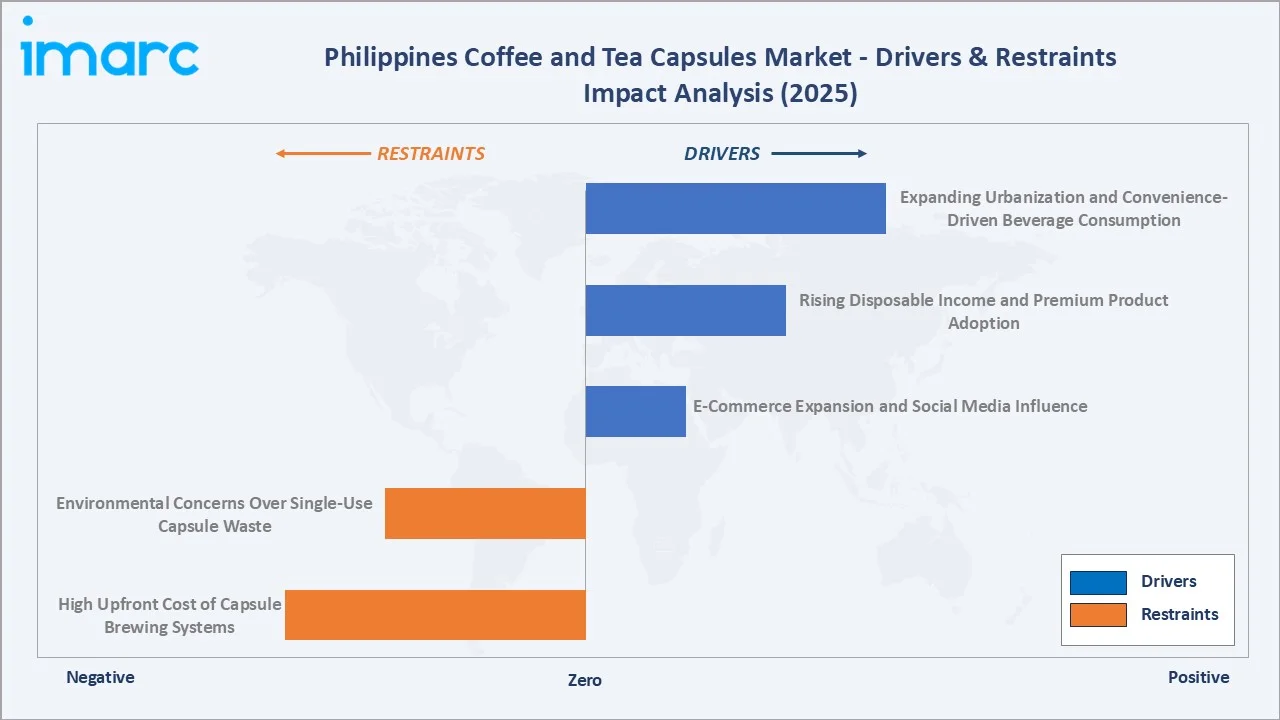
- Expanding Urbanization and Convenience-Driven Beverage Consumption: In 2024, approximately 62.22 million people, accounting for 55.2% of the Philippines’ total population of 112.73 million, resided in urban barangays. This marked an increase of 3.29 million people, or 5.6%, compared with the 58.93 million urban residents recorded in 2020. Urbanization is accelerating across the Philippines, with Metro Manila and secondary cities experiencing rapid growth in time-constrained professional populations. This shift toward busy urban lifestyles creates strong demand for convenient single-serve beverage formats that eliminate grinding, measuring, and brewing complexity.
- Rising Disposable Income and Premium Product Adoption: According to the Philippine Statistics Authority, the Philippines’ gross national disposable income reached PhP 34.04 trillion in 2025, representing a 7.5% increase compared with the previous year. The growing disposable income enables consumers to explore single-origin coffees, artisanal tea blends, and internationally recognized premium brands. Manufacturers have responded by introducing diverse ranges catering to multiple price points while maintaining quality standards that justify premium pricing.
- E-Commerce Expansion and Social Media Influence: The proliferation of e-commerce platforms combined with the Philippines' status as one of the most active social media populations has revolutionized capsule product discovery and distribution. Digital marketing through food influencers, lifestyle bloggers, and targeted social media advertising has significantly increased product awareness and trial rates.
Market Restraints
- High Upfront Cost of Capsule Brewing Systems: The requirement to purchase a compatible capsule brewing machine represents a significant barrier to entry for price-sensitive consumers. Entry-level capsule machines typically require high investments, placing them beyond the immediate reach of lower-income households. This limits market penetration to middle- and upper-income segments, constraining the addressable consumer base and slowing overall market growth velocity, particularly in provincial and rural areas.
- Environmental Concerns Over Single-Use Capsule Waste: Growing environmental consciousness among consumers, particularly among educated urban demographics, raises concerns about the waste generated by single-use plastic and aluminum capsules. Without well-developed recycling infrastructure for used capsules in the Philippines, environmental concerns create reputational risk for capsule brands and may deter environmentally conscious consumers from adopting capsule-based brewing formats.
Market Opportunities
- Local Philippine Coffee Variety Premiumization: The Philippines is home to internationally recognized premium coffee varieties, as well as rare and highly valued varieties. Developing premium capsule formats featuring these local varieties creates a compelling differentiation opportunity, appealing to national pride while commanding premium pricing. Local single-origin capsules can attract both domestic consumers and international buyers interested in Philippine specialty coffee.
- Biodegradable and Sustainable Capsule Innovation: The growing environmental awareness creates commercial opportunity for manufacturers developing biodegradable, compostable, or fully recyclable capsule formats. Brands that lead sustainable capsule innovation in the Philippines will capture environmentally conscious premium consumers and differentiate against conventional plastic alternatives.
Market Challenges
- Competition from Deep-Rooted Instant Coffee Formats: The Philippines has one of the highest per-capita instant coffee consumption rates, with the 3-in-1 sachet format deeply embedded in daily culture and food service channels. Shifting consumers from affordable, familiar instant coffee sachets to premium capsule formats requires sustained brand education, product trial incentivization, and price-point management that represents both a cost and time investment for market participants.
- Capsule Proprietary Compatibility and Consumer Lock-In Concerns: The proliferation of proprietary capsule formats from different brands creates consumer confusion and concern about compatibility, potential lock-in, and the risk of discontinued capsule support for their machine investment. Managing multi-format compatibility perceptions while protecting proprietary technology advantages is a persistent challenge for capsule manufacturers seeking to grow their installed machine base in the Philippine market.
Emerging Market Trends
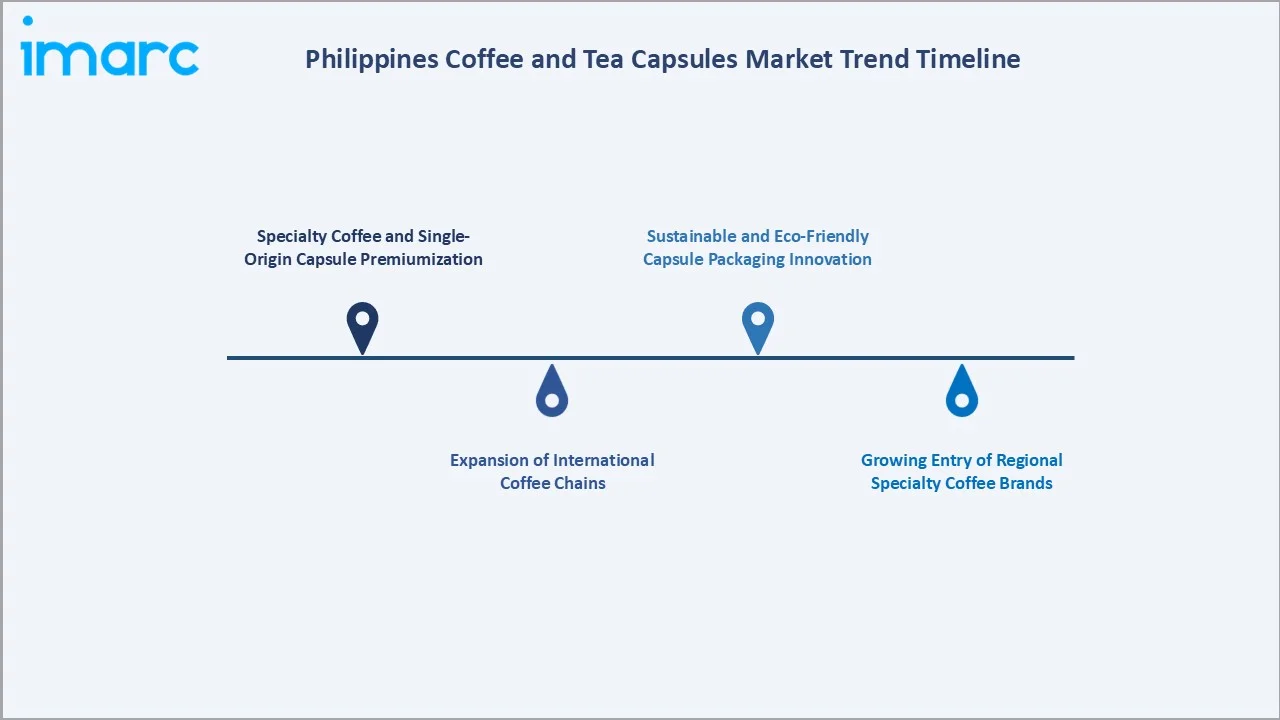
1. Specialty Coffee and Single-Origin Capsule Premiumization
The growing sophistication of coffee consumers, educated through specialty café experiences, is driving demand for single-origin, small-batch, and artisanal capsule formats that tell the story of coffee's provenance and flavor characteristics. Consumers increasingly seek capsules featuring specific Philippine origin coffees, as well as internationally acclaimed single origins. This premiumization trend enables higher margin realization and builds brand loyalty among quality-conscious consumers who view premium capsule selection as an extension of their lifestyle identity.
2. Expansion of International Coffee Chains
In February 2026, Jollibee Foods Corporation introduced Compose Coffee in the Philippines through a master franchise agreement with its subsidiary, Fresh N’ Famous Foods, Inc. The launch reflects the growing entry and expansion of international coffee brands in the Philippines, supported by rising café culture and consumer interest in diverse coffee experiences. This trend is intensifying competition and encouraging broader availability of premium and specialty coffee offerings across the market.
3. Sustainable and Eco-Friendly Capsule Packaging Innovation
Sustainability has emerged as a competitive differentiator in the Philippines capsule market, with leading brands investing in biodegradable, recyclable, and reduced-packaging formats. Filipino consumers, particularly in urban centers where environmental awareness is highest, increasingly factor environmental credentials into purchasing decisions, creating market differentiation opportunity for sustainability-leading brands.
4. Growing Entry of Regional Specialty Coffee Brands
In December 2024, Indonesian coffee brand Kenangan Coffee entered the Philippine market with the opening of its first outlet at SM Mall of Asia in Manila. The expansion was undertaken in partnership with the Fredley Group of Companies and introduces the brand’s signature Kenangan Latte, specialty beverages, pastries, and premium locally sourced coffee beans to Philippine consumers. This trend is broadening consumer choice and intensifying competition through distinctive flavors, specialty beverages, and localized offerings.
Industry Value Chain Analysis
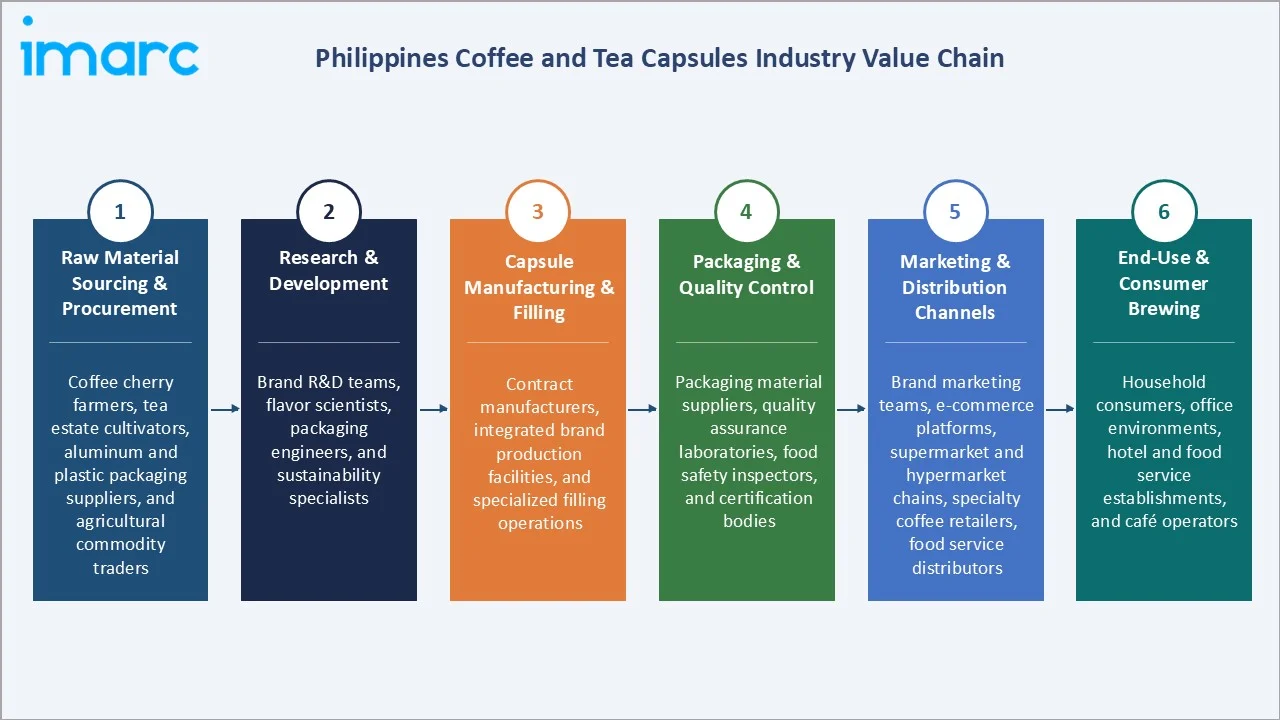
The Philippines coffee and tea capsules value chain integrates raw material sourcing and procurement, research and development, capsule manufacturing and filling, packaging and quality control, marketing and distribution channels, and end-use consumer brewing across the premium beverage ecosystem.
|
Stage |
Key Participants |
|
Raw Material Sourcing & Procurement |
Coffee cherry farmers, tea estate cultivators, aluminum and plastic packaging suppliers, and agricultural commodity traders. |
|
Research & Development |
Brand R&D teams, flavor scientists, packaging engineers, and sustainability specialists. |
|
Capsule Manufacturing & Filling |
Contract manufacturers, integrated brand production facilities, and specialized filling operations. |
|
Packaging & Quality Control |
Packaging material suppliers, quality assurance laboratories, food safety inspectors, and certification bodies. |
|
Marketing & Distribution Channels |
Brand marketing teams, e-commerce platforms, supermarket and hypermarket chains, specialty coffee retailers, food service distributors. |
|
End-Use & Consumer Brewing |
Household consumers, office environments, hotel and food service establishments, and café operators. |
Raw material sourcing and quality represent the most foundational value-creation stage, as the quality of coffee beans and tea leaves directly determines the flavor profile, consumer experience, and brand positioning premium that operators can achieve. Leading brands invest significantly in direct sourcing relationships with farms and estates, quality grading programs, and sustainability certifications that ensure both raw material quality and supply chain integrity, creating proprietary sourcing advantages that are difficult for competitors to replicate.
Technology Landscape in the Philippines Coffee and Tea Capsules Industry
Brewing System Technology and Smart Connectivity
Modern capsule brewing systems increasingly incorporate smart technology features including Bluetooth connectivity, mobile application control, personalized brewing parameter customization, and automatic descaling notifications. Advanced pressure and temperature regulation systems enable precise extraction profiles that optimize flavor quality for different capsule varieties. These technological enhancements reduce the quality gap between home-brewed capsule beverages and professionally prepared café drinks, driving machine adoption and sustained capsule consumption.
Sustainable Capsule Materials and Packaging Innovation
Materials science innovation is central to the capsule industry's sustainability transition. Biodegradable polylactic acid (PLA) capsules, compostable plant-fiber pods, and high-recycled-content aluminum formats are being commercialized to address environmental concerns. These innovations require significant investment in production line adaptation, material testing, and regulatory certification but create meaningful competitive differentiation in environmentally conscious consumer segments.
Digital Commerce and Data-Driven Consumer Personalization
Digital commerce platforms and data analytics are reshaping how capsule brands understand and serve Filipino consumers. Machine learning algorithms analyze purchase patterns, flavor preferences, and replenishment cycles to power personalized subscription recommendations and targeted promotions. Social commerce integration enables authentic product discovery through peer review and influencer demonstration. These digital capabilities enable smaller specialty capsule brands to compete effectively against large multinationals by building direct consumer relationships and efficient, low-cost distribution channels.
Competitive Landscape
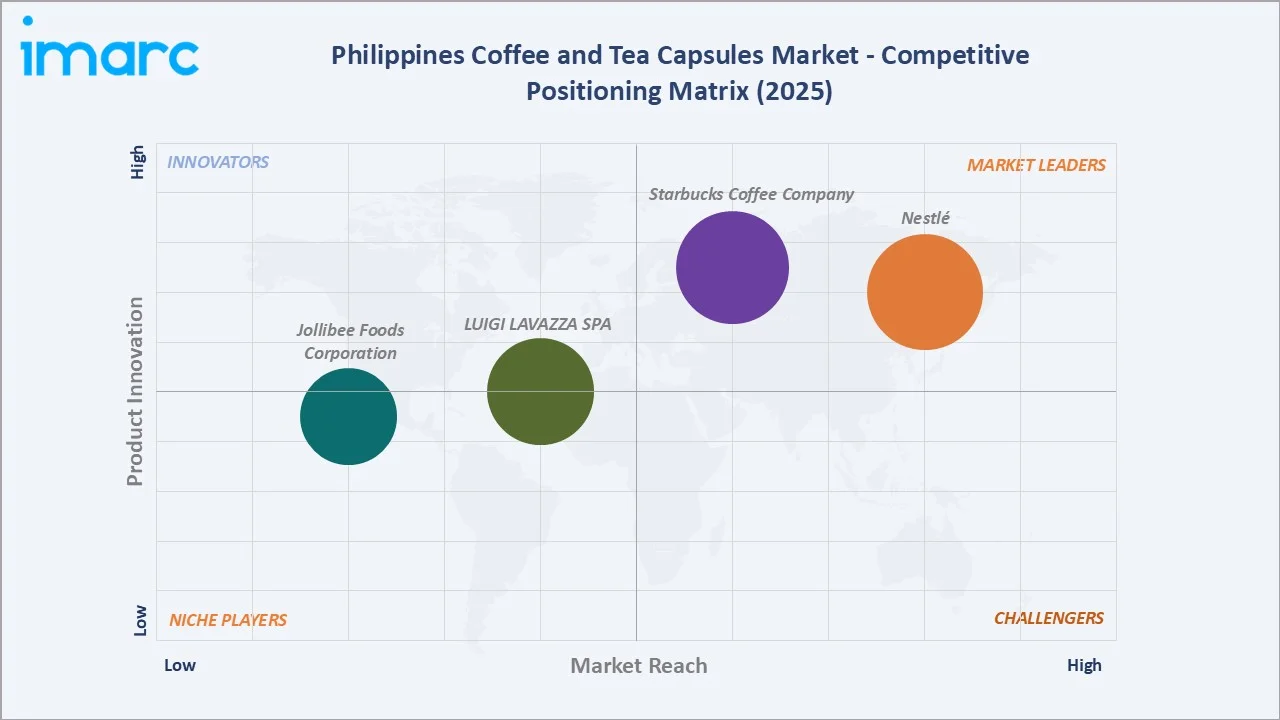
The Philippines coffee and tea capsules competitive landscape is dynamic and characterized by international market leaders, regional challengers, and emerging local specialty players. Leading multinational brands dominate through strong brand equity, broad machine compatibility, extensive distribution, and continuous product innovation. Local and regional competitors compete through niche positioning, local flavor adaptation, and price competitiveness.
|
Company |
Key Brands |
Market Position |
Core Strength |
|
Nestlé |
Nescafé Dolce Gusto |
Market Leader |
Nestlé Philippines holds a dominant, pioneering, and market-shaping role in the Philippine coffee and tea capsules market. |
|
Starbucks Coffee Company |
Starbucks |
Market Leader |
Starbucks Coffee Company drives its presence in the Philippine single-serve at-home segment through strategic co-branded partnerships. |
|
LUIGI LAVAZZA SPA |
Lavazza |
Established Player |
LUIGI LAVAZZA SPA acts as a key competitive market player supplying branded portioned coffee systems and capsules within the Philippine coffee and tea market. |
|
Jollibee Foods Corporation |
CBTL |
Established Player |
Jollibee Foods Corporation expands its beverage portfolio in the Philippines primarily through The Coffee Bean & Tea Leaf (CBTL). |
Companies across the competitive landscape are investing in product development to launch new coffee and tea varieties, collaborating with renowned designers to create premium packaging, engaging in strategic partnerships with local café chains to expand brand reach, and developing sustainability programs to address growing environmental concerns among Filipino consumers.
Key Company Profiles
Nestlé
Nestlé is a food and beverage company with a diversified portfolio spanning coffee, dairy products, nutrition, confectionery, prepared foods, and pet care. The company operates across numerous international markets and serves consumers through a broad range of established brands and product categories. Its business is supported by extensive manufacturing, distribution, research, and marketing capabilities. Nestlé focuses on product innovation, consumer health and wellness, sustainability, and long-term portfolio growth.
- Key Brands: Nescafé Dolce Gusto.
- Strategic Focus: Accelerating innovation across its core food and beverage categories, strengthening premium and health-oriented offerings, and expanding digital and direct-to-consumer capabilities. The company also emphasizes operational efficiency, sustainability, and disciplined portfolio management to support long-term growth.
Starbucks Coffee Company
Starbucks Coffee Company is a specialty coffee company with a strong presence across retail cafés, packaged beverages, and at-home coffee formats. Within the Philippines coffee and tea capsules market, the company participates through branded capsule offerings compatible with popular single-serve brewing systems. Its market presence is supported by strong brand recognition, premium positioning, and consumer demand for convenient café-style beverages at home.
- Key Brands: Starbucks
- Strategic Focus: Expanding premium at-home beverage consumption through convenient single-serve formats and strong brand-led product differentiation. The company also emphasizes flavor innovation, quality consistency, and wider retail availability to strengthen consumer engagement.
Market Concentration Analysis
The Philippines coffee and tea capsules market exhibits moderate-to-high concentration at the premium segment level, with Nestlé commanding the largest share of market revenues in 2025. International brands represent the established challenger tier, while emerging local and regional players address niche specialty and value segments. The annual growth rate is attracting new entrants from both international F&B companies seeking Asia-Pacific expansion and local entrepreneurs developing Philippines-specific specialty capsule products.
Market concentration is expected to moderate through 2034 as the rapid overall market growth provides sufficient revenue expansion opportunity for multiple participants to grow simultaneously without direct zero-sum competitive dynamics. The Philippines' large and growing consumer base, combined with significant geographic expansion opportunity beyond Metro Manila into regional markets, supports a competitive landscape that rewards both scale players and specialty niche operators.
Investment & Growth Opportunities
Highest Growth Segments
Premium and specialty capsules (~23.1% CAGR), wellness-oriented tea capsules (~20%+ CAGR), Philippine local origin capsule formats, biodegradable and sustainable capsule innovations, and direct-to-consumer e-commerce subscription models represent the highest-priority investment vectors in the Philippines coffee and tea capsules market through 2034.
Investment Themes
- Philippine local origin coffee capsule development: The Philippines hosts world-class specialty coffee growing regions. Developing premium capsule products featuring verifiable Philippine single-origin provenance creates compelling national pride positioning, commands premium pricing, and opens export opportunities to international specialty coffee markets seeking exotic Asian origin coffees.
- Sustainable packaging and circular economy investment: The transition from conventional aluminum and plastic capsules to biodegradable, compostable, and recycled-material formats is the defining sustainability investment theme. Companies that establish capsule recycling programs and biodegradable material supply chains in the Philippines early will create durable competitive advantages as environmental regulations and consumer expectations intensify through 2034.
Future Market Outlook (2026-2034)
The Philippines coffee and tea capsules market is projected to grow from USD 1.31 Billion in 2025 to USD 7.64 Billion by 2034, sustaining an exceptional CAGR of 20.56% over the forecast period. The market is projected to reach an anchor value of USD 3.34 Billion by 2030, representing the mid-period milestone at which capsule brewing machines are expected to achieve meaningful household penetration beyond the current premium consumer base and e-commerce subscription models reach structural scale.
Three structural growth forces will define the Philippines coffee and tea capsules market through 2034. First, the progressive upgrade of Filipino beverage consumption from instant powder and traditional brewing formats to premium single-serve capsule systems will be the primary volume growth driver. Second, product innovation in flavor diversity, sustainable packaging, wellness formulations, and local Philippine origin capsule development will expand the addressable consumer occasion and justify premium pricing throughout the forecast period. Third, the continued expansion of e-commerce infrastructure across the Philippines, including last-mile delivery improvements into provincial cities and the growth of social commerce, will dramatically expand distribution reach and consumer accessibility.
Research Methodology
Primary Research
Primary research comprised in-depth interviews with senior executives from capsule brand operators, specialty coffee importers, tea manufacturers, retail chain buyers, e-commerce platform representatives, and industry consultants. These discussions validated market size estimates, assessed consumer behavior trends, evaluated competitive dynamics, and provided insights into distribution channel evolution, regulatory requirements, and future innovation priorities in the Philippines coffee and tea capsules market.
Secondary Research
Secondary research encompassed company annual reports, food product registrations, trade statistics for coffee and tea imports, industry association publications, e-commerce platform category data, and international trade publications focused on the Asia-Pacific single-serve beverage market.
Forecasting Models
Forecasting models incorporated historical market growth trends, consumer penetration rate projections, machine installed base expansion scenarios, disposable income growth forecasts, e-commerce adoption curves, and competitive entry scenarios. Both top-down approaches using Philippine beverage market sizing and bottom-up approaches using capsule unit volume and average selling price modeling were applied and cross-validated to ensure forecast robustness.
Key Benefits for Stakeholders:
- IMARC’s report offers a comprehensive quantitative analysis of various market segments, historical and current market trends, market forecasts, and dynamics of the Philippines coffee and tea capsules market from 2020-2034.
- The research study provides the latest information on the market drivers, challenges, and opportunities in the Philippines coffee and tea capsules market.
- Porter's five forces analysis assist stakeholders in assessing the impact of new entrants, competitive rivalry, supplier power, buyer power, and the threat of substitution. It helps stakeholders to analyze the level of competition within the Philippines coffee and tea capsules industry and its attractiveness.
- Competitive landscape allows stakeholders to understand their competitive environment and provides an insight into the current positions of key players in the market.
Frequently Asked Questions About the Philippines Coffee and Tea Capsules Market Report
The Philippines coffee and tea capsules market reached USD 1.31 Billion in 2025, driven by emerging café culture, rising consumer incomes enabling premium product adoption, growing e-commerce accessibility, and increasing health awareness driving tea capsule consumption across Filipino households and workplaces.
The Philippines coffee and tea capsules market is projected to grow at an exceptional CAGR of 20.56% during 2026-2034, reflecting strong structural demand from urbanization, premiumization trends, e-commerce expansion, and the progressive shift from instant coffee formats to premium single-serve capsule systems.
The market is projected to reach approximately USD 3.34 Billion by 2030, representing the mid-period milestone at which capsule machine household penetration expands meaningfully and e-commerce subscription models reach structural scale across major Philippine urban markets.
The Philippines coffee and tea capsules market is projected to reach USD 7.64 Billion by 2034, sustained by continued premiumization, local origin capsule development, sustainable packaging innovation, and deep e-commerce penetration into provincial Philippine markets.
Key drivers include the emerging café culture and specialty coffee shop proliferation, rising disposable incomes enabling premium product adoption, e-commerce expansion and social media influence, government promotion of healthy lifestyle choices driving tea consumption, and escalating demand for convenient single-serve beverage formats among busy urban Filipino consumers.
Key players include Nestlé, Starbucks Coffee Company, LUIGI LAVAZZA SPA, and Jollibee Foods Corporation, among others.
Key opportunities include developing premium capsule products featuring Philippine local-origin coffees, innovating biodegradable and sustainable capsule packaging for eco-conscious consumers, building e-commerce subscription models, and introducing wellness-oriented functional tea capsule formulations targeting health-conscious Filipino consumers.
Need more help?
- Speak to our experienced analysts for insights on the current market scenarios.
- Include additional segments and countries to customize the report as per your requirement.
- Gain an unparalleled competitive advantage in your domain by understanding how to utilize the report and positively impacting your operations and revenue.
- For further assistance, please connect with our analysts.
 Request Customization
 Speak to an Analyst
 Request Brochure
 Inquire Before Buying
Benefits of Customization
- Personalize this research
- Triangulate with your data
- Get data as per your format and definition
- Gain a deeper dive into a specific application, geography, customer, or competitor
- Any level of personalization
Get in Touch With Us
UNITED STATES
Phone: +1-201-971-6302
INDIA
Phone: +91-120-433-0800
UNITED KINGDOM
Phone: +44-753-714-6104
Email: [email protected]
Client Testimonials




.webp)




.webp)













Related Reports

Choose your plan
*Please note that the prices mentioned below are starting prices for each bundle type. Kindly contact our team for further details.*
Single User License
- 1 User License, Access on 2 Devices
- PDF Report + Excel Dataset (Password Protected)
- Lifetime Access
- No Printing Rights
- 10% Free Report Customization
- 10–12 Weeks of Analyst Support
Five User License
- Access for 5 Users, 2 Devices per User
- PDF Report + Excel Dataset (Password Protected)
- Lifetime Access
- Dedicated Account Manager
- 12–14 Weeks of Analyst Support
- No Printing Rights
- 15% Free Report Customization
- 25% Discount on Your Next Purchase
Corporate User License
- Unlimited User Access (Within Your Organization)
- PDF Report + Excel Dataset
- Lifetime Access
- Dedicated Account Manager
- 14–20 Weeks of Analyst Support
- No Printing Rights
- 20% Free Report Customization
- 30% Discount on Your Next Purchase
Essential Insights
What's included:
3 reports
- Lifetime Access
- PDF Reports
- Excel Datasets
- 2 Weeks of Free Analyst Support
- 2 User Licenses
- Access on 2 Devices
- Printing Rights
- Complimentary PowerPoint (PPT) Version
- Complimentary License Upgrade
Professional Access
What's included:
5 reports
- Lifetime Access
- PDF Reports
- Excel Datasets
- 8 Weeks of Free Analyst Support
- 2 User Licenses
- Access on 2 Devices
- Printing Rights
- Complimentary PowerPoint (PPT) Version
- Complimentary License Upgrade
Business Advantage
What's included:
8 reports
- Lifetime Access
- PDF Reports
- Excel Datasets
- 14 Weeks of Free Analyst Support
- 2 User Licenses
- Access on 2 Devices
- Printing Rights
- Complimentary PowerPoint (PPT) Version
- Complimentary License Upgrade
Enterprise Intelligence
What's included:
10 reports
- Lifetime Access
- PDF Reports
- Excel Datasets
- 20 Weeks of Free Analyst Support
- 2 User Licenses
- Access on 2 Devices
- Printing Rights
- Complimentary PowerPoint (PPT) Version
- Complimentary License Upgrade