
Philippines Contact Lenses Market Size, Share, Trends and Forecast by Material, Design, Usage, Application, Distribution Channel, and Region, 2026-2034
Philippines Contact Lenses Market Summary:
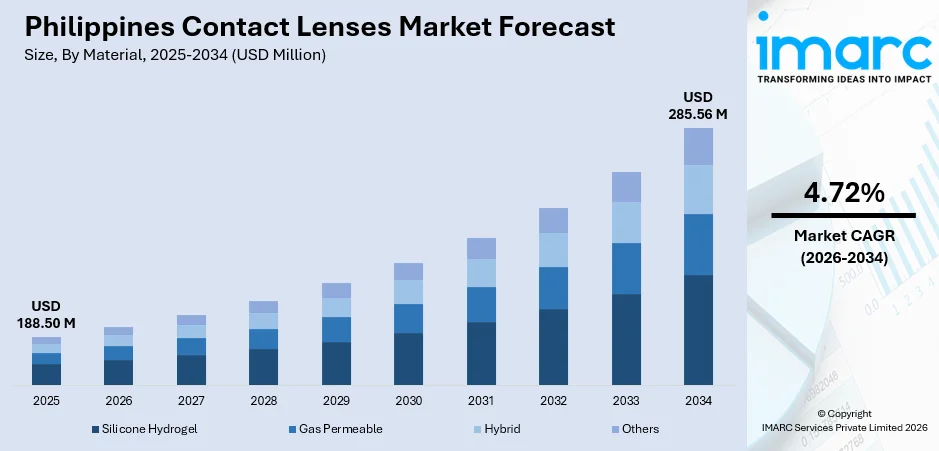
The Philippines contact lenses market size was valued at USD 188.50 Million in 2025 and is projected to reach USD 285.56 Million by 2034, growing at a compound annual growth rate of 4.72% from 2026-2034.
The Philippines contact lenses market is gaining strong momentum as the country experiences rising prevalence of refractive errors, growing consumer preference for corrective and cosmetic lenses, and expanding access to eye care services across urban and emerging regional centers. Increasing screen time among professionals and students, advancements in lens materials offering superior comfort and oxygen permeability, and the expanding retail and e-commerce distribution networks are further strengthening the Philippines contact lenses market share.
Key Takeaways and Insights:
- By Material: Silicone hydrogel dominates the market with a share of 46.9% in 2025, owing to its superior oxygen permeability that allows extended wear with reduced corneal hypoxia risk, combined with enhanced moisture retention properties that address comfort demands of digital device users experiencing prolonged screen exposure.
- By Design: Spherical leads the market with a share of 52.3% in 2025. This dominance is driven by the widespread prevalence of myopia and hyperopia requiring simple refractive correction, broad product availability across prescription ranges, and cost-effective pricing that ensures accessibility for diverse consumer segments.
- By Usage: Daily disposable comprises the largest segment with a share of 41.8% in 2025, reflecting growing consumer preference for single-use convenience, superior hygiene standards eliminating lens care requirements, and increasing recommendation rates from eye care practitioners for first-time contact lens wearers.
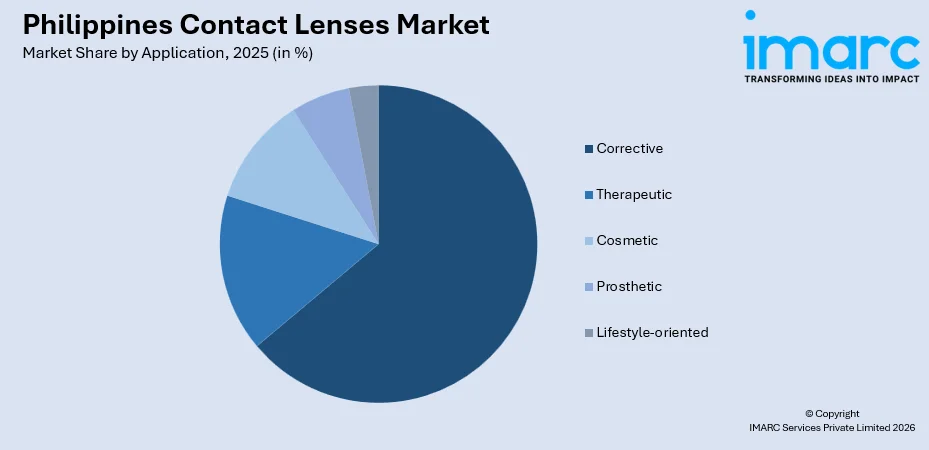
- By Application: Corrective prevails the market with a share of 63.7% in 2025, owing to the substantial population affected by refractive errors requiring vision correction, rising awareness of eye health importance, and improved access to eye examination services in both metropolitan and provincial areas.
- By Distribution Channel: Eye care practitioners exhibit a clear dominance in the market with 44.5% share in 2025, reflecting strong consumer reliance on professional guidance for lens fitting, prescription accuracy, and aftercare services that reduce the risk of complications associated with improper lens usage.
- By Region: Luzon comprises the largest region with 62.8% share in 2025, driven by the concentration of the Philippines’ population, economic activity, and healthcare infrastructure in Metro Manila and surrounding provinces, alongside higher disposable incomes enabling premium optical product adoption.
- Key Players: The market is moderately competitive, led by global brands and regional distributors offering soft daily and monthly lenses. Competition focuses on pricing, comfort, and retail availability through optical clinics and online platforms, with rising demand from younger, urban consumers.
To get more information on this market Request Sample
The Philippines contact lenses market is advancing as rising vision impairment rates, evolving consumer lifestyles, and expanding healthcare access converge to drive sustained demand for corrective and cosmetic lenses. The country’s rapidly growing business process outsourcing sector, expanding student population, and increasing digital device penetration are contributing to higher rates of myopia and digital eye strain, creating a substantial addressable market for contact lens products. Recent WHO data indicates rising myopia rates in the Philippines, with over 2.17 million Filipinos affected in 2023. Projections suggest that nearly half of the country’s population could experience myopia by 2050. Silicone hydrogel materials and daily disposable formats are gaining significant traction, offering improved comfort, convenience, and safety profiles that align with consumer expectations. Moreover, the expanding presence of organized optical retail chains across metropolitan and secondary cities, combined with growing e-commerce adoption, is broadening market accessibility and enabling penetration into previously underserved consumer segments.
Philippines Contact Lenses Market Trends:
Rising prevalence of myopia driving corrective lens adoption
The Philippines is experiencing a significant increase in myopia prevalence, particularly among younger demographics exposed to prolonged screen time and reduced outdoor activities. An industry report indicates that cataracts, glaucoma, and uncorrected refractive errors impact over one million people in the Philippines, driven by changing lifestyle patterns and extended digital device usage. This growing burden of vision impairment is fueling demand for corrective contact lenses as consumers seek convenient alternatives to traditional eyeglasses, supporting the Philippines contact lenses market growth.
Growing fashion-conscious adoption of cosmetic and colored lenses
Cosmetic and colored contact lenses are gaining strong traction among Filipino millennials and Generation Z consumers influenced by social media trends, beauty culture, and celebrity endorsements. The Philippine contact lens market recorded notable growth as fashion-conscious consumers increasingly adopted lenses over traditional eyeglasses, with colored and cosmetic options becoming particularly popular among younger demographics seeking to enhance their appearance and express personal style through diverse color and pattern options.
Expansion of optical retail infrastructure beyond metropolitan centers
The Philippines is witnessing a significant expansion of organized optical retail chains beyond Metro Manila into secondary and tertiary cities, improving consumer access to quality eye care products and professional fitting services. Vision Express Philippines currently operates over 80 stores nationwide, while OWNDAYS has expanded to 71 locations across the country, establishing comprehensive retail networks that bring premium contact lens products and professional eye care consultations to previously underserved provincial markets.
Market Outlook 2026-2034:
The Philippines contact lenses market is positioned for sustained growth as increasing vision impairment prevalence, expanding healthcare infrastructure, and evolving consumer preferences converge to drive robust demand across corrective and cosmetic segments. In line with this, continued expansion of the business process outsourcing industry, growing digital device penetration among students and professionals, and rising awareness of eye health are expected to sustain demand for advanced contact lens products. As such, the Philippines planned to launch WHO’s SPECS 2030 in late 2025, piloting it during 2026–2027 to address rising myopia affecting 2.17 million people in 2023. The program targets children, strengthens screening, and integrates refractive care into national health strategies. Likewise, the proliferation of optical retail chains into provincial cities, combined with accelerating e-commerce adoption for eyewear purchases, will broaden market accessibility and enable deeper penetration into emerging consumer segments throughout the forecast period. The market generated a revenue of USD 188.50 Million in 2025 and is projected to reach a revenue of USD 285.56 Million by 2034, growing at a compound annual growth rate of 4.72% from 2026-2034.
Philippines Contact Lenses Market Report Segmentation:
|
Segment Category |
Leading Segment |
Market Share |
|
Material |
Silicone Hydrogel |
46.9% |
|
Design |
Spherical |
52.3% |
|
Usage |
Daily Disposable |
41.8% |
|
Application |
Corrective |
63.7% |
|
Distribution Channel |
Eye Care Practitioners |
44.5% |
|
Region |
Luzon |
62.8% |
Material Insights:
- Gas Permeable
- Silicone Hydrogel
- Hybrid
- Others
Silicone hydrogel dominates with a market share of 46.9% of the total Philippines contact lenses market in 2025.
The Philippines contact lenses market shows that the silicone hydrogel segment controls the largest market share because the material provides better oxygen transmission which improves comfort for users during extended wear. The Filipino market shows that business process outsourcing workers and students who work on digital screens for extended periods prefer silicone hydrogel lenses because these lenses approach better corneal health while decreasing dryness problems. The material allows up to six times more oxygen transmission to the cornea compared to traditional hydrogel lenses which results in decreased risk of hypoxia-related complications and supports comfortable use during high-demand work periods.
Contact lens manufacturers continuously enhance silicone hydrogel contact lens technology to satisfy growing customer demands for eye health and comfort. The research develops new methods to improve lens performance through increased moisture retention, smoother surface characteristics and enhanced protection against protein and lipid accumulation. The advanced wetting agents and plasma surface treatments work together to maintain hydration during the day, which prevents dryness and irritation. The new improvements create better wearing comfort, which leads to longer usage times, and they help more people in the Philippines to start using contact lenses, including newcomers and current users.
Design Insights:
- Spherical
- Toric
- Multifocal
- Others
Spherical leads with a share of 52.3% of the total Philippines contact lenses market in 2025.
The spherical segment holds the largest share of the Philippines contact lenses market, reflecting the high prevalence of myopia and hyperopia among the Filipino population requiring straightforward refractive correction. Spherical lenses offer a cost-effective and widely accessible solution for correcting these common vision conditions, with extensive product availability across diverse prescription strengths and wearing modalities. The growing burden of myopia among younger demographics, driven by increasing screen time and urbanized lifestyles, is sustaining robust demand for spherical contact lenses. According to the World Health Organization, uncorrected myopia impacts over 2 billion people worldwide, with prevalence exceeding 80% among young adults in urban East Asia.
The affordability and simplicity of spherical lens designs make them the preferred entry point for first-time contact lens users in the Philippines, contributing to sustained segment leadership. Eye care practitioners across the country frequently recommend spherical lenses as the initial prescription option due to their predictable optical performance, ease of fitting, and broad compatibility with various lens materials and replacement schedules.
Usage Insights:
- Daily Disposable
- Disposable
- Frequently Replacement
- Traditional
The daily disposable exhibits a clear dominance with a 41.8% share of the total Philippines contact lenses market in 2025.
The daily disposable segment commands the largest share of the Philippines contact lenses market, driven by growing consumer preference for single-use convenience that eliminates lens care and storage requirements. The superior hygiene profile of daily disposable lenses reduces the risk of contact lens-related infections and complications, making them increasingly attractive to both eye care practitioners and consumers seeking hassle-free vision correction solutions. Filipino consumers in metropolitan centers are readily adopting daily disposables as lifestyle preferences shift toward products offering maximum convenience and minimal maintenance burden.
The expanding availability of daily disposable lenses across retail and online channels is further accelerating segment growth in the Philippines, as manufacturers introduce competitively priced options that broaden accessibility beyond premium consumer segments. Eye care practitioners are increasingly recommending daily disposables for patients with allergies, dry eye conditions, and active lifestyles where lens handling convenience is paramount. The migration of contact lens purchasing toward digital platforms is particularly benefiting the daily disposable category. According to the Vision Council, online sales of contact lenses increased to 39% of total sales in the first quarter of 2025, up from 35% in the fourth quarter of 2024, demonstrating accelerating e-commerce channel adoption.
Application Insights:
- Corrective
- Therapeutic
- Cosmetic
- Prosthetic
- Lifestyle-oriented
Access the comprehensive market breakdown Request Sample
Corrective represents the leading segment with a 63.7% share of the total Philippines contact lenses market in 2025.
The corrective segment holds the largest share of the Philippines contact lenses market, reflecting the substantial population requiring vision correction for refractive errors including myopia, hyperopia, astigmatism, and presbyopia. The growing prevalence of visual impairment among Filipino consumers across all age groups is sustaining robust demand for corrective contact lenses as convenient alternatives to prescription eyeglasses. Rising awareness of available vision correction options, improved access to eye care professionals, and the expanding network of optical retail outlets are collectively supporting segment expansion.
Technological advancements in corrective lens materials and designs are enhancing the value proposition for Filipino consumers, with innovations in silicone hydrogel formulations, aspheric optics, and customized prescription parameters delivering superior visual acuity and wearing comfort compared to earlier lens generations. The integration of digital eye strain management features and ultraviolet protection capabilities into corrective lenses is attracting technology-oriented consumers seeking comprehensive vision solutions beyond basic refractive correction. Research indicates that approximately 2.2 billion people globally live with some form of vision impairment according to the World Health Organization, underscoring the expansive addressable market for corrective contact lens products.
Distribution Channel Insights:
- E-commerce
- Eye Care Practitioners
- Retail Stores
Eye care practitioners hold the largest share at 44.5% of the total Philippines contact lenses market in 2025.
The eye care practitioners segment commands the largest share of the Philippines contact lenses market, driven by strong consumer reliance on professional guidance for accurate lens prescriptions, proper fitting assessments, and comprehensive aftercare services. Filipino consumers demonstrate a pronounced preference for purchasing contact lenses through qualified optometrists and ophthalmologists who provide personalized recommendations based on individual eye health profiles, lifestyle requirements, and wearing preferences. The professional channel’s dominance reflects the medical device classification of contact lenses, and the importance consumers place on ensuring safe and appropriate product selection. EO Executive Optical, recognized as the largest and most trusted optical shop in the Philippines, anchors the professional distribution network nationwide.
The eye care practitioners channel continues to benefit from expanding professional infrastructure across the Philippines, with new optical clinics and ophthalmology practices establishing operations in secondary cities and suburban areas beyond traditional metropolitan strongholds. Practitioners leverage their clinical expertise to introduce consumers to premium lens categories including daily disposables, multifocal designs, and advanced silicone hydrogel materials, driving higher average transaction values. Regulatory frameworks requiring FDA registration of all contact lenses sold in the country, as mandated under FDA Circular 2023-001, reinforce the professional distribution channel’s role by emphasizing the importance of qualified oversight in the contact lens purchasing and fitting process.
Regional Insights:
- Luzon
- Visayas
- Mindanao
Luzon accounts for the highest revenue share of 62.8% of the total Philippines contact lenses market in 2025.
Luzon commands the largest share of the Philippines contact lenses market, driven by the concentration of Metro Manila’s population, healthcare facilities, and optical retail infrastructure. The region benefits from higher disposable incomes, greater access to eye care professionals, and the presence of the country’s thriving business process outsourcing industry that contributes to increased digital eye strain among working professionals. South Luzon is emerging as a key BPO location, driven by talent availability and infrastructure. Accordingly, CALABA has 10 million residents, including 4.8 million working-age. Retail-integrated offices attract BPOs with 80% occupancy, as firms move away from Manila’s traditional districts.
Luzon’s dominance is further reinforced by rising urban lifestyles and increasing screen exposure among students and young professionals. Expanding private hospitals, optical chains, and specialty eye clinics across Metro Manila and nearby provinces improve accessibility to vision correction solutions. Growing awareness of eye health, routine vision screening programs, and wider availability of daily and disposable contact lenses are supporting higher adoption rates. Additionally, strong logistics networks and e-commerce penetration in Luzon enable faster distribution and broader product reach, further strengthening the region’s position in the Philippines contact lenses market.
Market Dynamics:
Growth Drivers:
Why is the Philippines Contact Lenses Market Growing?
Escalating prevalence of refractive errors and digital eye strain
The Philippines is experiencing a marked increase in refractive errors, particularly myopia, driven by fundamental shifts in lifestyle patterns including prolonged screen exposure, urbanization, and reduced outdoor activity among younger populations. The country’s rapidly expanding business process outsourcing sector, which employs millions of workers engaged in extended computer-based tasks, is contributing substantially to rising rates of digital eye strain and associated vision correction needs. According to the Philippine Department of Health and the Philippine Eye Research Institute, one study reported a 59% prevalence of myopia in a clinic-based Filipino population. Another report noted that 16% of high school students already exhibit signs of visual impairment. This growing burden of visual impairment is directly expanding the addressable market for contact lenses as consumers seek comfortable, convenient, and aesthetically discreet alternatives to traditional eyeglasses. Eye care practitioners are responding by increasing screening and awareness initiatives targeted at high-risk populations, further accelerating diagnosis rates and driving prescription contact lens adoption.
Expanding healthcare infrastructure and eye care accessibility
The Philippines is witnessing significant expansion of healthcare infrastructure dedicated to eye care services, with new optical retail chains, ophthalmology clinics, and eye care centers establishing operations across metropolitan and provincial locations. This infrastructure expansion is improving consumer access to professional contact lens fitting, prescription, and aftercare services that are critical for driving adoption and ensuring safe usage. The emergence of optical retail networks in newly developed commercial areas outside Metro Manila is particularly significant in extending market reach to previously underserved populations in secondary and tertiary cities. Furthermore, government initiatives are strengthening the eye care ecosystem, with PhilHealth considering coverage for prescription eyeglasses by December 2024, signaling broader institutional commitment to addressing vision health needs. These regulatory and infrastructure developments are collectively reducing barriers to contact lens adoption by ensuring consumers can access quality products through legitimate professional channels, supporting sustained market growth throughout the forecast period.
Technological advancements in lens materials and wearing modalities
Continuous innovation in contact lens materials and manufacturing technologies is significantly enhancing product performance characteristics, driving higher adoption rates among Filipino consumers who demand superior comfort, visual clarity, and wearing convenience. Silicone hydrogel materials represent a transformative advancement that allows substantially greater oxygen transmission to the cornea compared to conventional hydrogel formulations, enabling extended comfortable wear throughout demanding work and study schedules. The introduction of daily disposable formats incorporating advanced moisture retention technologies is addressing longstanding consumer concerns about lens dryness, handling inconvenience, and infection risk. Manufacturers are accelerating product innovation cycles to meet evolving consumer expectations, introducing lenses with enhanced ultraviolet protection, blue light filtering capabilities, and improved surface wettability that address the specific needs of digital device users.
Market Restraints:
What Challenges the Philippines Contact Lenses Market is Facing?
High-cost barriers relative to traditional eyeglasses
Contact lenses remain significantly more expensive than prescription eyeglasses on a total cost-of-ownership basis in the Philippines, creating substantial adoption barriers among price-sensitive consumers who constitute a large proportion of the market. The recurring expense of replacement lenses, cleaning solutions, and professional fitting consultations further amplifies cost concerns, particularly for daily disposable formats. Limited insurance coverage for contact lens products compounds affordability challenges and restricts market penetration among lower and middle-income demographics.
Limited awareness and access to eye care in rural areas
Eye care infrastructure and professional services remain heavily concentrated in urban centers, leaving substantial rural and semi-urban populations with limited access to qualified optometrists, ophthalmologists, and properly equipped optical retail outlets necessary for contact lens prescriptions and fittings. This geographic disparity restricts market penetration in provinces where traditional eyeglasses dominate due to simpler distribution requirements. Low consumer awareness about contact lens options, proper usage protocols, and available product innovations further constrains adoption beyond established metropolitan markets.
Strong competition from established eyeglasses market
The well-entrenched eyeglasses market in the Philippines presents formidable competitive pressure, with prescription glasses holding a dominant position as the primary vision correction method across all demographic segments. The Philippines eyewear market, with prescription glasses commanding substantial market share, underscores the deeply established consumer preference for spectacles. Cultural familiarity, lower maintenance requirements, and the fashion appeal of designer eyeglass frames continue to divert potential contact lens consumers toward traditional eyewear solutions.
Competitive Landscape:
The Philippines contact lenses market features a competitive landscape shaped by the presence of leading global manufacturers alongside established domestic optical retail chains that control distribution and consumer engagement. Companies are competing through product innovation, expanding their portfolios across corrective, cosmetic, and therapeutic categories while enhancing lens material technologies for improved comfort and safety. Strategic investments in retail network expansion, digital marketing, and e-commerce integration are enabling broader market coverage and deeper penetration into emerging consumer segments. Partnerships between international lens manufacturers and local optical chains are strengthening supply chain efficiency and accelerating the introduction of advanced lens technologies to Filipino consumers.
Recent Developments:
- In January 2026, JINS Philippines launched Beauty Lens, a beauty-inspired eyewear product designed to enhance facial warmth and everyday confidence. Available in three shades, the lenses combine subtle aesthetic effects with over 99% UV protection, targeting style-conscious consumers seeking functional, lifestyle-oriented eyewear.
- In October 2025, Vision Express Philippines launched its Fall/Winter 2025 “Unwrap the Holidays” campaign, promoting designer eyewear and premium lenses, including light-adaptive options. The campaign highlights advanced eye exams, AI-powered screenings, virtual styling tools, and festive Buy One, Get One lens and eyewear offer, with Jericho Rosales as brand ambassador.
Philippines Contact Lenses Market Report Coverage:
|
Report Features |
Details |
|
Base Year of the Analysis |
2025 |
|
Historical Period |
2020-2025 |
|
Forecast Period |
2026-2034 |
|
Units |
Million USD |
|
Scope of the Report |
Exploration of Historical Trends and Market Outlook, Industry Catalysts and Challenges, Segment-Wise Historical and Future Market Assessment:
|
|
Materials Covered |
Gas Permeable, Silicone Hydrogel, Hybrid, Others |
|
Designs Covered |
Spherical, Toric, Multifocal, Others |
|
Usages Covered |
Daily Disposable, Disposable, Frequently Replacement, Traditional |
|
Applications Covered |
Corrective, Therapeutic, Cosmetic, Prosthetic, Lifestyle-oriented |
|
Distribution Channels Covered |
E-commerce, Eye Care Practitioners, Retail Stores |
|
Regions Covered |
Luzon, Visayas, Mindanao |
|
Customization Scope |
10% Free Customization |
|
Post-Sale Analyst Support |
10-12 Weeks |
|
Delivery Format |
PDF and Excel through Email (We can also provide the editable version of the report in PPT/Word format on special request) |
Frequently Asked Questions About the Philippines Contact Lenses Market Report
The Philippines contact lenses market size was valued at USD 188.50 Million in 2025.
The Philippines contact lenses market is expected to grow at a compound annual growth rate of 4.72% from 2026-2034 to reach USD 285.56 Million by 2034.
Silicone hydrogel dominated the market with a share of 46.9%, driven by superior oxygen permeability, enhanced moisture retention properties, and growing consumer preference for comfortable extended-wear lenses suitable for digital device-intensive lifestyles.
Key factors driving the Philippines contact lenses market include rising prevalence of refractive errors, expanding eye care infrastructure, technological advancements in lens materials, growing cosmetic lens adoption, and increasing digital device penetration driving demand for corrective solutions.
Major challenges include high-cost barriers relative to eyeglasses, limited eye care access in rural areas, strong competition from established eyewear market, regulatory compliance requirements, and low consumer awareness about contact lens options in provincial markets.
Need more help?
- Speak to our experienced analysts for insights on the current market scenarios.
- Include additional segments and countries to customize the report as per your requirement.
- Gain an unparalleled competitive advantage in your domain by understanding how to utilize the report and positively impacting your operations and revenue.
- For further assistance, please connect with our analysts.
 Request Customization
 Speak to an Analyst
 Request Brochure
 Inquire Before Buying
Benefits of Customization
- Personalize this research
- Triangulate with your data
- Get data as per your format and definition
- Gain a deeper dive into a specific application, geography, customer, or competitor
- Any level of personalization
Get in Touch With Us
UNITED STATES
Phone: +1-201-971-6302
INDIA
Phone: +91-120-433-0800
UNITED KINGDOM
Phone: +44-753-714-6104
Email: [email protected]
Client Testimonials




.webp)




.webp)













Related Reports

Choose your plan
*Please note that the prices mentioned below are starting prices for each bundle type. Kindly contact our team for further details.*
Single User License
- 1 User License, Access on 2 Devices
- PDF Report + Excel Dataset (Password Protected)
- Lifetime Access
- No Printing Rights
- 10% Free Report Customization
- 10–12 Weeks of Analyst Support
Five User License
- Access for 5 Users, 2 Devices per User
- PDF Report + Excel Dataset (Password Protected)
- Lifetime Access
- Dedicated Account Manager
- 12–14 Weeks of Analyst Support
- No Printing Rights
- 15% Free Report Customization
- 25% Discount on Your Next Purchase
Corporate User License
- Unlimited User Access (Within Your Organization)
- PDF Report + Excel Dataset
- Lifetime Access
- Dedicated Account Manager
- 14–20 Weeks of Analyst Support
- No Printing Rights
- 20% Free Report Customization
- 30% Discount on Your Next Purchase
Essential Insights
What's included:
3 reports
- Lifetime Access
- PDF Reports
- Excel Datasets
- 2 Weeks of Free Analyst Support
- 2 User Licenses
- Access on 2 Devices
- Printing Rights
- Complimentary PowerPoint (PPT) Version
- Complimentary License Upgrade
Professional Access
What's included:
5 reports
- Lifetime Access
- PDF Reports
- Excel Datasets
- 8 Weeks of Free Analyst Support
- 2 User Licenses
- Access on 2 Devices
- Printing Rights
- Complimentary PowerPoint (PPT) Version
- Complimentary License Upgrade
Business Advantage
What's included:
8 reports
- Lifetime Access
- PDF Reports
- Excel Datasets
- 14 Weeks of Free Analyst Support
- 2 User Licenses
- Access on 2 Devices
- Printing Rights
- Complimentary PowerPoint (PPT) Version
- Complimentary License Upgrade
Enterprise Intelligence
What's included:
10 reports
- Lifetime Access
- PDF Reports
- Excel Datasets
- 20 Weeks of Free Analyst Support
- 2 User Licenses
- Access on 2 Devices
- Printing Rights
- Complimentary PowerPoint (PPT) Version
- Complimentary License Upgrade