
Philippines Data Center Storage Market Size, Share, Trends and Forecast by Storage Technology, Storage Type, End-User, and Region, 2026-2034
Philippines Data Center Storage Market Overview:
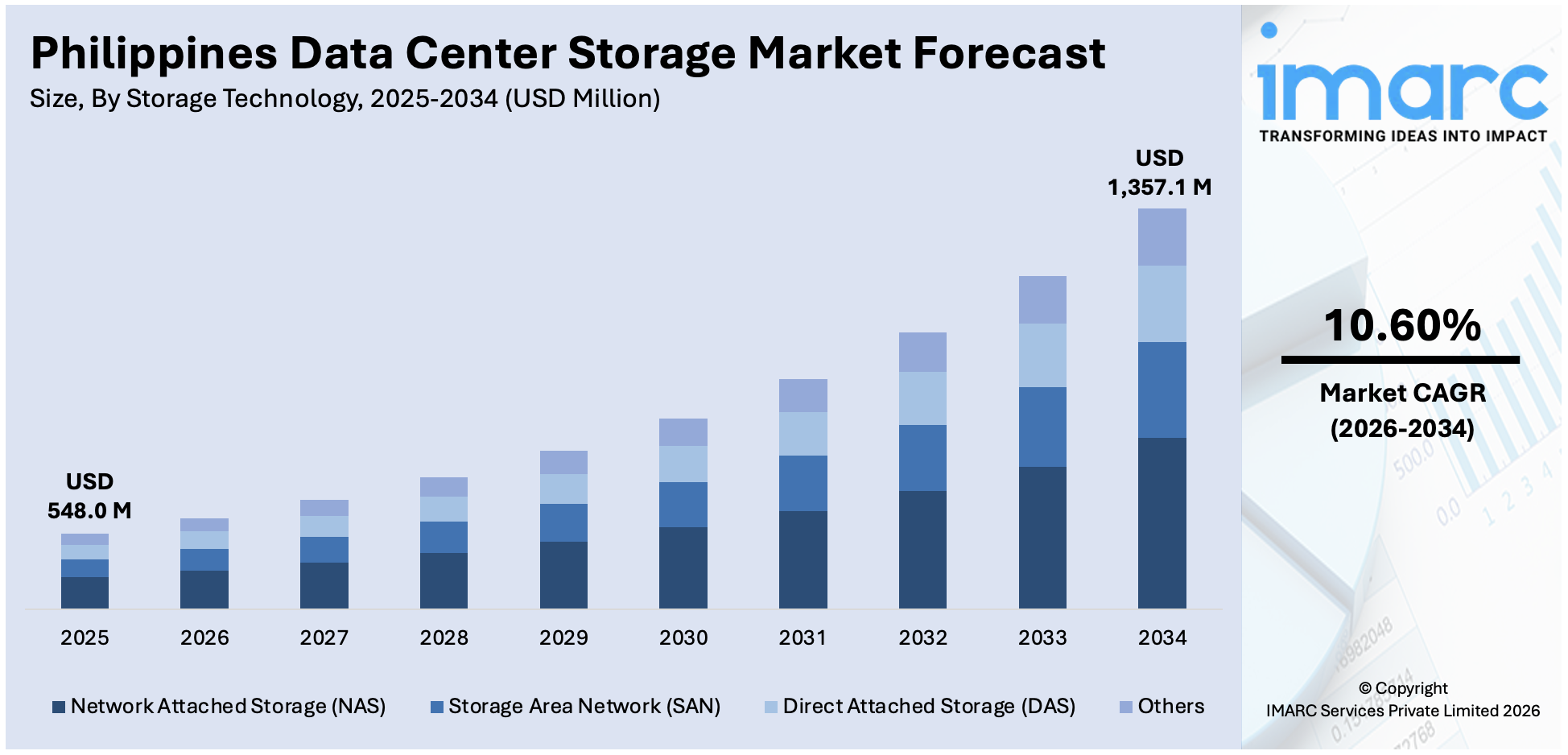
The Philippines data center storage market size reached USD 548.0 Million in 2025. Looking forward, IMARC Group expects the market to reach USD 1,357.1 Million by 2034, exhibiting a growth rate (CAGR) of 10.60% during 2026-2034. The rising digitalization, increasing cloud adoption, expanding e-commerce, growing demand for hyperscale data centers, government initiatives for digital infrastructure, higher enterprise IT spending, strong smartphone penetration, and increased investments from global data center operators are some of the major factors positively impacting the Philippines data center market share.
|
Report Attribute
|
Key Statistics
|
|---|---|
|
Base Year
|
2025 |
|
Forecast Years
|
2026-2034
|
|
Historical Years
|
2020-2025
|
| Market Size in 2025 | USD 548.0 Million |
| Market Forecast in 2034 | USD 1,357.1 Million |
| Market Growth Rate (2026-2034) | 10.60% |
Key Trends of Philippines Data Center Storage Market:
Expansion of Data Center Infrastructure
The growth of data centers across the Philippines is positively influencing the Philippines data center storage market outlook. Businesses are heavily investing in digital operations, cloud computing, and big data analytics, leading to a demand for more storage. Companies are also investing in local data centers to ensure that data can be accessed faster, thus minimizing latency, and also complying with regulations on data sovereignty. Increased internet penetration and digital transformation initiatives that are undertaken in various industries, such as banking, healthcare, and e-commerce, are supporting this trend. For instance, on July 23, 2024, Equinix declared the purchase of three data centers from Total Information Management in Philippines, aiming to strengthen its presence in the region. The developments in data centers ensure businesses can store and manage vast amounts of data while maintaining security and operational efficiency. Also, the emphasis on renewable energy sources in powering data centers is gaining traction, ensuring that storage solutions stay reliable and eco-friendly.
To get more information on this market Request Sample
Shift Towards Cloud and Hybrid Storage Solutions
Organizations in the Philippines are moving away from traditional on-premises storage systems toward cloud and hybrid solutions. On December 5, 2024, Huawei inaugurated a cloud region in Manila, Philippines, featuring three availability zones and over 100 cloud services. This expansion aims to provide efficient, reliable, and secure cloud solutions to local customers and partners. Collaborations with local data center firms, such as Digital Halo and PLDT's Vitro, were instrumental in this development. The transition to cloud solutions enables businesses to scale their storage needs efficiently, optimize costs, and enhance accessibility for remote teams. Hybrid storage models allow companies to combine private and public cloud solutions, ensuring data security while benefiting from cloud flexibility. Small and medium-sized enterprises are particularly leveraging cloud storage to reduce infrastructure costs and streamline operations. The adoption of cloud storage is also fueled by improvements in local internet infrastructure and government initiatives promoting digital transformation, which is contributing to the Philippines data center storage market growth.
Growth Drivers of Philippines Data Center Storage Market:
Digital Transformation and Enterprise Cloud Adoption
Digital transformation driving both public and private sectors at an increased rate is one of the most powerful drivers of growth for the Philippines data center storage market. As businesses go modern, they are leaning toward cloud-first, hybrid infrastructure, and data-driven services like artificial intelligence, big data analytics, and IoT, which all require scalable, high-resilience storage solutions. Specifically, industries such as fintech, e-commerce, healthcare, and logistics are producing vast amounts of data that need to be stored securely, accessed fast, and backed up reliably. This is driving demand for raw capacity along with high‑performance storage designs, object storage systems, strong disaster recovery features, and storage services conforming to changing regulatory standards. Companies are increasingly willing to unload storage loads on specialized providers or use colocation and hyperscale storage solutions, allowing them to concentrate on core competencies while realizing economies of scale.
Government Policy, Incentives, and Location‑Specific Advantages
According to the Philippines data center storage market analysis, government policy is also helping to spur growth by establishing an attractive investment environment, regulatory certainty, and infrastructure facilitation. Legislation and initiatives that offer fiscal incentives, tax holidays, and fast-tracked permitting in investment promotion agencies and economic zones are fostering both local and foreign investment in data center and storage facilities. Strategic plans to enhance digital infrastructure, such as the upgrade of broadband, inter‑island fiber links, submarine and land-based cable landing stations, are cutting latency, enhancing reliability, and facilitating deployments of edge storage outside Metro Manila. Geographic conditions are also used: the Philippines is located along primary subsea cable routes and, as a result, is a prime hub for data traffic within the region. In addition, secondary and tier‑2 or tier‑3 cities are being targeted as priority under national initiatives, with lower land prices, nascent pools of skilled labor, and possibilities for decentralized storage nodes to enhance disaster resistance and mitigate reliance on a single metro area.
Sustainability, Power, Infrastructure Reliability and Risk Mitigation
There are several drivers specific to the Philippines that are connected to the infrastructure limitations and environmental conditions, encouraging new ways to approach the planning and management of storage deployment. The presence of a tropical climate, vulnerability to typhoons, earthquakes, and seasonal outages means data centers have to design disaster‑recovery, redundancy, and robust power supply into their storage. Energy reliability is of particular concern; ongoing brownouts or unreliable grid power in a great many locations make backup power, renewable energy supply, and effective cooling imperative. As energy prices and environmental sensitivity increase, numerous operators are embracing energy-efficient storage equipment, looking for renewables, maximizing cooling and rack density, and finding new storage capacity in regions with reliable grids or cleaner power. Local data privacy, sovereignty, and compliance needs create additional layers, as storage solutions need to work in a manner satisfying local legal needs for protection, localization, and continuity in adverse conditions. All these considerations together make storage providers and data center operators focus on risk mitigation, resilience, and long-term operational stability as market differentiators.
Opportunity of Philippines Data Center Storage Market:
Expansion to Regional and Edge Locations Outside of Metro Manila
While Metro Manila has traditionally been the preeminent location for data center and storage infrastructure in the Philippines, there is a large opportunity that has existed in building facilities in regional cities that have traditionally been neglected. Cities like Cebu, Davao, Iloilo, and Clark are gaining appeal, with increasing basic infrastructure such as power reliability, road access, availability of real estate, and local demand from businesses, government offices, and institutions seeking lower latency and local storage. Edge computing requirements (e.g., content caching, local backup, disaster recovery) are particularly ready there. Decentralization of storage from a single hub enhances resilience (particularly with the Philippines' archipelagic location), yet also decreases the costs associated with transmission, decreases latency for consumers, and distributes development more uniformly. Further, with schools located in these areas churning out technical graduates, there is available local skilled labor that can provide support for operations, maintenance, and maybe even innovation. Therefore, data center and storage providers can gain new markets by setting up within or near second-tier cities and becoming part of digital infrastructure plans in the region.
Government Policies, Incentives, and Regulatory Reforms
A second major opportunity lies in the set of government policies, legislation reforms, and incentive packages to enhance digital infrastructure in the Philippines. Investment incentives through special economic zones, tax credits such as special company tax rates or better deductions for capital machinery or electricity, and legislation that promotes greater openness in data transmission are making the business climate more conducive to data center and storage suppliers. New legislation (like that encouraging open access in telecommunications) is designed to dampen connectivity bottlenecks, which in turn makes it more valuable to have stable local storage. The regulatory drive for data sovereignty, making sure that critical data of local business or the government is stored locally, also promotes demand for the capacity of local storage, instead of depending solely on foreign cloud or backup facilities. Government schemes that identify priority digital or "smart" cities are also making provisions for digital infrastructure, and storage is a fundamental component there. For operators, capitalizing on these reforms allows them to achieve competitive position, acquire long‑term customer contracts (government as well as industry customers), and enjoy cost savings through incentives, which further increases the Philippines data center storage market demand.
Green Energy Integration, Sustainability, and Differentiation Through Reliability
In the Philippines, climate and geography present risk and opportunity: common storms, earthquakes, islands, and issues with reliable power supply make resilience and reliability most important. This presents storage operators with chance to differentiate by providing very resilient, redundant configurations, disaster recovery, and reliable uninterruptible storage facilities. At the same time, the Philippines also has rich resources in renewable energy sources like solar, hydro, geothermal, and is increasingly driven toward incorporating renewable generation and sustainable energy mixes as components of national energy policy. Storage units situated close to or co‑located with renewable power sources (solar farms, geothermal stations, hydropower) can decrease operating power expenses, minimize carbon footprint, and attract strongly to clients (both local and international) with sustainability requirements. Energy efficient cooling, rack density optimization, battery backup units, and even multi‑source power feed options are chances to design storage systems that are cost‑effective and resilient. In addition, considering infrastructure catastrophes and natural disasters, spending on resilient storage architectures (e.g. with robust backup, geographic redundancy, offline duplicates) will most likely command a premium. Operators that can mix sustainability, dependability, and compliance are able to command a premium in the market.
Philippines Data Center Storage Market Segmentation:
IMARC Group provides an analysis of the key trends in each segment of the market, along with forecasts at the country level for 2026-2034. Our report has categorized the market based on storage technology, storage type, and end-user.
Storage Technology Insights:
- Network Attached Storage (NAS)
- Storage Area Network (SAN)
- Direct Attached Storage (DAS)
- Others
The report has provided a detailed breakup and analysis of the market based on the storage technology. This includes network attached storage (NAS), storage area network (SAN), direct attached storage (DAS), and others.
Storage Type Insights:
- Traditional Storage
- All-Flash Storage
- Hybrid Storage
A detailed breakup and analysis of the market based on the storage type have also been provided in the report. This includes traditional storage, all-flash storage, and hybrid storage.
End-User Insights:
Access the comprehensive market breakdown Request Sample
- IT & Telecommunication
- BFSI
- Government
- Media & Entertainment
- Others
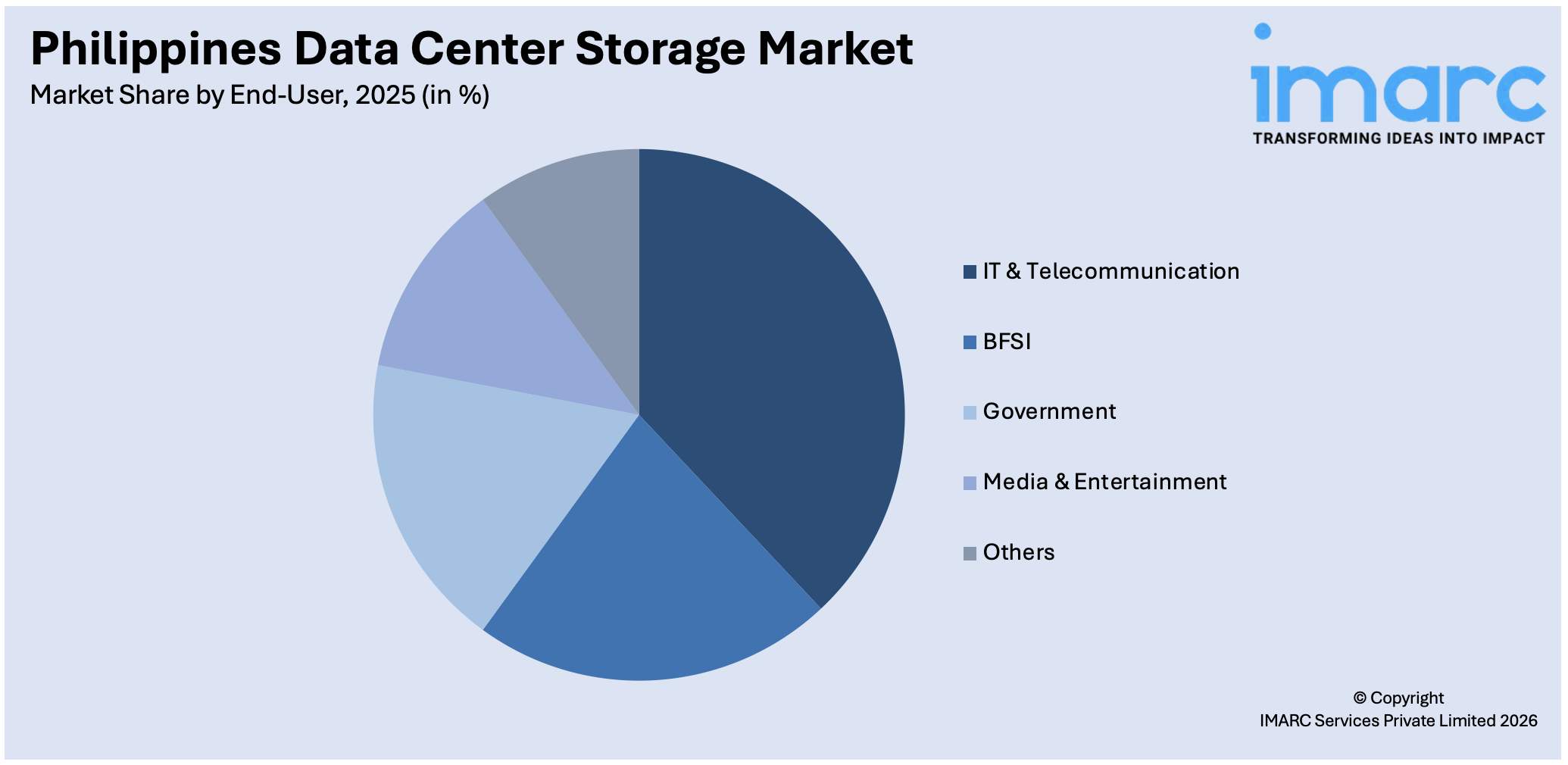
The report has provided a detailed breakup and analysis of the market based on the end-user. This includes IT & telecommunication, BFSI, government, media & entertainment, and others.
Regional Insights:
- Luzon
- Visayas
- Mindanao
The report has also provided a comprehensive analysis of all the major regional markets, which include Luzon, Visayas, and Mindanao.
Competitive Landscape:
The market research report has also provided a comprehensive analysis of the competitive landscape. Competitive analysis such as market structure, key player positioning, top winning strategies, competitive dashboard, and company evaluation quadrant has been covered in the report. Also, detailed profiles of all major companies have been provided.

Philippines Data Center Storage Market News:
- December 7, 2024: Evolution Data Centers (EDC) signed an MoU with Citicore Renewable Energy Corporation (CREC) to build a hyperscale data center in the Philippines. The center will be completely powered by renewable energy of up to 100 megawatts. This initiative responds to the increasing demand for sustainable data center storage solutions and ensure that hyperscale facilities can efficiently store and process vast amounts of data while minimizing their carbon footprint.
- December 17, 2024: ST Telemedia Global Data Centres (STT GDC) Philippines announced the structural completion of STT Fairview 1, the first carrier-neutral, environmentally friendly data center campus in the region. Designed to accommodate hyperscalers and AI companies, the facility supports a total IT capacity of 124 megawatts and is expected to start operating in the second quarter of 2025 upon physical completion.
Philippines Data Center Storage Market Report Coverage:
| Report Features | Details |
|---|---|
| Base Year of the Analysis | 2025 |
| Historical Period | 2020-2025 |
| Forecast Period | 2026-2034 |
| Units | Million USD |
| Scope of the Report |
Exploration of Historical Trends and Market Outlook, Industry Catalysts and Challenges, Segment-Wise Historical and Future Market Assessment:
|
| Storage Technologies Covered |
Network Attached Storage (NAS), Storage Area Network (SAN), Direct Attached Storage (DAS), Others |
| Storage Types Covered |
Traditional Storage, All-Flash Storage, Hybrid Storage |
| End – Users Covered |
IT & Telecommunication, BFSI, Government, Media & Entertainment, Others |
| Regions Covered |
Luzon, Visayas, Mindanao |
| Customization Scope | 10% Free Customization |
| Post-Sale Analyst Support | 10-12 Weeks |
| Delivery Format | PDF and Excel through Email (We can also provide the editable version of the report in PPT/Word format on special request) |
Key Benefits for Stakeholders:
- IMARC’s industry report offers a comprehensive quantitative analysis of various market segments, historical and current market trends, market forecasts, and dynamics of the Philippines data center storage market from 2020-2034.
- The research report provides the latest information on the market drivers, challenges, and opportunities in the Philippines data center storage market.
- Porter's five forces analysis assist stakeholders in assessing the impact of new entrants, competitive rivalry, supplier power, buyer power, and the threat of substitution. It helps stakeholders to analyze the level of competition within the Philippines data center storage industry and its attractiveness.
- Competitive landscape allows stakeholders to understand their competitive environment and provides an insight into the current positions of key players in the market.
Frequently Asked Questions About the Philippines Data Center Storage Market Report
The Philippines data center storage market was valued at USD 548.0 Million in 2025.
The Philippines data center storage market is projected to exhibit a CAGR of 10.60% during 2026-2034.
The Philippines data center storage market is expected to reach a value of USD 1,357.1 Million by 2034.
Growing use of hybrid cloud solutions, rising need for edge and regional storage, and a focus on data sovereignty are some of the major trends in the Philippines data center storage market. Sustainability, energy-efficient storage systems, and integration with renewable energy sources are also emerging, as providers focus on resilience, compliance, and environmental responsibility.
The Philippines data center storage market is driven by rising digital transformation, increased cloud adoption, government incentives, and demand for data localization. Expanding e-commerce, fintech, and remote work trends further accelerate storage needs. Infrastructure upgrades and growing interest in regional data centers also support long-term market growth across the archipelago.
Need more help?
- Speak to our experienced analysts for insights on the current market scenarios.
- Include additional segments and countries to customize the report as per your requirement.
- Gain an unparalleled competitive advantage in your domain by understanding how to utilize the report and positively impacting your operations and revenue.
- For further assistance, please connect with our analysts.
 Request Customization
 Speak to an Analyst
 Request Brochure
 Inquire Before Buying
Benefits of Customization
- Personalize this research
- Triangulate with your data
- Get data as per your format and definition
- Gain a deeper dive into a specific application, geography, customer, or competitor
- Any level of personalization
Get in Touch With Us
UNITED STATES
Phone: +1-201-971-6302
INDIA
Phone: +91-120-433-0800
UNITED KINGDOM
Phone: +44-753-714-6104
Email: [email protected]
Client Testimonials




.webp)




.webp)













Related Reports

Choose your plan
*Please note that the prices mentioned below are starting prices for each bundle type. Kindly contact our team for further details.*
Single User License
- 1 User License, Access on 2 Devices
- PDF Report + Excel Dataset (Password Protected)
- Lifetime Access
- No Printing Rights
- 10% Free Report Customization
- 10–12 Weeks of Analyst Support
Five User License
- Access for 5 Users, 2 Devices per User
- PDF Report + Excel Dataset (Password Protected)
- Lifetime Access
- Dedicated Account Manager
- 12–14 Weeks of Analyst Support
- No Printing Rights
- 15% Free Report Customization
- 25% Discount on Your Next Purchase
Corporate User License
- Unlimited User Access (Within Your Organization)
- PDF Report + Excel Dataset
- Lifetime Access
- Dedicated Account Manager
- 14–20 Weeks of Analyst Support
- No Printing Rights
- 20% Free Report Customization
- 30% Discount on Your Next Purchase
Essential Insights
What's included:
3 reports
- Lifetime Access
- PDF Reports
- Excel Datasets
- 2 Weeks of Free Analyst Support
- 2 User Licenses
- Access on 2 Devices
- Printing Rights
- Complimentary PowerPoint (PPT) Version
- Complimentary License Upgrade
Professional Access
What's included:
5 reports
- Lifetime Access
- PDF Reports
- Excel Datasets
- 8 Weeks of Free Analyst Support
- 2 User Licenses
- Access on 2 Devices
- Printing Rights
- Complimentary PowerPoint (PPT) Version
- Complimentary License Upgrade
Business Advantage
What's included:
8 reports
- Lifetime Access
- PDF Reports
- Excel Datasets
- 14 Weeks of Free Analyst Support
- 2 User Licenses
- Access on 2 Devices
- Printing Rights
- Complimentary PowerPoint (PPT) Version
- Complimentary License Upgrade
Enterprise Intelligence
What's included:
10 reports
- Lifetime Access
- PDF Reports
- Excel Datasets
- 20 Weeks of Free Analyst Support
- 2 User Licenses
- Access on 2 Devices
- Printing Rights
- Complimentary PowerPoint (PPT) Version
- Complimentary License Upgrade