
Philippines Perfume Market Size, Share, Trends and Forecast by Perfume Type, Category, and Region, 2026-2034
Philippines Perfume Market Summary:
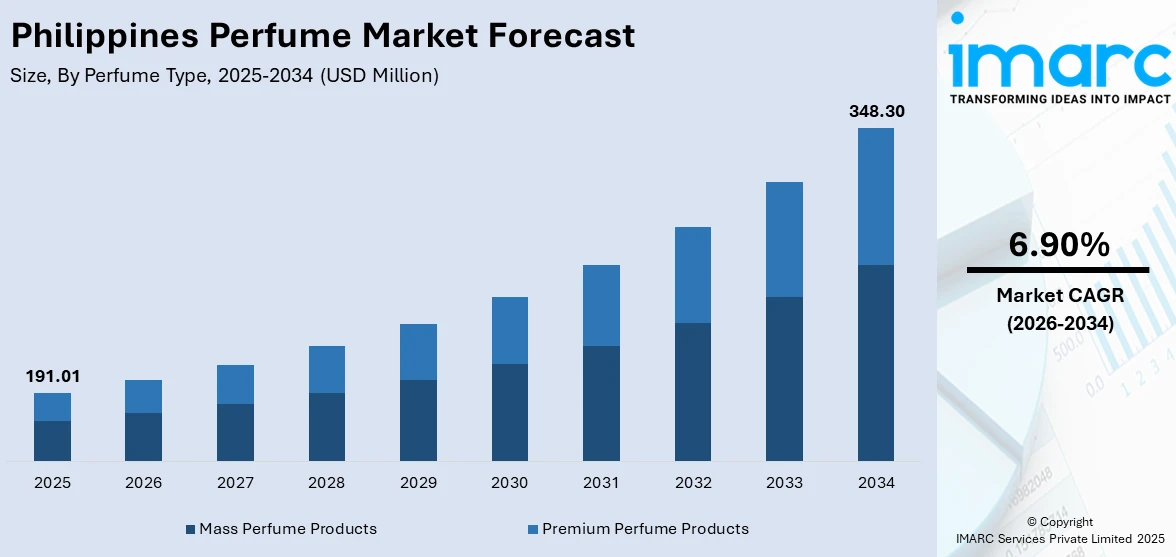
The Philippines perfume market size was valued at USD 191.01 Million in 2025 and is projected to reach USD 348.30 Million by 2034, growing at a compound annual growth rate of 6.90% from 2026-2034.
The market is driven by rising disposable incomes, increasing personal grooming consciousness among the consumers, expanding retail accessibility through mall-centric shopping environments, and growing social media influence on fragrance preferences. The proliferation of e-commerce platforms and brand stores has enhanced product visibility and consumer engagement, while the cultural emphasis on self-presentation and individual style expression continues to elevate perfume usage from occasional luxury purchases to everyday grooming essentials, contributing to the Philippines perfume market share.
Key Takeaways and Insights:
- By Perfume Type: Mass perfume products dominate the market with a share of 62% in 2025, driven by widespread affordability, extensive retail distribution, and strong appeal among price-conscious consumers seeking everyday fragrances.
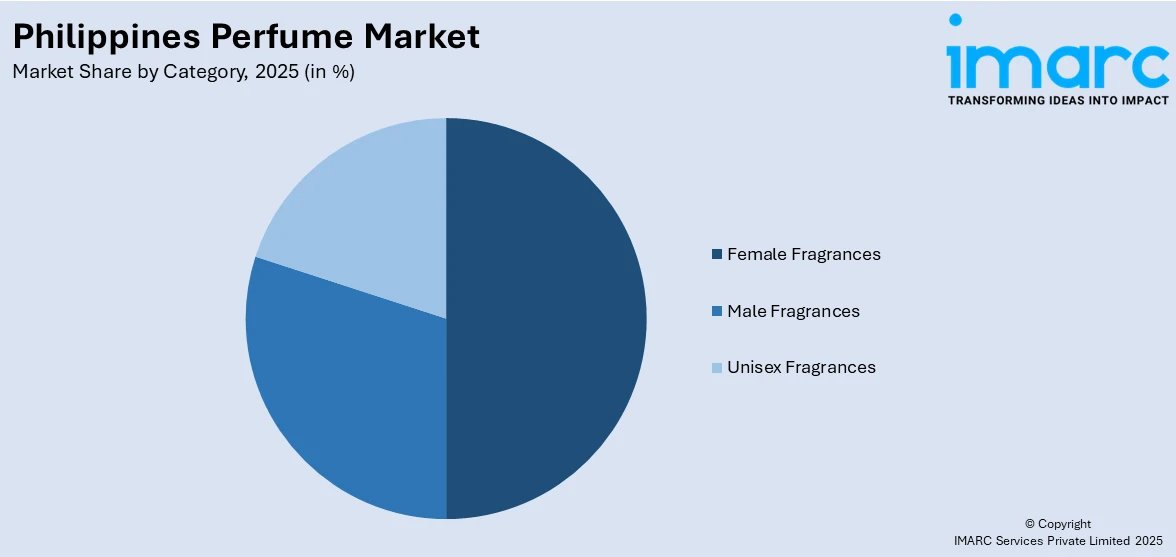
- By Category: Female fragrances lead the market with a share of 49% in 2025, owing to their focus on grooming by the women, variety of fragrances available, and fragrances being considered gift products by consumers.
- By Region: Luzon represents the market with a share of 60% in 2025, driven by population concentration in Metro Manila, higher purchasing power, and extensive premium retail infrastructure.
- Key Players: The Philippines perfume market exhibits a moderately fragmented competitive landscape, with established multinational beauty conglomerates competing alongside regional manufacturers and emerging local fragrance brands across diverse price segments and distribution channels.
To get more information on this market Request Sample
The Philippines perfume market is experiencing robust expansion fueled by a convergence of socioeconomic and cultural factors reshaping consumer behavior. Rising disposable incomes among the growing middle class have elevated personal grooming from basic hygiene to an essential expression of individual identity and social status. In June 2024, Maison Margiela Fragrances opened its first Philippine boutique at Greenbelt 5, Makati City, offering its full Replica perfume collection and immersive olfactory experiences to local luxury consumers. The country's youthful demographic composition, characterized by digitally connected millennials and Generation Z consumers, has accelerated fragrance adoption through heightened exposure to global beauty trends and influencer-driven content. Additionally, the mall-centric retail culture unique to the Philippines provides extensive opportunities for sensory product experiences, brand engagement, and impulse purchases. The expanding e-commerce ecosystem has further democratized access to diverse fragrance options, enabling consumers across geographic regions to explore and purchase products conveniently while benefiting from competitive pricing and promotional offers.
Philippines Perfume Market Trends:
Rising Preference for Natural and Sustainable Fragrances
Filipino consumers are increasingly gravitating toward perfumes formulated with natural ingredients and sustainable production practices, reflecting broader global consciousness about health and environmental responsibility. As per sources, in 2025, DOST-FPRDI showcased sustainable fragrance innovations using local aromatic plants at the NSTW forum, promoting eco-friendly essential oils and supporting Filipino perfumers and community livelihoods. Moreover, this shift is particularly pronounced among younger demographics who prioritize chemical-free formulations and eco-friendly packaging materials in their purchasing decisions. Brands offering transparency about ingredient sourcing and manufacturing processes are gaining competitive advantages in the market.
Digital Commerce and Social Media Influence Reshaping Purchase Behavior
The fragrance discovery and purchasing journey in the Philippines is undergoing fundamental transformation through digital platforms and social media ecosystems. Consumers increasingly rely on influencer recommendations, video reviews, and community-driven content on platforms to explore and evaluate fragrance options before making purchase decisions. According to sources, in 2025, 70% of Filipino digital buyers purchased products based on influencer recommendations, with over 15,625 Instagram macro-influencers actively shaping online consumer decisions. Furthermore, social commerce through popular e-commerce marketplaces has enabled direct-to-consumer brands and emerging local fragrance houses to build loyal customer bases without traditional retail intermediaries.
Personalization and Niche Fragrance Exploration
Filipino consumers are demonstrating growing interest in distinctive and personalized fragrance experiences that reflect their individual personalities and lifestyle aspirations. The demand for niche, artisanal, and limited-edition scents is expanding beyond traditional mass-market offerings as consumers seek exclusivity and uniqueness in their fragrance choices. As per sources, in 2025, Filipino perfumer Shale Albao was named a finalist for “Niche Perfumer” at the Asia Perfume Awards, highlighting the growing prominence of artisanal fragrance creators in the Philippines. Furthermore, customizable perfume options allowing consumers to create signature scents are gaining traction among those desiring differentiated personal expressions.
Market Outlook 2026-2034:
The Philippines perfume market is poised for sustained revenue expansion throughout the forecast period, supported by favorable demographic dynamics, continued urbanization, and rising consumer sophistication in fragrance preferences. The market is expected to witness accelerated revenue growth driven by the premiumization trend among aspirational middle-class consumers and the proliferation of accessible distribution channels. E-commerce platforms and brand-dedicated stores will continue serving as primary revenue contributors, while innovation in sustainable formulations and personalized offerings will unlock new revenue streams across diverse consumer segments in the coming years. The market generated a revenue of USD 191.01 Million in 2025 and is projected to reach a revenue of USD 348.30 Million by 2034, growing at a compound annual growth rate of 6.90% from 2026-2034.
Philippines Perfume Market Report Segmentation:
| Segment Category | Leading Segment | Market Share |
|---|---|---|
| Perfume Type | Mass Perfume Products | 62% |
| Category | Female Fragrances | 49% |
| Region | Luzon | 60% |
Perfume Type Insights:
- Premium Perfume Products
- Mass Perfume Products
Mass perfume products dominate with a market share of 62% of the total Philippines perfume market in 2025.
Mass perfume products command the leading position in the Philippines perfume market, reflecting price-conscious purchasing behavior prevalent across a significant consumer base. These products offer accessible entry points for fragrance adoption, enabling consumers across varied income levels to incorporate scented products into daily grooming routines. In 2025, BW Women launched the first-ever Perfume Lotion Spray in the Philippines, featuring four floral scents with skincare benefits, demonstrating strong local consumer interest in innovative mass-market fragrance products.
The trend of mass perfume popularity is also supported by the presence of a variety of perfume types, ranging from perfume, eau de perfume, to eau de toilette, and other scents, available at affordable prices. The marketing and promotion strategies of these products, such as emphasizing the need to use them in daily life due to their multi-scent capabilities, also appeal to masses who value their money but do not want to sacrifice quality.
Category Insights:
Access the comprehensive market breakdown Request Sample
- Female Fragrances
- Male Fragrances
- Unisex Fragrances
Female fragrances lead with a share of 49% of the total Philippines perfume market in 2025.
Female fragrances maintain the dominant share in the Philippines perfume market, driven by deeply rooted cultural traditions emphasizing personal grooming and self-care among Filipino women. The segment benefits from extensive product variety spanning floral, fruity, oriental, and fresh fragrance families, allowing consumers to select scents appropriate for different occasions, seasons, and personal moods. Perfumes remain popular gift choices for celebrations and special occasions, sustaining demand throughout the year. In March 2025, SM Beauty’s Scentsorium Fragrance Festival in Manila engaged fragrance enthusiasts, allowing attendees to personalize scents matching their aura, reinforcing female consumers’ emotional connection and everyday use of perfumes.
The market of female fragrances is also undergoing dynamic change in reaction to new demands for sophisticated and long-lasting perfumes and novel fragrances that juxtapose classic choices alongside new interpretations. The marketing approach of celebrity endorsement and aspirational positioning speaks well to a woman’s attempt to relate emotionally to a perfume brand. The increase in women becoming involved in the workforce has also increased morning and evening perfume usage occasions, moving perfume from a luxury accessory to a necessary accompaniment for a professional and social life.
Regional Insights:
- Luzon
- Visayas
- Mindanao
Luzon dominates with a market share of 60% of the total Philippines perfume market in 2025.
Luzon holds the commanding position in the Philippines perfume market, anchored by economic concentration and population density of Metro Manila and surrounding provinces. The region's advanced retail infrastructure, featuring numerous premium shopping malls and brand boutiques, provides extensive opportunities for product discovery and sensory engagement. Higher average incomes and greater exposure to international trends among Luzon consumers drive demand across both premium and mass-market segments. The cosmopolitan character of major urban centers shapes sophisticated fragrance preferences blending global trends with local sensibilities.
The presence of major commercial centers and multinational corporation headquarters contributes to a consumer base with sophisticated preferences and higher discretionary spending capacity. E-commerce penetration rates in Luzon exceed other island groups, facilitating convenient access to diverse fragrance selections and competitive pricing. The region's multicultural influences and fashion-forward population create dynamic market conditions attracting brand investments and retail expansion initiatives. Strategic positioning of flagship stores in prominent shopping destinations further reinforces Luzon's dominance in the national fragrance landscape.
Market Dynamics:
Growth Drivers:
Why is the Philippines Perfume Market Growing?
Expanding Personal Grooming Culture and Self-Expression
The Philippines is experiencing a fundamental cultural transformation in attitudes toward personal grooming, with fragrances becoming essential components of daily self-care routines. This evolution extends beyond basic hygiene to encompass confidence building and social identity formation among Filipino consumers. Younger generations view perfume selection as an extension of personal style, choosing scents that communicate their personalities and aspirations. As per sources, in 2025, SM Aura hosted Café Aromatique, a week-long festival blending specialty coffee and fine fragrances, giving Filipinos the opportunity to explore niche, designer, and local perfume brands through an immersive, multi-sensory experience.
Proliferation of Brand Stores and Retail Infrastructure
The expansion of dedicated brand boutiques and specialized fragrance retail spaces is significantly accelerating market growth by enhancing product accessibility and consumer engagement throughout the Philippines. The country's distinctive mall-centric shopping culture provides ideal environments for experiential retail, where consumers explore products through sensory interactions with trained beauty consultants. According to sources, in October 2025, niche fragrance house Parfums de Marly opened its first boutique at Glorietta 4, Manila, attracting celebrities William Jakraptr and Est Supha and offering immersive, personalized fragrance experiences. Furthermore, brand stores create immersive environments that elevate perfumes from commodity purchases to aspirational lifestyle acquisitions, building emotional connections between consumers and fragrance houses.
Digital Transformation and E-Commerce Expansion
The rapid growth of digital commerce platforms is revolutionizing fragrance distribution and consumer engagement in the Philippines, removing geographic barriers and enabling unprecedented product accessibility nationwide. E-commerce marketplaces and social commerce channels have become primary discovery platforms where consumers research, compare, and purchase fragrances conveniently from their homes. The integration of promotional campaigns, flash sales, and direct-to-consumer models through digital channels has expanded the addressable market beyond consumers with access to traditional retail infrastructure. This transformation enables emerging local fragrance brands to compete effectively by building direct relationships with target audiences.
Market Restraints:
What Challenges the Philippines Perfume Market is Facing?
Dependence on Imported Raw Materials
The Philippines perfume industry faces significant challenges related to limited domestic production of essential fragrance ingredients, including aromatic compounds, essential oils, alcohol bases, and specialized packaging components. This heavy reliance on imports from established manufacturing hubs creates vulnerability to supply chain disruptions, currency fluctuations, and logistics complications affecting production costs and product availability, constraining local manufacturers' competitive positioning.
Prevalence of Counterfeit Products
The market contends with substantial challenges from counterfeit and imitation fragrance products that undermine consumer trust and brand value propositions. These unauthorized reproductions, often sold through informal channels and unregulated online marketplaces, create confusion among consumers and erode purchasing confidence. The proliferation of fake products particularly impacts premium segments where authenticity assurance is fundamental to consumer value perceptions.
Intense Price Competition and Margin Pressure
The Philippines perfume market experiences significant competitive intensity creating persistent pressure on pricing and profit margins across industry participants. The presence of numerous international brands, regional manufacturers, and local producers competing for consumer attention results in aggressive promotional activities and price-based competition. This dynamic particularly impacts mid-tier segments where differentiation opportunities remain limited and consumers demonstrate price sensitivity.
Competitive Landscape:
The Philippines perfume market exhibits a dynamic competitive structure characterized by the coexistence of established multinational beauty conglomerates, regional fragrance specialists, and emerging local brands competing across diverse market segments. International players leverage global brand recognition, extensive product portfolios, and sophisticated marketing capabilities to maintain premium positioning and consumer loyalty. Regional manufacturers capitalize on distribution expertise and localized product development to address mass-market consumer preferences effectively. The emergence of homegrown fragrance houses utilizing social commerce strategies has introduced new competitive dynamics, particularly among younger demographics seeking authentic and affordable alternatives.
Recent Developments:
- In October 2024, Chanel Beauty opened its first boutique in the Philippines at Greenbelt 5, showcasing fragrances, skincare, and makeup. The 167-square-meter store offers interactive discovery tables, personalized services, and exclusive collections, enhancing luxury fragrance accessibility while reinforcing Chanel’s presence in the Philippine market.
Philippines Perfume Market Report Coverage:
| Report Features | Details |
|---|---|
| Base Year of the Analysis | 2025 |
| Historical Period | 2020-2025 |
| Forecast Period | 2026-2034 |
| Units | Million USD |
| Scope of the Report |
Exploration of Historical Trends and Market Outlook, Industry Catalysts and Challenges, Segment-Wise Historical and Future Market Assessment:
|
| Perfume Types Covered | Premium Perfume Products, Mass Perfume Products |
| Categories Covered | Female Fragrances, Male Fragrances, Unisex Fragrances |
| Regions Covered | Luzon, Visayas, Mindanao |
| Customization Scope | 10% Free Customization |
| Post-Sale Analyst Support | 10-12 Weeks |
| Delivery Format | PDF and Excel through Email (We can also provide the editable version of the report in PPT/Word format on special request) |
Frequently Asked Questions About the Philippines Perfume Market Report
The Philippines perfume market size was valued at USD 191.01 Million in 2025.
The Philippines perfume market is expected to grow at a compound annual growth rate of 6.90% from 2026-2034 to reach USD 348.30 Million by 2034.
Mass perfume products held the largest, driven by their widespread affordability, extensive distribution network across supermarkets, convenience stores, and local drugstores, and strong appeal among price-conscious consumers seeking accessible everyday fragrances for their daily personal grooming needs.
Key factors driving the Philippines perfume market include expanding personal grooming culture, proliferation of brand stores and retail infrastructure, digital transformation through e-commerce platforms, and increasing social media influence on consumer fragrance preferences.
Major challenges include heavy dependence on imported raw materials, prevalence of counterfeit products undermining brand trust, intense price competition creating margin pressures, limited domestic manufacturing capabilities, and consumer price sensitivity in certain market segments.
Need more help?
- Speak to our experienced analysts for insights on the current market scenarios.
- Include additional segments and countries to customize the report as per your requirement.
- Gain an unparalleled competitive advantage in your domain by understanding how to utilize the report and positively impacting your operations and revenue.
- For further assistance, please connect with our analysts.
 Request Customization
 Speak to an Analyst
 Request Brochure
 Inquire Before Buying
Benefits of Customization
- Personalize this research
- Triangulate with your data
- Get data as per your format and definition
- Gain a deeper dive into a specific application, geography, customer, or competitor
- Any level of personalization
Get in Touch With Us
UNITED STATES
Phone: +1-201-971-6302
INDIA
Phone: +91-120-433-0800
UNITED KINGDOM
Phone: +44-753-714-6104
Email: [email protected]
Client Testimonials




.webp)




.webp)













Related Reports

Choose your plan
*Please note that the prices mentioned below are starting prices for each bundle type. Kindly contact our team for further details.*
Single User License
- 1 User License, Access on 2 Devices
- PDF Report + Excel Dataset (Password Protected)
- Lifetime Access
- No Printing Rights
- 10% Free Report Customization
- 10–12 Weeks of Analyst Support
Five User License
- Access for 5 Users, 2 Devices per User
- PDF Report + Excel Dataset (Password Protected)
- Lifetime Access
- Dedicated Account Manager
- 12–14 Weeks of Analyst Support
- No Printing Rights
- 15% Free Report Customization
- 25% Discount on Your Next Purchase
Corporate User License
- Unlimited User Access (Within Your Organization)
- PDF Report + Excel Dataset
- Lifetime Access
- Dedicated Account Manager
- 14–20 Weeks of Analyst Support
- No Printing Rights
- 20% Free Report Customization
- 30% Discount on Your Next Purchase
Essential Insights
What's included:
3 reports
- Lifetime Access
- PDF Reports
- Excel Datasets
- 2 Weeks of Free Analyst Support
- 2 User Licenses
- Access on 2 Devices
- Printing Rights
- Complimentary PowerPoint (PPT) Version
- Complimentary License Upgrade
Professional Access
What's included:
5 reports
- Lifetime Access
- PDF Reports
- Excel Datasets
- 8 Weeks of Free Analyst Support
- 2 User Licenses
- Access on 2 Devices
- Printing Rights
- Complimentary PowerPoint (PPT) Version
- Complimentary License Upgrade
Business Advantage
What's included:
8 reports
- Lifetime Access
- PDF Reports
- Excel Datasets
- 14 Weeks of Free Analyst Support
- 2 User Licenses
- Access on 2 Devices
- Printing Rights
- Complimentary PowerPoint (PPT) Version
- Complimentary License Upgrade
Enterprise Intelligence
What's included:
10 reports
- Lifetime Access
- PDF Reports
- Excel Datasets
- 20 Weeks of Free Analyst Support
- 2 User Licenses
- Access on 2 Devices
- Printing Rights
- Complimentary PowerPoint (PPT) Version
- Complimentary License Upgrade