
Philippines Podcasting Market Size, Share, Trends and Forecast by Genre, Format, and Region, 2026-2034
Philippines Podcasting Market Summary:
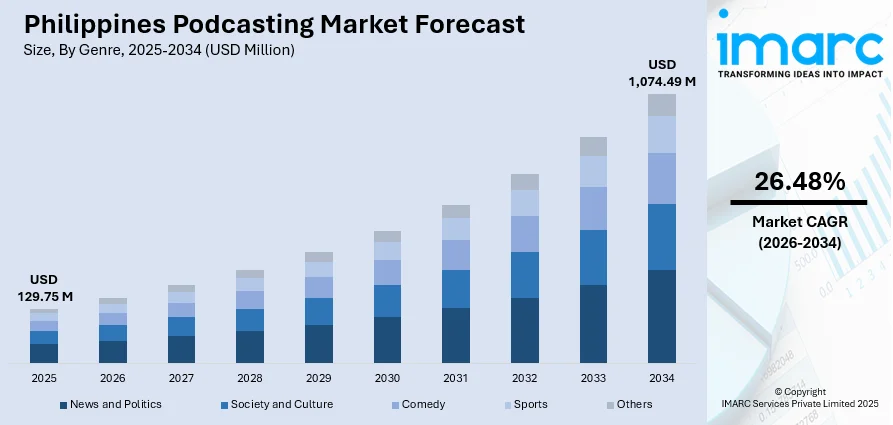
The Philippines podcasting market size reached USD 129.75 Million in 2025 and is projected to reach USD 1,074.49 Million by 2034, growing at a compound annual growth rate of 26.48% from 2026-2034.
The Philippines podcasting market is experiencing robust expansion driven by widespread smartphone adoption and affordable mobile data access across the archipelago. Rising demand for on-demand audio content, particularly among younger demographics, is reshaping media consumption patterns. Enhanced connectivity infrastructure, growing interest in vernacular programming, and the emergence of diverse content genres are collectively strengthening listener engagement and driving the Philippines podcasting market share.
Key Takeaways and Insights:
- By Genre: Comedy dominates the market with a share of 36% in 2025, driven by Filipino audiences' strong preference for entertainment content that provides humor, relatability, and stress relief through locally relevant comedic storytelling and personalities.
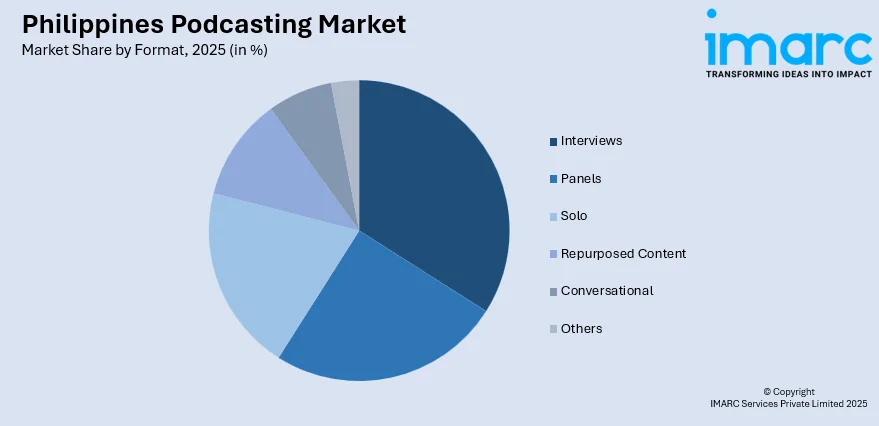
- By Format: Interviews leads the market with a share of 31% in 2025, reflecting listener preference for conversational content featuring guest appearances, celebrity discussions, and expert opinions that foster deeper engagement and authentic storytelling experiences.
- Key Players: The Philippines podcasting market exhibits a dynamic competitive landscape with established media networks, independent creators, and digital platforms competing for audience attention through diverse content offerings, strategic partnerships, and innovative monetization approaches.
To get more information on this market Request Sample
The Philippines podcasting market is evolving as digital audio consumption becomes increasingly embedded in the everyday routines of Filipino consumers. The confluence of high social media engagement, growing content creator ecosystems, and improving digital infrastructure creates favorable conditions for sustained market expansion. Local creators are capitalizing on cultural nuances and regional language preferences to develop authentic content that resonates deeply with domestic audiences. The integration of podcasting with popular social media platforms amplifies content discoverability and audience reach. For instance, in May 2025, Spotify and The Pod Network unveiled a new co-branded podcast studio, offering Filipino creators access to professional-grade facilities that were once exclusive to major media companies. The launch represents a key milestone in the ongoing professionalization of the Philippines’ podcasting industry, providing creators with advanced resources to produce high-quality content and elevate the overall standard of local audio production. Educational institutions, media companies, and influencers are increasingly recognizing podcasting as a powerful medium for storytelling, brand building, and community engagement, contributing to the diversification of content offerings across the market.
Philippines Podcasting Market Trends:
Growth of Vernacular and Hyperlocal Content
Filipino audiences are increasingly tuning into podcasts delivered in regional languages like Tagalog, Cebuano, and Ilocano. By creating content in vernacular languages, podcasters can engage listeners more authentically, addressing culturally relevant topics, local humor, and community-focused discussions. This approach allows creators to build deeper connections with audiences who may feel underserved by English-language programming. As a result, regional-language podcasts are playing a key role in driving the growth of the Philippines’ podcasting ecosystem.
Rise of Video Podcasting and Multi-Platform Distribution
Podcast creators in the Philippines are embracing video formats and distributing content across multiple digital platforms simultaneously. Leveraging the country’s high social media usage, podcasters combine visual storytelling with traditional audio formats, allowing them to engage both online viewers and mobile listeners. This strategy enhances audience reach, increases engagement, and provides flexible consumption options. By catering to diverse listener preferences, multi-platform video podcasts are becoming an increasingly important driver of the country’s podcasting market expansion.
Expansion of Niche and Educational Programming
Specialized podcasts targeting interests such as personal finance, mental health, career growth, and parenting are gaining popularity among Filipino audiences. These programs reflect a growing appetite for content that offers practical advice, expert insights, and educational value, going beyond purely entertainment-focused offerings. By providing listeners with meaningful and actionable information, niche and educational podcasts are attracting dedicated followings, encouraging greater content diversity, and supporting the overall development and sophistication of the podcasting market in the Philippines.
Market Outlook 2026-2034:
The Philippines podcasting market is positioned for substantial expansion as digital audio consumption continues gaining mainstream acceptance. Improving internet connectivity across provincial areas, rising smartphone ownership among younger populations, and evolving content monetization frameworks are expected to sustain growth momentum. Creator ecosystems are maturing with enhanced production capabilities and professional networks supporting quality improvements. Advertisers are increasingly recognizing podcasting as an effective channel for reaching engaged audiences, driving revenue diversification opportunities. The market generated a revenue of USD 129.75 Million in 2025 and is projected to reach a revenue of USD 1,074.49 Million by 2034, growing at a compound annual growth rate of 26.48% from 2026-2034.
Philippines Podcasting Market Report Segmentation:
| Segment Category | Leading Segment | Market Share |
|---|---|---|
| Genre | Comedy | 36% |
| Format | Interviews | 31% |
Genre Insights:
- News and Politics
- Society and Culture
- Comedy
- Sports
- Others
The comedy segment dominates with a market share of 36% of the total Philippines podcasting market in 2025.
Comedy podcasts have established clear dominance in the Philippine market, reflecting the cultural affinity of Filipino audiences for entertainment that combines humor with social commentary. Local comedic content resonates strongly with listeners seeking relatable narratives, celebrity banter, and lighthearted discussions that provide escapism from daily routines while addressing culturally relevant topics.
The popularity of comedy programming is further amplified by the crossover appeal of established entertainers and social media personalities entering the podcast space. These creators bring existing fan bases and production expertise, elevating content quality while expanding audience demographics beyond traditional podcast listeners.
Format Insights:
Access the comprehensive market breakdown Request Sample
- Interviews
- Panels
- Solo
- Repurposed Content
- Conversational
- Others
The interviews format leads with a share of 31% of the total Philippines podcasting market in 2025.
Interview-format podcasts have captured the largest market share by delivering compelling conversational content featuring notable guests, industry experts, and celebrities. Filipino audiences demonstrate strong preference for dialogue-driven programming that offers intimate glimpses into personalities and perspectives through engaging question-and-answer formats.
This format benefits from versatility across content genres, enabling creators to explore diverse topics while maintaining audience engagement through dynamic host-guest interactions. The interview structure also facilitates cross-promotion opportunities as guests share appearances with their own audiences, driving organic listener growth.
Regional Insights:
- Luzon
- Visayas
- Mindanao
Luzon, home to Metro Manila and the country’s largest urban population, is the primary hub for podcast consumption. High internet penetration, widespread smartphone usage, and strong social media engagement drive adoption. Podcasts in English, Tagalog, and regional languages thrive, covering topics from news and entertainment to personal development. Video podcasting and multi-platform distribution are particularly popular, supported by the region’s tech-savvy and culturally diverse audience.
The Visayas region shows growing interest in podcasts, especially in Cebuano and Hiligaynon languages, reflecting local cultural preferences. Urban centers like Cebu and Iloilo are driving adoption through increasing internet access, smartphone penetration, and social media activity. Listeners gravitate toward niche content such as local news, music, and lifestyle programming. Multi-platform availability, including YouTube and streaming services, allows creators to reach both younger and commuting audiences effectively.
Mindanao’s podcasting market is expanding steadily, with content in Cebuano, Filipino, and regional dialects resonating with local listeners. Urban areas like Davao and Cagayan de Oro lead in digital consumption, supported by rising smartphone usage and improved connectivity. Podcasts covering regional culture, news, and educational topics are gaining traction. Multi-platform strategies, including social media and video formats, help podcasters overcome geographic barriers and engage a diverse audience across the island.
Market Dynamics:
Growth Drivers:
Why is the Philippines Podcasting Market Growing?
Expanding Smartphone Penetration and Mobile Internet Access
The proliferation of affordable smartphones and competitive mobile data pricing across the Philippines has fundamentally transformed digital content consumption patterns. A recent study indicates that the number of smartphone users in the Philippines is expected to grow steadily over the coming years. Following nearly a decade of consistent increases, the country’s mobile user base is projected to expand significantly, reaching a new high by 2028 as more consumers adopt smartphones for communication, entertainment, and digital services. The growing accessibility of internet-enabled devices enables broader audience segments to discover and engage with podcast content through dedicated applications and streaming platforms. Improved network coverage extending beyond urban centers into provincial areas expands the addressable market for podcast creators. The mobile-first nature of Filipino digital consumption aligns naturally with podcast listening behaviors, as audiences increasingly utilize commute time and daily routines for audio content engagement. Telecommunications infrastructure investments and expanding coverage continue to lower barriers to podcast accessibility nationwide.
Rising Demand for On-Demand and Personalized Audio Content
Filipino consumers increasingly prefer content consumption on their own schedules rather than traditional broadcast programming. Podcasting addresses this preference by offering flexible listening options that accommodate diverse lifestyles and time constraints. The medium enables audiences to curate personalized content libraries aligned with individual interests, learning goals, and entertainment preferences. Growing appreciation for long-form discussions and in-depth explorations of topics drives engagement with podcast programming that traditional media formats cannot accommodate. The ability to pause, replay, and selectively consume content enhances listener control and satisfaction, reinforcing habitual engagement patterns. For instance, in October 2025, Radio drama, a long-standing Filipino storytelling tradition ranging from emotional family sagas to gripping thrillers, is making its digital debut. RMN Networks’ creative and marketing arm, Marketing and Media Ventures, has teamed up with Podcast Network Asia (PNA) to launch SeryeFM, a new platform set to bring classic and contemporary audio narratives to modern audiences, signaling a new era in the country’s audio entertainment landscape.
Strong Social Media Integration and Creator Economy Growth
The Philippines ranks among global leaders in social media usage, creating natural synergies between podcast promotion and audience building through established digital platforms. Content creators leverage cross-platform strategies to maximize discoverability and engagement, utilizing short-form clips and highlights to drive traffic toward full episodes. The maturing creator economy provides aspiring podcasters with viable pathways toward content monetization through advertising partnerships, sponsorships, and listener support mechanisms. Influencer culture embedded in Filipino digital behavior supports personality-driven podcast content, enabling established social media figures to successfully transition into audio programming.
Market Restraints:
What Challenges the Philippines Podcasting Market is Facing?
Limited Monetization Infrastructure and Revenue Streams
Despite growing audiences, many Filipino podcast creators struggle to generate sustainable revenue due to underdeveloped advertising ecosystems and limited brand investment in podcast sponsorships. The relative nascency of podcast-specific monetization platforms in the Philippine market constrains creator professionalization and content quality improvements.
Connectivity Inconsistencies Across Geographic Regions
Uneven internet infrastructure development creates disparities in podcast accessibility between metropolitan areas and provincial regions. Streaming quality issues, download limitations, and connectivity gaps in rural areas restrict audience expansion and create friction in listener experiences that may discourage sustained engagement.
Content Discoverability and Platform Fragmentation Challenges
The proliferation of podcast hosting platforms and distribution channels creates fragmentation that complicates audience building for emerging creators. Limited algorithmic promotion of local content on global platforms and inadequate discovery mechanisms hinder organic audience growth for Philippine-focused programming.
Competitive Landscape:
The Philippines podcasting market exhibits a dynamic competitive landscape characterized by the coexistence of established media networks, digital-native platforms, and independent content creators. Traditional broadcast companies are expanding into podcast programming to capture evolving audience preferences and leverage existing talent relationships. Meanwhile, global streaming platforms compete for market positioning through localized content investments and creator partnership programs. Independent podcasters constitute a significant and growing segment, differentiated through niche content specialization and authentic community engagement. Competition increasingly centers on content quality, production values, and exclusive programming arrangements. Strategic partnerships between platforms and prominent creators are reshaping market dynamics, while advertising networks develop specialized solutions for podcast monetization. The emergence of dedicated podcast studios and production facilities signals market maturation and professionalization trends.
Recent Developments:
- April 2025: The Pod Network, a premier podcast network in the Philippines, teamed up with audio production company Hit Productions to enhance the production quality and expand the audience reach of local podcast content. The partnership seeks to advance post-production expertise, covering areas such as sound design, mixing, and mastering, through mentorship and knowledge exchange from Hit Productions’ experienced audio professionals. This collaboration is set to elevate both the technical and creative quality of podcasts in the Philippines, fostering richer listener engagement and enabling more compelling and impactful brand storytelling.
- June 2024: GMA Integrated News’ Digital Strategy and Innovation Lab (DigiLab), in collaboration with GMA News Online and New Media Inc., launched “Philippines Today,” a new podcast delivering the latest and most significant news headlines to Filipinos around the world. The platform aims to keep listeners informed on current events, offering timely updates and in-depth coverage for audiences seeking reliable news in an accessible audio format.
Philippines Podcasting Market Report Coverage:
| Report Features | Details |
|---|---|
| Base Year of the Analysis | 2025 |
| Historical Period | 2020-2025 |
| Forecast Period | 2026-2034 |
| Units | Million USD |
| Scope of the Report |
Exploration of Historical Trends and Market Outlook, Industry Catalysts and Challenges, Segment-Wise Historical and Future Market Assessment:
|
| Genres Covered | News and Politics, Society and Culture, Comedy, Sports, Others |
| Formats Covered | Interviews, Panels, Solo, Repurposed Content, Conversational, Others |
| Regions Covered | Luzon, Visayas, Mindanao |
| Customization Scope | 10% Free Customization |
| Post-Sale Analyst Support | 10-12 Weeks |
| Delivery Format | PDF and Excel through Email (We can also provide the editable version of the report in PPT/Word format on special request) |
Frequently Asked Questions About the Philippines Podcasting Market Report
The Philippines podcasting market size was valued at USD 129.75 Million in 2025.
The Philippines podcasting market is expected to grow at a compound annual growth rate of 26.48% from 2026-2034 to reach USD 1,074.49 Million by 2034.
Comedy, holding the largest revenue share of 36% in 2025, dominates the Philippine podcasting landscape driven by strong audience preference for entertainment content, local humor, and relatable storytelling that resonates with Filipino cultural sensibilities.
Key factors driving the Philippines podcasting market include expanding smartphone penetration, affordable mobile data access, rising demand for on-demand audio content, strong social media integration, growing creator ecosystems, and increasing advertiser interest in podcast sponsorships.
Major challenges include limited monetization infrastructure, uneven internet connectivity across regions, content discoverability difficulties, platform fragmentation, underdeveloped podcast advertising ecosystems, and competition for listener attention from established media formats.
Need more help?
- Speak to our experienced analysts for insights on the current market scenarios.
- Include additional segments and countries to customize the report as per your requirement.
- Gain an unparalleled competitive advantage in your domain by understanding how to utilize the report and positively impacting your operations and revenue.
- For further assistance, please connect with our analysts.
 Request Customization
 Speak to an Analyst
 Request Brochure
 Inquire Before Buying
Benefits of Customization
- Personalize this research
- Triangulate with your data
- Get data as per your format and definition
- Gain a deeper dive into a specific application, geography, customer, or competitor
- Any level of personalization
Get in Touch With Us
UNITED STATES
Phone: +1-201-971-6302
INDIA
Phone: +91-120-433-0800
UNITED KINGDOM
Phone: +44-753-714-6104
Email: [email protected]
Client Testimonials




.webp)




.webp)













Related Reports

Choose your plan
*Please note that the prices mentioned below are starting prices for each bundle type. Kindly contact our team for further details.*
Single User License
- 1 User License, Access on 2 Devices
- PDF Report + Excel Dataset (Password Protected)
- Lifetime Access
- No Printing Rights
- 10% Free Report Customization
- 10–12 Weeks of Analyst Support
Five User License
- Access for 5 Users, 2 Devices per User
- PDF Report + Excel Dataset (Password Protected)
- Lifetime Access
- Dedicated Account Manager
- 12–14 Weeks of Analyst Support
- No Printing Rights
- 15% Free Report Customization
- 25% Discount on Your Next Purchase
Corporate User License
- Unlimited User Access (Within Your Organization)
- PDF Report + Excel Dataset
- Lifetime Access
- Dedicated Account Manager
- 14–20 Weeks of Analyst Support
- No Printing Rights
- 20% Free Report Customization
- 30% Discount on Your Next Purchase
Essential Insights
What's included:
3 reports
- Lifetime Access
- PDF Reports
- Excel Datasets
- 2 Weeks of Free Analyst Support
- 2 User Licenses
- Access on 2 Devices
- Printing Rights
- Complimentary PowerPoint (PPT) Version
- Complimentary License Upgrade
Professional Access
What's included:
5 reports
- Lifetime Access
- PDF Reports
- Excel Datasets
- 8 Weeks of Free Analyst Support
- 2 User Licenses
- Access on 2 Devices
- Printing Rights
- Complimentary PowerPoint (PPT) Version
- Complimentary License Upgrade
Business Advantage
What's included:
8 reports
- Lifetime Access
- PDF Reports
- Excel Datasets
- 14 Weeks of Free Analyst Support
- 2 User Licenses
- Access on 2 Devices
- Printing Rights
- Complimentary PowerPoint (PPT) Version
- Complimentary License Upgrade
Enterprise Intelligence
What's included:
10 reports
- Lifetime Access
- PDF Reports
- Excel Datasets
- 20 Weeks of Free Analyst Support
- 2 User Licenses
- Access on 2 Devices
- Printing Rights
- Complimentary PowerPoint (PPT) Version
- Complimentary License Upgrade