
Philippines Tire Market Report by Design (Radial Market, Bias Market), End Use (OEM Market, Replacement Market), Vehicle Type (Passenger Cars, Light Commercial Vehicles, Medium and Heavy Commercial Vehicles, Two Wheelers, Three Wheelers, Off-The-Road (OTR)), Distribution Channel (Offline, Online), Season (All Season Tires, Winter Tires, Summer Tires), and Region 2026-2034
Philippines Tire Market Overview:
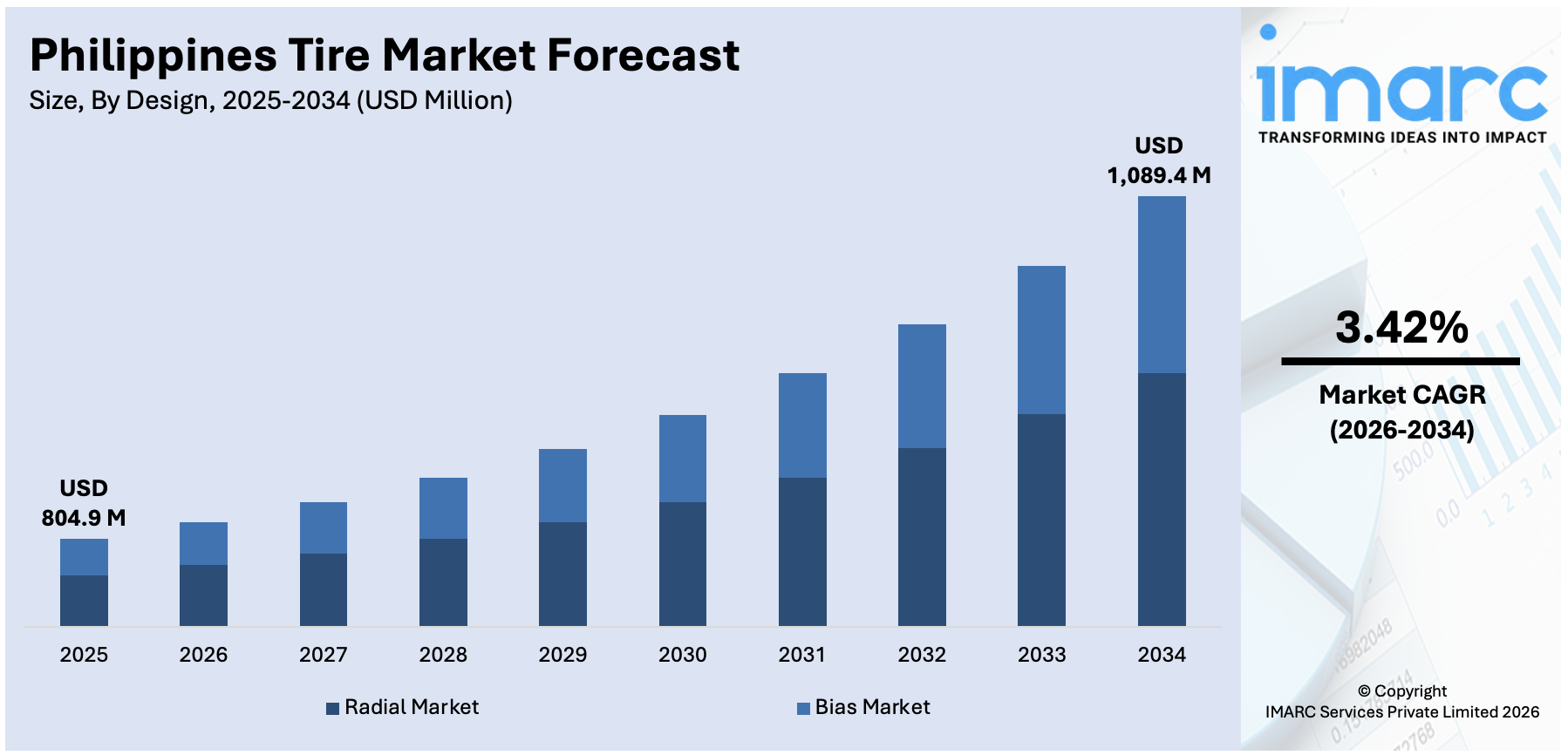
The Philippines tire market size reached USD 804.9 Million in 2025. Looking forward, the market is expected to reach USD 1,089.4 Million by 2034, exhibiting a growth rate (CAGR) of 3.42% during 2026-2034. Robust economic development and urbanization, government infrastructure initiatives, rising road safety awareness and tire maintenance practices, the proliferation of innovative tire technologies and e-commerce platforms, shifts towards electric vehicles (EVs), and the popularity of ride-sharing services and motorsports are bolstering the market growth.
|
Report Attribute
|
Key Statistics
|
|---|---|
|
Base Year
|
2025 |
|
Forecast Years
|
2026-2034
|
|
Historical Years
|
2020-2025
|
| Market Size in 2025 | USD 804.9 Million |
| Market Forecast in 2034 | USD 1,089.4 Million |
| Market Growth Rate (2026-2034) | 3.42% |
Key Trends of Philippines Tire Market:
Economic Development and Urbanization
The tire market in the Philippines grows primarily on account of the robust economic development of the country, stimulated by the rapid urbanization. With the growing economy, people are becoming economically affluent which enables them to buy more vehicles in every segment. The process of urbanization with population moving to cities and sustaining the high requirement for transportation services that include private cars, public buses and two-wheeler driving the tires market in the region. According to the industry reports, the urban population's share has been increasing year after year in the Philippines. The urban population comprised of about 48% of the total population in 2022. In addition, cities usually have good road infrastructure and links, which lead to heavy vehicle usage, increased replacement requirements, and shorter tire life.
To get more information on this market Request Sample
Infrastructure Development Initiatives
The government of the Philippines, with its emphasis on infrastructure development, is expected to act as a major driver for the Philippines tire market share in near future. The developments of infrastructure projects in road construction, expansion, and maintenance are expected to support an increase in regional connectivity. Greater traffic flow due to the extension of the road network and better quality of roads has left room for an increase in vehicle traffic and thus higher demand for tires. In addition, infrastructure projects often include the renewing of public transport fleet, which requires tire replacements and enhancements to comply with safety, and sustainability regulation. Consequently, the tire market is expected to fare well owing to this renewed appetite for infrastructure projects, thereby sustaining demand today and in the future from infrastructure development projects.
Road Safety Awareness and Tire Maintenance
Rising awareness about road safety and the importance of tire maintenance among consumers significantly impact the Philippines tire market growth. As road traffic increases, so does the emphasis on safety measures, including proper tire care and maintenance. Consumers are becoming more conscious of the role tires play in vehicle performance and safety, leading to a greater willingness to invest in high-quality tires and adhere to recommended maintenance schedules. Additionally, the implementation of government campaigns and initiatives promoting road safety further reinforce this awareness, encouraging regular tire inspections, proper inflation, and timely replacements, is acting as another growth-inducing factor. Consequently, the growing emphasis on road safety and tire maintenance drives demand for tires in the replacement and aftermarket segments, fostering market growth and encouraging manufacturers to develop innovative products tailored to consumer needs.
Growth Drivers of Philippines Tire Market:
Vehicle Ownership Expansion and Two-Wheeler Supremacy
One of the key drivers for the Philippines tire industry is fast growth in vehicle ownership, particularly the expansion of two-wheelers and light vehicles. Motorcycles, scooters, tricycles, and small passenger vehicles are strongly rooted in day-to-day transportation in urban and rural Philippines as primary means of commuting, delivery, and mobility between islands. As more families purchase motorcycles or second cars, demand for replacement tires, repair, and maintenance increases. Consumers are also more safety-, performance-, and ride-comfort-conscious, so they seek tires that provide greater grip, durability, and life. Furthermore, when newer car models enter the home market, OEM tire requirements become apparent. Rising disposable incomes enable people to use private transport instead of just public or shared transport, which multiplies the number of wear and replacement cycles. As several roads outside big metro areas are in mixed condition, tires that are appropriate for mixed use with stronger sidewalls, tread patterns suitable for country roads or the occasional flood, and bias or radial versions that can take rough use, are needed. This solid foundation in two-wheelers coupled with increased car ownership is the cornerstone of tire market growth.
Increased E-Commerce, Logistics, and Delivery Services
Fast development of e-commerce and last-mile delivery services throughout the Philippines is driving demand for an extensive variety of tires, particularly for commercial vehicles and light delivery trucks. As going online gains mainstream popularity, fleets of logistics nationwide and locally are growing and expanding, calling for durable, long-life tires to sustain operations. The expansion of motorcycle-based courier services, especially in metropolitan areas such as Metro Manila, Davao, and Cebu, has strongly increased demand for two-wheeler tires designed to handle stop-and-go traffic, heat endurance, and long road hours. Even small businesses, like provincial courier startups and food delivery services, have vehicles that require frequent tire replacement because they are driven frequently. Furthermore, most delivery operations cover different kinds of terrain, from urban roads to rural and island terrain, meaning that there is greater demand for versatile and long-lasting tire alternatives. The expansion in delivery services, brought about by digital retailing and mobile applications, sets up a Philippines tire market demand cycle within the replacement tire sector.
Increase Consumer Awareness, Technology and Replacement Demand
Growth in consumer awareness about tire quality, safety, efficiency, and performance drives demand for higher-spec, feature-packed replacement tires. Filipino motorists increasingly look for tires that are more fuel efficient (lower rolling resistance), have improved wet grip for monsoon rains, lower noise, and longer tread life. In addition, with further visibility in media, auto shows, dealerships, and social media, consumers are weighing choices and being willing to pay extra for premium or high-branded tires. Advances in technology from manufacturers, like radial tires becoming better than bias belts, improved rubber compounds, enhanced tread designs, and premium imported brands gaining traction, are meeting these expectations. Also, since most cars are old or second-hand, replacement demand constitutes a large part of the market; individuals replace or restore tires as maintenance instead of purchasing new cars. As per the Philippines tire market analysis, online tire selling accessibility and widespread availability of service points even in outer towns enable consumers to select from more brands and models, again raising aspirations and propelling market growth.
Philippines Tire Market Segmentation:
IMARC Group provides an analysis of the key trends in each segment of the market, along with forecasts at the country level for 2026-2034. Our report has categorized the market based on design, end use, vehicle type, distribution channel, and season.
Design Insights:
- Radial Market
- Bias Market
The report has provided a detailed breakup and analysis of the market based on the design. This includes radial market and bias market.
End Use Insights:
Access the comprehensive market breakdown Request Sample
- OEM Market
- Replacement Market
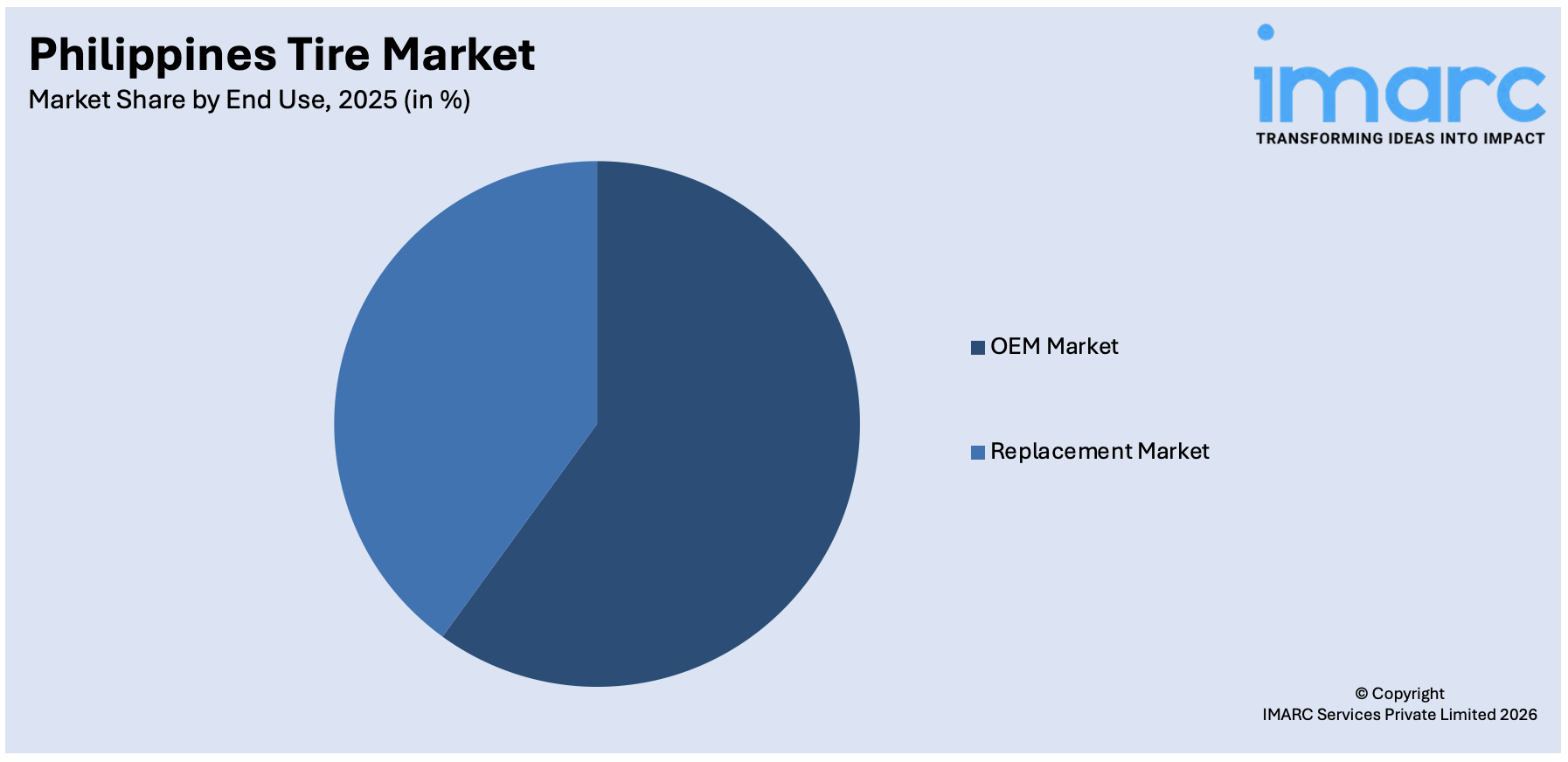
A detailed breakup and analysis of the market based on the end use have also been provided in the report. This includes OEM market and replacement market.
Vehicle Type Insights:
- Passenger Cars
- Light Commercial Vehicles
- Medium and Heavy Commercial Vehicles
- Two Wheelers
- Three Wheelers
- Off-The-Road (OTR)
The report has provided a detailed breakup and analysis of the market based on the vehicle type. This includes passenger cars, light commercial vehicles, medium and heavy commercial vehicles, two wheelers, three wheelers, and off-the-road (OTR).
Distribution Channel Insights:
- Offline
- Online
A detailed breakup and analysis of the market based on the distribution channel have also been provided in the report. This includes offline and online.
Season Insights:
- All Season Tires
- Winter Tires
- Summer Tires
The report has provided a detailed breakup and analysis of the market based on the season. This includes season tires, winter tires, and summer tires.
Regional Insights:
- Luzon
- Visayas
- Mindanao
The report has also provided a comprehensive analysis of all the major regional markets, which include Luzon, Visayas, and Mindanao.
Competitive Landscape:
The market research report has also provided a comprehensive analysis of the competitive landscape. Competitive analysis such as market structure, key player positioning, top winning strategies, competitive dashboard, and company evaluation quadrant has been covered in the report. Also, detailed profiles of all major companies have been provided.

Philippines Tire Market News:
- In 2024, Goodyear Tire & Rubber Co. introduced a specialized tire, the Urban Max BSAEV (Bus Service All-Position), designed specifically for use in electric buses and transit fleets. This tire was developed in collaboration with GILLIG, a leading manufacturer of heavy-duty buses in the United States.
Philippines Tire Market Report Coverage:
| Report Features | Details |
|---|---|
| Base Year of the Analysis | 2025 |
| Historical Period | 2020-2025 |
| Forecast Period | 2026-2034 |
| Units | Million USD |
| Scope of the Report | Exploration of Historical and Forecast Trends, Industry Catalysts and Challenges, Segment-Wise Historical and Predictive Market Assessment:
|
| Designs Covered | Radial Market, Bias Market |
| End Uses Covered | OEM Market, Replacement Market |
| Vehicle Types Covered | Passenger Cars, Light Commercial Vehicles, Medium and Heavy Commercial Vehicles, Two Wheelers, Three Wheelers, Off-The-Road (OTR) |
| Distribution Channels Covered | Offline, Online |
| Seasons Covered | All Season Tires, Winter Tires, Summer Tires |
| Regions Covered | Luzon, Visayas, Mindanao |
| Customization Scope | 10% Free Customization |
| Post-Sale Analyst Support | 10-12 Weeks |
| Delivery Format | PDF and Excel through Email (We can also provide the editable version of the report in PPT/Word format on special request) |
Key Benefits for Stakeholders:
- IMARC’s industry report offers a comprehensive quantitative analysis of various market segments, historical and current market trends, market forecasts, and dynamics of the Philippines tire market from 2020-2034.
- The research report provides the latest information on the market drivers, challenges, and opportunities in the Philippines tire market.
- Porter's five forces analysis assist stakeholders in assessing the impact of new entrants, competitive rivalry, supplier power, buyer power, and the threat of substitution. It helps stakeholders to analyze the level of competition within the Philippines tire industry and its attractiveness.
- Competitive landscape allows stakeholders to understand their competitive environment and provides an insight into the current positions of key players in the market.
Frequently Asked Questions About the Philippines Tire Market Report
The Philippines tire market was valued at USD 804.9 Million in 2025.
The Philippines tire market is projected to exhibit a CAGR of 3.42% during 2026-2034
The Philippines tire market is expected to reach a value of USD 1,089.4 Million by 2034.
Trends in the Philippines tire market include rising demand for durable, all-terrain tires, increased adoption of radial and tubeless options, and growing preference for fuel-efficient and low-noise designs. Online tire sales, mobile fitting services, and a shift toward premium and branded products also reflect evolving consumer behavior and expectations.
The Philippines tire market is driven by rising vehicle ownership, especially motorcycles, expanding e-commerce and delivery services, and increased demand for tire replacements. Urbanization, diverse terrain, and growing consumer awareness about safety and performance also contribute, alongside wider access to branded tires and service centers across provinces and cities.
Need more help?
- Speak to our experienced analysts for insights on the current market scenarios.
- Include additional segments and countries to customize the report as per your requirement.
- Gain an unparalleled competitive advantage in your domain by understanding how to utilize the report and positively impacting your operations and revenue.
- For further assistance, please connect with our analysts.
 Request Customization
 Speak to an Analyst
 Request Brochure
 Inquire Before Buying
Benefits of Customization
- Personalize this research
- Triangulate with your data
- Get data as per your format and definition
- Gain a deeper dive into a specific application, geography, customer, or competitor
- Any level of personalization
Get in Touch With Us
UNITED STATES
Phone: +1-201-971-6302
INDIA
Phone: +91-120-433-0800
UNITED KINGDOM
Phone: +44-753-714-6104
Email: [email protected]
Client Testimonials




.webp)




.webp)













Related Reports

Choose your plan
*Please note that the prices mentioned below are starting prices for each bundle type. Kindly contact our team for further details.*
Single User License
- 1 User License, Access on 2 Devices
- PDF Report + Excel Dataset (Password Protected)
- Lifetime Access
- No Printing Rights
- 10% Free Report Customization
- 10–12 Weeks of Analyst Support
Five User License
- Access for 5 Users, 2 Devices per User
- PDF Report + Excel Dataset (Password Protected)
- Lifetime Access
- Dedicated Account Manager
- 12–14 Weeks of Analyst Support
- No Printing Rights
- 15% Free Report Customization
- 25% Discount on Your Next Purchase
Corporate User License
- Unlimited User Access (Within Your Organization)
- PDF Report + Excel Dataset
- Lifetime Access
- Dedicated Account Manager
- 14–20 Weeks of Analyst Support
- No Printing Rights
- 20% Free Report Customization
- 30% Discount on Your Next Purchase
Essential Insights
What's included:
3 reports
- Lifetime Access
- PDF Reports
- Excel Datasets
- 2 Weeks of Free Analyst Support
- 2 User Licenses
- Access on 2 Devices
- Printing Rights
- Complimentary PowerPoint (PPT) Version
- Complimentary License Upgrade
Professional Access
What's included:
5 reports
- Lifetime Access
- PDF Reports
- Excel Datasets
- 8 Weeks of Free Analyst Support
- 2 User Licenses
- Access on 2 Devices
- Printing Rights
- Complimentary PowerPoint (PPT) Version
- Complimentary License Upgrade
Business Advantage
What's included:
8 reports
- Lifetime Access
- PDF Reports
- Excel Datasets
- 14 Weeks of Free Analyst Support
- 2 User Licenses
- Access on 2 Devices
- Printing Rights
- Complimentary PowerPoint (PPT) Version
- Complimentary License Upgrade
Enterprise Intelligence
What's included:
10 reports
- Lifetime Access
- PDF Reports
- Excel Datasets
- 20 Weeks of Free Analyst Support
- 2 User Licenses
- Access on 2 Devices
- Printing Rights
- Complimentary PowerPoint (PPT) Version
- Complimentary License Upgrade