
Philippines Travel Bags Market Size, Share, Trends and Forecast by Material Type, Luggage Type, Price Range, Demography, Distribution Channel, and Region, 2026-2034
Philippines Travel Bags Market Summary:
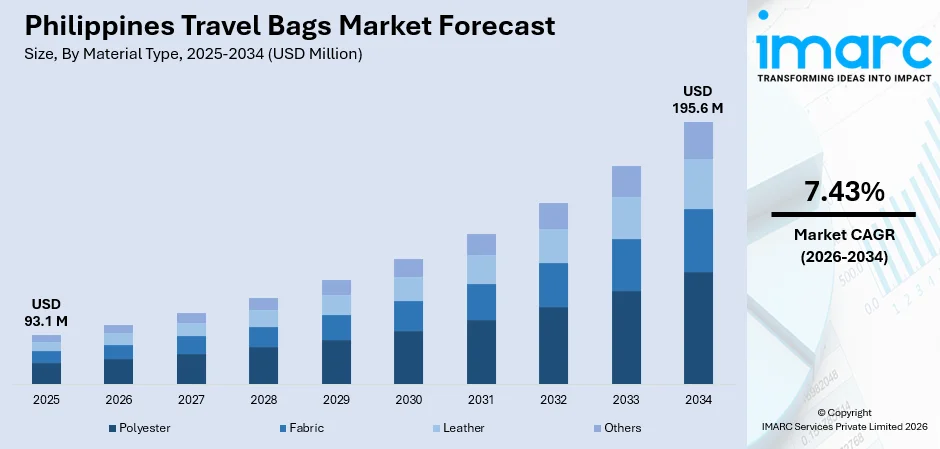
The Philippines travel bags market size was valued at USD 93.1 Million in 2025 and is projected to reach USD 195.6 Million by 2034, growing at a compound annual growth rate of 7.43% from 2026-2034.
The Philippines travel bags market is expanding steadily, as tourism activity, rising consumer mobility, and lifestyle spending continue to grow across the country. Increasing domestic and international travel participation is encouraging consumers to invest in durable and functional luggage products suited for both leisure and professional travel. The growing presence of organized retail channels, lifestyle stores, and e-commerce platforms is also improving accessibility to diverse luggage designs and brands.
Key Takeaways and Insights:
- By Material Type: Polyester dominates the market with a share of 32.5% in 2025, owing to its lightweight structure, durability, and cost-effective manufacturing that enables brands to offer versatile travel bag designs suited for diverse consumer needs.
- By Luggage Type: Trolley leads the market with a share of 42.8% in 2025, driven by strong consumer preference for wheeled luggage solutions that provide convenient mobility and improved travel comfort during long-distance journeys.
- By Price Range: Medium price comprises the largest segment with a market share of 43.5% in 2025, reflecting growing demand for travel bags that offer a balance between affordability, durability, and product quality.
- By Demography: Female prevails the market with a share of 52.5% in 2025, supported by strong purchasing influence in lifestyle accessories and increasing participation in both leisure and professional travel activities.
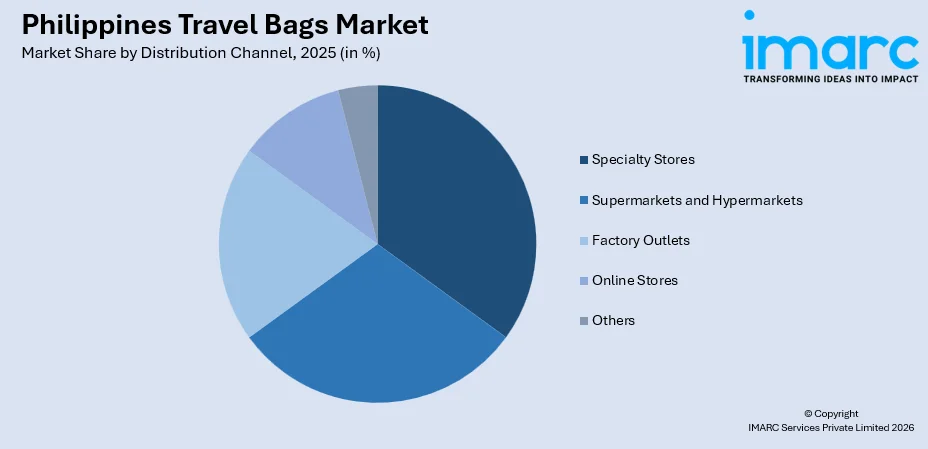
- By Distribution Channel: Specialty stores exhibit a clear dominance with a market share of 28.5% in 2025, as consumers prefer specialized retail outlets offering extensive luggage selections and expert product guidance. These stores also allow customers to physically evaluate product quality, durability, and design before making purchasing decisions.
- By Region: Luzon represents the largest region with 61.5% share in 2025, supported by dense urban populations, major commercial centers, and strong domestic and international travel activity.
- Key Players: Key players drive the Philippines travel bags market by expanding product portfolios, introducing lightweight and durable luggage materials, and strengthening distribution networks to meet evolving consumer travel needs. They are also focusing on innovative designs and improved functionality to enhance product appeal among modern travelers.
To get more information on this market Request Sample
The Philippines travel bags market continues to experience steady expansion, supported by evolving consumer travel behavior and rising lifestyle spending. Increasing domestic tourism, improved airline connectivity, and expanding middle-income households are encouraging consumers to purchase functional travel accessories. In 2024, domestic tourism spending increased to 3.2 Trillion Philippine pesos, representing three-quarters of overall tourism expenditure. Retail modernization and the expansion of shopping malls across major cities are also strengthening offline sales channels. Meanwhile, digital commerce platforms are enhancing accessibility to a wider variety of luggage brands and designs across the country. In addition, consumers are showing greater interest in organized and lightweight luggage solutions that improve travel convenience. Manufacturers are introducing travel bags, featuring enhanced durability, lightweight frames, and smart compartment designs, to meet these changing expectations.
Philippines Travel Bags Market Trends:
Rising Demand for Lightweight and Durable Luggage Materials
One of the key trends in the Philippines travel bags market is the growing consumer preference for lightweight yet durable luggage materials. People increasingly seek products that reduce carrying effort while providing long-term reliability during frequent use. Materials, such as polyester, polycarbonate, and reinforced synthetic fabrics, are gaining popularity because they offer strong resistance to wear, moisture, and rough handling. Manufacturers are responding by developing advanced fabric technologies and improved stitching techniques that enhance product durability.
Expansion of Organized Retail and Specialty Luggage Stores
The rapid expansion of organized retail infrastructure is significantly influencing purchasing patterns in the Philippines travel bags market. Shopping malls, specialty luggage stores, and lifestyle retail outlets are increasingly offering a wide variety of travel bag brands, styles, and materials. Consumers often prefer visiting specialized retail stores where they can physically examine product quality, test durability, and compare multiple luggage designs before making a purchase. Retailers are also enhancing the in-store shopping experience through curated product displays and expert assistance. This environment helps customers better understand product features and encourages more informed purchasing decisions across different travel bag categories.
Increasing Domestic and International Travel
Rising tourism and business travel in the Philippines are driving significant demand for travel bags across all segments. By December 2025, the Philippines reported over 5.2 Million arrivals, with more than 4.7 Million being international tourists, while the rest were categorized as overseas Filipinos. Travelers seek reliable, lightweight, and versatile luggage suitable for short trips, long vacations, and corporate travel. This trend is amplified by increased air travel accessibility and expanding tourism campaigns promoting both domestic and international destinations. Manufacturers are responding by offering ergonomic designs, expandable compartments, and stylish yet functional bags that cater to the diverse needs of frequent travelers and vacationers.
Market Outlook 2026-2034:
The Philippines travel bags market is expected to maintain steady growth throughout the forecast period, as tourism participation, urban mobility, and consumer lifestyle spending continue to increase. Surging international travel activities and the sustained expansion of domestic tourism are expected to create consistent demand for functional luggage solutions. Consumers are increasingly prioritizing durable materials, lightweight structures, and organized compartment designs that improve travel convenience. The market generated a revenue of USD 93.1 Million in 2025 and is projected to reach a revenue of USD 195.6 Million by 2034, growing at a compound annual growth rate of 7.43% from 2026-2034. Continued product innovation and evolving consumer travel habits are expected to sustain long-term market expansion.
Philippines Travel Bags Market Report Segmentation:
| Segment Category | Leading Segment | Market Share |
|---|---|---|
|
Material Type |
Polyester |
32.5% |
|
Luggage Type |
Trolley |
42.8% |
|
Price Range |
Medium Price |
43.5% |
|
Demography |
Female |
52.5% |
|
Distribution Channel |
Specialty Stores |
28.5% |
|
Region |
Luzon |
61.5% |
Material Type Insights:
- Polyester
- Fabric
- Leather
- Others
Polyester dominates with a market share of 32.5% of the total Philippines travel bags market in 2025.
Polyester remains widely preferred, due to its balance between affordability, durability, and lightweight characteristics. In order to promote long-term usability, manufacturers are increasingly utilizing sophisticated polyester materials that improve resistance to wear, moisture, and tearing. For travelers who need luggage that can resist frequent handling during flights and interstate travel, these benefits are especially crucial. Because polyester is so affordable, companies can create a variety of travel bag designs that cater to varying preferences of users.
Due to their practicality for both short and long excursions, polyester-based travel bags are becoming more popular, as the nation's tourism industry is growing. Customers are increasingly choosing bag materials that combine durability and mobility as travel activity increases. Additionally, polyester bags facilitate product design versatility by enabling producers to include ergonomic features, reinforced stitching, and additional sections. Their adaptability increases their popularity among frequent and infrequent travelers looking for dependable luggage for both local and foreign travel.
Luggage Type Insights:
- Duffel
- Trolley
- Backpacks
Trolley leads with a share of 42.8% of the total Philippines travel bags market in 2025.
Trolley is highly favored among Filipino travelers because it offers superior mobility and ease of transportation. Trolley travel bags are perfect for long-distance travel, train stations, and airports because of the combined wheel and handle system, which lessens the physical effort needed to carry bags. Consumer desire for wheeled luggage solutions is being reinforced by rising domestic travel and air passenger traffic. Because of this, trolley bags are becoming a common and useful travel gear for both business and pleasure travelers.
The increasing emphasis on well-organized packing and effective storage is another element contributing to the popularity of trolleys. To make traveling easier, these bags frequently have several compartments, strong structural designs, and safe locking mechanisms. The demand for small trolley bags that strike a compromise between capacity and portability has increased, due to the surge in weekend travel and brief business excursions. Manufacturers are being encouraged by this trend to develop lightweight trolley designs that improve mobility without sacrificing durability.
Price Range Insights:
- Premium Price
- Medium Price
- Low Price
Medium price exhibits a clear dominance with a 43.5% share of the total Philippines travel bags market in 2025.
Medium price dominates the market, as it strikes a balance between affordability and product quality. Consumers increasingly prefer luggage that offers durability, modern designs, and functional features without reaching premium price levels. This segment benefits from the purchasing behavior of middle-income households that prioritize value while still seeking reliable travel products. As tourism participation continues to expand, medium-priced luggage options are becoming the preferred choice for frequent domestic travelers.
Another important factor strengthening the medium price segment is the broad product variety offered by brands within this category. Manufacturers are introducing designs that incorporate reinforced materials, ergonomic handles, and stylish aesthetics while maintaining competitive pricing. This allows consumers to access well-designed luggage that supports convenience and durability without significantly increasing travel expenses. Consequently, the segment continues to attract strong demand from both occasional travelers and individuals who travel regularly for work.
By Demography Insights:
- Male
- Female
Female represents the leading segment with a 52.5% share of the total Philippines travel bags market in 2025.
Female prevails the market, due to her strong influence on lifestyle and fashion-related product choices. To appeal to female travelers, many travel bag designs include aesthetics, a range of colors, and functional elements. Additionally, this demographic group regularly buys travel bags for leisure and family vacations. Women's effect on luggage shopping decisions keeps growing as they continue to actively engage in both business and leisure travel. Their growing purchasing power and increasing travel frequency further reinforce their importance in shaping product trends in the market.
Additionally, companies are increasingly focusing on female consumers by launching travel bags that blend functionality with stylish designs. Female customers who appreciate both functionality and style are especially drawn to lightweight structures, well-organized compartments, and eye-catching patterns. Manufacturers are being encouraged by these design preferences to create a variety of product lines that are especially suited to the travel demands of women, which is strengthening their market dominance.
By Distribution Channel Insights:
Access the comprehensive market breakdown Request Sample
- Supermarkets and Hypermarkets
- Specialty Stores
- Factory Outlets
- Online Stores
- Others
Specialty stores comprise the leading segment with a 28.5% share of the total Philippines travel bags market in 2025.
Specialty stores remain the most prominent distribution channel for travel bags since they offer a large selection of luggage products along with a targeted purchasing experience. Before making a purchase, customers can physically examine materials, verify durability, and assess product characteristics at these establishments. When choosing travel bags for extended usage, brand-specific displays and individualized advice further boost consumer confidence. Increased customer satisfaction and repeat business are frequently the results of this practical experience.
Another advantage of specialty stores is their ability to showcase multiple luggage brands and design variations in one location. This encourages comparison shopping and allows consumers to identify products that best match their travel needs. Retailers also frequently provide promotional campaigns and in-store demonstrations that highlight product durability and functionality, helping customers make informed purchasing decisions. Additionally, these stores help build brand loyalty by creating memorable and engaging shopping experiences.
By Region Insights:
- Luzon
- Visayas
- Mindanao
Luzon prevails the market with a 61.5% share of the total Philippines travel bags market in 2025.
Luzon represents the largest regional market due to its dense urban population, strong economic activity, and the presence of major tourism and transportation hubs. Metro Manila and surrounding urban centers serve as the primary gateways for international and domestic travel in the Philippines. These areas host numerous shopping malls, specialty luggage stores, and travel retailers that significantly enhance product availability and consumer accessibility across the region. The concentration of affluent and frequent travelers also drives higher demand for premium and branded travel bags.
The region also benefits from a high concentration of airports, business districts, and tourism destinations that encourage frequent travel. The New Manila International Airport, referred to as Bulacan International Airport, is set to begin operations in 2028. Consumers in Luzon tend to purchase travel bags more regularly compared to other regions. Growing disposable incomes, improved retail infrastructure, and the expansion of e-commerce logistics further support the region’s strong demand for travel luggage.
Market Dynamics:
Growth Drivers:
Why is the Philippines Travel Bags Market Growing?
Rising Domestic and International Travel Activity
The consistent rise in both domestic and international travel throughout the Philippines is one of the main factors propelling the market for travel bags. Due to increased consumer interest in leisure travel, more airline connectivity, and government initiatives to encourage tourism, the Philippines is seeing a robust tourism resurgence. The demand for dependable travel luggage is growing as more people take part in short-distance weekend travel, family vacations, and business excursions. Travel bags are becoming necessary equipment for keeping clothes, electronics, and other items organized while traveling. Additionally, a larger portion of the population is being encouraged to travel more regularly due to the rising popularity of low-cost airlines and reasonably priced travel packages. Younger travelers and working professionals are increasingly exploring new destinations within the country, which further contributes to luggage demand.
Increasing Disposable Incomes and Lifestyle Spending
A major factor contributing to the growth of the Philippines travel bags market is the steady increase in disposable incomes and lifestyle-oriented consumer spending. Economic development and urbanization have improved purchasing power among middle-income households, enabling consumers to allocate more resources towards lifestyle products and travel accessories. Travel bags are increasingly viewed not only as functional products but also as fashion and lifestyle items that reflect personal style and convenience. Consumers are becoming more willing to purchase luggage that combines durability with modern design, organized compartments, and lightweight construction. In urban centers especially, shopping malls and lifestyle stores have expanded their range of travel accessories, allowing consumers to choose from a wide variety of brands and product styles. The growing influence of social media and travel-related content has also encouraged people to explore new destinations, which indirectly stimulates demand for luggage products. In January 2025, the Philippines had 90.8 Million social media user profiles, representing 78.0% of the entire population.
Expansion Of E-Commerce and Organized Retail Channels
The expansion of organized retail infrastructure and e-commerce platforms is another important driver supporting the Philippines travel bags market. As per IMARC Group, the Philippines e-commerce market size reached USD 28.0 Billion in 2025. Retail modernization has significantly improved the availability and visibility of luggage products across the country. Shopping malls, specialty luggage stores, and department stores offer extensive product displays that allow consumers to evaluate different bag sizes, materials, and designs. At the same time, e-commerce platforms are transforming the way consumers purchase travel bags by providing convenient access to numerous brands and product categories. Online marketplaces allow consumers to compare prices, read product reviews, and explore innovative luggage features before making purchasing decisions. The growth of digital payment systems and improved logistics networks has also enhanced consumer confidence in online shopping. For travelers living outside major urban centers, e-commerce platforms provide access to a wide range of travel bags that may not be readily available in local retail stores.
Market Restraints:
What Challenges the Philippines Travel Bags Market is Facing?
High Price Sensitivity Among Consumers
A significant challenge in the Philippines travel bags market is the high level of price sensitivity among consumers. Many buyers prioritize affordability when selecting travel accessories, which can limit demand for premium luggage products. This price-driven purchasing behavior encourages intense competition among manufacturers and retailers to offer lower-priced alternatives. As a result, brands often face pressure to maintain competitive pricing while still ensuring product durability and quality.
Availability of Low-Cost Counterfeit Products
Another restraint affecting market growth is the widespread availability of counterfeit or low-quality travel bags in informal retail markets. These products are often sold at significantly lower prices, attracting budget-conscious consumers despite limited durability. Counterfeit items reduce revenue potential for legitimate brands and create challenges related to product differentiation and consumer trust. The presence of such alternatives can discourage consumers from investing in higher-quality luggage products.
Fluctuations in Raw Material Costs
Variations in the cost of materials, such as polyester, nylon, and metal components, can affect manufacturing expenses for travel bag producers. When raw material prices increase, companies may face difficulties maintaining competitive pricing while preserving product margins. This challenge can influence production strategies, product pricing, and supply chain planning across the market.
Competitive Landscape:
The competitive landscape of the Philippines travel bags market is characterized by the presence of both international luggage brands and regional manufacturers competing across multiple price segments. Companies focus on expanding product portfolios with lightweight materials, durable construction, and modern designs that cater to evolving consumer preferences. Many brands emphasize innovation in trolley systems, ergonomic handles, and organized compartment structures to enhance travel convenience. Retail expansion through specialty stores, department stores, and online platforms has become a key strategy to strengthen market visibility and accessibility. In addition, manufacturers are increasingly investing in brand promotion, seasonal product launches, and collaborations with retail partners to attract consumers. The growing influence of e-commerce has also intensified competition, as brands leverage digital channels to reach a wider consumer base and offer diverse travel bag collections suited for leisure and business travelers.
Philippines Travel Bags Market Report Coverage:
| Report Features | Details |
|---|---|
| Base Year of the Analysis | 2025 |
| Historical Period | 2020-2025 |
| Forecast Period | 2026-2034 |
| Units | Million USD |
| Scope of the Report |
Exploration of Historical Trends and Market Outlook, Industry Catalysts and Challenges, Segment-Wise Historical and Future Market Assessment:
|
| Material Types Covered | Polyester, Fabric, Leather, Others |
| Luggage Types Covered | Duffle, Trolley, Backpacks |
| Price Ranges Covered | Premium Price, Medium Price, Low Price |
| Demographics Covered | Male, Female |
| Distribution Channels Covered | Supermarkets and Hypermarkets, Specialty Stores, Factory Outlets, Online Stores, Others |
| Regions Covered | Luzon, Visayas, Mindanao |
| Customization Scope | 10% Free Customization |
| Post-Sale Analyst Support | 10-12 Weeks |
| Delivery Format | PDF and Excel through Email (We can also provide the editable version of the report in PPT/Word format on special request) |
Frequently Asked Questions About the Philippines Travel Bags Market Report
The Philippines travel bags market size was valued at USD 93.1 Million in 2025.
The Philippines travel bags market is expected to grow at a compound annual growth rate of 7.43% from 2026-2034 to reach USD 195.6 Million by 2034.
Polyester dominated the market with a share of 32.5%, owing to its lightweight structure, durability, cost-effectiveness, and resistance to moisture and wear, which make it suitable for frequent travel and everyday luggage use.
Key factors driving the Philippines travel bags market include rising domestic and international travel activity, increasing disposable incomes, expanding tourism infrastructure, and the growing availability of travel bags through organized retail and e-commerce platforms.
Major challenges include intense price competition among manufacturers, the presence of low-cost unorganized products, fluctuating raw material costs, and limited product differentiation in lower price segments.
Need more help?
- Speak to our experienced analysts for insights on the current market scenarios.
- Include additional segments and countries to customize the report as per your requirement.
- Gain an unparalleled competitive advantage in your domain by understanding how to utilize the report and positively impacting your operations and revenue.
- For further assistance, please connect with our analysts.
 Request Customization
 Speak to an Analyst
 Request Brochure
 Inquire Before Buying
Benefits of Customization
- Personalize this research
- Triangulate with your data
- Get data as per your format and definition
- Gain a deeper dive into a specific application, geography, customer, or competitor
- Any level of personalization
Get in Touch With Us
UNITED STATES
Phone: +1-201-971-6302
INDIA
Phone: +91-120-433-0800
UNITED KINGDOM
Phone: +44-753-714-6104
Email: [email protected]
Client Testimonials




.webp)




.webp)













Related Reports

Choose your plan
*Please note that the prices mentioned below are starting prices for each bundle type. Kindly contact our team for further details.*
Single User License
- 1 User License, Access on 2 Devices
- PDF Report + Excel Dataset (Password Protected)
- Lifetime Access
- No Printing Rights
- 10% Free Report Customization
- 10–12 Weeks of Analyst Support
Five User License
- Access for 5 Users, 2 Devices per User
- PDF Report + Excel Dataset (Password Protected)
- Lifetime Access
- Dedicated Account Manager
- 12–14 Weeks of Analyst Support
- No Printing Rights
- 15% Free Report Customization
- 25% Discount on Your Next Purchase
Corporate User License
- Unlimited User Access (Within Your Organization)
- PDF Report + Excel Dataset
- Lifetime Access
- Dedicated Account Manager
- 14–20 Weeks of Analyst Support
- No Printing Rights
- 20% Free Report Customization
- 30% Discount on Your Next Purchase
Essential Insights
What's included:
3 reports
- Lifetime Access
- PDF Reports
- Excel Datasets
- 2 Weeks of Free Analyst Support
- 2 User Licenses
- Access on 2 Devices
- Printing Rights
- Complimentary PowerPoint (PPT) Version
- Complimentary License Upgrade
Professional Access
What's included:
5 reports
- Lifetime Access
- PDF Reports
- Excel Datasets
- 8 Weeks of Free Analyst Support
- 2 User Licenses
- Access on 2 Devices
- Printing Rights
- Complimentary PowerPoint (PPT) Version
- Complimentary License Upgrade
Business Advantage
What's included:
8 reports
- Lifetime Access
- PDF Reports
- Excel Datasets
- 14 Weeks of Free Analyst Support
- 2 User Licenses
- Access on 2 Devices
- Printing Rights
- Complimentary PowerPoint (PPT) Version
- Complimentary License Upgrade
Enterprise Intelligence
What's included:
10 reports
- Lifetime Access
- PDF Reports
- Excel Datasets
- 20 Weeks of Free Analyst Support
- 2 User Licenses
- Access on 2 Devices
- Printing Rights
- Complimentary PowerPoint (PPT) Version
- Complimentary License Upgrade