
Portugal Aquaculture Market Size, Share, Trends and Forecast by Fish Type, Environment, Distribution Channel, and Region, 2026-2034
Portugal Aquaculture Market Summary:
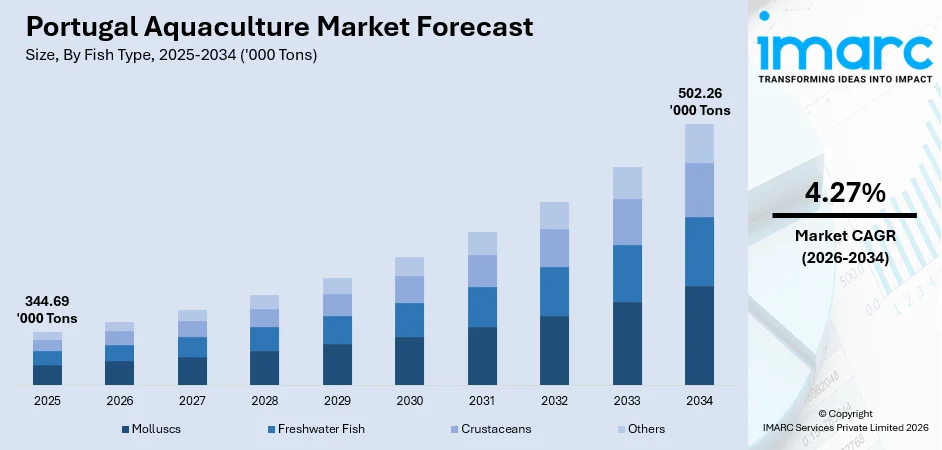
The Portugal aquaculture market size reached 344.69 Thousand Tons in 2025 and is projected to reach 502.26 Thousand Tons by 2034, growing at a compound annual growth rate of 4.27% from 2026-2034.
The aquaculture market in Portugal is seeing consistent growth fueled by the country's remarkably high seafood intake, strategic government actions aimed at enhancing local production, and increased demand for sustainably cultivated marine goods. Improvements in offshore aquaculture technologies, rising funding in recirculating aquaculture systems, and the growing shellfish farming along the Atlantic coastline are bolstering the industry's competitive standing. Consumer demand for traceable and certified seafood, along with European Union backing for blue economy advancement, is fostering a beneficial climate for market growth.
Key Takeaways and Insights:
- By Fish Type: Molluscs dominate the market with a share of 53.2% in 2025, driven by Portugal's deeply rooted shellfish farming tradition centered on clam cultivation in coastal lagoons and estuarine systems.
- By Environment: Marine water represents the largest segment with a market share of 63.2% in 2025, reflecting the country's extensive Atlantic coastline and favorable conditions for aquaculture production.
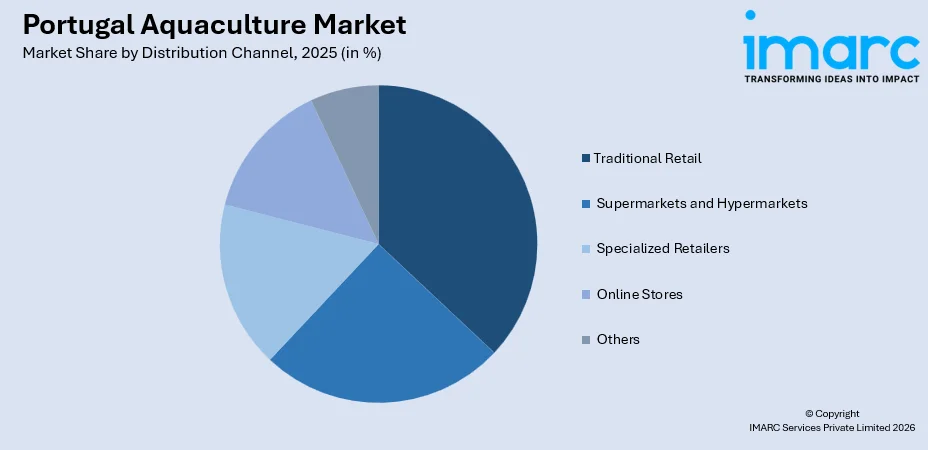
- By Distribution Channel: Traditional retail leads the market with a share of 35.7% in 2025, supported by Portugal's vibrant municipal fish markets and deep cultural tradition of purchasing fresh seafood directly from local vendors.
- Key Players: The Portugal aquaculture market exhibits a fragmented competitive landscape, with numerous small-scale shellfish producers operating alongside emerging technology-driven enterprises investing in sustainable offshore farming and recirculating aquaculture systems.
To get more information on this market Request Sample
The aquaculture market in Portugal is propelled by the growing seafood demand, sustainability goals, technological advancements, and heightened capital investment facilitating production expansion. The increasing focus on resource efficiency and environmental effectiveness is speeding up the use of controlled farming methods, especially recirculating aquaculture systems (RAS), that lower water usage and improve biosecurity. Investor trust in sustainable aquaculture systems is boosting growth potential, evident in 2025 when SEAentia obtained €16 million to enhance its Corvina production via RAS technology, aiming for 700 tons of yearly output supported by Indico Capital Partners' Blue Fund and the Mar2030 Program. Moreover, funding programs backed by the government, clearer regulations, and alignment with European blue economy goals are further strengthening sector growth. Besides this, improvements in hatchery management, processing for added value, and production aimed at export are boosting competitiveness. Collectively, these structural, financial, and technological elements are fostering consistent growth and enduring stability in Portugal's aquaculture sector.
Portugal Aquaculture Market Trends:
Public Funding Programs Supporting Blue Economy and Aquaculture Growth
The Portugal aquaculture market is being strengthened by government-backed financial initiatives aimed at accelerating sustainable seafood production and advancing blue economy priorities. Public investment plays a central role in supporting research, modernization, and industry competitiveness, particularly in meeting European aquaculture development targets. This trend was reinforced in 2024 when Portugal’s Minister of Agriculture and Fisheries announced a €22.8 million funding initiative under the Mar 2030 program to boost aquaculture and research. The initiative aimed to support sustainable fisheries and promote the blue economy. Such policy-driven support enhances sectoral capacity, encourages innovation, and enables producers to scale responsibly within EU-aligned sustainability frameworks.
Industrial Expansion of Water-Conserving Aquaculture Facilities
The expansion of advanced, water-efficient aquaculture infrastructure is emerging as a central trend in Portugal’s seafood sector, reflecting a strategic emphasis on sustainable scale-up. Producers are increasingly adopting recirculating aquaculture systems (RAS) to minimize freshwater use, strengthen biosecurity, and enhance production reliability under controlled conditions. This direction is exemplified by Stolt Sea Farm’s 2024 initiation of construction for its RAS II facility in Tocha, engineered to recirculate 95% of water in sole farming operations. Investments of this nature demonstrate a clear commitment to resource optimization, environmental stewardship, and long-term production capacity within technologically advanced farming systems.
Technological Advancements in Farming Practices
Adoption of modern aquaculture technologies is enhancing operational efficiency and production yields. Improved feed formulations, disease monitoring systems, and water quality management techniques are strengthening farm performance. Automation and digital monitoring tools enable better control over growth cycles and resource utilization. These advancements contribute to lower mortality rates and improved product quality. For instance, in 2026, Cell4Food, based in Portugal, partners with Algocell to enhance scalable cellular aquaculture. The collaboration integrates AI-powered bioprocess modeling with cell cultivation technology to optimize seafood production. This partnership aims to drive sustainability and efficiency in the global seafood supply.
Market Outlook 2026-2034:
The Portugal aquaculture market demonstrates strong growth potential throughout the forecast period, supported by strategic government investment, rising seafood demand, and expanding production capabilities. The market size was estimated at 344.69 Thousand Tons in 2025 and is expected to reach 502.26 Thousand Tons by 2034, reflecting a compound annual growth rate of 4.27% over the forecast period 2026-2034. Increasing offshore aquaculture development, species diversification, sustainability-driven innovation, and the growing integration of advanced farming technologies are expected to drive higher production volumes and foster a more competitive, mature aquaculture landscape across the country.
Portugal Aquaculture Market Report Segmentation:
|
Segment Category |
Leading Segment |
Market Share |
|
Fish Type |
Molluscs |
53.2% |
|
Environment |
Marine Water |
63.2 |
|
Distribution Channel |
Traditional Retail |
35.7% |
Fish Type Insights:
- Freshwater Fish
- Molluscs
- Crustaceans
- Others
Molluscs lead with a market share of 53.2% of the total Portugal aquaculture market in 2025.
Molluscs occupy the largest market share driven by the nation's extensive Atlantic coastline, beneficial estuarine environments, and high export demand. Species like clams, mussels, oysters, and cockles flourish in the coastal lagoons and bays of Portugal, especially in areas such as the Algarve and Ria de Aveiro. These regions offer optimal salinity and nutrient concentrations, facilitating high-output and economically efficient production. In contrast to finfish farming, mollusc farming needs comparatively lower feed inputs, since these organisms are filter feeders, which lowers operational costs. Their established role in local cuisine and high demand from European markets further solidify their leading status in national aquaculture production and income generation.
Moreover, molluscs gain from the increasing consumer demand for sustainable and traceable seafood choices. Their agriculture has a relatively reduced environmental impact, as shellfish farming can enhance water quality by filtering out surplus nutrients. Portugal's regulatory framework and EU-supported funding initiatives facilitate the modernization of shellfish farms, disease surveillance, and certification criteria, boosting competitiveness in export markets. The close connection between mollusc production and local fishing communities also supports rural coastal economies. These integrated economic, environmental, and cultural elements guarantee that molluscs continue to be the dominant sector within the aquaculture industry in Portugal.
Environment Insights:
- Fresh Water
- Marine Water
- Brackish Water
Marine water dominates with a market share of 63.2% of the total Portugal aquaculture market in 2025.
Marine water constitutes the largest segment because of its inherently stable ecological conditions and robust regenerative abilities. The extensive coastline ensures stable salinity, effective water movement, and elevated levels of dissolved oxygen, all of which together establish a beneficial environment for aquaculture activities. Natural tidal actions and constant water circulation aid in waste dispersion, lessening localized environmental pressure and promoting long-term sustainability. These benefits enhance productivity, environmental adherence, and operational effectiveness, bolstering marine water's leading role within the industry and underscoring its national strategic significance.
Furthermore, marine water bolsters Portugal's aquaculture sector by aligning with sustainable development frameworks and strategies for climate resilience. Open marine environments exhibit a higher ability to buffer against temperature changes and declines in water quality, reducing environmental risks and promoting consistent production cycles. Regulatory measures are progressively supporting marine-based activities as they correspond with ecosystem-based management strategies and cohesive coastal planning. The scalability of offshore infrastructure also improves environmental outcomes by maximizing spatial utilization and lessening pressures on land. Ongoing environmental surveillance and technological advancements are enhancing impact reduction, solidifying marine water's dominance in the industry.
Distribution Channel Insights:
Access the comprehensive market breakdown Request Sample
- Traditional Retail
- Supermarkets and Hypermarkets
- Specialized Retailers
- Online Stores
- Others
Traditional retail exhibits a clear dominance with a 35.7% share of the total Portugal aquaculture market in 2025.
Traditional retail leads the market owing to the country’s deeply rooted seafood consumption culture and preference for fresh purchases. Local fishmongers, municipal markets, and neighborhood grocery stores remain primary sources for aquaculture products, such as seabass, seabream, and molluscs. Consumers value freshness, personal interaction, and trust in vendors, which traditional outlets provide consistently. These stores often source directly from nearby aquaculture farms and coastal producers, ensuring shorter supply chains and daily replenishment. Competitive pricing and the ability to purchase customized quantities further strengthen their appeal among households. This strong consumer loyalty enables traditional retail to maintain a dominant share in seafood distribution nationwide.
Moreover, traditional retail benefits from their extensive geographic reach across urban centers and smaller coastal towns. Many family-run seafood shops have operated for generations, building lasting relationships with suppliers and customers. This model supports flexible procurement, allowing vendors to adjust stock according to seasonal aquaculture harvests. Cultural habits of buying seafood daily rather than stocking frozen products also sustain foot traffic in local markets. While supermarkets are expanding their seafood sections, traditional retailers continue to command strong trust for quality assurance and product authenticity. Their role in preserving Portugal’s culinary traditions and supporting local aquaculture producers ensures continued leadership in the distribution landscape.
Regional Insights:
- Norte
- Centro
- A.M. Lisboa
- Alentejo
- Others
Centro dominates the market due to its favorable coastal geography, established fishing communities, and strong infrastructure supporting marine farming. The region benefits from access to the Atlantic Ocean, providing suitable environmental conditions for cultivating species such as seabass, seabream, and molluscs. Centro also has a long tradition of seafood production and consumption, encouraging steady demand for locally farmed products. Proximity to major ports and processing facilities further strengthens supply chain efficiency. Regional investments in aquaculture technology and sustainable farming practices are enhancing productivity, making Centro a key hub for Portugal’s expanding aquaculture industry.
In addition, Centro’s strategic location between Lisbon and northern Portugal improves distribution reach to both domestic and export markets. The region hosts several aquaculture farms and hatcheries that contribute significantly to national output, supported by research institutions and government-backed coastal development programs. Local communities rely on aquaculture as an important economic activity, generating employment in farming, processing, and logistics. The growing interest in sustainable seafood is also encouraging producers in Centro to adopt eco-friendly methods, improving market competitiveness.
Market Dynamics:
Growth Drivers:
Why is the Portugal Aquaculture Market Growing?
Offshore Aquaculture Expansion through Large-Scale Capital Investment
The Portugal aquaculture market is increasingly driven by the rapid expansion of offshore farming capacity, supported by significant private investment. Offshore mariculture offers scalability, improved water circulation, and reduced pressure on coastal ecosystems, making it a strategic growth area for the sector. This trend is reflected in 2025, when Mariculture Systems, developer of Portugal’s first offshore aquaculture project, launched a €75 million funding round to advance its seabass and bream initiative into the construction phase. Such large-scale capital mobilization highlights the growing investor confidence in open-sea production models and strengthens Portugal’s ability to expand sustainable marine farming infrastructure.
Regulatory Approvals Enabling Project Deployment
The progression of Portugal aquaculture sector is increasingly supported by clearer regulatory pathways that enable offshore project execution. Final approvals for marine infrastructure reduce development uncertainty and accelerate investment readiness in high-capital aquaculture ventures. This was evident in 2024 when Mariculture Systems Portugal secured final approval for its offshore sea bass and bream project in the Algarve, clearing the way for semi-submersible platforms and navigation systems. Regulatory milestones such as these facilitate the transition from planning to deployment, reinforcing offshore aquaculture as a viable growth avenue within the marine economy of Portugal.
Growth of Open-Sea Shellfish Farming with Biodiversity Benefits
The Portugal aquaculture market is experiencing growing investment in open-sea shellfish farming, supported by its combined economic and environmental benefits. Large-scale clam cultivation not only strengthens domestic seafood supply but also contributes to ecosystem services by enhancing biodiversity and supporting natural carbon capture processes. This sustainability-driven approach aligns with evolving consumer and regulatory expectations for environmentally responsible production. The trend is illustrated by Oceano Fresco’s €17 million funding secured in 2024 to expand its sustainable clam aquaculture operations in open-sea farms. Such investments reflect rising interest in nature-positive aquaculture models that deliver commercial growth while reinforcing ecological resilience along Portugal’s coastal waters.
Market Restraints:
What Challenges the Portugal Aquaculture Market is Facing?
Rising Production Costs Pressuring Operational Viability
The growing energy and feed costs represent significant challenges for Portuguese aquaculture producers, particularly smaller enterprises operating on thin margins. Feed ingredients and energy represent the largest operational expenditure categories, and sustained price inflation are impacting profitability. These cost pressures are particularly acute for intensive and semi-intensive operations that require consistent inputs to maintain production cycles.
Environmental and Spatial Conflicts Constraining Expansion
Competition for coastal and marine space between aquaculture, tourism, fishing, and conservation interests creates significant barriers to sector expansion. Environmental concerns regarding the impact of aquaculture operations on sensitive coastal ecosystems and water quality require careful spatial planning. These conflicts can delay licensing processes and limit the availability of suitable sites for new establishments.
Regulatory Complexity and Lengthy Licensing Procedures
Complex regulatory frameworks and protracted licensing timelines continue to hinder the timely establishment of new aquaculture operations in Portugal. Navigating multiple regulatory authorities, environmental impact assessments, and permit requirements creates administrative burdens that discourage investment. Despite ongoing simplification efforts, the regulatory process remains time-consuming and resource-intensive for prospective operators.
Competitive Landscape:
The Portugal aquaculture market is marked by a fragmented competitive landscape, where small-scale, family-operated farms dominate, while an increasing number of technology-focused companies are emerging. Competition is increasingly defined by factors, such as sustainability practices, the adoption of advanced production technologies, and access to premium export markets. New entrants leveraging innovative systems and sustainable farming methods are transforming the market, driving competition, and attracting substantial venture capital investments, which are helping to redefine industry dynamics and accelerate growth in more efficient and environment-friendly practices.
Recent Developments:
- January 2026: Portuguese aquafeed production and research company Sparos and Greek fish farming software firm aquaManager launch the OptiFeeSH platform, a software solution to optimize feeding strategies for aquaculture. The platform has shown up to a 50% increase in biomass growth during commercial pilots, improving feed efficiency and growth predictability. It provides tailored feeding plans, helping producers move beyond trial-and-error strategies.
- November 2025: Hope Zones Foundation launches a regenerative seaweed farm in Nazaré, Portugal, bringing together surfers, fishers, aquaculture, and conservationists. The project aimed to support sustainable coastal tourism, ocean conservation, and blue carbon sequestration. It also focused on creating biostimulants for soil regeneration and exploring seaweed’s diverse applications.
Portugal Aquaculture Market Report Coverage:
|
Report Features |
Details |
|
Base Year of the Analysis |
2025 |
|
Historical Period |
2020-2025 |
|
Forecast Period |
2026-2034 |
|
Units |
Thousand Tons |
|
Scope of the Report |
Exploration of Historical Trends and Market Outlook, Industry Catalysts and Challenges, Segment-Wise Historical and Future Market Assessment:
|
|
Fish Types Covered |
Freshwater Fish, Molluscs, Crustaceans, Others |
|
Environments Covered |
Fresh Water, Marine Water, Brackish Water |
|
Distribution Channels Covered |
Traditional Retail, Supermarkets and Hypermarkets, Specialized Retailers, Online Stores, Others |
|
Regions Covered |
Norte, Centro, A.M. Lisboa, Alentejo, Others |
|
Customization Scope |
10% Free Customization |
|
Post-Sale Analyst Support |
10-12 Weeks |
|
Delivery Format |
PDF and Excel through Email (We can also provide the editable version of the report in PPT/Word format on special request) |
Frequently Asked Questions About the Portugal Aquaculture Market Report
The Portugal aquaculture market reached a volume of 344.69 Thousand Tons in 2025.
The Portugal aquaculture market is expected to grow at a compound annual growth rate of 4.27% from 2026-2034 to reach 502.26 Thousand Tons by 2034.
Molluscs dominate the Portugal aquaculture market with a share of 53.2% in 2025, driven by the nation's deeply rooted shellfish farming heritage, favorable coastal conditions, and strong domestic and European export demand for premium clams and oysters.
Key factors driving the Portugal aquaculture market include the increasing government funding through targeted financial support for sustainability and research. In 2024, a €22.8 million allocation under the Mar 2030 program was announced to strengthen aquaculture and fisheries development, supporting modernization, innovation, and alignment with European production and blue economy objectives.
Major challenges include rising production costs for energy and feed, environmental and spatial conflicts with tourism and conservation interests, complex regulatory and licensing procedures, strong international price competition, and climate change impacts on marine ecosystems and shellfish yields.
Need more help?
- Speak to our experienced analysts for insights on the current market scenarios.
- Include additional segments and countries to customize the report as per your requirement.
- Gain an unparalleled competitive advantage in your domain by understanding how to utilize the report and positively impacting your operations and revenue.
- For further assistance, please connect with our analysts.
 Request Customization
 Speak to an Analyst
 Request Brochure
 Inquire Before Buying
Benefits of Customization
- Personalize this research
- Triangulate with your data
- Get data as per your format and definition
- Gain a deeper dive into a specific application, geography, customer, or competitor
- Any level of personalization
Get in Touch With Us
UNITED STATES
Phone: +1-201-971-6302
INDIA
Phone: +91-120-433-0800
UNITED KINGDOM
Phone: +44-753-714-6104
Email: [email protected]
Client Testimonials




.webp)




.webp)













Related Reports

Choose your plan
*Please note that the prices mentioned below are starting prices for each bundle type. Kindly contact our team for further details.*
Single User License
- 1 User License, Access on 2 Devices
- PDF Report + Excel Dataset (Password Protected)
- Lifetime Access
- No Printing Rights
- 10% Free Report Customization
- 10–12 Weeks of Analyst Support
Five User License
- Access for 5 Users, 2 Devices per User
- PDF Report + Excel Dataset (Password Protected)
- Lifetime Access
- Dedicated Account Manager
- 12–14 Weeks of Analyst Support
- No Printing Rights
- 15% Free Report Customization
- 25% Discount on Your Next Purchase
Corporate User License
- Unlimited User Access (Within Your Organization)
- PDF Report + Excel Dataset
- Lifetime Access
- Dedicated Account Manager
- 14–20 Weeks of Analyst Support
- No Printing Rights
- 20% Free Report Customization
- 30% Discount on Your Next Purchase
Essential Insights
What's included:
3 reports
- Lifetime Access
- PDF Reports
- Excel Datasets
- 2 Weeks of Free Analyst Support
- 2 User Licenses
- Access on 2 Devices
- Printing Rights
- Complimentary PowerPoint (PPT) Version
- Complimentary License Upgrade
Professional Access
What's included:
5 reports
- Lifetime Access
- PDF Reports
- Excel Datasets
- 8 Weeks of Free Analyst Support
- 2 User Licenses
- Access on 2 Devices
- Printing Rights
- Complimentary PowerPoint (PPT) Version
- Complimentary License Upgrade
Business Advantage
What's included:
8 reports
- Lifetime Access
- PDF Reports
- Excel Datasets
- 14 Weeks of Free Analyst Support
- 2 User Licenses
- Access on 2 Devices
- Printing Rights
- Complimentary PowerPoint (PPT) Version
- Complimentary License Upgrade
Enterprise Intelligence
What's included:
10 reports
- Lifetime Access
- PDF Reports
- Excel Datasets
- 20 Weeks of Free Analyst Support
- 2 User Licenses
- Access on 2 Devices
- Printing Rights
- Complimentary PowerPoint (PPT) Version
- Complimentary License Upgrade