
Portugal Luxury Tourism Market Size, Share, Trends and Forecast by Type, Tour, Generation, Standard, and Region, 2026-2034
Portugal Luxury Tourism Market Summary:
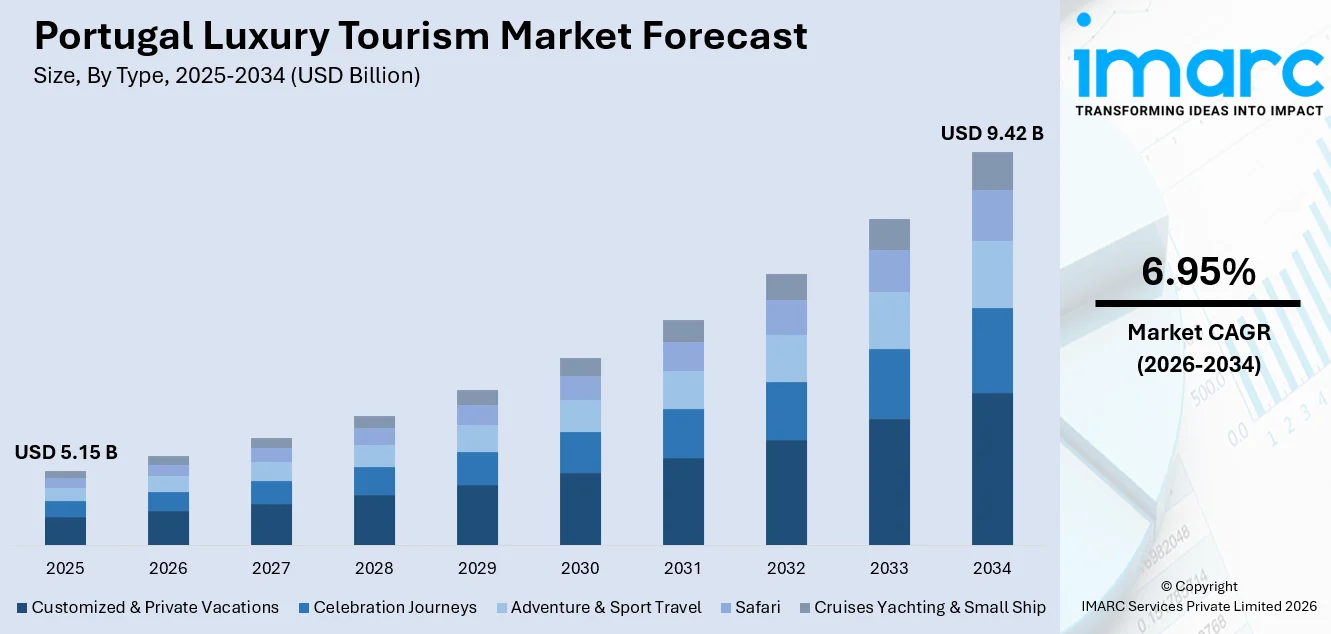
The Portugal luxury tourism market size was valued at USD 5.15 Billion in 2025 and is projected to reach USD 9.42 Billion by 2034, growing at a compound annual growth rate of 6.95% from 2026-2034.
The Portugal luxury tourism market is experiencing robust momentum as the country solidifies its position among Europe’s premier high-end travel destinations. Growing international visitor arrivals, expanding luxury hospitality infrastructure, and rising demand for curated cultural and wellness experiences are accelerating market expansion. Advancements in gastronomy-led tourism, wine tourism offerings, and bespoke private travel services are reshaping visitor expectations, positioning Portugal as a distinguished hub for premium experiential tourism.
Key Takeaways and Insights:
- By Type: Customized and private vacations dominate the market with a share of 47.8% in 2025, owing to the rising affluent traveler preference for tailor-made itineraries that combine exclusive cultural immersions, private vineyard tours, and bespoke wellness experiences across Portugal’s diverse landscapes.
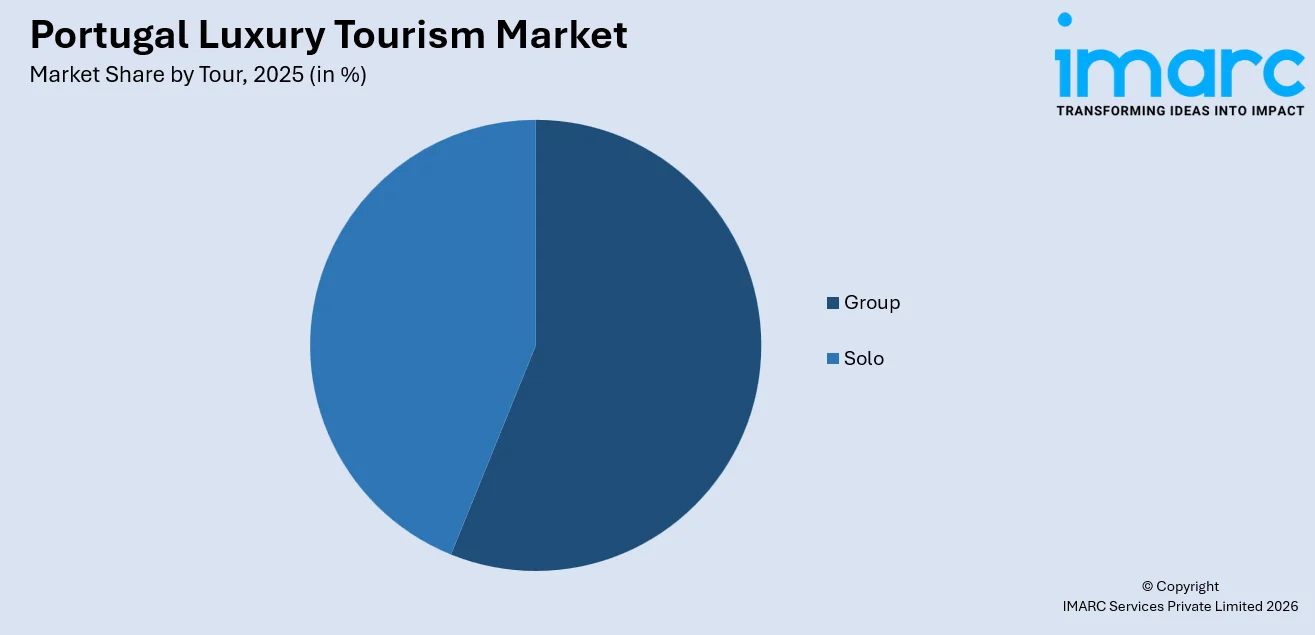
- By Tour: Group leads the market with a share of 56.3% in 2025. This dominance is driven by the growing popularity of curated group itineraries, multigenerational family travel packages, and celebration journeys that leverage shared luxury experiences across Portugal’s iconic destinations.
- By Generation: Millennial represents the largest segment with a market share of 41.2% in 2025, reflecting this cohort’s strong preference for experiential luxury, digitally curated travel, cultural authenticity, and sustainable tourism practices that align with their lifestyle values.
- By Standard: Luxury exhibits a clear dominance in the market with 62.6% share in 2025, driven by the expansion of four- and five-star hotel offerings, growing international brand presence, and increasing accessibility of premium travel packages across Portugal’s key tourism regions.
- By Region: A. M. Lisboa comprises the biggest region with 33.9% share in 2025, driven by Lisbon’s emergence as a top global luxury destination, its concentration of five-star hotels, Michelin-starred restaurants, and vibrant cultural offerings that attract high-spending international visitors.
- Key Players: The market is highly competitive, with Lisbon, Porto, and the Algarve attracting global hotel brands, boutique resorts, and premium travel operators. Competition centers on exclusive experiences, sustainability, personalized services, and cultural authenticity. Rising international demand is driving investment, differentiation, and upscale product expansion.
To get more information on this market Request Sample
The Portugal luxury tourism market is advancing as international hospitality brands, government agencies, and tourism operators collaborate to enhance the country’s premium travel ecosystem. A major factor shaping this progress is the accelerating investment in luxury hotel infrastructure, which supports higher-value visitor experiences and strengthens Portugal’s competitive positioning in the European luxury travel landscape. For instance, hotel investment in Portugal reached EUR 331 Million in the first half of 2025, representing a 33% increase compared to the same period in 2024, according to Portugal Resident. This surge reflects strong institutional confidence in the country’s hospitality sector. Policy encouragement through Turismo de Portugal’s strategic tourism initiatives, the expansion of international air connectivity, and rising demand for authentic cultural and gastronomic experiences are contributing to a more favorable environment for luxury tourism development. The growing recognition of destinations such as Lisbon, Porto, and the Algarve among affluent travelers further reinforces Portugal luxury tourism market share.
Portugal Luxury Tourism Market Trends:
Rising Demand for Bespoke and Experiential Luxury Travel
Portugal is witnessing a significant shift toward personalized, immersive luxury travel as affluent visitors increasingly seek curated cultural, culinary, and wellness experiences. Private vineyard tours, hands-on cooking classes with local chefs, and exclusive fado performances in historic Lisbon taverns are gaining strong traction. For instance, in April 2024, Cosmos Leisure Travel partnered with Red Elephant Reps to target luxury bespoke travel in Portugal, focusing on high-end customized journeys featuring exclusive vineyard tours and cultural immersions. This trend is reinforcing the Portugal luxury tourism market growth.
Expansion of Premium Hospitality Infrastructure
Portugal’s luxury hotel landscape is undergoing rapid transformation as global hospitality brands accelerate their expansion across the country. International chains are investing heavily in five-star properties, boutique resorts, and heritage-converted luxury accommodations from Lisbon to the Algarve. For example, Hyatt Hotels Corporation announced plans to open four new hotels in Portugal through 2026, including Andaz Lisbon and The Standard Lisbon, along with properties in Algarve and Madeira. Public-private partnerships are further strengthening the hospitality ecosystem, supporting higher-value tourism experiences.
Gastronomy and Wine Tourism as Luxury Differentiators
Portugal’s culinary scene is increasingly positioning the country as a gastronomic destination for luxury travelers. Fine dining, wine tourism, and farm-to-table experiences across the Douro Valley, Alentejo, and Lisbon are attracting high-spending visitors seeking authentic epicurean journeys. In the 2025 Michelin Guide, Portugal reached 38 one-star restaurants along with eight two-star establishments, with eight new one-star restaurants added during the February 2025 ceremony in Porto. This growing culinary recognition is strengthening Portugal’s premium tourism appeal.
Market Outlook 2026-2034:
Portugal’s luxury tourism market is positioned for sustained advancement, driven by expanding premium hospitality infrastructure, rising international visitor spending, and growing global recognition of the country’s cultural and gastronomic offerings. According to the latest Economic Impact Research (EIR), international visitor spending in Portugal is expected to rise to EUR 33.1 Billion, while domestic travel spending is projected at EUR 22.9 Billion. This represents growth of 24.2% and 59.5% compared with 2019 levels, highlighting sustained demand from both overseas and local travelers. Increasing investment from international hotel brands such as Hilton, Marriott, and Hyatt, coupled with Portugal’s strategic positioning as a year-round luxury destination, is expected to drive higher revenue streams and foster a more competitive and mature tourism landscape. The continued expansion of direct air connectivity from key source markets including the United States, United Kingdom, and Brazil, along with government-backed initiatives to promote sustainable luxury tourism, will further reinforce growth across the forecast period. The market generated a revenue of USD 5.15 Billion in 2025 and is projected to reach a revenue of USD 9.42 Billion by 2034, growing at a compound annual growth rate of 6.95% from 2026-2034.
Portugal Luxury Tourism Market Report Segmentation:
|
Segment Category |
Leading Segment |
Market Share |
|
Type |
Customized and Private Vacations |
47.8% |
|
Tour |
Group |
56.3% |
|
Generation |
Millennial |
41.2% |
|
Standard |
Luxury |
62.6% |
|
Region |
A. M. Lisboa |
33.9% |
Type Insights:
- Customized & Private Vacations
- Celebration Journeys
- Adventure & Sport Travel
- Safari
- Cruises Yachting & Small Ship
Customized and private vacations dominate with a market share of 47.8% of the total Portugal luxury tourism market in 2025.
The customized and private vacations segment leads the Portugal luxury tourism market as affluent travelers increasingly prioritize tailor-made itineraries that offer exclusive access to cultural landmarks, private guided tours, and personalized wellness retreats. Destination management companies are responding by curating bespoke journeys combining heritage exploration, gastronomic experiences, and luxury accommodations tailored to individual preferences. The growing availability of private transfers, dedicated concierge services, and exclusive vineyard and coastal experiences is further strengthening demand. According to a 2025 Condé Nast Johansens study surveying over 1,700 respondents, Lisbon emerged as the second most popular luxury destination globally, securing 28% of preferences, driven largely by demand for personalized cultural experiences.
The preference for customized travel is being reinforced by the expansion of specialist luxury tour operators offering Portugal-specific private itineraries that span multiple regions and themes. Travelers are seeking seamless, multi-destination journeys that blend urban exploration in Lisbon and Porto with countryside retreats in the Douro Valley and Alentejo. In the 2025 Virtuoso Luxe Report, Portugal was identified as a rising destination among affluent international travelers, with customized and private vacation formats representing the fastest-growing booking category. The integration of digital booking platforms with personalized advisor services is enabling more sophisticated trip design, strengthening the segment’s commanding market position.
Tour Insights:
Access the comprehensive market breakdown Request Sample
- Solo
- Group
Group leads with a share of 56.3% of the total Portugal luxury tourism market in 2025.
The group tour segment holds the largest share in the Portugal luxury tourism market, driven by the rising popularity of multigenerational family trips, celebration journeys, and curated group itineraries that offer shared luxury experiences. Portugal’s compact geography enables seamless multi-destination group travel, allowing operators to design cohesive itineraries spanning Lisbon, Porto, the Douro Valley, and the Algarve within a single journey. The country’s growing reputation as a premier group destination is supported by its expanding portfolio of luxury accommodations capable of hosting larger travel parties. Portugal welcomed a record 30 million visitors in 2024, generating an estimated EUR 27 Billion in tourism revenue, reflecting the strong group travel demand.
Luxury group travel in Portugal is further strengthened by the increasing demand for exclusive shared experiences such as private wine tastings, group cooking classes with renowned chefs, and curated cultural tours of UNESCO World Heritage sites. Tour operators are developing premium group packages that balance collective exploration with individual flexibility, appealing to affluent travelers who value social connectivity alongside personalized service. The growing trend of corporate retreats and incentive travel to Portugal is also contributing to segment expansion. In 2024, Portugal’s hotel revenues rose by 12%, with revenue per available room increasing by 8% to reach EUR 65.4, demonstrating the hospitality sector’s capacity to support high-value group tourism.
Generation Insights:
- Millennial
- Generation X
- Baby Boomers
- Others
Millennial is the largest segment, accounting for 41.2% of the total Portugal luxury tourism market in 2025.
Millennials represent the largest demographic group which drives Portugal's luxury tourism market because this generation enjoys authentic cultural experiences which they can book through online platforms. Millennial luxury travelers prioritize immersive experiences over material opulence, seeking out artisanal workshops, sustainable travel options, and unique cultural encounters that create lasting memories. Millennial travelers prefer to visit Portugal because the country offers historical attractions, active nightlife, excellent dining options, and outdoor sports. The Flywire 2024 Luxury Travel Report shows that 95% of Gen Z and millennial luxury travelers schedule their trips to coincide with special events which increases interest in Portugal's expanding collection of cultural festivals and interactive activities.
Millennial travelers through their sustainable and wellness-driven travel preferences now create a new luxury tourism market in Portugal. This demographic increasingly values eco-certified accommodations, farm-to-table dining, and regenerative tourism experiences that align with their environmental consciousness. The Portuguese wellness retreat network together with Atlantic coastal surf camps and rural boutique heritage properties provides all these existing customer needs. The development of hybrid "workation" packages which offer premium remote work facilities and luxury leisure amenities in Lisbon and the Algarve, boosts millennial participation in Portugal's high-end tourism market, which helps this demographic group establish its market leadership.
Standard Insights:
- Luxury
- Ultra-Luxury
Luxury holds the largest share at 62.6% of the total Portugal luxury tourism market in 2025.
The luxury standard segment commands the dominant share of the Portugal luxury tourism market, fueled by the rapid expansion of four- and five-star hotel properties and the growing presence of international hospitality brands across key destinations. The trend in Portugal’s hospitality industry is shifting toward an increase in four- and five-star rooms, while lower-rated accommodations are declining, reflecting the country’s strategic repositioning toward premium hospitality. Government incentives for hotel development, combined with increasing international brand interest, are reinforcing this upward trajectory. Portugal currently provides more than 113,000 hotel rooms, with the luxury and upscale segments leading in total room count across the national hospitality landscape.
The accessibility of luxury travel in Portugal compared to other Western European destinations positions the country as an attractive value proposition for affluent travelers seeking premium experiences. Luxury hotels across Lisbon, Porto, and the Algarve are enhancing their offerings through wellness-focused amenities, gastronomy-led experiences, and culturally immersive programming that resonates with modern luxury travelers. In August 2024, Hilton announced plans to open three new hotels in Portugal under its Canopy, Tapestry Collection, and DoubleTree brands, further expanding the luxury accommodation pipeline. The continued investment by global hospitality groups demonstrates strong institutional confidence in Portugal’s luxury tourism potential.
Regional Insights:
- Norte
- Centro
- A. M. Lisboa
- Alentejo
- Others
A. M. Lisboa represents the leading region with a 33.9% share of the total Portugal luxury tourism market in 2025.
The A. M. Lisboa region commands the largest share of Portugal’s luxury tourism market, anchored by Lisbon’s rapid emergence as one of Europe’s premier luxury travel destinations. The capital city’s unique combination of cultural heritage, Michelin-starred gastronomy, and premium urban experiences continues to attract high-spending international visitors from the United States, United Kingdom, and Brazil. Lisbon leads Portugal’s hotel development pipeline, with 34 hotels and over 5,100 rooms planned for the coming years. The Lisbon region also recorded a 14.8% growth in hotel room supply, including over 4,635 rooms under construction or in the planning phase, underscoring its centrality to Portugal’s luxury tourism expansion.
Lisbon’s luxury appeal is further strengthened by its growing recognition in international luxury travel rankings and its expanding portfolio of heritage-converted boutique properties and globally branded five-star hotels. The city’s vibrant artistic scene, traditional neighborhoods, live fado performances, and proximity to coastal destinations like Cascais and Sintra enhance its attractiveness for extended luxury stays. In 2025, Lisbon Cruise Port won the title of Best Port in Southern Europe at the World Luxury Travel Awards, reinforcing the city’s prominence in the luxury cruise tourism segment. The concentration of cultural assets, premium dining, and luxury retail along Avenida da Liberdade continues to position A. M. Lisboa as the primary gateway for luxury tourism in Portugal.
Market Dynamics:
Growth Drivers:
Why is the Portugal Luxury Tourism Market Growing?
Record-Breaking International Tourism and Rising Visitor Spending
Portugal’s tourism sector is experiencing unprecedented growth, with record visitor arrivals and spending directly fueling the luxury travel segment. The country has firmly established itself as one of Europe’s most competitive tourism destinations, attracting affluent travelers from key source markets including the United States, United Kingdom, Germany, and Brazil. The expanding air connectivity between Portugal and major international hubs is facilitating greater inbound tourism flows, particularly among high-spending visitor segments. According to the World Travel and Tourism Council, Portugal’s travel and tourism sector contributed EUR 60.6 Billion to the national economy in 2024, equivalent to 21.3% of GDP, while supporting approximately 1.2 Million jobs. International visitor spending reached EUR 31.8 Billion, marking an all-time high that reflects the increasing purchasing power and longer stays of premium international travelers. This economic momentum creates a strong foundation for continued luxury tourism expansion across the country.
Rapid Expansion of Premium Hospitality Infrastructure
Portugal is experiencing a significant acceleration in luxury and upscale hotel development, with major international hospitality brands committing substantial investments to expand their Portuguese portfolios. The influx of institutional capital into the hospitality sector is transforming the country’s accommodation landscape, creating new premium offerings that cater to the evolving expectations of affluent travelers seeking world-class service and facilities. A report by Lodging Econometrics, released in August 2024, predicts the opening of 114 new hotels in Portugal by 2026, making it the fifth country in Europe with the highest number of planned hotel openings. Additionally, Marriott International is developing a luxury hotel at Verdelago Resort in the Algarve with an investment of €52.5 Million, while Hilton is planning to add over 2,000 rooms to its existing capacity. These investments are enhancing Portugal’s ability to attract higher-spending luxury travelers.
Growing Global Recognition as a Cultural and Gastronomic Destination
Portugal’s rising international profile as a destination for cultural richness and gastronomic excellence is a significant driver of luxury tourism growth. The country’s UNESCO World Heritage sites, award-winning wine regions, and expanding fine dining scene are positioning it as a must-visit destination for discerning travelers who prioritize authentic cultural immersion alongside luxury comfort. Portugal was voted the World’s Best Wine Tourism Destination at the end of 2024, a recognition presented at the International Gastronomic Tourism Fair in Madrid to Carlos Abade, president of Turismo de Portugal. This growing gastronomic and cultural recognition is attracting a new wave of luxury travelers seeking comprehensive experiential journeys.
Market Restraints:
What Challenges the Portugal Luxury Tourism Market is Facing?
Shortage of Qualified Hospitality Workforce
The Portugal luxury tourism market faces mounting pressure from a shortage of skilled hospitality professionals capable of delivering the refined service standards expected by high-end travelers. Many experienced workers are pursuing opportunities abroad, leaving service gaps across luxury hotels and resorts. Challenges in attracting and retaining talent, coupled with relatively modest wage structures in the hospitality sector, further complicate workforce stability. This talent deficit risks affecting service consistency, guest satisfaction, and the overall reputation of Portugal’s premium tourism segment.
Overtourism Pressures in Key Destinations
Major destinations such as Lisbon, Porto, and the Algarve are experiencing rising overtourism pressures during peak travel periods. Heavy visitor flows strain infrastructure, increase congestion, and impact local communities, potentially eroding the sense of exclusivity valued by luxury travelers. Environmental stress in coastal and historic areas also raises sustainability concerns. Balancing strong tourist demand with the preservation of authentic, high-quality experiences remains a pressing challenge for stakeholders seeking long-term stability in the luxury tourism market.
Rising Operational Costs and Inflationary Pressures
Luxury hospitality operators in Portugal are contending with rising operational expenses that threaten profitability and future investment plans. Increasing property values, higher energy prices, and elevated food and supply costs are placing pressure on margins. Maintaining premium service standards while controlling expenditures has become more complex. Persistent inflationary pressures may delay expansion projects and reduce capital allocation toward new luxury developments, potentially slowing innovation and limiting the growth trajectory of Portugal’s high-end tourism offerings.
Competitive Landscape:
The Portugal luxury tourism market is becoming increasingly competitive as international hospitality brands accelerate their expansion across the country’s key destinations. Companies are focusing on diversifying luxury accommodation offerings, enhancing guest experiences through culturally immersive programming, and investing in sustainable tourism infrastructure to attract higher-spending visitors. Competition is also driven by strategic investments in wellness tourism, gastronomy-led experiences, and boutique heritage properties that differentiate Portugal from other European luxury destinations. Public-private partnerships and collaborations between tourism operators, hotel developers, and government agencies are fostering innovation and accelerating the delivery of world-class hospitality services. As a result, market players are continually refining their strategies to capture a larger share of the growing demand for premium travel experiences across Portugal.
Recent Developments:
- In August 2025, Ombria Algarve hosted Portugal’s first carbon-neutral luxury resort inauguration in June 2025, offsetting emissions from 300 guests through measured reductions and local sourcing. The event minimized energy use, eliminated unnecessary printing, and promoted sustainable practices, setting a new benchmark for eco-conscious luxury hospitality in Portugal.
- In March 2025, IHG Hotels & Resorts signed a dual-branded luxury and lifestyle development in Cascais, Portugal, with Grupo Onyria. The project includes Onyria Marinha Cascais, Vignette Collection (111 rooms) and Kimpton Quinta da Marinha Cascais (198 rooms), strengthening IHG’s expanding Portuguese luxury portfolio.
Portugal Luxury Tourism Market Report Coverage:
|
Report Features |
Details |
|
Base Year of the Analysis |
2025 |
|
Historical Period |
2020-2025 |
|
Forecast Period |
2026-2034 |
|
Units |
Billion USD |
|
Scope of the Report |
Exploration of Historical Trends and Market Outlook, Industry Catalysts and Challenges, Segment-Wise Historical and Future Market Assessment:
|
|
Types Covered |
Customized & Private Vacations, Celebration Journeys, Adventure & Sport Travel, Safari, Cruises Yachting & Small Ship |
|
Tours Covered |
Solo, Group |
|
Generations Covered |
Millennial, Generation X, Baby Boomers, Others |
|
Standards Covered |
Luxury, Ultra-Luxury |
|
Regions Covered |
Norte, Centro, A. M. Lisboa, Alentejo, Others |
|
Customization Scope |
10% Free Customization |
|
Post-Sale Analyst Support |
10-12 Weeks |
|
Delivery Format |
PDF and Excel through Email (We can also provide the editable version of the report in PPT/Word format on special request) |
Frequently Asked Questions About the Portugal Luxury Tourism Market Report
The Portugal luxury tourism market size was valued at USD 5.15 Billion in 2025.
The Portugal luxury tourism market is expected to grow at a compound annual growth rate of 6.95% from 2026-2034 to reach USD 9.42 Billion by 2034.
Customized and private vacations dominated the market with a share of 47.8%, driven by rising affluent traveler demand for tailor-made itineraries combining exclusive cultural immersions, private vineyard tours, and personalized wellness experiences across Portugal’s diverse tourism regions.
Key factors driving the Portugal luxury tourism market include record-breaking international visitor arrivals, rapid expansion of premium hospitality infrastructure, growing global recognition of Portugal’s cultural and gastronomic excellence, and increasing investment from major international hotel brands.
Major challenges include shortage of qualified hospitality workforce, overtourism pressures in key destinations such as Lisbon and the Algarve, rising operational costs driven by inflation, seasonal demand fluctuations, and the need to balance rapid tourism growth with sustainable development practices.
Need more help?
- Speak to our experienced analysts for insights on the current market scenarios.
- Include additional segments and countries to customize the report as per your requirement.
- Gain an unparalleled competitive advantage in your domain by understanding how to utilize the report and positively impacting your operations and revenue.
- For further assistance, please connect with our analysts.
 Request Customization
 Speak to an Analyst
 Request Brochure
 Inquire Before Buying
Benefits of Customization
- Personalize this research
- Triangulate with your data
- Get data as per your format and definition
- Gain a deeper dive into a specific application, geography, customer, or competitor
- Any level of personalization
Get in Touch With Us
UNITED STATES
Phone: +1-201-971-6302
INDIA
Phone: +91-120-433-0800
UNITED KINGDOM
Phone: +44-753-714-6104
Email: [email protected]
Client Testimonials




.webp)




.webp)













Related Reports

Choose your plan
*Please note that the prices mentioned below are starting prices for each bundle type. Kindly contact our team for further details.*
Single User License
- 1 User License, Access on 2 Devices
- PDF Report + Excel Dataset (Password Protected)
- Lifetime Access
- No Printing Rights
- 10% Free Report Customization
- 10–12 Weeks of Analyst Support
Five User License
- Access for 5 Users, 2 Devices per User
- PDF Report + Excel Dataset (Password Protected)
- Lifetime Access
- Dedicated Account Manager
- 12–14 Weeks of Analyst Support
- No Printing Rights
- 15% Free Report Customization
- 25% Discount on Your Next Purchase
Corporate User License
- Unlimited User Access (Within Your Organization)
- PDF Report + Excel Dataset
- Lifetime Access
- Dedicated Account Manager
- 14–20 Weeks of Analyst Support
- No Printing Rights
- 20% Free Report Customization
- 30% Discount on Your Next Purchase
Essential Insights
What's included:
3 reports
- Lifetime Access
- PDF Reports
- Excel Datasets
- 2 Weeks of Free Analyst Support
- 2 User Licenses
- Access on 2 Devices
- Printing Rights
- Complimentary PowerPoint (PPT) Version
- Complimentary License Upgrade
Professional Access
What's included:
5 reports
- Lifetime Access
- PDF Reports
- Excel Datasets
- 8 Weeks of Free Analyst Support
- 2 User Licenses
- Access on 2 Devices
- Printing Rights
- Complimentary PowerPoint (PPT) Version
- Complimentary License Upgrade
Business Advantage
What's included:
8 reports
- Lifetime Access
- PDF Reports
- Excel Datasets
- 14 Weeks of Free Analyst Support
- 2 User Licenses
- Access on 2 Devices
- Printing Rights
- Complimentary PowerPoint (PPT) Version
- Complimentary License Upgrade
Enterprise Intelligence
What's included:
10 reports
- Lifetime Access
- PDF Reports
- Excel Datasets
- 20 Weeks of Free Analyst Support
- 2 User Licenses
- Access on 2 Devices
- Printing Rights
- Complimentary PowerPoint (PPT) Version
- Complimentary License Upgrade