
Qatar Battery Energy Storage Market Size, Share, Trends and Forecast by Type, Connectivity, Application, Ownership, Capacity, and Region, 2026-2034
Qatar Battery Energy Storage Market Summary:
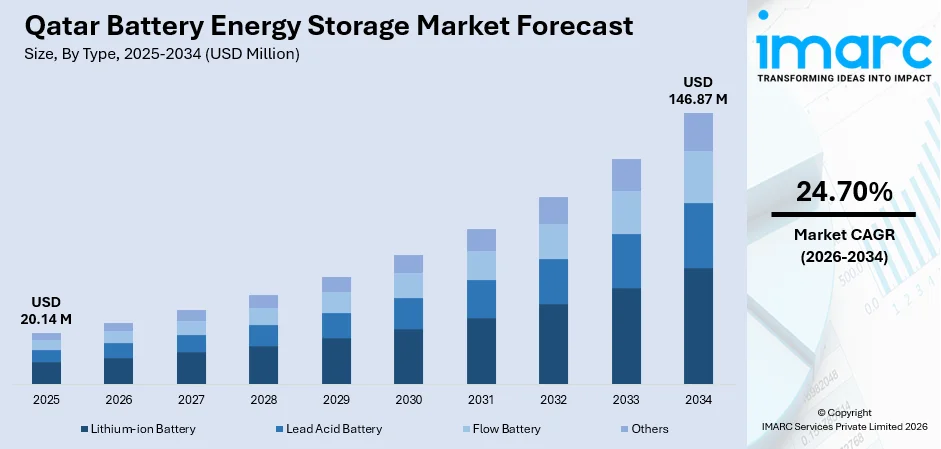
The Qatar battery energy storage market size was valued at USD 20.14 Million in 2025 and is projected to reach USD 146.87 Million by 2034, growing at a compound annual growth rate of 24.70% from 2026-2034.
The Qatar battery energy storage market is advancing rapidly as the country accelerates its clean energy transition under the Qatar National Vision 2030. Expanding solar power generation, rising electricity demand, and government-led sustainability initiatives are strengthening the case for energy storage deployment. Continued investments in grid modernization, renewable energy integration, and smart infrastructure are positioning the market for sustained expansion across residential, commercial, and utility-scale applications.
Key Takeaways and Insights:
- By Type: Lithium-ion battery dominates the market with a share of 69.8% in 2025, owing to its superior energy density, declining production costs, and mature global supply chain.
- By Connectivity: On-grid leads the market with a share of 72.1% in 2025. This dominance is driven by utility-scale renewable integration requirements, grid stabilization mandates from Kahramaa, and growing demand for peak shaving solutions across Qatar’s interconnected power network.
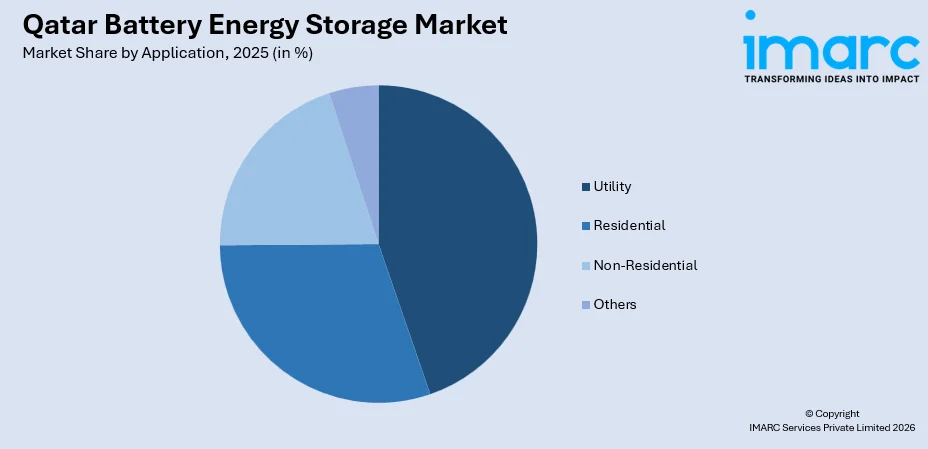
- By Application: Utility represents the largest segment with a market share of 44.5% in 2025, reflecting Qatar’s strategic prioritization of large-scale energy storage to support solar integration, manage peak demand fluctuations, and enhance overall grid reliability across the national electricity infrastructure.
- By Ownership: Utility owned exhibits a clear dominance in the market with 41.3% share in 2025, driven by Kahramaa’s central role in managing Qatar’s electricity transmission and distribution infrastructure, and its expanding mandate to integrate renewable energy sources into the national grid.
- By Capacity: Large scale (greater than 1 MW) makes the biggest segment with 66.4% share in 2025, supported by Qatar’s focus on utility-scale solar projects that require substantial energy storage capacity for grid balancing, demand management, and renewable energy dispatchability.
- By Region: Ad Dawhah reigns the market with 47.9% share in 2025, driven by the concentration of Qatar’s critical electricity infrastructure, advanced grid networks, major government institutions, and proximity to key renewable energy and industrial projects in the capital metropolitan area.
- Key Players: The market is moderately competitive, with international technology providers, regional energy companies, and local contractors competing on project scale, pricing, and technical expertise. Companies focus on grid integration, reliability, and long-term service agreements, while partnerships and utility tenders drive strategic positioning and capacity expansion.
To get more information on this market Request Sample
The Qatar battery energy storage market is evolving as the country pursues an ambitious energy diversification agenda underpinned by the Qatar National Vision 2030 and the Qatar National Renewable Energy Strategy. The government’s commitment to generating of renewable energy is creating a strong demand foundation for battery storage systems that can stabilize the grid and enable efficient solar energy utilization. Growing investments in solar photovoltaic infrastructure, coupled with regulatory mandates requiring new utility-scale renewable projects to integrate storage capacity, are accelerating market development. For instance, in April 2025, QatarEnergy inaugurated the Ras Laffan and Mesaieed solar power plants with a combined capacity of 875 megawatts, doubling the country’s total solar output to 1,675 megawatts and significantly strengthening the business case for complementary battery energy storage deployment across the national electricity network.
Qatar Battery Energy Storage Market Trends:
Integration of Storage with Expanding Solar Infrastructure
Qatar is rapidly scaling its solar energy portfolio, creating a strong pull for complementary battery storage solutions. For instance, QatarEnergy aimed for over 5 GW solar by 2035, with 800 MW Al Kharsaah and 1.7 GW Mesaieed/Ras Laffan plants by early 2025, plus a 500 MW North Field East project and 1.6 GW by 2029. As intermittent solar generation increases its share in the electricity mix, battery energy storage systems are becoming essential for managing supply-demand mismatches, ensuring grid stability during peak evening hours, and supporting Qatar battery energy storage market growth.
Rising Focus on Grid Modernization and Smart Energy Management
Qatar is investing in grid modernization to accommodate growing renewable penetration and evolving demand patterns. Kahramaa, the national utility, is advancing smart grid technologies, digital monitoring systems, and automated load management tools to enhance network efficiency. For instance, in November 2025, Qatar invested USD 1.6 Billion to expand Lusail Smart City’s energy automation, smart grids, and solar integration, building on 875 MW national capacity, targeting 18% renewables by 2030, and supporting growth. These developments are driving integration of advanced battery systems into Qatar’s power infrastructure.
Declining Lithium-ion Battery Costs Accelerating Deployment
The global decline in lithium-ion battery prices is making energy storage increasingly viable for Qatar’s market. According to BloombergNEF, global lithium-ion battery pack prices fell to a record low of USD 108 per kilowatt-hour in 2025, representing an 8% year-on-year decline, with stationary storage packs dropping to USD 70 per kilowatt-hour. This cost trajectory, driven by manufacturing overcapacity and LFP chemistry adoption, is improving the economic feasibility of large-scale battery deployments across Qatar’s utility and commercial sectors.
Market Outlook 2026-2034:
The Qatar battery energy storage market is positioned for robust expansion, driven by accelerating solar deployments, supportive government mandates, and declining battery system costs. As such, in January 2026, Qatar’s electricity authority (Kahramaa) has invited bids for its first major utility-scale battery energy storage system, supporting grid flexibility and renewable integration alongside about 1,675 MW solar now and a 5,000 MW target by 2035. In line with this, continued infrastructure modernization and rising demand for flexible power management solutions are expected to stimulate investment across utility-scale and distributed applications. Furthermore, expanding renewable capacity, evolving grid requirements, and increasing engagement from international technology providers are expected to create a more competitive and mature battery storage ecosystem in Qatar over the forecast period. The market generated a revenue of USD 20.14 Million in 2025 and is projected to reach a revenue of USD 146.87 Million by 2034, growing at a compound annual growth rate of 24.70% from 2026-2034.
Qatar Battery Energy Storage Market Report Segmentation:
|
Segment Category |
Leading Segment |
Market Share |
|
Type |
Lithium-ion Battery |
69.8% |
|
Connectivity |
On-Grid |
72.1% |
|
Application |
Utility |
44.5% |
|
Ownership |
Utility Owned |
41.3% |
|
Capacity |
Large Scale (Greater than 1 MW) |
66.4% |
|
Region |
Ad Dawhah |
47.9% |
Type Insights:
- Lithium-ion Battery
- Lead Acid Battery
- Flow Battery
- Others
Lithium-ion battery dominates with a market share of 69.8% of the total Qatar battery energy storage market in 2025.
Lithium-ion batteries serve as Qatar's primary energy storage solution because of their ability to store energy at high density and their capacity to scale up and their costs which are now becoming more affordable. The market position of lithium iron phosphate chemistry continues to grow through its widespread use because the technology provides better thermal stability which meets the requirements of Qatar's extreme heat conditions. The decreasing prices of lithium-ion battery packs enable Qatar's utility operators and project developers to find better economic value through grid storage solutions which can now be implemented at large scales.
Lithium-ion battery systems are integral to Qatar’s strategy for integrating solar energy into the national grid, providing essential services such as peak shaving, frequency regulation, and backup power. Their modular design allows flexible deployment across residential, commercial, and utility-scale applications. Kahramaa’s initial grid-scale pilot project at the Nuaija substation utilized Tesla Powerpack lithium-ion battery systems with a capacity of 1 megawatt and 4 megawatt-hours, demonstrating the technology’s viability in Qatar’s harsh climate conditions and opening pathways for larger deployments.
Connectivity Insights:
- Off-Grid
- On-Grid
On-grid leads with a share of 72.1% of the total Qatar battery energy storage market in 2025.
On-grid battery energy storage systems are the backbone of Qatar’s energy storage deployment, directly connected to the national electricity network managed by Kahramaa. These systems play a critical role in balancing supply and demand, especially as intermittent solar generation increases its contribution to the power mix. The commissioning of solar capacity underscores the growing need for grid-connected storage solutions to maintain power quality and reliability.
The emphasis on on-grid systems reflects Qatar’s centralized power infrastructure and utility-led approach to energy transition. Battery storage connected to the national grid enables efficient load shifting, peak demand management, and voltage stabilization across high-demand zones such as Doha and industrial areas like Ras Laffan and Mesaieed. Qatar’s regulatory framework mandating battery integration with new utility-scale renewable projects is further accelerating the deployment of on-grid storage systems, reinforcing their dominant position in the market.
Application Insights:
Access the comprehensive market breakdown Request Sample
- Residential
- Non-Residential
- Utility
- Others
Utility is the largest segment, accounting for 44.5% of the total Qatar battery energy storage market in 2025.
Utility-scale battery storage is the primary application segment in Qatar, reflecting the government’s strategy to deploy large-format energy storage alongside its expanding solar portfolio. Qatar’s utility sector, led by Kahramaa and QatarEnergy, is investing in storage to address the evening demand peak that occurs when solar production declines. In September 2025, QatarEnergy signed an EPC agreement with Samsung C&T for the 2,000-megawatt Dukhan solar power plant, which will significantly increase storage requirements for grid integration and demand management.
Utility-owned battery systems are being deployed to enhance grid flexibility and support the integration of variable renewable energy across Qatar’s transmission network. These systems provide critical services including frequency regulation, load shifting, and emergency backup, ensuring continuous power supply reliability. The growing scale of solar deployments, combined with Qatar’s ambitious target of generating over 4,000 megawatts of renewable energy by 2030, is expected to drive sustained investment in utility-scale storage to maintain grid stability and optimize energy dispatch.
Ownership Insights:
- Customer Owned
- Third-Party Owned
- Utility Owned
Utility owned holds the largest share at 41.3% of the total Qatar battery energy storage market in 2025.
Utility-owned battery energy storage systems represent the leading ownership model in Qatar, driven by Kahramaa’s central role as the sole electricity transmission and distribution operator. As the government accelerates renewable energy integration, utility-owned storage assets are essential for managing grid operations, peak demand, and power quality across the national network. Qatar’s National Renewable Energy Strategy requires new utility-scale renewable projects to incorporate storage, further reinforcing the utility ownership model as the primary pathway for large-scale battery deployment.
The concentration of ownership among utility entities reflects Qatar’s regulated energy market structure, where state-backed organizations lead infrastructure investment and operational decisions. Kahramaa and QatarEnergy have shown commitment through pilot battery storage projects and are preparing broader deployments to support rising solar generation. This centralized model enables coordinated planning, unified technical standards, and smoother integration with the national grid. It also supports long term reliability, controlled project execution, and alignment with national energy transition objectives.
Capacity Insights:
- Small Scale (Less than 1 MW)
- Large Scale (Greater than 1 MW)
Large scale (greater than 1 MW) represents the leading segment with a 66.4% share of the total Qatar battery energy storage market in 2025.
Large scale battery energy storage systems above utility level capacity represent the primary deployment format in Qatar, reflecting the country’s emphasis on grid scale infrastructure and industrial renewable integration. The expanding portfolio of solar projects, including Al Kharsaah, Ras Laffan, Mesaieed, and the upcoming Dukhan facilities, requires significant storage solutions to manage intermittency and stabilize supply. These systems support dispatchability, enhance peak load management, and improve overall grid reliability as renewable penetration continues to rise.
The preference for large scale storage reflects Qatar’s centralized energy system and the cost advantages associated with utility connected installations. The country is expanding storage procurement through structured partnership models and long-term capacity arrangements, signaling firm institutional backing for grid level deployment. This approach supports renewable integration, strengthens energy security, and enhances operational flexibility. Ongoing investments are steadily establishing Qatar as an emerging battery storage market within the wider Middle East energy sector.

Regional Insights:
- Ad Dawhah
- Al Rayyan
- Al Wakrah
- Others
Ad Dawhah dominates the market with a 47.9% share of the total Qatar battery energy storage in 2025.
Ad Dawhah, encompassing the capital city Doha, is the leading region for battery energy storage deployment in Qatar. The metropolitan area’s advanced electricity infrastructure, high population density, and concentration of commercial and government facilities create the strongest demand for reliable, flexible power solutions. According to the United Nations Department of Economic and Social Affairs, Population Division, Ad-Dawhah (Doha) has a population of 2,193,708, in 2025, reflecting an annual growth rate of 1.97%. As the hub for Kahramaa’s grid modernization initiatives and the primary distribution center for Qatar’s power network, Ad Dawhah serves as the natural focal point for battery storage integration aimed at managing peak loads and enhancing grid resilience.
The region also hosts major industrial zones, transport networks, and smart city developments that require stable power quality and backup capacity. Growing electrification in commercial buildings and public infrastructure further increases load variability, reinforcing the need for grid connected storage systems. This concentration of demand and infrastructure investment continues to position Ad Dawhah at the center of Qatar’s battery energy storage expansion.
Market Dynamics:
Growth Drivers:
Why is the Qatar Battery Energy Storage Market Growing?
Accelerating Solar Energy Deployment Under National Vision 2030
Qatar’s ambitious solar energy expansion is creating a substantial and growing demand for battery energy storage systems. The government’s commitment to achieving substantial renewable energy capacity, primarily through solar photovoltaic projects, necessitates robust storage infrastructure to manage intermittent generation and ensure reliable grid performance. As solar generation constitutes an increasing share of Qatar’s electricity mix, the mismatch between daytime solar production and evening peak demand creates a compelling case for battery storage. For instance, in September 2025, QatarEnergy awarded Samsung C&T the EPC contract for the Dukhan solar power plant, which is expected to contribute up to 30% of Qatar’s total peak electricity demand alongside existing solar facilities. This growing solar portfolio requires complementary battery storage to ensure energy dispatch reliability, optimize renewable utilization, and reduce dependence on gas-fired peaking plants.
Government-Led Grid Modernization and Regulatory Support
Qatar’s government is actively promoting battery energy storage through strategic policy frameworks, regulatory mandates, and direct investment in grid infrastructure. The Qatar National Renewable Energy Strategy, launched by Kahramaa in collaboration with 22 energy stakeholders, establishes clear deployment targets and regulatory requirements for energy storage integration. Under existing regulations, all new utility-scale renewable energy projects are required to incorporate battery storage systems to ensure grid reliability and dispatchability. The centralized nature of Qatar’s power sector, with Kahramaa controlling transmission and distribution, enables coordinated planning and efficient deployment of storage assets. The government has allocated significant resources toward energy storage infrastructure development, with plans to modernize the national grid to accommodate higher renewable penetration. These policy measures, combined with Qatar’s fiscal strength derived from hydrocarbon revenues, provide a strong foundation for sustained investment in battery energy storage systems across the forecast period.
Declining Battery Technology Costs Enhancing Economic Viability
The sustained global decline in lithium-ion battery prices is significantly improving the economic feasibility of energy storage deployments in Qatar. The cost reduction of batteries is driven by manufacturing overcapacity, economies of scale, intensified competition among cell producers, and growing adoption of lower-cost lithium iron phosphate chemistry. For Qatar, where solar photovoltaic electricity costs are already among the lowest in the world, the combination of affordable solar generation and declining storage costs creates an increasingly compelling investment case. The improved economics of battery systems are enabling longer-duration storage deployments, expanding the range of viable applications from peak shaving and frequency regulation to renewable energy time-shifting and emergency backup. As battery costs continue their downward trajectory, the total cost of ownership for integrated solar-plus-storage projects is expected to decrease further, driving accelerated adoption across Qatar’s energy infrastructure.
Market Restraints:
What Challenges the Qatar Battery Energy Storage Market is Facing?
High Initial Capital Requirements for Large-Scale Deployments
Despite declining battery prices, the upfront capital investment required for large-scale battery energy storage systems remains substantial. Utility-grade installations involving hundreds of megawatt-hours of storage capacity require significant procurement, engineering, and construction expenditures that can strain project budgets and extend payback periods. The absence of mature financing mechanisms specifically tailored for energy storage projects in Qatar adds further complexity, limiting the pace of new deployment.
Extreme Climate Conditions Affecting Battery Performance
Qatar’s harsh desert climate, characterized by extreme summer temperatures that frequently exceed 45 degrees Celsius, poses technical challenges for battery energy storage systems. High ambient temperatures accelerate battery degradation, reduce cycle life, and necessitate advanced thermal management solutions that increase system costs. Ensuring reliable battery performance in these demanding environmental conditions requires specialized engineering and ongoing maintenance investments.
Nascent Regulatory Framework and Limited Market Track Record
Although Qatar has established initial regulatory requirements for storage integration, the broader policy and market framework for battery energy storage remains at an early stage of development. The absence of established capacity payment mechanisms, time-of-use electricity tariff structures, and standardized procurement processes creates uncertainty for investors and project developers. Qatar’s limited operational history with grid-scale battery systems also means that long-term performance data and best practices are still being developed.
Competitive Landscape:
The Qatar battery energy storage market is characterized by active competition between international technology providers and domestic utilities and infrastructure partners. Global firms contribute advanced battery technologies, system integration capabilities, and access to financing, supporting the rollout of large-scale grid connected projects. Meanwhile, various entities guide procurement, regulatory alignment, and long-term planning in line with national energy objectives. As battery costs decline and solar capacity expands, competition is strengthening, attracting new entrants and prompting established players to widen their portfolios. Partnerships between foreign manufacturers and local engineering companies are enhancing technology transfer, improving project execution, and building in country technical expertise.
Recent Developments:
- In April 2025, QatarEnergy inaugurated an 875 MW solar PV complex at Ras Laffan and Mesaieed, built for QAR 2.3 Billion and using 1.6 million JA Solar modules. The project lifts national installed solar capacity to 1,675 MW and is expected to offset 4.7 million tonnes of CO₂ annually, supporting a 4 GW target by 2030.
- In March 2025, Nafees Batteries inaugurated a lead battery recycling plant in Qatar, opened by JMJ Group in February 2025. The facility will process used lead acid batteries into high purity lead alloys, aiming to cut hazardous waste, reduce import dependence, and support sustainable industrial development.
Qatar Battery Energy Storage Market Report Coverage:
|
Report Features |
Details |
|
Base Year of the Analysis |
2025 |
|
Historical Period |
2020-2025 |
|
Forecast Period |
2026-2034 |
|
Units |
Million USD |
|
Scope of the Report |
Exploration of Historical Trends and Market Outlook, Industry Catalysts and Challenges, Segment-Wise Historical and Future Market Assessment:
|
|
Types Covered |
Lithium-ion Battery, Lead Acid Battery, Flow Battery, Others |
|
Connectivities Covered |
Off-Grid, On-Grid |
|
Applications Covered |
Residential, Non-Residential, Utility, Others |
|
Ownerships Covered |
Customer Owned, Third-Party Owned, Utility Owned |
|
Capacities Covered |
Small Scale (Less than 1 MW), Large Scale (Greater than 1 MW) |
|
Regions Covered |
Ad Dawhah, Al Rayyan, Al Wakrah, Others |
|
Customization Scope |
10% Free Customization |
|
Post-Sale Analyst Support |
10-12 Weeks |
|
Delivery Format |
PDF and Excel through Email (We can also provide the editable version of the report in PPT/Word format on special request) |
Frequently Asked Questions About the Qatar Battery Energy Storage Market Report
The Qatar battery energy storage market size was valued at USD 20.14 Million in 2025.
The Qatar battery energy storage market is expected to grow at a compound annual growth rate of 24.70% from 2026-2034 to reach USD 146.87 Million by 2034.
Lithium-ion battery dominated the market with a share of 69.8%, driven by superior energy density, declining production costs, mature supply chains, and enhanced thermal stability suited for grid-scale and distributed storage applications across Qatar.
Key factors driving the Qatar battery energy storage market include accelerating solar energy deployment, government-led grid modernization mandates, declining lithium-ion battery costs, renewable energy integration requirements, and strategic investments in utility-scale storage infrastructure.
Major challenges include high initial capital requirements for large-scale deployments, extreme desert climate conditions affecting battery performance, nascent regulatory frameworks, limited operational track record with grid-scale systems, and the need for specialized thermal management solutions.
Need more help?
- Speak to our experienced analysts for insights on the current market scenarios.
- Include additional segments and countries to customize the report as per your requirement.
- Gain an unparalleled competitive advantage in your domain by understanding how to utilize the report and positively impacting your operations and revenue.
- For further assistance, please connect with our analysts.
 Request Customization
 Speak to an Analyst
 Request Brochure
 Inquire Before Buying
Benefits of Customization
- Personalize this research
- Triangulate with your data
- Get data as per your format and definition
- Gain a deeper dive into a specific application, geography, customer, or competitor
- Any level of personalization
Get in Touch With Us
UNITED STATES
Phone: +1-201-971-6302
INDIA
Phone: +91-120-433-0800
UNITED KINGDOM
Phone: +44-753-714-6104
Email: [email protected]
Client Testimonials




.webp)




.webp)













Related Reports

Choose your plan
*Please note that the prices mentioned below are starting prices for each bundle type. Kindly contact our team for further details.*
Single User License
- 1 User License, Access on 2 Devices
- PDF Report + Excel Dataset (Password Protected)
- Lifetime Access
- No Printing Rights
- 10% Free Report Customization
- 10–12 Weeks of Analyst Support
Five User License
- Access for 5 Users, 2 Devices per User
- PDF Report + Excel Dataset (Password Protected)
- Lifetime Access
- Dedicated Account Manager
- 12–14 Weeks of Analyst Support
- No Printing Rights
- 15% Free Report Customization
- 25% Discount on Your Next Purchase
Corporate User License
- Unlimited User Access (Within Your Organization)
- PDF Report + Excel Dataset
- Lifetime Access
- Dedicated Account Manager
- 14–20 Weeks of Analyst Support
- No Printing Rights
- 20% Free Report Customization
- 30% Discount on Your Next Purchase
Essential Insights
What's included:
3 reports
- Lifetime Access
- PDF Reports
- Excel Datasets
- 2 Weeks of Free Analyst Support
- 2 User Licenses
- Access on 2 Devices
- Printing Rights
- Complimentary PowerPoint (PPT) Version
- Complimentary License Upgrade
Professional Access
What's included:
5 reports
- Lifetime Access
- PDF Reports
- Excel Datasets
- 8 Weeks of Free Analyst Support
- 2 User Licenses
- Access on 2 Devices
- Printing Rights
- Complimentary PowerPoint (PPT) Version
- Complimentary License Upgrade
Business Advantage
What's included:
8 reports
- Lifetime Access
- PDF Reports
- Excel Datasets
- 14 Weeks of Free Analyst Support
- 2 User Licenses
- Access on 2 Devices
- Printing Rights
- Complimentary PowerPoint (PPT) Version
- Complimentary License Upgrade
Enterprise Intelligence
What's included:
10 reports
- Lifetime Access
- PDF Reports
- Excel Datasets
- 20 Weeks of Free Analyst Support
- 2 User Licenses
- Access on 2 Devices
- Printing Rights
- Complimentary PowerPoint (PPT) Version
- Complimentary License Upgrade