
Qatar Blockchain Market Size, Share, Trends and Forecast by Component, Provider, Type, Deployment Mode, Organization Size, Vertical, and Region, 2026-2034
Qatar Blockchain Market Summary:
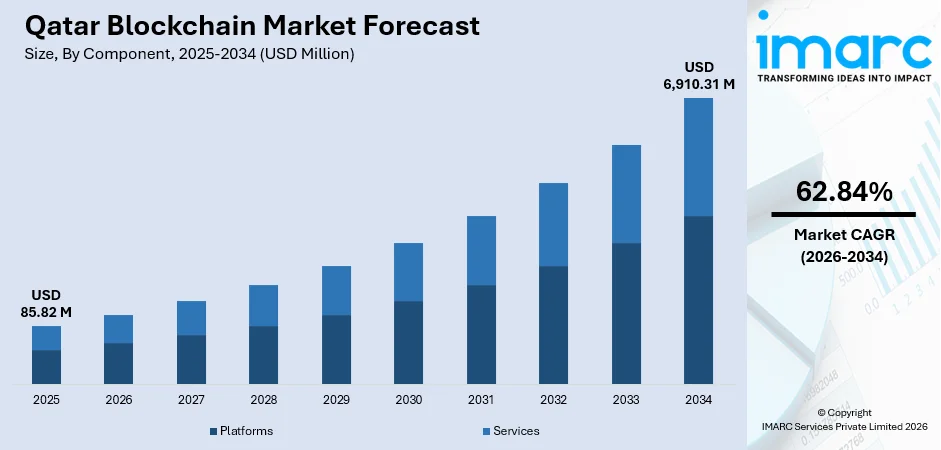
The Qatar blockchain market size was valued at USD 85.82 Million in 2025 and is projected to reach USD 6,910.31 Million by 2034, growing at a compound annual growth rate of 62.84% from 2026-2034.
This remarkable growth is driven by the government's strategic commitment to blockchain technology through initiatives, alongside increasing adoption across banking, government services, and digital finance sectors. Major financial institutions are implementing blockchain solutions for payment processing and Shariah-compliant finance, while the Qatar Financial Centre's Digital Assets Lab continues to foster innovation through public-private partnerships. These developments, combined with the country's heightened internet penetration and expanding fintech ecosystem, are expanding the Qatar blockchain market share.
Key Takeaways and Insights:
- By Component: Platforms dominate the market with a share of 58% in 2025, driven by the expansion of the QFC Digital Assets Lab which welcomed a large number of new firms in the first half of 2025.
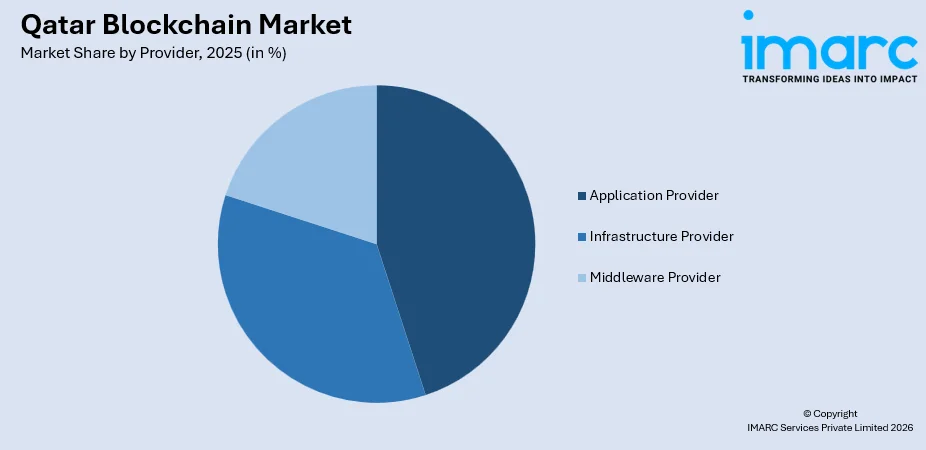
- By Provider: Application provider leads with 41% market share in 2025, fueled by increasing demand for blockchain applications across government agencies, healthcare, and financial services sectors.
- By Type: Private accounts for 47% market share in 2025, reflecting enterprise preference for permissioned networks in regulated sectors.
- By Deployment Mode: Cloud holds 66% market share in 2025, supported by infrastructure provisioned through major cloud providers.
- By Organization Size: Large enterprises command 69% market share in 2025, with major banks and financial institutions driving institutional adoption.
- By Vertical: Banking and financial services lead with 33% market share in 2025, exemplified by eight major middle eastern banks joining blockchain payment networks.
- By Region: Ad Dawhah dominates with 56% share in 2025, as Qatar's economic hub hosting the QFC Digital Assets Lab and major fintech initiatives.
- Key Players: Key blockchain players in Qatar improve business by forming partnerships, piloting regulated use cases, upgrading payment infrastructure, investing in talent, collaborating with government programs, and deploying enterprise platforms that enhance transparency, efficiency, security, and cross-border financial services and regional competitiveness.
To get more information on this market Request Sample
Qatar's blockchain market is experiencing transformative growth as the nation positions itself as a regional fintech hub through strategic government initiatives and institutional adoption. The Qatar Financial Centre has established itself as the primary catalyst for blockchain innovation, with the Digital Assets Lab launching its inaugural cohort of 29 innovators in September 2024 to develop cutting-edge distributed ledger technology solutions. In 2025, Qatar National Bank became the first Qatari institution to adopt JPMorgan's Kinexys blockchain platform, enabling corporate USD payment settlements within two minutes and processing approximately USD 3 billion in daily transactions. This milestone reflects broader institutional momentum, with various banks in the Middle East and North Africa joining blockchain payment networks. The government has allocated QAR 500 million for blockchain technology development. With heightened internet penetration, the ecosystem benefits from robust digital infrastructure.
Qatar Blockchain Market Trends:
Institutional Blockchain Adoption Accelerating in Banking and Financial Services
Financial institutions across Qatar are rapidly integrating blockchain technology to modernize payment infrastructure and enhance operational efficiency. In 2025, The Qatar Financial Center (QFC) has initiated a POC (Proof of Concept) for a digital receipt system (DRS) based on Hedera blockchain. The initiative will utilize blockchain in Islamic Finance, providing a clear, efficient, and regulated financial experience. The updated system will function on HashSphere, a permissioned private distributed ledger utilizing Hedera technology. It will be launched on Google Cloud through QFC’s Digital Asset Lab. This institutional momentum reflects broader digital transformation strategies among major banks, which are leveraging blockchain to reduce settlement costs, enhance liquidity management, and compete more effectively in the global financial environment.
Expansion of Decentralized Finance Platforms and Digital Lending Solutions
Decentralized finance platforms are gaining significant traction in Qatar's financial ecosystem, driven by government support and increasing digital adoption. The Qatari government allocated massive investments for blockchain technology development, with over 40% of financial institutions exploring blockchain solutions. The Qatar Central Bank reported a 30% increase in digital transactions, representing a major increase in users engaging with blockchain lending platforms. This growth is supported by the country's 99% internet penetration rate and expanding mobile wallet usage, which increased by 15% annually. The government's initiative to increase financial inclusion by 30% among Qatar's unbanked population, estimated at 12%, is driving demand for accessible decentralized finance solutions that provide alternatives to traditional banking services.
Digital Asset Tokenization and Real-World Asset Integration Advancing
Real-world asset tokenization is emerging as a transformative application of blockchain technology across Qatar's financial landscape. In 2025, the QFC Digital Assets Lab launched a pioneering proof of concept in collaboration with AlRayan Bank, Blade Labs, and Hashgraph, demonstrating a blockchain-based Digital Receipt System for Shariah-compliant asset-backed finance operating on HashSphere, a private permissioned distributed ledger technology network deployed on Google Cloud infrastructure. Qatar's payment environment is undergoing swift digital evolution, as the Qatar Central Bank (QCB) noted $4.4 billion in digital transactions for July 2025, executed over 51.7 million transactions. The QFC Digital Assets Lab expanded its portfolio in the first half of 2025 by welcoming 33 new firms, with collaborative projects including tokenized deposits, real estate tokenization, and blockchain-based rewards systems aligned with Qatar National Vision 2030 and digital transformation objectives.
Market Outlook 2026-2034:
The exceptional market expansion reflects accelerating institutional adoption, government strategic investments, and the maturation of blockchain applications across banking, government services, supply chain, and digital asset management. The market generated a revenue of USD 85.82 Million in 2025 and is projected to reach a revenue of USD 6,910.31 Million by 2034, growing at a compound annual growth rate of 62.84% from 2026-2034. The Qatar Financial Centre's Digital Assets Lab will continue serving as a catalyst for innovation, while major banks expand blockchain payment networks and Shariah-compliant financial solutions. Strategic partnerships between global technology leaders and local institutions, combined with regulatory frameworks supporting digital transformation, will drive mainstream adoption and establish Qatar as a leading blockchain hub in the Middle East region.
Qatar Blockchain Market Report Segmentation:
|
Segment Category |
Leading Segment |
Market Share |
|
Component |
Platforms |
58% |
|
Provider |
Application Provider |
41% |
|
Type |
Private Blockchain |
47% |
|
Deployment Mode |
Cloud |
66% |
|
Organization Size |
Large Enterprises |
69% |
|
Vertical |
Banking and Financial Services |
33% |
|
Region |
Ad Dawhah |
56% |
Component Insights:
- Platforms
- Services
- Professional Services
- Managed Services
Platforms dominate with a market share of 58% of the total Qatar blockchain market in 2025.
Platforms dominate the Qatar blockchain market as they provide the foundational infrastructure enabling organizations to develop, host, and utilize blockchain applications, smart contracts, and distributed ledger technology solutions across multiple sectors. The QFC Digital Assets Lab has established itself as the primary platform ecosystem, expanding its portfolio with 33 new firms in the first half of 2025 focused on collaborative projects including tokenized deposits, real estate tokenization, and blockchain-based rewards systems aligned with Qatar National Vision 2030. In September 2024, the Lab launched its inaugural cohort comprising 29 innovators with the goal of providing a comprehensive ecosystem to develop, test, and commercialize cutting-edge solutions addressing industry needs.
Major platform implementations demonstrate the segment's technical sophistication and enterprise adoption, with AlRayan Bank's September 2025 proof of concept operating on HashSphere, a private permissioned distributed ledger technology network built with Hedera technology and deployed on Google Cloud infrastructure. This implementation showcases blockchain platforms' capability to support Shariah-compliant asset-backed finance with enhanced transparency, efficiency, and regulatory compliance. Strategic partnerships are accelerating platform accessibility, exemplified by the January 2025 alliance between SettleMint and The Hashgraph Group facilitated through the QFC Digital Assets Lab to make distributed ledger technologies more accessible for organizations worldwide and drive their adoption on a global scale. The platform segment's growth is further supported by Qatar's 99% internet penetration rate and robust digital infrastructure, enabling seamless integration of blockchain platforms across financial services, government operations, and enterprise applications.
Provider Insights:
Access the comprehensive market breakdown Request Sample
- Application Provider
- Infrastructure Provider
- Middleware Provider
Application provider leads with a share of 41% of the total Qatar blockchain market in 2025.
The application provider segment dominates the Qatar blockchain market due to its direct focus on delivering practical, business-ready solutions that address real operational and regulatory needs. These providers develop blockchain-based applications for use cases such as digital payments, cross-border remittances, asset tokenization, trade finance, supply chain traceability, identity verification, and smart contracts. In Qatar, strong demand from banks, financial institutions, and government entities has accelerated the adoption of application-layer solutions, as organizations prioritize technologies that improve efficiency, transparency, and security without requiring extensive changes to existing infrastructure. Application providers also benefit from Qatar’s digital transformation agenda and supportive regulatory initiatives, which encourage pilot programs and controlled deployments in sectors like financial services, energy, healthcare, and real estate. By offering customized and compliant solutions tailored to local regulations, these providers are able to shorten implementation timelines and demonstrate clear return on investment, reinforcing their position as the largest segment in the market.
Furthermore, application providers in Qatar are strengthening their market leadership by forming strategic partnerships with financial institutions, fintech firms, cloud service providers, and government-backed innovation hubs. These collaborations allow application developers to integrate advanced features such as automated compliance, real-time settlement, data immutability, and enhanced cybersecurity into their platforms. Many providers are also focusing on scalability and interoperability to ensure their applications can operate across multiple blockchain networks and integrate seamlessly with legacy enterprise systems. This adaptability is critical in Qatar’s enterprise-driven market, where organizations seek long-term, future-proof digital solutions. In addition, application providers are investing in user experience, analytics, and support services to increase adoption among both institutional and commercial users. By continuously enhancing functionality, aligning with national economic goals, and addressing sector-specific challenges, application providers continue to capture the largest share of the Qatar blockchain market and remain the primary drivers of innovation and commercial value.
Type Insights:
- Public Blockchain
- Private Blockchain
- Hybrid Blockchain
- Consortium Blockchain
Private blockchain exhibits a clear dominance with a 47% share of the total Qatar blockchain market in 2025.
Private blockchain dominates the Qatar market as organizations prioritize controlled access, enhanced privacy, and regulatory compliance within permissioned network environments suitable for regulated financial and government sectors. Financial institutions including Qatar National Bank, Qatar Islamic Bank, Commercial Bank of Qatar, Masraf Al Rayan, and Doha Bank are implementing private blockchain solutions that enable secure, efficient operations while maintaining control over network participants and transaction visibility. The preference for private networks reflects regulatory requirements in Qatar's financial sector, where institutions must maintain oversight of data access and ensure compliance with anti-money laundering standards.
Government initiatives are similarly leveraging private blockchain networks to ensure data security and privacy while maintaining authority over access permissions and network governance. The Qatar Financial Centre's Digital Assets Lab infrastructure utilizes private permissioned networks to provide firms with a comprehensive ecosystem to develop and test blockchain solutions in controlled environments aligned with regulatory requirements and data protection standards. This approach enables organizations to experiment with blockchain technology while maintaining compliance with Qatar's evolving regulatory framework. Private blockchains also support the Qatar Central Bank's wholesale central bank digital currency project, which requires controlled access and regulatory oversight, demonstrating the architecture's suitability for national financial infrastructure initiatives requiring security, privacy, and governance controls.
Deployment Mode Insights:
- On-Premises
- Cloud
- Hybrid
Cloud leads with a share of 66% of the total Qatar blockchain market in 2025.
The cloud deployment mode leads the market due to its scalability, cost efficiency, and ability to support rapid implementation across multiple industries. Organizations in Qatar increasingly prefer cloud-based blockchain solutions because they eliminate the need for heavy upfront capital investment in hardware and on-site infrastructure. Cloud deployment enables enterprises, financial institutions, and government entities to access blockchain platforms on a subscription or usage-based model, making adoption more flexible and financially viable. This is particularly attractive for small and medium-sized enterprises and fintech startups, which can deploy blockchain applications quickly without extensive technical resources. Additionally, cloud platforms offer high availability, disaster recovery, and automated updates, allowing organizations to maintain secure and reliable blockchain operations while focusing on core business objectives rather than infrastructure management.
Another key factor driving the dominance of cloud deployment in Qatar is its compatibility with innovation, interoperability, and regulatory compliance requirements. Cloud-based blockchain environments allow organizations to easily scale operations, support multiple nodes, and integrate with emerging technologies such as artificial intelligence, Internet of Things (IoT), and big data analytics. Leading cloud service providers also offer advanced security features, encryption, and compliance certifications that align with Qatar’s data protection and financial regulations. This reassures enterprises and government bodies that sensitive data can be managed securely within controlled cloud environments. Furthermore, cloud deployment supports collaboration across departments, partners, and international stakeholders, which is essential for use cases like cross-border payments, supply chain management, and digital identity systems. As Qatar continues to invest in smart infrastructure and digital services, cloud-based blockchain deployment remains the preferred choice, driving faster adoption, continuous innovation, and sustained market growth.

Organization Size Insights:
- SMEs
- Large Enterprises
Large enterprises exhibit a clear dominance with a 69% share of the total Qatar blockchain market in 2025.
Large enterprises dominate the Qatar blockchain market as major financial institutions, government entities, and large corporations possess the resources, technical capabilities, and strategic imperative to implement blockchain solutions at scale across their operations. Few of the largest banks in the Middle East and North Africa have joined blockchain payment networks, with major Qatari institutions implementing blockchain solutions for payment processing, trade finance, and digital asset management. These financial institutions are leveraging blockchain to reduce settlement costs, enhance liquidity management, and compete more effectively in the global financial environment.
Government entities are similarly leading blockchain adoption, with the Ministry of Labor and Qatar Research, Development and Innovation Council developing blockchain-based certificate authentication systems in 2025, while the Qatar Central Bank advances wholesale central bank digital currency projects to enhance access to capital markets and improve domestic settlement efficiency. The average cost for blockchain projects represents a manageable investment for large enterprises with substantial technology budgets, while creating significant barriers for smaller organizations with limited capital resources. Large enterprises benefit from dedicated IT departments, access to specialized blockchain expertise, and established relationships with technology providers, enabling them to navigate implementation complexity and integrate blockchain solutions with existing enterprise systems and legacy infrastructure more effectively than resource-constrained SMEs.
Vertical Insights:
- Transportation and Logistics
- Agriculture and Food
- Manufacturing
- Energy and Utilities
- Healthcare and Life Sciences
- Media, Advertising, and Entertainment
- Banking and Financial Services
- Insurance
- IT and Telecom
- Retail and Ecommerce
- Government
- Real Estate and Construction
- Others
Banking and financial services lead with a share of 33% of the total Qatar blockchain market in 2025.
The banking and financial services vertical represents one of the most prominent and mature segments in Qatar’s blockchain market, driven by the sector’s strong focus on security, efficiency, transparency, and regulatory compliance. Banks and financial institutions in Qatar are increasingly adopting blockchain to modernize core processes such as cross-border payments, trade finance, settlements, and customer identity management. Blockchain technology enables faster transaction processing, reduced reconciliation costs, and real-time visibility across complex financial networks, addressing long-standing inefficiencies in traditional banking systems.
The growing demand for digital payments, coupled with Qatar’s position as a regional financial hub, has further accelerated blockchain adoption within this vertical. Financial institutions are also leveraging blockchain to enhance data integrity and reduce fraud risks, which is critical in high-value financial transactions. Supported by regulatory sandboxes and innovation programs, banks are able to pilot blockchain-based solutions in a controlled environment, ensuring alignment with national financial regulations and international compliance standards.
Regional Insights:
- Ad Dawhah
- Al Rayyan
- Al Wakrah
- Others
Ad Dawhah exhibits a clear dominance with a 56% share of the total Qatar blockchain market in 2025.
Ad Dawhah represents the largest regional market for blockchain adoption in Qatar, driven by its role as the country’s political, financial, and economic center. The region hosts the headquarters of major banks, financial institutions, government ministries, regulators, and large enterprises, making it the primary hub for digital innovation and emerging technologies. Blockchain adoption in Ad Dawhah is strongly supported by national digital transformation initiatives, smart city programs, and fintech-focused regulatory frameworks that encourage experimentation and commercialization.
Many blockchain pilots, proof-of-concept projects, and enterprise-scale deployments are launched in this region due to easier access to decision-makers, innovation hubs, and skilled talent. The presence of financial free zones, technology parks, and startup incubators further strengthens the ecosystem, allowing blockchain solution providers to collaborate closely with public and private stakeholders. As a result, Ad Dawhah attracts the majority of investments, partnerships, and technology deployments within Qatar’s blockchain market. In addition, Ad Dawhah’s dominance is reinforced by strong demand across multiple verticals, including banking and financial services, government, real estate, logistics, and IT and telecom.
Market Dynamics:
Growth Drivers:
Why is the Qatar Blockchain Market Growing?
Government Strategic Initiatives and Substantial Financial Commitment to Blockchain Development
The Qatari government has established comprehensive policy frameworks and committed substantial financial resources to position blockchain technology as a cornerstone of national digital transformation. The government allocated over USD 50 million to blockchain initiatives, with an additional investment specifically designated for blockchain technology development to establish Qatar as a regional fintech hub aligned with Qatar National Vision 2030. The Qatar Investment Authority is taking a major step to enhance Qatar's status in the worldwide investment arena, launching another $2 billion for its Fund of Funds initiative. The increase raises the total investment to $3 billion, indicating Qatar’s aim to establish itself as a key hub for venture capital, cutting-edge technology funding, and blockchain-led innovation.
Accelerating Digital Transformation and Expanding Financial Inclusion Initiatives
Qatar's robust digital infrastructure and widespread technology adoption are creating an optimal environment for blockchain implementation across financial services and public sectors. The country achieved 99% internet penetration among its 2.7 million population, contributing to a robust environment for adoption of digital payments and blockchain-based financial solutions. The Qatar Central Bank reported a 30% increase in digital transactions, with 65% of total financial transactions now conducted digitally, reflecting a significant shift toward online platforms and mobile financial services. Mobile wallet usage increased, supporting the transition to blockchain-based payment and lending solutions. In May 2024, Qatar National Bank launched the country's first open APIs services specifically tailored for corporate clients, pioneering open banking in Qatar ahead of the central bank's planned 2026 open banking framework.
Expansion of Fintech Ecosystem Through Public-Private Partnerships and Innovation Hubs
Qatar has cultivated a thriving fintech ecosystem through strategic public-private partnerships, innovation programs, and venture capital initiatives that accelerate blockchain adoption across sectors. The Qatar Fintech Hub, founded by Qatar Development Bank, has supported over 50 fintech startups that graduated from programs with a combined portfolio valued at USD 500 million, representing a substantial concentration of blockchain and digital finance innovation. Partnerships with global blockchain consortia are enabling Qatar to extend its global footprint and evolve beyond proof of concepts to fully commercialized products aligned with the Qatar FinTech Strategy and National Vision 2030.
Market Restraints:
What Challenges the Qatar Blockchain Market is Facing?
Regulatory Uncertainty and Lack of Comprehensive Legal Framework
Despite government support for blockchain initiatives, regulatory uncertainty remains a significant impediment to market expansion and investor confidence. Only a limited number of fintech companies report having a clear understanding of compliance requirements in Qatar, creating hesitancy among potential investors and slowing adoption of blockchain solutions across the financial sector. In past years, blockchain startups reported confidence in the regulatory environment, hampering innovation and deterring new market entrants due to concerns about ambiguous legal frameworks and potential penalties for non-compliance. The lack of comprehensive legal framework for digital assets has led to cautious approaches among institutional investors and traditional financial institutions evaluating blockchain implementations. While the Qatar Central Bank would regulate cryptocurrencies, financial transactions, and initial coin offerings under proposed frameworks, and the Qatar Development Bank would scrutinize blockchain investment activity, coordination across multiple regulatory bodies creates complexity for organizations navigating approval processes.
Cybersecurity Vulnerabilities and Data Protection Concerns
Cybersecurity represents a critical challenge undermining consumer trust and hindering growth of blockchain platforms and digital financial services. In Qatar, 60% of businesses reported experiencing cyberattacks in the past year, creating significant concerns about the security of blockchain implementations and digital asset platforms. The cost of cybercrime is rising, reflecting the magnitude of threats facing digital infrastructure and distributed ledger technology systems. These security vulnerabilities can undermine consumer confidence and make users reluctant to engage with platforms perceived as vulnerable to data breaches, fraud, and unauthorized access to sensitive financial information. The requirement for stringent cybersecurity measures, data protection protocols, and anti-money laundering standards adds complexity and cost to blockchain implementations, particularly for smaller organizations with limited technical resources and security expertise.
High Initial Investment Requirements and Technical Implementation Barriers
The substantial capital requirements and technical complexity of blockchain implementations create prohibitive barriers to entry, particularly for small and medium-sized enterprises. The average cost for a blockchain project in Qatar is increasing, representing a significant investment that discourages many organizations from exploring blockchain technology and limits overall market growth potential. High initial investment costs encompass infrastructure acquisition or cloud services, technical expertise recruitment, integration with existing systems, regulatory compliance measures, and ongoing maintenance and optimization. These financial barriers are particularly challenging for the expanding ecosystem of fintech startups and SMEs that lack the capital resources available to large financial institutions and government entities. Technical implementation complexity requires specialized expertise in distributed ledger technologies, smart contract development, cryptography, and network architecture, creating workforce challenges in a market with limited local blockchain expertise and requiring substantial investment in training programs and international talent recruitment.
Competitive Landscape:
Key market players in the Qatar blockchain market are improving their business by investing in application-driven solutions, forming strategic partnerships, and aligning offerings with national digital transformation goals. Banks and financial institutions are adopting blockchain for cross-border payments, trade finance, and digital asset platforms to enhance efficiency and transparency. Technology providers are focusing on cloud-based deployments, interoperability, and security to enable faster scalability and lower costs. Government-backed innovation hubs and regulatory sandboxes are being leveraged to test and commercialize blockchain use cases in a compliant environment. Market players are also collaborating with global blockchain firms to access advanced expertise and standards, while continuously enhancing user experience, analytics, and integration capabilities. These strategies help strengthen competitiveness, accelerate adoption, and create sustainable long-term growth across Qatar’s blockchain ecosystem.
Qatar Blockchain Market Report Coverage:
|
Report Features |
Details |
|
Base Year of the Analysis |
2025 |
|
Historical Period |
2020-2025 |
|
Forecast Period |
2026-2034 |
|
Units |
Million USD |
|
Scope of the Report |
Exploration of Historical Trends and Market Outlook, Industry Catalysts and Challenges, Segment-Wise Historical and Future Market Assessment:
|
|
Components Covered |
|
|
Providers Covered |
Application Provider, Infrastructure Provider, Middleware Provider |
|
Types Covered |
Public Blockchain, Private Blockchain, Hybrid Blockchain, Consortium Blockchain |
|
Deployment Modes Covered |
On-Premises, Cloud, Hybrid |
|
Organization Sizes Covered |
SMEs, Large Enterprises |
|
Verticals Covered |
Transportation and Logistics, Agriculture and Food, Manufacturing, Energy and Utilities, Healthcare and Life Sciences, Media, Advertising, and Entertainment, Banking and Financial Services, Insurance, IT and Telecom, Retail and Ecommerce, Government, Real Estate and Construction, Others |
|
Regions Covered |
Ad Dawhah, Al Rayyan, Al Wakrah, Others |
|
Customization Scope |
10% Free Customization |
|
Post-Sale Analyst Support |
10-12 Weeks |
|
Delivery Format |
PDF and Excel through Email (We can also provide the editable version of the report in PPT/Word format on special request) |
Frequently Asked Questions About the Qatar Blockchain Market Report
The Qatar blockchain market size was valued at USD 85.82 Million in 2025.
The Qatar blockchain market is expected to grow at a compound annual growth rate of 62.84% from 2026-2034 to reach USD 6,910.31 Million by 2034.
Platforms dominate the component segment with 58% market share in 2025, driven by the QFC Digital Assets Lab which welcomed 33 new firms in the first half of 2025 focused on developing distributed ledger technology solutions for tokenized deposits, real estate tokenization, and blockchain-based rewards systems.
Key growth drivers include government strategic initiatives with over USD 50 million allocated to blockchain development, digital transformation with 99% internet penetration and 30% increase in digital transactions, and fintech ecosystem expansion with over 50 startups graduating from Qatar Fintech Hub programs with USD 500 million combined portfolio value, alongside major institutional adoptions such as Qatar National Bank's May 2025 integration of JPMorgan's Kinexys blockchain platform processing USD 3 billion in daily transactions.
Major challenges include regulatory uncertainty with only a limited number of fintech companies understanding compliance requirements, cybersecurity threats affecting a major number of businesses, and high implementation costs rising per blockchain project.
Need more help?
- Speak to our experienced analysts for insights on the current market scenarios.
- Include additional segments and countries to customize the report as per your requirement.
- Gain an unparalleled competitive advantage in your domain by understanding how to utilize the report and positively impacting your operations and revenue.
- For further assistance, please connect with our analysts.
 Request Customization
 Speak to an Analyst
 Request Brochure
 Inquire Before Buying
Benefits of Customization
- Personalize this research
- Triangulate with your data
- Get data as per your format and definition
- Gain a deeper dive into a specific application, geography, customer, or competitor
- Any level of personalization
Get in Touch With Us
UNITED STATES
Phone: +1-201-971-6302
INDIA
Phone: +91-120-433-0800
UNITED KINGDOM
Phone: +44-753-714-6104
Email: [email protected]
Client Testimonials




.webp)




.webp)













Related Reports

Choose your plan
*Please note that the prices mentioned below are starting prices for each bundle type. Kindly contact our team for further details.*
Single User License
- 1 User License, Access on 2 Devices
- PDF Report + Excel Dataset (Password Protected)
- Lifetime Access
- No Printing Rights
- 10% Free Report Customization
- 10–12 Weeks of Analyst Support
Five User License
- Access for 5 Users, 2 Devices per User
- PDF Report + Excel Dataset (Password Protected)
- Lifetime Access
- Dedicated Account Manager
- 12–14 Weeks of Analyst Support
- No Printing Rights
- 15% Free Report Customization
- 25% Discount on Your Next Purchase
Corporate User License
- Unlimited User Access (Within Your Organization)
- PDF Report + Excel Dataset
- Lifetime Access
- Dedicated Account Manager
- 14–20 Weeks of Analyst Support
- No Printing Rights
- 20% Free Report Customization
- 30% Discount on Your Next Purchase
Essential Insights
What's included:
3 reports
- Lifetime Access
- PDF Reports
- Excel Datasets
- 2 Weeks of Free Analyst Support
- 2 User Licenses
- Access on 2 Devices
- Printing Rights
- Complimentary PowerPoint (PPT) Version
- Complimentary License Upgrade
Professional Access
What's included:
5 reports
- Lifetime Access
- PDF Reports
- Excel Datasets
- 8 Weeks of Free Analyst Support
- 2 User Licenses
- Access on 2 Devices
- Printing Rights
- Complimentary PowerPoint (PPT) Version
- Complimentary License Upgrade
Business Advantage
What's included:
8 reports
- Lifetime Access
- PDF Reports
- Excel Datasets
- 14 Weeks of Free Analyst Support
- 2 User Licenses
- Access on 2 Devices
- Printing Rights
- Complimentary PowerPoint (PPT) Version
- Complimentary License Upgrade
Enterprise Intelligence
What's included:
10 reports
- Lifetime Access
- PDF Reports
- Excel Datasets
- 20 Weeks of Free Analyst Support
- 2 User Licenses
- Access on 2 Devices
- Printing Rights
- Complimentary PowerPoint (PPT) Version
- Complimentary License Upgrade