
Qatar District Cooling Market Size, Share, Trends and Forecast by Production Technique, Application, and Region, 2026-2034
Qatar District Cooling Market Overview:
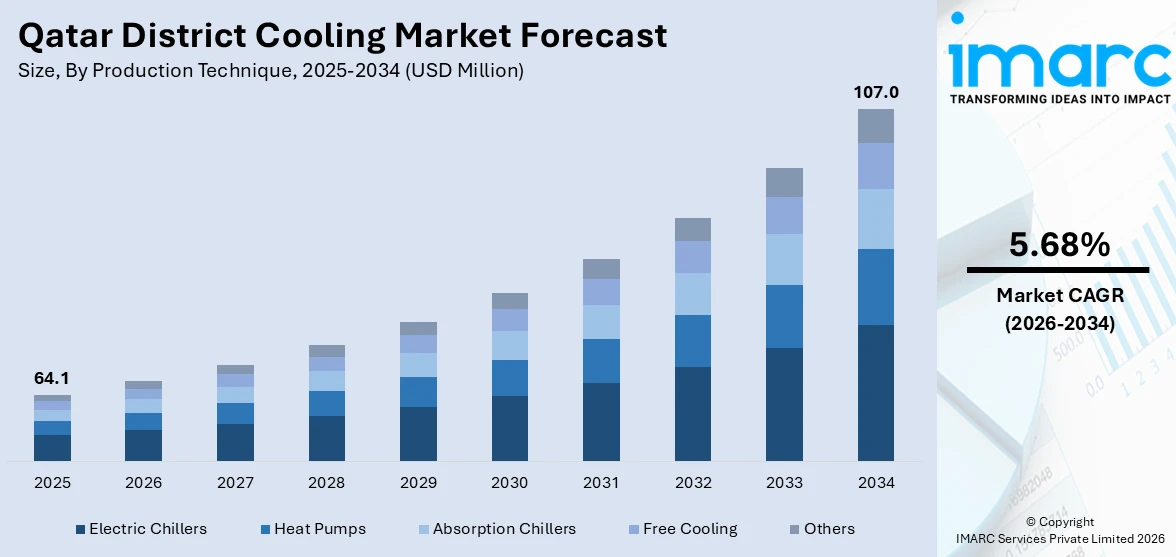
The Qatar district cooling market size reached USD 64.1 Million in 2025. The market is projected to reach USD 107.0 Million by 2034, exhibiting a growth rate (CAGR) of 5.68% during 2026-2034. The market is propelled by government sustainability initiatives under Qatar National Vision 2030, digital technology integration, and strategic use of treated wastewater. Programs like Tarsheed have reduced carbon emissions and achieved significant cost savings, while AI-driven monitoring and solar-powered systems enhance efficiency. Major infrastructure projects integrate district cooling from the planning stage, ensuring long-term demand. The shift toward sustainable, energy-efficient, and water-conserving cooling solutions is strengthening the country’s position as a regional leader, positively impacting the Qatar district cooling market share.
|
Report Attribute
|
Key Statistics
|
|---|---|
|
Base Year
|
2025
|
|
Forecast Years
|
2026-2034
|
|
Historical Years
|
2020-2025
|
| Market Size in 2025 | USD 64.1 Million |
| Market Forecast in 2034 | USD 107.0 Million |
| Market Growth Rate 2026-2034 | 5.68% |
Qatar District Cooling Market Trends:
Government-Driven Sustainability Initiatives Aligned with Qatar National Vision 2030
Qatar's commitment to environmental sustainability under Qatar National Vision 2030 is significantly driving the adoption of district cooling systems across the nation. The government, through the Qatar General Electricity and Water Corporation (Kahramaa), has implemented comprehensive policies and programs to promote energy conservation and reduce carbon emissions. District cooling represents a cornerstone technology in achieving these national objectives, as it consumes 30-40% less energy compared to conventional air conditioning systems and substantially reduces greenhouse gas emissions. In November 2024, the Tarsheed program achieved remarkable financial savings of approximately QR840 million while reducing harmful carbon emissions by 1.2 million tonnes, demonstrating the tangible impact of government-led conservation efforts. Furthermore, government investments in major infrastructure projects such as Lusail City, The Pearl Qatar, and FIFA World Cup stadiums have incorporated district cooling from the planning stage, establishing long-term demand anchors and driving Qatar district cooling market growth.
To get more information on this market Request Sample
Integration of Advanced Digital Technologies and Energy Efficiency Solutions
The Qatar district cooling market is being driven by the growing adoption of advanced digital technologies and smart infrastructure solutions that enhance energy efficiency and operational performance. Industry players are increasingly utilizing artificial intelligence, Internet of Things sensors, and sophisticated control systems to monitor and manage cooling operations in real time, achieving high levels of optimization. The integration of solar-powered cooling systems is gaining momentum, supported by the country’s expanding renewable energy capacity, which provides clean electricity for district cooling operations. Moreover, predictive maintenance enabled by digital technologies helps minimize downtime and extend equipment lifespan, improving the overall economics of district cooling projects. The convergence of digitalization and sustainability is establishing Qatar as a regional leader in innovative and efficient cooling solutions.
Water Resource Conservation Through Treated Wastewater Utilization
A critical trend reshaping the Qatar district cooling market is the strategic shift toward utilizing treated wastewater instead of potable water in cooling operations, addressing water scarcity challenges while advancing environmental sustainability goals. Qatar, like other Gulf Cooperation Council nations, faces significant water stress due to its arid climate and heavy reliance on energy-intensive desalination processes. District cooling systems traditionally require substantial water volumes for cooling tower operations, creating competition for precious freshwater resources. Recognizing this challenge, Kahramaa has emphasized the importance of switching to treated sewage effluent in all district cooling plants, establishing regulations and providing infrastructure support to facilitate this transition. According to reports, district cooling plants save 18.5 million cubic metres of water in 2024. This achievement represents a major milestone in resource conservation, demonstrating that district cooling can deliver both cooling comfort and water security simultaneously. Major district cooling providers including Qatar Cool have successfully implemented treated wastewater systems at their Pearl Qatar and West Bay facilities, setting industry best practices. The use of recycled water reduces desalinated water consumption by up to 98% in district cooling applications, generating substantial cost savings while alleviating pressure on desalination infrastructure. This water conservation trend aligns perfectly with Qatar National Vision 2030's environmental pillar and highlights Qatar district cooling market trends, positioning district cooling as an essential component of sustainable urban development.
Qatar District Cooling Market Segmentation:
IMARC Group provides an analysis of the key trends in each segment of the market, along with forecasts at the country and regional levels for 2026-2034. Our report has categorized the market based on production technique and application.
Production Technique Insights:
- Electric Chillers
- Heat Pumps
- Absorption Chillers
- Free Cooling
- Others
The report has provided a detailed breakup and analysis of the market based on the production technique. This includes electric chillers, heat pumps, absorption chillers, free cooling, and others.
Application Insights:
Access the comprehensive market breakdown Request Sample
- Residential
- Commercial
- Industrial
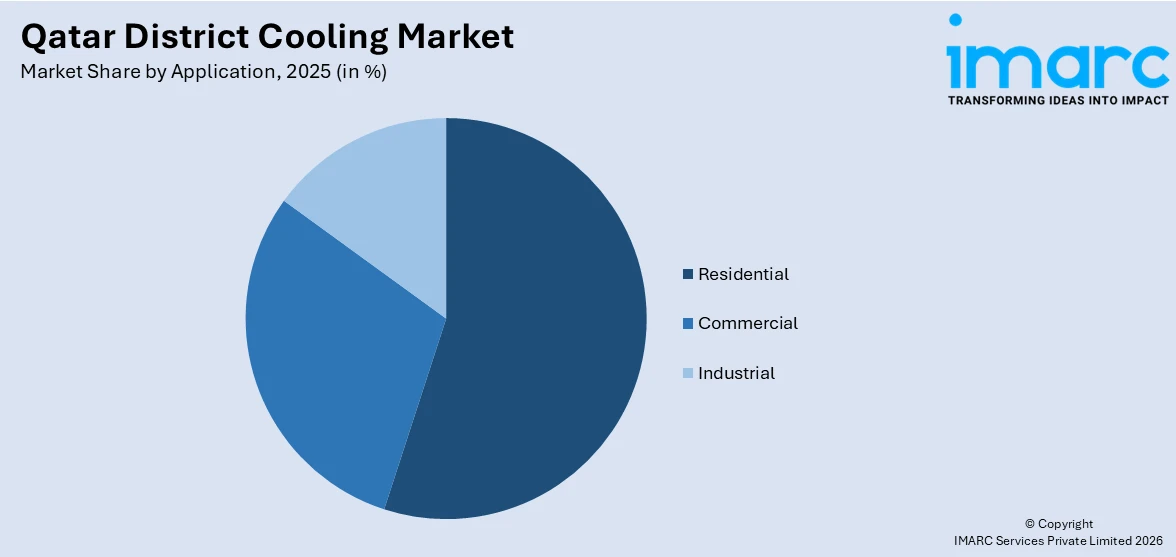
A detailed breakup and analysis of the market based on the application have also been provided in the report. This includes residential, commercial, and industrial.
Regional Insights:
- Ad Dawhah
- Al Rayyan
- Al Wakrah
- Others
The report has also provided a comprehensive analysis of all the major regional markets, which include Ad Dawhah, Al Rayyan, Al Wakrah, and others.

Competitive Landscape:
The market research report has also provided a comprehensive analysis of the competitive landscape. Competitive analysis such as market structure, key player positioning, top winning strategies, competitive dashboard, and company evaluation quadrant has been covered in the report. Also, detailed profiles of all major companies have been provided.
Qatar District Cooling Market News:
- June 2024: The United Development Company (UDC) approved the sale of a 40% stake in Qatar District Cooling Company (Qatar Cool) to the Qatar Investment Authority (QIA) for QR800 million (USD 216.6 million), while retaining a 51.06% stake. This strategic transaction enhances Qatar Cool's operational efficiency and competitiveness through partnership with Qatar's sovereign wealth fund, enabling continued investment in infrastructure and technology advancement. Zawya, "Qatar's UDC approves sale of 40% stake in Qatar Cool for $216.6mln", 2024.
Qatar District Cooling Market Report Coverage:
| Report Features | Details |
|---|---|
| Base Year of the Analysis | 2025 |
| Historical Period | 2020-2025 |
| Forecast Period | 2026-2034 |
| Units | Million USD |
| Scope of the Report |
Exploration of Historical Trends and Market Outlook, Industry Catalysts and Challenges, Segment-Wise Historical and Future Market Assessment:
|
| Production Techniques Covered | Electric Chillers, Heat Pumps, Absorption Chillers, Free Cooling, Others |
| Applications Covered | Residential, Commercial, Industrial |
| Regions Covered | Ad Dawhah, Al Rayyan, Al Wakrah, Others |
| Customization Scope | 10% Free Customization |
| Post-Sale Analyst Support | 10-12 Weeks |
| Delivery Format | PDF and Excel through Email (We can also provide the editable version of the report in PPT/Word format on special request) |
Key Questions Answered in This Report:
- How has the Qatar district cooling market performed so far and how will it perform in the coming years?
- What is the breakup of the Qatar district cooling market on the basis of production technique?
- What is the breakup of the Qatar district cooling market on the basis of application?
- What is the breakup of the Qatar district cooling market on the basis of region?
- What are the various stages in the value chain of the Qatar district cooling market?
- What are the key driving factors and challenges in the Qatar district cooling market?
- What is the structure of the Qatar district cooling market and who are the key players?
- What is the degree of competition in the Qatar district cooling market?
Key Benefits for Stakeholders:
- IMARC's industry report offers a comprehensive quantitative analysis of various market segments, historical and current market trends, market forecasts, and dynamics of the Qatar district cooling market from 2020-2034.
- The research report provides the latest information on the market drivers, challenges, and opportunities in the Qatar district cooling market.
- Porter's five forces analysis assist stakeholders in assessing the impact of new entrants, competitive rivalry, supplier power, buyer power, and the threat of substitution. It helps stakeholders to analyze the level of competition within the Qatar district cooling industry and its attractiveness.
- Competitive landscape allows stakeholders to understand their competitive environment and provides an insight into the current positions of key players in the market.
Need more help?
- Speak to our experienced analysts for insights on the current market scenarios.
- Include additional segments and countries to customize the report as per your requirement.
- Gain an unparalleled competitive advantage in your domain by understanding how to utilize the report and positively impacting your operations and revenue.
- For further assistance, please connect with our analysts.
 Request Customization
 Speak to an Analyst
 Request Brochure
 Inquire Before Buying
Benefits of Customization
- Personalize this research
- Triangulate with your data
- Get data as per your format and definition
- Gain a deeper dive into a specific application, geography, customer, or competitor
- Any level of personalization
Get in Touch With Us
UNITED STATES
Phone: +1-201-971-6302
INDIA
Phone: +91-120-433-0800
UNITED KINGDOM
Phone: +44-753-714-6104
Email: [email protected]
Client Testimonials




.webp)




.webp)













Related Reports

Choose your plan
*Please note that the prices mentioned below are starting prices for each bundle type. Kindly contact our team for further details.*
Single User License
- 1 User License, Access on 2 Devices
- PDF Report + Excel Dataset (Password Protected)
- Lifetime Access
- No Printing Rights
- 10% Free Report Customization
- 10–12 Weeks of Analyst Support
Five User License
- Access for 5 Users, 2 Devices per User
- PDF Report + Excel Dataset (Password Protected)
- Lifetime Access
- Dedicated Account Manager
- 12–14 Weeks of Analyst Support
- No Printing Rights
- 15% Free Report Customization
- 25% Discount on Your Next Purchase
Corporate User License
- Unlimited User Access (Within Your Organization)
- PDF Report + Excel Dataset
- Lifetime Access
- Dedicated Account Manager
- 14–20 Weeks of Analyst Support
- No Printing Rights
- 20% Free Report Customization
- 30% Discount on Your Next Purchase
Essential Insights
What's included:
3 reports
- Lifetime Access
- PDF Reports
- Excel Datasets
- 2 Weeks of Free Analyst Support
- 2 User Licenses
- Access on 2 Devices
- Printing Rights
- Complimentary PowerPoint (PPT) Version
- Complimentary License Upgrade
Professional Access
What's included:
5 reports
- Lifetime Access
- PDF Reports
- Excel Datasets
- 8 Weeks of Free Analyst Support
- 2 User Licenses
- Access on 2 Devices
- Printing Rights
- Complimentary PowerPoint (PPT) Version
- Complimentary License Upgrade
Business Advantage
What's included:
8 reports
- Lifetime Access
- PDF Reports
- Excel Datasets
- 14 Weeks of Free Analyst Support
- 2 User Licenses
- Access on 2 Devices
- Printing Rights
- Complimentary PowerPoint (PPT) Version
- Complimentary License Upgrade
Enterprise Intelligence
What's included:
10 reports
- Lifetime Access
- PDF Reports
- Excel Datasets
- 20 Weeks of Free Analyst Support
- 2 User Licenses
- Access on 2 Devices
- Printing Rights
- Complimentary PowerPoint (PPT) Version
- Complimentary License Upgrade