
Qatar Halal Food Market Size, Share, Trends and Forecast by Product, Distribution Channel, and Region, 2026-2034
Qatar Halal Food Market Summary:
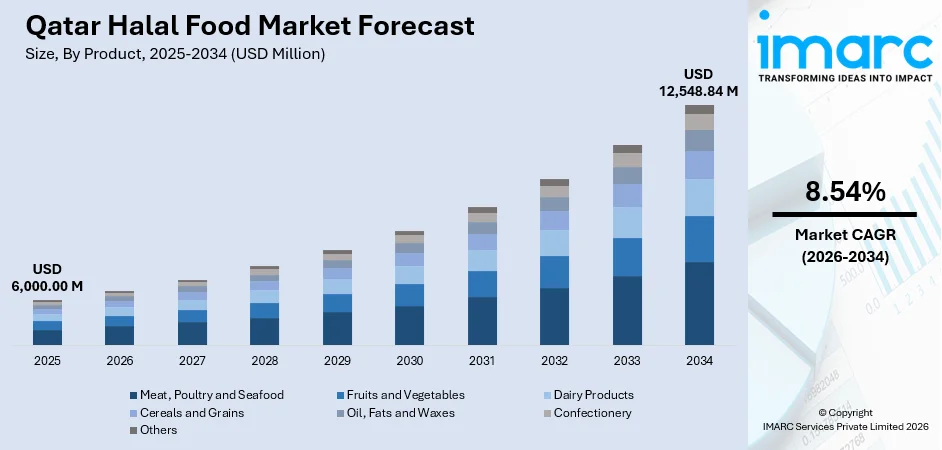
The Qatar halal food market size was valued at USD 6,000.00 Million in 2025 and is projected to reach USD 12,548.84 Million by 2034, growing at a compound annual growth rate of 8.54% from 2026-2034.
Due to the country's predominately Muslim populace, growing consumer demand for certified halal products, and the government's strong commitment to food security, the halal food industry in Qatar is expanding steadily. Consumption is also being driven by a growing tourist and hospitality industry, changing food habits, and increasing urbanization. The market share of halal food in Qatar is being strengthened by developments in local food production capabilities and the growth of contemporary retail infrastructure.
Key Takeaways and Insights:
- By Product: Meat, poultry and seafood dominate the market with a share of 41% in 2025, because of the strong adherence to Islamic dietary habits, the cultural importance of halal-certified protein products in Qatari cuisine, and the growing demand for premium meat among consumers due to increased disposable incomes.
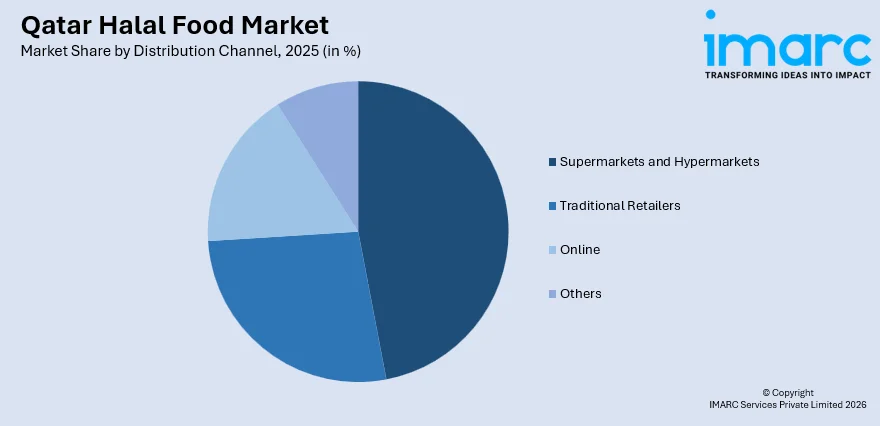
- By Distribution Channel: Supermarkets and hypermarkets lead the market with a share of 47% in 2025. Their wide range of products, aggressive pricing policies, one-stop shopping convenience, and the incorporation of halal-specific areas that boost customer confidence and trust are the main drivers of their supremacy.
- By Region: Ad Dawhah is the largest region with 51% share in 2025, fueled by the capital city's largest density of supermarkets and hypermarkets, prominent commercial buildings, flagship retail stores, and the population concentration of Qatar.
- Key Players: The market for halal food in Qatar is driven by major companies that increase product portfolios, improve halal certification requirements, invest in cold chain logistics, and establish strategic alliances with foreign suppliers to guarantee a steady supply of a wide range of halal-certified goods.
To get more information on this market Request Sample
The Qatar halal food market is advancing as government initiatives, expanding retail infrastructure, and evolving consumer lifestyles converge to create a favorable growth environment. The nation’s National Food Security Strategy 2030, launched by the Prime Minister in April 2025, is reshaping the food landscape by prioritizing domestic production, sustainable agriculture, and supply chain resilience. Qatar’s predominantly Muslim population ensures sustained baseline demand for halal-certified products across all food categories, while the growing expatriate community and tourism sector introduce diverse consumption patterns that broaden market opportunities. Over 950 productive farms are now operational nationwide, and the area dedicated to organic farming doubled in 2024, reflecting the government’s commitment to enhancing local food production capacity. The rapid expansion of e-commerce and digital food delivery platforms is further transforming consumer access to halal products, with online platforms enabling transparent product labeling, certification display, and traceability. Modern retail formats continue to expand, offering wider halal product assortments and reinforcing the market’s upward trajectory.
Qatar Halal Food Market Trends:
Rising Demand for Convenient and Ready-to-Eat Halal Food Products
Consumer tastes are shifting toward simple halal meal forms that need less preparation time due to changing lifestyles and rising workforce involvement. Precooked, frozen, and ready-to-eat meals that fit hectic work schedules are in great demand due to Qatar's high labor force participation rate. In the convenience market, organic and plant-based substitutes are being introduced as a result of health-conscious customers' simultaneous need for wholesome ready-to-eat solutions that adhere to halal certification criteria. The increasing demand for quick-serve meal options in both residential and commercial settings is propelling product variety and innovation, which in turn is bolstering the expansion of the halal food sector in Qatar.
Expansion of E-Commerce and Digital Food Delivery Platforms
The way that customers in Qatar may now obtain halal-certified goods is changing due to the explosive expansion of internet platforms. The reach of halal food brands has been greatly increased by online platforms and delivery apps, which allow processors and retailers to communicate directly with a larger audience without depending entirely on conventional retail channels. Additionally, visible product labeling, certification display, and traceability data are made possible by digital marketplaces, which boosts customer confidence in the authenticity of halal products. Quick-delivery partnerships and the growing use of mobile commerce are changing consumer behavior, promoting impulsive purchases, expanding product discovery, and opening up new distribution channels for up-and-coming halal food firms.
Government-Led Food Security and Domestic Production Initiatives
The government of Qatar is aggressively changing the halal food scene by implementing extensive food security initiatives that place an emphasis on independence and less reliance on imports. The halal food supply chain is being strengthened and domestic production capacities are being improved by sustained investments in livestock development, hydroponics, vertical farming, and agricultural technology. Government assistance programs provide nearby farmers access to markets, technological know-how, and necessary resources to increase output and product quality. These concerted efforts are encouraging food processing innovation, decreasing dependency on imported raw materials, and opening new business options for regional distributors and processors.
Market Outlook 2026-2034:
The Qatar halal food market is positioned for sustained expansion throughout the forecast period, supported by favorable demographic trends, government-backed food security programs, and modernizing retail and distribution infrastructure. Increasing consumer sophistication, coupled with rising demand for premium and organic halal-certified products, is expected to drive value growth across all product categories. The market generated a revenue of USD 6,000.00 Million in 2025 and is projected to reach a revenue of USD 12,548.84 Million by 2034, growing at a compound annual growth rate of 8.54% from 2026-2034. The expanding tourism and hospitality sectors, coupled with international events and the growing adoption of e-commerce and digital food delivery services, will continue boosting demand for diverse halal-certified food options. Strategic investments in cold chain logistics, domestic processing facilities, and halal certification infrastructure are expected to further strengthen the market’s competitive position within the broader GCC halal economy.
Qatar Halal Food Market Report Segmentation:
|
Segment Category |
Leading Segment |
Market Share |
|
Product |
Meat, Poultry and Seafood |
41% |
|
Distribution Channel |
Supermarkets and Hypermarkets |
47% |
|
Region |
Ad Dawhah |
51% |
Product Insights:
- Meat, Poultry and Seafood
- Fruits and Vegetables
- Dairy Products
- Cereals and Grains
- Oil, Fats and Waxes
- Confectionery
- Others
Meat, poultry and seafood dominate with a market share of 41% of the total Qatar halal food market in 2025.
Because the majority of Qatar's population is Muslim and adheres closely to Islamic dietary customs, meat, poultry, and seafood are the mainstays of the country's halal cuisine. These goods are consumed because of their cultural and religious value, which makes them mainstays of the local diet. Since chicken is still the most popular protein due to its affordability and adaptability across home and foodservice channels, consumers are spending more money on premium-grade halal meat, poultry, and seafood that satisfies strict quality expectations and certification standards as a result of rising disposable incomes.
The segment is further strengthened by Qatar’s strategic investments in domestic livestock production and cold chain infrastructure to reduce reliance on imports. In November 2024, Al Islami Foods, a prominent UAE-based halal poultry and meat provider, launched its extensive processed food range in Qatar, including burgers, nuggets, franks, kebabs, and mince, catering to modern households seeking convenient halal cooking solutions. The growing demand for processed and value-added meat products, combined with expanding retail availability through supermarkets and online platforms, continues to reinforce this segment’s leadership position.
Distribution Channel Insights:
Access the comprehensive market breakdown Request Sample
- Traditional Retailers
- Supermarkets and Hypermarkets
- Online
- Others
Supermarkets and hypermarkets lead with a share of 47% of the total Qatar halal food market in 2025.
Supermarkets and hypermarkets dominate halal food distribution in Qatar by offering extensive product assortments, competitive pricing, and dedicated halal sections that reinforce consumer trust and purchasing confidence. These modern retail formats provide a one-stop shopping experience with wide-ranging selections of fresh produce, frozen products, dairy items, and packaged halal-certified goods. The presence of major retail chains has expanded significantly across Qatar, with the country’s 19 largest malls currently offering nearly 1.5 Million Square Meters of gross leasable area, creating extensive retail touchpoints for halal food distribution.
The continued expansion of hypermarket and supermarket networks across Qatar’s residential and commercial districts is further consolidating this segment’s dominance. In February 2025, Al Meera Consumer Goods opened its latest state-of-the-art branch in Al Mansoura, spanning 5,500 Square Meters, equipped with cutting-edge digital screens, modern interiors, and a 6,500-Square-Meter parking basement. With over 69 branches nationwide, the retailer continues to strengthen halal food accessibility across all communities, offering high-quality local and international products at competitive prices and further reinforcing the channel’s pivotal role in Qatar’s halal food ecosystem.
Regional Insights:
- Ad Dawhah
- Al Rayyan
- Al Wakrah
- Others
The Ad Dawhah exhibits a clear dominance with 51% share of the total Qatar halal food market in 2025.
The capital and largest city of Qatar, Ad Dawhah, has the highest percentage of halal food consumption due to its high population density, thriving business district, and the greatest concentration of contemporary retail stores in the nation. The city is the main location for large supermarket and hypermarket chains, which together provide a wide variety of halal food products. Ad Dawhah's booming foodservice and hotel industries create significant institutional demand for halal-certified food items, and the city's status as the administrative and economic hub of the country further solidifies consumption trends for all product categories.
The region’s dominance is further reinforced by its role as Qatar’s economic and tourism center, attracting a diverse expatriate population and international visitors with varied dietary preferences that broaden halal food consumption patterns. Qatar recorded 5.08 Million visitor arrivals in 2024, with the majority of tourism activity concentrated in Ad Dawhah. Ongoing retail development, including the anticipated launch of Doha Mall with approximately 100,000 square meters of retail space, continues to expand the halal food distribution network and solidify Ad Dawhah’s position as the primary market for halal food consumption.

Market Dynamics:
Growth Drivers:
Why is the Qatar Halal Food Market Growing?
Strong Government Commitment to Food Security and Domestic Production
Through extensive investments in local manufacturing capacities and comprehensive food security measures, the government of Qatar is playing a crucial role in growing the market for halal food. Programs for national food security have been created with the goal of achieving sustained self-sufficiency through improved local production, robust supply systems, and flexible responses to international issues. Promoting healthy consumer behaviors, guaranteeing food safety and quality, and adjusting agricultural methods to climate change are the top priorities of these policies, which are in line with the nation's long-term goal. Through concerted marketing and distribution efforts, local vegetable production has achieved significant milestones, demonstrating the effectiveness of the government's agricultural assistance programs. Key government ministries' agricultural sections continue to supply local farmers with the knowledge and resources they need to increase output and quality. Investments in cutting-edge agricultural technology, such as vertical farming and hydroponics, are lowering dependency on conventional farming practices and enabling food production in dry environments. In order to boost innovation in cold chain logistics and food processing, the government is also encouraging collaborations between public organizations and private sector players. By increasing the robustness of the supply chain, decreasing reliance on imports, and encouraging innovation in agricultural and food processing technology, these government-led efforts are laying a strong foundation for the halal food industry.
Expanding Tourism and Hospitality Sector Driving Diverse Halal Food Demand
There is a significant demand for a variety of halal food items through institutional and retail channels due to Qatar's quickly expanding tourist and hospitality sectors. As part of its national development goal, the nation has ambitious intentions to further promote international tourism, and tourist arrivals have been steadily increasing. Increased consumption of halal-certified food products through hotels, restaurants, catering services, and retail establishments frequented by foreign tourists is a direct result of this tourism growth. The market for foodservice has expanded dramatically, and the breadth and diversity of Qatar's culinary scene are reflected in the wide and growing network of eateries. The country's standing as a top culinary destination is being enhanced by government-led tourism marketing efforts and worldwide culinary recognition programs, which are drawing food tourists and increasing demand for high-end halal products. As restaurants and hotels look for dependable sources of premium halal-certified ingredients to satisfy the varied dietary requirements of an increasingly global clientele, the growth of the hospitality industry is also driving growth in halal food processing, packaging, and supply chain services. Both local producers and imports catering to institutional clients are benefiting from the continuous demand created by the intersection of growing tourism and culinary diversity across a number of halal food categories.
Rising Consumer Awareness and Preference for Certified Halal Products
The growth of the Qatari halal food sector is being mostly driven by rising consumer knowledge of food safety, quality control, and ethical sourcing methods. Verified halal certification is becoming more and more important to consumers, who see it as a sign of improved sanitary standards, traceability, and overall product integrity in addition to religious conformity. This increased knowledge is not limited to Muslims; non-Muslim buyers in Qatar are also favoring halal-certified goods because they believe they are safer, cleaner, and more ethically made. Consumer trust in the halal food supply chain is strengthened by the Ministry of Public Health's extensive frameworks for importing halal food items, which include recognized certification organizations and stringent inspection procedures. The nation's dedication to growing the halal economy and strengthening international ties for halal commerce is further demonstrated by its active involvement in international halal industry forums and trade events. It is anticipated that important business executives and investors would attend planned halal-focused exhibits and conferences, solidifying Qatar's standing as a regional center for the halal economy. All demographic groups are benefiting from increased consumer participation and well-informed purchase decisions as a result of educational efforts and media activities raising awareness of halal.
Market Restraints:
What Challenges the Qatar Halal Food Market is Facing?
High Import Dependency and Supply Chain Vulnerabilities
Qatar’s arid climate restricts large-scale farming, poultry, and livestock production, making local food processors heavily dependent on international suppliers for halal-certified raw materials. Any disruption in global logistics, currency fluctuations, or geopolitical tensions affects supply continuity and increases procurement costs. Ensuring halal compliance along extended supply chains spanning multiple countries adds further complexity, reducing the ability to control quality and traceability at the primary source level and limiting product diversification capabilities.
Elevated Production Costs and Limited Scale Efficiencies
Halal food processing in Qatar faces higher production costs due to the small domestic market size, premium-priced labor, and expensive imported raw materials. Maintaining halal-compliant facilities requires segregation of equipment, stringent hygiene protocols, certified suppliers, and continuous auditing, which increase overhead expenses. Limited local demand restricts large-scale production, reducing cost efficiencies and making it difficult for domestic processors to compete against established halal exporters from countries with lower production costs.
Complex Regulatory and Certification Requirements
The halal food market in Qatar is subject to stringent regulatory standards and certification requirements that create compliance challenges for both domestic producers and international importers. Multiple layers of food safety inspections, halal certification verification, and quality control testing increase the time and cost associated with bringing products to market. Varying halal certification standards across different countries of origin further complicate the import process and can delay product availability for consumers.
Competitive Landscape:
The Qatar halal food market features a moderately competitive landscape with established domestic players and international brands competing for market share. Competition centers on product quality, halal certification authenticity, distribution network strength, and brand reputation built through consistent compliance with Islamic dietary laws. Key market participants are investing in vertical integration strategies encompassing raw material sourcing, processing facilities, and distribution channels to ensure end-to-end quality control and traceability. Companies differentiate through product innovations, including convenient formats, health-focused formulations, and premium positioning while maintaining stringent halal standards. Strategic partnerships with international brands and technology providers enable access to advanced processing equipment and management expertise, strengthening market positioning.
Qatar Halal Food Market Report Coverage:
|
Report Features |
Details |
|
Base Year of the Analysis |
2025 |
|
Historical Period |
2020-2025 |
|
Forecast Period |
2026-2034 |
|
Units |
Million USD |
|
Scope of the Report |
Exploration of Historical Trends and Market Outlook, Industry Catalysts and Challenges, Segment-Wise Historical and Future Market Assessment:
|
|
Products Covered |
Meat, Poultry and Seafood; Fruits and Vegetables; Dairy Products; Cereals and Grains; Oil, Fats and Waxes; Confectionery; Others |
|
Distribution Channels Covered |
Traditional Retailers, Supermarkets and Hypermarkets, Online, Others |
|
Regions Covered |
Ad Dawhah, Al Rayyan, Al Wakrah, Others |
|
Customization Scope |
10% Free Customization |
|
Post-Sale Analyst Support |
10-12 Weeks |
|
Delivery Format |
PDF and Excel through Email (We can also provide the editable version of the report in PPT/Word format on special request) |
Frequently Asked Questions About the Qatar Halal Food Market Report
The Qatar halal food market size was valued at USD 6,000.00 Million in 2025.
The Qatar halal food market size was valued at USD 6,000.00 Million in 2025.
The Qatar halal food market is expected to grow at a compound annual growth rate of 8.54% from 2026-2034 to reach USD 12,548.84 Million by 2034.
Meat, poultry and seafood dominated the market with a share of 41%, driven by the cultural centrality of halal-certified protein products, strong adherence to Islamic dietary practices, and growing demand for premium-quality meat across household and institutional channels.
Key factors driving the Qatar halal food market include government food security initiatives, expanding tourism and hospitality demand, rising consumer awareness of halal certification, growing e-commerce adoption, and increasing investments in domestic food production and processing capabilities.
Major challenges include high import dependency and supply chain vulnerabilities, elevated production costs limiting scale efficiencies, complex regulatory and certification requirements, stringent halal compliance across international supply chains, and limited domestic agricultural production capacity.
Need more help?
- Speak to our experienced analysts for insights on the current market scenarios.
- Include additional segments and countries to customize the report as per your requirement.
- Gain an unparalleled competitive advantage in your domain by understanding how to utilize the report and positively impacting your operations and revenue.
- For further assistance, please connect with our analysts.
 Request Customization
 Speak to an Analyst
 Request Brochure
 Inquire Before Buying
Benefits of Customization
- Personalize this research
- Triangulate with your data
- Get data as per your format and definition
- Gain a deeper dive into a specific application, geography, customer, or competitor
- Any level of personalization
Get in Touch With Us
UNITED STATES
Phone: +1-201-971-6302
INDIA
Phone: +91-120-433-0800
UNITED KINGDOM
Phone: +44-753-714-6104
Email: [email protected]
Client Testimonials




.webp)




.webp)













Related Reports

Choose your plan
*Please note that the prices mentioned below are starting prices for each bundle type. Kindly contact our team for further details.*
Single User License
- 1 User License, Access on 2 Devices
- PDF Report + Excel Dataset (Password Protected)
- Lifetime Access
- No Printing Rights
- 10% Free Report Customization
- 10–12 Weeks of Analyst Support
Five User License
- Access for 5 Users, 2 Devices per User
- PDF Report + Excel Dataset (Password Protected)
- Lifetime Access
- Dedicated Account Manager
- 12–14 Weeks of Analyst Support
- No Printing Rights
- 15% Free Report Customization
- 25% Discount on Your Next Purchase
Corporate User License
- Unlimited User Access (Within Your Organization)
- PDF Report + Excel Dataset
- Lifetime Access
- Dedicated Account Manager
- 14–20 Weeks of Analyst Support
- No Printing Rights
- 20% Free Report Customization
- 30% Discount on Your Next Purchase
Essential Insights
What's included:
3 reports
- Lifetime Access
- PDF Reports
- Excel Datasets
- 2 Weeks of Free Analyst Support
- 2 User Licenses
- Access on 2 Devices
- Printing Rights
- Complimentary PowerPoint (PPT) Version
- Complimentary License Upgrade
Professional Access
What's included:
5 reports
- Lifetime Access
- PDF Reports
- Excel Datasets
- 8 Weeks of Free Analyst Support
- 2 User Licenses
- Access on 2 Devices
- Printing Rights
- Complimentary PowerPoint (PPT) Version
- Complimentary License Upgrade
Business Advantage
What's included:
8 reports
- Lifetime Access
- PDF Reports
- Excel Datasets
- 14 Weeks of Free Analyst Support
- 2 User Licenses
- Access on 2 Devices
- Printing Rights
- Complimentary PowerPoint (PPT) Version
- Complimentary License Upgrade
Enterprise Intelligence
What's included:
10 reports
- Lifetime Access
- PDF Reports
- Excel Datasets
- 20 Weeks of Free Analyst Support
- 2 User Licenses
- Access on 2 Devices
- Printing Rights
- Complimentary PowerPoint (PPT) Version
- Complimentary License Upgrade