
Qatar Nuclear Energy Market Size, Share, Trends and Forecast by Application, Reactor Type, and Region, 2026-2034
Qatar Nuclear Energy Market Summary:
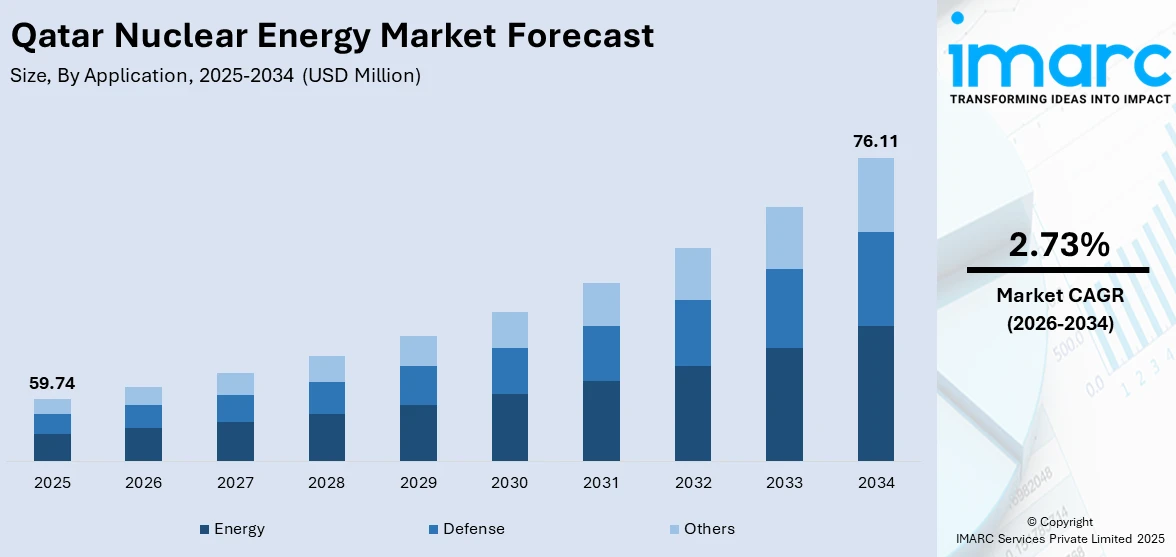
The Qatar nuclear energy market size reached USD 59.74 Million in 2025 and is projected to reach USD 76.11 Million by 2034, growing at a compound annual growth rate of 2.73% from 2026-2034.
The market is propelled by Qatar's strategic focus on energy diversification, environmental sustainability commitments under Qatar National Vision 2030, and growing interest in advanced nuclear technologies. Rising domestic electricity demand, fueled by rapid urbanization and industrial expansion, is encouraging exploration of nuclear power as a sustainable complement to the nation's existing energy infrastructure. Government initiatives aligned with carbon reduction goals and international collaborations with organizations such as the International Atomic Energy Agency further support the Qatar nuclear energy market share.
Key Takeaways and Insights:
- By Application: Energy dominates the market with a share of 85% in 2025, reflecting Qatar’s emphasis on generating clean electricity and strengthening baseload power capacity to support sustainable development objectives.
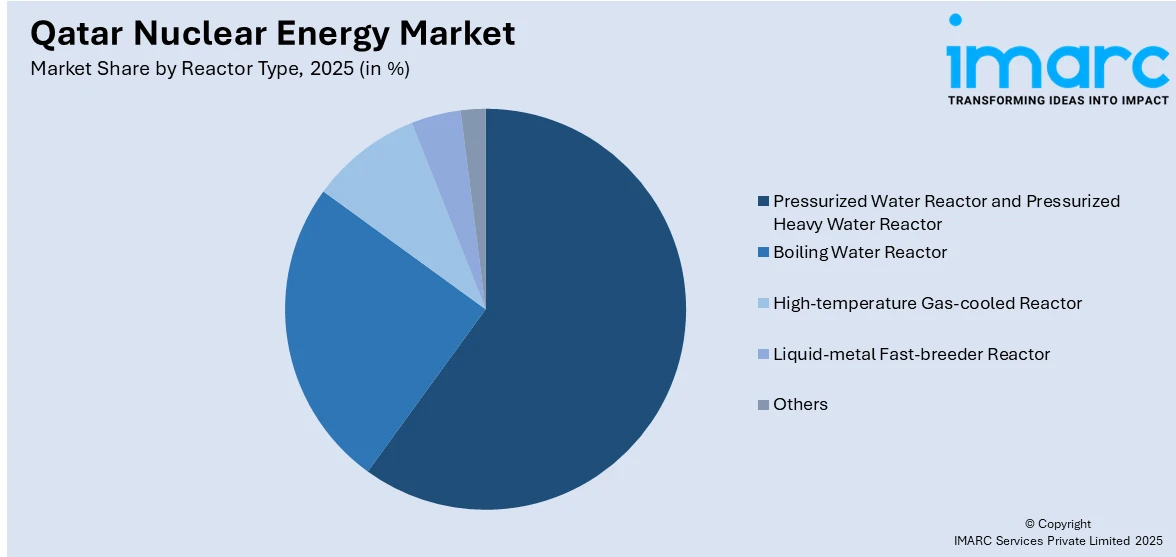
- By Reactor Type: Pressurized water reactor and pressurized heavy water reactor leads the market with a share of 60% in 2025, owing to proven operational reliability, established safety records, and suitability for regional climate conditions.
- Key Players: The Qatar nuclear energy market exhibits a nascent competitive landscape characterized by strategic international partnerships and sovereign wealth fund investments in global nuclear technology developers, reflecting the nation's exploration of emerging nuclear capabilities rather than domestic reactor deployment.
To get more information on this market Request Sample
Qatar’s nuclear energy sector is emerging as a strategic component of the nation’s broader energy diversification efforts. Although the country does not yet operate domestic nuclear power plants, its approach focuses on strategic investments and international partnerships to gain exposure to nuclear technologies. These initiatives allow Qatar to participate in the commercialization and development of advanced nuclear solutions while avoiding direct operational responsibilities. The market’s growth is supported by engagement with global nuclear agencies, enabling the country to strengthen regulatory frameworks and develop expertise in nuclear governance and safety. In parallel, Qatar is investing in human capital by fostering education and skills development in nuclear science, preparing a foundation for future sector expansion. Through a combination of financial participation, international collaboration, regulatory readiness, and talent cultivation, Qatar is positioning itself to play a knowledgeable and influential role in regional and global nuclear energy developments over the coming years. For instance, in November 2023, the International Atomic Energy Agency (IAEA) approved three national initiatives in Qatar, scheduled to commence in January and run over three years.
Qatar Nuclear Energy Market Trends:
Strategic Investment in Small Modular Reactor Technologies
Qatar is establishing itself as a strategic investor in advanced nuclear technologies, with a focus on small modular reactors that provide greater safety and flexible deployment. Through targeted investments in international nuclear ventures, the country is gaining exposure to cutting-edge technology and commercial developments. This approach allows Qatar to participate in global nuclear advancements while exploring potential future applications, including areas such as seawater desalination, where these reactors offer significant technical benefits. The strategy emphasizes knowledge acquisition, technology monitoring, and long-term energy diversification opportunities. For instance, in December 2025, Qatar invested £1 billion in climate technologies, reinforcing the UK’s position as a leader in clean energy. The funding supported projects led by Rolls-Royce, advancing the transition to low-carbon energy solutions. This initial milestone in the UK-Qatar clean energy partnership was marked by the Prime Minister and His Highness The Amir of Qatar during the state visit to Downing Street. The collaboration generated thousands of jobs in both the UK and Doha over the course of its implementation.
Enhanced International Cooperation for Nuclear Knowledge Transfer
Qatar has strengthened its collaboration with international nuclear governance organizations to advance knowledge sharing and capacity building. The country has worked closely with global agencies to enhance its nuclear regulatory framework and ensure robust governance. Efforts also focus on developing human capital, with initiatives supporting education, training, and skill-building in nuclear science. In parallel, Qatar has established itself as a regional center for nuclear medicine training, providing specialized programs and resources that enhance expertise in medical applications of nuclear technology and position the nation as a hub for regional knowledge exchange. For instance, in September 2024, Qatar expressed its appreciation to the IAEA for supporting the peaceful use of nuclear applications in developing countries and facilitating technology and knowledge transfer. HE Dr. Ahmed bin Hassan Al Hammadi, Secretary-General of the Ministry of Foreign Affairs and Qatar’s IAEA Governor, delivered the statement during the Board of Governors session in Vienna, emphasizing the Agency’s efforts in advancing nuclear science, technology, and applications.
Growing Focus on Nuclear Technology for Non-Electric Applications
Qatar is expanding the use of nuclear technology beyond power generation to support sectors such as food security, healthcare, agriculture, and water management. The country has highlighted the importance of non-electric nuclear applications and promoted programs addressing environmental and public health challenges. Efforts also focus on encouraging broader participation, including initiatives to support women in nuclear-related fields. This integrated approach aligns nuclear technology development with global sustainability goals and Qatar’s long-term objectives, positioning the nation to leverage nuclear science for social, environmental, and economic benefits across multiple sectors.
Market Outlook 2026-2034:
The Qatar nuclear energy market is set for gradual growth as the country pursues strategic investments in international nuclear technology while strengthening domestic regulatory frameworks. Rising energy needs make nuclear options increasingly relevant for long-term energy security. By focusing on small modular reactors, especially for potential desalination applications, Qatar is adopting a practical and regionally appropriate approach to engaging with nuclear technology, balancing innovation, safety, and sustainability in its broader energy diversification strategy. The market generated a revenue of USD 59.74 Million in 2025 and is projected to reach a revenue of USD 76.11 Million by 2034, growing at a compound annual growth rate of 2.73% from 2026-2034.
Qatar Nuclear Energy Market Report Segmentation:
| Segment Category | Leading Segment | Market Share |
|---|---|---|
|
Application |
Energy |
85% |
|
Reactor Type |
Pressurized Water Reactor and Pressurized Heavy Water Reactor |
60% |
Application Insights:
- Energy
- Defense
- Others
Energy dominates with a market share of 85% of the total Qatar nuclear energy market in 2025.
The energy application segment holds the largest share of Qatar’s nuclear energy market, reflecting the country’s strategic emphasis on diversifying electricity generation beyond natural gas. Growing electricity demand has fueled interest in reliable baseload power solutions that can complement variable renewable energy sources, positioning nuclear technology as a key component of Qatar’s long-term energy strategy and efforts to ensure a stable, sustainable power supply. The Third National Development Strategy 2024-2030 emphasizes sustainable energy infrastructure, positioning nuclear technology as a potential long-term contributor to grid stability and energy security.
Qatar’s nuclear energy initiatives extend beyond traditional power generation to include seawater desalination, addressing the nation’s reliance on energy-intensive water production. The Qatar energy storage market size reached 14.38 MWh in 2024. The market is projected to reach 329.72 MWh by 2033, exhibiting a growth rate (CAGR) of 41.63% during 2025-2033. The country is exploring small modular reactor technologies for dual-purpose plants capable of supplying both electricity and desalinated water. With growing focus on nuclear desalination, this area offers substantial potential to support Qatar’s long-term water security and sustainability objectives while integrating advanced nuclear solutions into critical infrastructure planning.
Reactor Type Insights:
Access the comprehensive market breakdown Request Sample
- Pressurized Water Reactor and Pressurized Heavy Water Reactor
- Boiling Water Reactor
- High-temperature Gas-cooled Reactor
- Liquid-metal Fast-breeder Reactor
- Others
Pressurized water reactor and pressurized heavy water reactor leads with a share of 60% of the total Qatar nuclear energy market in 2025.
Pressurized water reactor technology is a key focus in Qatar’s nuclear energy strategy due to its proven performance and established track record in regional deployments. This technology offers well-documented safety features, including advanced passive shutdown systems, making it a reliable option for countries exploring nuclear energy. Regional examples of successful implementation serve as benchmarks, providing insights into operational efficiency, regulatory compliance, and safety management. By studying these precedents, Qatar can evaluate the suitability of pressurized water reactors for its energy diversification goals while leveraging lessons learned from neighboring experiences.
Qatar’s investment in Rolls-Royce small modular reactors reflects its interest in the evolution of pressurized water reactor technology. These compact reactors are designed to deliver reliable power while requiring significantly less space than conventional nuclear facilities. Through strategic international partnerships, Qatar gains exposure to commercialized nuclear innovations without taking on direct operational responsibilities. This approach allows the country to monitor technological advancements, assess potential applications, and participate in next-generation nuclear development, supporting its long-term energy diversification and sustainability objectives while minimizing operational and financial risks.
Regional Insights:
- Ad Dawhah
- Al Rayyan
- Al Wakrah
- Others
Ad Dawhah, the capital city and economic center of Qatar, inspires interest in nuclear energy due to the high demand for electricity in the commercial, governmental, and residential sectors. The increase in urbanization, infrastructure, and facilities that are energy-demanding generates the necessity to have constant power that can be termed as baseload. The sustainable energy strategy and renewable sources combine with nuclear technology as a complementary option in the grid stability and long-term energy security in the city.
Al Rayyan, a fast-growing municipality that has educational establishments, residential areas, and industrial estates, is creating an interest in nuclear energy to facilitate energy diversification. The rising electricity demands in the region, together with the prospects of sustainable urbanization and modernization of the infrastructure, generate a need for stable baseload generation. Small modular reactors, and nuclear technologies in general, are regarded as a strategic addition to renewable energy, and can be used to improve reliability and long-term planning of energy in the region.
Al Wakrah’s industrial and port-centric economy, alongside residential expansion, drives nuclear energy considerations for a stable and efficient electricity supply. The infrastructure development of the municipality and the energy-intensive processes make them interested in the low-carbon baseload solutions. Nuclear energy, such as dual use for desalination, is placed as a strategic alternative to strengthen water and energy security and supplement renewable energy programs and sustainable development of the industrial and residential sectors.
Market Dynamics:
Growth Drivers:
Why is the Qatar Nuclear Energy Market Growing?
Energy Diversification and Carbon Reduction Commitments
Qatar's nuclear energy market growth is fundamentally driven by the nation's commitment to energy diversification and environmental sustainability under Qatar National Vision 2030. The country's Nationally Determined Contribution commits to reducing greenhouse gas emissions by 25% by 2030 compared to baseline scenarios, necessitating exploration of low-carbon energy alternatives. Nuclear energy's position as a carbon-free baseload power source aligns with these objectives while offering continuous generation capability that complements intermittent renewable sources. The Qatar National Renewable Energy Strategy targets 18% renewables in the power mix by 2030, and nuclear technology provides a complementary pathway for deeper decarbonization beyond this horizon.
Rising Domestic Electricity Demand and Energy Security Imperatives
Qatar faces substantial electricity demand growth driven by rapid urbanization, industrial expansion, and population increase. Electricity consumption has increased at 6.5% annually since 2020, reaching 56 terawatt-hours in 2024, with projections indicating a 58% demand increase by 2040 compared to 2021 levels. This sustained growth, combined with air conditioning loads and water desalination requirements unique to the Gulf climate, creates compelling rationale for diversified generation sources. While natural gas remains abundant, heavy dependence on a single fuel source presents long-term energy security risks. Nuclear energy offers baseload reliability independent of natural gas market dynamics, supporting Qatar's strategic objective of maintaining energy security while preserving LNG export capacity that generates critical government revenues.
Potential for Nuclear Desalination Applications
The arid climate and a short supply of freshwater in Qatar make the country very dependent on the energy-consuming desalination process. Nuclear technology, particularly small modular reactors promise solutions to the generation of electricity and desalinated water. Experience in the world has demonstrated the technical feasibility of nuclear desalination, and SMRs are under consideration to be implemented in high-power-demand desalination regions. With the investment in the advanced SMR technology, Qatar will be able to acquire the experience in the solutions designed to integrate water and power to serve the long-term national development objectives and improve the energy and water security in the country.
Market Restraints:
What Challenges the Qatar Nuclear Energy Market is Facing?
Absence of Domestic Nuclear Power Plant Development Plans
Qatar currently has no announced plans to incorporate nuclear power plants into its domestic energy infrastructure, constraining market growth to international investments and technology assessment activities. The nation's abundant natural gas reserves reduce immediate pressure to pursue capital-intensive nuclear construction, with existing thermal power capacity exceeding twelve gigawatts. This strategic posture limits direct market development compared to the neighboring UAE's operational reactor deployment.
Complex Regulatory and Infrastructure Requirements
Developing nuclear energy capabilities requires extensive regulatory frameworks, safety protocols, and specialized infrastructure that demand significant time and investment. Qatar's nuclear legal framework, based on the Radiation Protection Law of 2002, is undergoing strengthening with IAEA assistance. Building comprehensive regulatory capacity, training qualified workforce, and establishing nuclear-grade supply chains present substantial barriers to rapid market development.
Competition from Established Renewable Energy Initiatives
Qatar’s rapid expansion of solar energy is creating strong competition for clean energy investments. The declining costs and growing efficiency of solar technology are enhancing its attractiveness compared with other low-carbon options. This shift toward renewable energy is likely to influence near-term energy planning, potentially reducing the immediate focus on nuclear power development.
Competitive Landscape:
The Qatar nuclear energy market is shaped by a unique competitive structure focused on strategic international investments rather than direct domestic operations. The country emphasizes financial participation in global nuclear ventures, allowing it to gain exposure to nuclear technology commercialization without assuming operational responsibilities. Regional nuclear developments in neighboring Gulf countries provide insights and benchmarks for market positioning, while international technology providers offer potential collaboration opportunities. Qatar’s engagement in regulatory frameworks, knowledge transfer, and technical cooperation programs with global nuclear agencies helps build domestic expertise, supporting informed decision-making, technology evaluation, and the development of strategic partnerships for future nuclear initiatives.
Recent Developments:
- March 2024: Qatar addressed the IAEA Board of Governors meeting, praising the agency's role in nuclear technology transfer for peaceful purposes. Ambassador Jassim Yaqoub Al Hamadi highlighted Seibersdorf laboratories' training programs for Qatari experts and announced Qatar's ongoing investment in small modular reactor development with specialized global companies.
- May 2024: The International Atomic Energy Agency conducted a Legislative Assistance Mission to Doha, meeting with the Ministry of Environment and Climate Change to conduct a comprehensive review of Qatar's draft nuclear legislation and strengthen the national nuclear legal framework for safe, secure, and peaceful use of nuclear technology.
Qatar Nuclear Energy Market Report Coverage:
| Report Features | Details |
|---|---|
| Base Year of the Analysis | 2025 |
| Historical Period | 2020-2025 |
| Forecast Period | 2026-2034 |
| Units | Million USD |
| Scope of the Report | Exploration of Historical Trends and Market Outlook, Industry Catalysts and Challenges, Segment-Wise Historical and Future Market Assessment:
|
| Applications Covered | Energy, Defense, Others |
| Reactor Types Covered | Pressurized Water Reactor and Pressurized Heavy Water Reactor, Boiling Water Reactor, High-temperature Gas-cooled Reactor, Liquid-metal Fast-breeder Reactor, Others |
| Regions Covered | Ad Dawhah, Al Rayyan, Al Wakrah, Others |
| Customization Scope | 10% Free Customization |
| Post-Sale Analyst Support | 10-12 Weeks |
| Delivery Format | PDF and Excel through Email (We can also provide the editable version of the report in PPT/Word format on special request) |
Frequently Asked Questions About the Qatar Nuclear Energy Market Report
The Qatar nuclear energy market size was valued at USD 59.74 Million in 2025.
The Qatar nuclear energy market is expected to grow at a compound annual growth rate of 2.73% from 2026-2034 to reach USD 76.11 Million by 2034.
Energy dominated with 85% market share in 2025, driven by Qatar's strategic focus on clean electricity generation alternatives, baseload power reliability requirements, and potential integration with seawater desalination infrastructure for dual-purpose applications.
Key factors driving the Qatar nuclear energy market include energy diversification imperatives under Qatar National Vision 2030, carbon reduction commitments targeting 25% greenhouse gas emission reduction by 2030, rising domestic electricity demand, and strategic interest in small modular reactor technologies for potential desalination applications.
Major challenges include the absence of domestic nuclear power plant development plans, complex regulatory and safety infrastructure requirements, competition from rapidly expanding and cost-competitive solar energy initiatives, specialized workforce development needs, and regional geopolitical considerations affecting nuclear technology deployment decisions.
Need more help?
- Speak to our experienced analysts for insights on the current market scenarios.
- Include additional segments and countries to customize the report as per your requirement.
- Gain an unparalleled competitive advantage in your domain by understanding how to utilize the report and positively impacting your operations and revenue.
- For further assistance, please connect with our analysts.
 Request Customization
 Speak to an Analyst
 Request Brochure
 Inquire Before Buying
Benefits of Customization
- Personalize this research
- Triangulate with your data
- Get data as per your format and definition
- Gain a deeper dive into a specific application, geography, customer, or competitor
- Any level of personalization
Get in Touch With Us
UNITED STATES
Phone: +1-201-971-6302
INDIA
Phone: +91-120-433-0800
UNITED KINGDOM
Phone: +44-753-714-6104
Email: [email protected]
Client Testimonials




.webp)




.webp)













Related Reports

Choose your plan
*Please note that the prices mentioned below are starting prices for each bundle type. Kindly contact our team for further details.*
Single User License
- 1 User License, Access on 2 Devices
- PDF Report + Excel Dataset (Password Protected)
- Lifetime Access
- No Printing Rights
- 10% Free Report Customization
- 10–12 Weeks of Analyst Support
Five User License
- Access for 5 Users, 2 Devices per User
- PDF Report + Excel Dataset (Password Protected)
- Lifetime Access
- Dedicated Account Manager
- 12–14 Weeks of Analyst Support
- No Printing Rights
- 15% Free Report Customization
- 25% Discount on Your Next Purchase
Corporate User License
- Unlimited User Access (Within Your Organization)
- PDF Report + Excel Dataset
- Lifetime Access
- Dedicated Account Manager
- 14–20 Weeks of Analyst Support
- No Printing Rights
- 20% Free Report Customization
- 30% Discount on Your Next Purchase
Essential Insights
What's included:
3 reports
- Lifetime Access
- PDF Reports
- Excel Datasets
- 2 Weeks of Free Analyst Support
- 2 User Licenses
- Access on 2 Devices
- Printing Rights
- Complimentary PowerPoint (PPT) Version
- Complimentary License Upgrade
Professional Access
What's included:
5 reports
- Lifetime Access
- PDF Reports
- Excel Datasets
- 8 Weeks of Free Analyst Support
- 2 User Licenses
- Access on 2 Devices
- Printing Rights
- Complimentary PowerPoint (PPT) Version
- Complimentary License Upgrade
Business Advantage
What's included:
8 reports
- Lifetime Access
- PDF Reports
- Excel Datasets
- 14 Weeks of Free Analyst Support
- 2 User Licenses
- Access on 2 Devices
- Printing Rights
- Complimentary PowerPoint (PPT) Version
- Complimentary License Upgrade
Enterprise Intelligence
What's included:
10 reports
- Lifetime Access
- PDF Reports
- Excel Datasets
- 20 Weeks of Free Analyst Support
- 2 User Licenses
- Access on 2 Devices
- Printing Rights
- Complimentary PowerPoint (PPT) Version
- Complimentary License Upgrade