
Qatar Smart Cities Market Size, Share, Trends and Forecast by Focus Area, Smart Transportation, Smart Buildings, Smart Utilities, Smart Citizen Services, and Region, 2026-2034
Qatar Smart Cities Market Summary:
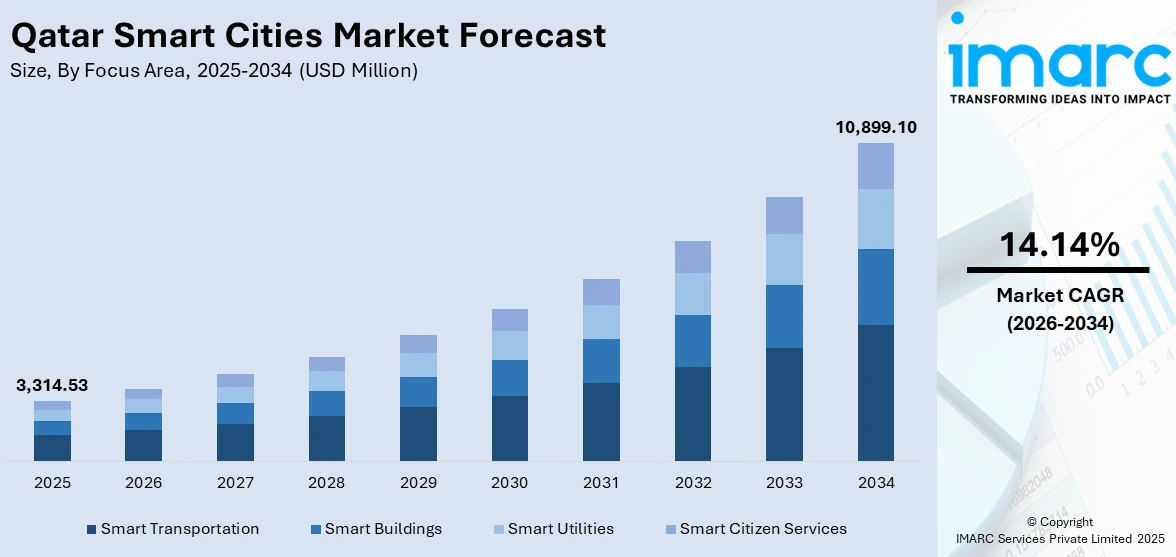
The Qatar smart cities market size was valued at USD 3,314.53 Million in 2025 and is projected to reach USD 10,899.10 Million by 2034, growing at a compound annual growth rate of 14.14% from 2026-2034.
The Qatar smart cities market is currently experiencing robust expansion driven by the government's commitment to digital transformation and sustainable urban development. The nation's strategic investments in intelligent infrastructure, IoT-enabled systems, and integrated urban management platforms are reshaping metropolitan landscapes. Advancing smart mobility solutions, energy-efficient building technologies, and citizen-centric digital services are collectively strengthening the Qatar smart cities market share.
Key Takeaways and Insights:
- By Focus Area: Smart transportation dominates the market with a share of 34% in 2025, driven by substantial government investments in intelligent traffic systems, metro network expansion, and autonomous vehicle pilot programs. Rising urban mobility demands and sustainability mandates are accelerating adoption.
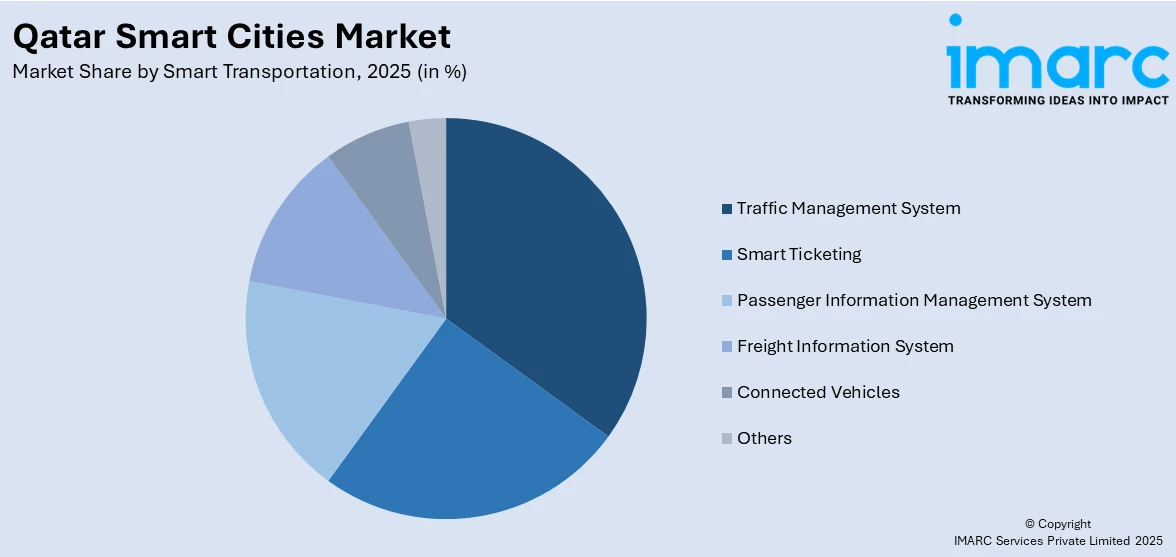
- By Smart Transportation: Traffic management system leads the market with a share of 30% in 2025, owing to Qatar's emphasis on reducing congestion and enhancing road safety through AI-powered analytics and real-time monitoring infrastructure across metropolitan corridors.
- By Smart Buildings: Building energy optimization exhibits a clear dominance with 38% share in 2025, reflecting Qatar's commitment to sustainability through GSAS certification requirements and advanced building management systems that reduce energy consumption.
- By Smart Utilities: Advanced metering infrastructure represents the biggest segment with a market share of 42% in 2025, supported by Kahramaa's nationwide smart meter deployment initiative targeting complete electricity meter coverage by the end of the year.
- By Smart Citizen Services: Smart healthcare dominates the market with a share of 29% in 2025, owing to expanded telemedicine platforms, electronic health record integration, and AI-powered diagnostic systems across government healthcare institutions.
- By Region: Ad Dawhah is the largest region with 46% share in 2025, driven by the concentration of government ministries, commercial headquarters, and flagship smart city developments including Msheireb Downtown Doha.
- Key Players: Key players drive the Qatar smart cities market by implementing integrated urban management platforms, expanding IoT connectivity networks, developing AI-powered analytics solutions, and forming strategic public-private partnerships to accelerate digital infrastructure deployment and smart service delivery.
To get more information on this market Request Sample
The Qatar smart cities market is advancing rapidly as the nation implements comprehensive digital transformation strategies aligned with Qatar National Vision 2030 and the Third National Development Strategy. Government authorities are deploying sophisticated urban management systems that leverage artificial intelligence, big data analytics, and Internet of Things technologies to enhance operational efficiency across transportation, utilities, and citizen services. The TASMU Smart Qatar initiative serves as the flagship program coordinating digital innovation across healthcare, transport, environment, logistics, and sports sectors. In September 2025, the Ministry of Transport launched its Strategy 2025-2030 comprising 125 projects across 42 initiatives with investments exceeding QAR 1.2 Billion, demonstrating Qatar's commitment to smart mobility innovation. Strategic developments in Lusail City and Msheireb Downtown Doha showcase integrated smart infrastructure combining energy-efficient buildings, intelligent transportation networks, and connected citizen services. These initiatives are fostering innovation ecosystems that attract technology providers, nurture local talent, and position Qatar as a regional smart city benchmark while achieving sustainability objectives.
Qatar Smart Cities Market Trends:
AI-Powered Smart City Operating Systems Integration
Qatar is witnessing accelerated adoption of artificial intelligence-driven smart city platforms that unify diverse urban systems including lighting, traffic management, and building operations into centralized command centers. These integrated operating systems leverage machine learning algorithms to analyze real-time data streams, enabling predictive maintenance and optimized resource allocation. Government authorities and private developers are increasingly deploying unified digital platforms that consolidate fragmented infrastructure into cohesive ecosystems, enhancing operational visibility while reducing response times for urban management challenges across metropolitan areas.
Digital Transformation of Utility Services
Qatar's utility sector is undergoing comprehensive digital modernization through advanced metering infrastructure deployment and smart grid technologies. The transformation enables real-time consumption monitoring, automated fault detection, and integration of renewable energy sources into the national grid. Kahramaa's smart meter project has achieved near-complete coverage, with over 528,000 smart electricity meters installed by mid-2025, supporting the Qatar smart cities market growth through enhanced operational efficiency and customer service capabilities.
Autonomous Vehicle and Smart Mobility Expansion
Qatar is advancing autonomous vehicle deployment as part of its comprehensive smart mobility strategy. Electric driverless vehicles are conducting route mapping trials across Doha, utilizing advanced sensors, high-definition cameras, and predictive software to navigate traffic conditions. Government authorities are pursuing phased implementation of robotaxis and autonomous electric buses, building upon successful pilot programs while integrating with existing metro and tram networks to reduce private vehicle dependency. These initiatives reflect the nation's commitment to pioneering next-generation transportation technologies that enhance mobility efficiency and environmental sustainability.
Market Outlook 2026-2034:
The Qatar smart cities market outlook remains exceptionally positive as the nation accelerates implementation of its Digital Agenda 2030 and National Development Strategy objectives. Government authorities are expanding intelligent infrastructure across transportation networks, utility grids, and public services while fostering innovation through technology incubation programs and public-private partnerships. The market generated a revenue of USD 3,314.53 Million in 2025 and is projected to reach a revenue of USD 10,899.10 Million by 2034, growing at a compound annual growth rate of 14.14% from 2026-2034. Strategic investments in flagship developments including Lusail City and Msheireb Downtown Doha are establishing integrated smart ecosystems that combine energy-efficient buildings, connected transportation, and digital citizen services. Advancing cybersecurity frameworks, expanding cloud infrastructure, and developing local technical talent are strengthening the foundation for sustained market expansion throughout the forecast period.
Qatar Smart Cities Market Report Segmentation:
|
Segment Category |
Leading Segment |
Market Share |
|
Focus Area |
Smart Transportation |
34% |
|
Smart Transportation |
Traffic Management System |
30% |
|
Smart Buildings |
Building Energy Optimization |
38% |
|
Smart Utilities |
Advanced Metering Infrastructure |
42% |
|
Smart Citizen Services |
Smart Healthcare |
29% |
|
Region |
Ad Dawhah |
46% |
Focus Area Insights:
- Smart Transportation
- Smart Buildings
- Smart Utilities
- Smart Citizen Services
Smart transportation dominates with a market share of 34% of the total Qatar smart cities market in 2025.
Smart transportation leads the Qatar smart cities market as government authorities prioritize intelligent mobility solutions to address urban congestion and enhance commuter experiences. The segment encompasses traffic management systems, connected vehicles, smart ticketing platforms, passenger information systems, and freight logistics technologies. Qatar's comprehensive metro network, featuring one of the world's fastest driverless train systems, exemplifies the nation's commitment to advanced transit infrastructure. Government strategies outline ambitious roadmaps comprising numerous projects and substantial investments to advance smart mobility across the nation.
The smart transportation segment benefits from Qatar's strategic positioning as a regional connectivity hub and ongoing urbanization that demands efficient movement of people and goods. Investments in intelligent traffic control systems, real-time passenger information displays, and integrated multimodal ticketing platforms are enhancing operational efficiency while reducing environmental impact. The nation is progressively converting its public bus fleet to electric vehicles, with targets to achieve complete electrification, demonstrating commitment to sustainable smart mobility that integrates seamlessly with metro and tram electric systems.
Smart Transportation Insights:
Access the comprehensive market breakdown Request Sample
- Smart Ticketing
- Traffic Management System
- Passenger Information Management System
- Freight Information System
- Connected Vehicles
- Others
Traffic management system leads with a share of 30% of the total Qatar smart cities market in 2025.
Traffic management systems represent the largest smart transportation subsegment as Qatar implements AI-powered solutions to optimize traffic flow across its expanding road network. These systems integrate real-time monitoring through closed-circuit television cameras, adaptive signal control, incident detection mechanisms, and predictive analytics to reduce congestion and improve safety. The Public Works Authority maintains centralized traffic control rooms monitoring signals and surveillance systems nationwide. Ongoing expressway programs incorporate intelligent transportation system components including variable speed limit signs, dynamic message boards, and automated weather stations.
The traffic management segment continues expanding as Qatar develops smart highway infrastructure connecting metropolitan areas and integrating with public transportation networks. Advanced traffic solutions leverage sensor networks and big data analytics to identify patterns, predict congestion, and dynamically reroute vehicles. The Masarak intelligent traffic platform, developed in partnership with government authorities, provides real-time travel information through web and mobile applications. Integration with autonomous vehicle initiatives and smart parking systems is creating comprehensive mobility ecosystems that enhance commuter convenience while reducing environmental impact through optimized traffic patterns.
Smart Buildings Insights:
- Building Energy Optimization
- Emergency Management System
- Parking Management System
- Others
Building energy optimization exhibits a clear dominance with 38% share of the total Qatar smart cities market in 2025.
Building energy optimization dominates the smart buildings segment as Qatar mandates sustainability standards through the Global Sustainability Assessment System certification for new construction projects. Building management systems integrate heating, ventilation, air conditioning, lighting, and access control into unified platforms that monitor consumption patterns and automatically adjust operations to minimize energy usage. Msheireb Downtown Doha exemplifies this approach, incorporating solar energy systems, water-efficient infrastructure, and district cooling to significantly reduce carbon footprint while maintaining occupant comfort.
The building energy optimization segment benefits from Qatar's extreme climate conditions that generate substantial cooling demands and the government's commitment to environmental sustainability aligned with National Vision 2030 objectives. Technology providers including global automation specialists are deploying advanced building management solutions across commercial, residential, and institutional facilities. Lusail City incorporates underground utility facilities and centralized cooling systems estimated to prevent one Million tons of annual carbon dioxide emissions, demonstrating how integrated smart building technologies contribute to broader sustainability goals while reducing operational costs.
Smart Utilities Insights:
- Advanced Metering Infrastructure
- Distribution Management System
- Substation Automation
- Others
Advanced metering infrastructure represents the leading segment with 42% share of the total Qatar smart cities market in 2025.
Advanced metering infrastructure dominates the smart utilities segment through Kahramaa's comprehensive smart meter deployment initiative that has achieved near-universal coverage across Qatar. The strategic project encompasses multiple sub-projects replacing conventional meters with digital devices capable of remote communication and real-time data transfer, enabling frequent automated readings. Substantial numbers of smart electricity meters and water meters have been installed nationwide, with targets for complete electricity meter coverage and continued water meter deployment extending through the coming years.
The advanced metering infrastructure segment provides foundational capabilities for Qatar's broader smart grid development and renewable energy integration objectives. Smart meters enable accurate consumption tracking, prepaid payment options, early fault detection, and streamlined property transfers while generating valuable data for demand forecasting and network optimization. Kahramaa has launched solar services enabling customers to install rooftop solar panels and feed surplus power back into the grid, demonstrating how smart metering infrastructure supports clean energy adoption and customer empowerment through bidirectional energy management capabilities that align with national sustainability goals.
Smart Citizen Services Insights:
- Smart Education
- Smart Healthcare
- Smart Public Safety
- Smart Street Lighting
- Others
Smart healthcare holds the largest share with 29% of the total Qatar smart cities market in 2025.
Smart healthcare leads the citizen services segment as Qatar advances digital health transformation through electronic health records, telemedicine platforms, and AI-powered diagnostic systems. The Ministry of Public Health coordinates initiatives including the Qatar Health Information Exchange platform for secure data sharing across healthcare providers. Major institutions including Hamad Medical Corporation and Primary Health Care Corporation have implemented advanced clinical systems that enhance patient safety, standardize care delivery, and improve service experiences through technology integration.
The smart healthcare segment benefits from Qatar's investments in world-class medical facilities and commitment to accessible, technology-enabled care delivery. Telemedicine services have expanded significantly, providing alternative consultation methods particularly beneficial for chronic disease management and remote patient monitoring. Qatar's National Health Strategy emphasizes digital innovation and establishes frameworks for artificial intelligence and machine learning applications in healthcare delivery. Wearable health monitors, remote patient monitoring systems, and digital therapeutic platforms are gaining traction as consumers and providers embrace connected health solutions that improve accessibility and enable personalized care management.
Regional Insights:
- Ad Dawhah
- Al Rayyan
- Al Wakrah
- Others
Ad Dawhah comprises the largest region with a 46% share of the total Qatar smart cities market in 2025.
Ad Dawhah dominates the regional market as Qatar's capital and primary economic center concentrating government ministries, commercial headquarters, healthcare institutions, and flagship smart city developments. The capital showcases integrated smart infrastructure combining automation systems, energy efficiency solutions, and connected services that establish benchmarks for intelligent urban development. Rapid urban transformation and technology adoption across metropolitan infrastructure reflect the region's commitment to achieving smart city excellence aligned with national development objectives.
The capital region benefits from concentrated digital infrastructure including advanced telecommunications networks, cloud computing centers, and the nation's most comprehensive public transportation connectivity. The Doha Metro system links key districts through extensive routes served by barrier-free accessible stations, providing efficient mobility solutions for residents and visitors. Government e-services through centralized portals and expansion of digital platforms across healthcare, education, and municipal services continue strengthening Ad Dawhah's smart city capabilities. The concentration of financial institutions, technology companies, and innovation hubs creates a dynamic ecosystem supporting continued smart infrastructure investment.
Market Dynamics:
Growth Drivers:
Why is the Qatar Smart Cities Market Growing?
Government Investment and Digital Transformation Initiatives
Qatar's comprehensive government investment programs and strategic digital transformation initiatives are primary catalysts driving the smart cities market expansion. The nation has committed substantial resources to modernizing urban infrastructure through coordinated programs that span transportation, utilities, healthcare, and citizen services. The TASMU Smart Qatar initiative serves as the flagship program coordinating digital innovation across priority sectors, identifying priority technologies for development including artificial intelligence, Internet of Things, and cybersecurity. The Ministry of Communications and Information Technology has launched national blueprints for digital transformation expected to generate significant economic contributions while creating jobs in the technology sector. National development strategies establish ambitious targets including positioning Qatar among leading countries globally for ease of doing business while attracting substantial foreign direct investment. These government-led initiatives provide stable demand for smart city solutions while fostering innovation ecosystems that attract technology providers, nurture local talent development programs, and establish Qatar as a regional benchmark for intelligent urban development aligned with National Vision 2030 objectives.
Expansion of Smart Transportation Infrastructure
The substantial expansion of smart transportation infrastructure is accelerating Qatar's smart cities market growth as authorities implement comprehensive mobility solutions addressing urban congestion and environmental sustainability objectives. Qatar has invested significantly in intelligent transportation systems encompassing traffic management centers, connected vehicle technologies, and multimodal transit integration that enhance commuter experiences while reducing environmental impact. The Doha Metro system, featuring automated driverless operations and integrated ticketing across buses, trams, and taxis, exemplifies this advancement. The metro's regenerative propulsion technology has earned recognition for sustainability innovation. Government transport strategies comprise numerous projects across multiple initiatives with substantial investments and private sector participation. These strategies prioritize smart control centers, digital applications addressing community needs, and complete transition of public bus fleets to electric vehicles. Autonomous vehicle trials are underway with electric driverless vehicles conducting route mapping, demonstrating Qatar's commitment to pioneering next-generation transportation technologies that enhance mobility efficiency.
Smart Building and Energy Efficiency Mandates
Qatar's mandatory smart building standards and energy efficiency requirements are driving substantial market growth as construction projects must comply with comprehensive sustainability frameworks. The Global Sustainability Assessment System certification, developed specifically for the region's climate conditions, establishes performance-based requirements for energy efficiency, water conservation, and environmental impact reduction in new developments. Major construction projects have earned GSAS certification, establishing benchmarks for sustainable construction practices. Flagship developments showcase how integrated smart building technologies combine with sustainable design principles to create low-carbon urban environments through solar energy systems, water-efficient infrastructure, district cooling, and underground utility facilities that substantially reduce carbon footprint and emissions. Government authorities enforce building codes mandating efficient and intelligent design, ensuring future construction aligns with sustainability principles. The construction sector's focus on green building certifications is creating sustained demand for building energy optimization systems, automated environmental controls, and smart facility management platforms that help developers achieve compliance while reducing operational costs.
Market Restraints:
What Challenges the Qatar Smart Cities Market is Facing?
High Implementation and Integration Costs
The substantial upfront investment required for implementing comprehensive smart city infrastructure poses challenges for widespread adoption. Deploying integrated systems across transportation, utilities, and buildings demands significant capital expenditure for hardware, software, installation, and system integration. Smaller municipalities and private sector entities may face financial constraints limiting their participation in smart city initiatives. The complexity of connecting diverse legacy systems with modern platforms further increases implementation costs and project timelines.
Cybersecurity Vulnerabilities and Data Privacy Concerns
The expanding attack surface created by interconnected smart city systems presents significant cybersecurity challenges requiring continuous vigilance and investment. Critical infrastructure including transportation networks, utility grids, and healthcare systems faces evolving cyber threats that could disrupt essential services and compromise sensitive data. Ensuring robust data privacy protections while enabling the information sharing necessary for smart city operations requires sophisticated governance frameworks and security technologies that demand ongoing resources and expertise.
Skilled Workforce Shortage
Qatar's smart cities sector faces constraints from limited availability of specialized technical professionals capable of designing, implementing, and maintaining complex intelligent infrastructure systems. The demand for expertise in artificial intelligence, Internet of Things, data analytics, and cybersecurity exceeds current local capacity. Developing sufficient national talent while attracting international specialists requires sustained investment in education, training programs, and competitive employment conditions that take considerable time to yield results.
Competitive Landscape:
The Qatar smart cities market is characterized by dynamic competition among technology providers, system integrators, and infrastructure developers competing for government contracts and private sector partnerships. Market participants are differentiating through comprehensive solution portfolios spanning intelligent transportation, building automation, utility management, and citizen services platforms. Competition intensifies around artificial intelligence capabilities, Internet of Things integration expertise, and data analytics proficiency that enable predictive operations and optimized resource management. Strategic partnerships between international technology leaders and local entities are shaping market dynamics as participants combine global expertise with regional knowledge. Providers are investing in localized service delivery capabilities, technical training programs, and innovation centers to strengthen competitive positioning while supporting Qatar's national development objectives.
Qatar Smart Cities Market Report Coverage:
| Report Features | Details |
|---|---|
| Base Year of the Analysis | 2025 |
| Historical Period | 2020-2025 |
| Forecast Period | 2026-2034 |
| Units | Million USD |
| Scope of the Report |
Exploration of Historical Trends and Market Outlook, Industry Catalysts and Challenges, Segment-Wise Historical and Future Market Assessment:
|
| Focus Areas Covered | Smart Transportation, Smart Buildings, Smart Utilities, Smart Citizen Services |
| Smart Transportations Covered | Smart Ticketing, Traffic Management System, Passenger Information Management System, Freight Information System, Connected Vehicles, Others |
| Smart Buildings Covered | Building Energy Optimization, Emergency Management System, Parking Management System, Others |
| Smart Utilities Covered | Advanced Metering Infrastructure, Distribution Management System, Substation Automation, Others |
| Smart Citizen Services Covered | Smart Education, Smart Healthcare, Smart Public Safety, Smart Street Lighting, Others |
| Regions Covered | Ad Dawhah, Al Rayyan, Al Wakrah, Others |
| Customization Scope | 10% Free Customization |
| Post-Sale Analyst Support | 10-12 Weeks |
| Delivery Format | PDF and Excel through Email (We can also provide the editable version of the report in PPT/Word format on special request) |
Frequently Asked Questions About the Qatar Smart Cities Market Report
The Qatar smart cities market size was valued at USD 3,314.53 Million in 2025.
The Qatar smart cities market is expected to grow at a compound annual growth rate of 14.14% from 2026-2034 to reach USD 10,899.10 Million by 2034.
Smart transportation dominated the market with a share of 34%, driven by substantial government investments in intelligent traffic systems, metro network expansion, and comprehensive smart mobility strategies across the nation.
Key factors driving the Qatar smart cities market include government digital transformation initiatives, expanding smart transportation infrastructure, mandatory building energy efficiency standards, advanced metering infrastructure deployment, and strategic investments in flagship smart city developments.
Major challenges include high implementation and integration costs, cybersecurity vulnerabilities and data privacy concerns, skilled workforce shortages, interoperability issues between legacy and modern systems, and the complexity of coordinating multi-stakeholder smart city initiatives.
Need more help?
- Speak to our experienced analysts for insights on the current market scenarios.
- Include additional segments and countries to customize the report as per your requirement.
- Gain an unparalleled competitive advantage in your domain by understanding how to utilize the report and positively impacting your operations and revenue.
- For further assistance, please connect with our analysts.
 Request Customization
 Speak to an Analyst
 Request Brochure
 Inquire Before Buying
Benefits of Customization
- Personalize this research
- Triangulate with your data
- Get data as per your format and definition
- Gain a deeper dive into a specific application, geography, customer, or competitor
- Any level of personalization
Get in Touch With Us
UNITED STATES
Phone: +1-201-971-6302
INDIA
Phone: +91-120-433-0800
UNITED KINGDOM
Phone: +44-753-714-6104
Email: [email protected]
Client Testimonials




.webp)




.webp)













Related Reports

Choose your plan
*Please note that the prices mentioned below are starting prices for each bundle type. Kindly contact our team for further details.*
Single User License
- 1 User License, Access on 2 Devices
- PDF Report + Excel Dataset (Password Protected)
- Lifetime Access
- No Printing Rights
- 10% Free Report Customization
- 10–12 Weeks of Analyst Support
Five User License
- Access for 5 Users, 2 Devices per User
- PDF Report + Excel Dataset (Password Protected)
- Lifetime Access
- Dedicated Account Manager
- 12–14 Weeks of Analyst Support
- No Printing Rights
- 15% Free Report Customization
- 25% Discount on Your Next Purchase
Corporate User License
- Unlimited User Access (Within Your Organization)
- PDF Report + Excel Dataset
- Lifetime Access
- Dedicated Account Manager
- 14–20 Weeks of Analyst Support
- No Printing Rights
- 20% Free Report Customization
- 30% Discount on Your Next Purchase
Essential Insights
What's included:
3 reports
- Lifetime Access
- PDF Reports
- Excel Datasets
- 2 Weeks of Free Analyst Support
- 2 User Licenses
- Access on 2 Devices
- Printing Rights
- Complimentary PowerPoint (PPT) Version
- Complimentary License Upgrade
Professional Access
What's included:
5 reports
- Lifetime Access
- PDF Reports
- Excel Datasets
- 8 Weeks of Free Analyst Support
- 2 User Licenses
- Access on 2 Devices
- Printing Rights
- Complimentary PowerPoint (PPT) Version
- Complimentary License Upgrade
Business Advantage
What's included:
8 reports
- Lifetime Access
- PDF Reports
- Excel Datasets
- 14 Weeks of Free Analyst Support
- 2 User Licenses
- Access on 2 Devices
- Printing Rights
- Complimentary PowerPoint (PPT) Version
- Complimentary License Upgrade
Enterprise Intelligence
What's included:
10 reports
- Lifetime Access
- PDF Reports
- Excel Datasets
- 20 Weeks of Free Analyst Support
- 2 User Licenses
- Access on 2 Devices
- Printing Rights
- Complimentary PowerPoint (PPT) Version
- Complimentary License Upgrade