
Qatar Smart Grid Market Size, Share, Trends and Forecast by Component, End-User, and Region, 2026-2034
Qatar Smart Grid Market Summary:
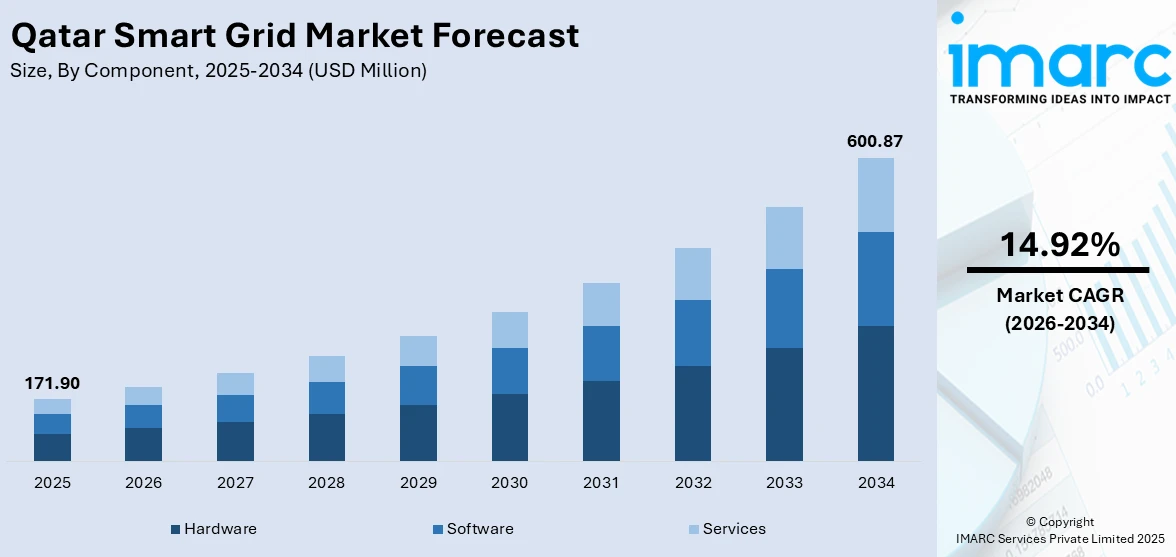
The Qatar smart grid market size was valued at USD 171.90 Million in 2025 and is projected to reach USD 600.87 Million by 2034, growing at a compound annual growth rate of 14.92% from 2026-2034.
The Qatar smart grid market is experiencing robust expansion driven by the nation’s strategic commitment to modernizing its power infrastructure in alignment with Qatar National Vision 2030. Accelerating investments in advanced metering infrastructure, real-time grid monitoring systems, and renewable energy integration are fueling demand for intelligent grid solutions. The government’s focus on energy efficiency, sustainability, and digital transformation of utility services, combined with rapid urban development and industrial diversification, is creating substantial opportunities for smart grid technology deployment across the Qatar smart grid market share.
Key Takeaways and Insights:
- By Component: Hardware dominated the market with a share of 46.3% in 2025, driven by extensive deployment of smart meters, sensors, programmable logic controllers, and networking equipment across Qatar’s electricity and water distribution networks.
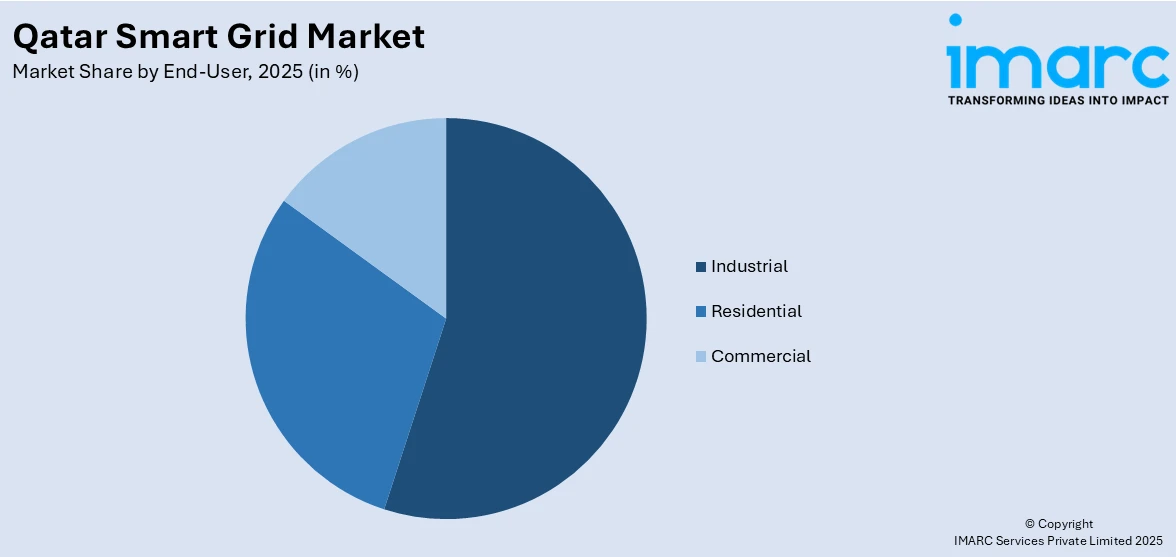
- By End-User: Industrial leads the market with a share of 41.7% in 2025, owing to the high energy intensity of Qatar’s oil and gas processing facilities, petrochemical complexes, and large-scale manufacturing operations requiring advanced grid management.
- By Region: Ad Dawhah represents the largest segment with a market share of 38.9% in 2025, attributed to the capital’s concentration of commercial establishments, government buildings, and dense residential communities driving smart grid infrastructure demand.
- Key Players: The Qatar smart grid market features a competitive landscape characterized by the participation of global technology corporations and regional utility service providers. The market is shaped by strategic partnerships between state-owned entities and international technology firms, with competition centered on advanced metering solutions, grid automation platforms, and integrated energy management systems.
To get more information on this market Request Sample
The Qatar smart grid market is experiencing a major transformation as the country accelerates the digitization of its energy infrastructure. A nationwide smart metering initiative has achieved full coverage, integrating electricity and water meters across residential, commercial, and industrial sectors. These advanced meters enable real-time consumption monitoring, automated billing, prepaid services, and early detection of faults, enhancing both operational efficiency and consumer engagement. The expansion of renewable energy generation, particularly from large-scale solar projects, is increasing the need for intelligent grid solutions that can manage bidirectional power flows and ensure grid stability. This shift toward a more digital and flexible energy network is driving demand for advanced metering infrastructure, grid automation, and energy management technologies. By combining smart metering with renewable integration, Qatar is positioning its energy system for greater efficiency, resilience, and adaptability to evolving consumption patterns and sustainable energy objectives.
Qatar Smart Grid Market Trends:
Accelerated Smart Metering and Digital Utility Transformation
Qatar is rapidly modernizing its utility infrastructure through the nationwide implementation of advanced metering systems. The smart meter program replaces traditional meters with intelligent digital devices, enabling real-time monitoring of electricity and water consumption, automated fault detection, and flexible billing options. The Qatar smart metering market size was valued at USD 58.09 Million in 2025 and is projected to reach USD 105.83 Million by 2034, growing at a compound annual growth rate of 6.89% from 2026-2034. This digital transition is transforming the interaction between utilities and consumers, providing greater transparency and control over resource usage. In addition, the program supports demand-side management and energy efficiency initiatives, contributing to sustainability goals while enhancing the reliability, responsiveness, and overall efficiency of the country’s utility network.
Renewable Energy Integration Driving Grid Intelligence Requirements
The rapid expansion of solar energy capacity in Qatar is creating substantial demand for smart grid solutions capable of managing intermittent renewable power sources. The commissioning of the Ras Laffan and Mesaieed solar plants in April 2025, adding a combined capacity of 875 MW to the existing 800 MW Al Kharsaah facility, has raised Qatar’s total solar capacity to 1,675 MW. Qatar has awarded a major solar power project that, once completed, will significantly expand the country’s renewable energy capacity. The development will require advanced grid management and energy storage solutions to efficiently integrate the additional solar generation into the national power system, supporting grid stability and enhancing the overall flexibility of the energy network.
Smart City Integration and Vehicle-to-Grid Infrastructure Development
Qatar’s smart grid ecosystem is evolving beyond conventional power management to include electric vehicle charging and smart city applications. A national initiative has deployed a network of connected EV charging stations, with plans to expand coverage significantly in the coming years. Integration with smart grid technologies enables vehicle-to-grid coordination and demand-responsive charging, allowing the energy system to better manage load and optimize efficiency. This convergence of advanced grid management and electric mobility infrastructure is creating new opportunities for integrated energy solutions, supporting sustainability goals while enhancing the flexibility and resilience of the country’s power network. The Qatar electric vehicle (EV) infrastructure market size reached USD 80.94 Million in 2025. The market is projected to reach USD 658.45 Million by 2034, growing at a CAGR of 26.23% during 2026-2034.
Market Outlook 2026-2034:
The Qatar smart grid market outlook remains highly promising, driven by the nation’s unwavering commitment to energy infrastructure modernization under Qatar National Vision 2030. The government’s strategic investments in substation expansion, advanced metering infrastructure, and renewable energy integration are expected to sustain strong demand for smart grid technologies throughout the forecast period. KAHRAMAA’s ongoing efforts to develop a fully integrated digital utility network, combined with the growing imperative to manage increasingly complex power flows from large-scale solar installations, will continue to propel market expansion. The convergence of energy efficiency mandates, industrial automation requirements, and smart city development initiatives positions the market for sustained double-digit growth. The market generated a revenue of USD 171.90 Million in 2025 and is projected to reach a revenue of USD 600.87 Million by 2034, growing at a compound annual growth rate of 14.92% from 2026-2034.
Qatar Smart Grid Market Report Segmentation:
|
Segment Category |
Leading Segment |
Market Share |
|
Component |
Hardware |
46.3% |
|
End-User |
Industrial |
41.7% |
|
Region |
Ad Dawhah |
38.9% |
Component Insights:
- Software
- Advanced Metering Infrastructure
- Smart Grid Distribution Management
- Smart Grid Network Management
- Substation Automation
- Others
- Hardware
- Sensor
- Programmable Logic Controller
- AMI Meter
- Networking Hardware
- Others
- Services
- Consulting
- Support and Maintenance
- Deployment and Integration
Hardware dominates the market with a share of 46.3% of the total Qatar smart grid market in 2025.
The hardware segment dominates Qatar’s smart grid market, driven by large-scale deployment of advanced metering infrastructure and related devices. Intelligent electricity meters, sensors, communication modules, and networking equipment form the backbone of the digital utility network, enabling real-time data collection, remote monitoring, and efficient grid management. The widespread adoption of these devices provides a robust foundation for smart grid operations, supporting energy efficiency, fault detection, and automated control while establishing a comprehensive hardware ecosystem essential for the modernization and digitization of the country’s power infrastructure.
The hardware segment also benefits from investments in substation and transmission infrastructure, including high-voltage substations, underground cables, and overhead lines equipped with advanced protection, monitoring, and automation systems. Integration of grid components to support renewable energy projects further strengthens the segment’s market position. These developments enhance network reliability, facilitate efficient energy flow, and provide scalable infrastructure for accommodating increasing electricity demand, renewable integration, and overall smart grid modernization.
End-User Insights:
Access the comprehensive market breakdown Request Sample
- Residential
- Commercial
- Industrial
Industrial leads the market with a share of 41.7% of total Qatar smart grid market in 2025.
The industrial sector dominates Qatar’s smart grid market due to its energy-intensive operations across oil, gas, and petrochemical processing. Large-scale industrial facilities require advanced grid management solutions to ensure reliable electricity supply, maintain stability, and optimize efficiency. Smart grid technologies support automated load balancing, power quality monitoring, and predictive maintenance, enabling industrial operations to operate smoothly while managing complex energy demands. Integration with on-site renewable energy further enhances operational flexibility, allowing industries to optimize consumption patterns and improve sustainability across their extensive manufacturing and processing infrastructure.
Industrial facilities are increasingly incorporating renewable energy systems into their power supply, necessitating smart grid infrastructure capable of seamless integration. Solar and other renewable installations at industrial sites support decarbonization objectives and improve energy efficiency. Advanced grid technologies enable real-time monitoring, automated control, and load optimization, ensuring stable and reliable energy delivery to complex industrial operations. This integration not only supports sustainability goals but also enhances operational resilience, allowing energy-intensive industries to manage variable renewable generation while maintaining consistent performance and reducing overall energy costs.
Regional Insights:
- Ad Dawhah
- Al Rayyan
- Al Wakrah
- Others
Ad Dawhah represent the largest share with 38.9% of the Qatar smart grid market in 2025.
Ad Dawhah holds a leading position in Qatar’s smart grid market due to its role as the country’s capital and main economic hub, hosting a dense mix of commercial, governmental, and residential areas. The city’s concentrated urban environment and ongoing development projects create strong demand for advanced electricity distribution management and smart grid solutions. Centralized utility operations in the capital have enabled early and widespread deployment of smart metering and grid automation technologies. This has positioned Ad Dawhah as the core region driving the country’s digital transformation of its energy infrastructure.
The region’s smart grid market growth is further supported by major infrastructure development projects and commercial real estate expansion. The concentration of high-rise buildings, shopping complexes, hospitality establishments, and financial district facilities in the greater Doha area creates substantial electricity demand requiring advanced load balancing and distribution management capabilities. Additionally, smart city initiatives in developments such as Msheireb Downtown Doha and Lusail City incorporate integrated building energy management systems that interface with the broader smart grid network, reinforcing Ad Dawhah’s position as the leading regional market for smart grid technology adoption.

Market Dynamics:
Growth Drivers:
Why is the Qatar Smart Grid Market Growing?
Government-Led Infrastructure Modernization and Strategic Grid Expansion
Qatar’s government is driving the growth of the smart grid market through a forward-looking strategy to modernize its electricity infrastructure. KAHRAMAA is advancing extensive grid expansion initiatives to meet rising urban and industrial power demand, focusing on building a resilient and intelligent network. The utility is integrating advanced protection systems, remote monitoring, and automation technologies across new substations and transmission lines, reflecting a commitment to efficiency, reliability, and sustainability. Guided by a strategic smart grid roadmap developed with Texas A&M University’s Qatar campus, these efforts align with Qatar National Vision 2030, supporting long-term national development and energy modernization goals.
Rapid Renewable Energy Integration Creating Smart Grid Demand
Qatar’s ambitious push into renewable energy is creating strong demand for smart grid technologies capable of managing two-way power flows and ensuring grid stability. As solar generation becomes a significant part of the energy mix, integrating intermittent energy sources requires advanced solutions such as energy management systems, grid balancing technologies, and real-time monitoring platforms. These technologies enable the seamless distribution of electricity, maintain supply reliability, and support efficient utilization of renewable resources. By modernizing the grid to accommodate clean energy, Qatar is laying the foundation for a more sustainable and resilient electricity network.
Nationwide Digital Metering Program Driving Technology Adoption
KAHRAMAA’s smart metering initiative represents one of the region’s most extensive digital infrastructure upgrades and is accelerating the adoption of smart grid technologies. By deploying advanced digital meters nationwide, the program establishes a robust data ecosystem that supports demand forecasting, analytics, and automated grid management. This digital foundation enables future applications such as demand response, time-of-use tariffs, and prosumer integration for distributed energy resources. With comprehensive meter coverage and connected infrastructure, Qatar is creating the backbone for a more intelligent, responsive, and efficient electricity network that can support evolving energy needs.
Market Restraints:
What Challenges the Qatar Smart Grid Market is Facing?
Cybersecurity Vulnerabilities in Interconnected Grid Infrastructure
The increasing digitalization and interconnectedness of Qatar’s electricity grid introduces significant cybersecurity risks that challenge smart grid deployment. As the network becomes more reliant on digital communication protocols, IoT-connected devices, and cloud-based management platforms, the potential attack surface for malicious cyber threats expands considerably. Protecting critical energy infrastructure from sophisticated cyberattacks requires continuous investment in cybersecurity frameworks, specialized personnel, and evolving defense technologies.
High Capital Investment Requirements and Technology Integration Complexity
The deployment of comprehensive smart grid solutions demands substantial upfront capital investment for hardware procurement, software licensing, communication infrastructure development, and skilled workforce training. The complexity of integrating diverse smart grid technologies from multiple vendors into a cohesive operational framework presents technical challenges related to interoperability standards, legacy system compatibility, and data integration protocols that can delay implementation timelines and increase project costs.
Extreme Climate Conditions Affecting Equipment Performance and Longevity
Qatar’s harsh desert climate, characterized by extreme temperatures regularly exceeding 45 degrees Celsius during summer months along with high humidity and dust exposure, poses significant challenges for smart grid equipment durability and performance. Outdoor sensors, communication devices, and metering infrastructure must be engineered to withstand these demanding environmental conditions, requiring specialized materials and designs that increase procurement costs and maintenance requirements.
Competitive Landscape:
The Qatar smart grid market features a moderately consolidated structure, largely influenced by the central role of the national utility as the sole transmission and distribution operator. Competitive dynamics are shaped by collaborations between the utility and international technology providers on large-scale infrastructure projects, with key competition occurring through tenders for smart metering, substation development, and grid automation initiatives. Market participants distinguish themselves through technological innovation, efficient project execution, high-quality after-sales support, and solutions tailored to local environmental and regulatory conditions. The emphasis on reliable, climate-adapted, and scalable smart grid solutions drives differentiation and supports the sector’s ongoing modernization efforts.
Recent Developments:
- September 2025: QatarEnergy signed an agreement with Samsung C&T’s Engineering and Construction Group for the construction of the 2,000 MW Dukhan solar power plant. The project, to be developed in two phases, will double Qatar’s solar power production capacity and contribute toward the target of exceeding 4,000 MW of renewable energy by 2030, requiring extensive smart grid infrastructure for grid integration.
- July 2025: KAHRAMAA completed the nationwide installation of smart electricity meters, achieving full coverage across all regions of Qatar. The strategic mega initiative encompassed over 12 sub-projects and deployed advanced digital meters featuring real-time consumption tracking, prepaid payment options, early fault detection, and dedicated mobile application support.
- May 2025: KAHRAMAA signed four strategic contracts valued at QR 3.1 billion for the construction of seven high-voltage substations and 212 kilometers of transmission lines. The contracts were awarded to Elsewedy Cables Qatar, Voltage Engineering, Best and Betash Consortium, and Taihan Cable & Solution, with Qatari companies accounting for 58.4% of total contract value.
Qatar Smart Grid Market Report Coverage:
|
Report Features |
Details |
|
Base Year of the Analysis |
2025 |
|
Historical Period |
2020-2025 |
|
Forecast Period |
2026-2034 |
|
Units |
Million USD |
|
Scope of the Report |
Exploration of Historical Trends and Market Outlook, Industry Catalysts and Challenges, Segment-Wise Historical and Future Market Assessment:
|
|
Components Covered |
|
|
End-Users Covered |
Residential, Commercial, Industrial |
|
Regions Covered |
Ad Dawhah, Al Rayyan, Al Wakrah, Others |
|
Customization Scope |
10% Free Customization |
|
Post-Sale Analyst Support |
10-12 Weeks |
|
Delivery Format |
PDF and Excel through Email (We can also provide the editable version of the report in PPT/Word format on special request) |
Frequently Asked Questions About the Qatar Smart Grid Market Report
The Qatar smart grid market size was valued at USD 171.90 Million in 2025.
The Qatar smart grid market is expected to grow at a compound annual growth rate of 14.92% from 2026-2034 to reach USD 600.87 Million by 2034.
Hardware dominated the Qatar smart grid market with a share of 46.3% in 2025, driven by the nationwide deployment of smart meters, sensors, programmable logic controllers, and networking equipment supporting KAHRAMAA’s digital transformation of utility infrastructure.
Key factors driving the Qatar smart grid market include government-led infrastructure modernization programs, rapid integration of large-scale solar energy installations, the nationwide digital metering initiative, and strategic investments in substation expansion and grid automation aligned with Qatar National Vision 2030.
Major challenges include cybersecurity vulnerabilities in increasingly interconnected grid infrastructure, high capital investment requirements for comprehensive smart grid deployment, technology integration complexity across multi-vendor environments, extreme climatic conditions affecting equipment performance, and the need for specialized workforce development.
Need more help?
- Speak to our experienced analysts for insights on the current market scenarios.
- Include additional segments and countries to customize the report as per your requirement.
- Gain an unparalleled competitive advantage in your domain by understanding how to utilize the report and positively impacting your operations and revenue.
- For further assistance, please connect with our analysts.
 Request Customization
 Speak to an Analyst
 Request Brochure
 Inquire Before Buying
Benefits of Customization
- Personalize this research
- Triangulate with your data
- Get data as per your format and definition
- Gain a deeper dive into a specific application, geography, customer, or competitor
- Any level of personalization
Get in Touch With Us
UNITED STATES
Phone: +1-201-971-6302
INDIA
Phone: +91-120-433-0800
UNITED KINGDOM
Phone: +44-753-714-6104
Email: [email protected]
Client Testimonials




.webp)




.webp)













Related Reports

Choose your plan
*Please note that the prices mentioned below are starting prices for each bundle type. Kindly contact our team for further details.*
Single User License
- 1 User License, Access on 2 Devices
- PDF Report + Excel Dataset (Password Protected)
- Lifetime Access
- No Printing Rights
- 10% Free Report Customization
- 10–12 Weeks of Analyst Support
Five User License
- Access for 5 Users, 2 Devices per User
- PDF Report + Excel Dataset (Password Protected)
- Lifetime Access
- Dedicated Account Manager
- 12–14 Weeks of Analyst Support
- No Printing Rights
- 15% Free Report Customization
- 25% Discount on Your Next Purchase
Corporate User License
- Unlimited User Access (Within Your Organization)
- PDF Report + Excel Dataset
- Lifetime Access
- Dedicated Account Manager
- 14–20 Weeks of Analyst Support
- No Printing Rights
- 20% Free Report Customization
- 30% Discount on Your Next Purchase
Essential Insights
What's included:
3 reports
- Lifetime Access
- PDF Reports
- Excel Datasets
- 2 Weeks of Free Analyst Support
- 2 User Licenses
- Access on 2 Devices
- Printing Rights
- Complimentary PowerPoint (PPT) Version
- Complimentary License Upgrade
Professional Access
What's included:
5 reports
- Lifetime Access
- PDF Reports
- Excel Datasets
- 8 Weeks of Free Analyst Support
- 2 User Licenses
- Access on 2 Devices
- Printing Rights
- Complimentary PowerPoint (PPT) Version
- Complimentary License Upgrade
Business Advantage
What's included:
8 reports
- Lifetime Access
- PDF Reports
- Excel Datasets
- 14 Weeks of Free Analyst Support
- 2 User Licenses
- Access on 2 Devices
- Printing Rights
- Complimentary PowerPoint (PPT) Version
- Complimentary License Upgrade
Enterprise Intelligence
What's included:
10 reports
- Lifetime Access
- PDF Reports
- Excel Datasets
- 20 Weeks of Free Analyst Support
- 2 User Licenses
- Access on 2 Devices
- Printing Rights
- Complimentary PowerPoint (PPT) Version
- Complimentary License Upgrade