
Qatar Tourism Tech Market Size, Share, Trends and Forecast by Technology Type, Tourist, End User, and Region, 2026-2034
Qatar Tourism Tech Market Summary:
The Qatar tourism tech market size reached USD 1,670.18 Million in 2025. The market is projected to reach USD 5,807.42 Million by 2034, growing at a CAGR of 14.85% during 2026-2034. The market is driven by government-led digital transformation initiatives that are accelerating technology adoption across hotels and tour operators, the integration of artificial intelligence and data analytics for enhanced visitor experiences through personalized itineraries and smart travel assistants, and the expansion of multi-modal tourism infrastructure with smart connectivity solutions across air, land, and sea access points. These developments are significantly expanding the Qatar tourism tech market share.
|
Report Attribute
|
Key Statistics
|
|---|---|
| Market Size in 2025 | USD 1,670.18 Billion |
| Market Forecast in 2034 | USD 5,807.42 Billion |
| Market Growth Rate (2026-2034) | 14.85% |
| Key Segments | Technology Type (Digital Booking and Reservation Platforms, Experience and Activity Tech, Hospitality Tech, Travel Mobility Tech, AI and Data Analytics, Metaverse and Augmented/Virtual Reality, Sustainability Tech), Tourist (Leisure Tourism, Business Tourism and MICE, Cultural and Heritage Tourism), End User (B2C (Business-to-Consumer), B2B (Business-to-Business), B2G (Business-to-Government)) |
|
Base Year
|
2025
|
|
Forecast Years
|
2026-2034
|
Qatar Tourism Tech Market Outlook (2026-2034):
The Qatar tourism tech market is positioned for robust growth as the country continues its ambitious digital transformation journey aligned with Qatar National Vision 2030. Government investments in AI infrastructure, expected to reach USD 5.7 billion by 2026, will catalyze innovation across booking platforms, hospitality management systems, and visitor engagement tools. The expansion of smart city developments like Lusail and strategic partnerships between technology giants and Qatar Tourism will further enhance the digital ecosystem. Additionally, Qatar's success in hosting major events and achieving record visitor numbers demonstrates strong market fundamentals that will drive sustained technology adoption throughout the forecast period.
.webp)
To get more information on this market Request Sample
Impact of AI:
Artificial intelligence is fundamentally transforming Qatar's tourism tech market by enabling hyper-personalization, operational efficiency, and data-driven decision-making. AI-powered travel assistants like Visit Qatar's GenAI Concierge provide customized itineraries and real-time recommendations in over 50 languages. AI is also optimizing hospitality operations through automated check-in systems, chatbots, predictive maintenance, and reputation management tools. Furthermore, Qatar's national AI hub is facilitating the development of AI solutions that enhance visitor engagement, improve demand forecasting, and create seamless experiences across the entire tourism value chain.
Market Dynamics:
Key Market Trends & Growth Drivers:
Government-Led Digital Transformation Initiatives Accelerating Tourism Technology Adoption
Qatar's government is actively driving digital innovation in the tourism sector through strategic initiatives and partnerships that are reshaping how tourism businesses operate and engage with visitors. The Ministry of Communications and Information Technology, in collaboration with Qatar Tourism, has launched comprehensive programs specifically designed to support the adoption of digital solutions across hotels and tour operators. These initiatives go beyond simply providing technology access; they offer integrated systems of tools and services that empower small and medium enterprises to innovate their business models, achieve greater operational efficiency, and expand their presence in both local and global markets. The government's commitment is reflected in the Digital Agenda 2030, which identifies tourism as a key sector for technological transformation and economic diversification. This strategic focus has created an environment where tourism businesses are incentivized and supported to embrace emerging technologies, from artificial intelligence to cloud computing. The SMEs Go Digital Program represents a cornerstone of this strategy, providing tailored digital assessments, customized transformation roadmaps, and opportunities to connect with service providers who can implement cutting-edge solutions. In October 2025, the Ministry of Communications and Information Technology, in collaboration with Qatar Tourism, held an awareness workshop under the SMEs Go Digital Program, a national initiative aimed at supporting SMEs in adopting digital solutions. The workshop focused specifically on showcasing the role of digital transformation and artificial intelligence in driving innovation across hotels and tour operators, where participants explored practical AI applications that enhance customer experience, simplify operations, and open new avenues for SME growth in Qatar's tourism sector. This hands-on approach ensures that technology adoption translates into tangible business improvements and competitive advantages for Qatar's tourism industry.
Integration of Artificial Intelligence and Data Analytics for Enhanced Visitor Experiences
The Qatar tourism tech market growth is being propelled by the rapid integration of artificial intelligence and advanced data analytics capabilities that are revolutionizing how tourists plan, experience, and engage with destinations. Qatar has positioned itself at the forefront of AI-driven tourism innovation through substantial investments in digital infrastructure, with spending on priority technologies including AI, IoT, and cybersecurity projected to reach USD 5.7 billion by 2026, representing a dramatic increase from USD 1.65 billion in 2022. This investment surge has enabled the development of sophisticated AI-powered platforms that deliver personalized, seamless experiences throughout the entire visitor journey. The tourism sector is leveraging AI for multiple applications including intelligent chatbots that provide instant multilingual support, predictive analytics that optimize pricing and inventory management, machine learning algorithms that generate customized itinerary recommendations based on individual preferences, and computer vision systems that enhance security and operational efficiency at tourist attractions and hospitality venues. These technologies are not merely improving existing services but fundamentally transforming the visitor experience by making travel planning more intuitive, accessible, and tailored to individual needs and preferences. In February 2025, Visit Qatar and Microsoft formalized their collaboration at Web Summit Qatar 2025 by signing a Memorandum of Understanding to drive digital innovation in tourism. Building on the success of the Visit Qatar GenAI Travel Concierge, which is powered by Microsoft Azure and OpenAI 4o and 4o mini technologies, the partnership aims to explore cutting-edge technologies to enhance visitor experiences and transform business operations. The Smart Travel Assistant seamlessly integrates text, voice, content, a conversational virtual assistant, maps, and an interactive planning interface, offering personalized itineraries in over 50 languages and making travel planning accessible and inclusive for international visitors from diverse backgrounds. This innovation was recognized with the Microsoft AI Excellence Award in December 2024, setting new standards for digital excellence in tourism.
Expansion of Multi-Modal Tourism Infrastructure and Smart Connectivity Solutions
Qatar is developing comprehensive smart tourism infrastructure that integrates multiple modes of visitor access with cutting-edge digital technologies, creating a seamlessly connected tourism ecosystem that enhances every aspect of the visitor experience. The country's multi-access strategy has proven highly successful, with 2024 data showing that international visitors arrived via diverse channels: 56% by air, 37% by land, and 7% by sea. This diversified approach not only accommodates different traveler preferences but also demonstrates Qatar's commitment to building resilient and flexible tourism infrastructure that can adapt to changing market conditions and visitor behaviors. The expansion extends beyond physical transportation to encompass smart city developments that serve as living laboratories for tourism technology innovation. Projects like Lusail City, which hosted significant FIFA World Cup infrastructure, and Msheireb Downtown Doha are integrating smart technologies ranging from intelligent transportation systems and energy-efficient buildings to IoT-enabled public spaces and digital information networks. These developments provide tourists with real-time information, seamless navigation, and enhanced safety while simultaneously generating valuable data that helps optimize tourism operations and urban planning. The deployment of advanced computing infrastructure is further accelerating this transformation. Qatar's travel and tourism sector stands to gain significantly from this AI-driven transformation, with AI technologies being used to personalize services for tourists through tailored recommendations for activities, restaurants, and experiences based on user preferences and behavior, streamline booking systems and customer service operations, and provide tourism operators with valuable data-driven insights to understand market trends and optimize offerings.
Key Market Challenges:
Cybersecurity Vulnerabilities Amid Rapid Digital Transformation
As Qatar accelerates its digital tourism initiatives and embraces increasingly sophisticated technologies, cybersecurity has emerged as one of the most critical challenges facing the tourism tech market. The rapid digitalization of tourism services, from online booking platforms and mobile applications to IoT-enabled hotel rooms and contactless payment systems, has exponentially increased the attack surface for malicious actors. According to industry reports, Qatar faces approximately 5.1 million internal and external cyber-attacks and 45,000 intrusion attempts regularly, highlighting the persistent and evolving nature of cyber threats in the region. The tourism sector is particularly vulnerable because it handles vast amounts of sensitive personal and financial data, including passport information, credit card details, travel itineraries, and biometric data. A successful cyberattack on tourism infrastructure could not only compromise this sensitive information but also disrupt critical services, damage Qatar's reputation as a safe travel destination, and undermine visitor confidence in digital tourism platforms. The challenge is compounded by the interconnected nature of modern tourism ecosystems, where vulnerabilities in one system can cascade across multiple stakeholders, including hotels, airlines, tour operators, payment processors, and government agencies.
Digital Skills Gap Among Tourism SMEs
A significant challenge constraining the full realization of Qatar's tourism tech potential is the substantial digital skills gap, particularly among small and medium enterprises that form the backbone of the tourism and hospitality sectors. While Qatar has made remarkable investments in technology infrastructure and attracted global technology partnerships, the human capital development required to effectively leverage these technologies has not kept pace with the rate of technological advancement. Qatar's comprehensive Digital Skills Framework identifies 115 digital competencies across 19 domains that need to be addressed to support the country's digital transformation ambitions, and the tourism sector faces particularly acute challenges in this area. Many hospitality operators, tour guides, hotel staff, and tourism service providers lack adequate training on emerging technologies such as AI-powered customer service platforms, data analytics tools, digital marketing systems, and cloud-based management solutions. This skills deficit reduces the effectiveness of technology investments, as sophisticated digital tools remain underutilized or improperly implemented, failing to deliver their full potential value. The challenge is multifaceted, encompassing not only technical proficiency but also digital literacy, change management capabilities, and the mindset shifts required to embrace technology-driven business models. SMEs often lack the resources to invest in comprehensive training programs, and employees may resist adopting new technologies due to unfamiliarity or concerns about job security. Furthermore, the rapid pace of technological change means that skills can quickly become outdated, requiring continuous learning and adaptation. The government has recognized this challenge and launched initiatives such as the SMEs Go Digital Program and partnerships with technology companies like Microsoft to provide training opportunities, but bridging the skills gap remains a long-term challenge that requires sustained effort, investment, and collaboration among government, educational institutions, private sector employers, and technology providers.
Infrastructure Integration and Interoperability Complexities
As Qatar implements an increasingly diverse array of tourism technologies across multiple stakeholders and platforms, ensuring seamless integration and interoperability has emerged as a formidable challenge that threatens to undermine the efficiency and user experience that digital transformation promises to deliver. The tourism ecosystem in Qatar encompasses a complex web of interconnected entities including international hotel chains with their proprietary management systems, local boutique accommodations, airlines with sophisticated reservation and loyalty platforms, government agencies managing visa and immigration systems, tour operators using specialized booking software, transportation providers with fleet management systems, attractions with ticketing platforms, and numerous other service providers each operating their own technology stack. Achieving seamless data exchange and functional integration across this heterogeneous landscape requires overcoming significant technical, organizational, and regulatory hurdles. Legacy systems, which many established tourism businesses continue to rely on, often lack modern APIs or standardized data formats that would enable easy integration with newer digital platforms. Data privacy regulations and concerns about competitive information sharing can also inhibit the free flow of information that would enable truly integrated tourism experiences. Additionally, the absence of universally adopted industry standards for data formats, communication protocols, and authentication mechanisms means that custom integration solutions must often be developed on a case-by-case basis, increasing costs and implementation timelines while reducing scalability. The challenge is particularly acute when attempting to create unified visitor experiences that span multiple touchpoints and service providers, such as seamless transfers between airport, hotel, and attractions, or integrated payment and loyalty programs that work across different vendors. Without effective integration, tourists may face fragmented experiences requiring multiple registrations, redundant data entry, and inconsistent service quality, while tourism businesses lose valuable insights that could be gained from comprehensive data analysis across the entire visitor journey.
Qatar Tourism Tech Market Report Segmentation:
IMARC Group provides an analysis of the key trends in each segment of the Qatar tourism tech market, along with forecasts at the country and regional levels for 2026-2034. The market has been categorized based on technology type, tourist, and end user.
Analysis by Technology Type:
- Digital Booking and Reservation Platforms
- Experience and Activity Tech
- Hospitality Tech
- Travel Mobility Tech
- Ride-hailing
- Car Rental
- Public Transport Apps
- AI and Data Analytics
- Metaverse and Augmented/Virtual Reality
- Sustainability Tech
- Carbon Tracking
- Green Booking
The report has provided a detailed breakup and analysis of the market based on the technology type. This includes digital booking and reservation platforms, experience and activity tech, hospitality tech, travel mobility tech (ride-hailing, car rental, and public transport apps), AI and data analytics, metaverse and augmented/virtual reality, and sustainability tech (carbon tracking and green booking).
Analysis by Tourist:
- Leisure Tourism
- Business Tourism and MICE
- Cultural and Heritage Tourism
A detailed breakup and analysis of the market based on the tourist have also been provided in the report. This includes leisure tourism, business tourism and MICE, and cultural and heritage tourism.
Analysis by End User:
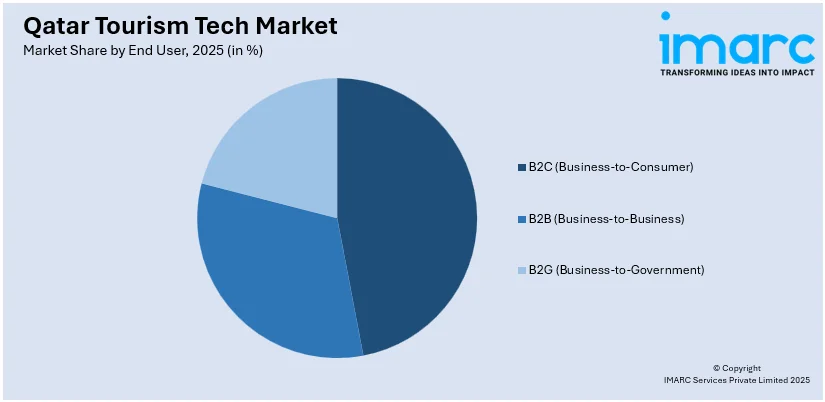
Access the comprehensive market breakdown Request Sample
- B2C (Business-to-Consumer)
- B2B (Business-to-Business)
- B2G (Business-to-Government)
The report has provided a detailed breakup and analysis of the market based on the end user. This includes B2C (business-to-consumer), B2B (business-to-business), and B2G (business-to-government).
Analysis by Region:
- Ad Dawhah
- Al Rayyan
- Al Wakrah
- Others
The report has also provided a comprehensive analysis of all the major regional markets, which include Ad Dawhah, Al Rayyan, Al Wakrah, and others.
Competitive Landscape:
The Qatar tourism tech market exhibits a dynamic competitive landscape characterized by a strategic mix of international technology giants partnering with local entities, government-backed digital initiatives, and innovative startups targeting specific tourism technology niches. Competition primarily revolves around technological innovation, particularly in AI and data analytics capabilities, integration capabilities with existing tourism infrastructure, and the ability to deliver seamless, personalized visitor experiences. Major international players like Microsoft and technology providers are establishing strong partnerships with Qatar Tourism and local telecommunications leaders such as Ooredoo to deliver cutting-edge solutions including AI-powered travel assistants, cloud computing infrastructure, and cybersecurity frameworks. The government plays a pivotal role in shaping the competitive landscape through initiatives like the SMEs Go Digital Program, which levels the playing field by providing smaller tourism businesses with access to technology and training. Emerging competition comes from regional and international platform providers offering specialized solutions in areas such as digital booking systems, hospitality management software, virtual reality tourism experiences, and sustainability tracking tools. The market is experiencing increasing interest from international technology companies seeking to establish Qatar as a regional hub for tourism innovation, particularly given the country's strong digital infrastructure, high-income visitor demographics, and strategic geographic position.
Qatar Tourism Tech Industry Latest Developments:
- August 2025: Ooredoo and Qatar Airways announced a strategic partnership to establish Qatar as a regional AI, cloud, and cybersecurity innovation hub. The collaboration includes the creation of a national AI hub with state-of-the-art infrastructure and the operationalization of NVIDIA's GPU platform in July 2025, providing businesses, government entities, and developers with high-performance computing capabilities. This partnership specifically targets the enhancement of Qatar's tourism sector through AI-powered solutions that personalize visitor services and improve operational efficiencies across telecommunications and aviation sectors.
Qatar Tourism Tech Market Report Coverage:
| Report Features | Details |
|---|---|
| Base Year of the Analysis | 2025 |
| Historical Period | 2020-2025 |
| Forecast Period | 2026-2034 |
| Units | Million USD |
| Scope of the Report |
Exploration of Historical Trends and Market Outlook, Industry Catalysts and Challenges, Segment-Wise Historical and Future Market Assessment:
|
| Technology Types Covered |
|
| Tourists Covered | Leisure Tourism, Business Tourism and MICE, Cultural and Heritage Tourism |
| End Users Covered | B2C (Business-to-Consumer), B2B (Business-to-Business), B2G (Business-to-Government) |
| Regions Covered | Ad Dawhah, Al Rayyan, Al Wakrah, Others |
| Customization Scope | 10% Free Customization |
| Post-Sale Analyst Support | 10-12 Weeks |
| Delivery Format | PDF and Excel through Email (We can also provide the editable version of the report in PPT/Word format on special request) |
Key Questions Answered in This Report:
- How has the Qatar tourism tech market performed so far and how will it perform in the coming years?
- What is the breakup of the Qatar tourism tech market on the basis of technology type?
- What is the breakup of the Qatar tourism tech market on the basis of tourist?
- What is the breakup of the Qatar tourism tech market on the basis of end user?
- What is the breakup of the Qatar tourism tech market on the basis of region?
- What are the various stages in the value chain of the Qatar tourism tech market?
- What are the key driving factors and challenges in the Qatar tourism tech market?
- What is the structure of the Qatar tourism tech market and who are the key players?
- What is the degree of competition in the Qatar tourism tech market?
Key Benefits for Stakeholders:
- IMARC's industry report offers a comprehensive quantitative analysis of various market segments, historical and current market trends, market forecasts, and dynamics of the Qatar tourism tech market from 2020-2034.
- The research report provides the latest information on the market drivers, challenges, and opportunities in the Qatar tourism tech market.
- Porter's five forces analysis assist stakeholders in assessing the impact of new entrants, competitive rivalry, supplier power, buyer power, and the threat of substitution. It helps stakeholders to analyze the level of competition within the Qatar tourism tech industry and its attractiveness.
- Competitive landscape allows stakeholders to understand their competitive environment and provides an insight into the current positions of key players in the market.
Need more help?
- Speak to our experienced analysts for insights on the current market scenarios.
- Include additional segments and countries to customize the report as per your requirement.
- Gain an unparalleled competitive advantage in your domain by understanding how to utilize the report and positively impacting your operations and revenue.
- For further assistance, please connect with our analysts.
 Request Customization
 Speak to an Analyst
 Request Brochure
 Inquire Before Buying
Benefits of Customization
- Personalize this research
- Triangulate with your data
- Get data as per your format and definition
- Gain a deeper dive into a specific application, geography, customer, or competitor
- Any level of personalization
Get in Touch With Us
UNITED STATES
Phone: +1-201-971-6302
INDIA
Phone: +91-120-433-0800
UNITED KINGDOM
Phone: +44-753-714-6104
Email: [email protected]
Client Testimonials




.webp)




.webp)













Related Reports

Choose your plan
*Please note that the prices mentioned below are starting prices for each bundle type. Kindly contact our team for further details.*
Single User License
- 1 User License, Access on 2 Devices
- PDF Report + Excel Dataset (Password Protected)
- Lifetime Access
- No Printing Rights
- 10% Free Report Customization
- 10–12 Weeks of Analyst Support
Five User License
- Access for 5 Users, 2 Devices per User
- PDF Report + Excel Dataset (Password Protected)
- Lifetime Access
- Dedicated Account Manager
- 12–14 Weeks of Analyst Support
- No Printing Rights
- 15% Free Report Customization
- 25% Discount on Your Next Purchase
Corporate User License
- Unlimited User Access (Within Your Organization)
- PDF Report + Excel Dataset
- Lifetime Access
- Dedicated Account Manager
- 14–20 Weeks of Analyst Support
- No Printing Rights
- 20% Free Report Customization
- 30% Discount on Your Next Purchase
Essential Insights
What's included:
3 reports
- Lifetime Access
- PDF Reports
- Excel Datasets
- 2 Weeks of Free Analyst Support
- 2 User Licenses
- Access on 2 Devices
- Printing Rights
- Complimentary PowerPoint (PPT) Version
- Complimentary License Upgrade
Professional Access
What's included:
5 reports
- Lifetime Access
- PDF Reports
- Excel Datasets
- 8 Weeks of Free Analyst Support
- 2 User Licenses
- Access on 2 Devices
- Printing Rights
- Complimentary PowerPoint (PPT) Version
- Complimentary License Upgrade
Business Advantage
What's included:
8 reports
- Lifetime Access
- PDF Reports
- Excel Datasets
- 14 Weeks of Free Analyst Support
- 2 User Licenses
- Access on 2 Devices
- Printing Rights
- Complimentary PowerPoint (PPT) Version
- Complimentary License Upgrade
Enterprise Intelligence
What's included:
10 reports
- Lifetime Access
- PDF Reports
- Excel Datasets
- 20 Weeks of Free Analyst Support
- 2 User Licenses
- Access on 2 Devices
- Printing Rights
- Complimentary PowerPoint (PPT) Version
- Complimentary License Upgrade