
Qatar Wellness Market Size, Share, Trends and Forecast by Wellness Type, Product/Service Type, End User, Distribution Channel, Application, and Region, 2026-2034
Qatar Wellness Market Summary:
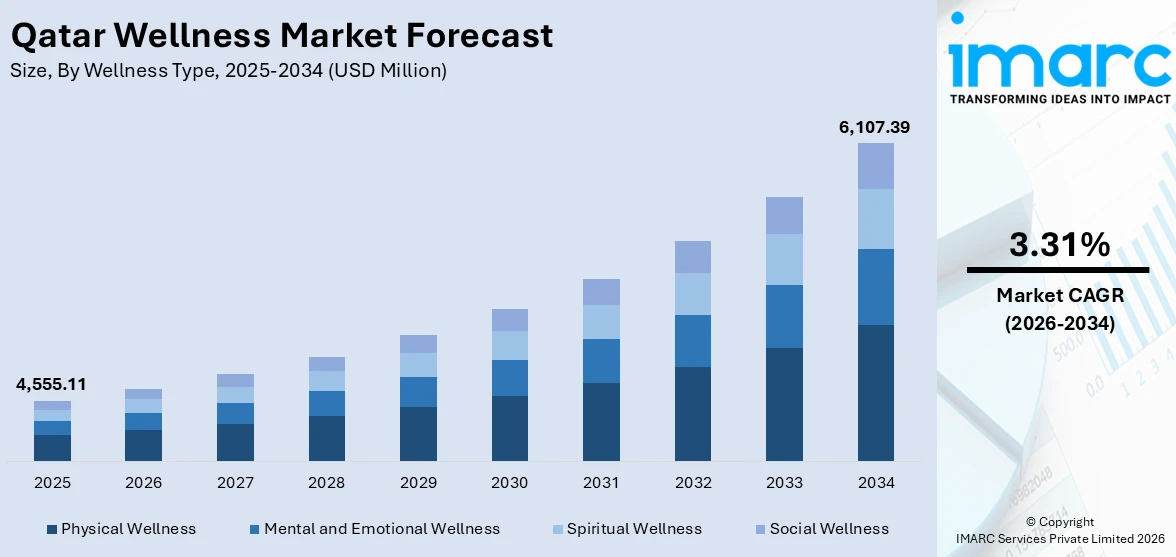
The Qatar wellness market size was valued at USD 4,555.11 Million in 2025 and is projected to reach USD 6,107.39 Million by 2034, growing at a compound annual growth rate of 3.31% from 2026-2034.
The Qatar wellness market is witnessing sustained expansion driven by increasing health consciousness, a strategic shift toward preventive healthcare, and the government’s commitment to promoting population well-being under the National Vision 2030 framework. Rising demand for holistic wellness solutions, including fitness services, spa therapies, nutritional supplements, and mental health support, is reshaping consumer spending patterns. The proliferation of premium wellness facilities, integration of digital health technologies, and growing corporate wellness adoption are collectively reinforcing the Qatar wellness market share.
Key Takeaways and Insights:
- By Wellness Type: Physical wellness dominates the market with a share of 38.5% in 2025, driven by rising fitness awareness and widespread gym adoption across Qatar’s urban centers.
- By Product/Service Type: Wellness services lead the market with a share of 56.4% in 2025, reflecting strong consumer preference for spa treatments, fitness coaching, and preventive healthcare consultations.
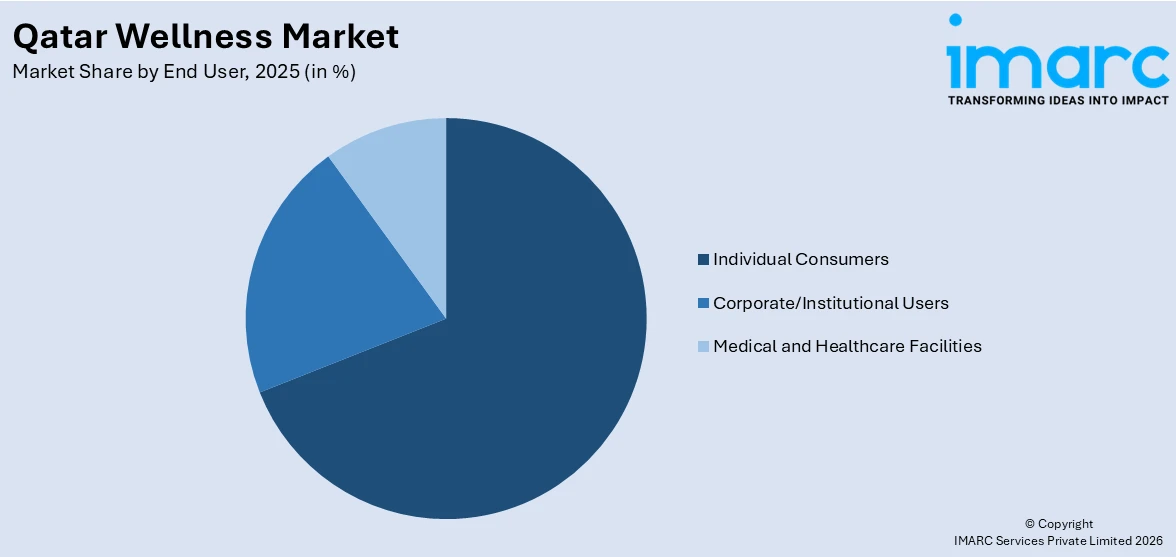
- By End User: Individual consumers dominate the market with a share of 68.9% in 2025, supported by high disposable incomes and growing personal health awareness among residents and expatriates.
- By Distribution Channel: Offline represents the largest segment with 72.3% market share in 2025, as consumers prefer in-person experiences at wellness centers, pharmacies, fitness clubs, and spa retreats.
- By Application: Disease prevention and healthy aging lead the market with a share of 29.6% in 2025, owing to escalating prevalence of lifestyle-related chronic conditions and proactive health management trends.
- By Region: Ad Dawhah dominates the market with 64.8% share in 2025, due to its concentration of premium healthcare infrastructure, luxury wellness resorts, and the majority of Qatar’s population.
- Key Players: The Qatar wellness market is moderately competitive, with established local and international wellness service providers, luxury hospitality brands, healthcare operators, and fitness chains competing across premium and mass-market segments to strengthen their market positioning.
To get more information on this market Request Sample
The Qatar wellness market is advancing rapidly as the nation prioritizes holistic well-being as a cornerstone of its long-term development strategy. The Ministry of Public Health’s National Health Strategy 2024–2030 outlines ambitious targets, including reducing deaths from non-communicable diseases by 36% and increasing the share of adults who regularly participate in consistent weekly physical activity that meets recommended fitness and health guidelines. The country’s wellness ecosystem encompasses a broad spectrum of offerings, from state-of-the-art fitness facilities and luxury spa retreats to digital health platforms and personalized nutrition services. Qatar’s diverse expatriate population, which constitutes a significant majority of residents, brings varied wellness preferences and drives demand for culturally inclusive wellness solutions. The emergence of world-class wellness destinations, such as the Zulal Wellness Resort by Chiva-Som, the Middle East’s first and largest full-immersion wellness facility, underscores Qatar’s growing stature as a regional wellness hub.
Qatar Wellness Market Trends:
Integration of Traditional Arabic and Islamic Medicine into Modern Wellness
Qatar is experiencing a growing shift toward wellness models that combine Traditional Arabic and Islamic Medicine with contemporary therapeutic practices. Rooted in classical healing philosophies, this integrated approach emphasizes balance, prevention, and holistic well-being while aligning with modern clinical standards. Wellness providers are incorporating herbal remedies, dietary guidance, and mind–body therapies into structured programs that resonate strongly with local cultural values. This fusion creates distinctive wellness experiences that appeal to both residents and international visitors seeking culturally grounded yet modern health solutions, supporting long-term development of the wellness sector. For instance, in January 2026, Zulal Wellness Resort by Chiva-Som, recognized as the region’s most comprehensive wellness retreat, introduced a premium membership program aimed at supporting residents in adopting long-term, balanced, and mindful lifestyle practices.
Expansion of Digital Wellness and Connected Fitness Platforms
Digital wellness solutions are becoming integral to Qatar’s evolving wellness ecosystem as consumers increasingly seek convenient, personalized health management tools. Connected fitness platforms, mobile wellness applications, virtual coaching, and remote health consultations are gaining popularity across diverse age groups. These technologies enable continuous health tracking, tailored fitness routines, and proactive lifestyle management. Public and private stakeholders are encouraging the adoption of digital health tools to enhance accessibility and preventive care, accelerating the shift toward technology-enabled wellness services across the country.
Rising Focus on Mental and Emotional Wellness Services
Mental health awareness is gaining strong traction in Qatar as public institutions and healthcare providers place greater emphasis on emotional well-being and psychological support. National strategies are encouraging open dialogue, early intervention, and community-based care, helping reduce stigma around seeking mental health assistance. Expanded access to counseling services within primary healthcare settings is making support more approachable and integrated into everyday healthcare. These efforts are fostering a more supportive environment where individuals feel empowered to prioritize mental wellness, contributing to a more holistic and inclusive national wellness landscape.
Market Outlook 2026-2034:
The Qatar wellness market is poised for steady growth over the forecast period, underpinned by the government’s sustained investment in healthcare infrastructure, proactive wellness policies, and a growing culture of preventive health management. The expanding wellness tourism segment, increasing corporate wellness program adoption, and rising demand for personalized nutrition and holistic therapies are expected to create new growth avenues. Continued infrastructure development in municipalities beyond Doha, including Al Rayyan and Al Wakrah, will broaden market accessibility. The market generated a revenue of USD 4,555.11 Million in 2025 and is projected to reach a revenue of USD 6,107.39 Million by 2034, growing at a compound annual growth rate of 3.31% from 2026-2034.
Qatar Wellness Market Report Segmentation:
|
Segment Category |
Leading Segment |
Market Share |
|
Wellness Type |
Physical Wellness |
38.5% |
|
Product/Service Type |
Wellness Services |
56.4% |
|
End User |
Individual Consumers |
68.9% |
|
Distribution Channel |
Offline |
72.3% |
|
Application |
Disease Prevention and Healthy Aging |
29.6% |
|
Region |
Ad Dawhah |
64.8% |
Wellness Type Insights:
- Physical Wellness
- Mental and Emotional Wellness
- Spiritual Wellness
- Social Wellness
Physical wellness dominates with a market share of 38.5% of the total Qatar wellness market in 2025.
Physical wellness in Qatar spans fitness activities, sports nutrition, exercise equipment, and body care services, collectively supporting the nation’s growing emphasis on active and balanced lifestyles. The segment’s strong position is supported by an expanding ecosystem of fitness centers, personal training offerings, and organized initiatives that encourage regular physical activity among residents. Increased participation in structured workouts, recreational sports, and guided fitness programs reflects a broader cultural shift toward proactive health management, reinforcing sustained demand for comprehensive physical wellness solutions across diverse age groups.
Rising awareness of lifestyle-related health conditions is encouraging consumers in Qatar to invest more actively in physical wellness and preventive fitness solutions. Individuals are increasingly prioritizing regular exercise, structured training, and holistic body care as part of long-term health maintenance. This shift has supported the growth of specialized fitness formats, including boutique studios, women-focused wellness spaces, and premium fitness facilities within resorts and mixed-use developments. Together, these offerings are broadening the appeal of physical wellness services and attracting a wider, more diverse consumer base.
Product/Service Type Insights:
- Wellness Products
- Dietary Supplements and Functional Foods
- Personal Care and Beauty Products
- Fitness Equipment and Wearables
- Wellness Services
- Fitness and Mind-Body Services (Yoga, Meditation)
- Spa and Thermal Services
- Preventive and Personalized Healthcare
- Counseling and Mental Health Services
Wellness services lead with a share of 56.4% of the total Qatar wellness market in 2025.
Wellness services in Qatar cover a broad spectrum of experiential and therapeutic offerings, including fitness training, spa treatments, preventive health guidance, and mental well-being support. The luxury hospitality sector plays a central role in setting high service standards, with premium hotels integrating sophisticated wellness centers and spa experiences into their properties. These environments elevate consumer expectations and encourage holistic lifestyle choices, positioning wellness services as an integral part of leisure, self-care, and long-term health management rather than occasional indulgences.
A growing focus on preventive, personalized healthcare is shifting consumer preference toward wellness services instead of standalone health products. Individuals are increasingly seeking ongoing support through guided fitness programs, health consultations, and stress management solutions that fit their lifestyles. This trend is reinforced by rising engagement with organized healthcare and workplace wellness initiatives. Corporate programs offering fitness access, health assessments, and mental well-being activities are gaining traction, as employers recognize the link between employee wellness, productivity, and overall organizational performance.
End User Insights:
Access the comprehensive market breakdown Request Sample
- Individual Consumers
- Corporate/Institutional Users
- Medical and Healthcare Facilities
Individual consumers represent the largest share at 68.9% of the total Qatar wellness market in 2025.
Individual consumers represent the primary demand driver in Qatar’s wellness market, propelled by high per-capita income levels, growing health literacy, and a culturally evolving emphasis on personal well-being. Qatar’s healthcare expenditure per capita stands at approximately USD 2,214, the highest in the GCC region, reflecting a population willing to invest significantly in health-related goods and services. Affluent residents and expatriates increasingly seek personalized wellness experiences, ranging from concierge health checkups to customized nutrition plans.
The growing adoption of digital wellness platforms is enabling individuals in Qatar to take a more proactive role in managing their health and lifestyle choices. Fitness tracking applications, virtual coaching, and personalized wellness tools are becoming part of everyday routines, supporting goal-based health management. This shift is complemented by rising interest in dietary supplements and nutrition-focused products that support prevention and overall vitality. Health-conscious consumers increasingly favor organic, natural, and functionally enhanced wellness offerings, reflecting a broader move toward self-directed, holistic approaches to long-term well-being.
Distribution Channel Insights:
- Online
- Offline
- Specialty Wellness Centers
- Pharmacies
- Fitness Centers
- Spas and Retreats
Offline exhibits a clear dominance with a 72.3% share of the total Qatar wellness market in 2025.
The offline distribution channel maintains its dominant position owing to the inherently experiential nature of wellness services, where consumers prioritize direct engagement with trained practitioners, specialized equipment, and therapeutic environments. Qatar’s premium fitness centers, luxury spas, and specialized wellness retreats offer immersive experiences that cannot be replicated through digital channels. The country hosts numerous internationally recognized spa destinations, with facilities spanning luxury hotels, standalone wellness centers, and destination retreats.
Pharmacies and specialty wellness centers serve as critical offline touchpoints for wellness product distribution, offering consumers professional guidance on dietary supplements, personal care items, and functional health products. The expanding network of Primary Health Care Corporation facilities, which continues to add new health centers with capacity for tens of thousands of patients, reinforces offline healthcare and wellness access. Qatar’s ongoing infrastructure development, including new wellness-integrated residential compounds, further supports the offline channel’s sustained relevance.
Application Insights:
- Stress Management
- Weight Management
- Disease Prevention and Healthy Aging
- Beauty and Anti-Aging
- Others
Disease prevention and healthy aging represent the highest revenue with a 29.6% share of the total Qatar wellness market in 2025.
Disease prevention and healthy aging have become the most prominent areas within the wellness landscape, supported by rising awareness of lifestyle-related health risks and a growing emphasis on long-term well-being. The consumer is also becoming more focused on proactive health care by monitoring and early diagnosis, as well as daily healthy practices. This trend is prompting an increase in the demand for personal health appliances, preventive examinations, and self-care systems that aid in continuous health management. The preventive wellness applications are taking centre stage in the daily health decisions as people pay more attention to sustaining vitality and independence as time goes by.
The demand is being strengthened by national health policies that put more emphasis on prevention and quality of life that promote wellness services that are concerned with early intervention and healthy living. Consumer behavior and the services provided are being influenced by the public efforts in promoting regular screenings, vaccinations, and lifestyle changes. Wellness services are getting more normalized, and because of that, preventive care is now integrated into primary healthcare systems, places of work, and community programmes. This integration facilitates wider use of health counseling, nutrition education, behavior-change interventions, and this increases the market in the solutions that focus on protecting against long-term disease and long-term healthy aging.

Regional Insights:
- Ad Dawhah
- Al Rayyan
- Al Wakrah
- Others
Ad Dawhah represent the largest segment with a market share of 64.8% of the total Qatar wellness market in 2025.
Ad Dawhah, encompassing the capital city Doha, commands the dominant regional share due to its concentration of premium healthcare infrastructure, luxury wellness facilities, and the nation’s primary commercial and residential hub. The municipality hosts major healthcare institutions including Hamad Medical Corporation’s Medical City, Sidra Medicine, and most Qatar’s private wellness centers and luxury hotel spas. Doha’s high population density and affluent consumer base create strong demand across all wellness segments, from fitness services to spa therapies and preventive healthcare.
Al Rayyan and Al Wakrah are emerging as secondary wellness hubs, benefiting from satellite clinic expansions and Primary Health Care Corporation facility development. The government’s continued investment in decentralizing healthcare and wellness infrastructure is gradually broadening market access beyond Doha, with new health centers and fitness facilities opening in suburban municipalities to serve growing residential communities.
Market Dynamics:
Growth Drivers:
Why is the Qatar Wellness Market Growing?
Government-Led Health Initiatives Under the National Health Strategy 2024–2030
Qatar’s government is playing a central role in accelerating wellness market development through long-term health policies and institutional support aligned with national development goals. Public strategies emphasize improving quality of life, promoting preventive healthcare, and encouraging more active lifestyles among residents. Strong policy focus on reducing lifestyle-related illnesses and fostering regular physical activity is shaping consumer behavior and industry priorities. Ongoing investments in healthcare infrastructure, community wellness programs, and nationwide health awareness initiatives are strengthening the foundation for wellness adoption. For instance, in September 2025, The University of Doha for Science and Technology (UDST) unveiled its Wellness Strategy 2025–2027 at a press conference attended by senior officials, including Dr. Ibrahim bin Saleh Al Nuaimi and UDST President Dr. Salem Al Naemi, along with representatives from government, academia, and the wider community.
Rising Prevalence of Lifestyle-Related Chronic Diseases
The growing prevalence of non-communicable conditions such as diabetes, obesity, cardiovascular disorders, and hypertension is encouraging consumers in Qatar to prioritize preventive wellness solutions. Rising health awareness is shifting behavior toward proactive lifestyle management rather than reactive treatment. As a result, demand is increasing for dietary supplements, structured fitness programs, weight management solutions, and routine preventive health screenings. Consumers are becoming more conscious of the long-term benefits of maintaining balanced nutrition, regular physical activity, and early health monitoring. This evolving health environment is steadily directing spending toward wellness-focused products and services that support long-term disease prevention and overall quality of life.
Growing Expatriate Population and High Disposable Income Levels
Qatar’s diverse expatriate population, which constitutes most residents, brings varied wellness preferences and cultural fitness practices that enrich the market landscape. These residents often arrive from countries with established wellness cultures and seek comparable services in Qatar, driving demand for international fitness franchises, specialized yoga studios, alternative therapy centers, and premium spa experiences. The country’s high GDP per capita and tax-free income structure provide residents with substantial discretionary spending capacity for wellness investments. Employers frequently supplement employee packages with gym memberships, wellness allowances, and healthcare benefits, further stimulating market demand and broadening the consumer base for wellness services.
Market Restraints:
What Challenges the Qatar Wellness Market is Facing?
Stringent Regulatory Environment and Compliance Requirements
Qatar’s wellness industry operates under rigorous regulatory oversight by the Ministry of Public Health, which enforces comprehensive safety standards, product registration protocols, and facility licensing requirements. These regulations create significant compliance burdens, particularly for new market entrants and small-to-medium wellness enterprises. The extensive documentation and approval processes for dietary supplements, wellness products, and healthcare services can delay market entry and increase operational costs.
High Cost of Premium Wellness Services
Qatar’s wellness market is heavily skewed toward premium and luxury offerings, creating affordability barriers for a substantial portion of the population. High operational costs, including real estate, imported wellness products, and specialized international practitioners, translate into elevated service pricing. This cost structure limits market penetration among lower-income expatriate segments and constrains the overall addressable market, concentrating demand within affluent consumer demographics.
Climate-Related Constraints on Outdoor Wellness Activities
Qatar’s extreme summer temperatures, which frequently exceed 45 degrees Celsius, significantly restrict outdoor physical activity and wellness pursuits for several months each year. This climatic limitation increases dependence on indoor wellness facilities, raising infrastructure requirements and operational costs. The seasonal nature of outdoor wellness engagement creates demand fluctuations and requires providers to invest in climate-controlled environments to maintain year-round service continuity.
Competitive Landscape:
The Qatar wellness market operates within a moderately competitive landscape characterized by a diverse mix of international hospitality brands, regional healthcare operators, global fitness franchises, and specialized local wellness providers. Competition is driven by service quality differentiation, facility investment, wellness program innovation, and the ability to deliver culturally relevant experiences. Major hospitality groups leverage their luxury properties to offer integrated spa and wellness services, while standalone fitness operators and boutique wellness studios target niche consumer segments. Strategic partnerships between healthcare institutions and wellness providers are becoming increasingly common, enabling comprehensive wellness ecosystems. Market participants are investing in digital wellness platforms, personalized health technologies, and traditional healing modalities to capture evolving consumer preferences and strengthen competitive positioning.
Recent Developments:
- In April 2025, Zulal Wellness Resort by Chiva-Som was named Best Spa Retreat in the Middle East at The Luxury Spa Edit Awards 2025 for the second consecutive year, recognizing the resort’s unique blend of Traditional Arabic and Islamic Medicine with modern wellness therapies at Qatar’s first full-immersion wellness destination.
- In December 2024, Hamad Medical Corporation’s Mental Health Service and the Primary Health Care Corporation announced the launch of 24 additional specialist mental health clinics within PHCC facilities, significantly expanding access to assessment, treatment, and care for mental health conditions across multiple locations in Qatar.
Qatar Wellness Market Report Coverage:
|
Report Features |
Details |
|
Base Year of the Analysis |
2025 |
|
Historical Period |
2020-2025 |
|
Forecast Period |
2026-2034 |
|
Units |
Million USD |
|
Scope of the Report |
Exploration of Historical Trends and Market Outlook, Industry Catalysts and Challenges, Segment-Wise Historical and Future Market Assessment:
|
|
Wellness Types Covered |
Physical Wellness, Mental and Emotional Wellness, Spiritual Wellness, Social Wellness |
|
Product/Service Types Covered |
|
|
End Users Covered |
Individual Consumers, Corporate/Institutional Users, Medical and Healthcare Facilities |
|
Distribution Channels Covered |
|
|
Applications Covered |
Stress Management, Weight Management, Disease Prevention and Healthy Aging, Beauty and Anti-Aging, Others |
|
Regions Covered |
Ad Dawhah, Al Rayyan, Al Wakrah, Others |
|
Customization Scope |
10% Free Customization |
|
Post-Sale Analyst Support |
10-12 Weeks |
|
Delivery Format |
PDF and Excel through Email (We can also provide the editable version of the report in PPT/Word format on special request) |
Frequently Asked Questions About the Qatar Wellness Market Report
The Qatar wellness market size was valued at USD 4,555.11 Million in 2025.
The Qatar wellness market is expected to grow at a compound annual growth rate of 3.31% from 2026-2034 to reach USD 6,107.39 Million by 2034.
Physical wellness, representing the largest revenue share of 38.5% in 2025, remains the dominant segment in Qatar’s wellness market, driven by growing fitness awareness, expanding gym infrastructure, rising demand for sports nutrition products, and increasing government-led physical activity promotion programs.
Key factors driving the Qatar wellness market include government health initiatives under the National Health Strategy 2024–2030, rising prevalence of non-communicable diseases, high disposable incomes, expanding expatriate population, growing corporate wellness adoption, and increasing consumer demand for preventive healthcare solutions.
Major challenges include stringent regulatory compliance requirements for wellness products and services, high costs of premium wellness offerings limiting mass-market accessibility, climate-related constraints on outdoor wellness activities, and evolving consumer expectations requiring continuous service innovation and investment.
Need more help?
- Speak to our experienced analysts for insights on the current market scenarios.
- Include additional segments and countries to customize the report as per your requirement.
- Gain an unparalleled competitive advantage in your domain by understanding how to utilize the report and positively impacting your operations and revenue.
- For further assistance, please connect with our analysts.
 Request Customization
 Speak to an Analyst
 Request Brochure
 Inquire Before Buying
Benefits of Customization
- Personalize this research
- Triangulate with your data
- Get data as per your format and definition
- Gain a deeper dive into a specific application, geography, customer, or competitor
- Any level of personalization
Get in Touch With Us
UNITED STATES
Phone: +1-201-971-6302
INDIA
Phone: +91-120-433-0800
UNITED KINGDOM
Phone: +44-753-714-6104
Email: [email protected]
Client Testimonials




.webp)




.webp)













Related Reports

Choose your plan
*Please note that the prices mentioned below are starting prices for each bundle type. Kindly contact our team for further details.*
Single User License
- 1 User License, Access on 2 Devices
- PDF Report + Excel Dataset (Password Protected)
- Lifetime Access
- No Printing Rights
- 10% Free Report Customization
- 10–12 Weeks of Analyst Support
Five User License
- Access for 5 Users, 2 Devices per User
- PDF Report + Excel Dataset (Password Protected)
- Lifetime Access
- Dedicated Account Manager
- 12–14 Weeks of Analyst Support
- No Printing Rights
- 15% Free Report Customization
- 25% Discount on Your Next Purchase
Corporate User License
- Unlimited User Access (Within Your Organization)
- PDF Report + Excel Dataset
- Lifetime Access
- Dedicated Account Manager
- 14–20 Weeks of Analyst Support
- No Printing Rights
- 20% Free Report Customization
- 30% Discount on Your Next Purchase
Essential Insights
What's included:
3 reports
- Lifetime Access
- PDF Reports
- Excel Datasets
- 2 Weeks of Free Analyst Support
- 2 User Licenses
- Access on 2 Devices
- Printing Rights
- Complimentary PowerPoint (PPT) Version
- Complimentary License Upgrade
Professional Access
What's included:
5 reports
- Lifetime Access
- PDF Reports
- Excel Datasets
- 8 Weeks of Free Analyst Support
- 2 User Licenses
- Access on 2 Devices
- Printing Rights
- Complimentary PowerPoint (PPT) Version
- Complimentary License Upgrade
Business Advantage
What's included:
8 reports
- Lifetime Access
- PDF Reports
- Excel Datasets
- 14 Weeks of Free Analyst Support
- 2 User Licenses
- Access on 2 Devices
- Printing Rights
- Complimentary PowerPoint (PPT) Version
- Complimentary License Upgrade
Enterprise Intelligence
What's included:
10 reports
- Lifetime Access
- PDF Reports
- Excel Datasets
- 20 Weeks of Free Analyst Support
- 2 User Licenses
- Access on 2 Devices
- Printing Rights
- Complimentary PowerPoint (PPT) Version
- Complimentary License Upgrade