
Redox Flow Battery Market Size, Share, Trends and Forecast by Type, Product, Application, and Region, 2026-2034
Redox Flow Battery Market Size, Share, Trends & Forecast (2026-2034)
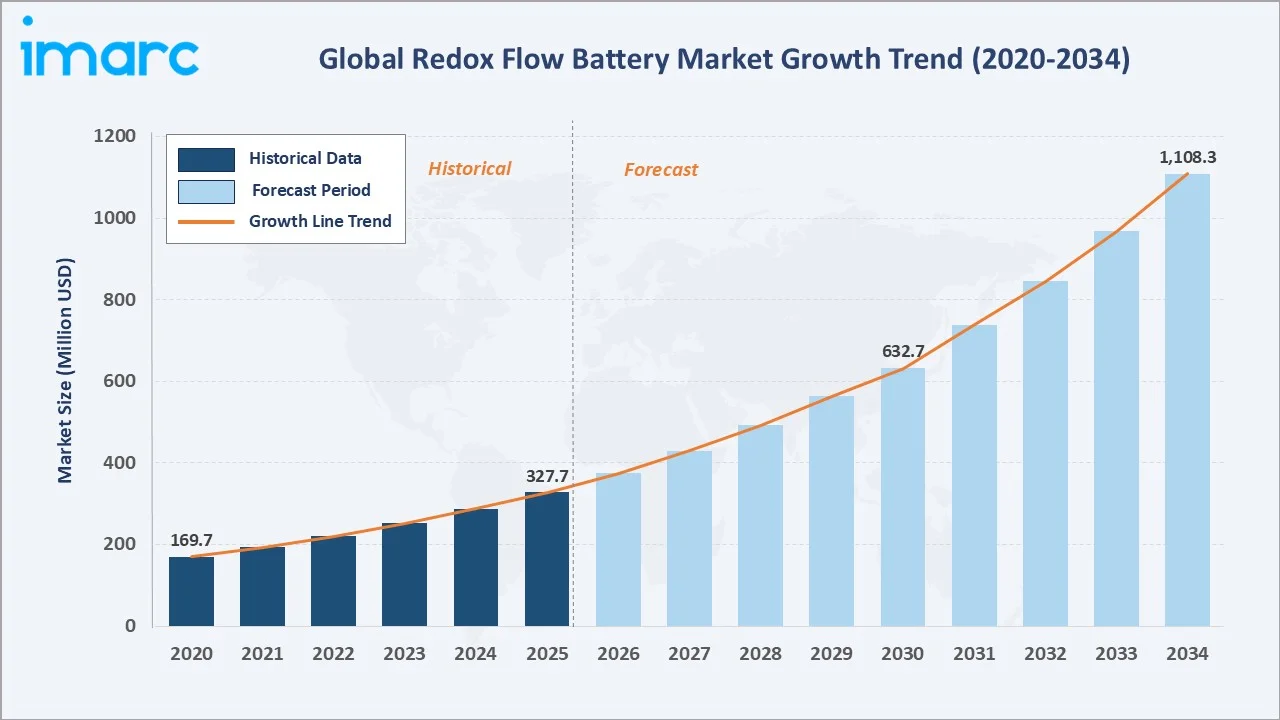
The global redox flow battery (RFB) market reached USD 327.7 Million in 2025 and is projected to reach USD 1,108.3 Million by 2034, growing at a CAGR of 14.06% during 2026-2034. The market is driven by rising demand for long-duration energy storage to support renewable energy integration and grid stability. In Q1 2026, stationary battery energy stationary storage installations reached 9.7 GWh. Utility-scale storage remained the key growth driver, with 7.8 GWh/1.5 GW installed, while six states each added more than 500 MWh of new capacity. This supports the redox flow battery market by highlighting rising demand for large-scale, long-duration energy storage solutions. Vanadium redox flow battery leads type at 72.6%. Utility services lead application at 41.5%. Asia-Pacific leads at 42.8%.
Market Snapshot
|
Metric |
Value |
|
Market Size (2025) |
USD 327.7 Million |
|
Forecast Market Size (2034) |
USD 1,108.3 Million |
|
CAGR (2026-2034) |
14.06% |
|
Base Year |
2025 |
|
Historical Period |
2020-2025 |
|
Forecast Period |
2026-2034 |
|
Dominant Type |
Vanadium Redox Flow Battery (72.6%, 2025) |
|
Dominant Application |
Utility Services (41.5%, 2025) |
|
Leading Region |
Asia-Pacific (42.8%, 2025) |
The global redox flow battery market is witnessing rapid expansion, growing from USD 169.7 Million in 2020 to USD 327.7 Million in 2025, reflecting increasing adoption of long-duration energy storage solutions. The market is expected to reach USD 632.7 Million by 2030 as utilities and renewable energy developers invest in grid-scale storage infrastructure. Continued deployment of renewable power generation, grid modernization initiatives, and demand for safer, longer-life battery technologies are projected to drive the market to USD 1,108.3 Million by 2034.
To get more information on this market, Request Sample
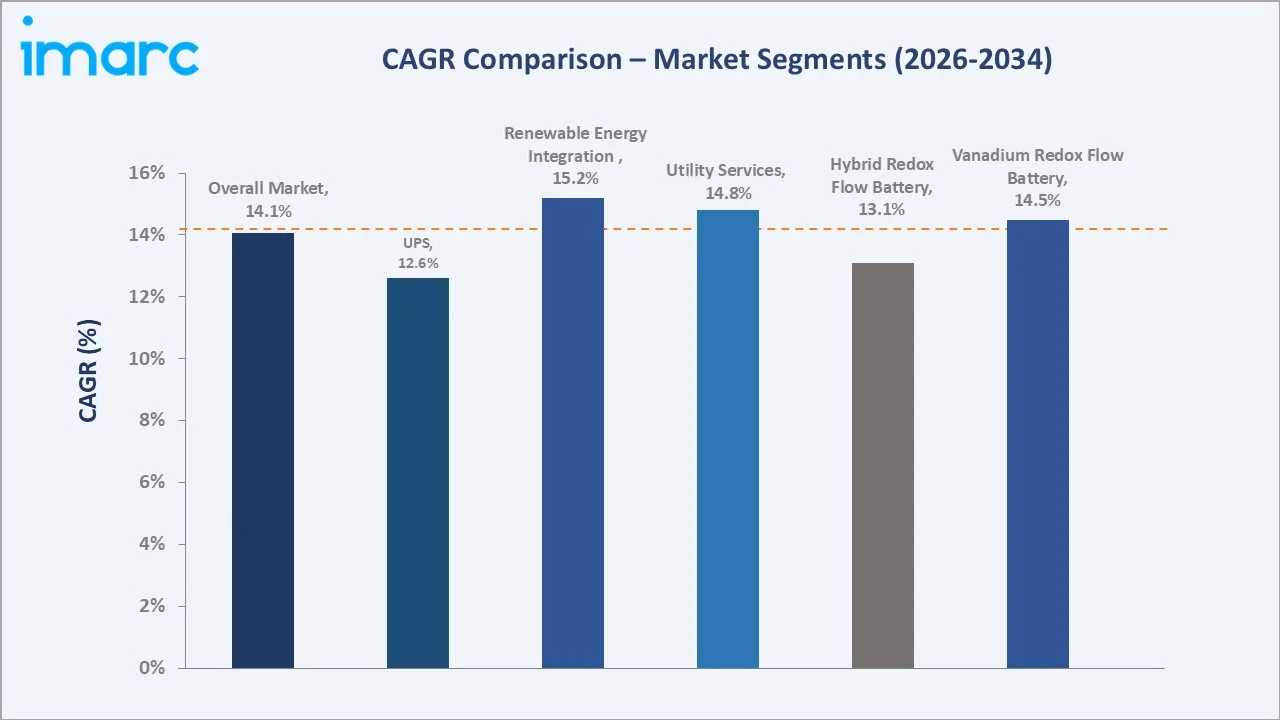
Renewable energy integration grows fastest at ~15.2% CAGR through solar and wind firming, behind-the-meter storage, and offshore wind VRFB. Vanadium redox flow battery (VRFB) grows at ~14.5% CAGR. Hybrid redox flow battery grows at ~13.1% CAGR through iron-flow, zinc-bromine, and next-generation alternative chemistry scale.
Executive Summary
The global redox flow battery market reached USD 327.7 Million in 2025, driven by rising demand for long-duration energy storage, renewable energy integration, and grid stability. Utility-scale projects are increasingly adopting redox flow batteries due to their scalability, long cycle life, safety, and ability to support multi-hour discharge. Expanding investments in solar and wind power, microgrids, and grid modernization are further strengthening market demand. The market is projected to reach USD 1,108.3 Million by 2034. Vanadium redox flow battery at 72.6% leads through utility deployment. Utility services at 41.5% leads application through grid frequency regulation and peak shaving. Asia-Pacific leads regionally at 42.8%.
Key Market Insights
|
Insight |
Data |
|
Dominant Type |
Vanadium Redox Flow Battery - 72.6% share (2025) |
|
Dominant Application |
Utility Services - 41.5% market share (2025) |
|
Leading Region |
Asia-Pacific - 42.8% share (2025) |
|
Market Opportunity |
Offshore wind firming VRFB; military microgrid resilience; data center behind-the-meter RFB |
Key Analytical Observations Supporting the Above Data:
- Vanadium Redox Flow Battery at 72.6%: Vanadium redox flow batteries (VRFBs) dominate due to their long cycle life, high scalability, and ability to provide reliable multi-hour energy storage with minimal capacity degradation. Their strong safety profile, ease of electrolyte reuse, and suitability for utility-scale applications make them the preferred choice for grid and renewable energy storage projects.
- Utility Services at 41.5%: Utility services dominate because electric utilities require large-scale, long-duration energy storage to balance renewable power generation, enhance grid reliability, and manage peak electricity demand. Redox flow batteries are particularly attractive for utility applications due to their long operational life, scalability, and ability to deliver sustained energy over extended periods.
- Asia-Pacific at 42.8%: Asia-Pacific dominates regionally due to strong renewable energy deployment, large-scale grid storage investments, and supportive clean energy policies across China, Japan, South Korea, Australia, and India. The region’s expanding utility-scale storage projects and domestic battery manufacturing ecosystem further strengthen its leading position.
Redox Flow Battery Market Overview
The global redox flow battery market operates as a long-duration energy storage application technology through RFB's independently scalable power and energy architecture. The market encompasses vanadium redox flow, hybrid flow batteries, and next-generation organic and aqueous RFB chemistries in development. The uniqueness of the market lies in its ability to independently scale power and energy capacity, offering greater flexibility than conventional battery technologies. Unlike lithium-ion batteries, redox flow batteries provide long-duration storage, extremely long cycle life, and minimal performance degradation over time.
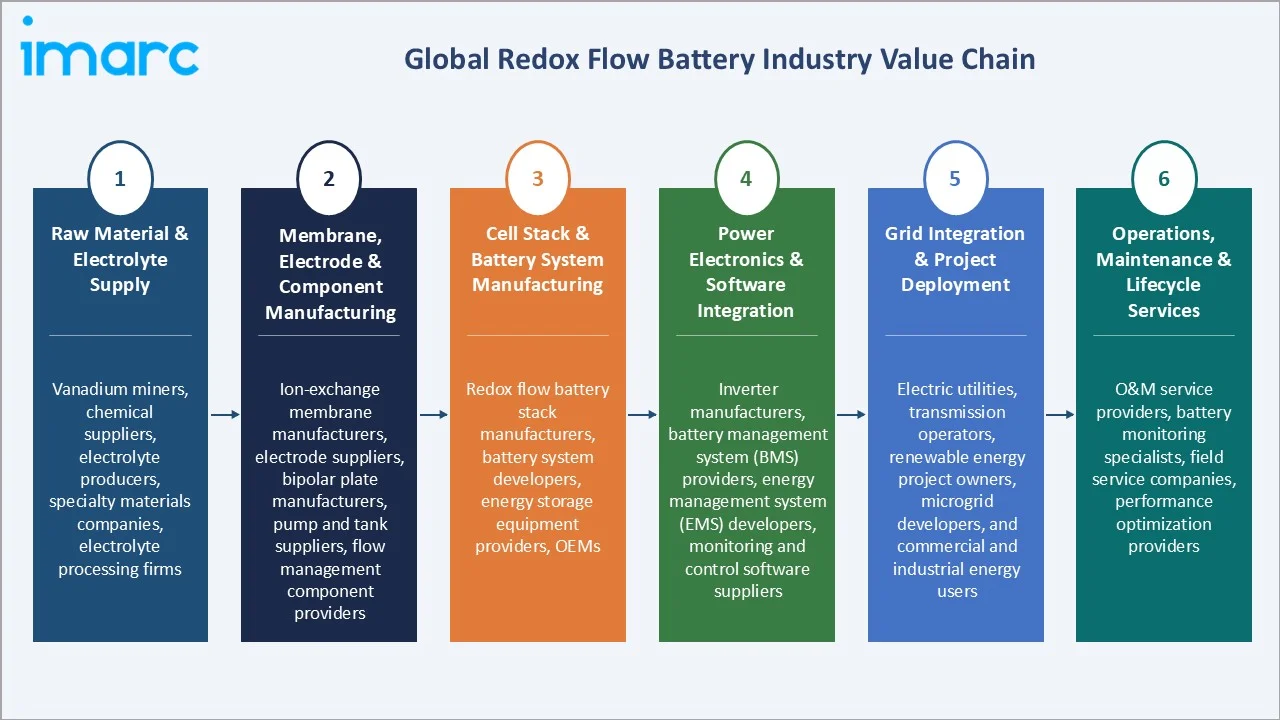
The RFB ecosystem integrates vanadium mining and electrolyte supply, cell stack and bipolar plate manufacturing, battery management and energy management software, EPC and system integration, grid and site commissioning, and lifetime electrolyte reuse. Macroeconomic factors include rising renewable energy investments, grid modernization programs, and increasing electricity demand.
Market Dynamics
To evaluate market opportunities, Request Sample
Market Drivers
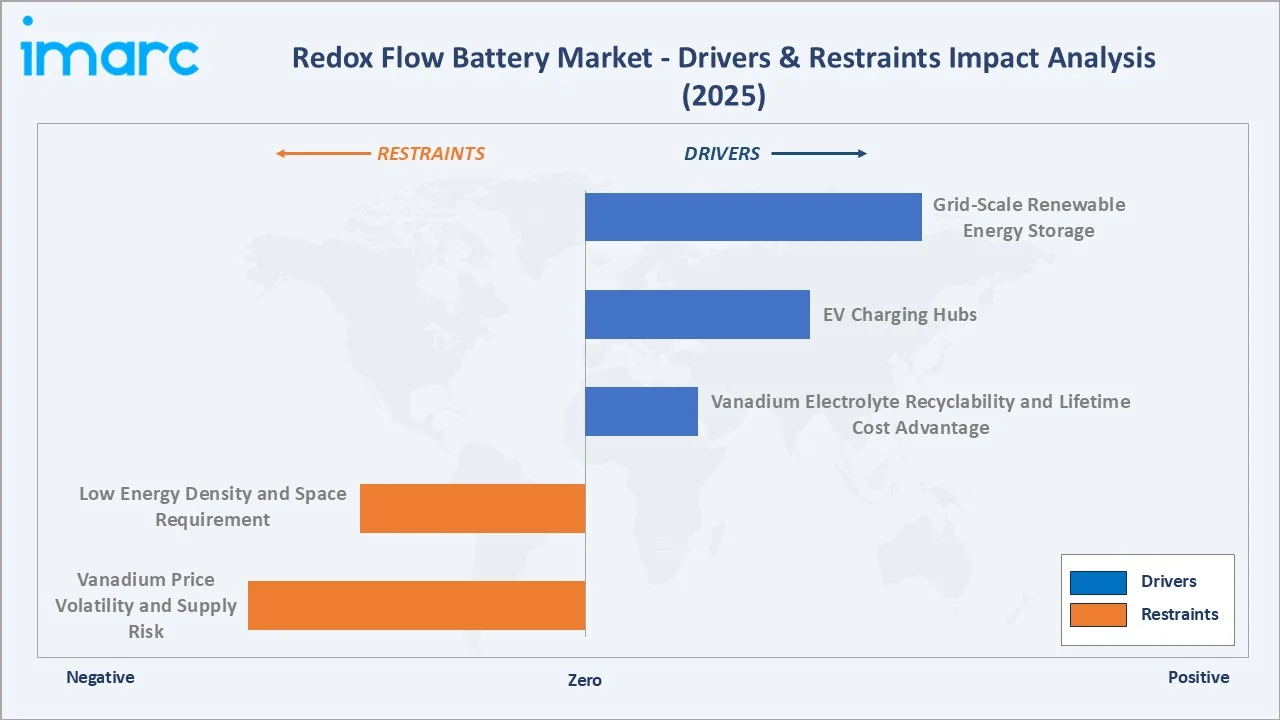
- Grid-Scale Renewable Energy Storage: Grid-scale renewable energy storage is driving the market as utilities increasingly require long-duration storage to manage the intermittent nature of solar and wind power generation. Global renewable power capacity is expected to rise by nearly 4,600 GW between 2025 and 2030, with utility-scale and distributed solar PV accounting for almost 80% of the total renewable electricity capacity addition. This sharp expansion highlights the growing need for energy storage systems that can balance intermittent renewable power generation.
- EV Charging Hubs: EV charging hubs create demand for reliable energy storage systems that can manage high-power charging loads and reduce stress on local electricity grids. Redox flow batteries can store renewable energy during off-peak periods and supply power during peak EV charging demand, improving grid stability. In 2024, the global public EV charging network expanded by more than 1.3 million charging points, marking over 30% growth from the previous year. Redox flow batteries offer long-duration discharge, high safety, and durability, making them suitable for energy storage-backed EV charging infrastructure.
- Vanadium Electrolyte Recyclability and Lifetime Cost Advantage: Vanadium electrolyte recyclability and lifetime cost advantage are driving the market because the electrolyte can be reused, recovered, or repurposed at the end of the battery’s life. This reduces material waste and improves the long-term economic value of vanadium redox flow batteries. Their long cycle life and low degradation also lower replacement costs compared to conventional batteries. As utilities focus on sustainable and cost-effective long-duration storage, the recyclable vanadium electrolyte is becoming a key adoption factor.
Market Restraints
- Low Energy Density and Space Requirement: Low energy density and space requirement are significant challenges because these systems store energy in external electrolyte tanks, requiring considerably more physical space than lithium-ion batteries. The larger footprint makes deployment difficult in urban environments, commercial buildings, and space-constrained facilities. In addition, lower energy density can increase installation and infrastructure costs for certain applications. These limitations restrict adoption in projects where compactness and high energy storage per unit area are critical requirements.
- Vanadium Price Volatility and Supply Risk: Vanadium price volatility and supply risk hamper the market because vanadium is a key electrolyte material, and fluctuations in its price can significantly affect system costs. Limited geographic concentration of vanadium supply also creates procurement uncertainty for battery manufacturers and project developers. Sudden price increases can reduce project bankability and make redox flow batteries less competitive against lithium-ion and other storage technologies. These risks slow adoption, especially in cost-sensitive utility-scale storage projects.
Market Opportunities
- Long-Duration Storage for Microgrids and Remote Power Systems: Long-duration storage for microgrids and remote power systems presents a significant opportunity because these locations often require a reliable power supply for extended periods without access to stable grid infrastructure. Redox flow batteries can provide multi-hour to multi-day energy storage, making them well-suited for integrating solar and wind power in remote communities, islands, mining sites, and industrial facilities. Their long cycle life, low degradation, and high safety profile reduce maintenance requirements and lifetime costs. As demand for resilient and sustainable off-grid energy solutions grows, adoption of redox flow batteries is expected to increase.
- Data Center Long-Duration UPS VRFB: There were approximately 11,800 data centers worldwide, as of March 2024. These data centers require highly reliable backup power to ensure uninterrupted operations. Traditional UPS systems are increasingly being supplemented by long-duration storage solutions that can provide extended runtime during grid outages and support renewable energy integration. Vanadium redox flow batteries (VRFBs) offer long cycle life, high safety, and minimal degradation, making them well-suited for mission-critical infrastructure. As hyperscale and AI-driven data centers expand globally, demand for resilient and sustainable backup power systems is expected to increase.
Market Challenges
- High Upfront Installation Cost: High upfront installation cost is challenging because these systems require large electrolyte tanks, pumps, power stacks, control systems, and site-specific engineering. Initial project costs can be higher than conventional battery technologies, making financing difficult for cost-sensitive utilities and commercial users. Additional expenses for installation, land, civil works, and integration with grid infrastructure further increase capital requirements. This can delay adoption, especially in markets where long-term lifecycle benefits are not yet fully recognized.
- Competition From Lithium-Ion and Other Emerging Battery Technologies: Competition from lithium-ion and other emerging battery technologies is a major challenge, as lithium-ion batteries benefit from large-scale manufacturing, declining costs, and a well-established supply chain. Many utilities and commercial users prefer lithium-ion systems due to their higher energy density, smaller footprint, and widespread deployment experience. Emerging technologies such as sodium-ion, solid-state, and metal-air batteries are also attracting investment and technological development. This intensifying competition can slow the adoption of redox flow batteries despite their advantages in long-duration energy storage, safety, and cycle life.
Emerging Market Trends
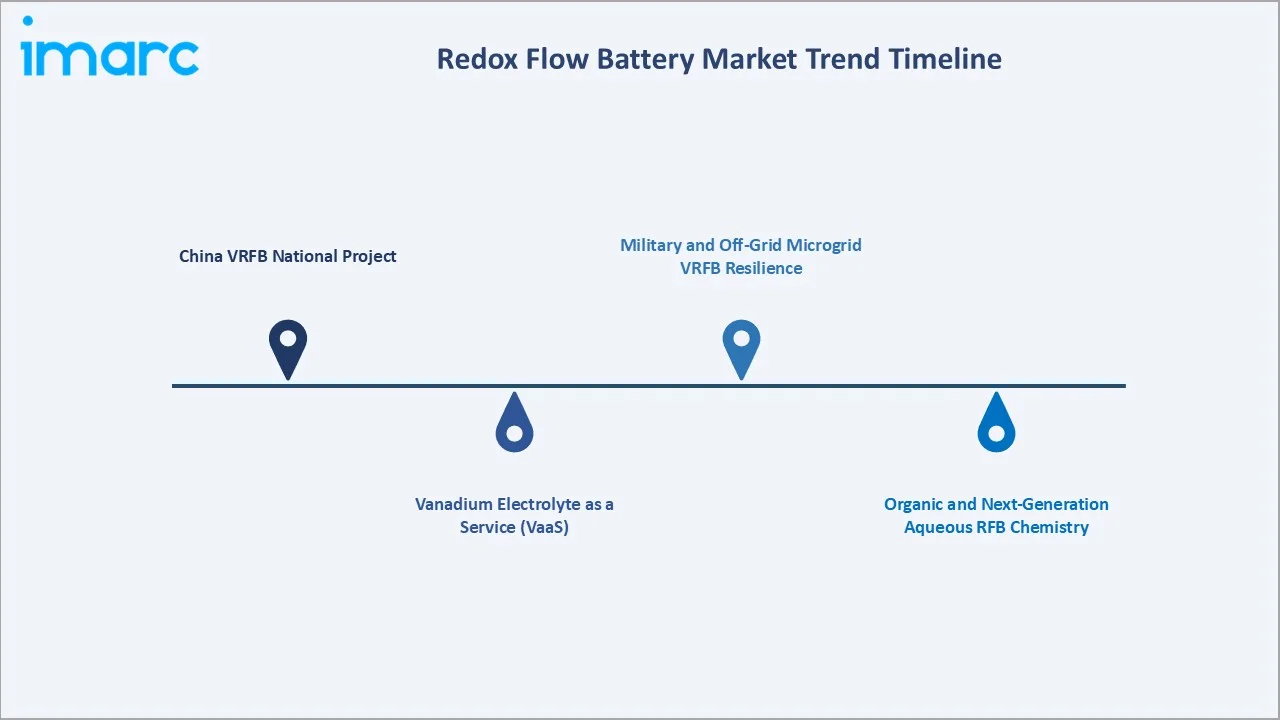
1. China VRFB National Project
In July 2025, China finished the main construction phase of the world’s largest vanadium redox flow battery (VRFB) energy storage project. Backed by China Huaneng Group, the project combines a 200 MW/1 GWh VRFB system with a 1 GW solar power facility in Jimusar, Xinjiang, with a total investment of around CNY 3.8 billion. Once operational, it is expected to produce 1.72 TWh of electricity annually and cut CO₂ emissions by over 1.6 million tonnes per year. Such projects validate redox flow batteries for grid-scale renewable integration, long-duration storage, and carbon reduction, encouraging wider utility adoption and future investments.
2. Vanadium Electrolyte as a Service (VaaS)
Vanadium electrolyte as a service (VaaS) reduces the high upfront cost of vanadium electrolyte ownership. Under this model, customers lease or subscribe to electrolyte instead of purchasing it outright, improving project affordability and bankability. It also supports electrolyte reuse, recycling, and value recovery at the end of system life. As utilities seek flexible financing models for long-duration storage, VaaS is expected to accelerate VRFB adoption.
3. Organic and Next-Generation Aqueous RFB Chemistry
Organic and next-generation aqueous RFB chemistry is emerging as researchers seek alternatives to vanadium-based systems. These advanced chemistries use organic molecules or abundant, lower-cost materials to reduce dependence on critical minerals and improve cost competitiveness. They also offer the potential for enhanced sustainability, supply chain security, and tailored performance characteristics. As commercialization efforts accelerate, next-generation aqueous flow batteries are expected to expand the range of applications for long-duration energy storage.
4. Military and Off-Grid Microgrid VRFB Resilience
Military and off-grid microgrid VRFB resilience is emerging as defense organizations and remote facilities seek reliable, long-duration energy storage solutions. Vanadium redox flow batteries provide extended backup power, high safety, and stable performance under harsh operating conditions, making them well-suited for military bases, remote communities, mining sites, and critical infrastructure. Their long cycle life and low degradation reduce maintenance requirements in isolated locations. As energy security and grid independence become strategic priorities, adoption of VRFB-powered microgrids is expected to increase.
Industry Value Chain Analysis
The redox flow battery value chain integrates raw material & electrolyte supply, membrane, electrode & component manufacturing, cell stack & battery system manufacturing, power electronics & software integration, grid integration & project deployment, and operations, maintenance & lifecycle services.
|
Stage |
Key Participants |
|
Raw Material & Electrolyte Supply |
Vanadium miners, chemical suppliers, electrolyte producers, specialty materials companies, electrolyte processing firms |
|
Membrane, Electrode & Component Manufacturing |
Ion-exchange membrane manufacturers, electrode suppliers, bipolar plate manufacturers, pump and tank suppliers, flow management component providers |
|
Cell Stack & Battery System Manufacturing |
Redox flow battery stack manufacturers, battery system developers, energy storage equipment providers, OEMs |
|
Power Electronics & Software Integration |
Inverter manufacturers, battery management system (BMS) providers, energy management system (EMS) developers, monitoring and control software suppliers |
|
Grid Integration & Project Deployment |
Electric utilities, transmission operators, renewable energy project owners, microgrid developers, and commercial and industrial energy users |
|
Operations, Maintenance & Lifecycle Services |
O&M service providers, battery monitoring specialists, field service companies, performance optimization providers |
The cell stack & battery system manufacturing stage is the most value-added stage of the value chain. This stage incorporates proprietary battery chemistry, stack design, system engineering, power management integration, and performance optimization, which collectively determine battery efficiency, lifespan, safety, and competitiveness. Companies operating at this stage typically capture the highest margins through technological differentiation and intellectual property.
Technology Landscape in the Redox Flow Battery Industry
Vanadium Redox Flow Battery Technology
Vanadium redox flow battery (VRFB) technology forms the foundation of the redox flow battery industry due to its proven capability for long-duration energy storage, high safety, and exceptional cycle life. The technology uses vanadium-based electrolytes in separate storage tanks, enabling independent scaling of power and energy capacity. In November 2025, Union Minister Shri Manohar Lal inaugurated India’s largest and first megawatt-hour-scale vanadium redox flow battery system, with a capacity of 3 MWh. The project marks an important milestone in India’s long-duration energy storage development and supports stronger renewable energy integration, improved grid stability, and enhanced energy resilience. VRFB technology is becoming a preferred solution for utility-scale renewable integration, grid stabilization, and large-scale energy storage applications.
Organic Redox Flow Battery Chemistry
Organic redox flow battery chemistry introduces alternatives to metal-based electrolytes such as vanadium. These systems utilize organic molecules derived from abundant and potentially lower-cost materials, helping reduce raw material dependency and supply chain risks. Ongoing advancements in electrolyte stability, energy density, and cycle life are improving their commercial viability. As a result, organic flow batteries are gaining attention as a sustainable and cost-effective option for long-duration energy storage applications.
Advanced Ion-Exchange Membrane Technology
Advanced ion-exchange membrane technology is improving ion selectivity, conductivity, and overall battery efficiency. These membranes help minimize electrolyte crossover, reduce energy losses, and enhance system durability over extended operating cycles. Ongoing innovations are also lowering membrane costs while improving chemical stability and performance in demanding environments. As a result, advanced membrane technologies are helping increase the commercial competitiveness and scalability of redox flow batteries for utility-scale energy storage applications.
Market Segmentation Analysis
The report covers the following segments:
|
Segment Category |
Leading Segment |
Market Share |
Year |
|
Type |
Vanadium Redox Flow Battery |
72.6% |
2025 |
|
Product |
🔒 |
🔒 |
2025 |
|
Application |
Utility Services |
41.5% |
2025 |
|
Region |
Asia-Pacific |
42.8% |
2025 |

By Type
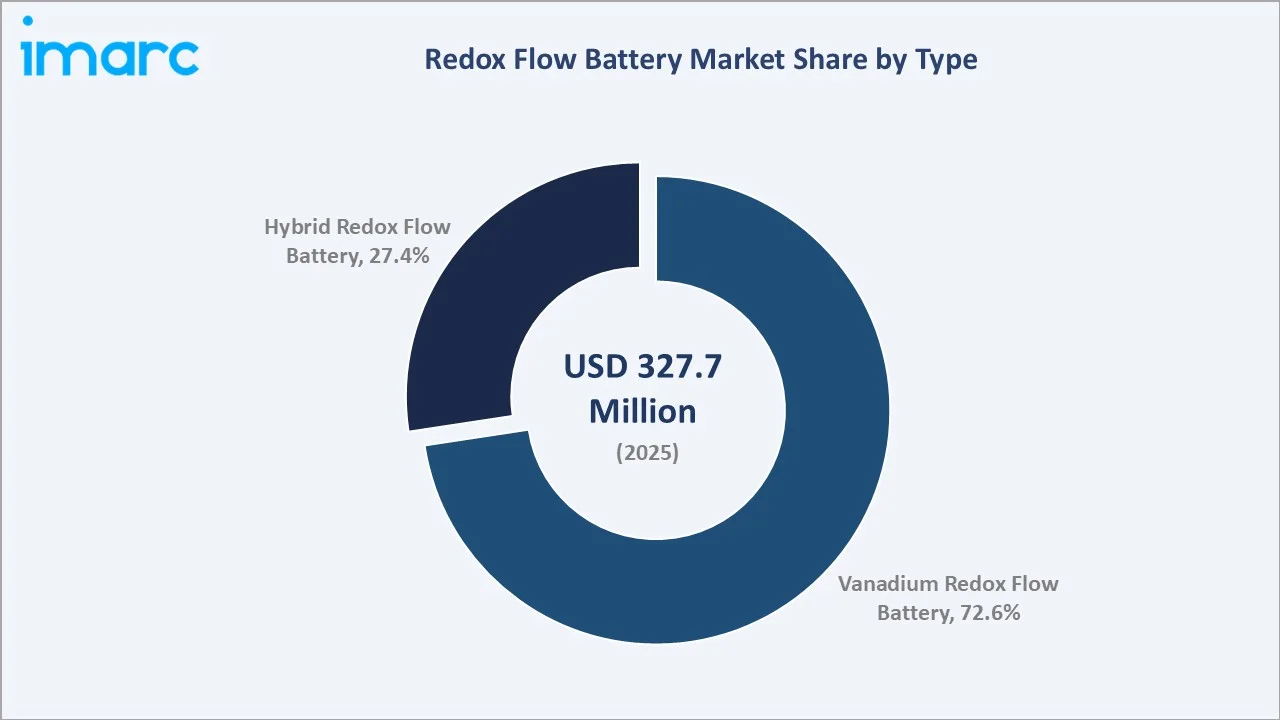
Vanadium redox flow battery leads at 72.6% (2025), due to their proven commercial maturity, long cycle life, and suitability for large-scale, long-duration energy storage applications. Unlike many alternative chemistries, VRFBs experience minimal capacity degradation over thousands of charge-discharge cycles and offer high operational safety through non-flammable electrolytes.
To access detailed market analysis, Request Sample
Hybrid redox flow battery at 27.4% driven by the growing need to combine the long-duration storage capability of flow batteries with the high-power response and compact footprint of technologies such as lithium-ion batteries.
By Application
Utility services lead at 41.5% (2025), through grid frequency regulation, peak shaving, transmission congestion relief, and grid stability.
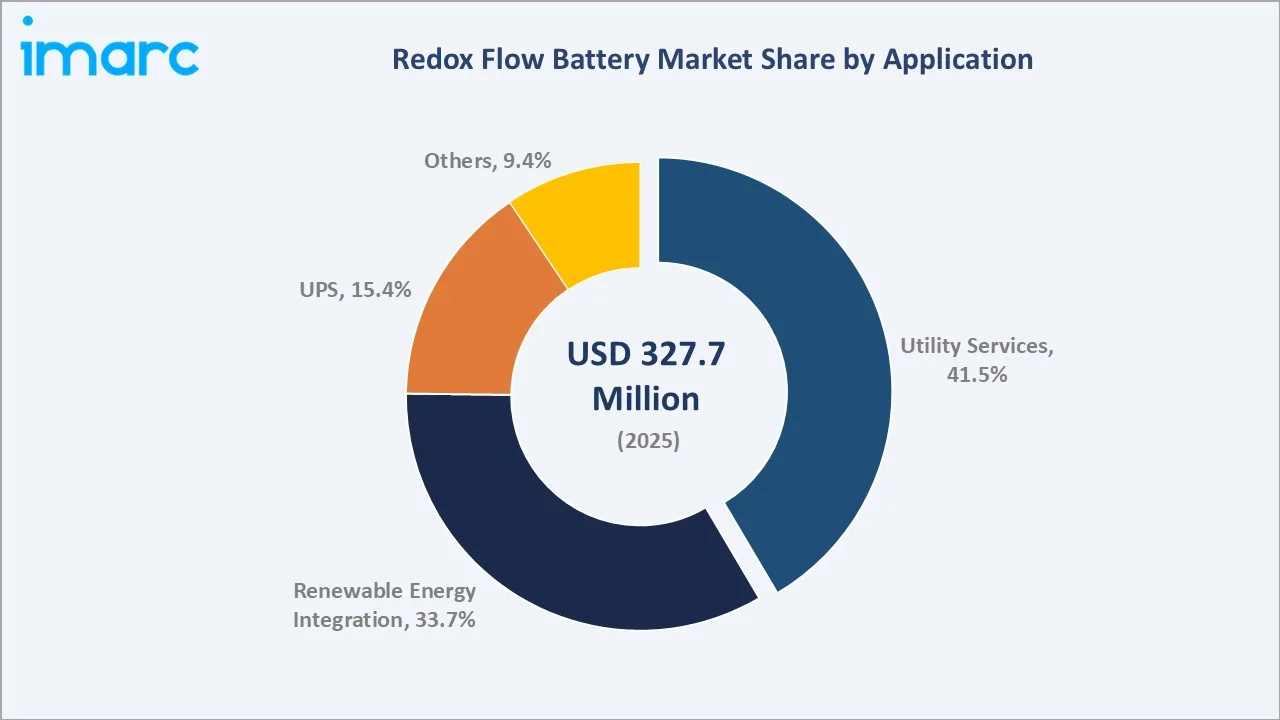
Renewable energy integration at 33.7% grows fastest at ~15.2% CAGR through solar and wind firming co-location and offshore wind VRFB. UPS at 15.4% reflects data center VRFB long-duration UPS above conventional short-duration UPS. Others at 9.4% include EV charging hub buffer, military microgrid, and island off-grid.
Regional Market Insights
|
Region |
Share (2025) |
Key Redox Flow Battery Market Drivers & Characteristics |
|
Asia-Pacific |
42.8% |
Driven by large-scale renewable energy deployment, grid modernization programs, and strong government support for long-duration energy storage. |
|
Europe |
24.6% |
Reflects strong decarbonization policies, renewable energy integration targets, and increasing demand for grid-scale energy storage. |
|
North America |
22.3% |
Supported by growing utility-scale storage installations, grid resilience initiatives, and rising investments in renewable energy infrastructure. |
|
Latin America |
5.7% |
Driven by expanding renewable energy capacity, particularly solar and wind projects, along with growing interest in grid stabilization and energy access solutions. |
|
Middle East and Africa |
4.6% |
Supported by renewable energy development, off-grid electrification projects, and investments in resilient power infrastructure. |
Asia-Pacific's 42.8% dominance is driven by large-scale renewable energy deployment, utility-scale storage investments, and strong government support for long-duration energy storage, particularly in China, Japan, South Korea, and Australia. Europe's 24.6% supported by decarbonization policies, energy transition goals, and increasing demand for grid flexibility.
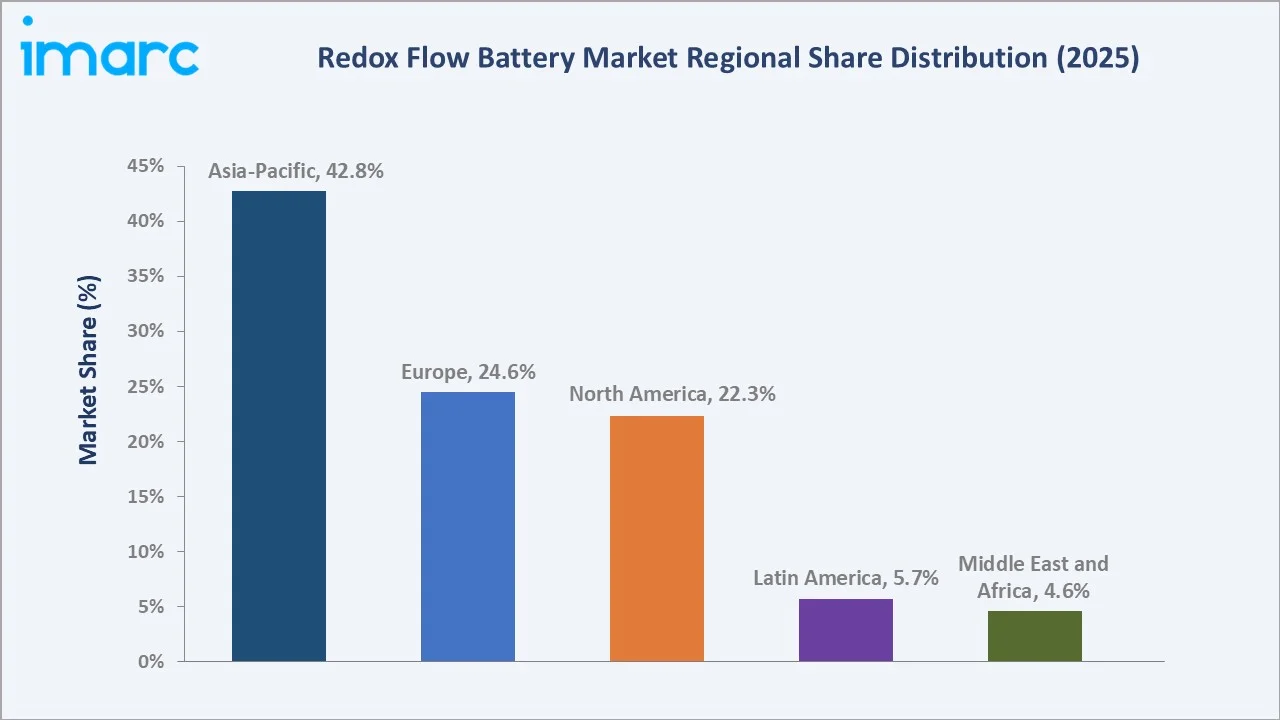
North America's 22.3% experiencing strong growth due to grid modernization initiatives, renewable energy expansion, and rising investments in long-duration storage projects. Latin America's 5.7% and Middle East & Africa's 4.6% benefiting from renewable energy development, rural electrification programs, and growing demand for resilient power infrastructure.
Competitive Landscape
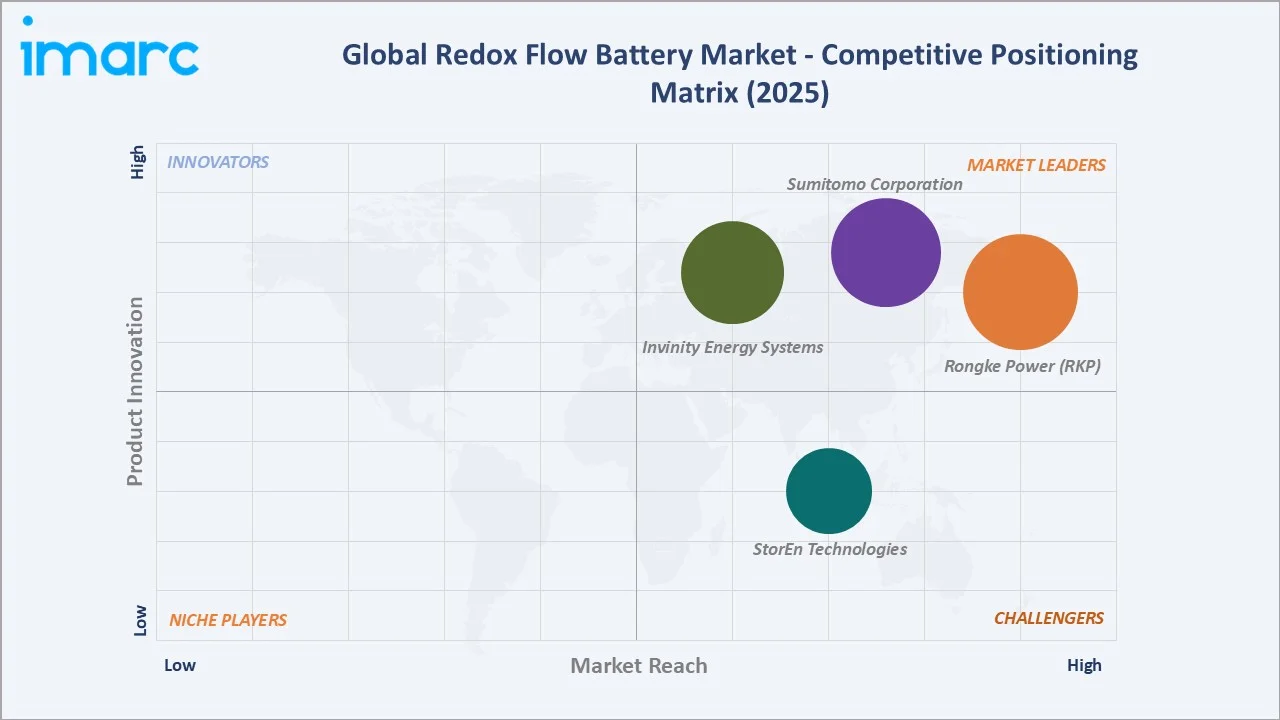
The global redox flow battery market is moderately concentrated, with competition centered on technology innovation, electrolyte chemistry, system efficiency, and large-scale project execution capabilities. Leading players focus on vanadium redox flow battery development, advanced membrane technologies, and long-duration energy storage solutions for utility and renewable energy applications.
|
Company |
Key Products |
Market Position |
Core Strength |
|
Rongke Power (RKP) |
UPower Series, SPower Series |
Market Leader |
Rongke Power (RKP) is one of the leaders in vanadium flow battery (VFB) technology. They specialize in scalable, long-duration energy storage systems for grid stability, peak-shaving, and renewable integration. |
|
Sumitomo Corporation |
Vanadium Redox Flow Battery |
Market Leader |
Sumitomo Corporation, with its affiliated company, Sumitomo Electric Industries, Ltd., specializes in Vanadium Redox Flow Batteries (VRFBs). |
|
Invinity Energy Systems |
Invinity ENDURIUM |
Market Leader |
Invinity Energy Systems is one of the leaders in vanadium redox flow battery (VRFB) technology. They design, manufacture, and commercialize modular, containerized flow batteries that store large amounts of renewable energy safely and without degradation, making them an ideal solution for grid-scale stability. |
|
StorEn Technologies |
StorEn Vanadium Flow Batteries |
Strong Challenger |
StorEn Technologies specializes in engineering sustainable vanadium redox flow batteries for long-duration, grid-scale applications. |
Strategic partnerships, pilot projects, manufacturing expansions, and electrolyte leasing models are becoming increasingly important competitive differentiators. Companies are also investing in next-generation flow battery chemistries and cost-reduction initiatives to improve commercial adoption and strengthen their market position.
Key Company Profiles
Rongke Power (RKP)
Rongke Power (RKP) is a leading China-based vanadium redox flow battery manufacturer specializing in large-scale, long-duration energy storage systems. The company focuses on VRFB technology for grid stabilization, renewable energy integration, peak shaving, and utility-scale energy storage applications.
- Key Products: UPower Series, SPower Series.
- Recent Developments: In April 2026, Rongke Power launched the TPower2000 in Beijing, describing it as the world’s highest-power single vanadium flow battery storage system. Rated at 2 MW/8 MWh, the system is designed for long-duration storage applications linked to renewable energy bases, grid-side peak shaving, and microgrids.
- Strategic Focus: Expanding the commercialization of vanadium redox flow battery (VRFB) technology for utility-scale and long-duration energy storage applications.
Sumitomo Corporation
Sumitomo Corporation, through its affiliate Sumitomo Electric Industries, Ltd., is a prominent participant in the redox flow battery market with a strong focus on Vanadium Redox Flow Battery (VRFB) technology. The company has decades of experience in developing, deploying, and commercializing large-scale energy storage systems for grid support, renewable energy integration, microgrids, and peak load management.
- Key Products: Vanadium Redox Flow Battery.
- Recent Developments: In May 2025, Sumitomo Electric installed its first vanadium redox flow battery system at the Kurokiyama Solar Power Plant, a community solar microgrid in Minamikyushu City, Kagoshima Prefecture. The system stores solar power generated during the day and supplies electricity to the local grid during evening and nighttime hours. With a 250 kW, four-hour flow battery system and 1,125 kWh of storage capacity, the project will support electricity supply to ten commercial and industrial facilities through dedicated power lines.
- Strategic Focus: Expanding long-duration energy storage solutions that support renewable energy integration, grid reliability, and decarbonization initiatives.
Market Concentration Analysis
The redox flow battery market is moderately concentrated, with a few established players leading commercial deployment and several emerging companies developing alternative flow battery chemistries. Key players such as Rongke Power (RKP), Sumitomo Corporation, Invinity Energy Systems, and StorEn Technologies hold strong positions through technology expertise, utility-scale projects, and long-duration storage solutions. Competition is focused on system efficiency, electrolyte chemistry, project scalability, lifecycle cost, and grid-integration capabilities. Large players benefit from proven deployments and manufacturing scale, while newer entrants compete through organic, iron, and zinc-bromine chemistries. As demand for long-duration energy storage grows, partnerships, project pipelines, and electrolyte supply strategies are becoming major competitive differentiators.
Investment & Growth Opportunities
Highest Growth Segments
Renewable energy integration (~15.2% CAGR), utility services (~14.8% CAGR), VRFB (~14.5% CAGR), Asia-Pacific (~15.5% CAGR), and military microgrid (~10-12% CAGR) represent RFB's highest-growth investment vectors through 2034.
Investment Themes
Vanadium Electrolyte-as-a-Service (VaaS): Vanadium electrolyte-as-a-service (VaaS) is an attractive investment theme as it reduces the upfront capital cost of vanadium redox flow battery projects by allowing customers to lease electrolyte rather than purchase it. The model improves project economics, creates recurring revenue streams for providers, and supports wider adoption of long-duration energy storage systems in utility and commercial markets.
Future Market Outlook (2026-2034)
The global redox flow battery market is set for strong expansion, growing from USD 327.7 Million in 2025 to USD 1,108.3 Million by 2034 at a 14.06% CAGR over the forecast period. The projected USD 632.7 Million value in 2030 indicates a commercial inflection point, where redox flow battery adoption moves beyond pilots into larger utility-scale deployments. Growth will be driven by renewable energy integration, grid modernization, long-duration storage needs, and rising demand for safer, longer-life battery systems.
Three structural forces define redox flow battery market growth through 2034. First, the rapid expansion of renewable energy generation is increasing demand for long-duration energy storage to balance intermittent solar and wind power. Second, grid modernization and energy security initiatives are driving utility investments in large-scale storage systems with long operating lifespans. Third, growing adoption of microgrids, EV charging infrastructure, and resilient backup power solutions is creating new opportunities for scalable and safe redox flow battery deployments.
Research Methodology
Primary Research
Primary research comprised interviews with redox flow battery manufacturers, electrolyte suppliers, system integrators, utility companies, renewable energy developers, and energy storage experts. Discussions were also conducted with project developers, EPC contractors, technology providers, and grid operators to assess technology adoption, deployment trends, pricing dynamics, and future market opportunities.
Secondary Research
Secondary research encompassed company websites, annual reports, investor presentations, press releases, energy storage databases, and industry publications. It also included reviewing government renewable energy policies, grid storage tenders, utility project announcements, and technical papers on flow battery technologies.
Forecasting Models
Forecasting models combined historical market performance, utility-scale energy storage deployment trends, renewable energy capacity additions, and long-duration storage demand projections to estimate future market growth. Quantitative methods such as CAGR analysis, demand forecasting, and scenario-based modeling were supplemented by qualitative assessments of technology advancements, policy support, and investment activity. Expert validation and sensitivity analysis were applied to ensure robust market projections through 2034.
Redox Flow Battery Industry Report Scope:
| Report Features | Details |
|---|---|
| Base Year of the Analysis | 2025 |
| Historical Period | 2020-2025 |
| Forecast Period | 2026-2034 |
| Units | Million USD |
| Scope of the Report | Exploration of Historical Trends and Market Outlook, Industry Catalysts and Challenges, Segment-Wise Historical and Future Market Assessment:
|
| Types Covered | Vanadium Redox Flow Battery, Hybrid Redox Flow Battery |
| Products Covered | Compact, Large Scale |
| Applications Covered | Utility Services, Renewable Energy Integration, UPS, Others |
| Regions Covered | Asia Pacific, Europe, North America, Latin America, Middle East and Africa |
| Countries Covered | United States, Canada, Germany, France, United Kingdom, Italy, Spain, Russia, China, Japan, India, South Korea, Australia, Indonesia, Brazil, Mexico |
| Companies Covered | Rongke Power (RKP), Sumitomo Corporation, Invinity Energy Systems, StorEn Technologies, etc. |
| Customization Scope | 10% Free Customization |
| Post-Sale Analyst Support | 10-12 Weeks |
| Delivery Format | PDF and Excel through Email (We can also provide the editable version of the report in PPT/Word format on special request) |
Key Benefits for Stakeholders:
- IMARC’s industry report offers a comprehensive quantitative analysis of various market segments, historical and current market trends, market forecasts, and dynamics of the redox flow battery market from 2020-2034.
- The research report provides the latest information on the market drivers, challenges, and opportunities in the global redox flow battery market.
- The study maps the leading, as well as the fastest-growing, regional markets. It further enables stakeholders to identify the key country-level markets within each region.
- Porter's five forces analysis assists stakeholders in assessing the impact of new entrants, competitive rivalry, supplier power, buyer power, and the threat of substitution. It helps stakeholders to analyze the level of competition within the redox flow battery industry and its attractiveness.
- The competitive landscape allows stakeholders to understand their competitive environment and provides insight into the current positions of key players in the market.
Frequently Asked Questions About the Redox Flow Battery Market Report
The global redox flow battery market reached USD 327.7 Million in 2025, driven by rising demand for long-duration energy storage to support renewable energy integration and grid stability. Growth is further supported by utility-scale storage deployments, microgrid development, and the need for safer, longer-life alternatives to lithium-ion batteries. Expanding EV charging infrastructure and grid modernization programs are also accelerating adoption.
The global redox flow battery market grows at 14.06% CAGR during 2026-2034, reaching USD 1,108.3 Million by 2034. Growth will be supported by rising demand for long-duration energy storage, renewable energy integration, and utility-scale grid stabilization solutions.
Vanadium redox flow battery leads at 72.6% due to their proven commercial maturity, long cycle life, and strong suitability for utility-scale long-duration storage. Their scalable design, low degradation, and high safety make them preferred for renewable energy integration, grid balancing, and peak-shaving applications.
Utility services lead at 41.5% as utilities require large-scale, long-duration storage to balance renewable energy supply, support peak shaving, and improve grid reliability. Redox flow batteries are well-suited for utility applications due to their scalability, long cycle life, and ability to provide stable multi-hour discharge.
Asia-Pacific leads at 42.8% due to strong renewable energy expansion, utility-scale storage investments, and supportive clean energy policies across China, Japan, South Korea, Australia, and India. The region’s large grid modernization programs and growing VRFB project pipeline further strengthen its market leadership.
Leading companies include Rongke Power (RKP), Sumitomo Corporation, Invinity Energy Systems, and StorEn Technologies, among others.
The market is projected to reach approximately USD 632.7 Million by 2030, reflecting rising commercial adoption of long-duration energy storage. Growth will be driven by utility-scale renewable integration, grid modernization, and demand for safer, longer-life battery systems.
Three priority investment opportunities include Vanadium Electrolyte-as-a-Service (VaaS) models, which lower upfront project costs and improve the economics of VRFB deployments. Long-duration storage for microgrids and remote power systems offers strong growth potential as energy resilience and off-grid electrification gain importance. Additionally, data center long-duration UPS applications using VRFBs represent a promising opportunity, driven by the rapid expansion of hyperscale data centers and the need for reliable, sustainable backup power solutions.
Need more help?
- Speak to our experienced analysts for insights on the current market scenarios.
- Include additional segments and countries to customize the report as per your requirement.
- Gain an unparalleled competitive advantage in your domain by understanding how to utilize the report and positively impacting your operations and revenue.
- For further assistance, please connect with our analysts.
 Request Customization
 Speak to an Analyst
 Request Brochure
 Inquire Before Buying
Benefits of Customization
- Personalize this research
- Triangulate with your data
- Get data as per your format and definition
- Gain a deeper dive into a specific application, geography, customer, or competitor
- Any level of personalization
Get in Touch With Us
UNITED STATES
Phone: +1-201-971-6302
INDIA
Phone: +91-120-433-0800
UNITED KINGDOM
Phone: +44-753-714-6104
Email: [email protected]
Client Testimonials




.webp)




.webp)













Related Reports

Choose your plan
*Please note that the prices mentioned below are starting prices for each bundle type. Kindly contact our team for further details.*
Single User License
- 1 User License, Access on 2 Devices
- PDF Report + Excel Dataset (Password Protected)
- Lifetime Access
- No Printing Rights
- 10% Free Report Customization
- 10–12 Weeks of Analyst Support
Five User License
- Access for 5 Users, 2 Devices per User
- PDF Report + Excel Dataset (Password Protected)
- Lifetime Access
- Dedicated Account Manager
- 12–14 Weeks of Analyst Support
- No Printing Rights
- 15% Free Report Customization
- 25% Discount on Your Next Purchase
Corporate User License
- Unlimited User Access (Within Your Organization)
- PDF Report + Excel Dataset
- Lifetime Access
- Dedicated Account Manager
- 14–20 Weeks of Analyst Support
- No Printing Rights
- 20% Free Report Customization
- 30% Discount on Your Next Purchase
Essential Insights
What's included:
3 reports
- Lifetime Access
- PDF Reports
- Excel Datasets
- 2 Weeks of Free Analyst Support
- 2 User Licenses
- Access on 2 Devices
- Printing Rights
- Complimentary PowerPoint (PPT) Version
- Complimentary License Upgrade
Professional Access
What's included:
5 reports
- Lifetime Access
- PDF Reports
- Excel Datasets
- 8 Weeks of Free Analyst Support
- 2 User Licenses
- Access on 2 Devices
- Printing Rights
- Complimentary PowerPoint (PPT) Version
- Complimentary License Upgrade
Business Advantage
What's included:
8 reports
- Lifetime Access
- PDF Reports
- Excel Datasets
- 14 Weeks of Free Analyst Support
- 2 User Licenses
- Access on 2 Devices
- Printing Rights
- Complimentary PowerPoint (PPT) Version
- Complimentary License Upgrade
Enterprise Intelligence
What's included:
10 reports
- Lifetime Access
- PDF Reports
- Excel Datasets
- 20 Weeks of Free Analyst Support
- 2 User Licenses
- Access on 2 Devices
- Printing Rights
- Complimentary PowerPoint (PPT) Version
- Complimentary License Upgrade