
Brazil Cloud Security Market Size, Share, Trends and Forecast by Service Model, Deployment Model, Organization Size, Solution Type, Industry Verticals, and Region, 2026-2034
Brazil Cloud Security Market Size, Share, Trends & Forecast (2026-2034)
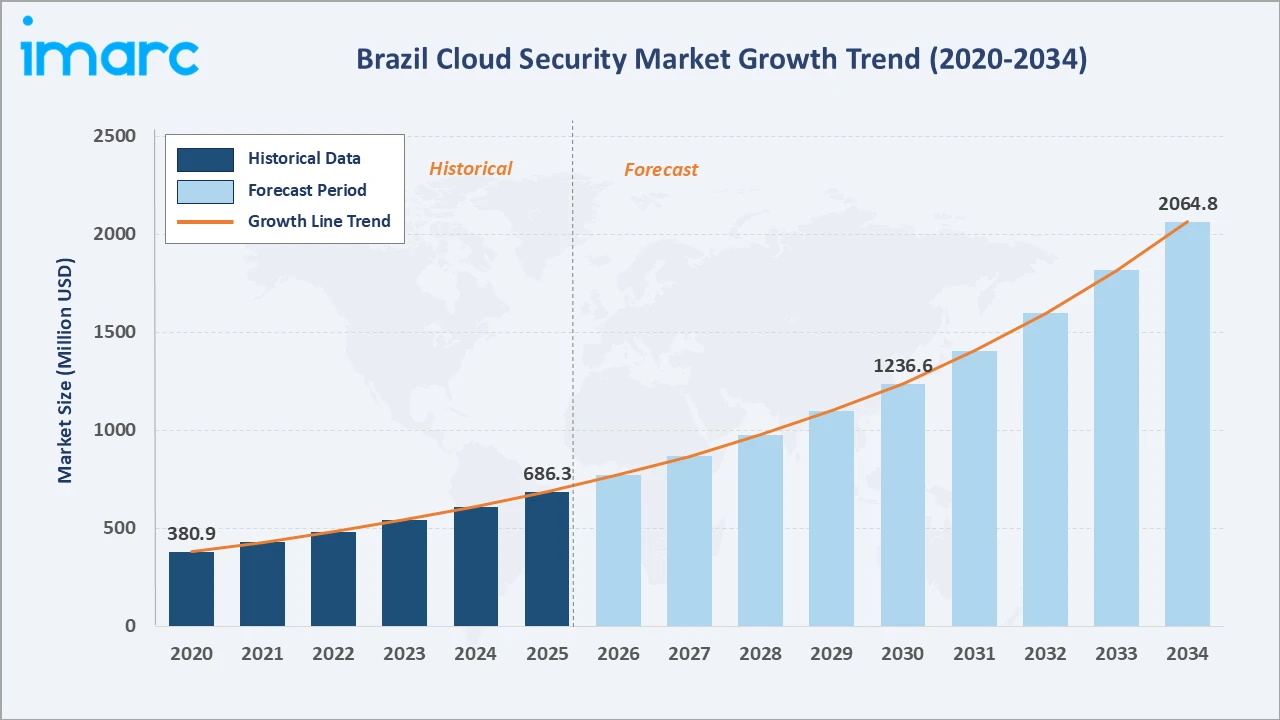
The Brazil cloud security market reached a value of USD 686.3 Million in 2025 and is projected to reach USD 2,064.8 Million by 2034, exhibiting a CAGR of 12.50% during 2026-2034. Brazil recorded more than 10 Billion cyberattack attempts in 2023, ranking among the most targeted countries worldwide and intensifying enterprise demand for advanced protection.
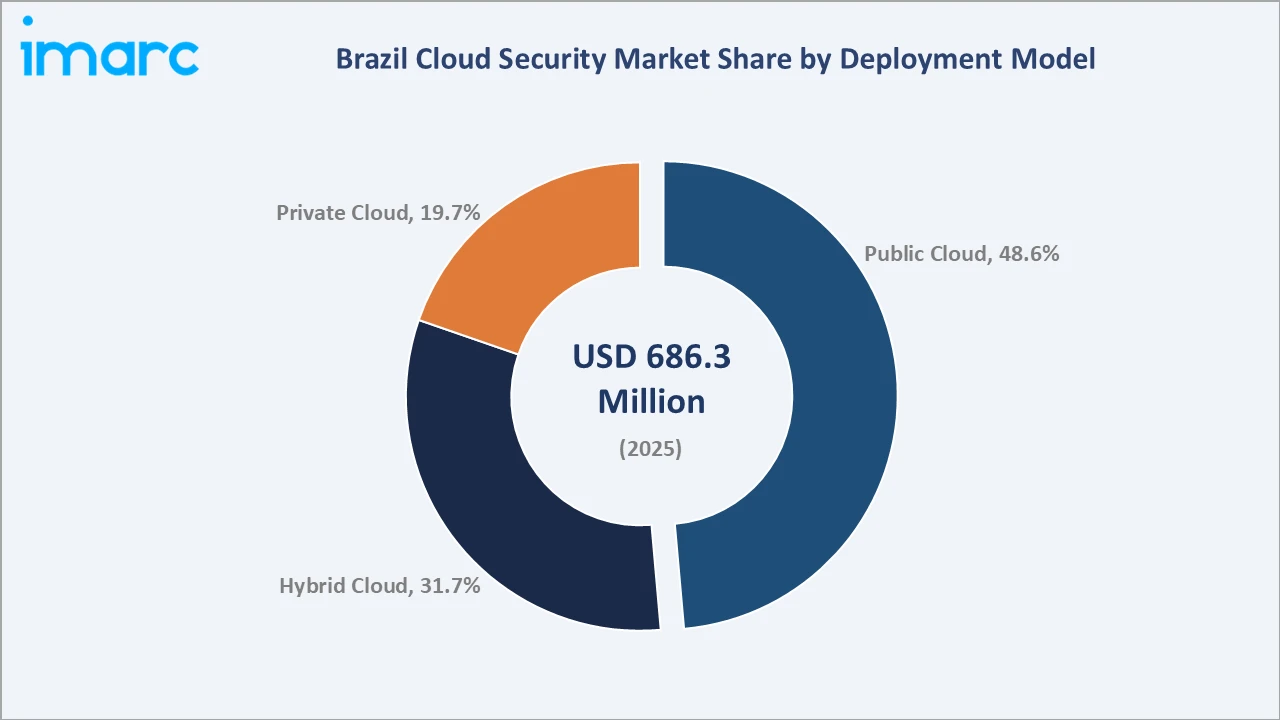
Public cloud leads the deployment model segment at 48.6%, large enterprises dominate the organization size segment at 62.5%, and Southeast commands 47.6% of the regional share.
Market Snapshot
|
Metric |
Value |
|
Market Size (2025) |
USD 686.3 Million |
|
Forecast Market Size (2034) |
USD 2,064.8 Million |
|
CAGR (2026-2034) |
12.50% |
|
Base Year |
2025 |
|
Historical Period |
2020-2025 |
|
Forecast Period |
2026-2034 |
|
Largest Region |
Southeast (47.6%, 2025) |
|
Second Largest Region |
South (21.5%, 2025) |
|
Leading Deployment Model |
Public Cloud (48.6%, 2025) |
|
Leading Organization Size |
Large Enterprises (62.5%, 2025) |
The Brazil cloud security market expanded from USD 380.9 Million in 2020 to USD 686.3 Million in 2025, driven by widening enterprise digitalization, growing regulatory pressure, and rapid multi-cloud infrastructure expansion across the country. Anchored at USD 1236.6 Million in 2030, the forecast to USD 2,064.8 Million by 2034 is supported by accelerating adoption of zero trust architecture, expanding managed security services, and a more mature compliance environment for regulated industries.
To get more information on this market, Request Sample
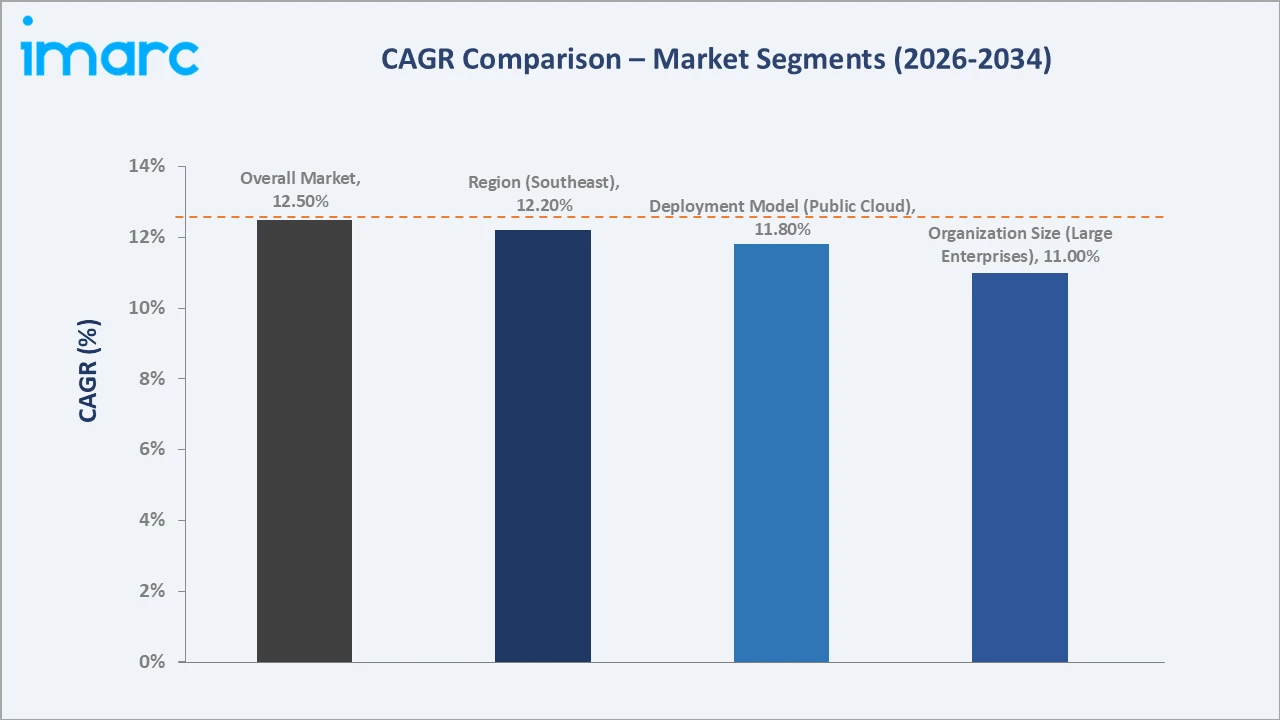
CAGR trajectories across deployment model, organization size, and regional sub-segments show hybrid cloud and small and medium-sized enterprises (SMEs) expanding faster than the overall 12.50% market CAGR, driven by tightening compliance requirements and increasingly accessible subscription-based security offerings.
Executive Summary
The Brazil cloud security market is on a steady growth trajectory, expanding from USD 380.9 Million in 2020 to USD 2,064.8 Million by 2034. The market has moved from perimeter-based, on-premises security toward cloud-native, platform-led protection spanning public, private, and hybrid environments. Enterprises are increasingly prioritizing identity management, workload protection, and continuous compliance monitoring as core components of their cybersecurity strategy.
Public cloud dominates the deployment model segment at 48.6% in 2025, supported by hyperscaler expansion and improving regional data center capacity. Large enterprises lead the organization size segment at 62.5%, reflecting larger IT budgets and more complex multi-cloud environments. Southeast commands 47.6% of the regional share, anchored by São Paulo's position as the country's leading technology and financial hub.
Key Market Insights
|
Insight |
Data |
|
Leading Deployment Model |
Public Cloud - 48.6% share (2025) |
|
Second Largest Deployment Model |
Hybrid Cloud - 31.7% share (2025) |
|
Leading Organization Size |
Large Enterprises - 62.5% share (2025) |
|
Second Largest Organization Size |
Small and Medium-sized Enterprises (SMEs) - 37.5% share (2025) |
|
Leading Region |
Southeast - 47.6% share (2025) |
|
Second Largest Region |
South - 21.5% share (2025) |
|
Top Companies |
Microsoft, IBM, Cisco Systems, Inc., Palo Alto Networks, Fortinet, Inc., Check Point Software Technologies Ltd. |
Key Analytical Observations Expanding On The Data Above:
- Public cloud dominance at 48.6% is supported by lower upfront IT investment requirements, rapid scalability, and expanding hyperscaler data center capacity, making it the preferred deployment route for security-conscious enterprises.
- Hybrid cloud adoption at 31.7% is expanding as organizations balance scalability with data residency requirements under the Lei Geral de Proteção de Dados (LGPD), keeping sensitive workloads on private infrastructure while leveraging public cloud elasticity for other functions.
- Large enterprises leadership at 62.5% reflects larger cybersecurity budgets, more complex multi-cloud footprints, and earlier adoption of advanced posture management and workload protection tools.
- Small and medium-sized enterprises (SMEs) adoption at 37.5% is rising steadily as subscription-based, security-as-a-service models lower entry barriers and reduce the need for in-house security expertise.
- Southeast dominance at 47.6% is reinforced by concentrated hyperscaler investment. In September 2024, AWS committed USD 1.8 Billion to expand its Brazil data center operations through 2034, strengthening the region's position as the country's primary cloud and security infrastructure hub.
Brazil Cloud Security Market Overview
Cloud security refers to the technologies, policies, and controls used to protect cloud-based infrastructure, applications, and data from unauthorized access, breaches, and compliance violations. The market spans cloud security posture management, cloud workload protection platforms, identity and access management, data loss prevention, and managed detection and response services delivered across public, private, and hybrid cloud environments.
The Brazilian ecosystem integrates global hyperscalers, specialized security vendors, systems integrators, managed security service providers, regulatory authorities, and enterprise IT teams. Expanding e-commerce and fintech activities continue to reinforce demand for resilient, compliant cloud security infrastructure across sectors.
Market Dynamics
To evaluate market opportunities, Request Sample
Market Drivers
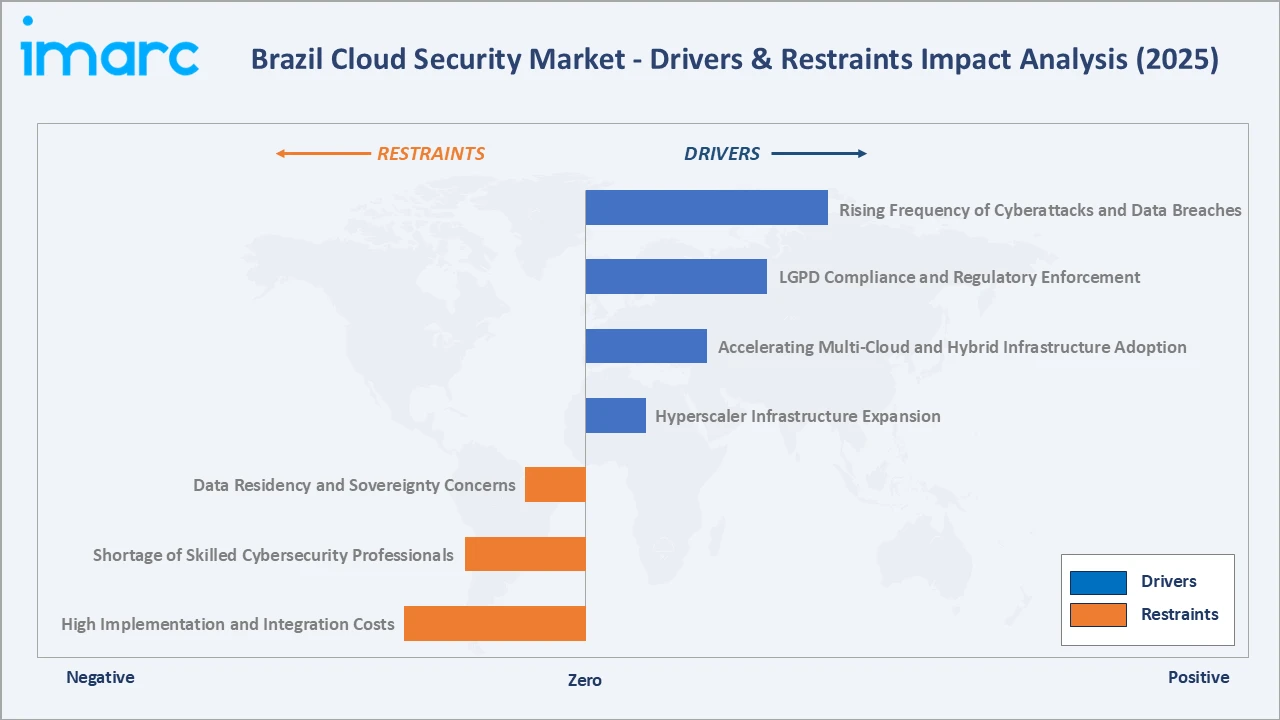
- Rising Frequency of Cyberattacks and Data Breaches: The escalating volume and sophistication of cyber incidents targeting Brazilian enterprises across finance, healthcare, and government sectors is driving sustained investment in advanced cloud-native protection.
- LGPD Compliance and Regulatory Enforcement: Strengthened enforcement of LGPD is compelling organizations to adopt continuous compliance monitoring, encryption, and access-control tools across their cloud environments.
- Accelerating Multi-Cloud and Hybrid Infrastructure Adoption: Enterprises are diversifying workloads across multiple cloud providers to improve resilience and avoid vendor lock-in, expanding the addressable base for cross-platform security solutions.
- Hyperscaler Infrastructure Expansion: In September 2024, Microsoft announced a USD 2.70 Billion investment to expand cloud and AI infrastructure across Brazil over three years, reinforcing the underlying capacity that security vendors build upon.
Market Restraints
- High Implementation and Integration Costs: Deploying comprehensive cloud security platforms across legacy and modern systems requires significant upfront investment, limiting adoption speed among smaller organizations.
- Shortage of Skilled Cybersecurity Professionals: The limited pool of trained security professionals in Brazil is constraining enterprises' ability to deploy, manage, and optimize advanced cloud security solutions effectively.
- Data Residency and Sovereignty Concerns: Uncertainty around cross-border data transfer requirements continues to complicate deployment decisions for multinational cloud security platforms operating in Brazil.
Market Opportunities
- Managed Security Services Expansion: Growing demand for outsourced monitoring and incident response is creating opportunities for managed security service providers to serve resource-constrained mid-market enterprises.
- Zero Trust and SASE Adoption Among Mid-Market Enterprises: Increasing awareness of identity-centric security models is opening new revenue pools beyond traditional perimeter-based approaches.
Market Challenges
- Fragmented Regulatory Enforcement Across Sectors: Inconsistent application of compliance requirements across industries creates uncertainty for vendors designing standardized security offerings.
- Legacy IT Infrastructure Integration: Many Brazilian enterprises continue to operate on-premises legacy systems that complicate seamless integration with modern cloud-native security architectures.
Emerging Market Trends
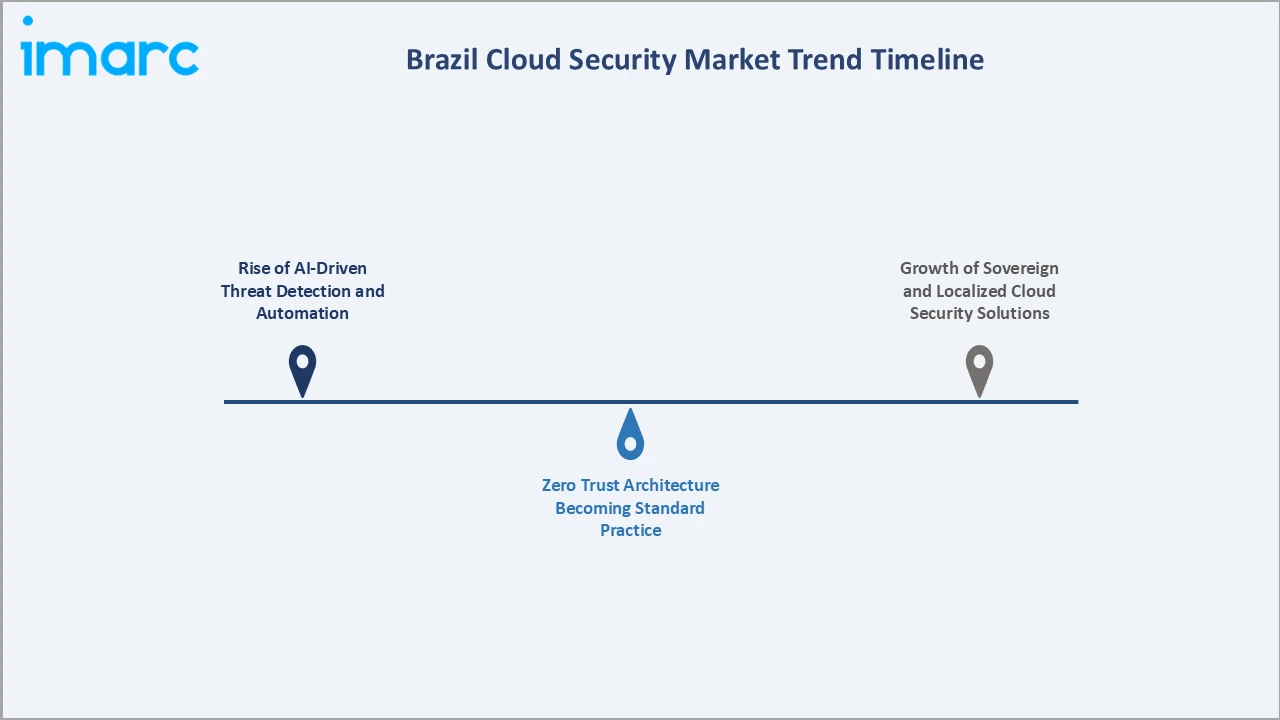
1. Rise of AI-Driven Threat Detection and Automation
Security vendors are embedding machine learning models into detection engines to identify anomalous behavior in real time. This shift is reducing response times and enabling security teams to manage growing volumes of cloud telemetry more efficiently.
2. Zero Trust Architecture Becoming Standard Practice
Enterprises are moving away from perimeter-based models toward continuous identity verification for every user and device. The transition is reshaping how access controls are designed across distributed cloud environments.
3. Growth of Sovereign and Localized Cloud Security Solutions
Rising data-residency expectations are encouraging vendors to expand locally hosted security infrastructure, giving Brazilian enterprises greater control over where regulated data is processed and stored.
Industry Value Chain Analysis
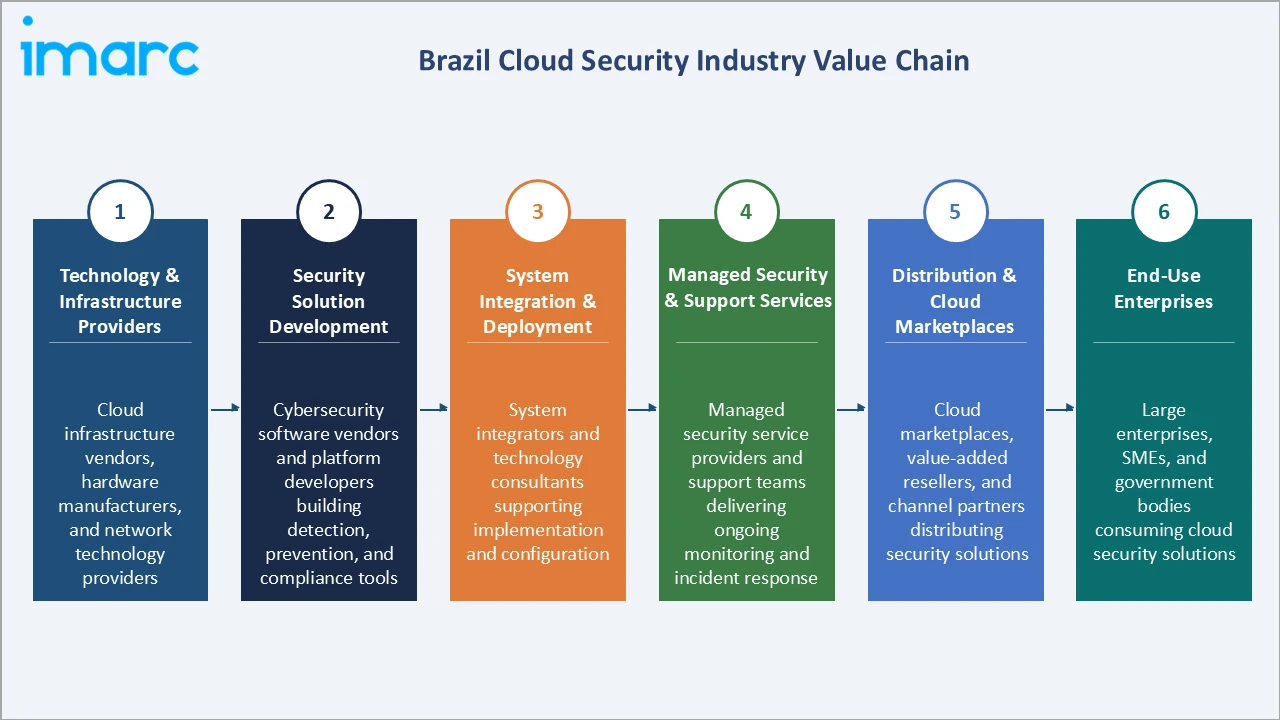
The Brazil cloud security value chain spans six stages, from underlying technology infrastructure through end-use consumption. Security solution development and managed services capture the highest value-add, while distribution and integration capabilities increasingly determine competitive positioning in this fast-scaling category.
|
Stage |
Key Players / Examples |
|
Technology & Infrastructure Providers |
Cloud infrastructure vendors, hardware manufacturers, and network technology providers enabling backend security systems |
|
Security Solution Development |
Cybersecurity software vendors and platform developers building detection, prevention, and compliance tools |
|
System Integration & Deployment |
System integrators and technology consultants supporting implementation and configuration |
|
Managed Security & Support Services |
Managed security service providers and support teams delivering ongoing monitoring and incident response |
|
Distribution & Cloud Marketplaces |
Cloud marketplaces, value-added resellers, and channel partners distributing security solutions |
|
End-Use Enterprises |
Large enterprises, SMEs, and government bodies consuming cloud security solutions |
Vendors with proprietary detection engines, deep automation capabilities, and direct enterprise relationships are positioned to capture greater value than partners reliant on third-party infrastructure alone.
Technology Landscape in the Brazil Cloud Security Industry
AI-Driven Detection and Threat Intelligence
Modern platforms increasingly rely on machine learning models trained on global threat intelligence to identify misconfigurations, anomalous access patterns, and emerging attack techniques across multi-cloud estates.
Identity and Access Management (IAM) and Zero Trust
Continuous identity verification, least-privilege access policies, and micro-segmentation are becoming foundational to how Brazilian enterprises architect cloud environments.
Automation and Security Orchestration
Security orchestration, automation, and response tooling is reducing manual workloads for lean security teams, enabling faster containment of incidents across distributed infrastructure.
Encryption and Compliance Tooling
Native encryption, tokenization, and automated compliance-reporting features are being integrated directly into cloud platforms to help enterprises meet LGPD and sector-specific regulatory obligations.
Market Segmentation Analysis
The report covers the following segments:
|
Segment Category |
Leading Segment |
Market Share |
Year |
|
Service Model |
🔒 |
🔒 |
2025 |
|
Deployment Model |
Public Cloud |
48.6% |
2025 |
|
Organization Size |
Large Enterprises |
62.5% |
2025 |
|
Solution Type |
🔒 |
🔒 |
2025 |
|
Industry Verticals |
🔒 |
🔒 |
2025 |
|
Region |
Southeast |
47.6% |
2025 |

By Deployment Model
Public cloud commands a 48.6% majority share in 2025, driven by lower upfront costs, rapid scalability, and expanding hyperscaler data center capacity across Southeast. The segment benefits from continuous platform updates and native security tooling offered directly by cloud providers.
To access detailed market analysis, Request Sample
Hybrid cloud follows at 31.7% in 2025, favored by organizations balancing scalability with data residency obligations under the LGPD.
By Organization Size
Large enterprises dominate with 62.5% share in 2025, reflecting bigger cybersecurity budgets, more complex multi-cloud footprints, and earlier adoption of advanced posture management tools across regulated sectors.
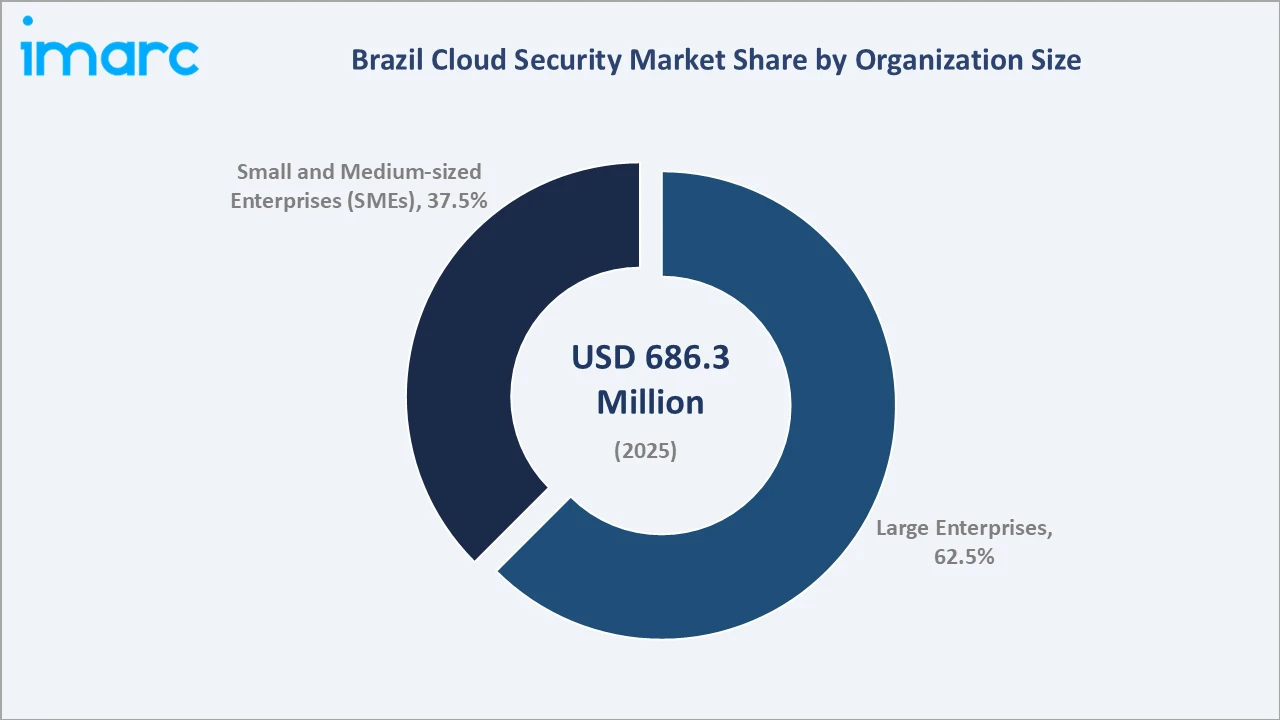
Small and medium-sized enterprises (SMEs) account for 37.5% and represent the faster-scaling cohort, supported by subscription-based, security-as-a-service models that lower the barrier to enterprise-grade protection.
Regional Market Insights
|
Region |
Share (2025) |
Key Growth Drivers |
|
Southeast |
47.6% |
Large concentration of enterprises, strong digital infrastructure, deep hyperscaler presence, and high cloud adoption |
|
South |
21.5% |
Growing industrial digitalization, expanding technology talent base, and rising enterprise cloud investment |
|
Northeast |
14.2% |
Expanding digital economy, growing e-commerce activity, and increasing government technology initiatives |
|
Central-West |
9.1% |
Rising public sector digitalization, expanding agribusiness technology adoption, and growing regional connectivity |
|
North |
7.6% |
Emerging digital infrastructure investment, improving connectivity, and gradual enterprise cloud migration |
Southeast leads the regional landscape at 47.6% in 2025, anchored by São Paulo and Rio de Janeiro. Dense enterprise concentration, mature digital infrastructure, and a large base of technology talent support sustained leadership across the region.
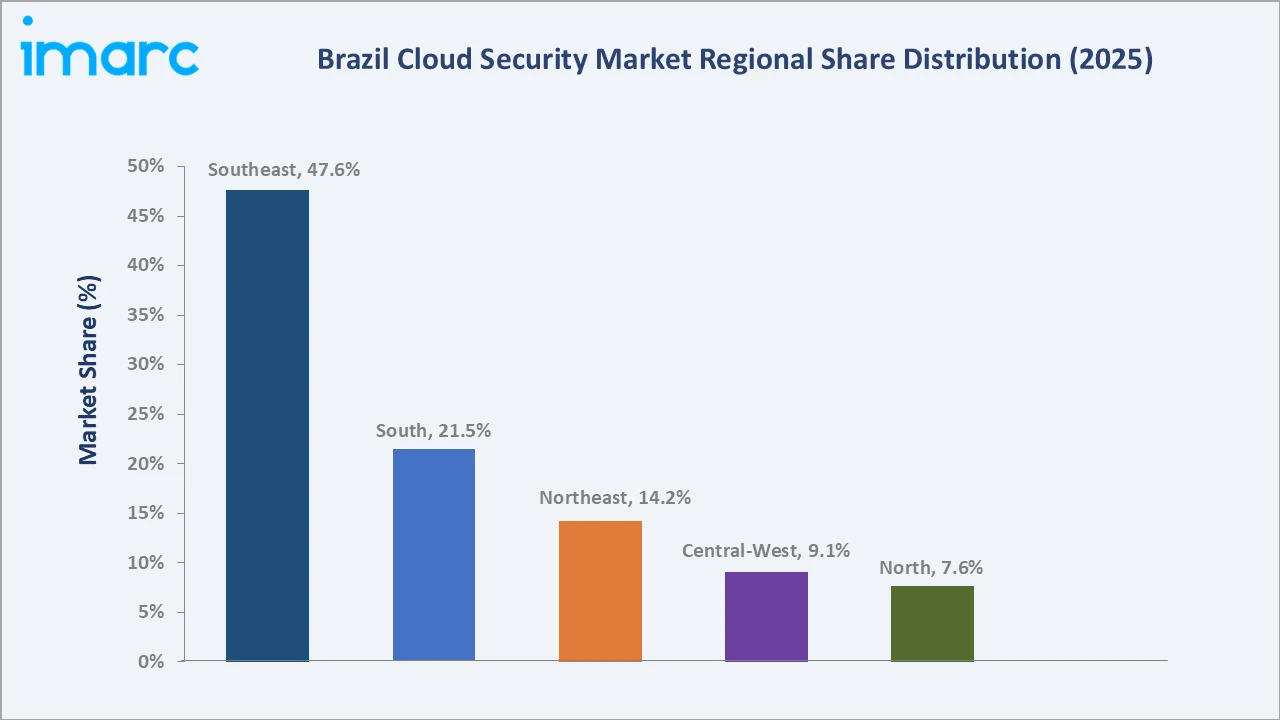
South at 21.5% is supported by a strong industrial base, growing enterprise cloud adoption, and increasing investment in cybersecurity across the manufacturing and technology sectors.
Competitive Landscape
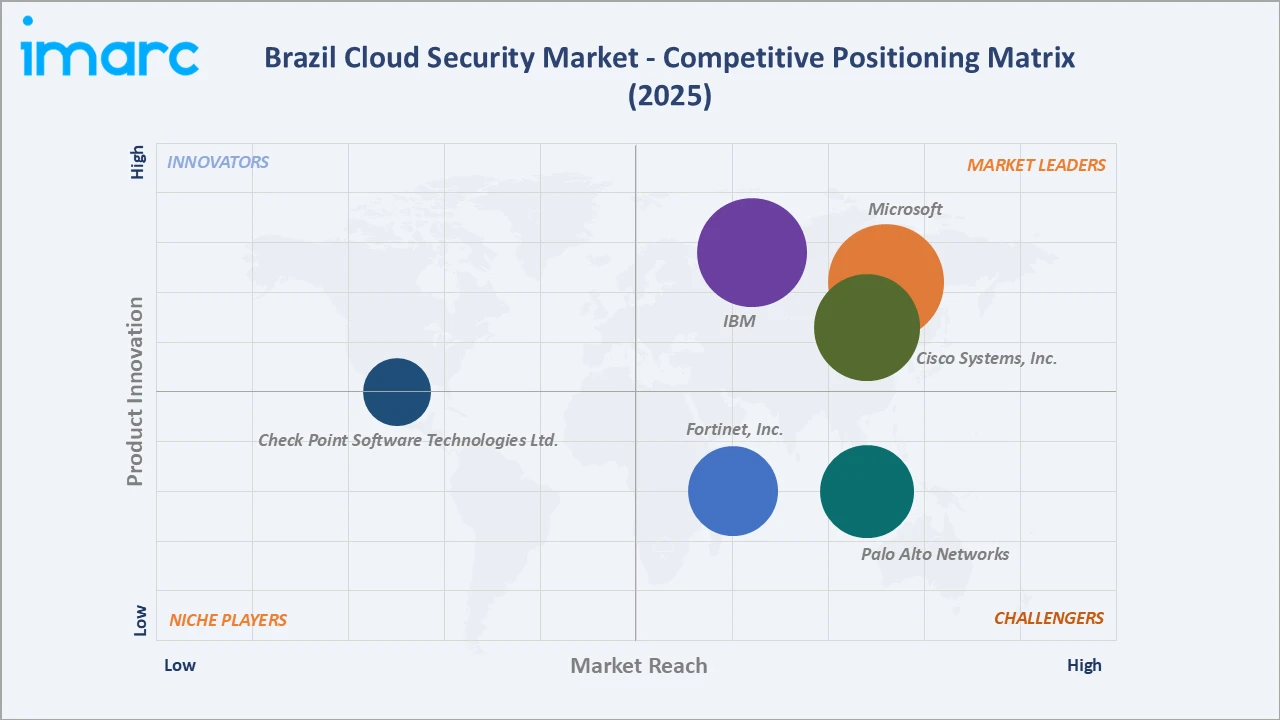
The Brazil cloud security market is moderately fragmented, with established global technology vendors leading platform breadth and enterprise reach while regional systems integrators compete on localized deployment and support. Technology depth, compliance readiness, and channel partnerships form the key competitive moats following LGPD's tightening enforcement environment.
|
Company Name |
Brand / Key Product |
Position |
Strategic Focus |
|
Microsoft |
Microsoft Defender for Cloud |
Leader |
Expanding integrated, AI-assisted cloud security across its hyperscaler ecosystem |
|
IBM |
IBM Guardium |
Leader |
Strengthening hybrid cloud security capabilities through integrated data protection and enterprise security solutions for multi-cloud environments |
|
Cisco Systems, Inc. |
Cisco Secure Access |
Leader |
Broadening network and cloud security convergence for enterprise customers |
|
Palo Alto Networks |
Cortex Cloud |
Challenger |
Consolidating cloud security and security operations under the unified Cortex platform |
|
Fortinet, Inc. |
FortiGate / FortiCloud |
Challenger |
Extending integrated security-driven networking across hybrid environments |
|
Check Point Software Technologies Ltd. |
CloudGuard (Check Point Cloud Security) |
Emerging |
Broadening integrated cloud security capabilities across hybrid and multi-cloud environments |
Key players include Microsoft, IBM, Cisco Systems, Inc., Palo Alto Networks, Fortinet, Inc., and Check Point Software Technologies Ltd., among others.
Key Company Profiles
Microsoft
Microsoft is a global technology company headquartered in Redmond, Washington, United States, offering cloud security capabilities. In Brazil, the company maintains a growing enterprise and government customer base supported by expanding regional cloud infrastructure.
- Product Portfolio: Microsoft Defender for Cloud, providing cloud security posture management and workload protection across multi-cloud environments.
- Recent Developments: The company continues to expand its cloud security portfolio through ongoing platform enhancements, AI-driven security capabilities, and broader integration across enterprise cloud environments.
- Strategic Focus: Advancing unified cloud security capabilities by integrating AI-driven protection across its expanding cloud platform.
IBM
IBM is a global technology and consulting company headquartered in Armonk, New York, United States, with an established enterprise presence in Brazil spanning hybrid cloud and security services.
- Product Portfolio: IBM Guardium, providing unified data security posture management, discovery, and compliance monitoring across hybrid multicloud environments.
- Recent Developments: The company continues to strengthen its hybrid cloud data security portfolio and expand managed security service offerings for enterprise customers.
- Strategic Focus: Enhancing enterprise hybrid cloud resilience through advanced data security and integrated protection solutions.
Cisco Systems, Inc.
Cisco Systems, Inc. is a global networking and cybersecurity company headquartered in San Jose, California, United States, with an established enterprise networking and security footprint across Brazil.
- Product Portfolio: Cisco Secure Access, a cloud-delivered security service edge solution providing secure internet, private application, and remote access.
- Recent Developments: The company continues to expand its secure access and cloud security offerings to support distributed enterprise workforces across Brazil.
- Strategic Focus: Expanding secure, cloud-native networking solutions to support evolving enterprise cybersecurity requirements.
Market Concentration Analysis
The Brazil cloud security market is moderately concentrated, with the top six global vendors accounting for a significant share of enterprise deployments, supported by their integrated platform ecosystems and established local partner networks.
Barriers to entry include the need for extensive compliance certifications, large-scale threat intelligence infrastructure, and established distribution relationships with regional systems integrators. These factors favor well-capitalized global vendors with mature product portfolios and local support capabilities.
Consolidation is accelerating as larger vendors acquire specialized point solutions to broaden platform coverage, while smaller regional players increasingly partner with global providers to access advanced detection and compliance capabilities.
Investment & Growth Opportunities
Fastest-Growing Segments
Hybrid cloud and small and medium-sized enterprises (SMEs) represent the fastest-scaling segments, driven by expanding regulatory compliance needs and increasingly accessible subscription-based security offerings.
Emerging Markets
Central-West and Northeast represent significant untapped opportunity for vendors able to deliver region-specific deployment support and localized compliance capabilities as digital infrastructure expands beyond the Southeast.
Venture & Investment Trends
Investment is concentrated in AI-driven detection platforms, managed security service providers, and compliance-automation tooling aligned with Brazil's evolving regulatory environment.
Future Market Outlook (2026-2034)
The Brazil cloud security market is forecast to expand from USD 686.3 Million in 2025 to USD 2,064.8 Million by 2034 at a CAGR of 12.50%, adding significant incremental market value over the forecast period.
Four forces will shape the market through 2034: maturing regulatory enforcement under the LGPD; the rise of AI-driven detection and zero trust architectures; deeper integration between cloud infrastructure and security platforms; and expanding managed security service adoption among mid-market enterprises.
By 2034, cloud security in Brazil is expected to be defined by compliant, platform-led protection, with hybrid cloud and SME adoption collectively accounting for a meaningfully higher share of overall market activity.
Research Methodology
Primary Research
Primary research included structured interviews with cloud security platform executives, systems integrators, compliance specialists, and enterprise IT decision-makers, validating market sizing, segment mix, and regional demand patterns.
Secondary Research
Secondary sources included regulatory publications from the Autoridade Nacional de Proteção de Dados, industry association reports, company annual reports, and press releases from listed technology vendors.
Forecasting Models
Market forecasts used top-down and bottom-up models combining enterprise cloud spending trends, regulatory transition scenarios, and macroeconomic variables specific to the Brazilian technology sector.
Brazil Cloud Security Market Report Coverage:
| Report Features | Details |
|---|---|
| Base Year of the Analysis | 2025 |
| Historical Period | 2020-2025 |
| Forecast Period | 2026-2034 |
| Units | Million USD |
| Scope of the Report |
Exploration of Historical Trends and Market Outlook, Industry Catalysts and Challenges, Segment-Wise Historical and Future Market Assessment:
|
| Service Models Covered | Infrastructure as a Service (IaaS), Platform as a Service (PaaS), Software as a Service (SaaS) |
| Deployment Models Covered | Public Cloud, Private Cloud, Hybrid Cloud |
| Organization Sizes Covered | Small and Medium-sized Enterprises (SMEs), Large Enterprises |
| Solution Types Covered | Email and Web Security, Cloud Identity and Access Management, Data Loss Prevention, Intrusion Detection System/Intrusion Prevention System, Security Information and Event Management, Others |
| Industry Verticals Covered | BFSI, IT and Telecom, Energy and Utilities, Government and Public Sector, Healthcare and Life Sciences, Manufacturing, Others |
| Regions Covered | Southeast, South, Northeast, North, Central-West |
| Companies Covered | Microsoft, IBM, Cisco Systems Inc., Palo Alto Networks, Fortinet Inc., Check Point Software Technologies Ltd., etc |
| Customization Scope | 10% Free Customization |
| Post-Sale Analyst Support | 10-12 Weeks |
| Delivery Format | PDF and Excel through Email (We can also provide the editable version of the report in PPT/Word format on special request) |
Key Benefits for Stakeholders:
- IMARC's industry report offers a comprehensive quantitative analysis of various market segments, historical and current market trends, market forecasts, and dynamics of the Brazil cloud security market from 2020-2034.
- The research report provides the latest information on the market drivers, challenges, and opportunities in the Brazil cloud security market.
- Porter's five forces analysis assist stakeholders in assessing the impact of new entrants, competitive rivalry, supplier power, buyer power, and the threat of substitution. It helps stakeholders to analyze the level of competition within the Brazil cloud security industry and its attractiveness.
- Competitive landscape allows stakeholders to understand their competitive environment and provides an insight into the current positions of key players in the market.
Frequently Asked Questions About the Brazil Cloud Security Market Report
The Brazil cloud security market was valued at USD 686.3 Million in 2025, driven by rising cyberattacks, LGPD enforcement, and growing multi-cloud adoption among enterprises.
The market is projected to grow at a CAGR of 12.50% from 2026-2034, reaching USD 2,064.8 Million, supported by expanding regulatory compliance requirements and hyperscaler investment.
Public cloud leads at 48.6% in 2025, driven by scalability and expanding hyperscaler infrastructure. Its broad adoption across enterprises and public-sector organizations continues to strengthen demand for cloud-native security solutions.
Large enterprises dominate at 62.5% in 2025, reflecting larger cybersecurity budgets and more complex multi-cloud environments requiring advanced protection.
Southeast commands 47.6% in 2025, led by São Paulo and Rio de Janeiro's concentration of enterprises and digital infrastructure.
Leading players include Microsoft, IBM, Cisco Systems, Inc., Palo Alto Networks, Fortinet, Inc., and Check Point Software Technologies Ltd., among others.
AI-driven detection and automation are enabling platforms to identify threats faster, reduce false positives, and manage growing volumes of cloud telemetry more efficiently.
High implementation costs, a shortage of skilled cybersecurity professionals, and data residency concerns remain key restraints for enterprises adopting cloud security solutions.
Need more help?
- Speak to our experienced analysts for insights on the current market scenarios.
- Include additional segments and countries to customize the report as per your requirement.
- Gain an unparalleled competitive advantage in your domain by understanding how to utilize the report and positively impacting your operations and revenue.
- For further assistance, please connect with our analysts.
 Request Customization
 Speak to an Analyst
 Request Brochure
 Inquire Before Buying
Benefits of Customization
- Personalize this research
- Triangulate with your data
- Get data as per your format and definition
- Gain a deeper dive into a specific application, geography, customer, or competitor
- Any level of personalization
Get in Touch With Us
UNITED STATES
Phone: +1-201-971-6302
INDIA
Phone: +91-120-433-0800
UNITED KINGDOM
Phone: +44-753-714-6104
Email: [email protected]
Client Testimonials




.webp)




.webp)













Related Reports

Choose your plan
*Please note that the prices mentioned below are starting prices for each bundle type. Kindly contact our team for further details.*
Single User License
- 1 User License, Access on 2 Devices
- PDF Report + Excel Dataset (Password Protected)
- Lifetime Access
- No Printing Rights
- 10% Free Report Customization
- 10–12 Weeks of Analyst Support
Five User License
- Access for 5 Users, 2 Devices per User
- PDF Report + Excel Dataset (Password Protected)
- Lifetime Access
- Dedicated Account Manager
- 12–14 Weeks of Analyst Support
- No Printing Rights
- 15% Free Report Customization
- 25% Discount on Your Next Purchase
Corporate User License
- Unlimited User Access (Within Your Organization)
- PDF Report + Excel Dataset
- Lifetime Access
- Dedicated Account Manager
- 14–20 Weeks of Analyst Support
- No Printing Rights
- 20% Free Report Customization
- 30% Discount on Your Next Purchase
Essential Insights
What's included:
3 reports
- Lifetime Access
- PDF Reports
- Excel Datasets
- 2 Weeks of Free Analyst Support
- 2 User Licenses
- Access on 2 Devices
- Printing Rights
- Complimentary PowerPoint (PPT) Version
- Complimentary License Upgrade
Professional Access
What's included:
5 reports
- Lifetime Access
- PDF Reports
- Excel Datasets
- 8 Weeks of Free Analyst Support
- 2 User Licenses
- Access on 2 Devices
- Printing Rights
- Complimentary PowerPoint (PPT) Version
- Complimentary License Upgrade
Business Advantage
What's included:
8 reports
- Lifetime Access
- PDF Reports
- Excel Datasets
- 14 Weeks of Free Analyst Support
- 2 User Licenses
- Access on 2 Devices
- Printing Rights
- Complimentary PowerPoint (PPT) Version
- Complimentary License Upgrade
Enterprise Intelligence
What's included:
10 reports
- Lifetime Access
- PDF Reports
- Excel Datasets
- 20 Weeks of Free Analyst Support
- 2 User Licenses
- Access on 2 Devices
- Printing Rights
- Complimentary PowerPoint (PPT) Version
- Complimentary License Upgrade