
Brazil Electric Vehicle Charging Station Market Size, Share, Trends and Forecast by Charging Station Type, Vehicle Type, Installation Type, Charging Level, Connector Type, Application, and Region, 2026-2034
Brazil Electric Vehicle Charging Station Market Size, Share, Trends & Forecast (2026-2034)
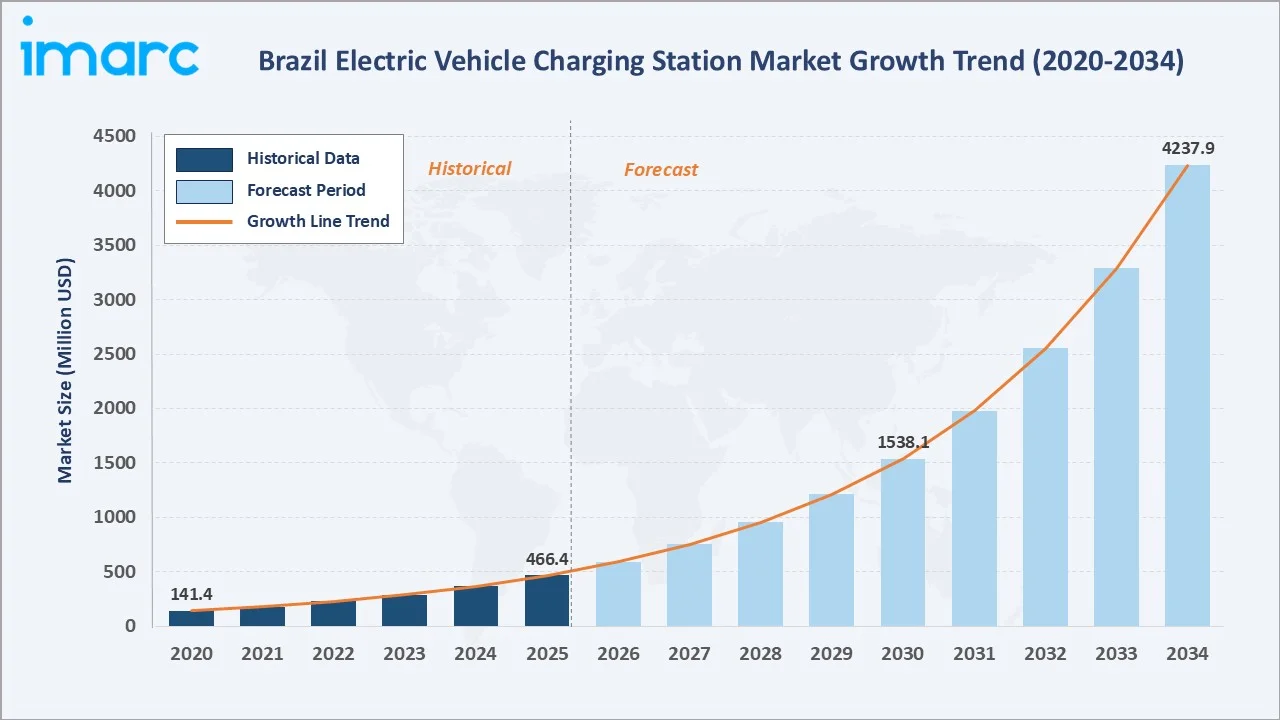
The Brazil electric vehicle charging station market was valued at USD 466.4 Million in 2025 and is projected to reach USD 4,237.9 Million by 2034, exhibiting a CAGR of 26.95% during 2026-2034. Broadening government mandates, rising electric vehicle adoption, expanding private sector investment, and increasing integration of renewable energy into the national grid are the primary forces shaping market growth.
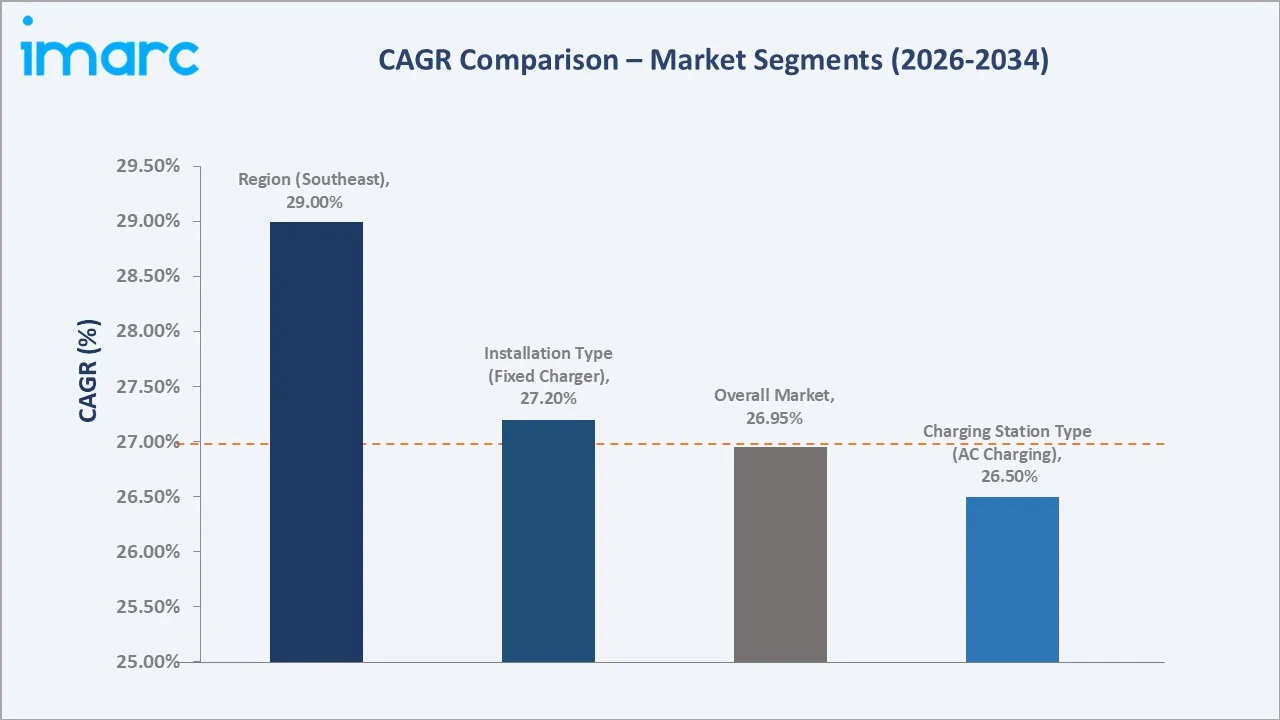
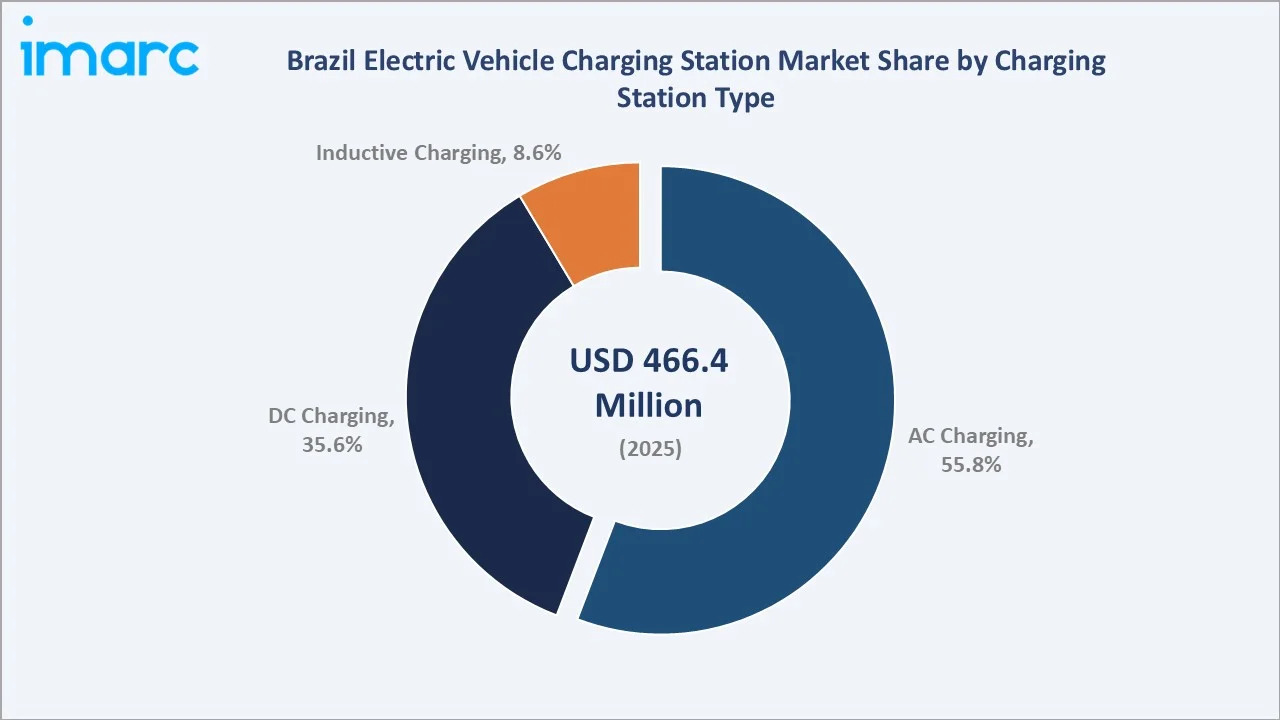
AC charging commands the leading position at 55.8% of the charging station type segment, fixed charger dominates installation type at 68.1%, and Southeast accounts for 43.6% of the regional share.
Market Snapshot
|
Metric |
Value |
|
Market Size (2025) |
USD 466.4 Million |
|
Forecast Market Size (2034) |
USD 4,237.9 Million |
|
CAGR (2026-2034) |
26.95% |
|
Base Year |
2025 |
|
Historical Period |
2020-2025 |
|
Forecast Period |
2026-2034 |
|
Largest Region |
Southeast (43.6%, 2025) |
|
Second Largest Region |
South (24.1%, 2025) |
|
Leading Charging Station Type |
AC Charging (55.8%, 2025) |
|
Leading Installation Type |
Fixed Charger (68.1%, 2025) |
The Brazil electric vehicle charging station market expanded from USD 141.4 Million in 2020 to USD 466.4 Million in 2025, underpinned by accelerating electric vehicle adoption, expanding charging network coverage, and growing support from utilities and energy companies. Anchored at USD 1538.1 Million in 2030, the forecast to USD 4,237.9 Million by 2034 reflects the rapid roll-out of public fast-charging corridors, smart grid integration, and emerging inductive charging technologies across urban and highway networks.
To get more information on this market, Request Sample
CAGR trajectories across charging station type and installation type sub-segments indicate that DC charging and portable charger are expanding at above-average rates relative to the overall 26.95% market CAGR, driven by demand for faster charging times, fleet electrification, and flexible installation models across commercial and highway segments.
Executive Summary
The Brazil electric vehicle charging station market is on a high-growth trajectory, expanding from USD 141.4 Million in 2020 to a projected USD 4,237.9 Million by 2034. The transition from a nascent network of scattered residential chargers to a structured, utility-integrated public infrastructure ecosystem is underway. Policy support from the federal government and state-level electric vehicle incentives are driving both supply-side investment and consumer demand.
AC charging leads the charging station type segment at 55.8% in 2025, favored for residential and overnight commercial use due to lower installation cost and compatibility with most electric vehicle models. Fixed charger dominates the installation type segment at 68.1%, supported by the growing deployment of public and workplace charging stations. Southeast commands 43.6% of market share, anchored by São Paulo and Rio de Janeiro, the leading electric vehicle ownership bases in the country.
Key Market Insights
|
Insight |
Data |
|
Leading Charging Station Type |
AC Charging - 55.8% share (2025) |
|
Second Largest Charging Station Type |
DC Charging - 35.6% share (2025) |
|
Leading Installation Type |
Fixed Charger - 68.1% share (2025) |
|
Second Largest Installation Type |
Portable Charger - 31.9% share (2025) |
|
Leading Region |
Southeast - 43.6% share (2025) |
|
Second Largest Region |
South - 24.1% share (2025) |
|
Top Companies |
WEG, ABB, Schneider Electric, Raízen S.A., Enel S.p.A. |
Key Analytical Observations Supporting the Above Data:
- AC charging leadership at 55.8% is underpinned by broad electric vehicle model compatibility, lower installation cost, and suitability for residential, workplace, and fleet overnight charging. This segment forms the backbone of Brazil's emerging public and semi-public charging network.
- DC charging at 35.6% is concentrated along intercity highway corridors and urban fast-charging hubs. Shorter dwell times, higher power output, and growing fleet electrification demand are supporting rapid DC infrastructure deployment across the São Paulo–Rio de Janeiro corridor and major routes in South.
- Fixed charger at 68.1% dominates the installation type landscape due to regulatory frameworks favoring permanent, grid-connected infrastructure at public venues, shopping centers, and highway rest stops.
- Portable charger share at 31.9% serves residential and fleet users requiring flexible, cost-effective solutions. Ease of deployment and minimal installation requirements make portable chargers particularly attractive for users with limited access to dedicated charging infrastructure.
- Southeast at 43.6% concentrates Brazil's densest electric vehicle ownership base, driven by São Paulo and Rio de Janeiro's urban mobility programs, high household income, and the greatest concentration of retail, commercial, and workplace charging infrastructure in the country.
Brazil Electric Vehicle Charging Station Market Overview
An electric vehicle charging station is a dedicated infrastructure unit that delivers electrical energy to replenish the battery of a battery electric vehicle (BEV) or a plug-in hybrid electric vehicle (PHEV). The Brazilian market encompasses fixed public chargers, semi-public chargers at commercial venues, residential units, and portable charging solutions for flexible deployment.
The ecosystem integrates equipment manufacturers, charging network operators, distribution utilities, renewable energy providers, software and connectivity platform vendors, installation contractors, and regulatory bodies. Brazil's abundant renewable energy base, particularly hydropower, solar, and wind, positions the country to deliver near-zero-emission electric vehicle charging at scale as the grid mix evolves.
Market Dynamics
To evaluate market opportunities, Request Sample
Market Drivers
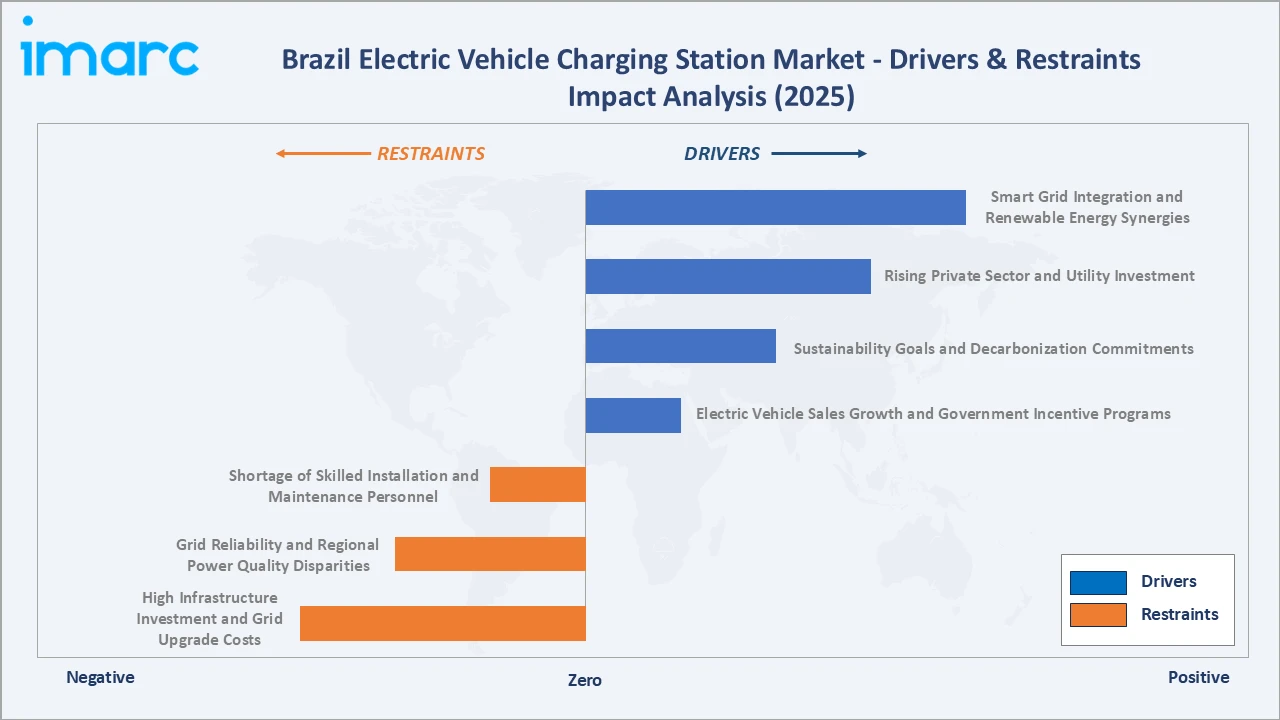
- Electric Vehicle Sales Growth and Government Incentive Programs: Brazil's accelerating electric vehicle adoption, driven by federal and state-level tax exemptions and subsidized financing for electric vehicle purchases, is directly increasing demand for residential, commercial, and public charging infrastructure across major urban centers and highway corridors. The Brazilian Electric Vehicle Association (ABVE) reported that from January to April 2026, the monthly average sales of hybrid and fully electric vehicles hit 30,600 units, reflecting a 124% increase compared to the same timeframe in 2025, which recorded average monthly sales of 13,600 units.
- Sustainability Goals and Decarbonization Commitments: National climate targets and growing corporate sustainability initiatives are accelerating investment in electric vehicle charging infrastructure as a critical enabler of transport sector decarbonization. Utilities, infrastructure developers, and private investors are increasingly directing capital toward charging network expansion to support long-term emissions reduction objectives.
- Rising Private Sector and Utility Investment: Energy distributors, fuel retail networks, real estate developers, and mobility startups are deploying capital into public and semi-public charging stations. Highway-facing charging hubs, shopping mall installations, and corporate fleet charging depots represent the fastest-growing investment categories.
- Smart Grid Integration and Renewable Energy Synergies: Brazil's high share of renewable electricity creates a natural competitive advantage for low-carbon electric vehicle charging. Smart charging systems that integrate vehicle-to-grid (V2G) capability, demand response protocols, and solar co-generation are gaining traction among large commercial and industrial users, driving premium product adoption.
Market Restraints
- High Infrastructure Investment and Grid Upgrade Costs: The capital-intensive nature of charging station deployment, particularly for DC fast chargers requiring high-voltage grid connections, remains a significant barrier to rapid network expansion outside major metropolitan centers. Grid capacity upgrades and transformer installations add substantial cost and timeline friction.
- Grid Reliability and Regional Power Quality Disparities: Uneven grid reliability across Brazil's vast territory, particularly in North and Northeast, limits the commercial viability of public fast-charging deployments in areas with frequent power interruptions or constrained distribution capacity.
- Shortage of Skilled Installation and Maintenance Personnel: The rapid expansion of charging infrastructure is increasing demand for qualified electrical engineers, technicians, and grid integration specialists. Workforce shortages can lead to installation delays, higher labor costs, and longer maintenance response times.
Market Opportunities
- Highway Fast-Charging Corridor Development: Brazil's extensive highway network connecting major economic centers represents a large, underserved opportunity for DC fast-charging corridor deployment. Concession holders, energy companies, and fuel retailers are well-positioned to develop dedicated highway electric vehicle charging hubs serving intercity travel demand.
- Fleet Electrification and Commercial Charging Depots: The electrification of logistics fleets, ride-hailing vehicles, and public transport buses is creating demand for high-capacity, managed charging depots with overnight and opportunity charging capability, representing a high-value segment for charging equipment manufacturers and network operators.
Market Challenges
- Consumer Range Anxiety and Limited Network Coverage: Despite urban charging growth, perceived gaps in charging availability along intercity routes and in smaller cities continue to act as a barrier to electric vehicle adoption, indirectly constraining overall market expansion for charging infrastructure.
- Regulatory Fragmentation and Permitting Delays: Inconsistent permitting processes, varying state-level utility regulations, and absence of a unified national electric vehicle charging framework continue to introduce delays and cost uncertainty for charging network operators seeking to expand beyond established markets.
Emerging Market Trends
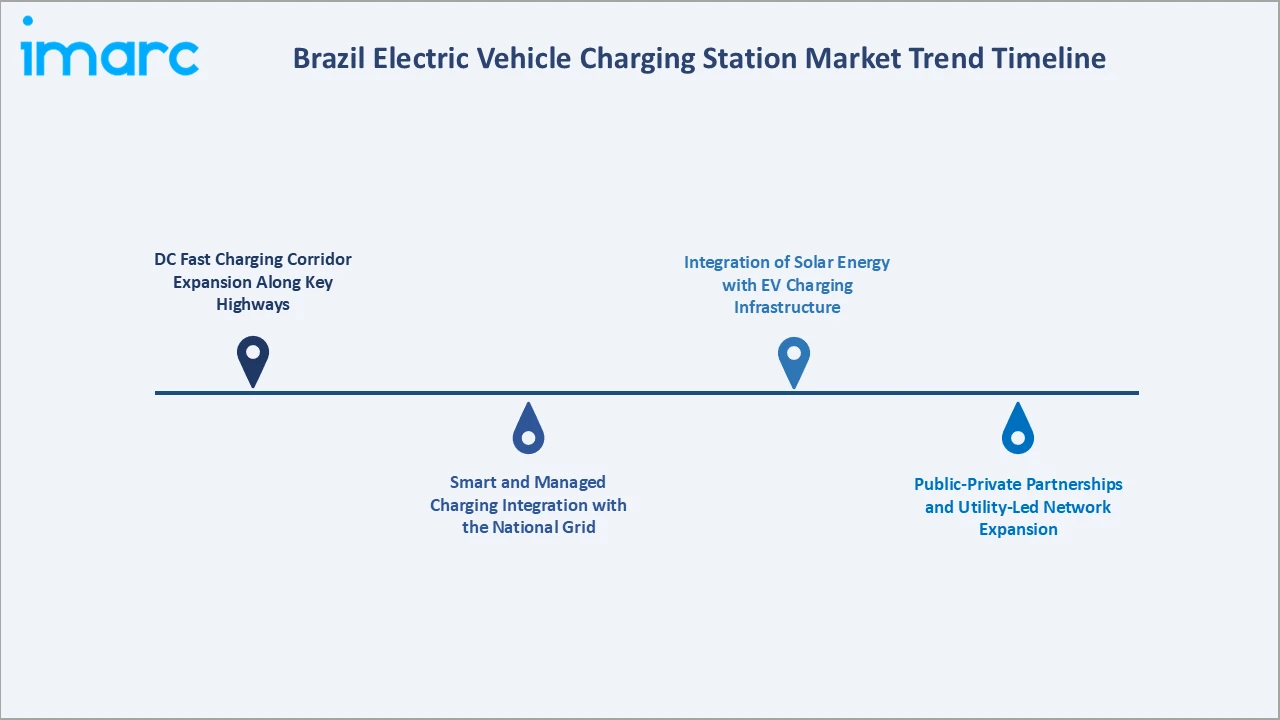
1. DC Fast Charging Corridor Expansion Along Key Highways
Investments in DC fast-charging corridors along Brazil's busiest highway axes are reducing intercity range anxiety and enabling longer-distance electric vehicle travel. Energy companies and highway concessionaires are entering multi-year deployment agreements to establish charger clusters at regular intervals.
2. Smart and Managed Charging Integration with the National Grid
Smart charging platforms enabling demand response, time-of-use tariff optimization, and load management are being deployed at commercial and fleet charging sites. Integration with energy management systems and renewable power sources is improving grid efficiency while reducing peak electricity demand and charging costs.
3. Integration of Solar Energy with Electric Vehicle Charging Infrastructure
Solar-integrated charging stations combining photovoltaic generation, battery storage, and electric vehicle chargers are gaining commercial traction in Brazil's high-irradiance regions, particularly in the Northeast and Central-West. This model reduces operating costs, enhances grid independence, and aligns with the sustainability mandates of corporate fleet operators.
4. Public-Private Partnerships and Utility-Led Network Expansion
Distribution utilities are positioning electric vehicle charging as a new revenue stream and grid asset management tool. Public-private partnership frameworks for shared charging infrastructure at government facilities, airports, and transit hubs are emerging as a scalable model for accelerating network coverage beyond the Southeast.
Industry Value Chain Analysis
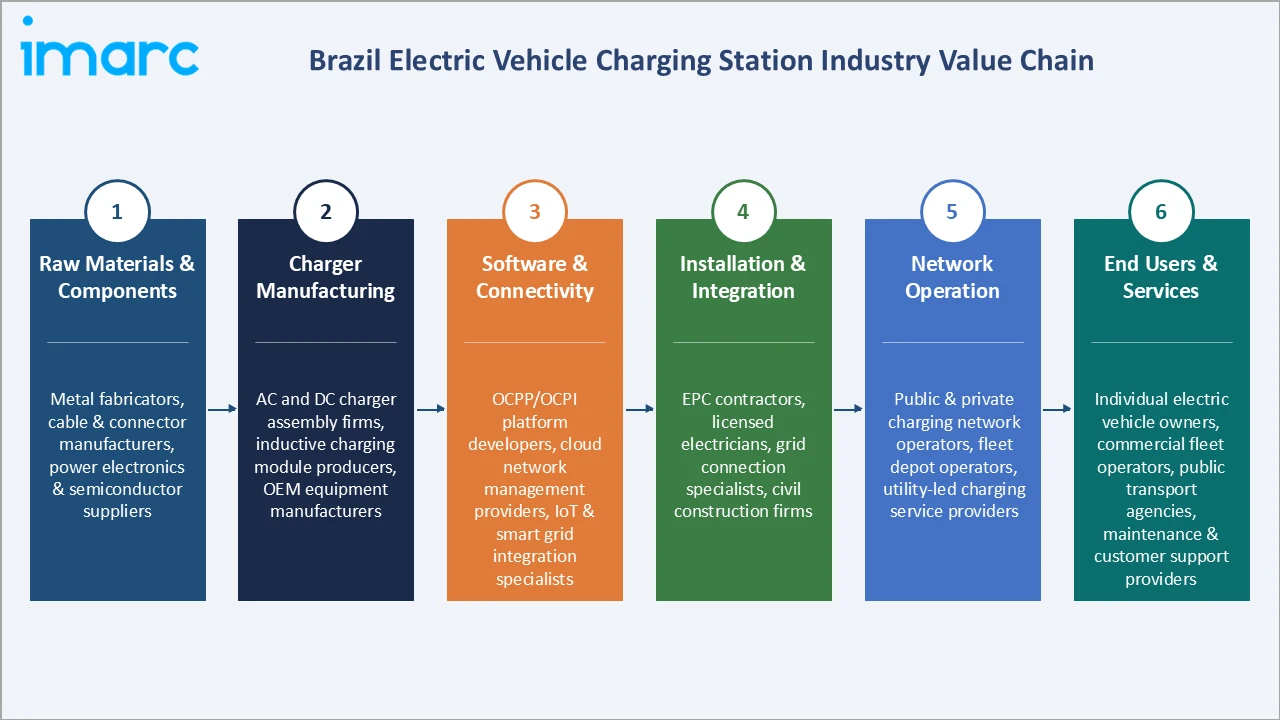
The Brazil electric vehicle charging station value chain spans six stages from raw material supply through end-user lifecycle management. Equipment manufacturing, software and connectivity, and network operations capture the highest value-add, while installation quality and service maintenance increasingly determine competitive differentiation for operators serving commercial and highway segments.
|
Stage |
Key Players / Examples |
|
Raw Materials & Components |
Metal fabricators, cable and connector manufacturers, power electronics suppliers, semiconductor providers |
|
Charger Manufacturing |
AC and DC charger assembly firms, inductive charging module producers, OEM equipment manufacturers |
|
Software & Connectivity |
Open Charge Point Protocol (OCPP) and Open Charge Point Interface (OCPI) platform developers, cloud network management providers, IoT and smart grid integration specialists |
|
Installation & Integration |
EPC contractors, licensed electricians, grid connection specialists, civil construction firms |
|
Network Operation |
Public and private charging network operators, fleet depot operators, utility-led charging service providers |
|
End Users & Services |
Individual electric vehicle owners, commercial fleet operators, public transport agencies, maintenance and customer support providers |
Vertically integrated players combining charger manufacturing, software platforms, and direct network operations capture the greatest share of lifetime value per station deployed. Operators investing in proprietary network management and data analytics platforms are building durable competitive advantages as the market transitions from infrastructure build-out to service monetization.
Technology Landscape in the Brazil Electric Vehicle Charging Station Industry
AC Charging Technology
AC chargers typically range from around 1.8 kW to 22 kW depending on configuration and remain the dominant technology for residential, workplace, and overnight commercial applications. Advances in onboard charger efficiency, dynamic load balancing, and integration with home energy management systems are extending the utility of AC charging beyond basic overnight replenishment.
DC Fast Charging Technology
DC fast chargers are the critical enablers of highway and urban fast-charging networks. Continuous improvements in power electronics, cooling systems, and charger reliability are reducing charging times and supporting higher vehicle throughput.
Smart Charging and Network Management
OCPP and OCPI are widely adopted interoperability protocols for smart charging in Brazil. Cloud-based network management platforms enable remote monitoring, load management, dynamic pricing, reservation systems, and demand response participation, supporting the commercial viability of large multi-charger deployments.
Market Segmentation Analysis
The report covers the following segments:
|
Segment Category |
Leading Segment |
Market Share |
Year |
|
Charging Station Type |
AC Charging |
55.8% |
2025 |
|
Vehicle Type |
🔒 |
🔒 |
2025 |
|
Installation Type |
Fixed Charger |
68.1% |
2025 |
|
Charging Level |
🔒 |
🔒 |
2025 |
|
Connector Type |
🔒 |
🔒 |
2025 |
|
Application |
🔒 |
🔒 |
2025 |
|
Region |
Southeast |
43.6% |
2025 |

By Charging Station Type
AC charging commands 55.8% of the charging station type segment in 2025, driven by its compatibility with the majority of passenger electric vehicles, lower capital cost, and suitability for extended-duration charging at residential, workplace, and fleet applications. The segment benefits from minimal grid upgrade requirements and broad installation flexibility.
To access detailed market analysis, Request Sample
DC charging holds 35.6% in 2025 and is the second largest format within the segment. The sub-segment is concentrated at highway rest stops, shopping centers, and urban mobility hubs where high throughput and short session durations are commercially critical.
By Installation Type
Fixed charger dominates with 68.1% share in 2025, favored for public and semi-public charging deployments requiring permanent grid connection, network connectivity, and long-term structural durability. The sub-segment spans curbside public chargers, workplace stations, and high-power fast-charging hubs.
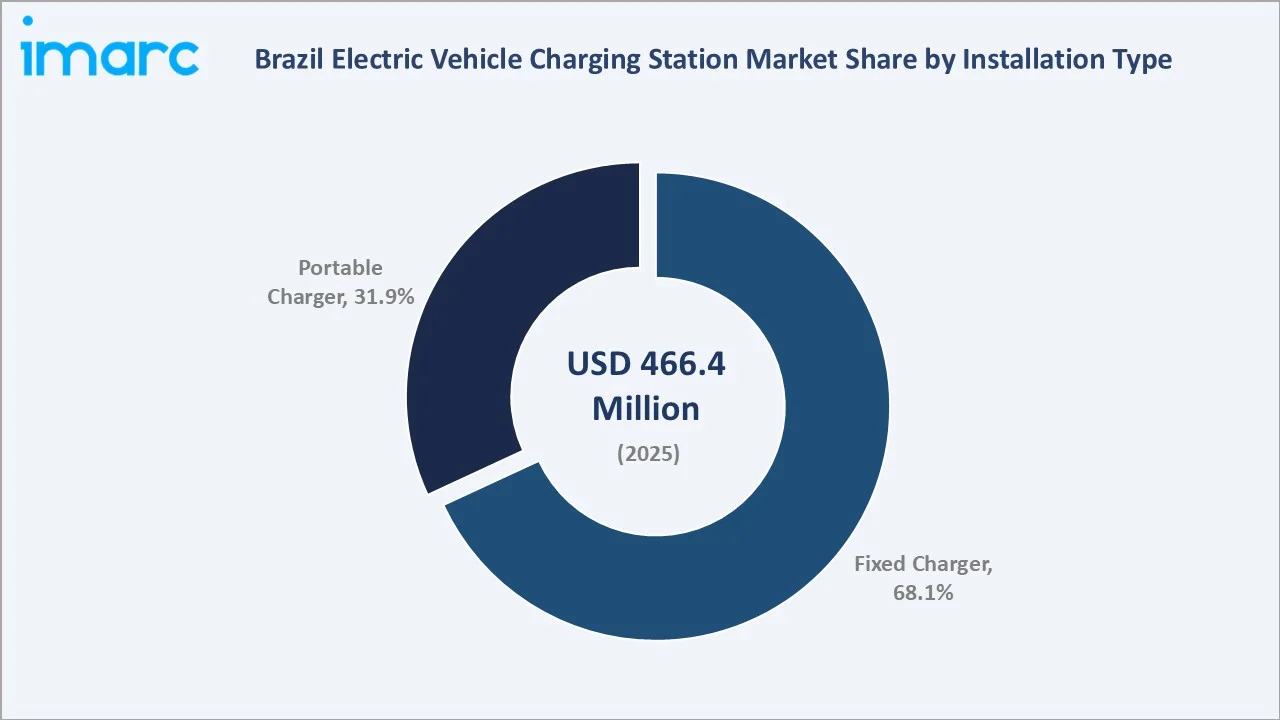
Portable charger accounts for 31.9% in 2025 and serves residential electric vehicle owners, small fleet operators, and users in areas where permanent installation is impractical or cost-prohibitive. The growing affordability of smart portable units with load management features and plug-and-play installation is sustaining steady demand growth in this sub-segment.
Regional Market Insights
|
Region |
Share (2025) |
Key Growth Drivers |
|
Southeast |
43.6% |
Large urban electric vehicle owner base, dense public charging network, high household income, strong policy support in São Paulo and Rio de Janeiro |
|
South |
24.1% |
High renewable energy availability, industrial electrification, strong state-level electric vehicle incentives, growing highway corridor demand |
|
Northeast |
15.3% |
Expanding solar energy integration with charging infrastructure, rising urban electric vehicle adoption, growing government-led public charging programs |
|
Central-West |
9.2% |
Agribusiness fleet electrification pilots, expanding logistics network electrification, growing urban electric vehicle adoption in Brasília and Goiânia |
|
North |
7.8% |
Emerging market with early-stage infrastructure investment, government-led rural electrification programs, growing urban mobility initiatives |
Southeast commands 43.6% of the regional market in 2025, anchored by São Paulo and Rio de Janeiro, which together host the leading concentration of registered EVs in Brazil. Dense urban mobility demand, high commercial real estate penetration of charging amenities, and strong utility-led charging programs underpin sustained regional leadership through the forecast period.
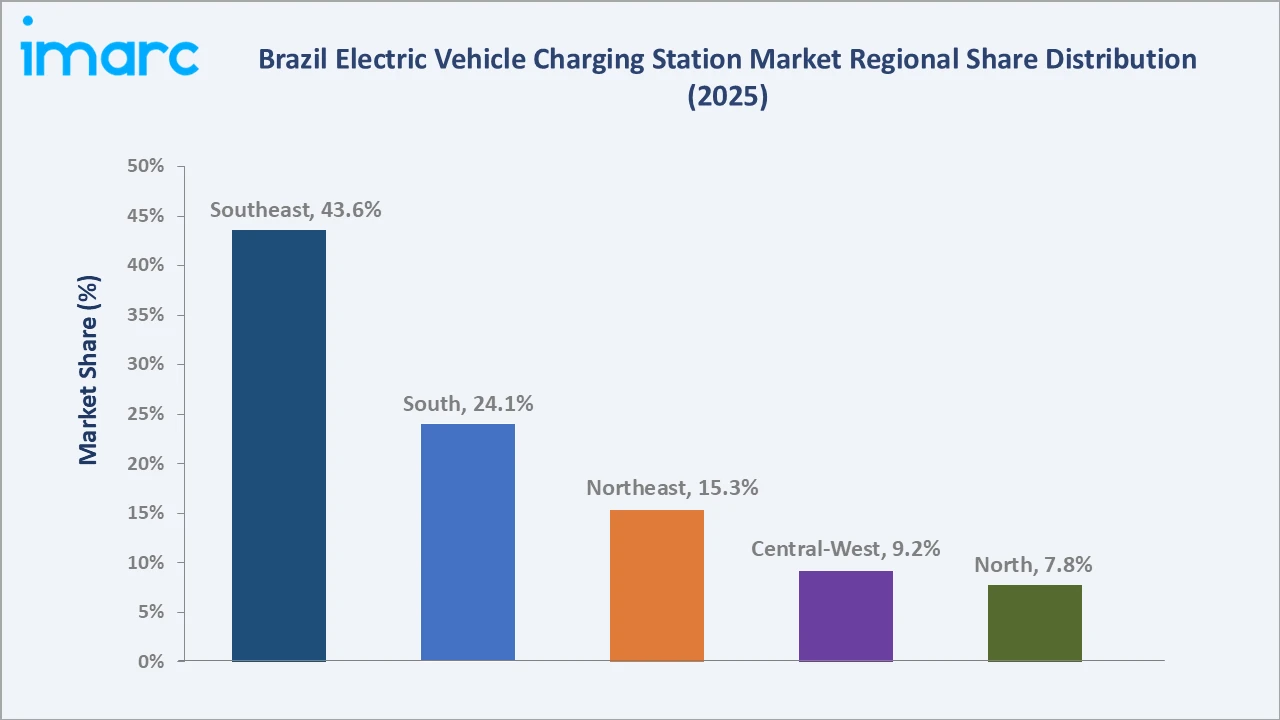
South at 24.1% is the second-largest region outside the Southeast, driven by above-average renewable energy generation, active industrial fleet electrification, and state-level electric vehicle programs in Rio Grande do Sul, Santa Catarina, and Paraná.
Competitive Landscape
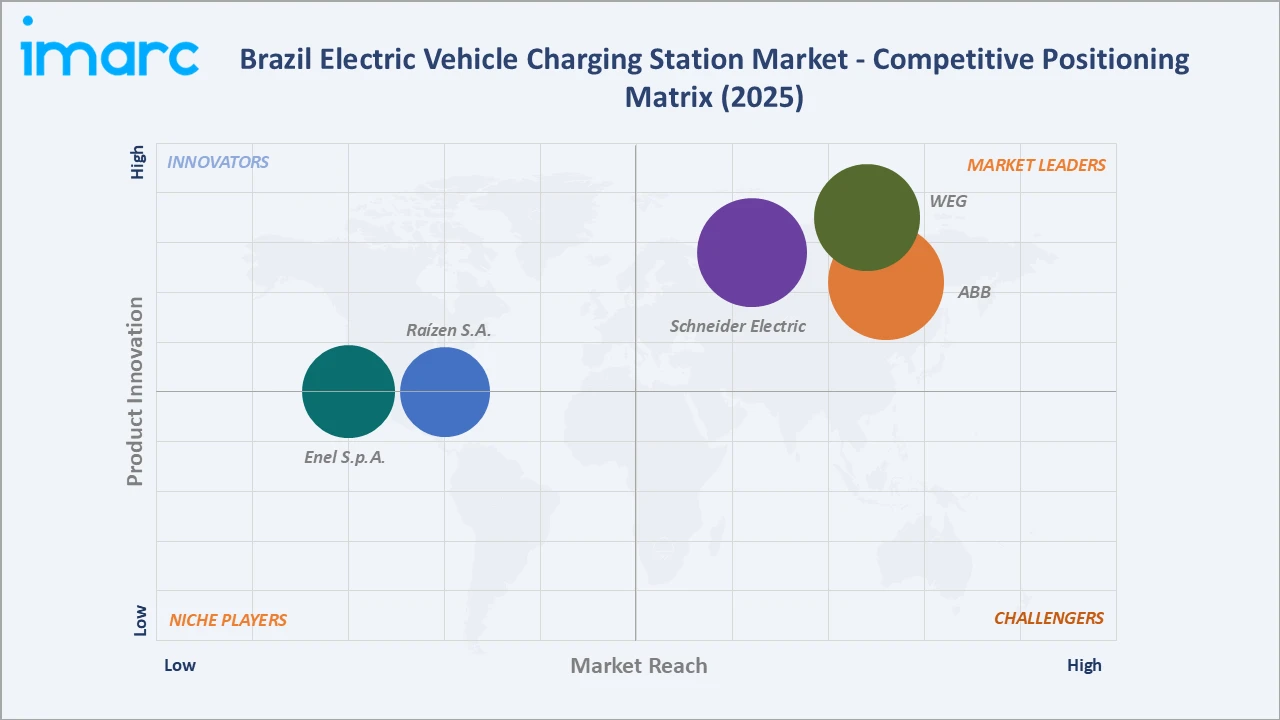
The Brazil electric vehicle charging station market is moderately fragmented, with multinational energy technology corporations, domestic utilities, and emerging charging network specialists competing across manufacturing, installation, and network operation segments. Product innovation, network coverage breadth, software integration capability, and relationships with automotive OEMs and distribution utilities define the key competitive dimensions.
|
Company Name |
Brand / Key Product |
Position |
Strategic Focus |
|
WEG |
WEMOB |
Leader |
Broad product portfolio spanning AC and DC chargers with domestic manufacturing advantage |
|
ABB |
Terra 360 |
Leader |
High-power DC fast charger technology with global installed base and smart grid integration |
|
Schneider Electric |
EVlink Pro |
Leader |
Integrated energy management and smart charging solutions for commercial and fleet segments |
|
Raízen S.A. |
Shell Recharge |
Emerging |
Fuel retail and highway corridor charging integration leveraging existing station footprint |
|
Enel S.p.A. |
Enel X Way |
Emerging |
Urban and residential smart charging solutions |
Key players include WEG, ABB, Schneider Electric, Raízen S.A., and Enel S.p.A., among others.
Key Company Profiles
WEG
WEG is a global electro-electronic equipment company headquartered in Jaraguá do Sul, Santa Catarina, Brazil. The company is one of Brazil's largest manufacturers of electric motors, transformers, drives, and industrial automation equipment, and has expanded into electric vehicle charging infrastructure as part of its energy transition product strategy.
- Product Portfolio: WEMOB product line spanning residential, commercial, and fleet charging applications, including AC wall-mount chargers, semi-fast parking chargers, and DC fast chargers, supported by a fleet management platform for multi-vehicle charging environments.
- Recent Developments: In August 2024, WEG became the first company in Brazil to obtain Inmetro accreditation for its electric vehicle charging stations, covering the WEMOB Wall and WEMOB Parking models.
- Strategic Focus: Expanding the WEMOB charging portfolio across residential, commercial, and fleet segments while leveraging domestic manufacturing scale and partnerships with leading automotive brands to strengthen market position in Brazil.
ABB
ABB is a Swiss multinational technology company headquartered in Zürich, Switzerland, with operations spanning electrification, motion, robotics, and process automation. ABB has established a commercial presence in the Brazilian market through partnerships with fuel retail and highway infrastructure operators.
- Product Portfolio: Terra 360 ultra-fast charger with simultaneous multi-vehicle charging capability, alongside the Terra AC Wallbox for semi-fast applications and a cloud-based network management platform supporting remote monitoring and dynamic power allocation.
- Recent Developments: ABB has been expanding its Terra charger installations at highway and commercial locations in Brazil, supporting the country's growing intercity electric vehicle travel demand and commercial fleet charging requirements.
- Strategic Focus: Deploying high-power DC fast chargers at strategic highway and commercial locations in Brazil, supported by global manufacturing scale, technical service capabilities, and cloud-based charging management solutions.
Raízen S.A.
Raízen S.A. is one of Brazil’s largest integrated energy companies, with operations in sugar-energy, biofuels, fuel distribution, and convenience retail across a network of several service stations. The company is also expanding its presence in electric mobility by developing and operating EV charging infrastructure through strategic partnerships and integrated energy solutions.
- Product Portfolio: Shell Recharge electric vehicle charging network comprising AC and DC fast chargers at Raízen S.A.-operated Shell service stations across major Brazilian cities.
- Recent Developments: Raízen S.A. has been expanding its Shell Recharge charging network through strategic partnerships and the deployment of new public charging hubs at selected service station locations, strengthening its integrated electric mobility ecosystem across Brazil.
- Strategic Focus: Capitalizing on its extensive highway fuel retail footprint and the Shell brand to build a leading public electric vehicle charging network in Brazil, targeting a significant market share in the charging station segment.
Market Concentration Analysis
The Brazil electric vehicle charging station market is moderately fragmented, with multinational technology companies, domestic utilities, and emerging charging specialists each capturing meaningful positions across the equipment manufacturing, network operation, and installation service segments. The top three players (WEG, ABB, and Schneider Electric) collectively account for an estimated 55% to 65% of the addressable market, reflecting a moderately concentrated competitive landscape.
Barriers to entry include the capital intensity of DC fast charger deployments, the need for deep grid integration capabilities, software platform development costs, and the commercial relationships required with utilities, OEMs, and large-scale commercial property operators. These factors favor well-capitalized incumbents with established manufacturing, distribution, and service infrastructure.
Consolidation trends are emerging as charging network operators seek economies of scale, and as utilities acquire or partner with technology-focused charger manufacturers. Strategic alliances between automakers, energy companies, and charging infrastructure specialists are increasingly common, reflecting the interdependency of the electric vehicle ecosystem across hardware, software, and energy supply dimensions.
Investment & Growth Opportunities
Fastest-Growing Segments
DC charging is the fastest-growing charging station type, driven by expanding highway corridors, urban fast-charging hubs, and commercial fleet depot deployments. Portable charger represents a growing opportunity in residential and fleet segments seeking flexible, lower-cost charging solutions. South and Northeast are emerging as the highest-growth geographic opportunities outside the established Southeast.
Emerging Markets
Central-West at 9.2% and North at 7.8% represent significant long-term development opportunities as agribusiness fleet electrification, logistics network electrification, and government-led rural electric vehicle programs gain momentum. Solar-integrated charging in the high-irradiance Northeast and Central-West offers compelling economics for off-grid and hybrid-grid deployments in underserved areas.
Venture & Investment Trends
Investment is concentrating in smart charging software platforms, DC fast-charging corridor projects on major Brazilian highways, and solar-integrated charging deployments. BNDES and development bank financing is increasingly available for certified electric vehicle charging infrastructure projects, supporting expanded access to concessionary capital for qualifying operators and network builders.
Future Market Outlook (2026-2034)
The Brazil electric vehicle charging station market is forecast to expand from USD 466.4 Million in 2025 to USD 4,237.9 Million by 2034 at a CAGR of 26.95%, adding approximately USD 3,771.5 Million in incremental annual market value over the forecast period.
Four forces will shape the market through 2034: accelerating electric vehicle fleet penetration driven by policy and affordability improvements; the build-out of a national DC fast-charging highway network; the maturation of smart and V2G charging ecosystems; and the progressive entry of inductive charging technology into commercial deployment.
By 2034, Brazil's electric vehicle charging infrastructure is expected to be defined by a stratified, nationally distributed network integrating residential, commercial, and public segments under unified software and payment platforms. Regulatory evolution, standardization of charging protocols, continued renewable energy expansion, and deepening automotive OEM-charging operator partnerships are expected to further accelerate the evolution of the Brazil electric vehicle charging ecosystem toward full-scale commercial maturity within the forecast horizon.
Research Methodology
Primary Research
Primary research included structured interviews with electric vehicle charging equipment manufacturers, charging network operators, distribution utilities, automotive OEM representatives, regulatory specialists, and investment analysts, validating market sizing, segment dynamics, regional distribution, and competitive positioning assessments.
Secondary Research
Secondary sources included ANEEL regulatory publications, DENATRAN vehicle registration data, ABVE (Brazilian Association of Electric Vehicles) market reports, BNDES investment program documentation, utility annual reports, and press releases and investor presentations from key market participants.
Forecasting Models
Market forecasts used top-down and bottom-up models combining electric vehicle fleet penetration curves, charging infrastructure deployment ratios, regional distribution patterns, technology adoption timelines, and macroeconomic variables. Scenario analysis addressed regulatory pace, technology cost trajectories, and grid investment timelines.
Brazil Electric Vehicle Charging Station Market Report Coverage:
| Report Features | Details |
|---|---|
| Base Year of the Analysis | 2025 |
| Historical Period | 2020-2025 |
| Forecast Period | 2026-2034 |
| Units | Million USD |
| Scope of the Report | Exploration of Historical Trends and Market Outlook, Industry Catalysts and Challenges, Segment-Wise Historical and Future Market Assessment:
|
| Charging Station Types Covered | AC Charging, DC Charging, Inductive Charging |
| Vehicle Types Covered | Battery Electric Vehicle (BEV), Plug-in Hybrid Electric Vehicle (PHEV), Hybrid Electric Vehicle (HEV) |
| Installation Types Covered | Portable Charger, Fixed Charger |
| Charging Levels Covered | Level 1, Level 2, Level 3 |
| Connector Types Covered | Combines Charging Station (CCS), CHAdeMO, Normal Charging, Tesla Supercharger, Type-2 (IEC 621196), Others |
| Applications Covered | Residential, Commercial |
| Regions Covered | Southeast, South, Northeast, North, Central-West |
| Companies Covered | WEG, ABB, Schneider Electric, Raízen S.A., Enel S.p.A., etc. |
| Customization Scope | 10% Free Customization |
| Post-Sale Analyst Support | 10-12 Weeks |
| Delivery Format | PDF and Excel through Email (We can also provide the editable version of the report in PPT/Word format on special request) |
Key Benefits for Stakeholders:
- IMARC's industry report offers a comprehensive quantitative analysis of various market segments, historical and current market trends, market forecasts, and dynamics of the Brazil electric vehicle charging station market from 2020-2034.
- The research report provides the latest information on the market drivers, challenges, and opportunities in the Brazil electric vehicle charging station market.
- Porter's five forces analysis assist stakeholders in assessing the impact of new entrants, competitive rivalry, supplier power, buyer power, and the threat of substitution. It helps stakeholders to analyze the level of competition within the Brazil electric vehicle charging station industry and its attractiveness.
- Competitive landscape allows stakeholders to understand their competitive environment and provides an insight into the current positions of key players in the market.
Frequently Asked Questions About the Brazil Electric Vehicle Charging Station Market Report
The Brazil electric vehicle charging station market was valued at USD 466.4 Million in 2025, driven by rising electric vehicle adoption, government incentives, and expanding public and private charging network deployments.
The market is projected to grow at a CAGR of 26.95% from 2026-2034, reaching USD 4,237.9 Million, supported by fast-charging corridor expansion, fleet electrification, and smart grid integration.
AC charging leads at 55.8% in 2025 due to broad electric vehicle model compatibility, lower installation cost, and suitability for residential and commercial overnight charging applications.
Fixed charger dominates with 68.1% share in 2025, favored for permanent grid-connected deployments at public venues, shopping centers, workplaces, and highway rest stops.
Southeast commands 43.6% in 2025, anchored by São Paulo and Rio de Janeiro's dense electric vehicle ownership base, urban mobility programs, and high concentration of public charging infrastructure.
Leading players include WEG, ABB, Schneider Electric, Raízen S.A., and Enel S.p.A., among others.
Key investment drivers include accelerating electric vehicle sales growth, government incentive programs, BNDES development financing, corporate ESG commitments, and the commercial opportunity in highway corridor fast-charging deployments.
Smart charging platforms enabling demand response, load management, and dynamic pricing are improving charging station economics, grid reliability, and the commercial viability of large multi-charger deployments across urban and commercial segments.
Need more help?
- Speak to our experienced analysts for insights on the current market scenarios.
- Include additional segments and countries to customize the report as per your requirement.
- Gain an unparalleled competitive advantage in your domain by understanding how to utilize the report and positively impacting your operations and revenue.
- For further assistance, please connect with our analysts.
 Request Customization
 Speak to an Analyst
 Request Brochure
 Inquire Before Buying
Benefits of Customization
- Personalize this research
- Triangulate with your data
- Get data as per your format and definition
- Gain a deeper dive into a specific application, geography, customer, or competitor
- Any level of personalization
Get in Touch With Us
UNITED STATES
Phone: +1-201-971-6302
INDIA
Phone: +91-120-433-0800
UNITED KINGDOM
Phone: +44-753-714-6104
Email: [email protected]
Client Testimonials




.webp)




.webp)













