
Brazil Virtual Reality Gaming Market Size, Share, Trends and Forecast by Segment, Device, Age Group, Type of Games, and Region, 2026-2034
Brazil Virtual Reality Gaming Market Size, Share, Trends & Forecast (2026-2034)
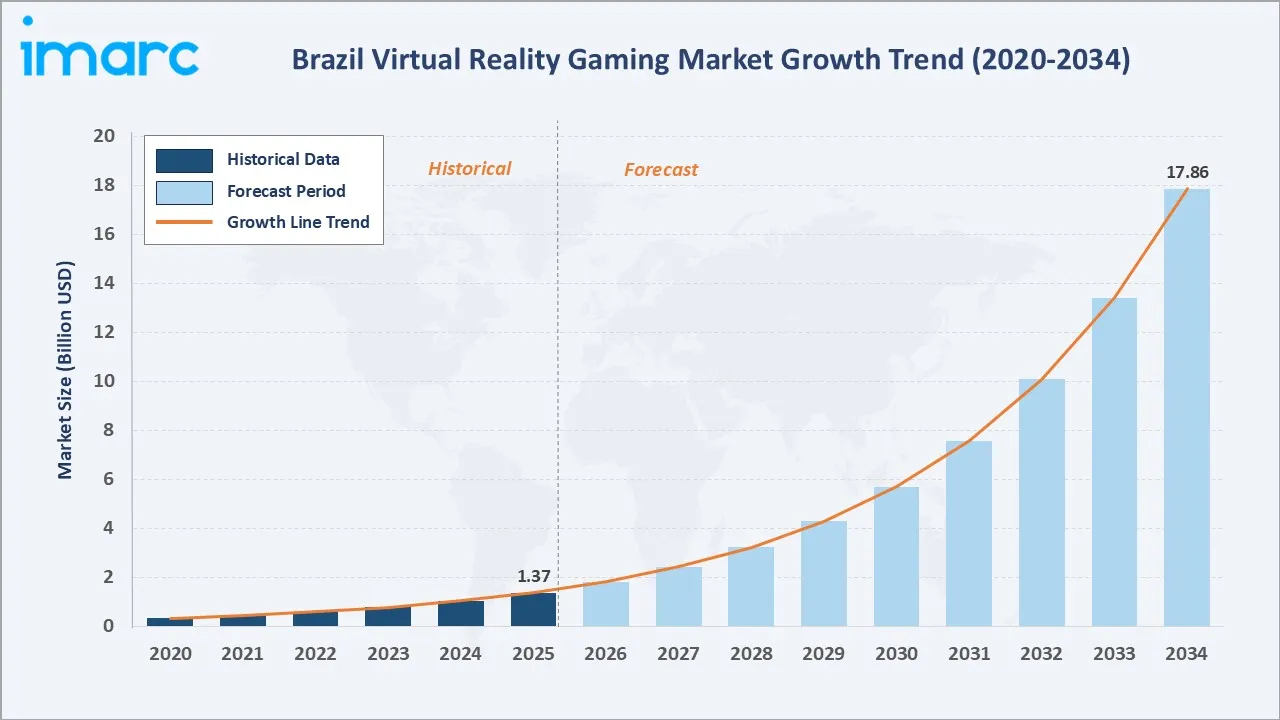
The Brazil virtual reality gaming market grew from USD 1.37 Billion in 2025 to USD 1.82 Billion in 2026 and is projected to reach USD 17.86 Billion by 2034, exhibiting a CAGR of 32.99% during 2026-2034. Rising demand for immersive gaming experiences, increasing adoption of affordable virtual reality headsets, and Brazil’s expanding gaming community are the primary forces shaping market growth.
Software leads the segment at 55.0%, personal computers dominate the device segment at 38.0%, and Southeast commands 55.0% of regional share.
Market Snapshot
|
Metric |
Value |
|
Base Year Market Size (2025) |
USD 1.37 Billion |
|
Market Size (2026) |
USD 1.82 Billion |
|
Forecast Market Size (2034) |
USD 17.86 Billion |
|
CAGR (2026-2034) |
32.99% |
|
Base Year |
2025 |
|
Historical Period |
2020-2025 |
|
Forecast Period |
2026-2034 |
|
Largest Region |
Southeast (55.0%, 2025) |
|
Second Largest Region |
South (18.0%, 2025) |
|
Leading Segment |
Software (55.0%, 2025) |
|
Leading Device |
Personal Computers (38.0%, 2025) |
The Brazil virtual reality gaming market size increased from USD 0.33 Billion in 2020 to USD 1.37 Billion in 2025 and is estimated to reach USD 1.82 Billion in 2026. The market is further expected to grow to USD 5.71 Billion by 2030 and USD 17.86 Billion by 2034. The market is commercially unique among regional gaming markets, underpinned by Brazil’s large gaming community, expanding virtual reality hardware ecosystem, and growing content library across entertainment, education, and training verticals.
To get more information on this market, Request Sample
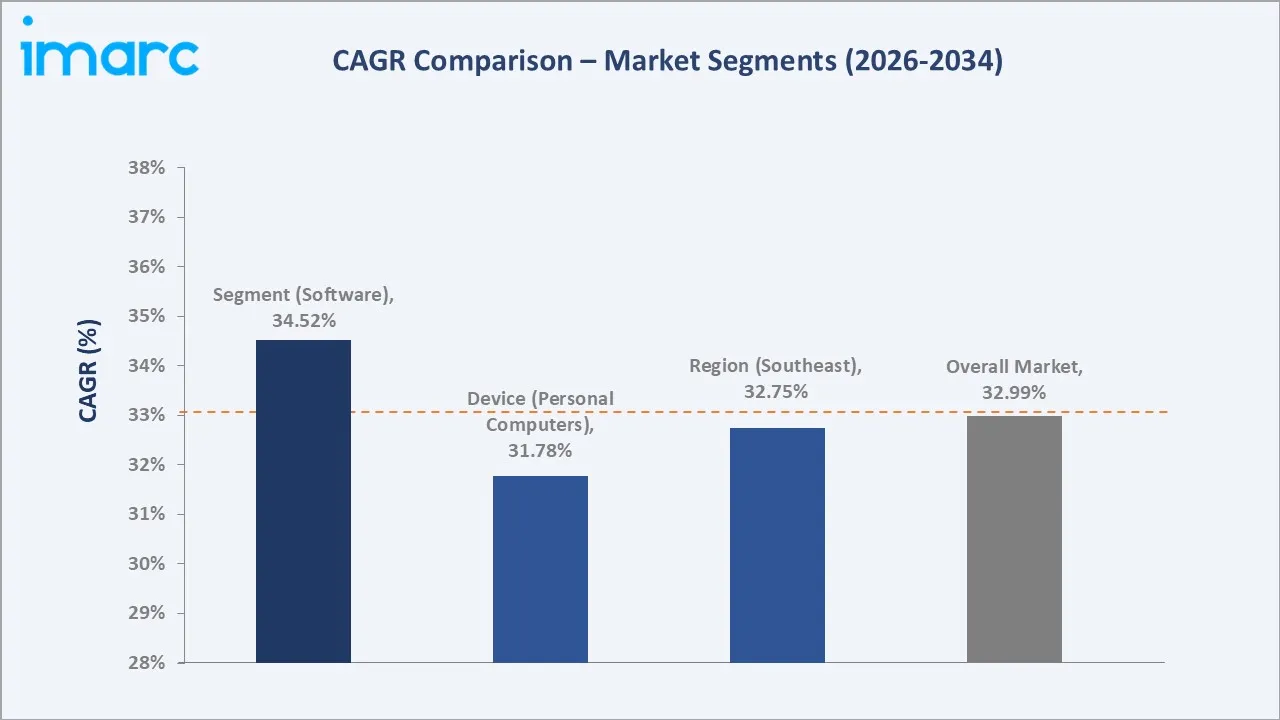
CAGR trajectories across segment, device, and regional sub-segments indicate mobile devices and Northeast expanding faster than the overall 32.99% market CAGR, driven by smartphone penetration growth, expanding digital infrastructure, and rising gaming community development in Brazil’s emerging regional markets.
Executive Summary
The Brazil virtual reality gaming market expanded from USD 1.37 Billion in 2025 to an estimated USD 1.82 Billion in 2026, positioning it among the fastest-growing virtual reality gaming markets globally. Rising hardware accessibility, expanding virtual reality content investment, and Brazil’s large gaming community are driving broad-based market growth across all consumer segments.
Software commands 55.0% segment share, reflecting the high and recurring demand for virtual reality game titles, platform licenses, and content subscriptions across Brazil’s digital gaming ecosystem. Personal computers represent 38.0% of the device segment, driven by Brazil’s strong PC gaming culture and the performance advantage of PC-based virtual reality platforms. Southeast leads regional share at 55.0%, anchored by São Paulo and Rio de Janeiro’s large urban gaming communities, high per capita digital spending, and concentration of gaming and esports infrastructure.
Key Market Insights
|
Insight |
Data |
|
Leading Segment |
Software - 55.0% share (2025) |
|
Second Largest Segment |
Hardware - 45.0% share (2025) |
|
Leading Device |
Personal Computers - 38.0% share (2025) |
|
Second Largest Device |
Gaming Consoles - 35.0% share (2025) |
|
Leading Region |
Southeast - 55.0% share (2025) |
|
Second Largest Region |
South - 18.0% share (2025) |
|
Top Companies |
Meta Platforms, Inc., HTC Corporation, Microsoft Corporation, Valve Corporation |
Key Analytical Observations Expanding On the Data Above:
- Software dominance at 55.0% reflects the recurring revenue model of virtual reality platforms and the growing library of Brazil-compatible Portuguese-language virtual reality game titles that sustain engagement and spending beyond initial hardware purchases.
- Hardware share at 45.0% is growing as headset prices decline and next-generation standalone devices gain adoption across Brazil’s mid-income consumer segment, expanding the addressable market.
- Personal computers leadership at 38.0% is driven by the strong PC gaming culture in Brazil, where enthusiast gamers invest in high-performance hardware capable of running premium virtual reality titles.
- Gaming consoles at 35.0% are supported by the growing adoption of console-based virtual reality experiences and increasing consumer interest in immersive gameplay through established gaming platforms.
- Southeast at 55.0% leads regional share due to São Paulo and Rio de Janeiro’s high population density and strong digital infrastructure.
Brazil Virtual Reality Gaming Market Overview
Virtual reality gaming refers to interactive entertainment experiences delivered through head-mounted displays and motion controllers, creating immersive simulated environments for players. The technology integrates advanced display optics, motion tracking, haptic feedback, and spatial audio to replicate realistic gameplay environments. Applications span entertainment gaming, esports training, fitness gaming, social platforms, and educational simulation across consumer and enterprise verticals.
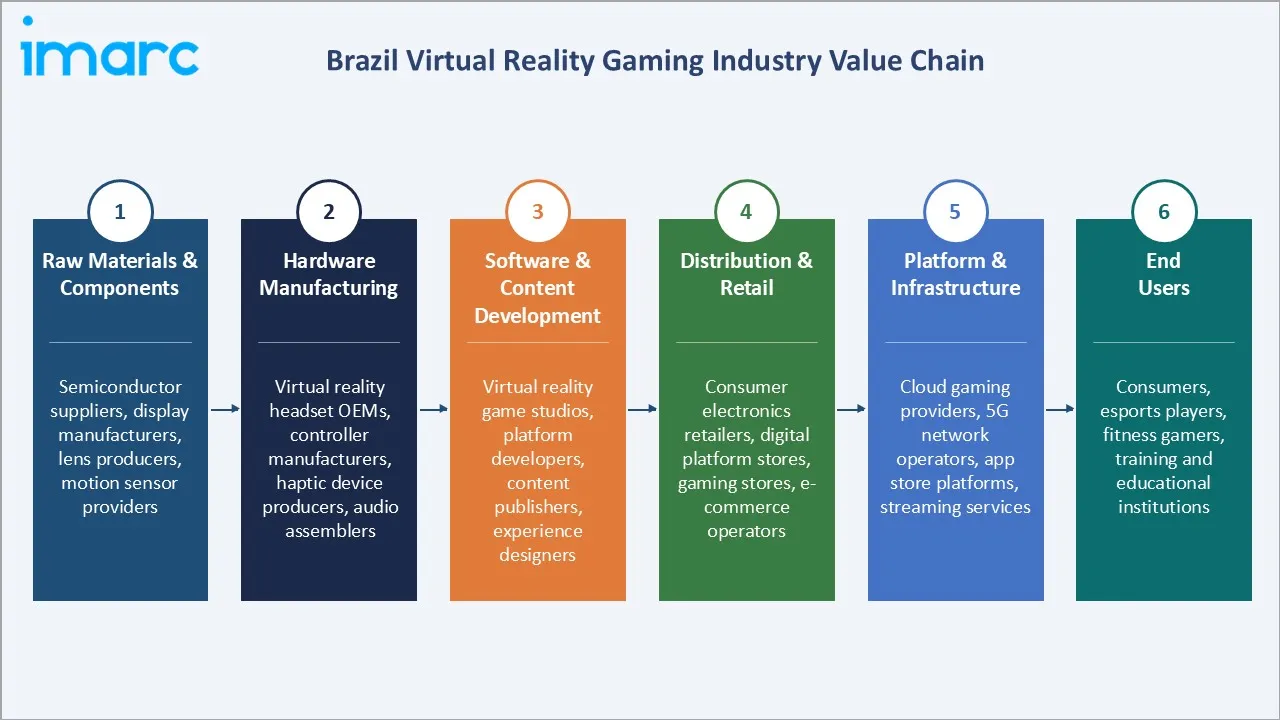
The Brazilian virtual reality gaming ecosystem integrates hardware manufacturers, software developers, content publishers, platform operators, distribution networks, and end consumers. Technology providers, cloud gaming platforms, and 5G network operators form the supporting infrastructure layer. Together, they enable a scalable, increasingly accessible, and content-rich gaming experience across Brazil’s major metropolitan and emerging regional markets.
Market Dynamics
To evaluate market opportunities, Request Sample
Market Drivers
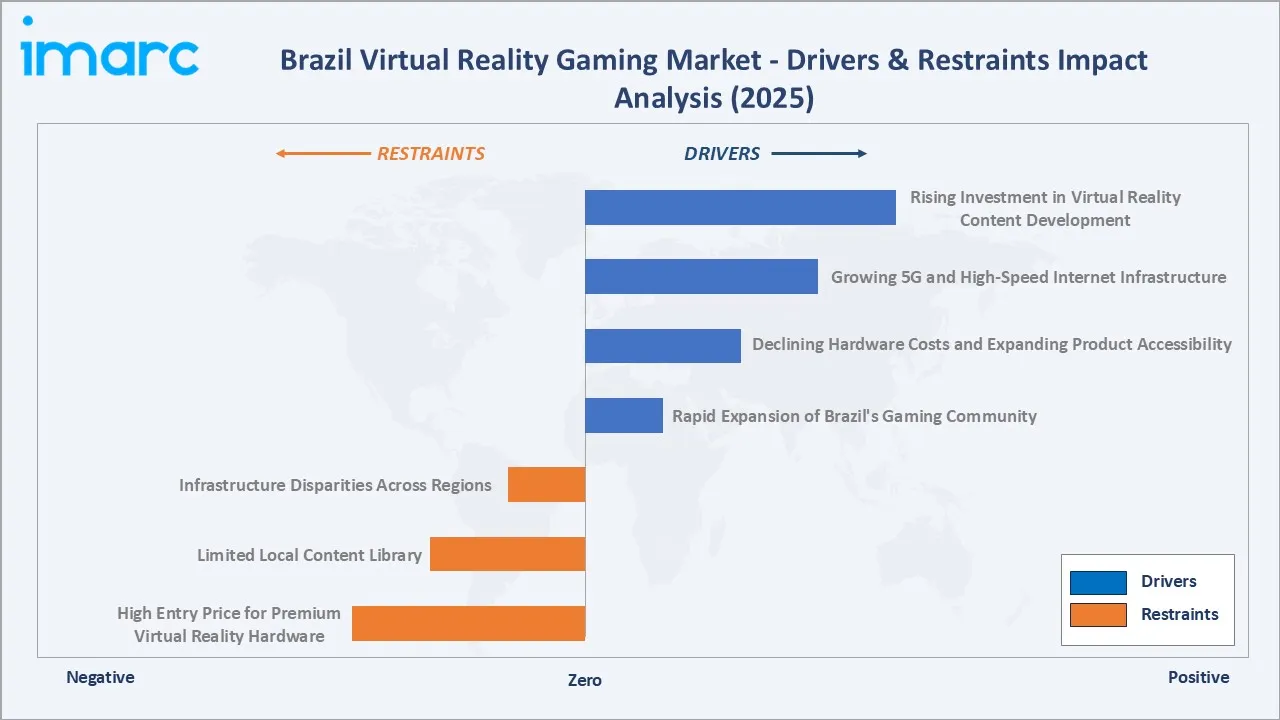
- Rapid Expansion of Brazil’s Gaming Community: The gaming community in Brazil is expanding, creating substantial demand for advanced gaming experiences, including virtual reality platforms and immersive content across all device categories.
- Declining Hardware Costs and Expanding Product Accessibility: Successive generations of virtual reality headsets have brought entry-level devices within reach of Brazil’s growing middle class, expanding the addressable consumer base beyond enthusiast early adopters to a broader mainstream audience.
- Growing 5G and High-Speed Internet Infrastructure: Expanding 5G network coverage and improved broadband connectivity across Brazil’s major cities are enabling cloud-streamed virtual reality content, reducing hardware performance requirements and broadening market access. As per IMARC Group, the Brazil 5G services market size is projected to reach USD 23,227.34 Million by 2034, growing at a compound annual growth rate of 20.89% from 2026-2034.
- Rising Investment in Virtual Reality Content Development: Game developers and platform operators are increasing investment in Brazil-compatible Portuguese-language virtual reality content, addressing a key adoption barrier and improving platform engagement across the domestic market.
Market Restraints
- High Entry Price for Premium Virtual Reality Hardware: The cost of premium virtual reality headsets and compatible computing hardware remains a barrier for a significant portion of Brazil’s consumer market, particularly outside high-income urban segments.
- Limited Local Content Library: The availability of high-quality Portuguese-language virtual reality game titles is restricted compared to the broader global market, limiting immersive engagement for Brazilian consumers who prefer localized content experiences.
- Infrastructure Disparities Across Regions: Uneven broadband and 5G network coverage between Southeast and North creates access disparities that restrict market penetration in lower-connectivity regions of Brazil.
Market Opportunities
- Expansion of Cloud-Based Virtual Reality Gaming Platforms: Cloud gaming infrastructure eliminates the need for expensive local hardware, enabling virtual reality game streaming on mid-range devices and extending the addressable consumer base across Brazil’s price-sensitive market segments.
- Growing Esports and Competitive Virtual Reality Gaming Ecosystem: Brazil’s well-established esports culture and competitive gaming community present a significant opportunity for virtual reality-integrated tournament formats, training platforms, and spectator experiences.
Market Challenges
- High Import Tariffs on Electronic Hardware: Brazil’s elevated import duties on consumer electronics significantly inflate virtual reality headset retail prices compared to global benchmarks, compressing demand and slowing hardware adoption across all income segments.
- Consumer Education and Awareness Gaps: A substantial share of potential users across Brazil’s tier-2 and tier-3 cities remain unaware of available virtual reality platforms and content, limiting market penetration below awareness-saturation levels in major metros.
Emerging Market Trends
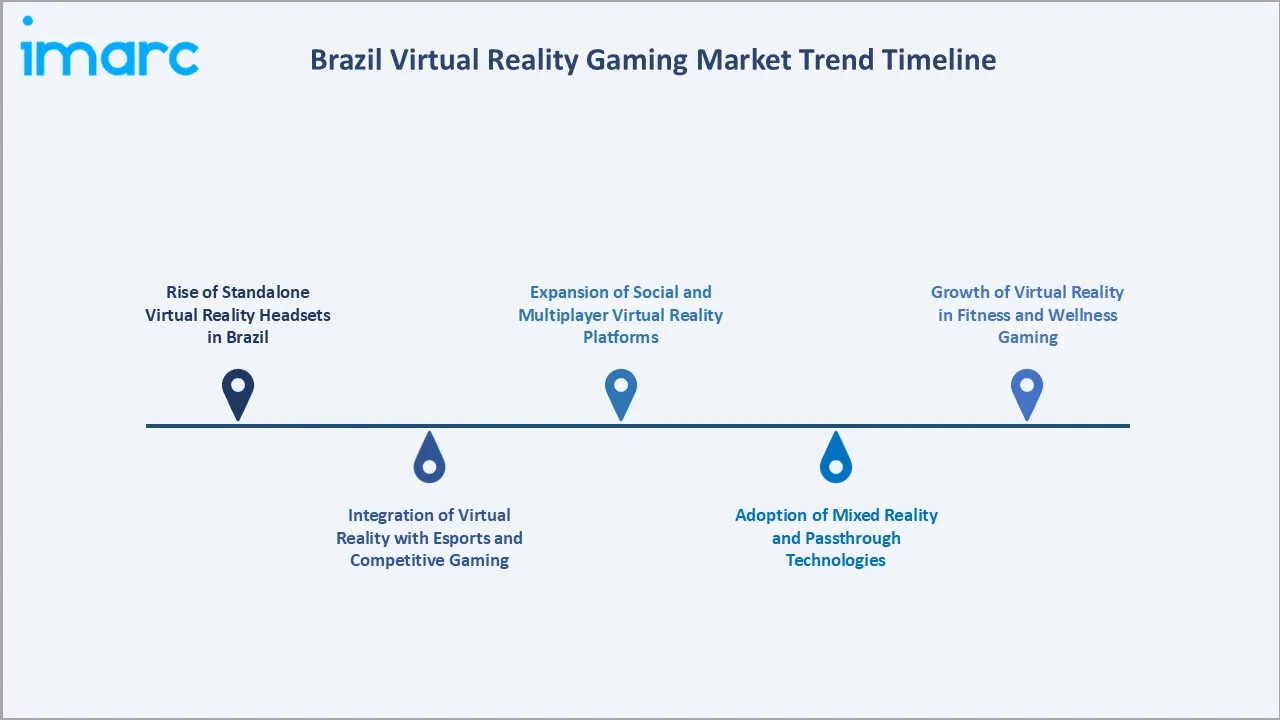
1. Rise of Standalone Virtual Reality Headsets in Brazil
Standalone virtual reality headsets, requiring no external PC or console connection, are transforming accessibility across Brazil’s gaming market. Growing retail availability across Brazil’s major electronics chains is accelerating standalone device penetration among mid-core gamers.
2. Integration of Virtual Reality with Esports and Competitive Gaming
Virtual reality gaming is increasingly intersecting with Brazil’s established esports ecosystem, with competitive virtual reality titles and tournament formats gaining traction. Virtual reality esports events are emerging as a new content vertical, attracting sponsorship and viewership beyond traditional 2D gaming formats. This integration is driving demand for performance-grade virtual reality hardware and low-latency streaming infrastructure.
3. Adoption of Mixed Reality and Passthrough Technologies
Mixed reality capabilities, blending virtual content with physical environments, are gaining traction in Brazil’s premium gaming segment. Next-generation headsets featuring high-resolution color passthrough are enabling hybrid gaming experiences that expand the utility of virtual reality hardware beyond dedicated play sessions. This trend is broadening the perceived value of virtual reality devices and supporting upgrade cycles across consumer segments.
4. Expansion of Social and Multiplayer Virtual Reality Platforms
Social virtual reality platforms enabling multiplayer interaction in virtual environments are growing in adoption among Brazil’s younger gaming demographic. Mobile virtual reality penetration is expanding broadly, enabling platform-agnostic social virtual reality experiences at accessible entry costs across diverse income groups. Brazilian gamers are increasingly engaging with shared virtual spaces for gaming, socialization, and community events.
5. Growth of Virtual Reality in Fitness and Wellness Gaming
Fitness-focused virtual reality titles, gamifying physical exercise through interactive experiences, are gaining a dedicated user base in Brazil’s health-conscious urban gaming segment. The overlap between gaming and wellness is creating new content investment opportunities and expanding the virtual reality gaming demographic beyond traditional gaming audiences. Developer studios are increasing investment in fitness virtual reality titles compatible with Brazilian market preferences.
Industry Value Chain Analysis
The Brazil virtual reality gaming value chain spans six stages, from component sourcing through end-user engagement. Software development and platform infrastructure stages capture the highest value-add, while distribution and retail stages are increasingly shifting toward digital channels as platform stores and cloud gaming services displace physical retail activity.
| Stage | Key Players / Examples |
|---|---|
| Raw Materials & Components | Semiconductor suppliers, display panel manufacturers, lens producers, and motion sensor component providers |
| Hardware Manufacturing | Virtual reality headset OEMs, controller manufacturers, haptic feedback device producers, and audio component assemblers |
| Software & Content Development | Virtual reality game studios, platform developers, content publishers, and interactive experience designers |
| Distribution & Retail | Consumer electronics retailers, digital platform stores, gaming specialty stores, and e-commerce operators |
| Platform & Infrastructure | Cloud gaming providers, 5G network operators, app store platforms, and streaming service providers |
| End Users | Consumers, esports players, fitness gaming users, enterprise training operators, and educational institutions |
Vertically integrated operators controlling content development, platform distribution, and device ecosystems capture greater margin than single-stage participants dependent on third-party platforms and content libraries.
Technology Landscape in the Brazil Virtual Reality Gaming Industry
Head-Mounted Display Technology
Display technology in virtual reality headsets has advanced from early LCD panels to high-density OLED and micro-LED displays, improving pixel density and reducing screen-door effect. Pancake lens optics are emerging as a standard for compact, premium headset designs, enabling thinner form factors and improved visual clarity for Brazilian consumers investing in high-end virtual reality devices.
Motion Tracking and Controllers
Inside-out tracking systems, using onboard cameras for position tracking without external sensors, have simplified setup and improved consumer adoption. Advanced controller designs incorporating finger-tracking and haptic feedback are increasing immersion and enabling more intuitive virtual reality interactions across gaming and social platform applications.
Cloud and 5G-Enabled Virtual Reality Streaming
Edge computing and 5G network infrastructure are enabling low-latency virtual reality game streaming, reducing the hardware performance threshold for quality virtual reality experiences. Expanding 5G coverage across Brazil’s urban centers is creating conditions for cloud-rendered virtual reality gaming at accessible hardware entry points for price-sensitive consumers.
AI-Driven Experience Personalization
AI is being integrated into virtual reality gaming platforms to personalize content recommendations, adapt game difficulty, and optimize rendering performance. AI-driven personalization is improving user engagement and session duration across virtual reality gaming platforms serving Brazilian consumers across all device categories.
Market Segmentation Analysis
The report covers the following segments:
|
Segment Category |
Leading Segment |
Market Share |
Year |
|
Segment |
Software |
55.0% |
2025 |
|
Device |
Personal Computers |
38.0% |
2025 |
|
Age Group |
🔒 |
🔒 |
2025 |
|
Type of Games |
🔒 |
🔒 |
2025 |
|
Region |
Southeast |
55.0% |
2025 |

By Segment
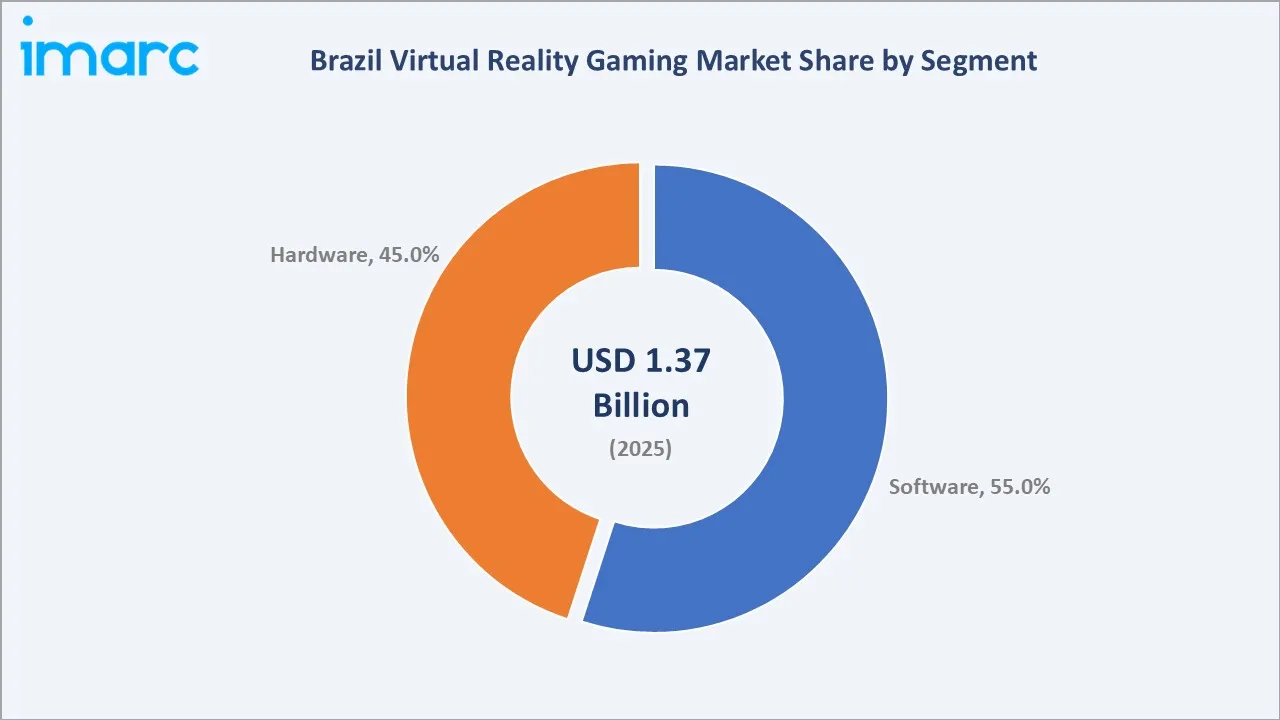
Software commands a 55.0% majority share in 2025, driven by the recurring demand for game titles, platform subscriptions, and content updates that sustain ongoing consumer spending beyond initial hardware investment. The segment benefits from Brazil’s digital distribution infrastructure, with major platform stores enabling seamless game download and content access across the country.
To access detailed market analysis, Request Sample
Hardware at 45.0% is the second-largest segment, supported by ongoing device refresh cycles, declining headset prices, and expanding product availability through Brazil’s consumer electronics retail channels. Continued hardware innovation is improving value-for-money propositions and driving device upgrades among early adopter segments across the country.
By Device
Personal computers represent 38.0% of the device segment in 2025, directly reflecting Brazil’s strong PC gaming culture and the performance advantage of PC-based virtual reality platforms for delivering premium immersive gaming experiences to enthusiast gamers.
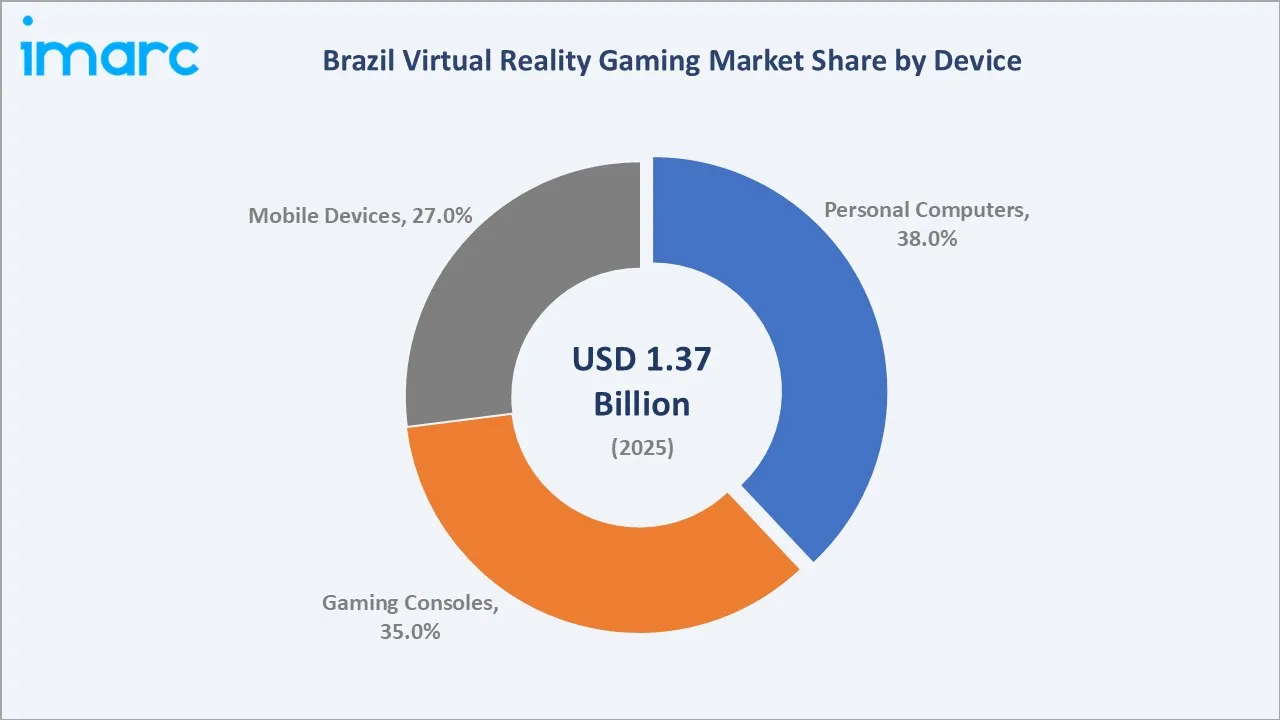
Mobile devices at 27.0% are the fastest-growing sub-segment, driven by improving smartphone virtual reality compatibility and affordable entry-level headset adoption.
Regional Market Insights
|
Region |
Share (2025) |
Key Virtual Reality Market Drivers & Characteristics |
|
Southeast |
55.0% |
High population density in São Paulo and Rio de Janeiro, strong digital infrastructure, high per capita gaming spend, and concentration of gaming and esports venues |
|
South |
18.0% |
Strong technology sector in Curitiba and Porto Alegre, growing middle-class gaming community, expanding digital retail, and high broadband penetration |
|
Northeast |
12.0% |
Increasing smartphone and internet penetration, growing urban gaming communities in Fortaleza and Recife, rising disposable income, and improving digital infrastructure |
|
Central-West |
9.0% |
Growing urban economy in Brasília and Goiânia, expanding technology sector, rising income levels, and improving broadband connectivity |
|
North |
6.0% |
Emerging gaming community in Belém and Manaus, improving infrastructure, growing youth population, and rising digital economy engagement |
Southeast at 55.0% in 2025 leads the regional landscape, anchored by São Paulo and Rio de Janeiro’s large gaming communities and high concentration of digital retail and esports infrastructure.
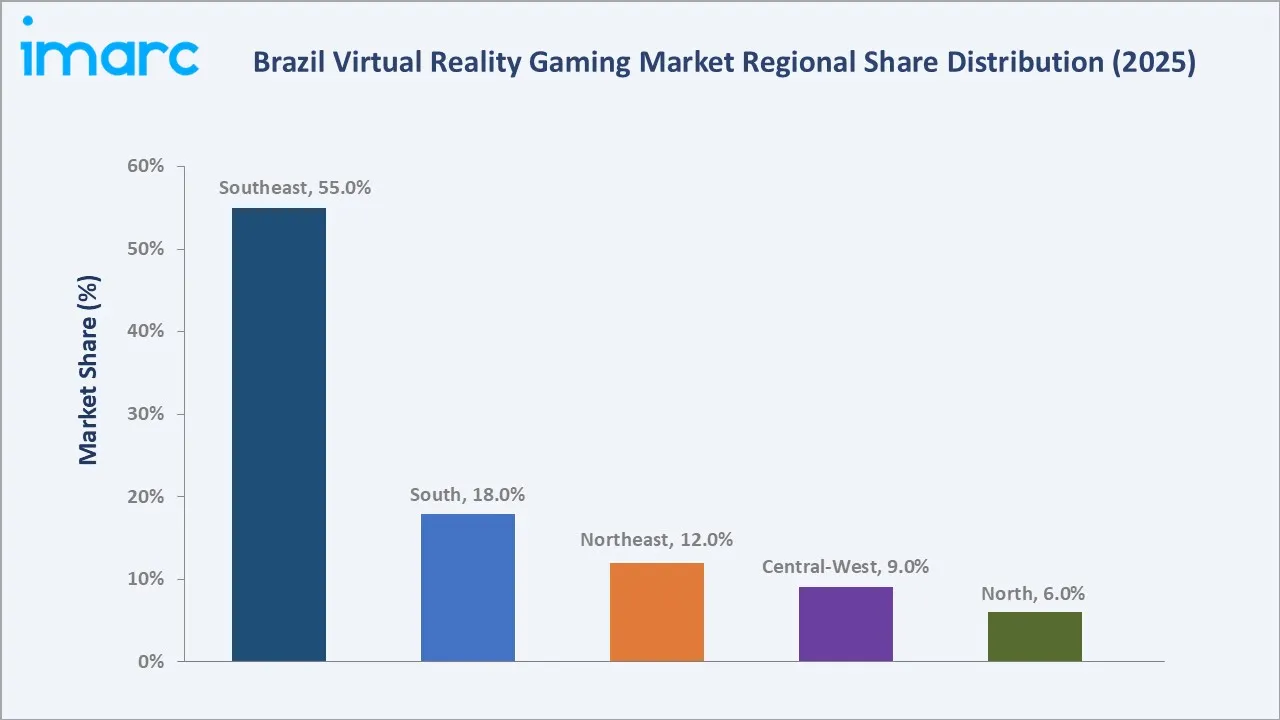
North, while currently the smallest regional contributor at 6.0%, is expanding as internet penetration improves across the Amazon region and as mobile virtual reality adoption grows among younger demographics in emerging urban centers.
Competitive Landscape
The Brazil virtual reality gaming market is highly competitive, with global technology giants, specialized virtual reality hardware manufacturers, and software platform operators competing on device performance, content ecosystem depth, and price-to-performance positioning. Brand recognition, developer partnerships, and exclusive content agreements form the key competitive differentiators in the market.
| Company Name | Brand / Key Product | Position | Strategic Focus |
|---|---|---|---|
| Meta Platforms, Inc. | Meta Quest 3 / Quest 3S | Leader | Growing standalone virtual reality headset market share through affordable device pricing and content investment |
| HTC Corporation | VIVE | Challenger | Developing enterprise virtual reality solutions under the VIVE brand, with ongoing commitment to high-fidelity immersive experiences |
| Microsoft Corporation | Xbox / Xbox Cloud Gaming | Challenger | Expanding virtual reality gaming capabilities through platform development and strategic technology partnerships. |
| Valve Corporation | Steam Frame | Challenger | Building PC virtual reality ecosystem through platform content diversity and new Steam Frame hardware for enthusiasts |
Key players include Meta Platforms, Inc., HTC Corporation, Microsoft Corporation, and Valve Corporation, among others.
Key Company Profiles
Meta Platforms, Inc.
Meta Platforms, Inc. is a United States-based technology conglomerate headquartered in Menlo Park, California. The company develops the Meta Quest line of standalone virtual reality headsets.
- Product Portfolio: Meta Quest 3 and Quest 3S standalone virtual reality headsets.
- Recent Developments: The company continues to enhance its Meta Quest portfolio through software updates, improved mixed reality capabilities, and expanded access to immersive gaming content.
- Strategic Focus: Driving mass-market virtual reality adoption through competitive pricing, deepening the Meta Horizon content ecosystem, and expanding strategic partnerships with gaming and technology platforms to broaden the Meta Quest value proposition.
HTC Corporation
HTC Corporation is a Taiwanese consumer electronics company headquartered in Taoyuan, Taiwan. The company develops the VIVE product line of virtual reality headsets, targeting enterprise and premium consumer applications with a focus on high-fidelity immersive experiences.
- Product Portfolio: VIVE Focus Vision enterprise virtual reality headset, VIVE XR Elite, and VIVEPORT virtual reality content subscription platform.
- Recent Developments: The firm has reinforced its enterprise virtual reality positioning, focusing on the VIVE Focus Vision and high-fidelity business applications for training, simulation, and collaboration.
- Strategic Focus: Strengthening enterprise virtual reality adoption through dedicated hardware and software solutions while maintaining platform presence in premium market segments through the VIVE brand.
Microsoft Corporation
Microsoft Corporation is a United States-based technology conglomerate. The company participates in the virtual reality gaming market through its Xbox Cloud Gaming platform.
- Product Portfolio: Xbox Cloud Gaming on Meta Quest, enabling users to access and stream a broad library of console games through compatible virtual reality headsets.
- Recent Developments: The firm continues to strengthen its gaming ecosystem through platform enhancements, service expansion, and improvements in cross-device accessibility.
- Strategic Focus: Strengthening gaming capabilities through technological innovation, platform development, and strategic partnerships to expand user engagement and market reach.
Market Concentration Analysis
The Brazil virtual reality gaming market exhibits moderate-to-high concentration at the hardware level, with a few established technology companies accounting for a considerable share of headset sales and platform offerings. This competitive structure is shaped by product innovation, brand recognition, and ecosystem development.
Barriers to entry include the capital requirements for hardware development and manufacturing, the need for extensive developer ecosystems and content libraries, established brand relationships with Brazil’s gaming retail channels, and the ongoing software investment required to sustain platform engagement. These factors favor large-scale global technology companies over domestic market entrants.
Consolidation trends include platform consolidation around a few dominant operating systems and content aggregation through platform-exclusive publishing deals. The market’s high growth rate is attracting new hardware entrants from consumer electronics manufacturers seeking to capture share of a rapidly expanding virtual reality installed base across Brazilian consumers.
Investment & Growth Opportunities
Fastest-Growing Segments
Mobile devices are expanding fastest among device sub-segments, driven by improving smartphone virtual reality compatibility and the growing adoption of mobile-compatible virtual reality headsets at accessible price points. Software is expected to sustain an above-average growth rate as the platform content library expands and subscription-based access models mature across Brazil’s digital gaming ecosystem.
Emerging Markets
Northeast is the fastest-growing regional market, supported by improving smartphone penetration, rising urban gaming communities, and improving digital infrastructure investment. The region represents significant untapped potential for mobile virtual reality platforms and digital content operators ahead of hardware price normalization.
Venture & Investment Trends
Investment activity is concentrated in cloud gaming infrastructure, virtual reality content development studios targeting Portuguese-language markets, and platform ecosystem expansion. Capital is also flowing into location-based virtual reality entertainment venues and competitive virtual reality esports infrastructure, as operators seek to build premium gaming experiences that complement at-home virtual reality adoption across Brazilian consumers.
Future Market Outlook (2026-2034)
The Brazil virtual reality gaming market is projected to grow from USD 1.37 Billion in 2025 to USD 1.82 Billion in 2026, reaching USD 17.86 Billion by 2034, registering a CAGR of 32.99% during 2026-2034.
Four forces will shape the market through 2034 progressive virtual reality hardware price normalization enabling mass-market penetration across Brazil’s income spectrum; expansion of Portuguese-language virtual reality content libraries addressing domestic consumer preferences; 5G network rollout enabling cloud-rendered virtual reality gaming at accessible hardware thresholds; and deepening integration of virtual reality with Brazil’s established esports and competitive gaming ecosystem.
By 2034, the Brazil virtual reality gaming market is expected to be characterized by a mature standalone virtual reality installed base, a diverse software platform ecosystem, and growing convergence between virtual reality gaming and broader mixed reality entertainment experiences. Continued income growth in Brazil’s middle class will sustain strong consumer demand through the forecast period.
Research Methodology
Primary Research
Primary research included structured discussions with virtual reality hardware retailers, game developers, platform operators, and digital entertainment distributors in Brazil, validating market sizing, segment mix, and regional demand patterns across the virtual reality gaming ecosystem.
Secondary Research
Secondary sources included regulatory filings from Brazilian telecommunications agencies, gaming industry association reports, public disclosures from listed technology companies and game publishers, and trade publications covering the global virtual reality gaming industry.
Forecasting Models
Market forecasts used top-down and bottom-up models combining gaming population data, virtual reality device adoption rate projections, software spending per capita estimates, and hardware price trajectory assumptions. Scenario analysis addressed 5G rollout pace, hardware cost normalization, content investment trends, and regional digital infrastructure development rates.
Brazil Virtual Reality Gaming Market Report Coverage:
| Report Features | Details |
|---|---|
| Base Year of the Analysis | 2025 |
| Historical Period | 2020-2025 |
| Forecast Period | 2026-2034 |
| Units | Billion USD |
| Scope of the Report |
Exploration of Historical Trends and Market Outlook, Industry Catalysts and Challenges, Segment-Wise Historical and Future Market Assessment:
|
| Segments Covered | Software, Hardware |
| Devices Covered | Personal Computers, Gaming Consoles, Mobile Devices |
| Age Groups Covered | Adults, Children |
| Types of Games Covered | Racing, Adventure, Fighting, Shooting, Mystery Thriller, Puzzle, Science Fiction, Others |
| Regions Covered | Southeast, South, Northeast, North, Central-West |
| Companies Covered | Meta Platforms, Inc., HTC Corporation, Microsoft Corporation, Valve Corporation, etc. |
| Customization Scope | 10% Free Customization |
| Post-Sale Analyst Support | 10-12 Weeks |
| Delivery Format | PDF and Excel through Email (We can also provide the editable version of the report in PPT/Word format on special request) |
Key Benefits for Stakeholders:
- IMARC’s industry report offers a comprehensive quantitative analysis of various market segments, historical and current market trends, market forecasts, and dynamics of the Brazil virtual reality gaming market from 2020-2034.
- The research report provides the latest information on the market drivers, challenges, and opportunities in the Brazil virtual reality gaming market.
- Porter's five forces analysis assist stakeholders in assessing the impact of new entrants, competitive rivalry, supplier power, buyer power, and the threat of substitution. It helps stakeholders to analyze the level of competition within the Brazil virtual reality gaming industry and its attractiveness.
- Competitive landscape allows stakeholders to understand their competitive environment and provides an insight into the current positions of key players in the market.
Frequently Asked Questions About the Brazil Virtual Reality Gaming Market Report
The Brazil virtual reality gaming market size is estimated at USD 1.82 Billion in 2026, driven by growing gaming communities, expanding virtual reality hardware access, and increasing investment in virtual reality content across the country.
The market is projected to grow at a CAGR of 32.99% from 2026-2034, reaching USD 17.86 Billion, supported by 5G expansion, hardware price normalization, and growing content ecosystems.
Software dominates the market at 55.0% segment share in 2025, driven by the high and recurring demand for virtual reality game titles, platform subscriptions, and content updates.
Personal computers lead the device segment at 38.0% share in 2025, reflecting Brazil’s strong PC gaming culture and the performance advantage of PC-based virtual reality platforms for delivering immersive gaming experiences.
Southeast commands 55.0% share in 2025, led by São Paulo and Rio de Janeiro’s large gaming communities, strong digital infrastructure, and high per capita gaming spend.
Northeast is the fastest-growing region, supported by improving smartphone penetration, rising urban gaming communities, and expanding digital infrastructure investment.
Key players include Meta Platforms, Inc., HTC Corporation, Microsoft Corporation, and Valve Corporation, among others.
Key drivers include Brazil’s expanding gaming community, declining virtual reality hardware costs, growing 5G connectivity, and rising investment in virtual reality-compatible content development.
Key trends include the rise of standalone virtual reality headsets, integration of virtual reality with esports, adoption of mixed reality technologies, and expansion of social and multiplayer virtual reality platforms.
Need more help?
- Speak to our experienced analysts for insights on the current market scenarios.
- Include additional segments and countries to customize the report as per your requirement.
- Gain an unparalleled competitive advantage in your domain by understanding how to utilize the report and positively impacting your operations and revenue.
- For further assistance, please connect with our analysts.
 Request Customization
 Speak to an Analyst
 Request Brochure
 Inquire Before Buying
Benefits of Customization
- Personalize this research
- Triangulate with your data
- Get data as per your format and definition
- Gain a deeper dive into a specific application, geography, customer, or competitor
- Any level of personalization
Get in Touch With Us
UNITED STATES
Phone: +1-201-971-6302
INDIA
Phone: +91-120-433-0800
UNITED KINGDOM
Phone: +44-753-714-6104
Email: [email protected]
Client Testimonials























Related Reports

Choose your plan
*Please note that the prices mentioned below are starting prices for each bundle type. Kindly contact our team for further details.*
Single User License
- 1 User License, Access on 2 Devices
- PDF Report + Excel Dataset (Password Protected)
- Lifetime Access
- No Printing Rights
- 10% Free Report Customization
- 10–12 Weeks of Analyst Support
Five User License
- Access for 5 Users, 2 Devices per User
- PDF Report + Excel Dataset (Password Protected)
- Lifetime Access
- Dedicated Account Manager
- 12–14 Weeks of Analyst Support
- No Printing Rights
- 15% Free Report Customization
- 25% Discount on Your Next Purchase
Corporate User License
- Unlimited User Access (Within Your Organization)
- PDF Report + Excel Dataset
- Lifetime Access
- Dedicated Account Manager
- 14–20 Weeks of Analyst Support
- No Printing Rights
- 20% Free Report Customization
- 30% Discount on Your Next Purchase
Essential Insights
What's included:
3 reports
- Lifetime Access
- PDF Reports
- Excel Datasets
- 2 Weeks of Free Analyst Support
- 2 User Licenses
- Access on 2 Devices
- Printing Rights
- Complimentary PowerPoint (PPT) Version
- Complimentary License Upgrade
Professional Access
What's included:
5 reports
- Lifetime Access
- PDF Reports
- Excel Datasets
- 8 Weeks of Free Analyst Support
- 2 User Licenses
- Access on 2 Devices
- Printing Rights
- Complimentary PowerPoint (PPT) Version
- Complimentary License Upgrade
Business Advantage
What's included:
8 reports
- Lifetime Access
- PDF Reports
- Excel Datasets
- 14 Weeks of Free Analyst Support
- 2 User Licenses
- Access on 2 Devices
- Printing Rights
- Complimentary PowerPoint (PPT) Version
- Complimentary License Upgrade
Enterprise Intelligence
What's included:
10 reports
- Lifetime Access
- PDF Reports
- Excel Datasets
- 20 Weeks of Free Analyst Support
- 2 User Licenses
- Access on 2 Devices
- Printing Rights
- Complimentary PowerPoint (PPT) Version
- Complimentary License Upgrade