
India Functional Beverages Market Size, Share, Trends and Forecast by Type, Distribution Channel, End User, and Region, 2026-2034
India Functional Beverages Market Size, Share, Trends & Forecast (2026-2034)
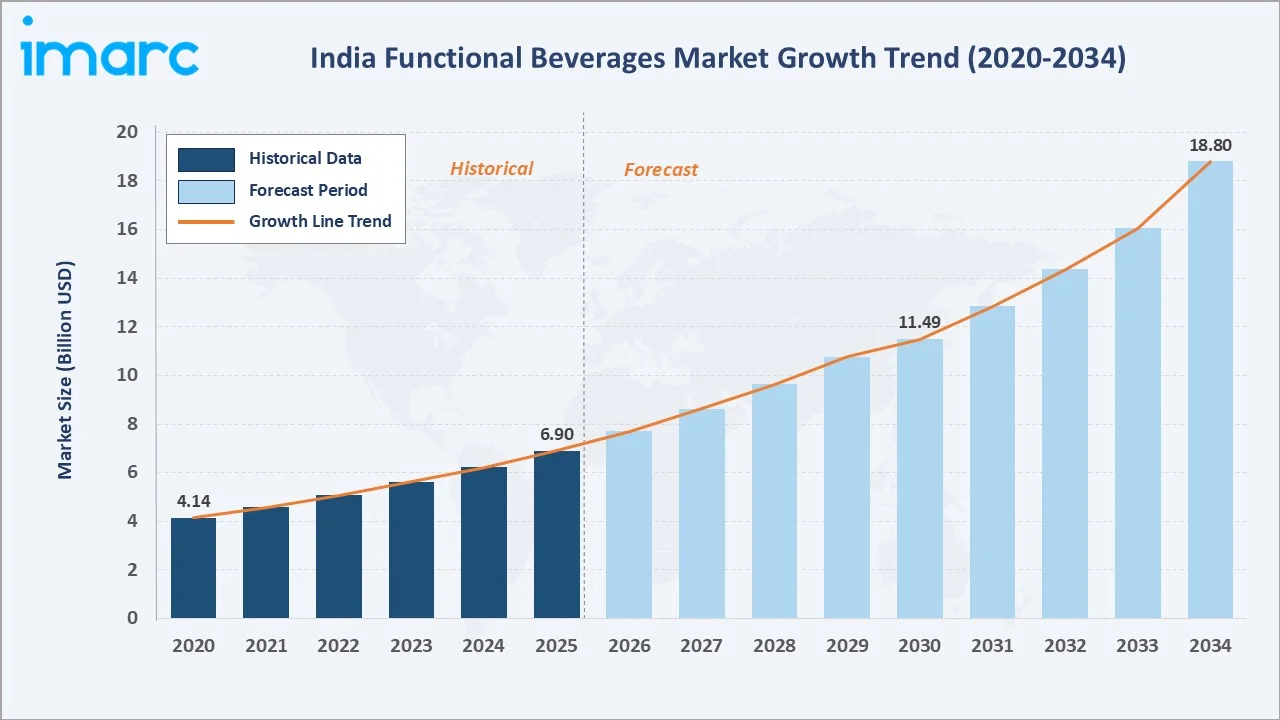
The India functional beverages market grew from USD 6.9 Billion in 2025 to USD 8.3 Billion in 2026 and is projected to reach USD 18.8 Billion by 2034, growing at a CAGR of 10.74% during 2026-2034. The market is driven by rising consumer demand for health and wellness products, growing fitness culture among urban Indians, and the mainstreaming of Ayurvedic and herbal formulations. India’s value gyms currently form the backbone of the country’s fitness ecosystem, accounting for approximately 78% of total gym memberships and 80% of fitness facilities, reflecting the expanding active-lifestyle consumer base that directly fuels functional beverage demand. Fitness lifestyle users lead at 46.8% by end user, supermarkets and hypermarkets dominate at 38.5% by distribution channel, and North India commands the largest regional share at 31.4% in 2025.
Market Snapshot
|
Metric |
Value |
|
Base Year Market Size (2025) |
USD 6.9 Billion |
|
Market Size (2026) |
USD 8.3 Billion |
|
Forecast Market Size (2034) |
USD 18.8 Billion |
|
CAGR (2026-2034) |
10.74% |
|
Base Year |
2025 |
|
Historical Period |
2020-2025 |
|
Forecast Period |
2026-2034 |
|
Dominant Distribution Channel |
Supermarket & Hypermarket (38.5%, 2025) |
|
Dominant End User |
Fitness Lifestyle Users (46.8%, 2025) |
|
Leading Region |
North India (31.4%, 2025) |
The India functional beverages market grew from USD 4.14 Billion in 2020 to USD 6.9 Billion in 2025, and further to USD 8.3 Billion in 2026, reflecting sustained consumer demand, expanding organized retail, and growing digital commerce adoption. The market is projected to reach USD 11.49 Billion by 2030 before reaching USD 18.8 Billion by 2034.
To get more information on this market, Request Sample
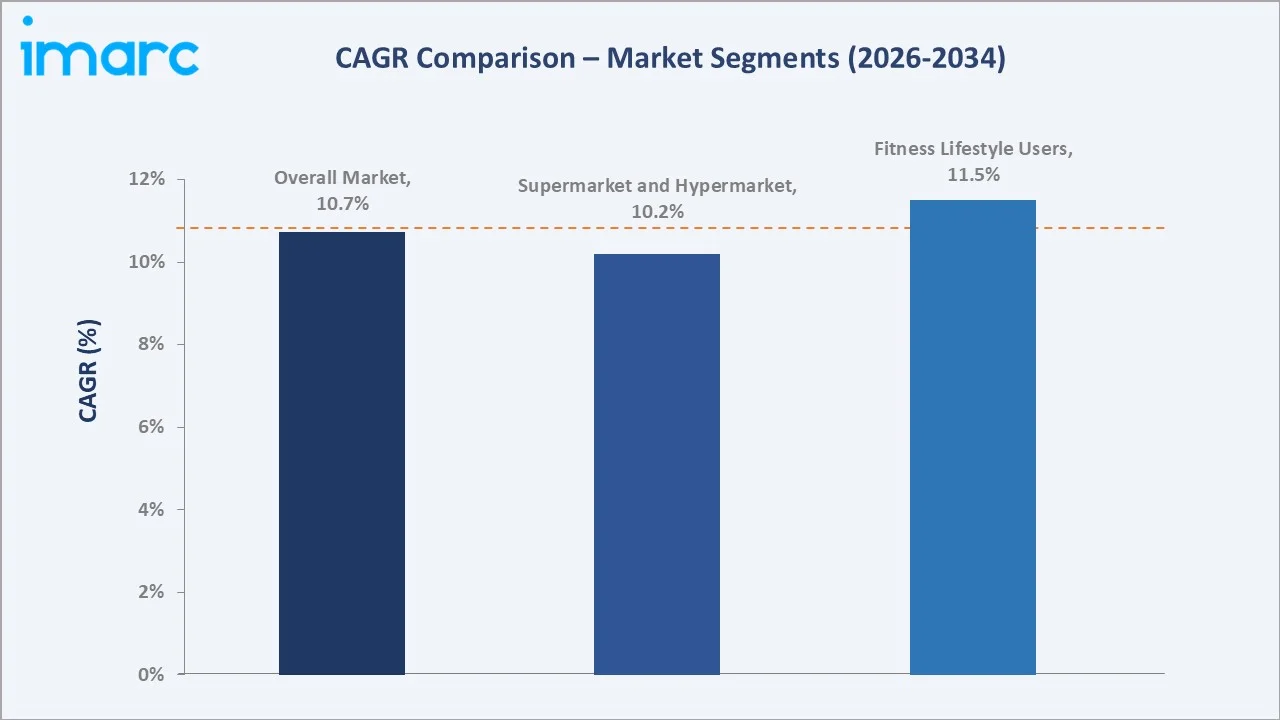
Fitness lifestyle users are projected to grow at approximately 11.5% CAGR as urban health consciousness intensifies. The supermarket and hypermarket channel is expected to grow at approximately 10.2% CAGR, supported by expanding modern retail infrastructure. E-commerce emerges as the fastest-growing distribution channel, driven by direct-to-consumer brand strategies.
Executive Summary
The India functional beverages market is on a high-growth trajectory, underpinned by structural shifts in consumer behavior toward preventive health, fitness culture, and natural ingredient preference. The market has expanded steadily, driven by post-COVID immunity awareness, the mainstreaming of Ayurvedic formulations, and the rapid growth of organized retail and e-commerce channels that have brought functional beverages to a broader consumer base across metro and tier-2 cities.
Fitness lifestyle users account for 46.8% of total demand in 2025, reflecting the strong growth of gym culture, sports participation, and general wellness consciousness among urban Indian consumers. On the distribution side, supermarkets and hypermarkets lead at 38.5%, supported by expanding modern trade. North India leads regionally at 31.4%, driven by urban health-conscious consumers in Delhi NCR and other northern metros.
Key Market Insights
|
Insight |
Data |
|
Dominant Distribution Channel |
Supermarket & Hypermarket - 38.5% share (2025) |
|
Dominant End User |
Fitness Lifestyle Users - 46.8% share (2025) |
|
Leading Region |
North India - 31.4% (2025) |
|
Key Market Opportunity |
Rising demand for Ayurvedic and herbal functional beverages and premiumization across fitness and wellness consumer segments |
Key Analytical Observations Supporting the Above Data:
- Supermarket and Hypermarket at 38.5%: The organized retail channel dominates because supermarkets and hypermarkets offer consumers the ability to browse, compare, and trial functional beverages alongside regular grocery shopping. Shelf placement, in-store sampling, and promotional visibility remain critical drivers of functional beverage adoption among first-time buyers.
- Fitness Lifestyle Users at 46.8%: This segment reflects the broadening of functional beverage consumption beyond competitive sports into everyday wellness, driven by gym membership growth, workplace wellness programs, and rising awareness of hydration, energy, and gut health among working professionals and urban millennials.
- North India at 31.4%: North India's leadership reflects the dense urban consumer base in greater metro-tier-2 connectivity and the strong penetration of organized retail formats, including national and regional supermarket chains that serve as primary functional beverage purchase points.
India Functional Beverages Market Overview
The India functional beverages market encompasses beverages formulated with specific functional ingredients, including vitamins, minerals, probiotics, adaptogens, electrolytes, proteins, and herbal extracts, designed to deliver measurable health, wellness, or performance benefits beyond basic hydration. Product categories include energy drinks, sports and hydration drinks, probiotic beverages, herbal and Ayurvedic infusions, fortified juices, dairy-based functional drinks, and functional water.
The market serves two primary consumer groups: fitness-oriented users seeking performance and recovery benefits, and general wellness consumers seeking immunity, gut health, cognitive, and energy support from their daily beverage choices. The industry ecosystem spans raw material and ingredient suppliers, specialized formulation and manufacturing facilities, brand and marketing organizations ranging from large FMCG conglomerates to emerging D2C startups, and a multi-channel distribution architecture spanning organized retail, e-commerce, specialty health stores, and foodservice.
Market Dynamics
To evaluate market opportunities, Request Sample
Market Drivers
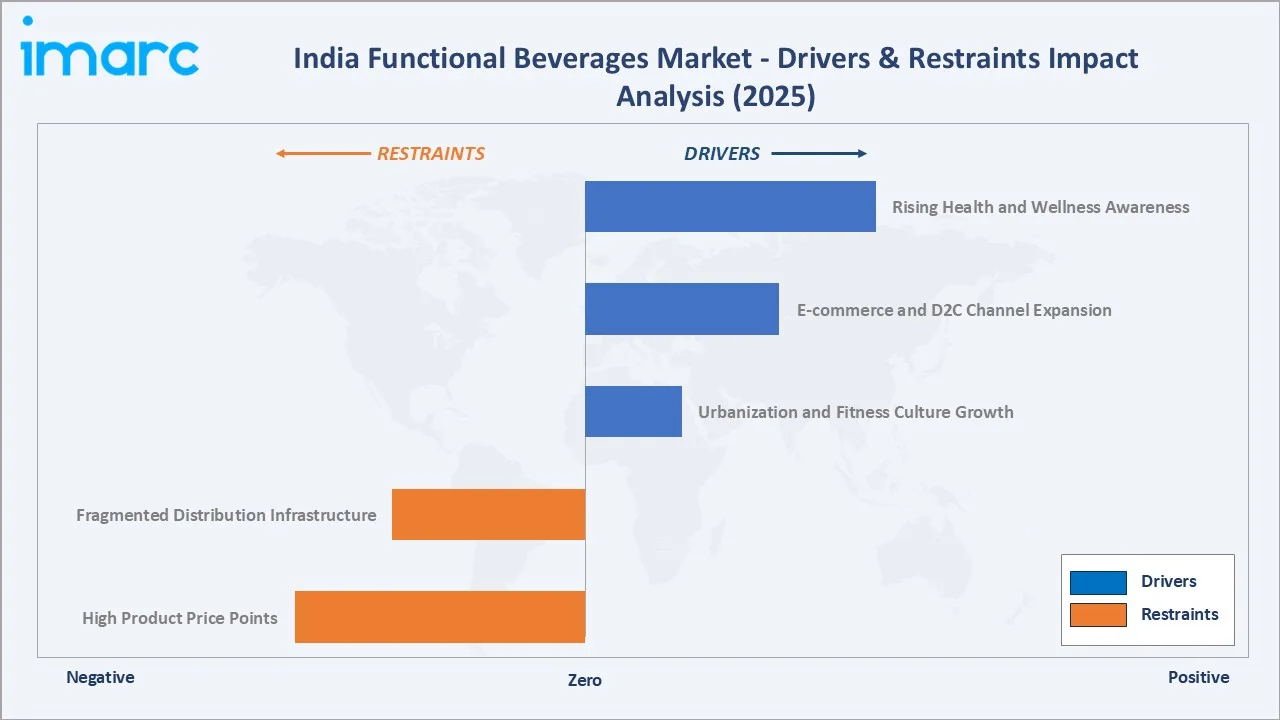
- Rising Health and Wellness Awareness: In January 2025, Reliance Consumer Products Limited (RCPL) launched RasKik Gluco Energy, its functional wellness beverage under the Campa Cola FMCG expansion, reflecting how India's largest consumer companies are responding to rising consumer demand for health-functional beverages. A broader shift from sugary carbonated drinks toward functional alternatives is driving consistent category volume growth across urban and semi-urban markets.
- E-commerce and D2C Channel Expansion: E-commerce accounts for 27.4% of the functional beverage distribution in 2025 and is the fastest-growing channel, enabling brands to reach health-conscious consumers outside organized retail footprints. D2C brands are leveraging social media, influencer partnerships, and subscription models to build loyal repeat-purchase audiences at lower customer acquisition costs than traditional retail.
- Urbanization and Fitness Culture Growth: India’s urban population is projected to expand by approximately 270 million people by 2040, reflecting the country’s continued pace of urbanization. The expanding organized fitness industry, including gym chains, yoga studios, and corporate wellness programs, is creating consistent demand for functional beverages among urban and semi-urban professionals who view functional drinks as integral to active lifestyle routines rather than occasional supplementation.
Market Restraints
- High Product Price Points: Functional beverages are priced at a significant premium over conventional beverages, limiting mass-market penetration beyond urban and upper-income consumers. Price sensitivity in tier-2 and tier-3 markets constrains volume growth in geographies that represent a significant portion of India's consumer base.
- Fragmented Distribution Infrastructure: Outside major metro cities, functional beverage distribution relies on traditional trade channels that lack the cold chain infrastructure, shelf space prioritization, and educated retailer networks that support effective category selling, limiting geographic reach for premium functional products.
Market Opportunities
- Ayurvedic and Herbal Beverage Category Expansion: In May 2026, Café Swasthya strengthened its footprint across Delhi-NCR by opening its fourth outlet at Gates 5 and 6 of Rajiv Chowk Metro Station. The takeaway-focused outlet caters to daily commuters by providing convenient access to a range of Ayurvedic food and beverage offerings, illustrating the commercial potential of culturally rooted functional formulations that blend traditional wellness with modern beverage formats.
- Premiumization and Personalized Nutrition: Increasing consumer willingness to pay for premium functional formulations, including adaptogens, nootropics, and clinically validated probiotic strains, is creating a high-value segment within the broader functional beverage market that commands superior margins and brand loyalty.
Market Challenges
- Consumer Education and Trust Building: A meaningful portion of Indian consumers remains skeptical of functional claims, particularly for novel international ingredient categories. Building trust requires sustained investment in consumer education, transparent labeling, and credible third-party endorsements that many brands, particularly newer entrants, struggle to maintain at scale.
- Intense Competition Across Price Segments: The market faces competition from multiple directions, established FMCG beverages adapting with functional variants, international brands entering India, domestic Ayurvedic brands, and new D2C startups, creating intense competition for shelf space, consumer attention, and marketing investment across all price segments.
Emerging Market Trends
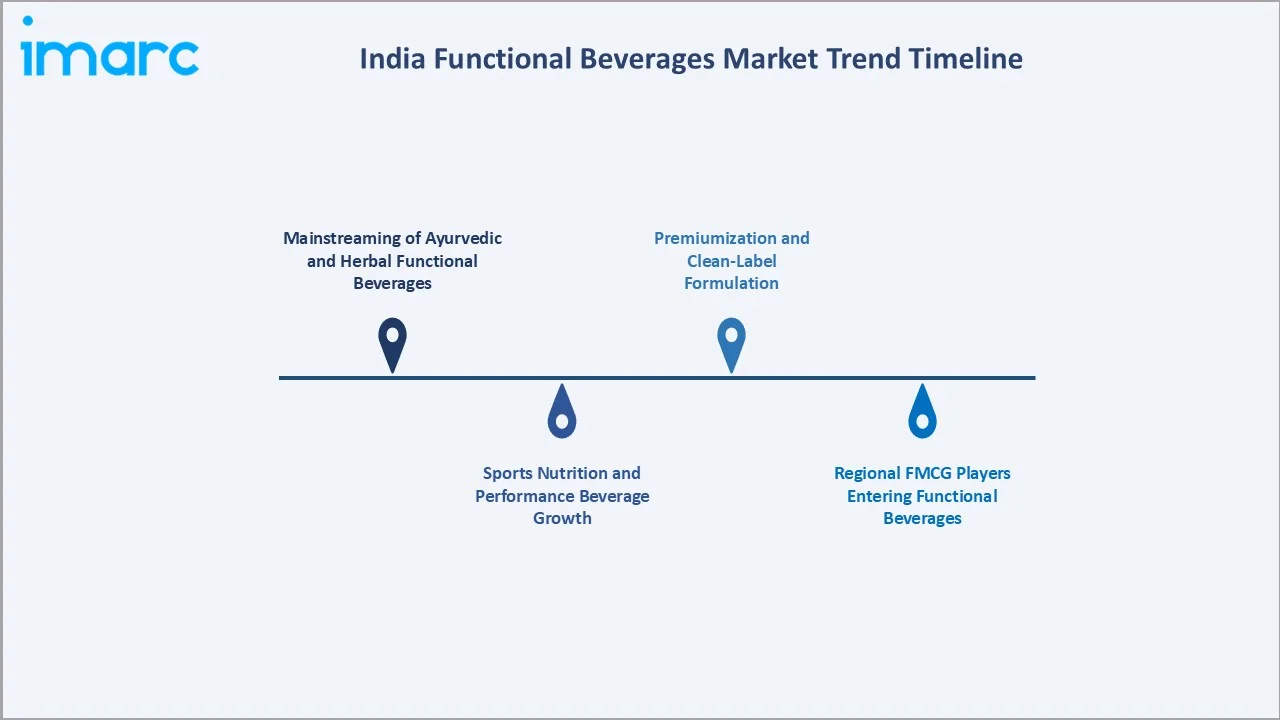
1. Mainstreaming of Ayurvedic and Herbal Functional Beverages
In July 2024, Zydus Wellness expanded its Complan product line with Complan Immuno-Gro in Tamil Nadu, incorporating over 20 Ayurvedic herbs including Amla, Ashwagandha, and Brahmi to address immunity and overall health. This launch illustrates how established FMCG players are integrating Ayurvedic functional positioning into mass-market beverage formats, accelerating the mainstream adoption of herbal functional beverages beyond specialty and wellness channel limitations.
2. Sports Nutrition and Performance Beverage Growth
In February 2025, Coca-Cola is expanding its India beverage portfolio with the launch of sports drink brand BodyArmor Lyte, alongside brands such as Honest Tea and Vitaminwater. The company is also widening the availability of Coke Zero Sugar and Sprite Zero Sugar to address growing demand for diversified and low-sugar beverage options. This strategic commitment by a major FMCG company to purpose-built sports beverages reflects the growing commercial scale of India's sports nutrition category, supported by rising gym membership, competitive sports participation, and active lifestyle adoption across both metro and tier-2 urban markets.
3. Premiumization and Clean-Label Formulation
Consumer preference is shifting toward functional beverages with transparent ingredient sourcing, reduced sugar content, and clinically validated functional ingredients including specific probiotic strains, adaptogens, and electrolyte blends. Premiumization is driving a growing high-value segment within functional beverages that commands superior margins, and brands are investing in ingredient quality communication, third-party certifications, and premium packaging as key differentiators in this evolving consumer segment.
4. Regional FMCG Players Entering Functional Beverages
In June 2026, PepsiCo India launched Adrenaline Rush to strengthen its presence in the functional beverage market, positioning the energy drink as a product for consumers seeking greater alertness and sustained energy during daily activities. The entry of large, distribution-heavy consumer companies into functional beverages is expanding category accessibility at mass price points and accelerating geographic reach into tier-2 and tier-3 markets where premium functional brands have limited presence, broadening the overall category consumer base.
Industry Value Chain Analysis
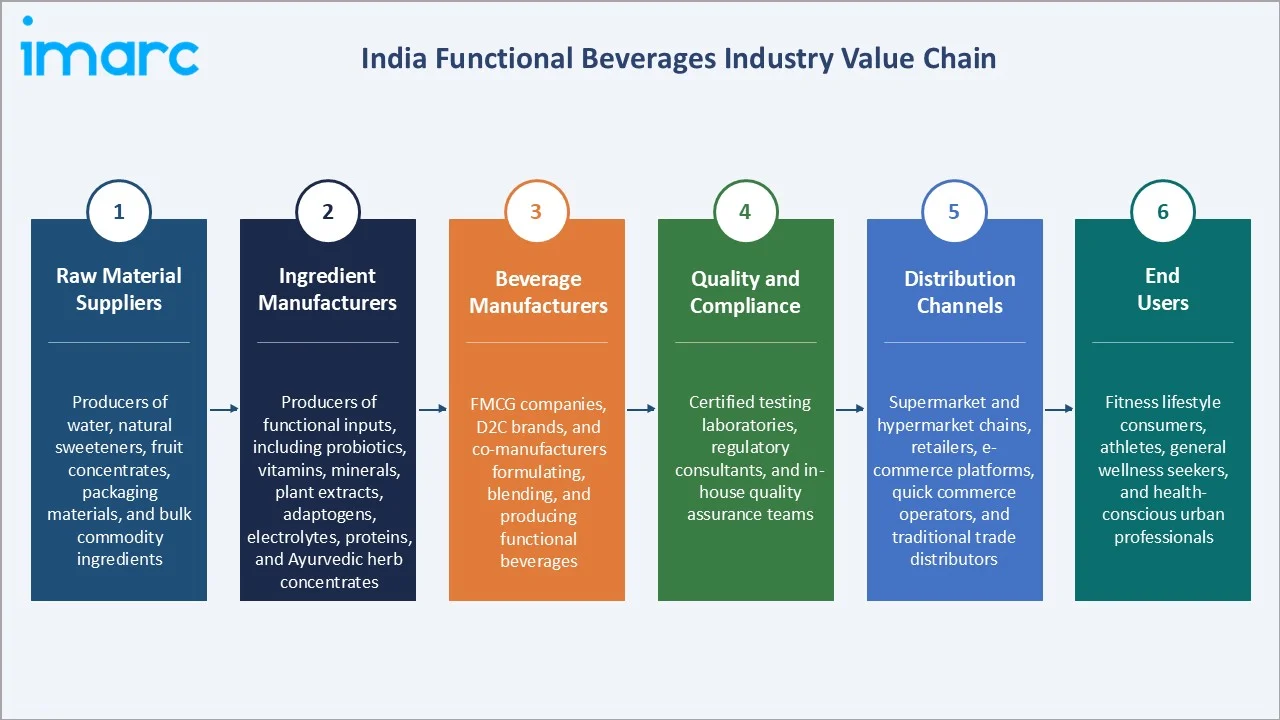
The India functional beverages value chain is structured across six integrated stages from input materials through end-user consumption. The chain is characterized by growing investment in premium functional ingredients at the upstream stage and rapid innovation in brand formulation, packaging, and multi-channel distribution at the downstream stage, creating value accumulation opportunities across all tiers.
|
Stage |
Key Participants |
|
Raw Material Suppliers |
Producers of water, natural sweeteners, fruit concentrates, packaging materials, and bulk commodity ingredients. |
|
Ingredient Manufacturers |
Producers of functional inputs including probiotics, vitamins, minerals, plant extracts, adaptogens, electrolytes, proteins, and Ayurvedic herb concentrates. |
|
Beverage Manufacturers |
FMCG companies, D2C brands, and co-manufacturers formulating, blending, and producing functional beverages. |
|
Quality and Compliance |
Certified testing laboratories, regulatory consultants, and in-house quality assurance teams. |
|
Distribution Channels |
Supermarket and hypermarket chains, retailers, e-commerce platforms, quick commerce operators, and traditional trade distributors. |
|
End Users |
Fitness lifestyle consumers, athletes, general wellness seekers, and health-conscious urban professionals. |
The e-commerce and D2C channel evolution is compressing the value chain by enabling manufacturers to reach end consumers with minimal intermediary layers, improving margins and consumer relationship depth.
Technology Landscape in the India Functional Beverages Industry
Functional Ingredient Innovation
Advanced ingredient sourcing and formulation technology is enabling beverage brands to incorporate clinically validated functional ingredients including specific Lactobacillus and Bifidobacterium probiotic strains, ashwagandha root extracts standardized for withanolide content, and electrolyte blends optimized for bioavailability.
Advanced Packaging and Shelf-Life Technology
Aseptic packaging, modified atmosphere packaging, and Tetra Pak formats are extending shelf life for probiotic and natural ingredient functional beverages without preservatives, enabling ambient-temperature distribution and wider retail reach. Cold-chain requirements for live culture beverages are being addressed through microencapsulation technology that protects probiotic viability throughout the distribution chain, expanding the addressable retail geography for probiotic beverage brands.
E-commerce and Digital Commerce Technology
Quick commerce platforms, subscription commerce models, and AI-driven personalization are reshaping functional beverage purchasing behavior. E-commerce distribution reflects the growing role of digital channels in functional beverage discovery and repurchase. Brands are using data-driven marketing, personalized recommendation engines, and loyalty program technology to build sustainable D2C customer relationships that reduce dependence on traditional trade.
Market Segmentation Analysis
The report covers the following segments:
|
Segment Category |
Leading Segment |
Market Share |
Year |
|
Type |
🔒 |
🔒 |
2025 |
|
Distribution Channel |
Supermarket and Hypermarket |
38.5% |
2025 |
|
End User |
Fitness Lifestyle Users |
46.8% |
2025 |
|
Region |
North India |
31.4% |
2025 |

By Distribution Channel
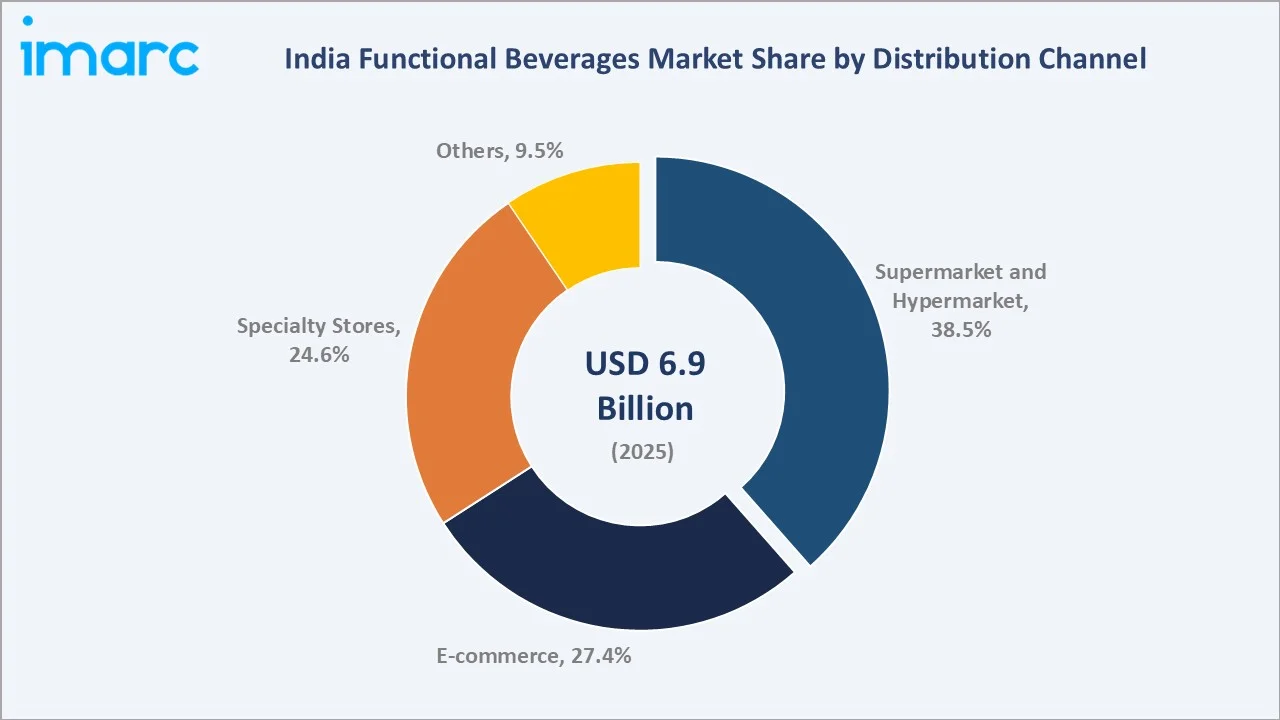
Supermarkets and hypermarkets lead at 38.5% in 2025, reflecting the critical importance of organized retail in driving consumer discovery, trial, and repeat purchase. Modern trade formats offer functional beverages the shelf visibility, cooling infrastructure, and promotional support needed to compete effectively against conventional beverage alternatives.
To access detailed market analysis, Request Sample
E-commerce at 27.4% is the fastest-growing distribution channel, driven by D2C brand expansion, quick commerce platform growth, and subscription-based health product purchasing behavior among urban professionals. Specialty stores at 24.6% serve the premium health-conscious consumer segment through gym chains, fitness studios, organic stores, and health supplement retailers that provide a curated, brand-complementary retail environment. Others at 9.5% include institutional, foodservice, and traditional trade channels.
By End User
Fitness lifestyle users lead at 46.8% in 2025, reflecting the broad and growing consumer segment that incorporates functional beverages into everyday health and wellness routines rather than exclusively performance-based consumption. This segment encompasses gym-goers, yoga practitioners, active professionals, and general wellness seekers who consume functional beverages for energy, hydration, gut health, and immunity benefits as part of their daily lifestyle.
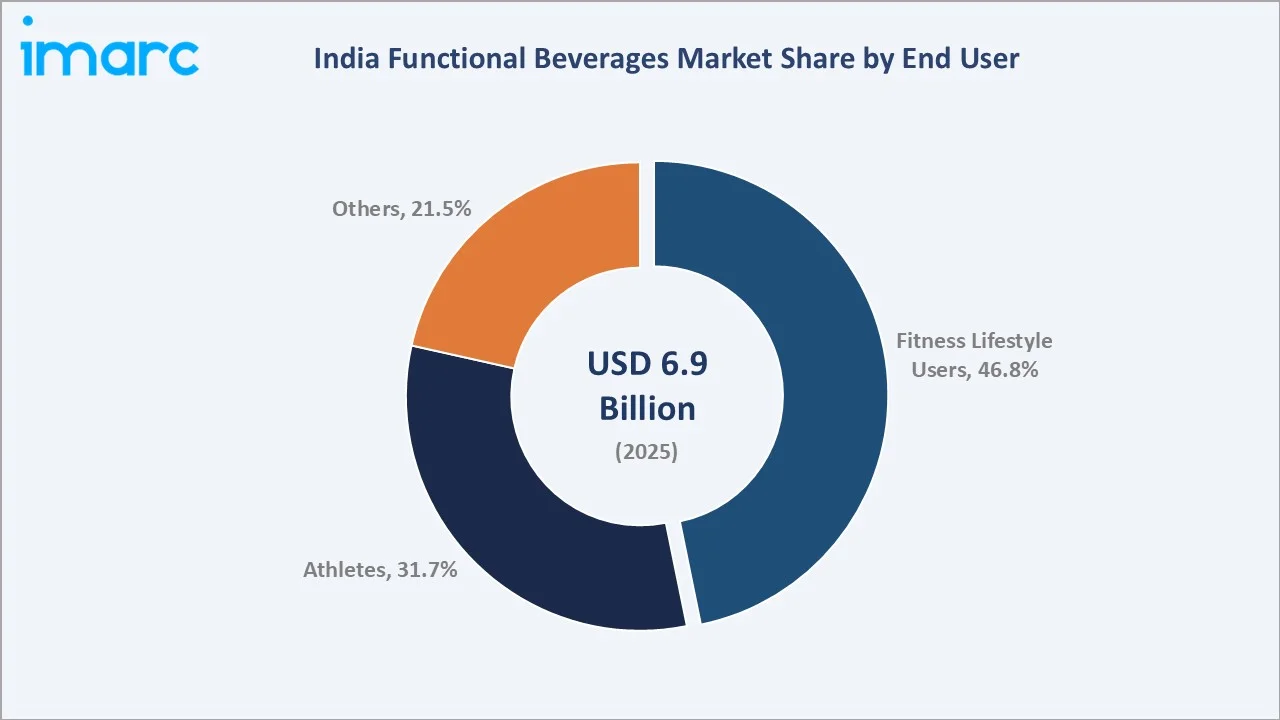
Athletes at 31.7% represent the performance-nutrition-focused consumer segment that prioritizes sports-specific functional benefits including electrolyte replenishment, protein recovery, creatine supplementation, and pre-workout energy. This segment drives the highest per-unit spend and strongest brand loyalty, with product innovation in sports nutrition formats commanding premium pricing. Others at 21.5% encompass general population consumers, elderly wellness seekers, and children's nutrition categories.
Regional Market Insights
|
Region |
Share (2025) |
Key India Functional Beverages Market Drivers & Characteristics |
|
North India |
31.4% |
Reflecting the region's large and health-conscious urban consumer base, with high modern retail penetration, active gym culture, and strong demand across energy, sports nutrition, and Ayurvedic beverage categories. |
|
West India |
28.7% |
Reflecting a premium wellness consumer base, strong organized retail and e-commerce adoption, and growing fitness and active lifestyle culture that drives consistent functional beverage demand. |
|
South India |
24.6% |
Reflecting technology-sector-driven health-conscious consumer segments, strong D2C and e-commerce adoption, and growing demand for probiotic, herbal, and sports nutrition functional beverages. |
|
East India |
15.3% |
Reflecting a developing but growing functional beverage market anchored in urban centers, with organized retail expansion, rising health awareness, and growing youth fitness culture creating progressive demand for functional beverage categories. |
North India's 31.4% regional leadership reflects the concentration of health-conscious urban consumers and high modern trade penetration. The region benefits from strong gym culture, active wellness consumer communities, and robust organized retail infrastructure that supports functional beverage discovery, trial, and repeat purchase across multiple product categories.
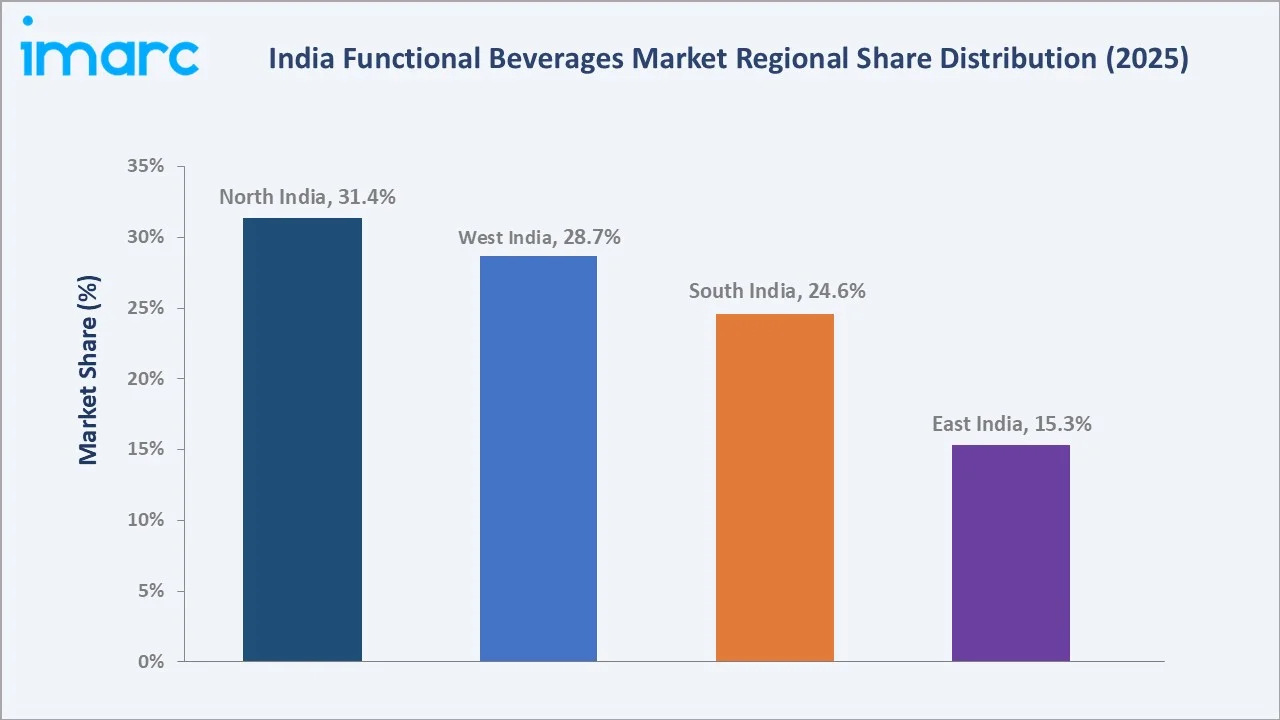
West India at 28.7% draws strength from a premium wellness consumer orientation and strong e-commerce adoption that enables D2C functional beverage brands to reach consumers efficiently. South India at 24.6% is anchored by technology-sector consumers who combine high disposable incomes with strong health and fitness orientation. East India at 15.3% is the smallest regional contributor but is showing progressive growth as organized retail expands and fitness culture develops across urban centers.
Competitive Landscape
The India functional beverages market features a competitive landscape spanning large FMCG conglomerates, dedicated sports nutrition brands, international energy and functional drink majors, and a growing ecosystem of D2C health and wellness startups. Competition is driven by product formulation innovation, distribution reach, marketing investment, channel strategy, and brand credibility in functional health claims.
|
Company |
Key Brands |
Market Position |
Core Strength |
|
Tata Sons Private Limited |
Tata Gluco+ |
Market Leader |
Tata Sons Private Limited drives its functional beverage strategy through its FMCG subsidiary, Tata Consumer Products Limited. |
|
Dabur India Ltd. |
Real Activ Juices, Dabur |
Market Leader |
The company has systematically transitioned from standard carbonated or pure commodity fruit drinks into value-added, wellness-centric, and health-fortified liquid nutrition. |
|
Red Bull |
Red Bull |
Established Player |
Established the energy drink sub-segment within India's broader functional beverage sector. |
|
PepsiCo |
Gatorade, Rockstar Energy, YACHAK, Muscle Milk |
Established Player |
PepsiCo plays a major role in shaping India's functional and health-conscious beverage market by shifting focus toward low-sugar, zero-sugar, and nutrient-enriched hydration options. |
|
ITC LIMITED |
B Natural |
Challenger |
ITC Limited holds a major and rapidly growing role in India's functional and health-oriented beverage market, shifting the battlefield away from traditional high-sugar soft drinks. |
Competition in the India functional beverages market is intensifying across all price segments as FMCG leaders launch purpose-built functional products, international brands expand their India presence, and D2C startups build loyal health-conscious consumer communities.
Key Company Profiles
Tata Sons Private Limited
Tata Sons Private Limited is the principal investment holding company, one of India’s largest diversified business conglomerates. Through its group companies, Tata has a presence across consumer products, beverages, retail, hospitality, technology, and several other industries. In the functional beverages space, the group addresses evolving consumer preferences for health, wellness, hydration, and convenience through its broader food and beverage portfolio. Its strong brand recognition, extensive distribution network, and focus on product innovation support its position in India’s rapidly evolving beverage industry.
- Key Brands: Tata Gluco+.
- Strategic Focus: Strengthening its presence in the functional beverages market through product innovation, portfolio diversification, and alignment with evolving health and wellness trends. The group emphasizes expanding distribution and developing convenient, value-added beverage offerings to address changing consumer preferences across India.
Dabur India Ltd.
Dabur India Ltd. is one of India's largest consumer goods companies with deep roots in Ayurvedic and natural health products. Its functional beverage portfolio leverages a century of consumer trust in natural formulations and health credentials, combined with extensive distribution across modern and traditional trade channels spanning urban and rural India.
- Key Brands: Real Activ Juices, Dabur.
- Strategic Focus: Leveraging the brand equity to capture functional beverage demand across juice, energy, and digestive wellness categories, expanding distribution in tier-2 and tier-3 markets where Dabur's traditional trade presence provides a competitive distribution advantage.
Market Concentration Analysis
The India functional beverages market is moderately fragmented, with a mix of large FMCG conglomerates, dedicated beverage companies, international brands, and a growing number of D2C startups competing across different price segments and product categories. No single player commands a dominant share of the total market, reflecting the product diversity across energy drinks, sports beverages, herbal infusions, probiotic drinks, and functional juices that each have distinct competitive dynamics and leading brands.
Large established players benefit from extensive distribution networks and strong brand recognition, while international brands hold category-defining positions in the premium energy drink segment. The D2C and startup ecosystem, including brands targeting specific wellness segments such as gut health, sports recovery, and Ayurvedic immunity, is adding competitive pressure from below through social media-driven brand building and e-commerce-first distribution strategies. Market concentration is expected to evolve through the forecast period as organized players consolidate their functional beverage portfolios, new product launches from FMCG majors increase category investment, and the D2C ecosystem matures through consolidation or partnership with larger distribution networks.
Investment & Growth Opportunities
Highest Growth Segments
E-commerce and D2C functional beverage brands represent the highest-growth distribution opportunity, with e-commerce at 27.4% growing faster than any other channel as urban health-conscious consumers shift toward online and subscription-based functional beverage purchasing. Sports nutrition and performance beverages, Ayurvedic and herbal formulations, and probiotic gut health drinks are the three fastest-growing product categories within the broader functional beverages market.
Investment Themes
- Ayurvedic and Herbal Beverage Formulation: Brands that successfully combine clinically validated Ayurvedic ingredients with modern beverage formats and accessible price points are well positioned to capture the growing mainstream wellness consumer segment that values natural credentials. Investment in ingredient sourcing, standardization, and formulation R&D delivers significant competitive differentiation.
- E-commerce and Quick Commerce Brand Building: D2C brands building functional beverage consumer relationships through e-commerce, quick commerce, and subscription commerce platforms are capturing the highest-margin, most loyal consumer segments. Technology investment in personalization, loyalty programs, and data-driven product development enables superior unit economics versus traditional trade channel brands.
- Sports Nutrition and Performance Category Development: The growing organized fitness industry and youth sports participation in India are creating a large and underserved sports nutrition beverage market. Investment in sports-specific functional formulations, athlete brand partnerships, and gym and fitness facility distribution represents a significant whitespace opportunity for specialized and FMCG brands alike.
Future Market Outlook (2026-2034)
The India functional beverages market grew from USD 6.9 Billion in 2025 to USD 8.3 Billion in 2026, reaching USD 18.8 Billion by 2034, exhibiting a CAGR of 10.74% during the forecast period. The market is expected to reach an intermediate milestone of approximately USD 11.49 Billion by 2030, as the mainstream adoption of functional beverages expands beyond urban metros into tier-2 and tier-3 cities, and as product innovation in Ayurvedic, sports nutrition, and probiotic categories deepens consumer penetration.
Three structural forces will define India's functional beverages market through 2034. First, the mainstreaming of health and wellness consciousness driven by post-COVID behavioral change, social media fitness culture, and greater awareness of preventive nutrition will systematically expand the consumer base for functional beverages. Second, product category innovation will create new consumer occasions and expand the functional beverage definition to include a broader range of daily wellness beverages. Third, channel evolution through e-commerce maturation, quick commerce scale, and modern retail expansion into tier-2 cities will progressively close the distribution access gap that currently constrains functional beverage penetration beyond India's largest urban markets.
Research Methodology
Primary Research
Primary research comprised structured interviews and consultations with functional beverage brand executives, retail channel buyers and category managers, organized fitness industry professionals, sports nutrition specialists, ingredient suppliers, regulatory experts, and e-commerce platform health and wellness category managers. These discussions validated market sizing estimates, assessed channel dynamics, identified consumer trend drivers, and provided insights into competitive positioning and innovation pipelines across the India functional beverages sector.
Secondary Research
Secondary research drew on published IMARC Group data, regulatory publications, company annual reports and investor presentations, industry association reports from the Indian Beverage Association, retail channel sales data, e-commerce platform category insights, and relevant trade publications covering the Indian FMCG and health beverage sectors. Historical market data spanning 2020 through 2025 was cross-validated across multiple sources to ensure baseline accuracy.
Forecasting Models
Market forecasts were developed using bottom-up and top-down modeling approaches incorporating historical market growth trends, consumer health and wellness behavior evolution, distribution channel expansion projections, product innovation pipeline analysis, pricing trend assumptions, competitive entry dynamics, urbanization and income growth forecasts, and macroeconomic indicators relevant to India's consumer market trajectory through 2034.
India Functional Beverages Market Report Coverage:
| Report Features | Details |
|---|---|
| Base Year of the Analysis | 2025 |
| Historical Period | 2020-2025 |
| Forecast Period | 2026-2034 |
| Units | Billion USD |
| Scope of the Report |
Exploration of Historical Trends and Market Outlook, Industry Catalysts and Challenges, Segment-Wise Historical and Future Market Assessment:
|
| Types Covered | Energy Drinks, Sports Drinks, Dairy-based Beverages, Juices, Others |
| Distribution Channels Covered | Supermarket and Hypermarket, Specialty Stores, E-commerce, Others |
| End Users Covered | Athletes, Fitness Lifestyle Users, Others |
| Regions Covered | North India, South India, East India, West India |
| Companies Covered | Tata Sons Private Limited, Dabur India Ltd., Red Bull, PepsiCo, ITC LIMITED, etc. |
| Customization Scope | 10% Free Customization |
| Post-Sale Analyst Support | 10-12 Weeks |
| Delivery Format | PDF and Excel through Email (We can also provide the editable version of the report in PPT/Word format on special request) |
Key Benefits for Stakeholders:
- IMARC’s industry report offers a comprehensive quantitative analysis of various market segments, historical and current market trends, market forecasts, and dynamics of the India functional beverages market from 2020-2034.
- The research report provides the latest information on the market drivers, challenges, and opportunities in the India functional beverages market.
- Porter's five forces analysis assist stakeholders in assessing the impact of new entrants, competitive rivalry, supplier power, buyer power, and the threat of substitution. It helps stakeholders to analyze the level of competition within the India functional beverages industry and its attractiveness.
- Competitive landscape allows stakeholders to understand their competitive environment and provides an insight into the current positions of key players in the market.
Frequently Asked Questions About the India Functional Beverages Market Report
The India functional beverages market reached USD 8.3 Billion in 2026, driven by rising health awareness, fitness culture growth, and expanding distribution across organized retail and e-commerce channels.
The market is projected to grow at a CAGR of 10.74% during 2026-2034, supported by health consciousness mainstreaming, product innovation in Ayurvedic and sports nutrition categories, and expanding distribution reach into tier-2 and tier-3 cities.
The market is projected to reach approximately USD 11.49 Billion by 2030, driven by mainstream adoption of functional beverages, expanding modern trade and e-commerce penetration, and sustained product innovation across wellness, sports, and herbal categories.
Fitness lifestyle users lead with a 46.8% share in 2025, reflecting the broad adoption of functional beverages among health-conscious urban consumers who incorporate these products into daily wellness routines beyond exclusively athletic consumption.
Supermarkets and hypermarkets lead with a 38.5% share in 2025, providing the shelf visibility, cooling infrastructure, and consumer discovery environment needed for functional beverage trial and purchase by mainstream shoppers.
North India leads with a 31.4% share in 2025, reflecting the large health-conscious consumer base in Delhi NCR, high modern retail penetration, and strong gym and fitness culture that drives functional beverage demand.
Key players include Tata Sons Private Limited, Dabur India Ltd., Red Bull, PepsiCo, and ITC LIMITED, among others.
The market is projected to reach USD 18.8 Billion by 2034, driven by mainstream health consciousness adoption, product innovation in Ayurvedic and sports nutrition categories, and expanding organized retail and digital commerce distribution.
Need more help?
- Speak to our experienced analysts for insights on the current market scenarios.
- Include additional segments and countries to customize the report as per your requirement.
- Gain an unparalleled competitive advantage in your domain by understanding how to utilize the report and positively impacting your operations and revenue.
- For further assistance, please connect with our analysts.
 Request Customization
 Speak to an Analyst
 Request Brochure
 Inquire Before Buying
Benefits of Customization
- Personalize this research
- Triangulate with your data
- Get data as per your format and definition
- Gain a deeper dive into a specific application, geography, customer, or competitor
- Any level of personalization
Get in Touch With Us
UNITED STATES
Phone: +1-201-971-6302
INDIA
Phone: +91-120-433-0800
UNITED KINGDOM
Phone: +44-753-714-6104
Email: [email protected]
Client Testimonials










Related Reports

Choose your plan
*Please note that the prices mentioned below are starting prices for each bundle type. Kindly contact our team for further details.*
Single User License
- 1 User License, Access on 2 Devices
- PDF Report + Excel Dataset (Password Protected)
- Lifetime Access
- No Printing Rights
- 10% Free Report Customization
- 10–12 Weeks of Analyst Support
Five User License
- Access for 5 Users, 2 Devices per User
- PDF Report + Excel Dataset (Password Protected)
- Lifetime Access
- Dedicated Account Manager
- 12–14 Weeks of Analyst Support
- No Printing Rights
- 15% Free Report Customization
- 25% Discount on Your Next Purchase
Corporate User License
- Unlimited User Access (Within Your Organization)
- PDF Report + Excel Dataset
- Lifetime Access
- Dedicated Account Manager
- 14–20 Weeks of Analyst Support
- No Printing Rights
- 20% Free Report Customization
- 30% Discount on Your Next Purchase
Essential Insights
What's included:
3 reports
- Lifetime Access
- PDF Reports
- Excel Datasets
- 2 Weeks of Free Analyst Support
- 2 User Licenses
- Access on 2 Devices
- Printing Rights
- Complimentary PowerPoint (PPT) Version
- Complimentary License Upgrade
Professional Access
What's included:
5 reports
- Lifetime Access
- PDF Reports
- Excel Datasets
- 8 Weeks of Free Analyst Support
- 2 User Licenses
- Access on 2 Devices
- Printing Rights
- Complimentary PowerPoint (PPT) Version
- Complimentary License Upgrade
Business Advantage
What's included:
8 reports
- Lifetime Access
- PDF Reports
- Excel Datasets
- 14 Weeks of Free Analyst Support
- 2 User Licenses
- Access on 2 Devices
- Printing Rights
- Complimentary PowerPoint (PPT) Version
- Complimentary License Upgrade
Enterprise Intelligence
What's included:
10 reports
- Lifetime Access
- PDF Reports
- Excel Datasets
- 20 Weeks of Free Analyst Support
- 2 User Licenses
- Access on 2 Devices
- Printing Rights
- Complimentary PowerPoint (PPT) Version
- Complimentary License Upgrade